
Our readers keep the lights on and my garage snacks stocked. As an Amazon Associate, I earn from qualifying purchases.
Specs are compiled from manufacturer listings and verified buyer reviews and can change over time — please confirm the key details on the product page before buying.
When your subwoofer hits hard and your headlights dim in rhythm with the bassline, that’s your stock battery saying it can’t keep up. A dedicated audio battery gives your amplifiers a stable power reserve so your music plays loud and clean without dragging down your car’s electrical system.
I’m Min Islam — the founder and writer behind Trending Car. This guide is built by comparing the manufacturers’ published specifications and the patterns across verified customer reviews, so you get each pick’s real strengths and trade-offs instead of marketing spin.
To keep your amplifier from dimming your lights or cutting out, you need a car audio battery that matches your amp’s actual current draw in three ways: capacity (how much power it stores), chemistry (how it delivers that power), and physical size (whether it fits your vehicle).
Our Picks at a Glance


How To Choose The Best Car Audio Battery
An audio battery is a reservoir of power parked right next to your amplifier. It smooths out the huge, instant current demands of bass hits so your alternator and main battery don’t get dragged down. Picking the wrong one usually means dimming lights, voltage sag, or a size that doesn’t fit your install.
Match Capacity to Your Amplifier
Amp-hours (Ah) tells you how much energy the battery stores. A small 22Ah cell suits a modest subwoofer setup, while a 90Ah unit carries a serious multi-thousand-watt build. Bigger amplifiers draw more current, so they need more stored amp-hours to stay stable during long bass passages.
Know Your Chemistry: AGM Is the Standard
Absorbed Glass Mat (AGM) batteries hold the electrolyte in fiberglass matting instead of free liquid. That makes them spill-proof, sealed, and safe to mount in nearly any position — exactly what you want in a trunk or spare-tire well. They also handle the repeated deep discharges that audio systems demand better than a standard starting battery.
Reserve Capacity for Engine-Off Listening
Reserve capacity measures how long a battery can deliver a steady current before dropping below a usable voltage. If you listen with the engine off at tailgate parties or car meets, a higher reserve rating keeps your system playing longer before the voltage falls off.
Quick Comparison
| Model | Best For | Capacity | Reserve Capacity | Weight | Amazon |
|---|---|---|---|---|---|
| XS Power XP750★ Best Overall | Mid-size supplemental installs | 22 Ah | 28 minutes | — | Amazon |
| Mighty Max Viper VP-800Best Value | High-current 800W setups | 35 Ah | — | — | Amazon |
| Kinetik HC800 BLUPro Pick | 800W stereo systems | — | — | 20.9 lbs | Amazon |
| DS18 INF-35AH | Multi-vehicle power cells | 35 Ah | — | 22 lbs | Amazon |
| ENERGIE PR4000 | High-wattage competition builds | 90 Ah | — | 61 lbs | Amazon |
| OPTIMA D34 YELLOWTOP | Dual-purpose starting and audio | 55 Ah | 120 minutes | 42.9 lbs | Amazon |
| OPTIMA DH6 YELLOWTOP | Group 48 dual-purpose power | 72 Ah | 140 minutes | 54 lbs | Amazon |
| XS Power D6500 | High-output competition audio | 75 Ah | — | 53.8 lbs | Amazon |
| XS Power D4800 | Group 48 deep-cycle systems | 72 Ah | — | 47.6 lbs | Amazon |
In-Depth Reviews
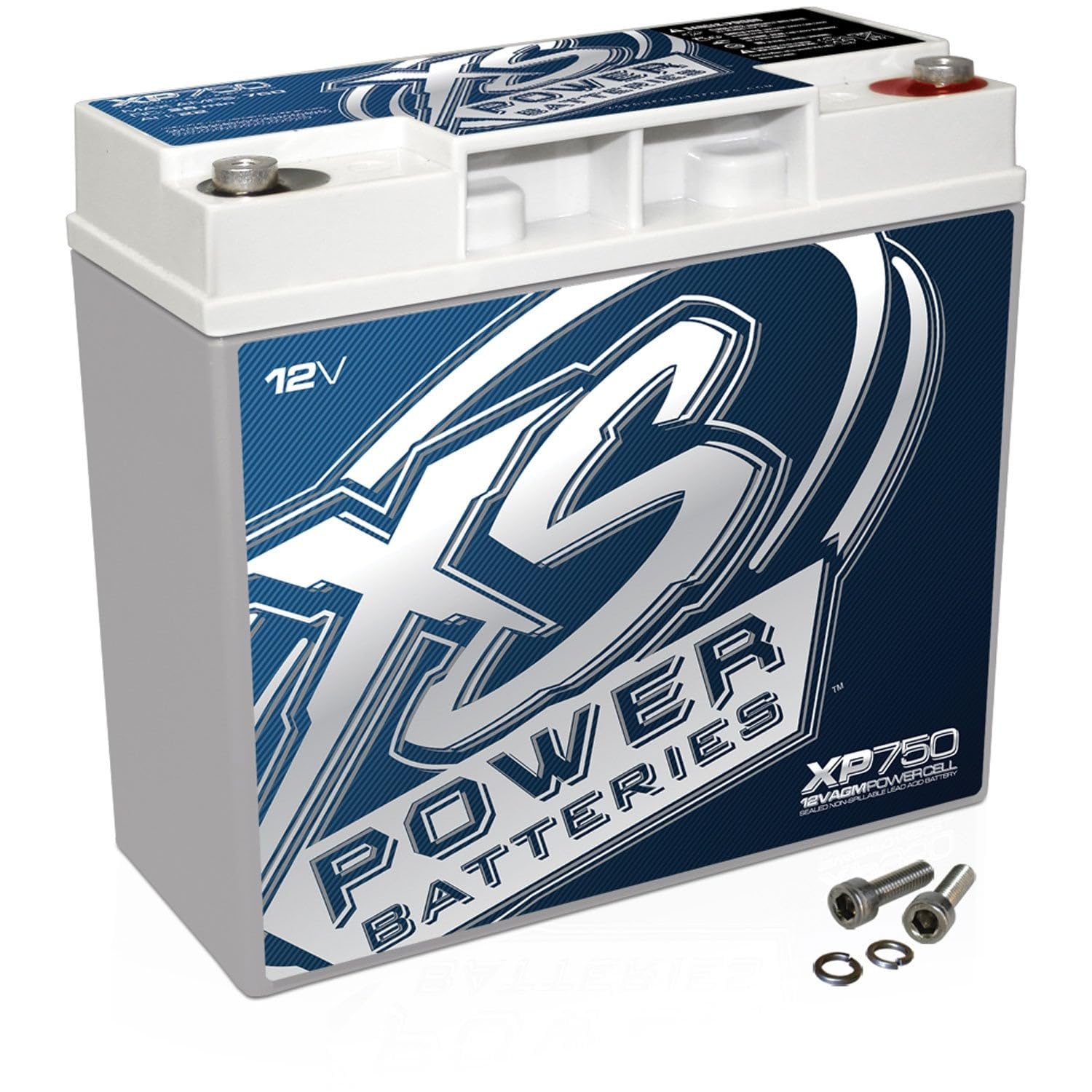
1. XS Power XP750
Our pick — 4.5★ from 350+ verified ratings; the strongest balance of quality and price.
The compact power cell that kills light dimming without eating your trunk space.
This 12-volt AGM cell stores 22 amp-hours and delivers a 28-minute reserve capacity, which is enough stored energy to stop voltage sag on a mid-size subwoofer system. Because the electrolyte is suspended in fiberglass, it’s spill-proof, sealed, and valve-regulated, so you can mount it on its side or flipped over in a tight spot without leaking.
What wins people over is the build quality and how well it just works as a second battery. Buyers report it cleared up headlight dimming and voltage drops to the amplifier right after install. One hybrid Honda owner noted it worked as a direct replacement and instantly cleared the error lights on the dash.
It’s worth a mention that a few owners treat AGMs as a stepping stone — one switched to lithium for a massive system, noting AGMs become a hassle when you run multiple units because you need isolators. For a typical single-supplemental install, it’s a non-issue.
What Owners Appreciate
- Compact case fits easily beside an amp or under a seat
- Sealed AGM design allows flexible mounting positions
- Reliable voltage delivery that stops dimming
The Honest Trade-Off
- 22 Ah is modest — not enough for a huge multi-amp competition build
- A few units reported early voltage loss, which is a risk with any AGM
Reach for this one if: you need a dependable, compact second battery for a single solid subwoofer setup under the hood or in the trunk.
Think twice if: you’re running multiple large amplifiers — you’ll outgrow this capacity fast.
2. Mighty Max Battery Viper VP-800
A budget-friendly 35 Ah AGM that punches well above its price point.
This Viper holds a full 35 amp-hours — a big leap over the XP750’s 22 Ah, giving it roughly 59% more stored energy for sustained bass. It’s rated for 800 watts of reinforcement and uses sealed non-spillable AGM technology, so you can mount it in any position without worrying about leaks.
Owners mention it holds up to serious demand — one ran a 2500W amp off a pair of these without complaint, and another fed a 1200W sub plus 800W mids at a stable 12.4V. The price point gets repeated praise, with owners saying you can’t beat the value for the capacity.
The honest caveat that keeps it from the top spot: one long-term owner found that after about a year the battery wouldn’t hold a charge, dropping to 9 volts within a minute of a full charge. It’s a single report, but it’s worth knowing the warranty is one year.
Big power, small bill: 35 Ah of AGM storage at a budget-friendly price makes this the smart pick for a single strong amplifier without spending premium money. The catch is that long-term lifespan is a slight gamble based on owner reports.
Best for: the value-minded builder who wants 35 Ah of reserve power for an 800W-class system without the premium price tag.
Who should pass: anyone planning to keep the same battery for many years — early aging has been reported.
3. Kinetik HC800 BLU
The 800W workhorse that holds a charge like it just came off the line.
This sealed AGM cell is built for 800W car audio systems and tipped the scales at a manageable 20.9 pounds — noticeably lighter than the DS18 below, which is 22 pounds. In practical terms, that means an easier lift into a trunk and less weight penalty in a daily driver.
Customers note this unit is strong enough to start your car in an emergency — one owner used it to get a vehicle running when the audio battery was too weak, and another said it improved cold starting. The standout story: one unit sat on a shelf for a full year before install and was still fully charged when opened. That low self-discharge (how slowly a battery loses charge while sitting unused) is exactly what you want from an auxiliary cell.
The main trade-off owners flag is size — several note it’s very small, so check your mounting tray if you want it to fill a big space. Battery life draws mixed feedback, with some praising charge retention and others finding it doesn’t maintain power as long as hoped.
Charge keeper: the standout trait is how well it holds a charge over long idle periods, which is a genuine edge for an auxiliary trunk battery. The small footprint is a plus for tight installs but a minus if you expected a large case.
Grab it for: an 800W system where you want a proven, compact AGM with excellent shelf-life behavior.
Look elsewhere if: you need a physically large battery to fill a big battery tray or you plan to run far more than 800W.
4. DS18 INF-35AH

The 22-pound, 35 Ah cell that doubles as a voltage stabilizer for big amps.
This AGM power cell carries a 35 Ah rating and weighs 22 pounds, designed for car audio, motorsports, motorcycles, jet skis, ATVs, and UTVs. It uses a non-spill design that allows upside-down or multi-angle mounting, plus M5 terminals for a secure connection with options for add-on terminals and busbars.
Reviewers point out it works beautifully as a secondary battery in a 2005 Honda Accord Coupe, solving issues that a capacitor previously handled. One owner wired it in the trunk for a Stinger amp and watched voltage climb from 12.6 to 13.8. Another confirmed it powers two 10-inch subs and eliminates light dimming at full tilt.
The flip side: one owner found a weak reserve charge even after trickle charging and switched to XS Power, though the return cost was the bigger frustration than the battery itself. It’s a single report, but it’s the reason the warranty terms are worth reading before you buy.
Voltage lifter: owners consistently report higher stable voltage and no dimming once this is wired in, which is the whole point of an audio cell. Read the return policy carefully — one unlucky owner found return shipping steep.
Perfect for: a 35 Ah supplemental battery in a car, UTV, or motorcycle where versatile mounting and M5 terminal options matter.
skip it if: you’re wary about warranty support — the one-year manufacturer warranty is the safety net here.
5. ENERGIE PR4000

A 61-pound, 90 Ah beast built for systems where voltage sag is the enemy.
This is the big one: 90 amp-hours of storage rated for a maximum system wattage of 4000 watts, and it weighs a hefty 61 pounds. For context, that’s roughly three times the stored energy of the 22 Ah XP750 — this is for serious builds, not a starter sub.
Shoppers say it completely eliminates voltage drop during heavy bass hits, with one noting it drops and recharges before the stock battery even moves a tenth of a volt. Another replaced eight batteries with two of these and an optimal cranking battery, running 12,000 watts without a hint of voltage sag.
The only real consideration is weight and size — at 61 pounds, you need a solid mounting point and a plan for getting it into the vehicle. It’s a premium-tier investment, but for competition-grade systems, the reserve is exactly what the bass demands.
Voltage fortress: the sheer 90 Ah reserve means your amplifiers see steady voltage even during sustained full-volume bass. The weight is the price you pay for that stability.
Built for: the competitor or enthusiast running multiple amplifiers or 4000W-plus systems who needs a massive energy reserve.
Not for: anyone with a modest single-sub setup — this is overkill in capacity and weight for a daily driver.
6. OPTIMA D34 YELLOWTOP
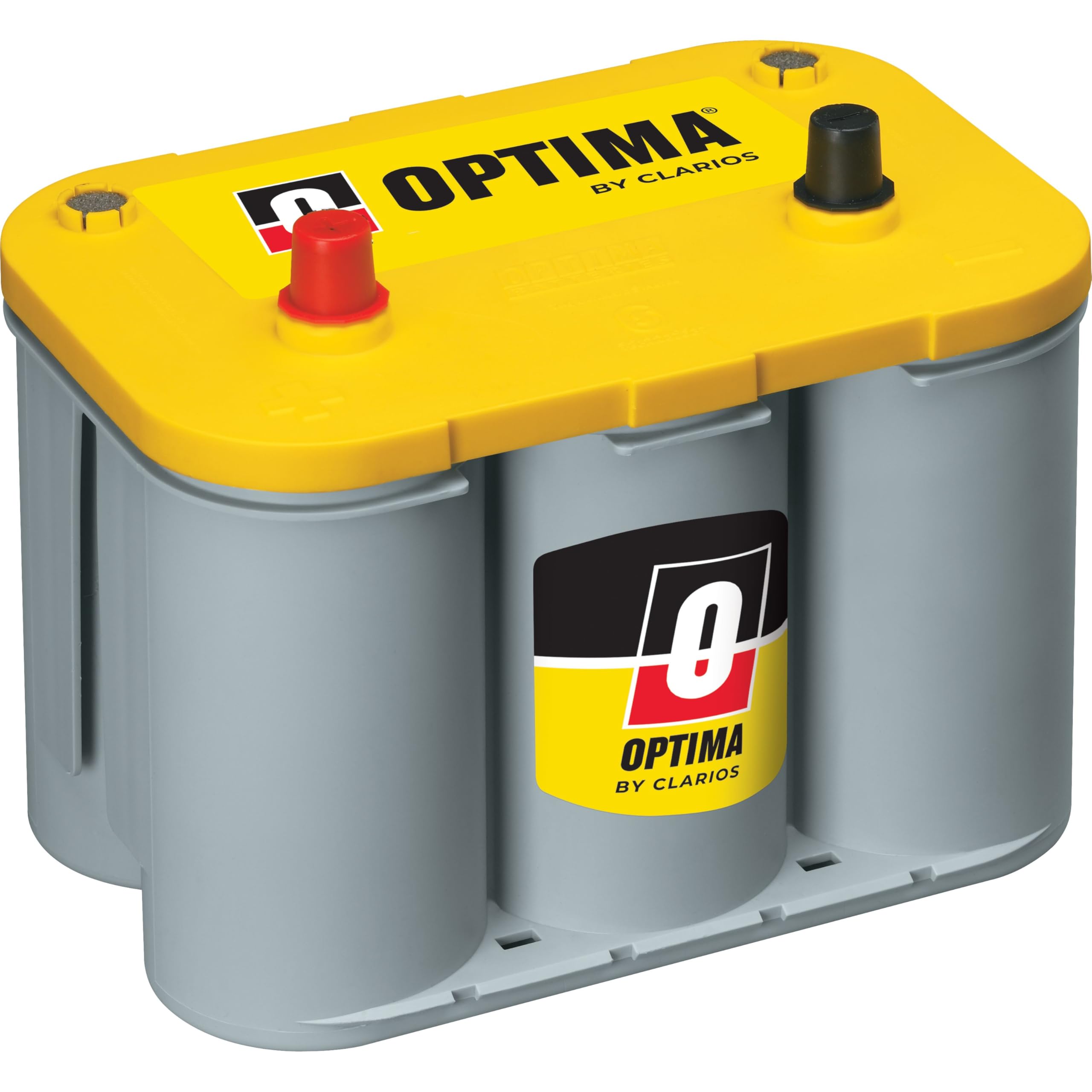
The dual-purpose legend that starts your car and powers your audio without flinching.
This is the battery that does double duty: 750 cold cranking amps (CCA) for reliable starts in bad weather and a 55 Ah C20 capacity for deep-cycle audio use. It holds a 120-minute reserve capacity, so it keeps delivering power for a long time even when the engine is off.
OPTIMA’s SPIRALCELL technology uses 99.99% pure lead in a spiral-wound design that’s fifteen times more resistant to vibration than a standard flooded battery. Buyers report it survives deep drains and slow recharges — one owner’s unit was coming up on five years after constant drain-and-recharge cycles, and another drove 30 miles on a failed alternator thanks to the reserve.
At 42.9 pounds with a 10″ x 6 7/8″ x 7 13/16″ case, it’s a versatile fit for many vehicles. The catch? Some installs need small modifications — terminal straightening, a wire extension, or a battery relocator — and a few owners note the hood gap on certain cars after install.
Why It Stands Out
- Dual-purpose: cranks your engine and feeds your amp
- 120-minute reserve for engine-off listening
- Spiralcell design shrugs off vibration and deep drains
What to Know Before Buying
- May require minor fitment mods in some vehicles
- Premium price reflects the long-life reputation
The verdict: if you want one battery that starts the car reliably and powers a strong sound system, this is the reference standard — the crowd favorite for good reason.
The caution: measure your battery tray first; a few owners needed terminal work or a relocator to make it fit perfectly.
7. OPTIMA DH6 YELLOWTOP

The 800 CCA Group 48 that fixes electrical gremlins in modern cars.
This bigger YELLOWTOP delivers 800 cold cranking amps and a 72 Ah C20 capacity in a Group 48 (BCI) case that measures 10.94 inches long. It uses PUREFLOW technology — 99.99% pure lead in compressed radial grid plates — engineered to resist vibration and corrosion damage while providing 140 minutes of reserve capacity.
Owners mention it solves tricky electrical problems: one owner fixed persistent issues in a 2021 Ford F-150 after three factory batteries died, and another cured cold-start failures in a RAV4 and bought a second for the Camry. The long power-draw tolerance and stable voltage are exactly what modern, electronics-heavy vehicles need.
The honest trade-off is the warranty: at 36 months, it’s shorter than some competitors’ coverage, and one owner watched a unit fail at 30 months. At 54 pounds, it’s a substantial piece of hardware to handle during install.
Gremlin killer: owners consistently report it stabilizes flaky electronics and delivers rock-solid cold starts in modern vehicles. The 36-month warranty is shorter than ideal, so keep that in mind.
Choose this for: a modern car with heavy electronics, or an audio system needing 72 Ah of deep-cycle capacity in a Group 48 footprint.
Think twice if: warranty length is your top priority — some rivals offer longer coverage for less money.
8. XS Power D6500

The brutal 75 Ah AGM that powers monster systems without flickering a light.
Rated for a staggering 3,900 amps with a 75 Ah capacity, this is XS Power’s serious high-output cell for competition builds. It’s a brute at 53.8 pounds, and it uses the same spill-proof, sealed, valve-regulated AGM design as the XP750 but with vastly more energy on tap.
Customers note it powers enormous systems — one owner runs a 35,000-watt setup, another feeds 2 Kicker CompVR 12s with headroom for two more plus screens and LEDs with zero light flicker. The durability shows too: one owner dropped it on the ground while carrying it and it survived with just a scuff.
The mixed feedback centers on longevity — some units reportedly lasted around 25 months, and one owner had a frustrating experience with a dead unit shortly after install. It’s a premium investment, so the 30-day warranty window is note before you commit.
System anchor: for a serious multi-thousand-watt build, the D6500’s 75 Ah reserve keeps voltage steady under brutal load. The warranty is short at 30 days, so inspect it immediately on arrival.
Built for: the competitor running 35,000W-class systems who needs massive current delivery and a rugged, vibration-resistant case.
Approach with care if: you want a long warranty — 30 days is thin for a premium purchase, and lifespan reports are mixed.
9. XS Power D4800
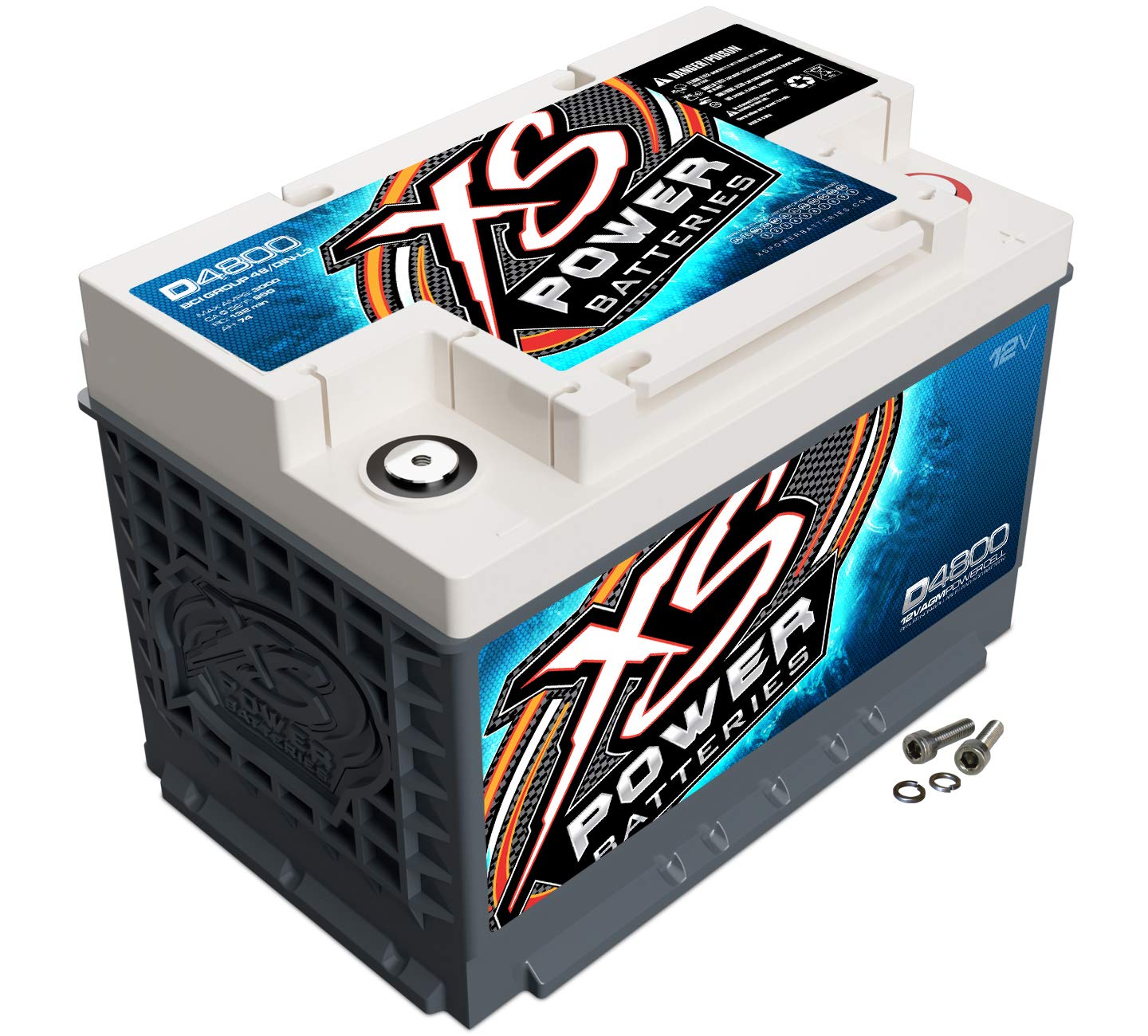
The Group 48 deep-cycle cell that outlasts the stock battery it replaces.
This Group 48 battery packs 72 amp-hours and 950 cranking amps (CA) into a 47.6-pound frame, making it a deep-cycle AGM power cell for car audio and performance cars. It’s a Universal Fit type, though owners note it’s a tight fit in some vehicles — one fitted it into an ’06 VW Jetta TDI with careful maneuvering.
Reviewers point out it dramatically outperforms stock: one owner running a 2800W RMS amp with 0-gauge wiring went from near-stalling on bass hits to only slight headlight dimming at full volume. Another reports it maintained voltage through extreme duty cycles, and a third got three years of service in Arizona heat — longer than the typical two years from other batteries.
The one caution: a single owner found a negative post burned and leaking after a few months, though the crank power itself was praised. It’s an isolated report, but it highlights why checking the terminals on arrival is a good habit.
Stock-slayer: the consistent owner story is that this battery outlasts and outperforms factory units, especially in hot climates. The tight fit in some cars means measure before you buy.
Ideal for: a Group 48 install where you want deep-cycle reserve for audio plus reliable cranking, with a reputation for heat resistance.
Check first: your exact tray dimensions — the 14-inch depth makes it a snug fit in some vehicles.
Understanding the Specs
Amp-Hours (Ah)
Amp-hours measure how much energy a battery can store and deliver over time. A 35 Ah battery can theoretically supply 35 amps for one hour or 1 amp for 35 hours. For audio, more Ah means a bigger reservoir to keep voltage stable during bass hits, which is why the 90 Ah ENERGIE PR4000 handles 12,000W systems while a 22 Ah cell suits a single sub.
Reserve Capacity (RC)
Reserve capacity tells you how many minutes a battery can deliver a steady current before voltage drops below usable levels. The OPTIMA D34’s 120-minute rating means it can play your system with the engine off for a solid stretch before struggling. If you tailgate or listen at car meets, higher RC numbers keep the music going longer.
Cold Cranking Amps (CCA)
Cold cranking amps measure a battery’s ability to start an engine in cold weather. It matters most if your audio battery also handles starting duties, like the OPTIMA dual-purpose units. A pure supplemental trunk battery doesn’t need high CCA — it just needs amp-hours and reserve capacity for the amplifiers.
AGM Chemistry
Absorbed Glass Mat batteries hold the electrolyte suspended in fiberglass mats rather than free liquid. That makes them sealed, spill-proof, and safe to mount in any position — from upside-down in a trunk to sideways under a seat. AGM also handles the repeated deep discharges from audio systems far better than a standard flooded starting battery.
FAQ
Do I need a second battery for my car audio system?
Can I use an audio battery as my main starting battery?
What size battery do I need for a 1000-watt amplifier?
How long will an AGM car audio battery last?
What is the difference between AGM and a regular flooded battery for audio?
Will a bigger battery stop my headlights from dimming?
Can I mount an audio battery on its side or upside down?
How much does a car audio battery weigh?
Final Thoughts: The Verdict
For most systems, the car audio battery winner is the XS Power XP750 because it pairs a dependable 22 Ah AGM design with a compact case and a strong record of stopping light dimming for a modest investment. If you want one battery that both starts your car and powers a big stereo, the OPTIMA D34 YELLOWTOP is the premium dual-purpose reference. And for a competition-grade build where voltage sag simply isn’t an option, the ENERGIE PR4000 delivers 90 Ah of raw reserve that owners trust for 12,000W systems.
How We Picked
We do not accept paid placement. Every pick is matched to a real buyer and a real use-case; we do not hands-on test units.
Sources & Methodology
Specifications: manufacturer listings and product documentation. Review insights: verified customer reviews, as of August 2026. Pricing: not shown on this page (it changes often); check the current price via the retailer link.
As an Amazon Associate, Trending Car earns from qualifying purchases. This does not affect which products we feature.