
Our readers keep the lights on and my garage snacks stocked. As an Amazon Associate, I earn from qualifying purchases.
Specs are compiled from manufacturer listings and verified buyer reviews and can change over time — please confirm the key details on the product page before buying.
A capacitor for your car system stores a jolt of energy right near your amplifier. When a bass note hits, that stored energy gives your amp an instant power reserve. Your headlights stop flickering with the beat, your music stays clean (no distortion, no voltage sag), and your alternator gets a much-needed break. The best capacitor for car system acts like a small, fast battery dedicated entirely to your audio gear. This guide matches seven top options to real-world system sizes and budgets.
I’m Min Islam — the founder and writer behind Trending Car. This guide is built by comparing the manufacturers’ published specifications and the patterns across verified customer reviews, so you get each pick’s real strengths and trade-offs instead of marketing spin.
Are you wrestling with headlight dimming at red lights? Chasing the last bit of mid-range clarity from a booming trunk setup? This breakdown of the capacitor for car system will help you match the right capacitance (measured in Farads) and build quality to your actual amplifier load.
Our Picks at a Glance
How To Choose The Best Capacitor For Car System
Picking the right capacitor depends on three numbers: how many Farads you need, the voltage your car actually runs at, and how much physical space you have. Here is the short version of what matters most.
Farad Rating — The Energy Tank
Think of Farads as the size of the energy reservoir. A common rule of thumb in this category is roughly 1 Farad per 1,000 watts of amplifier power. A 1.0 Farad cap works for a modest 600-1000W system; a 5.5 Farad unit handles a big subwoofer amp that pulls serious current on every kick drum. More Farads means more reserve, but also more size and cost.
Voltage Rating and Display
Your car’s electrical system runs at roughly 12-14.4V DC when running. A capacitor should have a maximum voltage rating at least 16V to handle the charge cycle safely — some premium caps go to 20V or 24V to survive surges. A built-in digital voltage display (red or blue LED) lets you see at a glance whether the cap is holding a charge and whether your alternator is keeping up.
Build Quality and Low ESR
Low ESR (Equivalent Series Resistance) means the cap can discharge its stored energy quickly — exactly what an amplifier needs during a transient bass note. A cap with high ESR will react too slowly, and your lights may still dim. Aluminum construction, solid terminals, and a clear warning buzzer for reverse polarity are signs of a well-made unit.
Quick Comparison
| Model | Best For | Capacitance | Max Voltage | Weight | Amazon |
|---|---|---|---|---|---|
| Stinger SPC5010 | High-power systems up to 2000W | 10 Farad | 18V surge | 3.2 Pounds | Amazon |
| Rockville RXC4D | Universal 12V integration | 4 Farad | 24 Volts | — | Amazon |
| Audiopipe BCAP5.5 | Heavy bass lines & large amps | 5.5 Farad | 20 Volts | — | Amazon |
| Belva BB2D | 2000W systems & easy display | 2 Farad | 16 Volts (DC) | — | Amazon |
| Audiopipe BCAP3.3 | Mid-power builds & diesel rigs | 3.3 Farad | 20 Volts | 2.9 Pounds | Amazon |
| Belva BB1D | Systems up to 1000W | 1 Farad | 16 Volts (DC) | 3 Pounds | Amazon |
| RECOIL R1D | Entry-level value & quality | 1 Farad | 16 Volts | 2.5 Kilograms | Amazon |
In‑Depth Reviews
1. Stinger SPC5010 10 Farad Digital Hybrid Super Capacitor
Our pick — over 4★ from 750+ verified ratings; the strongest balance of quality and price.

This 10-Farad hybrid acts like a battery and a capacitor combined for big systems.
If you run a system approaching 2000W and already upgraded your alternator, the Stinger SPC5010 is the final piece that stops amps from cutting out on deep bass lines. Its hybrid technology combines fast-acting electrolytic cells with high-power carbon cells, so it charges and discharges much faster than a standard cap — it functions like a battery and a capacitor in one package. The working voltage is 16 DCV with an 18 DCV surge rating, and the ESR (Equivalent Series Resistance, a measure of internal resistance that slows energy delivery) is an extremely low 0.0015 ohm at 120Hz, meaning almost no internal resistance slows down the energy delivery.
Buyers report that after upgrading both the alternator and batteries, a single 10 Farad Stinger finally fixed clipping that had been happening at high volume. Another owner noted it “stabilizes power and prevents amps from cutting out.” The unit accepts two 1/0GA or 4GA inputs and outputs, so it handles serious wire without adapters. At 3.2 pounds and 14.25 inches long, it is a space commitment — this is not a quick tuck-behind-the-radio cap.
The built-in warning buzzers protect against reverse polarity, over-voltage, and low-voltage conditions — a safety net smaller caps do not always offer. Unlike the 4.5″W x 3.5″H Belva units, the Stinger is a slim but long rectangle (2″H x 14.25″L x 5.125″W), so plan your mounting spot in advance.
Hybrid advantage: The SPC5010 delivers the fastest charge/discharge cycle in this lineup, ideal for a high-wattage system where any voltage sag kills the sound.
Reach for this if: you have a system right at or above 2000W, you have already addressed your alternator and battery, and you want the most advanced energy reserve available in this form factor.
One real limitation: the mounting hardware screws can be fragile — two buyers reported screw heads snapping off during installation, so handle the included hardware with care.
2. Rockville RXC4D 4 Farad Digital Car Capacitor

A 4-Farad cap with a 24V surge ceiling that fits almost any 12V install.
The Rockville RXC4D stands out because its maximum voltage rating is 24 Volts — a full 50% more headroom than the 16V caps from RECOIL and Belva. That extra safety margin means this cap can handle charging spikes from a healthy alternator without stressing internal components. The lucite-encapsulated digital display shows a red voltage readout alongside a blue charge/discharge meter, so you get real-time feedback on whether the cap is absorbing energy or feeding the amp.
Owners mention that installation was straightforward on a 2021 Ram 1500 with a 1500W amp and a 2000W sub — the cap fixed the light flickering that prompted the purchase. One reviewer noted that after one year of use “it is still going strong” powering a substantial setup, though they admitted some light dimming still occurred, just far less than before. The IC-controlled circuitry includes reverse polarity protection, a welcome safeguard for first-time installers.
Unlike the beefier 10-Farad Stinger, the RXC4D is a comfortable size for a trunk or under-seat mount and comes with unbreakable mounting brackets. If you compare it directly to the similar 4-Farad tier, the Rockville’s dual-LED metering and 24V surge capacity make it a noticeably more sturdy pick for a daily driver that also needs to survive the occasional voltage spike.
Why it stands out
- 24 Volt maximum voltage — the highest surge rating among mid-range caps here, offering a big safety margin.
- Dual red/blue LED display gives you both voltage and charge/discharge status at a glance.
Watch for
- Terminal Allen key heads can strip easily if over-tightened — use gentle torque.
- Does not completely eliminate light dimming on very high-wattage builds; more of a big improvement than a total cure.
Best for: someone with a 1500-2000W system who wants a mid-range cap with the best voltage safety margin and easy-to-read metering.
3. Audiopipe BCAP5.5 Bullz Audio 5.5 Farad Capacitor
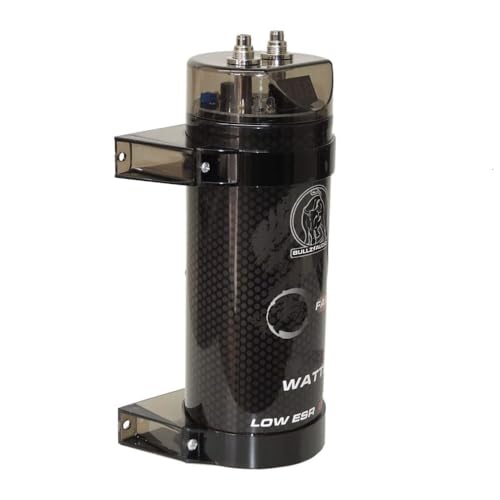
Five-and-a-half Farads of reserve that kills headlight dimming on big subwoofer amps.
This rectangular 5.5 Farad cap from Xscorpion (branded Bullz Audio) is the middle-distance runner between the 4-Farad and 10-Farad tiers — enough reserve to keep a serious sub amp fed without the physical footprint of the Stinger. At 20 Volts maximum voltage, it matches the BCAP3.3’s ceiling but holds 2.2 more Farads of energy. That extra capacitance makes a real difference: one buyer mentioned that running a Sound Stream T5.2500 amp, the power this thing reserves “keeps the amp at a constant voltage with NO dimming of my headlights when playing even the heaviest of tracks.”
The aluminum body and floor-mount design make installation straightforward, but the digital display behavior can be inconsistent — multiple reviewers mention the readout goes blank most of the time. If you rely on the display to monitor system health, that is a genuine irritation. Also, the included English instructions are described as “over explained” and a bit confusing; read them twice before connecting the resistor.
Compared head-to-head with the 3.3 Farad Audiopipe, this 5.5 Farad version costs very little more for 2.2 extra Farads of storage — a worthwhile bump if you suspect your amp is still hungry after a 3-4 Farad cap. It is not a hybrid like the Stinger, but for a traditional electrolytic cap at a budget-friendly price point, the BCAP5.5 delivers the energy density most 2000W-ish systems need.
Energy monster: At 5.5 Farad, this cap holds 5.5x the reserve of a 1-Farad unit like the Belva BB1D — enough to stabilize a substantial subwoofer amplifier without needing the bigger footprint of a 10-Farad hybrid.
Reach for this if: you run a single large sub amp (like a 2500W class D) and want a proven fix for headlight dimming without spending premium money.
Look elsewhere if: you need a reliable voltage display — the readout on this model has a known tendency to go blank intermittently.
4. Belva BB2D 2.0 Farad Capacitor with Red Digital Display

A 2-Farad balance for 1600-2000W builds that want a clean red display and surface-mount convenience.
The Belva BB2D is the twin to the well-reviewed BB1D but with double the capacitance — 2.0 Farad instead of 1.0 Farad, rated for systems up to 2000 Watts. The red digital voltage display and audible warning indicators are identical, and the rectangular body (4.5″W x 3.5″H) is compact enough to surface-mount almost anywhere. Customers note it “eliminated headlight dimming on bass hits” in a 2013 Chevy Impala and gave “cleaner, more consistent sound at high volume.” Another owner used it to fix a voltage-drop issue that was causing his 1600W JL Audio system to cut out.
There is a catch with the included charging resistor: several buyers mention it can be faulty and recommend using a test light or a standard 12V bulb instead for the initial charge. Without a proper slow charge, the cap may blow fuses or weld terminals — the same warning applies to every cap in this category. Once installed, the Belva’s audible warning tone will sound if voltage drops too low or if polarity is reversed, which is a handy failsafe.
Compared to the 1.0-Farad RECOIL R1D or the Belva BB1D, the BB2D gives you twice the energy reserve for roughly 40% more in cost. It is a smart step-up for a builder who suspects 1-Farad is not quite enough but does not want to jump to 3 or 4 Farads.
What works
- 2.0 Farad is a perfect middle ground for most 1600-2000W aftermarket systems.
- Red digital display is legible in daylight and dims nicely at night.
What to improve
- Included charging resistor may not work reliably — budget for a test light or bulb for the initial charge.
- The bright blue LED under the display can be distracting; some buyers cover it with tape.
Best for: a daily driver with a solid 1600-2000W system where you want the proven reliability of the Belva line with double the energy reserve of the 1-Farad model.
5. Audiopipe BCAP3.3 Bullz Audio 3.3 Farad Capacitor

A 3.3-Farad round cap that proves you do not need a monster build to fix light flicker.
The Audiopipe BCAP3.3 drops the Farad count from the 5.5 version but keeps the same 20 Volt maximum and the same Low ESR (Equivalent Series Resistance, meaning it discharges quickly for its size) design. It weighs 2.9 Pounds, making it a few ounces lighter than the 3-Pound Belva BB1D despite holding 3.3x the capacitance. Round shape and floor-mount design fit neatly into tight trunk corners. One buyer captured the real-world value perfectly: “just charge it with the little resistor for a couple minutes and she’s all set! hits hard now and way less dimming on one battery with a 3300w amp.”
That 3300W amp number might seem high for a 3.3-Farad cap, but the key detail is that the dimming was already happening on a single battery — the BCAP3.3 smoothed out the voltage enough to make a clear improvement. Another owner used two of these units in a Ford 6.0 diesel and reported more stable voltage overall. The aluminum body dissipates heat well, and the integrated digital display gives you a quick check on system status without needing a multimeter.
Compared directly to the 5.5 Farad version, the BCAP3.3 is noticeably more compact and costs quite a bit less, making it a stronger value proposition for a system in the 1500-2000W range. Just keep the terminals covered — one buyer jokes “do not let the terminals touch things will weld,” which is fair advice for any cap this size.
Pros
- 3.3 Farad at a very accessible price point — strong value per Farad.
- 20V max voltage gives good safety margin for most cars and trucks.
Cons
- Round shape may not sit as securely as rectangle caps with mounting brackets.
- Some units have minor cosmetic flaws (terminal plastic coating tears during shipping).
Skip the bigger cap if: your system is in the 1500-2000W range and you want the best energy-per-dollar ratio. The BCAP3.3 gives you that without overbuying.
6. Belva BB1D 1.0 Farad Car Audio Power Capacitor

The 1-Farad gatekeeper that has been saving alternators for years — still running after four.
The Belva BB1D is the most-reviewed capacitor in this lineup (799 ratings) and for good reason: it is the affordable, dependable entry point for a system up to 1000W. The red voltage display is simple and readable, the audible warning tone alerts you to voltage drops or reverse polarity, and the included mounting brackets make surface mounting secure. One buyer sums up the real-world performance: “capacitor holds voltage steady at 14+V with 600W RMS amp/sub.” Another owner reports zero headlight dimming in a 1987 F150 with an 1100W amp.
There are two quirks to know. First, the bright blue flashing LED that illuminates the display can be distracting at night — several buyers cover it with tape. Second, the instructions are not the clearest; one owner reported that after disconnecting the resistor, the voltage initially dropped, which confused them. The fix is to let the cap fully charge and then leave the connection stable. At just 1 Farad, it is not going to solve dimming on a massive 2000W+ system, but it pairs perfectly with a compact 600-1000W setup.
Durability is a standout here: one buyer reports buying the BB1D “4 years ago if my memory doesn’t fail, and it is still working like a champ.” That is the kind of long-term reliability that makes this cap a safe bet for someone trying a capacitor for the first time.
Time-tested: With 799 ratings at 4.3/5 and multiple owners reporting years of trouble-free service, the BB1D is the most battle-tested cap in this list.
Who it is for: a first-time buyer with a modest 600-1000W sub/amp combo who just wants the headlight flicker to stop without spending much.
Who it is not for: anyone running serious current — you will outgrow 1 Farad the moment you add a second amp or a larger sub.
7. RECOIL R1D 1.0 Farad Car Audio Energy Storage Reinforcement Capacitor

The 1-Farad budget pick that feels beefy in hand and delivers clean power delivery.
The RECOIL R1D is a straightforward 1.0 Farad cap with a blue digital voltmeter, rated for systems up to 1000W with a 20V surge capacity and an operating range of 10-16 Volts DC. Owners consistently describe the build as “beefy and heavy” — at 2.5 Kilograms (about 5.5 pounds), it is noticeably heavier than the 3-Pound Belva BB1D, even though both are 1-Farad units. That heft comes from solid aluminum and ceramic construction that feels durable in the hand. Reviewers point out it “provides good sound quality” and that “the cap does what it’s supposed to do by providing extra power to the amp without dropping voltage.”
However, there is a clear limitation: one owner notes that even with the RECOIL installed, it “wasn’t enough to prevent my lights from dimming” and that they may need a “bigger cap because my battery life drains too fast.” This is the reality of a 1-Farad cap on a demanding system — it helps, but it is not a substitute for a deep-cycle battery or a higher-Farad capacitor. The instructions are also minimal; multiple buyers advise having a professional handle the install if you are not comfortable reading a basic wiring diagram.
If you compare the RECOIL head-to-head with the Belva BB1D, both are 1 Farad at similar voltage ratings, but the RECOIL weighs notably more and feels more premium in construction. The blue LED display looks modern, and the automatic shutoff protection is a nice safety touch. For a low-cost entry into capacitors, the R1D is a solid choice — just know its limits before you buy.
Standout features
- Feels very solidly built — heavier than most 1-Farad competitors.
- Blue digital voltmeter is clear and aesthetically pleasing for visible installations.
Limitations
- 1 Farad is not enough to fully solve dimming on a system above 1000W.
- Lacks comprehensive installation instructions — not beginner-friendly if you are new to car audio wiring.
Best for: someone who values build quality and a modern blue display over rock-bottom pricing, and has a system modest enough that 1 Farad is genuinely sufficient.
One honest caveat: if you already know your lights dim with the bass, expect this to improve the situation — do not expect it to fix it entirely without a larger cap or a second battery.
Understanding the Specs
Farad — The Capacity Number
The Farad rating tells you how much electrical energy the capacitor can store — think of it as the size of the water tank feeding your amplifier. A 1-Farad cap holds enough reserve for a typical 600-1000W system, while a 10-Farad unit like the Stinger SPC5010 can stabilize a high-power build without breaking a sweat. More Farads means more instant power on tap, but also a physically larger unit.
Voltage Rating — The Safety Ceiling
Every capacitor has a maximum voltage it can handle before it fails. Your car’s electrical system sits around 12-14.4V while running, so a cap rated at 16V (like the Belva or RECOIL units) is the minimum safe choice. A 20V or 24V rating (like the Rockville RXC4D) provides extra headroom for surge protection during sudden alternator spikes — especially useful in vehicles with upgraded charging systems.
Low ESR — Speed of Delivery
ESR stands for Equivalent Series Resistance, and “low” is good — it means the cap can release its stored energy very quickly. When your amplifier demands a sudden burst of power for a bass note, a low-ESR capacitor responds almost instantly, preventing that millisecond of voltage sag that causes audio distortion. The Stinger SPC5010’s 0.0015 ohm ESR is an excellent example.
Digital Voltage Display — Your Dashboard
Almost every modern capacitor includes a built-in voltmeter, usually red or blue LED, that shows the voltage at the capacitor’s terminals. This lets you see in real time whether the cap is charged, whether your alternator is keeping up with demand, and whether the system voltage is dropping under load. A blank or flickering display can sometimes indicate a loose connection or an internal issue.
FAQ
How many Farads do I need for my car audio system?
Do I need a capacitor if I already upgraded my alternator and battery?
Which is better — 1 Farad or 10 Farad?
Will a capacitor completely stop my headlights from dimming?
Why do some capacitors have voltage displays and others don’t?
Can I install a car audio capacitor myself?
What is the charging resistor for — and can I skip it?
How long does a car audio capacitor last?
Is a capacitor the same as a battery for my car audio system?
Will a capacitor improve my sound quality?
Final Thoughts: The Verdict
If you want one dependable pick, the capacitor for car system winner is the Stinger SPC5010 because its 10-Farad hybrid technology delivers the fastest charge/discharge cycle and the biggest energy reserve for high-power systems that demand the most. If you want a solid mid-range value with great voltage headroom, grab the Rockville RXC4D. And for a modest daily-driver build at an entry-level spend, the standout is the time-tested Belva BB1D.
How We Picked
We do not accept paid placement. Every pick is matched to a real buyer and a real use-case; we do not hands-on test units.
Sources & Methodology
Specifications: manufacturer listings and product documentation. Review insights: verified customer reviews, as of July 2026. Pricing: not shown on this page (it changes often); check the current price via the retailer link.
As an Amazon Associate, Trending Car earns from qualifying purchases. This does not affect which products we feature.