
Our readers keep the lights on and my garage snacks stocked. As an Amazon Associate, I earn from qualifying purchases.
Specs are compiled from manufacturer listings and verified buyer reviews and can change over time — please confirm the key details on the product page before buying.
You just bolted in a fresh camshaft. The lifter bottoms out. One dry crank — a single turn of the engine before oil pressure builds — and that precision-ground lobe can scuff, gall, or flatten before the car ever leaves the garage. That is why a dedicated camshaft assembly lubricant is not a nice-to-have; it is the cheap insurance that determines whether your rebuild fires up smoothly or you get a knock you cannot unhear on the first warm idle.
I’m Min Islam — the founder and writer behind Trending Car. This guide is built by comparing the manufacturers’ published specifications and the patterns across verified customer reviews, so you get each pick’s real strengths and trade-offs instead of marketing spin.
Every product below is a proven best camshaft assembly lubricant that sticks to metal surfaces, resists wash-off during the critical break-in minutes, and keeps your rotating assembly safe until the oil pump takes over.
Quick Picks
- Red Line 80319 Liquid Synthetic Assembly Lube — Pro Choice
- PRM 81950 Ultra Slick Engine Assembly Lube — Best Value
- Liqui Moly LM 48 Installation Paste, 50 g — High-Heat King
- Lubriplate L0034-094 No. 105 Motor Assembly — Best Overall
- Sta-Lube Extreme Pressure Engine Assembly Lube — Heavy Hitter
- ARP 100-9909 Ultra Torque Assembly Lubricant — Compact Pick
- COMP Cams 153 Cam and Lifter Installation Lube — Warranty Saver
How To Choose The Best Camshaft Assembly Lubricant
You cannot use engine oil here. The moment you spin the crank, gravity and shear force strip ordinary oil off a cam lobe before the lifter hits it. That is why you need an assembly lube: a thick, clingy compound designed to survive the gap between cranking and oil pressure. Look for three things — stickiness, temperature tolerance, and the additive package that prevents metal-to-metal galling.
Stickiness and Wash-Off Resistance
The best lubricants for this job feel like heavy grease or paste. They need to stay on vertical lifter bores and overhead cam lobes for hours or days after application. If a lube runs off into the oil pan before you have bolted the timing cover on, it has failed. Products like Lubriplate No. 105 or Sta-Lube SL3331 use lithium-soap thickeners and moly-graphite solids that cling tenaciously to metal — buyers report they stay in place “for days before startup.”
Flash Point and High-Temp Survival
Your camshaft area can hit 300–400°F during break-in if tolerances are tight. The lubricant needs a flash point well above your expected operating temperature so it does not burn off and leave a dry metal surface. Liqui Moly LM 48, for example, lists a service temperature range from -31°F up to 842°F, while Sta-Lube sets its flash point at 450°F. A low flash point product will smoke away on the first heat cycle.
Friction Modifiers and Extreme Pressure Additives
Zinc dithiophosphate, molybdenum disulfide, and graphite are the workhorses here. These solid-film lubricants form a sacrificial layer that slides under extreme pressure, preventing scuffing even if oil is not yet circulating. The ARP 100-9909 is specifically formulated as a torque compound, but its extreme-pressure additives also protect threads and washer faces from galling — a dual-use benefit many engine builders rely on.
Quick Comparison
| Model | Best For | Volume | Form | Flash Point | Amazon |
|---|---|---|---|---|---|
| ARP 100-9909 | Torque-critical fasteners | 1.69 oz | Liquid | — | Amazon |
| PRM 81950 2-Pack | Full rebuild covering | 4 oz (2x) | Liquid | — | Amazon |
| Liqui Moly LM 48 | High-temp valve train | 50 g | Paste | 101°C | Amazon |
| Lubriplate No. 105 | Everything assembly | 10 oz | Grease | 150°F | Amazon |
| Sta-Lube SL3331 | Cam lobe protection | 10 Wt Oz | Grease | 450°F | Amazon |
| Red Line 80319 | Thin-film coverage | 12 oz | Liquid | — | Amazon |
| COMP Cams 153 | Camshaft break-in | 8 oz | Liquid | — | Amazon |
In‑Depth Reviews
1. Red Line 80319 Liquid Synthetic Assembly Lube

The go-to for machinists who insist on a filter-friendly film that does not clog.
You get 12 fluid ounces of synthetic chemistry here — 12 fluid ounces versus the Lubriplate’s 10 oz tube, which means you can coat an entire rotating assembly plus timing chain without rationing. Owners mention using it on a 2.4L EcoTec with zero issues on startup, noting that the lubricant is “pretty sticky” and adheres the way it should. Unlike some black moly greases that can plug an oil filter on first fire, Red Line says this version moves through the system without blocking it.
The consistency is noticeably thinner than a heavy grease like Sta-Lube, which is a trade-off. It spreads and coats fast, but customers note it “stays put unless globbed.” Several owners mention it leaves a lasting slick film that feels superior to oil. If you prefer a brush-on liquid over a squeeze-and-smear paste, this is your pick.
One key difference versus the Lubriplate grease below: this is a synthetic fluid, not a calcium-soap grease, so it resists separation over longer storage periods between assembly and startup.
What Works
- Won’t clog oil filters according to the maker
- Sticks well despite thinner consistency
- Generous 12 oz supply covers big builds
Watch Out
- Thinner than paste lubes — may drip off vertical surfaces if over-applied
- No published flash point for extreme-heat confidence
Reach for it when: you are assembling a modern engine with tight oil passages and want a liquid that flows easily under the cam before fire-up.
Think twice if: your engine sits unstarted for weeks — a paste-type grease holds up longer during storage.
2. PRM 81950 Ultra Slick Engine Assembly Lube, 4 oz, 2 Pack

Two bottles for the price of one single — a budget-tier ticket to full rebuild protection.
This is a 4-ounce two-pack from PRM (sold under the Permatex brand name) that comes out to 8 total ounces of sticky liquid lube. One buyer listed exactly where they used it: “crank bearings, cam bearings, rods, rings, oil pump, cam lobes, lifters, pushrods, rocker arms.” That is essentially every friction surface inside a long-block, so the coverage here is real. The manufacturer recommends it for camshafts, lifters, valves, guides, and rocker shaft assemblies, and the formulation is said to meet OEM performance specs for engine assembly lubricants.
The consistency is notably thick. Multiple reviews call it “very sticky stuff” that ensures a lasting coating during the break-in process. One builder who races noted that engine parts “look great after racing for many many laps,” which suggests the film does not shear off under high RPM. Compared to the ARP product above, you get a lot more volume for roughly the same cost — about 8 total ounces versus ARP’s 1.69 oz tube.
One thing to keep in mind: the bottles have a nozzle tip, but the lube is thick enough that you may need to squeeze with some muscle to get it flowing evenly across a cam lobe.
Stands Out For
- Two-pack gives enough to do an entire engine build
- Extremely sticky — resists running off vertical surfaces
- Recommended for cam bearings, lobes, lifters, and more
One Trade-Off
- Thick consistency means you have to work it into tight gaps
- No flash point listed for very high-heat applications
Perfect for: a first-time engine builder on a budget who wants enough lube to cover every bearing, lobe, and rocker without buying a second tube.
skip it if: you need a paste for cam-lobe-only precision — this is a general assembly lube, not a dedicated cam paste.
3. Liqui Moly LM 48 Installation Paste, 50 g

The German paste that lives through 842°F without smoking off the lobe.
Liqui Moly LM 48 uses a unique solid-lubricant system — zinc sulfide, graphite, fluorides, and tungsten disulfide — that forms a dry-film layer under extreme pressure. That mix gives it a service temperature range of -31°F to plus 842°F, which is dramatically wider than most tube greases we see in this category. The Sta-Lube below has a flash point of 450°F; this paste is rated for roughly double that. That matters if you are running a boosted or high-compression engine where valve-train heat spikes hard during initial cam break-in.
Reviewers point out it works “amazing on valve-train parts and assemblies” and that it “does not cause any issues mixing with oil.” A single 50-gram tube goes a long way — buyers comment that one tube covers a full engine assembly. The paste consistency means you can apply a thin, precise layer directly to cam lobes and lifter faces without dripping anywhere else.
A couple of things to compare: the 50g tube holds about 1.76 oz by weight, so it is a small tube — much less volume than the 10-ounce Lubriplate or the 12-ounce Red Line. You are paying for extreme-temperature chemistry, not for bulk. Also, this is a paste, not a liquid, so it takes more finger-work to spread evenly.
Why It Wins
- Rated to 842°F — handles the hottest valve-train conditions
- Unique solid-lubricant blend (zinc sulfide, graphite, fluorides, tungsten disulfide)
- Does not contaminate engine oil, per buyer reports
The Catch
- Small 50g tube — not enough for a full long-block build
- Paste requires manual spreading; not a pour-and-coat liquid
Best suited for: the valve-train specialist who wants to guarantee cam lobe protection in a high-heat, high-RPM build where standard grease would burn off.
Not right if: you want a budget-friendly all-in-one lube for every engine bearing — the tube is too small for that scope.
4. Lubriplate L0034-094 No. 105 Motor Assembly Grease, 10 oz

The white grease that truck-shop mechanics have trusted unchanged for four decades.
Lubriplate No. 105 is a calcium-based grease in a 10-fluid-ounce tube with a max operating temperature of 150°F. One reviewer who runs a semi-truck repair shop says they “always restock this brand.” Another buyer sums it up plainly: “I use this grease on the assembly of almost everything.” The key feature here is staying power — it resists wash-off and does not run off vertical surfaces, which is exactly what a cam lobe needs during the dry seconds between cranking and oil pressure build. The NLGI grade of 0 means it is a semi-fluid grease, softer than a chassis grease but thicker than a liquid assembly lube, so it clings without being impossible to spread.
Compare this with the Red Line liquid above — at 10 fluid ounces vs Red Line’s 12 fluid ounces, the Lubriplate gives you only slightly less volume, but the 150°F max temp is notably lower than the 450°F flash point on the Sta-Lube. That means Lubriplate is better suited to standard street builds, not extreme-duty or forced-induction engines. For a daily-driver cam install or general engine rebuild, buyers across decades say it simply has not let them down.
One reviewer who has been using it for 40 years says the product “has not changed in 40 years” — the exact same formula keeps working. That kind of track record is rare in this category.
Trusted Qualities
- Decades-old proven formula — reportedly unchanged for 40 years
- Semi-fluid grease stays put on cam lobes and lifters
- Generous 10 oz tube covers a full engine assembly
Limitation
- 150°F max temp is low vs extreme-pressure competitors
- Calcium-based — not as chemically durable as synthetic pastes
Pick this if: you want a no-surprises, time-tested grease for a standard engine rebuild that will not run off before the first start.
Look elsewhere if: your engine sees high boost, nitrous, or racing use where temperatures push well past 150°F.
5. Sta-Lube Extreme Pressure Engine Assembly Lube SL3331

The thick cam grease one builder used for a timing-belt job that turned into two engine builds.
Sta-Lube SL3331 is a lithium-based grease packed with moly-graphite solids, and it comes in a 10 Wt Oz tube. One buyer specifically describes using it on “new camshaft lobes, journals, and bearings during timing belt/water pump install” and notes it stays in place “for days before startup” before dissolving into motor oil. Another reviewer built two engines with the same tube — that kind of coverage from a single tube is impressive. The flash point is listed at 450°F, which is 450°F versus the Lubriplate No. 105’s 150°F max, so this grease is ready for high-heat break-in cycles.
At 0.69 pounds, the Sta-Lube tube is 0.69 pounds versus the ARP 100-9909’s 0.14 pounds, giving you more material for a modest price step up. The extreme-pressure additive package — lithium soap plus moly-graphite — is designed to prevent friction, galling, and wear during assembly, start-up, and break-in. One owner who used it on camshaft and rocker arms during a cylinder head rebuild says after thousands of miles there were “no issues.”
One thing to note: the moly-graphite solids are black and can stain hands and clothes. It also takes a strong squeeze from the tube to get the thick grease flowing onto a cam lobe.
Strengths
- Moly-graphite extreme-pressure formula sticks tenaciously
- 450°F flash point handles break-in heat
- Shoppers say using it on multiple complete engine builds
Downside
- Thick grease is messy and stains
- Tube nozzle can be hard to squeeze for precision application
Ideal when: you are doing a cam-only swap or a full rebuild and want a high-temperature, long-lasting grease that stays put for days or weeks before startup.
Avoid if: you need a thin liquid that flows into tight tolerances — this is a heavy grease, not a pour-grade lube.
6. ARP 100-9909 Ultra Torque Assembly Lubricant

ARP’s tiny squeeze tube that delivers precision torque accuracy and cam protection in one.
The ARP 100-9909 is a 1.69-ounce fluid squeeze tube that was originally designed as a torque compound for lubricating threads on head studs and fasteners to get accurate torque readings. But because of its extreme-pressure anti-gall properties, engine builders also use it on cam lobes and lifter faces during assembly — the same way they need accurate thread friction, they also need that friction control on sliding cam surfaces. At 0.14 pounds, it weighs a fraction of the 0.69-pound Sta-Lube tube, and the volume difference is stark: 1.69 oz vs 10 Wt oz. You are paying for the specialized extreme-pressure chemistry and the trusted ARP name, not for quantity.
One reviewer explicitly says: “Remember when using torquing compound, make sure all the threads are clean.” That same buyer advises putting a “light amount on the faces of washers and all contacts spots” to prevent galling. Another review calls it “great compound for getting accurate torque.” So this lubricant has a dual identity — it is both an anti-seize thread lubricant and an assembly paste. That works well if you are already using ARP fasteners on your build and you want one compound for bolts and cam lobes.
The catch, as buyers report, is that the tube is small. You will use most of it on head studs and main-cap bolts, leaving little spare for coating every cam lobe and lifter. If you need generous cam coverage, you will probably pair this with a bigger tube like the PRM 2-pack or Sta-Lube.
Best Feature
- Eliminates torque-reading errors on head studs and bolts
- Extreme-pressure additives prevent galling on metal surfaces
- Made in the USA by a trusted fastener brand
Limitation
- Very small tube — 1.69 oz — not enough for full cam coverage
- Primarily a torque compound; not tune as a cling-cam grease
Use it for: assembling ARP rod bolts and head studs while also applying a thin coat to lifter faces for the first fire.
Do not rely on it for: coating an entire camshaft from end to end — you will run out before you finish.
7. COMP Cams 153 Cam and Lifter Installation Lube, 8 oz
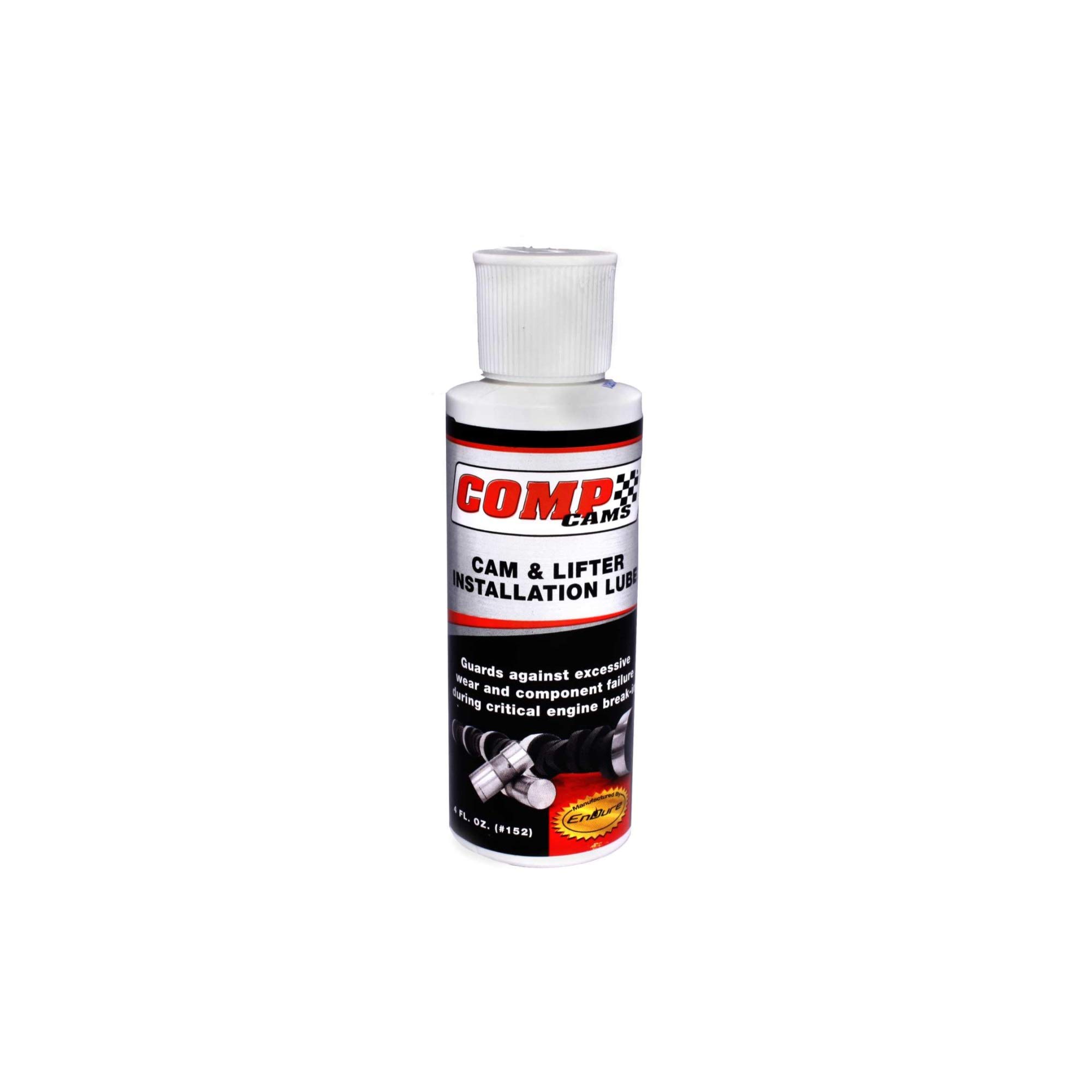
Comp Cams’ dedicated lube that keeps your cam warranty valid and the lobes alive.
COMP Cams is arguably the best-known aftermarket camshaft brand in the USA, and they sell their own installation lube — the 153, an 8-ounce bottle. The label says it is “for camshaft break-in,” and one reviewer specifically notes that it is “needed to maintain your Comp warranty.” That alone is a compelling reason to buy: if you install a Comp cam without their lube and have a failure, you may void the warranty. The liquid volume works out to 0.24 liters, placing it between the small ARP tube and the larger Lubriplate tube in terms of capacity.
Owners mention that it stays on the cam shaft — “working great it stays on the cam shaft” — even after the engine sits for a while following a rebuild. One owner of a Coyote Aluminator engine (a Ford crate motor) used it and had no complaints. Another more experienced builder notes that the protection “lasts for a long time following application,” which is valuable for engines that sit on a stand for weeks or months before the first start. The material is listed as “lubricating oil” so it pours easily from the bottle, unlike paste lubes.
One reviewer does warn that it is “a little more expensive than some other equivalent products.” You are paying a premium for the Comp Cams brand trust and the warranty assurance. But for a racer or builder installing a Comp stick specifically, it is the easiest decision in this list.
Advantage
- Required to maintain COMP Cams warranty on their camshafts
- Long-lasting protection for engines that sit before startup
- Pour-friendly bottle — easy to apply precisely
Downside
- Premium-priced compared to equivalent lubes
- Thinner than paste — may run off vertical surfaces if over-applied
Buy this if: you are fitting a COMP Cams stick and want to keep the warranty intact while ensuring the cam and lifters survive break-in.
pass on it if: you are using a different cam brand — you can save money with a general-purpose assembly lube without losing protection.
Understanding the Specs
Flash Point
This is the temperature at which the lubricant’s vapors can ignite. A higher flash point (such as the Sta-Lube’s 450°F or the Liqui Moly’s 842°F service temp) means the grease will not burn off or degrade when the cam and lifters heat up during break-in. If you see a low flash point like 150°F on a tube, save it for low-stress general assembly, not the valve train of a boosted engine.
Moly-Graphite vs Synthetic Paste
Molybdenum disulfide and graphite are solid-film lubricants that form a dry sliding layer between metal surfaces. They are excellent for extreme-pressure conditions like cam lobe-to-lifter contact. Synthetic pastes (like Liqui Moly LM 48) use a blend of solid lubricants — zinc sulfide, fluorides, tungsten disulfide — that operate over a broader temperature range. Know your engine’s operating temperature before picking between the two.
FAQ
Can I use regular engine oil as a camshaft assembly lubricant?
How much assembly lube do I need for a single cam swap?
Does assembly lube expire or go bad?
Will assembly lube clog my oil filter on first start?
Can I use a torque compound like ARP 100-9909 on cam lobes?
What is the difference between paste and liquid assembly lube?
Do I need zinc additive in addition to assembly lube?
How long can I leave assembly lube on before starting the engine?
Final Thoughts: The Verdict
For most buyers, the best camshaft assembly lubricant winner is the Lubriplate No. 105 because its semi-fluid grease consistency, decade-proven formula, and generous 10-ounce tube hit the balance for a standard engine rebuild without breaking the budget. If you want extreme heat tolerance for a race or boosted build, grab the Liqui Moly LM 48. And for thick cam-specific cling that stays put for days before startup, the standout is the Sta-Lube SL3331.
How We Picked
We do not accept paid placement. Every pick is matched to a real buyer and a real use-case; we do not hands-on test units.
Sources & Methodology
Specifications: manufacturer listings and product documentation. Review insights: verified customer reviews, as of July 2026. Pricing: not shown on this page (it changes often); check the current price via the retailer link.
As an Amazon Associate, Trending Car earns from qualifying purchases. This does not affect which products we feature.