
Our readers keep the lights on and my garage snacks stocked. As an Amazon Associate, I earn from qualifying purchases.
Specs are compiled from manufacturer listings and verified buyer reviews and can change over time — please confirm the key details on the product page before buying.
Camping in sweltering heat with a broken AC turns a dream trip into a sweaty nightmare. You need to know if a 15,000 BTU powerhouse (a unit that cools about 450–500 square feet) fits your large fifth wheel, or if a low-profile 13,500 BTU model suits a nimble camper van. You also need to decide if ducted airflow (cooling through ceiling vents) or a heat pump (which also warms) matters for your year-round travel. This guide breaks down the best rooftop units by performance, noise, and real owner experience so you can pick the one that fits your RV and your ears.
I’m Min Islam — the founder and writer behind Trending Car. This guide is built by comparing the manufacturers’ published specifications and the patterns across verified customer reviews, so you get each pick’s real strengths and trade-offs instead of marketing spin.
Finding the right camper ac unit depends on balancing cooling power (measured in BTUs), noise level (in decibels), and power draw (how much electricity it uses) for your specific rig and travel habits.
Our Picks at a Glance


How To Choose The Best Camper AC Unit
Picking a rooftop air conditioner for your camper is a big purchase, so it pays to understand the few specs that actually change how it performs on the road. The three things that matter most are BTU output for the size of your rig, the physical profile and mounting type, and the noise level measured in decibels. Once you grasp those, the rest is matching features like heat pumps and remote controls to your own camping style.
Match the BTUs to Your Rig Size
The cooling power of a unit is measured in British thermal units (BTUs), and this number tells you how much heat it can remove per hour. A 13,500 BTU unit is the standard workhorse for most campers and trailers, while a 15,000 BTU unit is better for larger fifth wheels and longer coaches that need more muscle in extreme heat. If you go too small, the AC will run constantly and never catch up; too large and it may cycle on and off too frequently.
Ducted vs. Non-Ducted Airflow
You have to match the AC to how your RV delivers air. A non-ducted unit blows cool air directly down into the room from a ceiling assembly, which is simpler and common on many mid-size campers. A ducted system pushes air through channels in the ceiling to multiple vents throughout the rig, which is ideal for longer trailers where you want even cooling in the bedroom and living area. Know which system your camper uses before you buy.
Noise Level and Power Draw
A camping AC that rattles all night will ruin your sleep, so check the decibel rating — a unit around 55 dB is whisper-quiet while 65 dB is closer to a loud conversation. Also consider the power draw: units with low amp draw run happily on a 30-amp campground hookup or a 2200-watt generator, which matters a lot for boondocking and solar setups. These two specs determine whether the unit is a joy or a burden on your trips.
Quick Comparison
| Model | Best For | BTU | Noise Level | Heat Pump | Amazon |
|---|---|---|---|---|---|
| RecPro 15K Quiet★ Best Overall | Overall Power & Quiet | 15,000 | 55.4 dB | Yes | Amazon |
| ASA Advent AirBest Value | Budget Value | 13,500 | — | No | Amazon |
| Airxcel Mach 3 PlusTop Performer | Reliable Mid-Range | 13,500 | — | No | Amazon |
| RecPro 13.5K | Quiet Non-Ducted | 13,500 | 59.7 dB | No | Amazon |
| Dometic FreshJet 3 | Lightweight Upgrade | 15,000 | — | No | Amazon |
| TURBRO Inverter 13.5K | Tech & Efficiency | 13,500 | — | Yes | Amazon |
| Coleman-Mach 15 Plus Black | Premium Replacement | 15,000 | — | No | Amazon |
| Coleman-Mach 15 Upper | DIY Install | 15,000 | — | No | Amazon |
| Dometic Penguin II | Low Profile Sleekness | 13,500 | — | No | Amazon |
In-Depth Reviews
1. RecPro RV 15K Quiet AC Heat Pump
Our pick — 4.5★ from 300+ verified ratings; the strongest balance of quality and price.
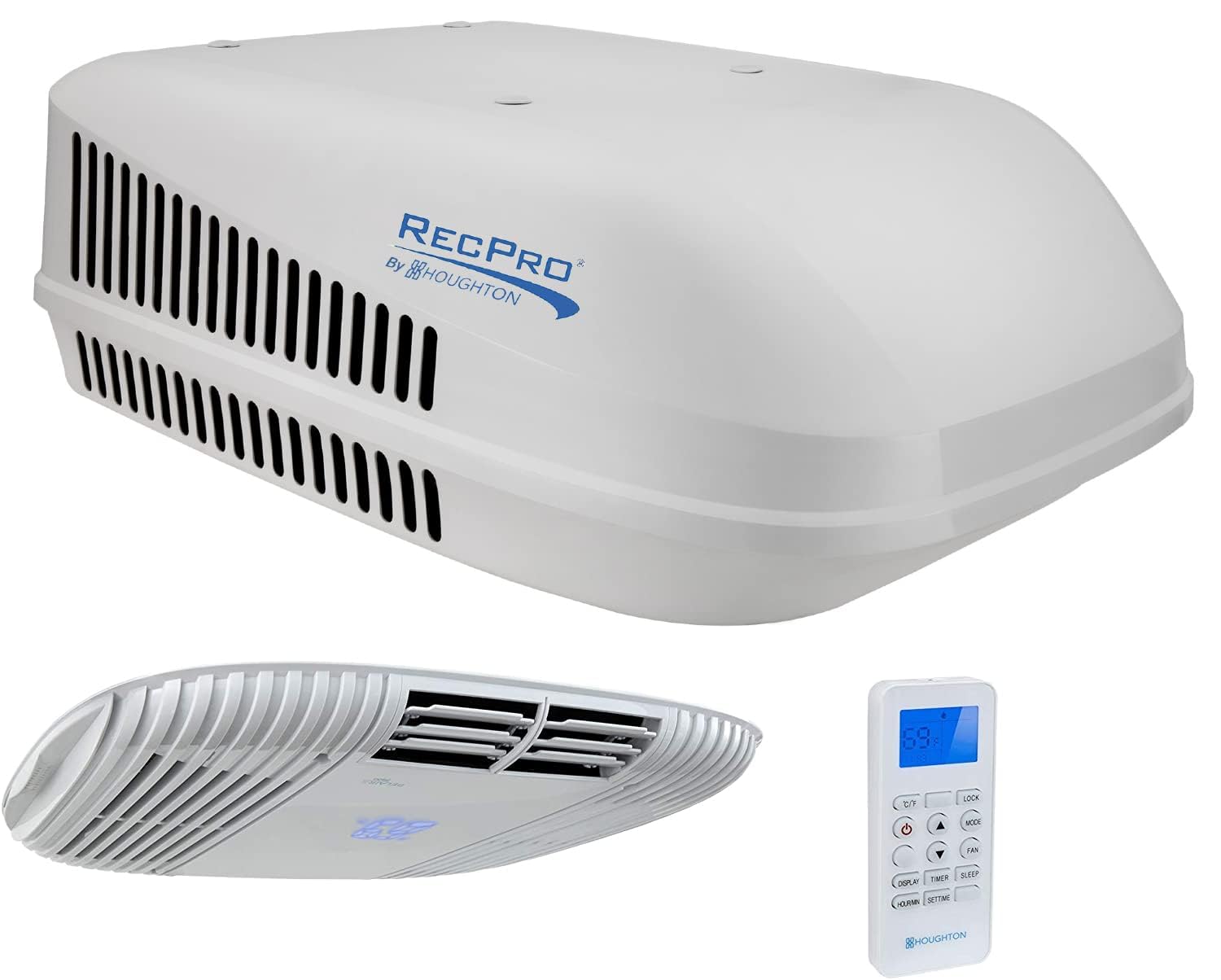
This 15,000 BTU unit delivers powerful cooling at a whisper-quiet 55.4 dB, plus a heat pump for year-round comfort.
If you want the rare combination of serious cooling muscle and a bedroom-quiet hum, this RecPro is the one to beat. It pumps out a hefty 15,000 BTU to cool a 36-foot coach, yet it runs at just 55.4 dB — a noise level the maker compares to gentle rain, so you can actually sleep under it. The built-in heat pump is the standout trick here, giving you supplemental warmth on chilly evenings that a standard cooling-only unit simply can’t match.
The crowd favorite — 4.5 stars across 300+ owners — has a clear pattern: people repeatedly call it quieter than their old Dometic and Coleman units, and one buyer reports running it for two straight weeks without a hiccup. Buyers report the install is straightforward with four bolts and three wires, though the unit is over 100 lbs, so you will want a second pair of hands on the roof. A few note that the manual is weak and the cover can arrive cracked, but the performance reviews are overwhelmingly strong.
What really seals the deal is the efficiency story. Owners say it draws less power than the Coleman Mach it replaced, meaning you can run two of these on a single generator where an older unit struggled. The wireless remote and LED touch display let you switch between cool, dry, fan, sleep, and timer modes without running any low-voltage thermostat wiring. For a big rig that needs real cooling power and near-silent operation, this is the complete package.
What wins people over
- 55.4 dB operation is genuinely quiet for sleeping
- 15,000 BTU handles large coaches with ease
- Heat pump provides warmth in cooler months
- Low amp draw works well with generators
Where it takes effort
- Over 100 lbs, so installation needs two people
- Occasional report of cracked covers on delivery
- Manual is thin, DIY videos help more
Reach for this if: you own a larger coach or fifth wheel and want maximum cooling with a heat pump bonus.
Think twice if: you are on a tight budget or your camper doesn’t have the roof support for a heavy unit.
2. ASA Electronics Advent Air 13,500 BTU
This 13,500 BTU unit delivers reliable cooling in extreme heat at a budget-friendly price.
This is the value pick that handles the worst heat America throws at it. One owner reports it “kept trailer cool in 115+°F Arizona heat” while running continuously from May through October on a 3500W generator without a single issue — a testimonial that shows up repeatedly in the review data. At a 13,500 BTU rating on 115-volt AC power, it’s the classic workhorse size for most campers and travel trailers.
What wins people over is the performance — it consistently out-cools the original equipment it replaces, with owners calling it smoother, colder, and quieter than the Dometic units it swaps out. The rigid metal base pan gives it a rugged feel that some cheaper plastic competitors lack, and the thick watertight vent gasket with six dense foam support pads helps keep rain and road dust out of your rig. Installation is described as plug-and-play with the lower control box, which is a huge plus for DIY owners.
There’s a reason it’s the budget champion, but a few honest caveats exist. Some owners note the mounting screws run short for thicker roofs, and a small number of units arrive with less-than-perfect control boxes. The overall rating of 4.2 stars across 300+ owners shows the happy majority far outweighs the occasional gripe. For a straightforward, affordable replacement that simply works, this Advent Air is tough to beat at this price.
The strong points
- Proven in 115°F extreme heat conditions
- Rigid metal base pan adds durability
- Easy plug-and-play installation
- Three fan speeds for airflow control
The trade-offs
- Mounting screws may be short for thick roofs
- Occasional control box quality complaints
- No heat pump for cold weather camping
Best for: campers in hot climates who want reliable cooling without spending premium money.
Look elsewhere if: you need a heat pump or plan to camp in freezing temperatures.
3. Airxcel Mach 3 Plus 13.5
This 13,500 BTU unit from a trusted brand delivers strong airflow to beat high heat and humidity.
When you want a proven, no-nonsense cooling unit from a household name, the Coleman Mach 3 Plus delivers. This 13,500 BTU unit handles a 66-foot airstream in hot conditions, and one owner reports it “cools well in 100°F/humidity” with 320 CFM of airflow pushing cold air through the rig. It draws a modest 13.1 amps on a standard 115-volt connection, so it plays nicely with typical RV electrical systems.
The value story here is what gets owners excited — one DIYer installed it on a 2016 Jayco Greyhawk in about an hour and saved thousands compared to dealer estimates. The plug-and-play cables make the electrical connection straightforward, and the kit fits the standard 14.25″ x 14.25″ roof opening without modification. Owners also praise its longevity, with several noting their previous Mach units lasted a decade or more before needing replacement.
It’s not the quietest unit on this list, with owners describing the noise as normal for an RV AC — moderate but not intrusive. The installation manual has been called nearly useless, and a few units arrive with minor shroud damage, but neither stops the unit from performing. The 4.1-star rating across 365 owners reflects a solid, dependable machine that does exactly what you ask of it: cool your camper fast.
Where it shines
- 320 CFM airflow for strong cooling
- Plug-and-play cables simplify DIY install
- Proven brand with impressive longevity
- Good value for the cooling output
Where it’s average
- Noise is typical for an RV AC, not whisper-quiet
- Manual is poorly organized
- Occasional delivery damage reports
Choose it if: you want a trusted brand with proven cooling performance and easy wiring.
skip it if: quiet sleep is your top priority over brand reliability.
4. RecPro 13.5K Non-Ducted RV Air Conditioner

This 13,500 BTU unit runs at a quiet 59.7 dB, making it a peaceful upgrade for small to mid-size campers.
If you’re upgrading from an old loud unit, this RecPro 13.5K is a revelation. Owners who swapped it in place of a Furrion report it’s roughly 20 dB quieter, with one amazed buyer noting the compressor is completely inaudible and you only hear a gentle fan. At 59.7 dB, it’s slightly louder than its 15K sibling but still far quieter than most stock RV units, and it delivers 13,500 BTU of ice-cold cooling that handles a 23-foot motorhome in 99°F California sun.
The installation ease is what earns it the most praise — the process takes about two hours with clear instructions, just four bolts, and the plenum included in the box. Owners running off-grid love that it sips power, with one confirming it runs on a 2200W generator and noting it uses less electricity than the Coleman Mach it replaced on solar. The wireless remote and LED touch display let you dial in cool, dry, fan, sleep, and timer modes without any thermostat wiring.
The main honest caveat is the remote control, which draws mixed feedback — it works fine for most, but a few owners found the connection finicky. There’s also a rare quirk where the unit seems dead until you reverse the remote plug connection during setup. The 4.4-star rating across 212 owners reflects a high-quality, genuinely quiet unit that delivers on its core promise of peaceful, powerful cooling.
The quiet strengths
- 59.7 dB is quiet enough for sleeping
- Roughly 20 dB quieter than older Furrion units
- Efficient enough for 2200W generators
- Two-hour install with included plenum
The honest flaws
- Remote control behavior is mixed across owners
- Ceiling cover screws can be tricky to identify
- No heat pump for cold-weather camping
Grab it if: you want near-silent cooling for a small to mid-size camper, especially off-grid.
Pass if: you rely on the remote heavily or need a heat pump.
5. Dometic FreshJet 3 Series RV Air Conditioner

This lightweight 15,000 BTU unit upgrades cooling while reusing your existing thermostat and airbox.
This one is built for upgraders who want more power without ripping out their whole system. The FreshJet 3 pushes 15,000 BTU — a solid step up from a tired 13.5K — yet it’s designed as a lightweight replacement that keeps your existing ADB (air distribution box, the part that routes cooled air) and works plug-and-play with an old analog thermostat and airbox. The lightweight construction makes it easier to heft onto the roof than the heavy units on this list, and owners say it cools a rig in extreme heat with a temperature difference of less than 20°F between outside and inside.
The e-coated evaporator coils are the engineering highlight here, a flexible epoxy polymer coating that gives excellent corrosion resistance. That’s a meaningful advantage for campers who spend time near the coast or in humid climates where salt air and moisture eat standard coils. Owners also note it’s noticeably quieter and more efficient than the aging Briskaire and Coleman units it replaces, and the included roof gasket makes sealing straightforward.
The catch is what’s not in the box: this is the upper unit only, so you need to reuse your existing interior air distributor, thermostat, and control box. A handful of owners mention shipping damage, and a few were surprised it lacked mounting hardware. The 4.1-star rating across 131 owners reflects strong cooling performance with a clear caveat — verify your existing controls are compatible before you commit.
Why it stands out
- Lightweight design eases roof installation
- E-coated coils resist corrosion
- 15,000 BTU upgrade from older 13.5K units
- Works with existing thermostat and airbox
Know before you buy
- No interior air distributor or thermostat included
- Some units arrive with shipping damage
- Hardware not included for all installations
Ideal for: a straightforward power upgrade while keeping your working controls and airbox.
Not for: anyone starting from scratch without an existing compatible thermostat setup.
6. Coleman-Mach Signature Series MACH 15

This 13,500 BTU inverter unit offers WiFi control, a heat pump, and a slim profile for efficient year-round comfort.
This is the technological leap forward for RV cooling. The inverter compressor delivers up to 30% greater efficiency than non-inverter systems while automatically adjusting speed to minimize both energy use and noise, and its smooth start eliminates the need for a separate soft starter. That efficiency translates to real-world numbers: one owner reports it uses just 600 to 1100 watts, and another ran it for 7 hours on a 2200W Honda generator in eco mode.
The year-round comfort story is genuinely different here. Beyond its 13,500 BTU cooling, the heat pump delivers heating that the maker claims is up to four times the output of traditional electric heaters, and it works in environments from 19.4°F to 109.4°F. The slim 10-inch profile is up to 35% thinner than most competing units, which reduces air resistance for better fuel efficiency while driving. You also get WiFi control through a smart app plus a remote, and the ceiling assembly even includes an atmosphere lamp with blue, yellow, or white lights.
The mixed feedback centers on noise and the thermostat. While many owners find it quieter than their old Penguin II or Coleman, a few report it being “extremely loud” at higher fan speeds, and one notes the thermostat sensor near the cold outlet reads 10-15°F low, causing the unit to run longer than needed. The 4.0-star rating across 83 owners shows real innovation with a couple of rough edges still being polished.
The tech advantages
- Inverter compressor uses 600-1100 watts
- 10-inch profile is up to 35% thinner
- WiFi app control with scheduling
- Heat pump works down to 19.4°F
The rough edges
- Noise level is inconsistent across owners
- Thermostat can read low near the outlet
- Fragile display cover latches
Reach for this if: you want modern inverter efficiency, app control, and heating in one slim package.
Step back if: you’re sensitive to inconsistent fan noise or prefer simpler, proven tech.
7. Coleman-Mach 48204-069 Mach 15 Plus

This 15,000 BTU unit in a black finish cools large RVs with a single rooftop installation.
Style meets substance in this black-shrouded Coleman, which owners say cools an entire Ravcon in Texas heat using just this single unit. It delivers a serious 15,000 nominal BTU of cooling, and one owner measured an impressive 30°F temperature differential between the suction and discharge lines in 90°F heat — clear proof it’s moving real cold air. The medium profile keeps it low on the roof while the wood skid protects the unit during shipping.
Installation is a genuine bright spot here, with owners calling it easy and noting it’s an exact replacement for the original factory unit. One DIYer completed the swap in about an hour with just basic tools, describing it as plug-and-play, while another notes it needs a few people to hoist safely given the weight. The 4.5-star rating across 94 owners is among the highest on this list, driven by strong cooling performance and quieter operation than what most campers had before.
The honest caveats are minor but worth knowing. As one owner discovered, you need to order the control module with freeze sensor separately — it won’t work without that control board. A couple of units arrive with a busted box and damaged outer casing, though they still run fine. The recurring advice from long-time owners: turn it off during lightning storms and consider a surge protector, which is smart practice for any rooftop unit.
What makes it premium
- 15,000 BTU cools large RVs with one unit
- Black finish stands out from the crowd
- 30°F temperature differential in 90°F heat
- Plug-and-play replacement install
What you must know
- Control module with freeze sensor sold separately
- Heavy, needs a few people to lift
- Occasional shipping box damage
Grab this if: you want premium 15K power, a distinctive black look, and easy replacement install.
Plan ahead if: you don’t already have the compatible control module, since it’s required to run.
8. Coleman-Mach 08-0080 Mach 15 Upper Unit

A 15K upper unit for DIYers who already have the lower control panel wired.
Here’s the smart money move for experienced RV owners: buy just the upper unit when your existing lower control panel and wiring are still good. This 15,000 BTU Coleman drops into a standard 14″ x 14″ roof opening and, as one owner reports, “cools well in Arizona summer heat” while another says it keeps even a leaky pop-up camper cool. The 1/3 HP fan motor moves plenty of air, and the exterior shroud measures 13.8″ H x 26.1″ W x 38″ L for a clean fit.
The DIY appeal is strong — owners describe a straightforward swap of four bolts, the control module, the freeze sensor, and one connector, taking about two hours even with the roof lift. Many report a significant temperature difference of 15-20°F after replacing a faulty unit, and the pre-installed gasket makes sealing a quick job. With a 4.2-star rating across 460 owners, this is the highest-volume pick on the list, proof of its proven reputation.
Read the fine print carefully: this is the upper unit only, with no install hardware or control board included, so you must reuse your old mounting brackets, bolts, and control module. A few owners found the unit louder than the advertised 28 dB, and some had to deal with flimsy pallet packaging in shipping. The noise-level feedback is genuinely mixed, so this is best for owners who prioritize proven cooling over absolute silence.
The DIY advantages
- 15,000 BTU proven in Arizona heat
- Four-bolt swap in about 2 hours
- Pre-installed gasket simplifies sealing
- Highest review volume shows trust
The fine print
- No hardware or control board included
- Noise level draws mixed feedback
- Packaging can arrive damaged
Best for: capable DIYers replacing a failed unit while keeping their existing lower controls.
Avoid if: you need a complete kit with everything in the box or demand whisper-quiet operation.
9. Dometic Penguin II 13.5K BTU

A sleek low-profile Penguin that cuts wind resistance and cools with modern refrigerant.
For drivers who care about aerodynamics and fuel efficiency, the Penguin II is the sleek solution. Its low-profile design improves airflow over the roof, reducing wind resistance for smoother, more efficient travel down the highway. The EPP foam housing lightens the overall weight while actually boosting cooling efficiency, and the rib-reinforced base pan stands up to weather, so it’s a genuinely durable choice for full-time travelers.
The comfort story is strong — a high-performance motor and fan deliver maximum cooling, and customers note it maintains an even temperature while cooling the front rooms of a 32-foot trailer in 90°F heat with ease. It runs on eco-friendly R410A refrigerant (a type that cools more efficiently and has less environmental impact than older options). The 13,500 BTU output is the balance for most campers and smaller trailers.
This is a cool-only unit with no pre-installed controls, so you need a compatible CCC2 or CT thermostat, and a few owners found they needed a conversion kit and return vent when replacing a Coleman. The noise feedback is split — some find it quieter than their old unit, others call it a little noisy. The 4.1-star rating across 140 owners reflects solid performance with the recurring caveat that shipping can be rough, with a few units arriving damaged.
The design strengths
- Low profile cuts wind resistance
- EPP foam reduces weight, boosts efficiency
- R410A refrigerant is eco-friendly
- Rib-reinforced base for durability
Know the limits
- No pre-installed controls or thermostat
- Needs compatible CCC2 or CT thermostat
- Some units arrive with shipping damage
Reach for this if: you want a low-profile, aerodynamic unit with modern refrigerant and you already have compatible controls.
pass on it if: you need a plug-and-play complete kit or prefer a heat pump for cold weather.
Understanding the Specs
BTU Cooling Power
British thermal units (BTUs) measure how much heat an air conditioner can remove in an hour. A 13,500 BTU unit is the standard for most campers and travel trailers, while 15,000 BTU is the go-to for larger fifth wheels and longer coaches. A bigger number means faster cooling in extreme heat, but also usually means a heavier unit and higher power draw, so match the BTU outputto the size of your rig rather than maxing out every time.
Decibel Rating
Noise is measured in decibels (dB), and this single spec often determines whether you sleep or toss and turn. A unit at 55-60 dB is roughly the level of gentle rain or a quiet conversation, which most sleepers find acceptable. Units above 65 dB are closer to a loud office or a vacuum cleaner in the next room, so they’re fine for daytime use but tough for overnight comfort. Check this number before you buy if quiet camping matters to you.
FAQ
What size camper AC unit do I need for my RV?
What is the difference between ducted and non-ducted AC units?
Will a heat pump AC unit keep my camper warm in winter?
Can I run a camper AC unit on a generator?
How hard is it to install a rooftop camper AC unit?
What does a low amp draw mean for my camper’s electrical system?
Is a 15,000 BTU unit worth the extra cost over a 13,500 BT?
Why do some units come without controls or hardware?
How long do rooftop camper AC units typically last?
What is a soft starter and do I need one for my camper AC?
Final Thoughts: The Verdict
If you want one dependable pick, the camper ac unit winner is the RecPro 15K Quiet because it pairs 15,000 BTU of serious cooling with a whisper-quiet 55.4 dB hum and a built-in heat pump — the complete package for comfort in every season. If you want budget-friendly reliability proven in 115°F desert heat, grab the ASA Advent Air. And for the tech-savvy camper who wants inverter efficiency, WiFi control, and a heat pump in a slim profile, the TURBRO Inverter 13.5K is the one to reach for.
How We Picked
We do not accept paid placement. Every pick is matched to a real buyer and a real use-case; we do not hands-on test units.
Sources & Methodology
Specifications: manufacturer listings and product documentation. Review insights: verified customer reviews, as of August 2026. Pricing: not shown on this page (it changes often); check the current price via the retailer link.
As an Amazon Associate, Trending Car earns from qualifying purchases. This does not affect which products we feature.