
Our readers keep the lights on and my garage snacks stocked. As an Amazon Associate, I earn from qualifying purchases.
Specs are compiled from manufacturer listings and verified buyer reviews and can change over time — please confirm the key details on the product page before buying.
Strapped to your helmet or handlebars, the camera that comes along for the ride either captures the glory of the descent or turns the entire video into a motion-sickness reel. Stabilization is the single spec that matters most — shaky footage ruins a great ride, while a stable camera makes any commute look pro-level. Battery life, mounting flexibility, and resolution only matter if the shot stays steady first.
I’m Min Islam — the founder and writer behind Trending Car. This guide is built by comparing the manufacturers’ published specifications and the patterns across verified customer reviews, so you get each pick’s real strengths and trade-offs instead of marketing spin.
Whether you are logging daily commutes, weekend trail runs, or long-distance touring, choosing the right camera for bike riding means matching your riding style to a camera that stays mounted, stays powered, and stays smooth no matter how rough the road gets.
Our Picks at a Glance

How To Choose The Best Camera for Bike Riding
Choosing a bike camera depends on real-world factors that matter more than spec-sheet numbers. You need a camera that stays mounted, a battery that lasts your ride, and a mount that keeps the lens aimed where you look.
Stabilization Is Everything on a Bike
Road vibration, handlebar chatter, and sudden potholes turn raw footage into a blurry mess. Look for electronic image stabilization (EIS) or a branded system like FlowState or HorizonSteady — these smooth out the bumps so your video looks like it was shot on a gimbal. The more aggressive the terrain (mountain biking, gravel, cobblestones), the higher the stabilization spec you need. For road cycling, a solid standard EIS is usually enough.
Battery Life Matched to Your Ride Length
A camera that dies at mile 12 on a 30-mile ride is worse than no camera. Check the battery life spec in real-world recording time, not standby time. Some cameras come with multiple batteries in the bundle (like the DJI Adventure Combo), letting you swap mid-ride. Others rely on a single integrated battery that may need recharging on long tours. If you ride all day, prioritize a camera with a removable battery or a bundle with spares.
Mounts That Fit Your Helmet or Handlebars
Not every camera ships with a bike-ready mount. Look for a curved adhesive mount for helmets, a handlebar quick-release bracket, or a magnetic clip system. Some cameras (like the Insta360 GO 3S) use a magnetic Action Pod that doubles as a mount, giving you placement options a traditional camera cannot match. Make sure the bundle includes at least one mount you can actually use on a bike — many budget cameras leave this out, forcing you to buy extra parts.
Quick Comparison
| Model | Best For | Stabilization | Battery Life | Waterproof Depth | Amazon |
|---|---|---|---|---|---|
| DJI Osmo Action 5 Pro Adventure Combo★ Best Overall | All-day touring & night/dawn riders | 360° HorizonSteady | 4 hrs per battery (3 included) | 20m (IP68) | Amazon |
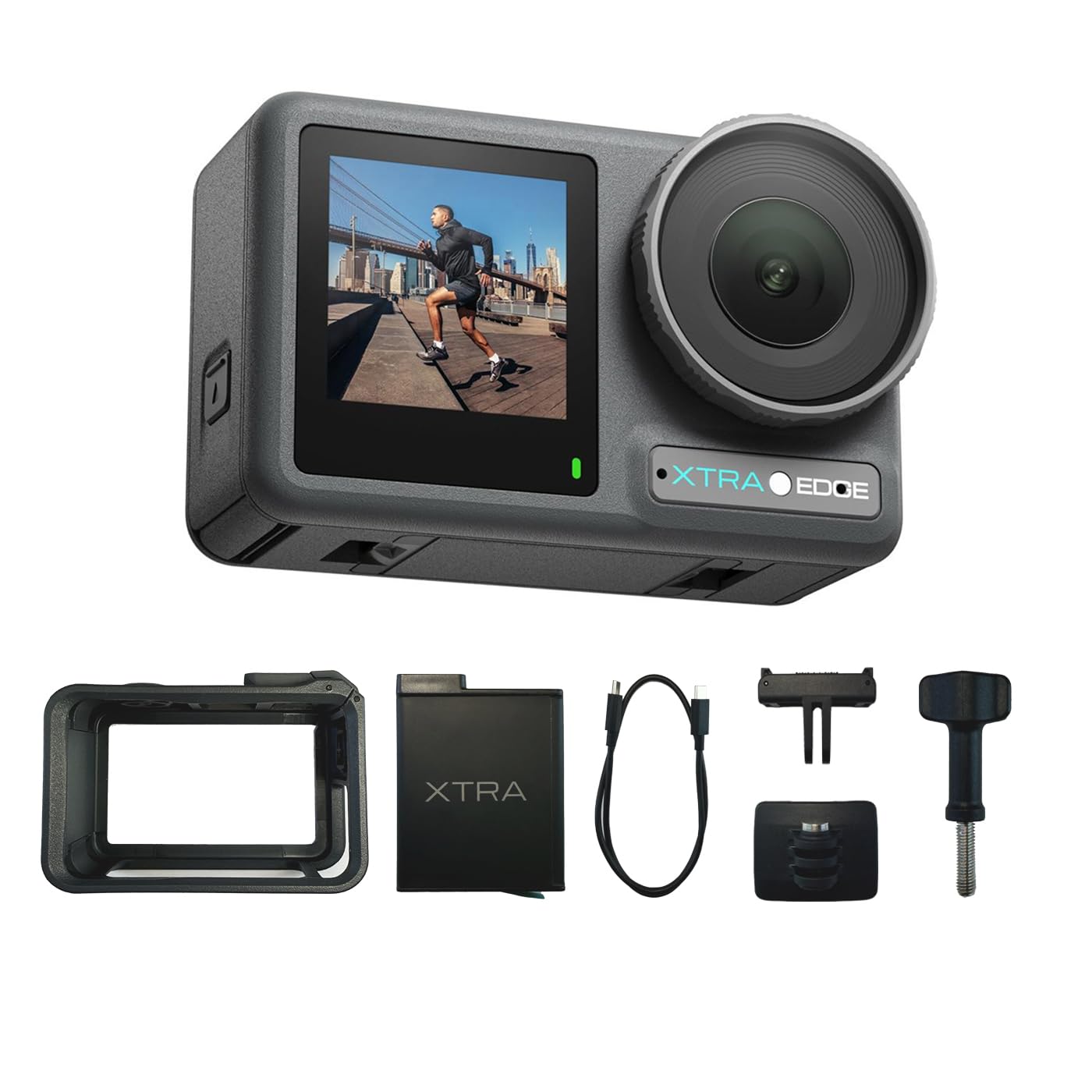
| Xtra Edge Action CameraTop Performer | Budget-conscious trail riders | Hyper Stabilization | ~3 hours | 52 ft | Amazon |
| GoPro MAX | 360° creative shots & vloggers | 360 + HERO stabilization | 1+ hour | 16 ft (without housing) | Amazon |
| Insta360 GO 3S Cycling POV Bundle | Ultra-light POV & helmet mounts | FlowState + Horizon Lock | 140 min (Action Pod) | 10m (IPX8) / 60m with Dive Case | Amazon |
| AKASO EK7000 4K30fps | Entry-level budget bundle | Standard EIS | ~2 games of 4K recording | 131 ft (with waterproof case) | Amazon |
| Z10 4K Action Camera | Ultra-compact & simple recording | No stabilization mentioned | ~hours (depends on usage) | With waterproof case | Amazon |
In‑Depth Reviews
1. DJI Osmo Action 5 Pro Adventure Combo
Our pick — over 4.5★ from 900+ verified ratings; the strongest balance of quality and price.
The camera that keeps your horizon straight even when you don’t.
DJI’s 1/1.3-inch sensor really shines in low light, so dawn commutes and evening trail rides come out clear rather than a grainy mess. That sensor pairs with 2.4 µm large pixels and a 13.5-stop dynamic range (the camera’s ability to keep both bright sky and dark shadows visible in the same frame), meaning you do not lose detail in shadows or overexpose the sky. For the spec-focused: it shoots 4K/120fps and captures 40 MP stills — the effective still resolution is 40 MP, which is double the 20 MP of the AKASO, giving you noticeably more detail for cropping or printing.
The headline here is 360° HorizonSteady stabilization — it removes roll-axis shakes completely, so even if your bike hits a rut, the footage stays level. DJI claims up to 4 hours of recording per battery on the 1950mAh pack, and this Adventure Combo includes three batteries plus a charging case, giving you well over 12 hours of total recording for all-day touring. It is also IP68 rated, meaning it works underwater to 20 meters without any extra housing. Buyers report using it as a motorcycle dashcam: one owner noted a “MotoRadds chin mount for dashcam use,” praising the one-button record and rain survival.
The main trade-off is that the 2x digital zoom is half what the AKASO offers, so you cannot pull distant subjects as close without losing quality. Also, the camera generates heat after a few minutes of 4K recording — several reviewers mentioned this — but no one reported it overheating to the point of shutdown.
What Stands Out
- 360° HorizonSteady eliminates roll-axis shake for level footage on any terrain
- 40 MP still resolution — 2x the detail of the AKASO EK7000
- Three 1950mAh batteries with charging case for all-day power
The Catch
- Digital zoom is only 2x — half the reach of budget competitors
- Runs warm after extended 4K recording
Reach for this if: you need a camera that works from dawn to dusk in any weather, with rock-solid stabilization that makes your ride footage look gimbal-mounted.
Look elsewhere if: zoom range matters more to you than stabilization and battery life — the AKASO gives you 4x digital zoom at a lower price.
2. Xtra Edge Action Camera
A big sensor in a compact body that outperforms pricier rivals.
The Xtra Edge matches the DJI’s 1/1.3-inch sensor size at a significantly lower cost, giving you vibrant 4K cinematic video and solid low-light performance without the premium price tag. Its Hyper Stabilization keeps trail and road riding footage smooth, and reviewers specifically call out that the stabilization handles “walking/cycling” with buttery results — one reviewer noted “excellent stabilization for walking/cycling.” It is waterproof to 52 feet without a housing, so you can spray it off after a muddy ride without worry.
Battery life averages around 3 hours (one buyer mentioned “~2.5-3hr battery”), which is enough for most recreational rides. The universal quick mount with a magnetic lock lets you switch from horizontal to vertical shooting in seconds, a feature the budget Z10 cannot match. It comes with a dual-facing mount adapter and a cold-resistant battery in the standard bundle, though some owners mention that night footage is dim and recharging is slow.
The Core Strengths
- 1/1.3-inch sensor delivers vibrant color and detail similar to the DJI
- Hyper Stabilization keeps cycling footage smooth on rough terrain
- Waterproof to 52 ft without a housing
The Limits
- Night footage is dim — not ideal for after-dark rides
- Slow recharge time between rides
This pick fits: the rider who wants DJI-level image quality and stabilization without spending premium money, especially for daylight trail and road use.
skip it if: you regularly ride after sunset or need fast battery turnaround on long tours — the DJI’s three-battery system is better.
3. GoPro MAX

Shoot everything, frame it later — the ultimate freedom for bike content.
The GoPro MAX captures 5.6K30 spherical video, meaning it records everything around you in 360 degrees. Its 360° video lets you mount it on a pole that vanishes from the shot, enabling drone-like selfie footage without a second person. The GoPro Quik app lets you reframe that spherical footage after the ride, picking any angle you want — including object tracking that follows your bike automatically. It also works in standard HERO mode for 1080p or 1440p video when you want a traditional single-lens shot.
That said, the battery life is shorter at just over an hour, and reviewers warn that the lenses scratch easily, causing visible distortion in footage. It is waterproof only to 16 ft without housing, so heavy rain is a risk. Customers note the stabilization is excellent for vivid colors, but the 360° feature may not capture the rider’s direct forward view — it captures everything, not just where you are looking. One owner reported that the camera is “very similar to the previous model,” meaning the hardware is mature but not bleeding-edge.
Why It Stands Out
- 5.6K30 360° video lets you choose the angle after the ride
- Stealth mount makes extension poles vanish from the shot
- Versatile: works as both 360 and standard HERO camera
The Drawbacks
- Lenses scratch easily, causing distortion — handle with care
- Battery lasts only about one hour of recording
Best suited for: the creative rider who wants to reframe footage after the ride and create unique angles that a fixed-lens camera cannot deliver.
Not for you if: you need a long battery for all-day tours or want the sharpest forward-facing image — a single-lens camera like the DJI is sharper in that direction.
4. Insta360 GO 3S Cycling POV Bundle
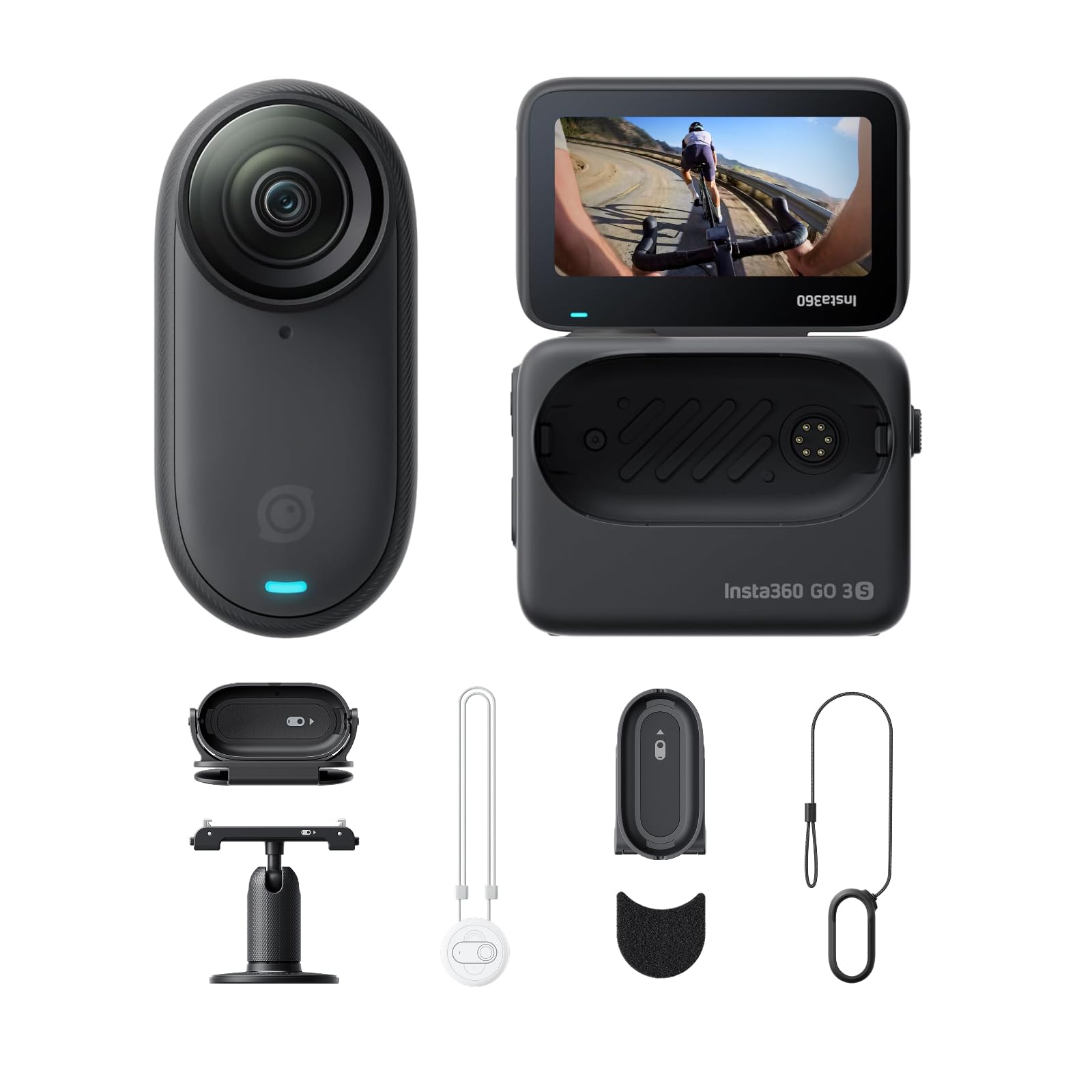
At 39 grams you forget it is there until you see the footage.
The Insta360 GO 3S weighs just 1.4 ounces (39 grams) and is thumb-sized, so it mounts almost anywhere without adding noticeable weight to your helmet or handlebars. It captures 4K hands-free POV video using a new wide-angle lens with MegaView FOV (field of view that gives you an ultra-wide shot with less distortion). The Action Pod — a 2.2-inch flip-screen that serves as both remote control and battery pack — gives you a 140-minute battery life total. Reviewers point out it fits most helmets (modular, off-road, street) and is “great for quick track laps or rides,” though the battery on the pod does not last long by itself.
FlowState Stabilization with Horizon Lock keeps footage smooth and level regardless of how you mount it, and the magnetic design lets you attach it to metal surfaces or use included accessories for helmet/chest/handlebar placement. The camera itself is IPX8 waterproof (10m), and the Action Pod is IPX4 splash-resistant. The catch: it runs hot during extended 4K recording and may shut down — one experienced reviewer recommends switching to 2.7K for long sessions. Low-light footage is also grainy with motion blur, so it is best for daytime rides only.
The Magic
- Ultra-light 39g body, mountable almost anywhere on a bike or helmet
- FlowState + Horizon Lock gives gimbal-like stabilization in a tiny package
- Magnetic Action Pod with 2.2″ flip screen for control and preview
The Catch
- Overheating and shutdown risk during long 4K recording sessions
- Grainy low-light footage with motion blur — daytime camera only
The right pick for: the minimalist who wants the lightest possible setup for short rides, POV clips, and creative angles that no other camera can reach.
Pass if: you need all-day recording, low-light capability, or a camera that can handle continuous 4K without overheating — the DJI is more reliable for long sessions.
5. AKASO EK7000 4K30fps Action Camera
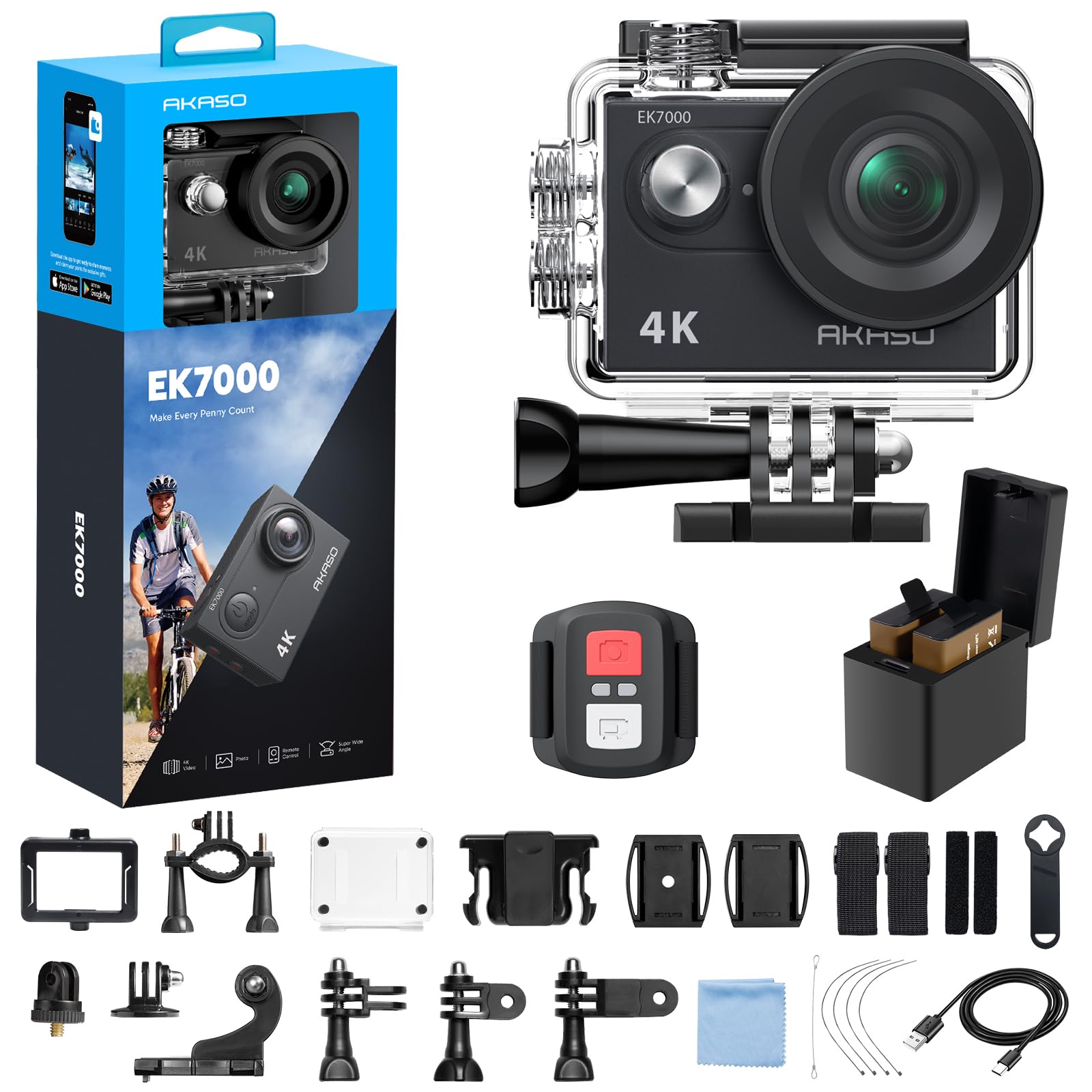
A full accessory bundle that costs less than a mid-range camera alone.
The AKASO EK7000 shoots 4K at 30fps and 20 MP stills, and its 4x digital zoom is double the DJI’s 2x — useful for getting closer to wildlife or road signs on long rides. It comes with a wireless wrist remote (2.4G) so you can start/stop recording without reaching for the camera on your helmet or handlebars. Buyers consistently call it an “excellent budget 4K action camera bundle,” noting that it includes a huge accessory kit — some even mention receiving a 256GB U3 card in the box, which is plenty of storage for a season of rides.
Stabilization is standard EIS (electronic image stabilization), which handles moderate road vibration but will not match the 360° HorizonSteady or FlowState systems on rougher terrain. It is waterproof to 131 feet with the included case, so it is safe for rain and puddles. The trade-off is that the Wi-Fi app (AKASO GO) can be unreliable for accessing files — reviewers recommend using a card reader instead, which is a minor workflow extra. Also, one customer observed the on/off light is hard to see in bright sun, which matters when helmet-mounted.
What You Get for the Money
- 4x digital zoom — 2x more reach than the DJI Action 5 Pro
- Wireless wrist remote for easy recording on the bike
- Full accessory kit often includes a large-capacity SD card
The Trade-Offs
- Standard EIS cannot match premium stabilization on rough trails
- Wi-Fi app is finicky; card reader is a more reliable transfer method
Grab this if: you are new to bike cameras and want a low-risk entry with every accessory you could need, plus stronger zoom than the premium picks.
pass on it if: you ride aggressive mountain bike trails where stabilization matters more than zoom — the Xtra Edge or DJI will give you much smoother footage.
6. Z10 4K Action Camera
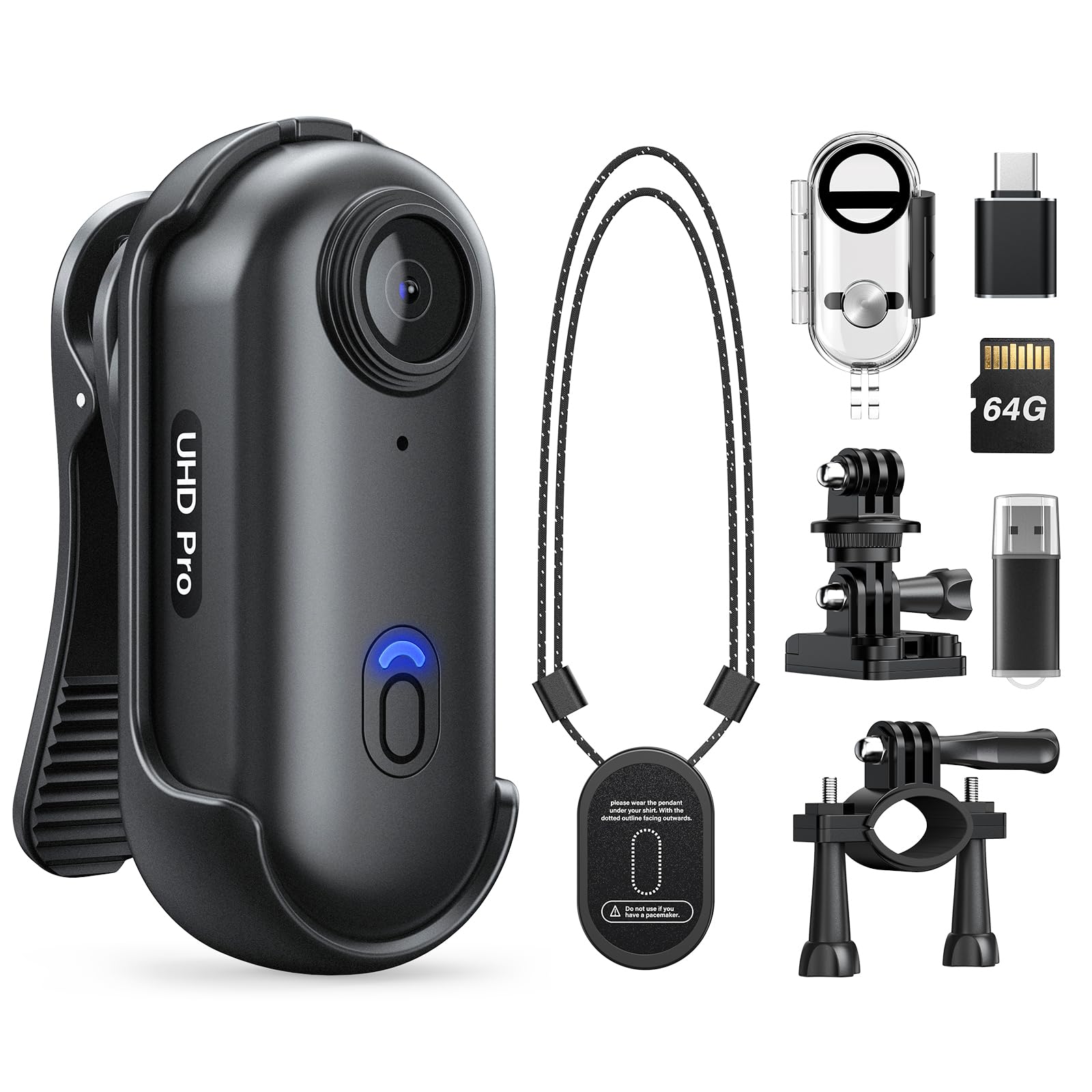
The no-Wi-Fi, no-fuss body cam that just records.
At 49 grams with 128GB of built-in flash storage, the Z10 is the simplest camera in this roundup: press one big button to start recording, press again to stop, and the footage saves as 5-minute MP4 clips. There is no Wi-Fi, no Bluetooth, no app to configure — you plug it into a computer via USB to get your files. The magnetic clip and quick-mount bracket let you attach it to your helmet or handlebars in seconds, and the large button is easy to press with gloves on. Some shoppers say the footage is actually 3840×2160 Ultra HD at 30fps, not the “2K” advertised on the box, which is a pleasant surprise.
The catch is durability. One verified buyer wrote: “This thing lasted less than 6 months,” and another reported that SD cards (when used) become stuck inside the housing. Stabilization is absent, so footage from bumpy trails will be shaky — the camera is better suited for smooth pavement or stationary mounting. The waterproof case protects it from rain, but the fisheye effect on the wide-angle lens is noticeable. For the price, you get a complete kit with many mounts and a strong magnetic necklace, but reliability is a real question mark.
The Simple Appeal
- One-button recording with no app, Wi-Fi, or setup required
- Ultra-light 49g design with magnetic clip for helmet/handlebar mounting
- 128GB built-in storage — no separate SD card needed
The Real Risks
- Buyers report units failing within 6 months of use
- No stabilization, so footage on uneven terrain will be shaky
Use it for: short, simple recordings on smooth roads where you do not want to mess with a phone app or Wi-Fi transfer — just press and go.
Avoid if: you need reliable gear that lasts more than a season, or you ride rough terrain that demands stabilization — invest in the AKASO bundle instead for similar money and better reliability.
Understanding the Specs
Stabilization Systems
This is the single most important spec for bike footage. Electronic Image Stabilization (EIS) uses software to smooth out vibration, while branded systems like DJI’s 360° HorizonSteady, Insta360’s FlowState, and GoPro’s HyperSmooth use advanced algorithms to keep the horizon level even when the camera tilts. For cycling, look for “horizon lock” or “360° roll-axis” features — these handle the worst handlebar chatter.
Waterproof Depth Ratings
IPX8 means the camera can sit in water up to a certain depth without damage, while “waterproof with case” means you need the included plastic housing to go underwater. For bike use, IPX8 or IP68 (like the DJI at 20m) is best because you can ride in heavy rain without extra gear. A camera that needs a case to be waterproof is fine for occasional puddles but extra hassle for daily commuting in wet weather.
Battery Life in Real Recording Time
Manufacturers often quote battery life at lower resolutions or with Wi-Fi off. The real-world number you want is at the same resolution you plan to shoot (typically 4K30). A camera that claims “up to 4 hours” may get 2.5 hours in practice with stabilization and Wi-Fi on. The best advice is to check the number of batteries included — a bundle with three batteries (like the DJI Adventure Combo) is far more practical for long rides than a single battery camera.
Effective Still Resolution vs Video Resolution
Effective still resolution (measured in megapixels, or MP) tells you the photo quality when you grab a frame as a still image. The DJI’s 40 MP is excellent for wall prints or cropping. Video resolution (like 4K or 5.6K) tells you the sharpness of the moving footage. For bike cameras, video resolution matters more than still resolution since you are recording motion, but a higher still resolution helps when you want to extract a photo from your video.
FAQ
What is the best mounting position for a bike camera?
Is 4K 30fps enough for bike riding video?
Can I use a GoPro without a waterproof housing for bike riding?
How long does a typical bike camera battery last?
Does image stabilization really matter for road cycling?
Can I use a GoPro MAX as a regular forward-facing camera?
What does the IPX8 waterproof rating mean for my bike camera?
How much storage do I need for a full day of riding?
Is a 360 camera better than a traditional camera for cycling?
Can I use my bike camera as a dashcam for safety?
Final Thoughts: The Verdict
For most riders, the camera for bike riding winner is the DJI Osmo Action 5 Pro Adventure Combo because its 360° HorizonSteady stabilization, three-battery system, and waterproof design make it the one camera that works for every ride from commuting to touring. If you want ultra-light and creative mounting angles, grab the Insta360 GO 3S Cycling POV Bundle. And for a budget-friendly entry with a full accessory kit, the standout is the AKASO EK7000 4K30fps.
How We Picked
We do not accept paid placement. Every pick is matched to a real buyer and a real use-case; we do not hands-on test units.
Sources & Methodology
Specifications: manufacturer listings and product documentation. Review insights: verified customer reviews, as of July 2026. Pricing: not shown on this page (it changes often); check the current price via the retailer link.
As an Amazon Associate, Trending Car earns from qualifying purchases. This does not affect which products we feature.