
Our readers keep the lights on and my garage snacks stocked. As an Amazon Associate, I earn from qualifying purchases.
Specs are compiled from manufacturer listings and verified buyer reviews and can change over time — please confirm the key details on the product page before buying.
If your starter cranks slow, your inverter cuts out, or your accessories flicker, the problem is often thin, corroded wires—not the battery. The wrong battery terminal wires waste power as heat, leaving you stranded or underpowered. This guide cuts through spec-sheet confusion to find cables that deliver full current to your car, truck, RV, or solar setup.
I’m Min Islam — the founder and writer behind Trending Car. This guide is built by comparing the manufacturers’ published specifications and the patterns across verified customer reviews, so you get each pick’s real strengths and trade-offs instead of marketing spin.
You will find a focused look at the best battery terminal wires for a range of real-world uses, from heavy-duty diesel ground fixes to clean accessory additions on daily drivers.
Quick Picks
- Vgate 8-Way Lead Acid Battery Terminal Connector — Pro-Grade Hub
- DLronwey Battery Terminal Connectors — Full Rebuild Kit
- Shirbly 1/0 AWG Flexible Battery Cable — Ground Fix Specialist
- A ABIGAIL 4 AWG Battery Cable (4FT) — Long-Reach Inverter Pair
- ECO-WORTHY 2AWG Battery Cable — Compact RV Value
- A ABIGAIL 2 AWG Battery Cable 2Gauge Pure Copper — Tractor & Series Link
- TOPDC 4 AWG Battery Cable 24-Inch Set — Essentials Set
How To Choose The Best Battery Terminal Wires
The right battery terminal wire delivers full current to your starter, inverter, or winch without overheating. Here are the three specs that separate a permanent fix from a future headache.
Wire Gauge: The Thickness That Carries Your Load
Lower gauge numbers mean thicker wire and higher current capacity. A 4 AWG wire works for most car batteries and small inverters, while 2 AWG handles bigger loads like RVs and marine engines. For serious setups—large inverters or diesel trucks—1/0 AWG (pronounced “one-aught”) is the standard because it can manage over 300 amps without significant voltage drop. If you undersize the gauge, the wire heats up and your equipment starves for power.
Conductor Material: Pure Copper vs. Tinned Copper
Pure copper (OFC or oxygen-free copper) gives the best conductivity. Tinned copper has a thin tin coating that resists corrosion from salt, moisture, and battery acid better than bare copper—making it the smarter pick for marine use or vehicles driven in wet climates. Some budget cables use copper-clad aluminum (CCA), which carries less current for the same gauge and is worth avoiding for high-draw applications.
Terminal Type and Included Hardware
A pre-crimped cable with ring terminals (usually 3/8-inch or 5/16-inch lugs) saves you the hassle of buying a crimping tool and doing it yourself. Look for sealed connections with heat shrink tubing at the ends to keep out moisture. For complete terminal replacement, some kits include the positive and negative posts, corrosion washers, and covers—everything you need beyond the bare wire.
Quick Comparison
| Model | Best For | Gauge | Material | Terminal Lug Size | Amazon |
|---|---|---|---|---|---|
| Vgate 8-Way Terminal Connector | Multi-accessory setups | Accepts 8 AWG to 4/0 AWG | Solid aluminum block | Multiple stud sizes | Amazon |
| DLronwey Military Spec Kit | Full terminal rebuild | 2 AWG | Alloy terminals + copper lugs | 3/8 inch | Amazon |
| 1/0 AWG Flexible Cable (Shirbly) | High-current ground fix | 1/0 AWG | OFC pure copper | 3/8 inch | Amazon |
| 4 AWG A ABIGAIL (4FT) | Long-run inverter wiring | 4 AWG | Pure copper + tinned lugs | 3/8 inch | Amazon |
| ECO-WORTHY 2AWG | Budget RV cable pair | 2 AWG | Tinned copper | 5/16 inch | Amazon |
| A ABIGAIL 2 AWG (1FT) | Series battery connections | 2 AWG | Pure copper | 5/16 inch | Amazon |
| TOPDC 4 AWG (24IN) | Simple car battery extender | 4 AWG | Pure copper | 3/8 inch | Amazon |
In‑Depth Reviews
1. Vgate 8-Way Lead Acid Battery Terminal Connector

The block that turns one battery post into eight clean, organized connection points.
You can connect a winch, an alternator charger, an amplifier, and your main starter cable all from one post without a tangled mess. The Vgate terminal does this with a solid aluminum block that has 4 hole-holders and 4 threaded studs. It works with lead acid battery types including AGM (Absorbent Glass Mat) and GEL, and supports systems from 6 volts up to 48 volts.
Buyers report that after installing it on a Chevy Duramax 3500, the stereo sound noticeably improved compared to the old chassis ground—a sign that the solid aluminum block is delivering cleaner, more stable power. One reviewer on a 2005 Dodge Ram 2500 with a Cummins diesel noted it fit their dual-battery setup well, needing only a small spacer on the negative side. The included plastic insulator on the back prevents accidental shorts against body metal.
This is overkill if you only need to replace one short cable. But if you have an aftermarket accessory habit—lights, compressor, stereo, winch—this hub replaces a spaghetti nightmare with a single, serviceable block.
What makes it a hub
- Eight connection points handle multiple accessories without stacking ring terminals.
- Sturdy machined aluminum locks onto the battery post and stays tight.
- Supports a wide voltage range (6V to 48V) for almost any lead-acid system.
The trade-off
- Requires a separate wire purchase—this is only the terminal block, not a cable set.
- May need a small spacer for proper fit on certain battery posts, as some buyers found.
Who should grab it: Anyone with multiple aftermarket accessories—winch, lights, stereo, compressor—who wants a single, solid connection point at the battery.
skip it if: You just need a simple replacement cable for a stock battery; the Vgate adds complexity and cost that a basic pre-crimped wire handles more directly.
2. DLronwey Battery Terminal Connectors, Military Spec Kit
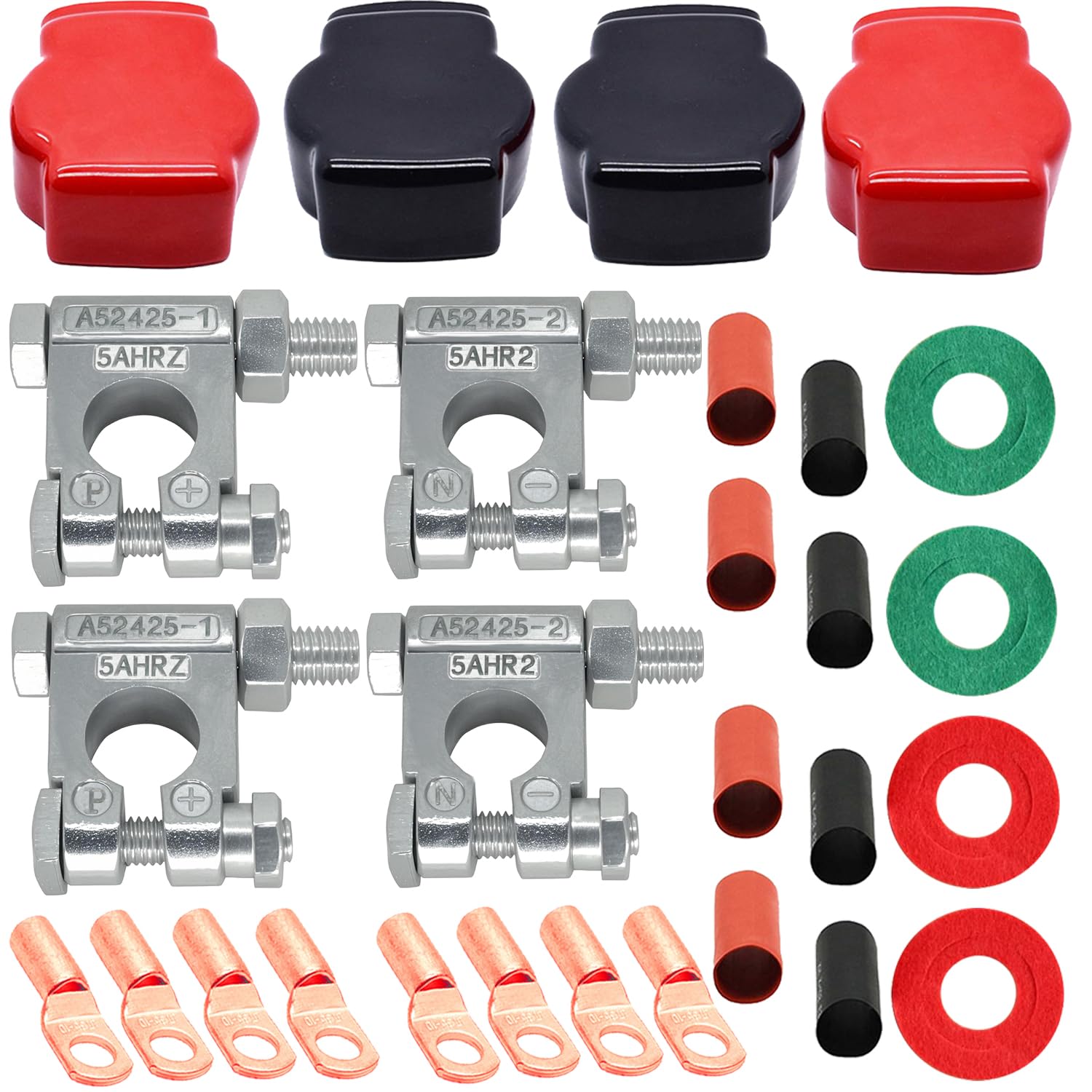
Everything you need to replace both battery terminals including the cables, lugs, and covers in one box.
When your factory battery cable ends fail, this military-spec kit gives you the parts to re-terminate both positive and negative sides without running to the hardware store for extras. The set includes 4 heavy duty battery terminals (alloy material for good conductivity), 4 battery terminal covers, 4 anti-corrosion gaskets, 8 pieces of heat shrink tubing, and 8 pieces of No. 2 3/8 inch copper lugs—all packed in a storage case.
One reviewer noted the kit saved labor and money on a 2006 Dodge Ram 3500, requiring only a slight trim to existing cables to avoid pulling the starter and ground wires. The terminals are clearly labeled positive and negative, and the red and black covers add both visual clarity and waterproofing. Compared to the Vgate hub above, this DLronwey kit is the complete terminal replacement package—you get the wire lugs and heat shrink, whereas the Vgate is purely the block.
The catch is that you will need a heavy-duty terminal crimping tool to attach your old cables to the new connectors. The kit includes the lugs but not the tool, so factor that in if your tool drawer is light.
Everything included
- Complete set: terminals, covers, anti-corrosion washers, lugs (8 pieces of No. 2 3/8 inch), and heat shrink.
- Storage case keeps the unused parts organized for future use.
- One year quality guarantee with 24-hour response time on issues.
Plan ahead
- Does not include a crimping tool—you must buy or borrow one to attach your existing cables.
- The copper lugs are specifically sized for 2 AWG wire only, not other gauges.
Best for: DIYers who want to replace the factory terminal ends entirely and need a complete parts bundle to do it correctly in one sitting.
Look elsewhere if: You just need a simple pre-crimped cable and do not want to crimp anything yourself—choose a ready-made wire pair instead.
3. Shirbly 1/0 AWG Flexible Battery Cable with 3/8″ Terminals
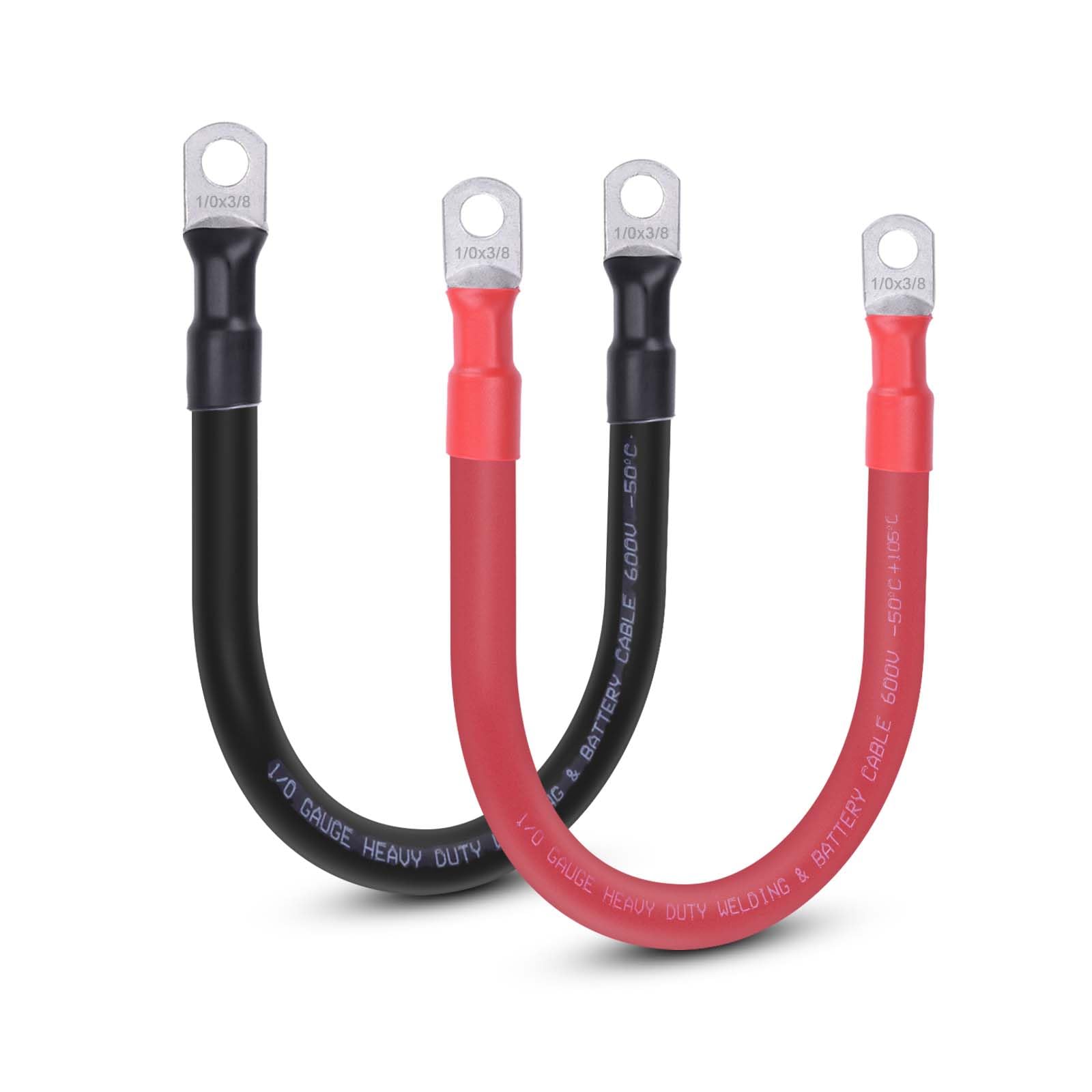
The heavy-gauge fix that resolved one buyer’s major Camaro ground issue in minutes.
This is a 1/0 AWG cable—noticeably thicker than the 2 AWG wires elsewhere in this list. It is built from OFC (oxygen-free copper) with 1703 strands of 0.2mm wire, making it far more flexible than a typical battery cable of this thickness. The EPDM rubber insulation handles temperatures from -58°F to +221°F and is resistant to solvents and fire, so it survives under-hood abuse year-round.
One buyer mentioned that this cable “FIXED A MAJOR NEGATIVE GROUND ISSUE ON MY CAMARO,” attributing the fix to the low resistance of the pure copper conductor. The 3/8-inch lugs are pre-crimped and covered with 3:1 dual-wall adhesive heat shrink—thicker than standard 2:1 shrink tubing—which seals out moisture and acid. Unlike the A ABIGAIL 2 AWG set that comes as a pair, this Shirbly cable is a single wire (one foot black plus one foot red sold together, but each is individual), so think about if you need a positive and negative pair or just one heavy ground cable.
For the Vgate terminal block user who needs a single, extremely high-capacity cable to connect their block to the starter, this 1/0 AWG wire is the partner piece. The downside is that the extreme thickness reduces flexibility—it is manageable but not as bendable as a 4 AWG cable around tight corners.
Built for big current
- 1/0 AWG OFC pure copper handles very high amperage without voltage drop.
- 1703 fine strands make this cable more flexible than typical 1/0 AWG.
- EPDM rubber jacket resists extreme temperatures (-58°F to +221°F) and solvents.
Consider this
- Sold as individual wires (black and red each 1 foot) rather than a complete positive/negative set.
- The large 1/0 AWG diameter is stiff in tight engine bay spaces despite the flexible stranding.
Reach for this if: You need a heavy-duty ground cable for a big-block engine or to connect a high-power inverter—this gauge delivers where thinner wires fail.
Look elsewhere if: You expect a ready-to-bolt-in positive-and-negative pair; this is a single cable and you will need to buy two for a full battery circuit.
4. A ABIGAIL 4 AWG Battery Cable (4FT)
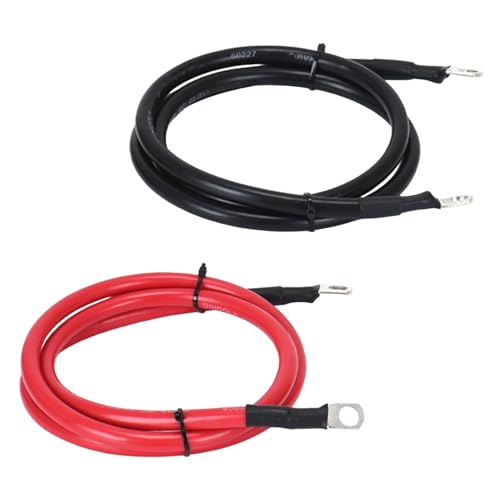
The longer 4-foot reach that makes routing to your inverter or second battery straightforward.
Most short battery cables top out at 12 to 24 inches, which often is not enough to reach from a battery to a nearby inverter or an auxiliary battery tray. This A ABIGAIL cable set gives you a full 4 feet of positive (red) and 4 feet of negative (black) 4 AWG pure copper wire with pre-crimped 3/8-inch ring terminals at both ends. The maximum current rating is 85 amps, which suits most mid-sized inverters and accessory fuse blocks.
The tinned copper lugs resist corrosion better than bare copper—important if the cable runs along the chassis where road salt and moisture collect. In terms of gauge, this is the same 4 AWG thickness as the TOPDC pick at the bottom of this list, but the 4-foot length makes it a different tool for a different job. The shorter TOPDC is a direct battery extension, while this longer pair is meant for installations where the battery and load are spaced apart.
Owners mention the wire works well for dual-battery setups in trucks and solar battery banks, a sign that the 85-amp rating is realistic for these applications. The trade-off is that 4 AWG is not enough for a large inverter over 1000 watts at this length—you would need to step up to 2 AWG or 1/0 AWG for that draw.
Why the extra length helps
- 4-foot positive and negative cables reach from battery to inverter or second battery with slack to spare.
- Tinned copper lugs fight corrosion better than bare copper in exposed chassis runs.
- Flexible PVC insulation makes routing around frame rails simpler.
Know the limit
- 85-amp max current is enough for mid-size inverters but not for large RV inverters or high-power winch setups.
- 4 AWG diameter means a measurable voltage drop over the full 4-foot length at high loads.
Good for: Running power from a battery to a midsize inverter or a second battery bank where the distance between them is around 3 to 4 feet.
Not for: High-amperage setups over 85 amps—move to 2 AWG or 1/0 AWG for those loads.
5. ECO-WORTHY 2AWG Battery Cable with 5/16” Lug Terminals

A well-priced 2 AWG pair with a high temperature range for engine-bay confidence.
This ECO-WORTHY set gives you one 2 AWG positive (red) and one 2 AWG negative (black) cable at 12 inches each, with 5/16-inch nickel-plated lugs. The 2 AWG gauge is noticeably thicker than the 4 AWG wires above, and the tinned copper construction provides better corrosion resistance for marine or high-moisture environments. The maximum operating current is 150 amps, and the temperature range spans from -76°F to +392°F—surviving both freezing winters and the heat radiating off a running engine block.
The 5/16-inch lugs suit common battery terminal bolts and starter studs. In the comparison table, this ECO-WORTHY cable uses 5/16-inch lugs while the DLronwey kit uses 3/8-inch lugs, so if you are replacing terminal ends with aftermarket hardware, check which size your setup requires. Buyers consistently note the wire is well-made for the price, with no reports of premature corrosion or poor crimps.
The catch is that at 12 inches, these are short—perfect for linking batteries in a parallel bank or replacing a battery-to-starter cable on a compact engine, but not long enough to reach across an engine bay to an inverter or fuse block.
Solid mid-range pair
- 2 AWG tinned copper handles up to 150 amps with minimal heat buildup.
- Extreme temperature tolerance (-76°F to +392°F) works in engine bays or solar setups.
- Nickel-plated 5/16-inch lugs resist corrosion and hold a tight connection.
Short length limits use
- 12 inches is too short for routing from battery to a distant inverter or second battery.
- 5/16-inch lugs may not fit all aftermarket terminal blocks—some use 3/8-inch or metric studs.
Reach for this if: You need a short, high-current 2 AWG bridge between two batteries in a series bank or from battery to a nearby starter.
Look elsewhere if: Your installation requires longer cable runs to reach an inverter or fuse panel across the vehicle.
6. A ABIGAIL 2 AWG Battery Cable 2Gauge Pure Copper (1FT)

The 2 AWG set that one buyer used to replace 60-year-old cables on a tractor with series-wired batteries.
This A ABIGAIL set includes one positive and one negative 2 AWG cable, each 12 inches long, with 5/16-inch ring terminals at both ends. The pure copper conductor provides a good balance of current capacity (rated at 95 amps) and flexibility. Customers note it works perfectly for replacing old cables on a tractor with batteries wired in series, calling the build quality solid.
Another reviewer used it to install an inline switch on a car battery, noting that the cable felt heavy-duty. The PVC insulation resists abrasion and moisture, and the ends are sealed with heat shrink tubing to keep out battery acid. Compared to the ECO-WORTHY 2 AWG pair above, this A ABIGAIL cable is also 2 AWG with 5/16-inch lugs and a similar use case. Where they differ: the ECO-WORTHY is tinned copper (better against corrosion), while this is pure copper (max conductivity). If you drive in wet or salty conditions, the tinned option edges ahead.
The 2 AWG gauge is a solid choice for most car, truck, and RV applications, but at 95 amps it trails behind the 150-amp rating of the ECO-WORTHY tinned cable—so for a high-draw inverter or winch, consider moving up to 1/0 AWG.
Solid series-link cable
- Pure copper conductors boost conductivity for efficient power transfer.
- Positive (red) and negative (black) pair ready to bolt on.
- Heat shrink sealed ends keep out moisture and acid.
Capacity ceiling
- 95 amp max current is lower than many 2 AWG cables; not ideal for high-draw setups.
- Pure copper (not tinned) may corrode faster in wet or coastal environments.
Best for: Linking two batteries in series or parallel on a tractor, boat, or camper where the current draw stays under 95 amps.
pass on it if: You need the corrosion resistance of tinned copper for a marine or salt-belt vehicle, or if your load exceeds 95 amps.
7. TOPDC 4 AWG Battery Cable 24-Inch Set

The 24-inch pure copper cable that one buyer used to extend battery cables on a 2007 Pontiac Grand Prix.
This TOPDC cable is a single 4 AWG pure copper wire measuring 24 inches (2 feet) with 3/8-inch ring terminals pre-crimped at both ends. The 24-inch length is a balance for many under-hood repairs: long enough to reach from the battery to a nearby ground point or to extend an existing cable that has corroded ends, but short enough to keep voltage drop minimal. The insulation is flexible PVC with heat shrink sealing the ends, offering good abrasion and moisture resistance.
Reviewers point out the cable “worked great for extending battery cables on 2007 Pontiac Grand Prix,” confirming the 24-inch length is practical for a common DIY extension job. Another reviewer called the build quality durable with strong, reliable conductivity and no heat buildup. Compared to the 4-foot A ABIGAIL set above, this TOPDC is a full 24 inches shorter—it is meant as a close-proximity extension or replacement, not a long-distance run to an inverter.
The obvious limit: this is a single cable. You will need to buy two if you want to replace both the positive and negative cables on your vehicle. Also, 4 AWG is the thinnest gauge in this lineup, so for high-wattage inverters or winches, you would need to bump up to 2 AWG or 1/0 AWG.
Handy extension length
- 24 inches is a practical length for extending a corroded battery cable or reaching a nearby ground point.
- Pure copper conductor minimizes power loss in the circuit.
- Flexible PVC insulation with heat shrink ends seals against moisture.
Only one cable
- Sold as a single cable, not a positive/negative pair—buy two for a full replacement.
- 4 AWG is not thick enough for high-draw setups like large inverters or winches.
Good for: Replacing or extending a single battery cable on a car, truck, or boat where the distance is under 2 feet and the draw is moderate.
it’s not for you if: You need a positive and negative pair, or you need thicker gauge for a high-power application.
Understanding the Specs
Gauge (AWG) — How Thick Does It Need To Be?
American Wire Gauge (AWG) numbers tell you the wire’s thickness. The rule is simple: a smaller number means a thicker wire that can carry more current without overheating. 4 AWG (0.2043-inch diameter) handles up to roughly 85-95 amps typically, 2 AWG (0.2576-inch) handles up to 150 amps, and 1/0 AWG (0.3249-inch) can manage over 300 amps. Choosing the right gauge prevents your wires from turning into heaters under heavy load.
Ring Terminal Size — What Fits Your Battery Stud?
Ring terminals are measured by the inner hole diameter. The most common sizes on battery cables are 3/8 inch (M10 metric equivalent) and 5/16 inch (M8 metric equivalent). A 3/8-inch lug fits the standard battery terminal clamp bolt and many aftermarket terminal blocks. A 5/16-inch lug is slightly smaller and fits many OEM starter and ground studs. Always check the bolt size on your battery or accessory before buying—using the wrong size forces you to drill out or replace the lug.
FAQ
What gauge battery wire do I need for my car?
Can I use a 2 AWG cable where a 4 AWG is currently installed?
What is the difference between pure copper and tinned copper cable?
How long should my battery terminal wires be?
Is a 3/8-inch ring terminal the same as M10?
How do I know if my battery cable ends are bad?
Can I cut a pre-crimped cable shorter?
What does “military spec” mean on battery terminals?
Final Thoughts: The Verdict
For most owners, the best battery terminal wires choice is the 1/0 AWG Flexible Cable (Shirbly) because its pure copper construction and extreme temperature range fix ground issues and high-current drops that thinner wires cannot handle. If you want a complete terminal rebuild with all the hardware included, grab the DLronwey Military Spec Kit. And for simple short-run replacements and extensions on daily drivers, the TOPDC 4 AWG 24-Inch cable delivers a budget-friendly fix that one buyer already used to get a Pontiac Grand Prix back on the road.
How We Picked
We do not accept paid placement. Every pick is matched to a real buyer and a real use-case; we do not hands-on test units.
Sources & Methodology
Specifications: manufacturer listings and product documentation. Review insights: verified customer reviews, as of July 2026. Pricing: not shown on this page (it changes often); check the current price via the retailer link.
As an Amazon Associate, Trending Car earns from qualifying purchases. This does not affect which products we feature.