
Our readers keep the lights on and my garage snacks stocked. As an Amazon Associate, I earn from qualifying purchases.
Specs are compiled from manufacturer listings and verified buyer reviews and can change over time — please confirm the key details on the product page before buying.
Dead battery, stranded ride — that is the only outcome of picking the wrong battery chemistry or size. Flooded lead-acid, AGM (absorbed glass mat – a sealed fiberglass sponge that holds acid), and lightweight lithium each have a clear winner depending on your bike’s tray dimensions (group size code), your engine’s cold-start power requirement (Cold Cranking Amps, or CCA — how many amps the battery can push at 0°F for 30 seconds), and your budget. This guide pinpoints which battery cranks your specific bike, fits the tray, and lasts the season without costing a fortune.
I’m Min Islam — the founder and writer behind Trending Car. This guide is built by comparing the manufacturers’ published specifications and the patterns across verified customer reviews, so you get each pick’s real strengths and trade-offs instead of marketing spin.
For any cruiser, sport bike, ATV, or adventure tourer, the right battery for motorcycles matches its cold cranking amps, dimensions, and chemistry to your engine and climate — never the cheapest option on the shelf.
Quick Picks
- TYKOOL LFP14-BS-STD Lithium Battery — Top Performer
- Deka Power Sports ETX20L Battery — Big Cranker
- Yuasa YUAM327BS YTX7L-BS Maintenance Free AGM — OEM Match
- Anti-Gravity AG-ATZ-10-RS LITHIUM-ION Battery — Smart Lithium
- Weize YTX14 BS ATV Battery High Performance — Best Value
- Yuasa YUAM329BS YTX9-BS Maintenance Free AGM — Compact Power
- ExpertPower YTX12-BS AGM Motorcycle Battery — Budget Champion
How To Choose The Best Battery For Motorcycles
Choosing a battery for your motorcycle isn’t just about finding something that fits in the tray. The chemistry, cold cranking amps, and maintenance requirements determine whether your bike starts reliably on a cold morning or leaves you stranded after a month in storage.
Match the Battery Group Size and Terminal Polarity
The group size (like YTX14-BS or YTX9-BS) dictates the physical dimensions and terminal layout. A battery that is too tall won’t fit under the seat, and reversed polarity can fry your bike’s electronics. Always measure your old battery’s length, width, and height, and verify the positive terminal is on the left or right as required by your model.
Cold Cranking Amps (CCA) vs Your Engine Size
CCA (cold cranking amps) measures how much power a battery can deliver at 0°F for 30 seconds. A 600cc sport bike might start fine with 150 CCA, while a 1200cc twin needs at least 200 CCA to crank reliably in cold weather. Too little CCA means slow cranking and potential no-starts when temperatures drop.
Quick Comparison
| Model | Best For | Chemistry | CCA | Weight | Amazon |
|---|---|---|---|---|---|
| ExpertPower YTX12-BS | Budget Rider | AGM | — | — | Amazon |
| Weize YTX14-BS | Value AGM | AGM | 200 | 9.6 lbs | Amazon |
| Yuasa YTX7L-BS | OEM Replacement | Lead-Calcium AGM | — | 5.97 lbs | Amazon |
| Yuasa YTX9-BS | Compact AGM | AGM | — | 4 lbs | Amazon |
| TYKOOL LFP14-BS | Weight-Conscious Rider | Lithium (LiFePO4) | 400 | 3.31 lbs | Amazon |
| Deka ETX20L | High-Cranking ATV/Snowmobile | Sealed Lead Acid | 310 | — | Amazon |
| Anti-Gravity AG-ATZ-10-RS | Premium Lithium + Jump Start | Lithium | — | 2.6 lbs (1.18 kg) | Amazon |
In‑Depth Reviews
1. TYKOOL LFP14-BS-STD Lithium Battery
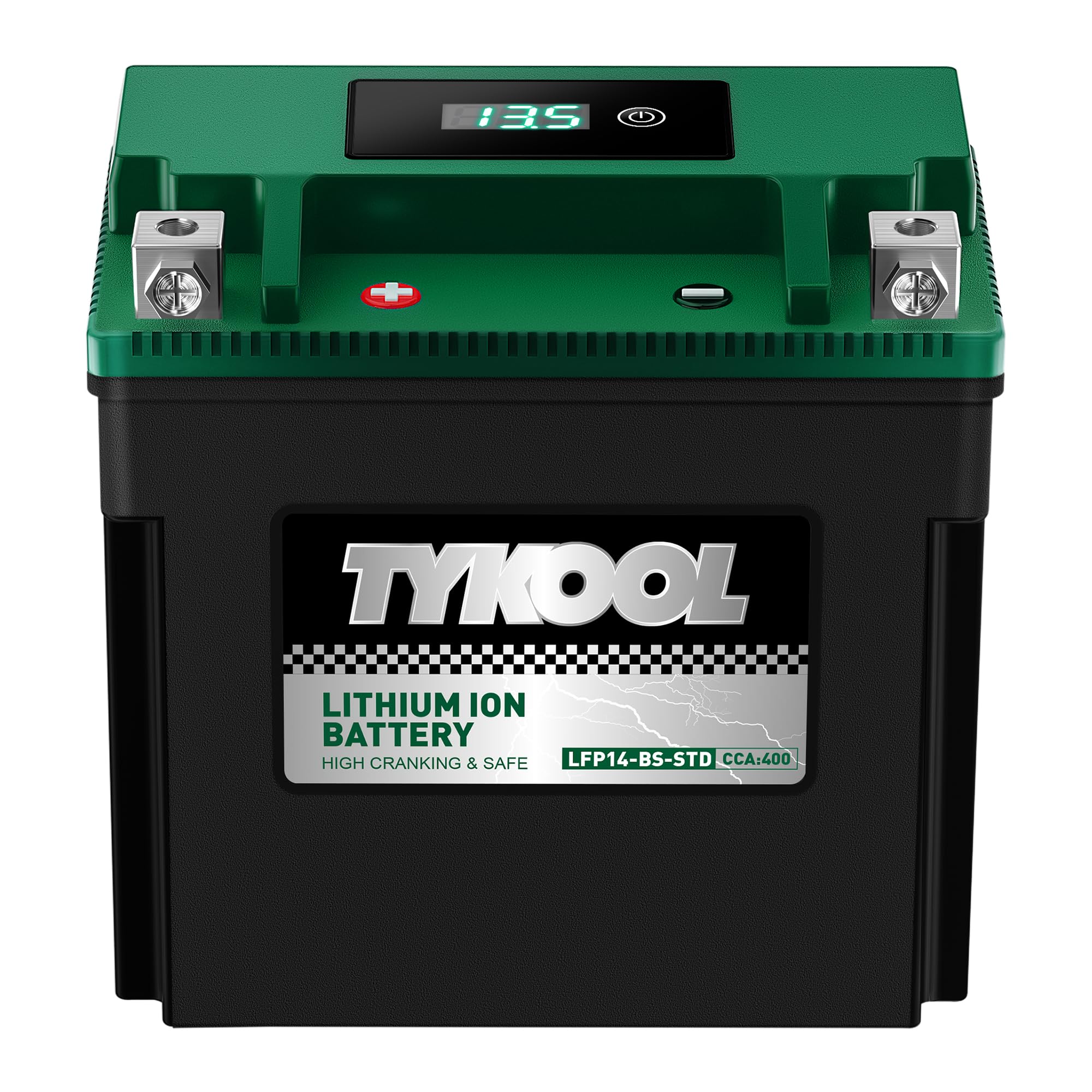
Drops nearly 8 lbs of weight while delivering 400 cold cranking amps for instant ignition — at 3.31 lbs versus the Weize YTX14-BS at 9.6 lbs.
The TYKOOL LFP14-BS is a lithium (LiFePO4) battery built for adventure riders who want to reduce weight at the top of the bike. At just 3.31 lbs, it weighs 3.31 lbs compared to the Weize YTX14-BS at 9.6 lbs. That weight savings lowers the bike’s center of gravity, making cornering and off-road handling feel more agile.
An integrated LCD voltage display lets you check the battery’s health at a touch, so you can monitor the electrical system while touring. Its IP66 waterproof casing (fully protected against powerful water jets) protects the cells during river crossings or heavy rain. The catch: you must confirm your bike’s charging system stays under 15.0V, because lithium cells need a stabilized voltage to avoid damage.
Major Upgrades
- 400 CCA cranks large engines easily in cold weather
- LCD voltage telemetry provides at-a-glance battery health checks
- Over 2500+ cycle life with Smart BMS (Battery Management System) protection that safeguards against overcharge and short circuits
- IP66 waterproof rating for all-weather touring
Important Limits
- Requires charging system output under 15.0V — check your regulator
- Must use dedicated LiFePO4 charger, not a pulse-repair charger
- One reviewer noted a complete failure after 2.5 weeks
Reach for it if: You want to drop weight, gain cranking power, and have the voltage monitoring to keep an eye on things during long tours.
Look elsewhere if: Your bike’s charging system is unregulated or you prefer the simpler, lower-cost AGM chemistry.
2. Deka Power Sports ETX20L Battery
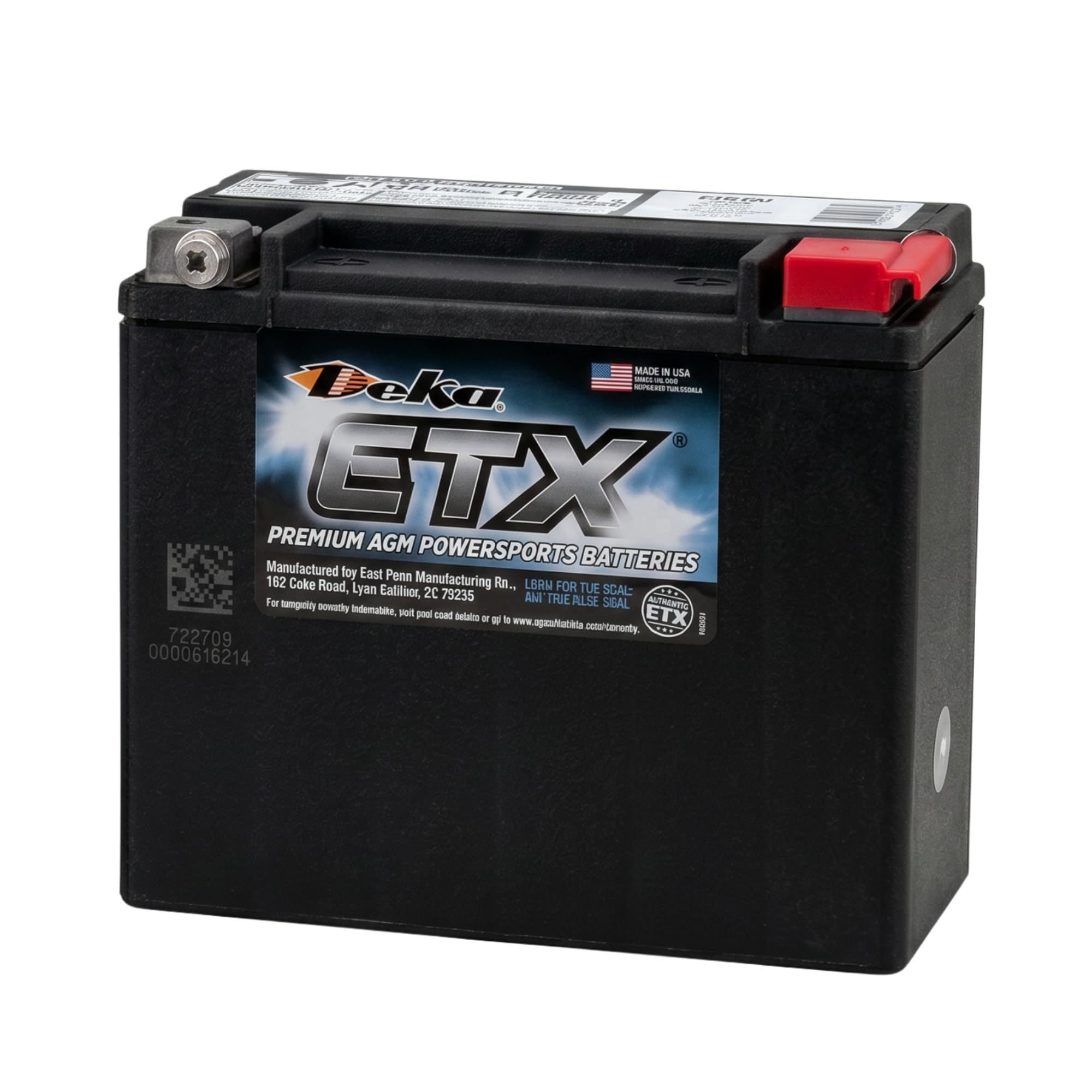
A sealed lead-acid brute with 310 CCA that replaces YTX20L-BS and fits big twins and jet skis — stronger cranking than the TYKOOL lithium (310 CCA vs 400 CCA) though heavier.
The Deka ETX20L is a straightforward, no-nonsense sealed battery for riders who need raw cranking power without lithium complexity. Those 310 CCA (cold cranking amps) matter for larger engines, cold starts, or vehicles with high parasitic draws like jet skis with stereo systems.
Ships fully charged and ready to install — no acid filling required. The 18Ah capacity (amp-hours — how long it delivers current, roughly 18 amps for one hour) supports long cranking sessions without voltage sag. Buyers report it fits 2000 Harley Fat Boys and 97 Sportsters correctly, and one buyer installed it in an airplane with a first-crank start. The trade-off is weight: as a sealed lead-acid unit, it is heavier than AGM or lithium options, so you will feel it on a sport bike where weight distribution matters.
Why It Works
- 310 cold cranking amps — strong starting power for large engines
- Sealed and leakproof, no maintenance or water checks
- Comes fully charged, install and ride immediately
Why It Might Not Fit
- Heavier than AGM or lithium alternatives — adds weight high on the bike
- Lead-acid chemistry has shorter lifespan than lithium with deep discharges
Ideal for: Large-displacement cruisers, ATVs, and jet skis that need high CCA and no-fuss installation.
Not for: Sport bike riders focused on weight reduction or anyone who wants a compact battery for a tight tray.
3. Yuasa YUAM327BS YTX7L-BS Maintenance Free AGM Battery

The same battery many Suzuki and Honda dealers install — one buyer mentioned theirs lasted 8 years on a Suzuki.
The Yuasa YTX7L-BS is a bottle-supplied AGM battery, meaning it ships dry with a separate container of electrolyte (acid) that you add yourself. This design keeps the battery fresh on the shelf indefinitely because no chemical reaction has started. Once filled, the lead-calcium chemistry is engineered to hold its specific gravity more than three times longer than conventional lead-antimony batteries.
Its dimensions are 5.5 inches deep, 7 inches wide, and 5.25 inches tall, giving it a larger footprint than many equivalent-capacity batteries. The trade-off comes when you compare it to the Weize YTX14-BS, which measures 3.42 inches deep vs 5.5 inches for the Yuasa — that is a 61% difference in depth. Buyers consistently report that this Yuasa is the genuine OEM fit for models like the Honda CRF250L and Suzuki DRZ400, and one owner reported it lasted a full 8 years on a Suzuki. The catch is that initial filling requires care — the included acid bottle’s cap doubles as the battery cover, and you need M5 bolts and rectangular nuts that are not included in the box.
Genuine Upgrade
- Genuine Yuasa — OEM-equivalent quality for many Japanese bikes
- Lead-calcium technology holds specific gravity (the concentration of acid, which determines charge) 3x longer than antimony types
- Ships dry with acid pack, so shelf life is indefinite before activation
Fitting Quirks
- Requires manual acid filling and initial charging — not ready from the start
- No mounting hardware included — you need separate M5 bolts and nuts
- Larger depth than compact AGM options — verify tray space
Best for: Riders who want the exact OEM battery their bike came with and are willing to spend 15 minutes filling and charging it.
skip it if: You want a battery that works right from the start or your battery tray is shorter than 5.5 inches deep.
4. Anti-Gravity AG-ATZ-10-RS LITHIUM-ION Battery

A lithium battery with a built-in jump-start button that saves you when the battery is too drained to crank — far handier than the TYKOOL’s voltage display alone.
The Anti-Gravity AG-ATZ-10-RS uses “Re-Start” technology — a dedicated reserve of power that you activate by pressing a button on the battery case. If you drain the main charge by leaving the headlights on or an alarm running, you press the button and the battery delivers enough power to start the bike without needing jumper cables or a separate jump pack. One owner noted that after a month of sitting, his FZ07 was completely dead, but the re-start feature got him running again.
At just 1.18 kg (about 2.6 lbs), it is significantly lighter than the AGM batteries in this list. It has posts on both sides, making it versatile for routing positive and negative cables however your bike requires. A reviewer riding a 2024 KTM 1290 Super Adventure R confirmed it fit perfectly with no software adjustments needed. The main downsides are its premium price and the fact that while the re-start works, you still need to recharge the battery fully after using it — it is not a permanent fix for a deeply discharged cell.
what separates it
- Built-in Re-Start jump-start button — no jumper cables needed
- Extremely lightweight at 1.18 kg (2.6 lbs) — sheds pounds off the bike
- Dual terminal posts for flexible cable routing
What To Watch
- Premium price compared to AGM alternatives
- Not tolerant of non-lithium chargers — use only LiFePO4-compatible chargers
Reach for it if: You have an alarm, heated gear, or long storage periods that drain the battery, and you want the confidence of a built-in jump start.
Look elsewhere if: You are on a tight budget or your bike has an unregulated charging system that could overvoltage lithium cells.
5. Weize YTX14 BS ATV Battery High Performance

An AGM battery that gives you 200 cold cranking amps at a price that undercuts most name brands by a wide margin — for riders who want drop-in reliability without spending lithium money.
The Weize YTX14-BS is a sealed AGM (absorbed glass mat) battery that comes fully charged and ready to install. It is designed to replace YTX14-BS, ETX14, and CTX14-BS types across Honda, Kawasaki, Suzuki, Yamaha ATVs and motorcycles. The battery delivers 200 CCA and has 12Ah capacity at the 10-hour discharge rate, which is enough to reliably start a 750cc to 1200cc engine in moderate climates.
At 9.6 pounds, it is heavier than the Yuasa YTX9-BS (4 lbs) featured next, but that weight comes from the AGM plates that give it strong cranking power. The dimensions are 5.9 inches wide by 3.42 inches deep by 5.7 inches tall, which is more compact than the Yuasa YTX7L-BS (5.5 inches deep). One customer observed the battery died after 60 days, but the seller immediately sent a replacement — a sign of responsive customer service. Another owner left the bike neglected all winter, drained the battery completely, gave it a short charge, and it went strong again, so it handles deep discharge better than expected.
Value Highlights
- 200 CCA provides reliable starting for mid-size engines
- Fully charged from the start — no acid filling needed
- Seller offers fast replacement support if the battery fails early
Practical Trade-offs
- At 9.6 lbs, it is heavier than lithium alternatives
- One user highlighted a 60-day failure, though the replacement was honored
Smart pick for: Budget-conscious riders who want a drop-in AGM battery with decent CCA and good customer support if something goes wrong.
Not for: Racers or weight weenies who need the absolute lightest option for performance.
6. Yuasa YUAM329BS YTX9-BS Maintenance Free AGM Battery

A compact 4-pound AGM battery that fits tight motorcycle trays — 4 lbs versus the Weize YTX14-BS at 9.6 lbs while packing OEM-level performance.
The Yuasa YTX9-BS is the same Advanced lead-calcium AGM design as its larger sibling above, but in a smaller package — 3.44 inches deep by 6 inches wide by 4.19 inches tall. At just 4 pounds, it is lighter than the Weize YTX14-BS (9.6 lbs) while still providing maintenance-free, spill-proof power. It ships dry with an acid bottle (BS = bottle supplied), meaning you fill it yourself before the first use, which guarantees the cells are fresh.
Buyers on sport bikes like the Kawasaki ZX-6R report strong cranking in both hot and cold weather, and one KTM 390 Adventure owner called it the “gold standard” for AGM batteries. However, one reviewer experienced a failure at 3 months where the battery would not hold a charge, and had to deal with a slow replacement process. That is a reminder that even reputable brands can have a bad unit slip through, though the general consensus across reviews is very positive for consistent starts.
Compact Advantage
- Weighs only 4 lbs — far lighter than standard AGM batteries
- Genuine Yuasa build quality with advanced lead-calcium technology
- Ships dry with acid — no shelf-aging before you buy
Minor Caveats
- Requires manual acid filling and initial charging — not instant install
- One shopper added a failure at 3 months and slow seller response
Ideal for: Sport bike riders who need a lightweight, compact AGM that fits small battery boxes and cranks reliably in chilly weather.
pass on it if: You want a battery that works straight from the start without filling or if you need high CCA for a large-displacement twin.
7. ExpertPower YTX12-BS AGM Motorcycle Battery

An entry-level sealed AGM battery that fits Recons and smaller ATVs at roughly one-third the local shop price — the lowest upfront cost on this list by far.
The ExpertPower YTX12-BS is a sealed lead-acid AGM battery that comes fully charged and requires no acid handling or water top-ups. Its dimensions are 3.43 inches deep by 5.91 inches wide by 5.12 inches tall, and it is designed to fit vehicles using the YTX12-BS, GTX12-BS, or UTX12-BS group sizes. It replaces batteries in the Honda TRX250 Recon and other small to mid-size ATVs and motorcycles.
The biggest selling point is the price: one reviewer noted they paid about one-third of what the local shop wanted, and the battery arrived the next day. It is factory-activated, so you can install it immediately. However, there is a notable caution in the reviews — one buyer mentioned the battery failed from day one, requiring daily charging and jump starts, and only resolved the issue by switching brands. That means while the value is strong, you might get a dud, and there is no mention of a generous replacement policy like the Weize has.
Budget Perks
- Extremely competitive price — often one-third of dealer prices
- Fully charged and sealed — install without any setup or filling
- Fits YTX12-BS slots for Recons and similar ATVs
Real Risks
- One owner reported a defective unit from day one that required daily charging
- No standout CCA or Ah rating provided in the data for comparison
Best for: Riders on a tight budget or replacing a battery in a small-displacement ATV who want the lowest upfront cost.
Not for: Anyone who relies on a motorcycle for daily commuting and cannot risk an unpredictable battery failure.
Understanding the Specs
Cold Cranking Amps (CCA)
CCA (cold cranking amps) measures how much current a battery can deliver at 0°F for 30 seconds while maintaining at least 7.2 volts. A higher CCA means your engine cranks faster on a freezing morning. If you ride in cold climates or have a large-displacement engine, aim for at least 200 CCA. Lower CCA batteries are fine for warm-weather riding or small singles.
Battery Chemistry: AGM vs Lithium
AGM (absorbed glass mat) batteries use fiberglass mats soaked in electrolyte. They are sealed, spill-proof, and cost less than lithium. Lithium batteries (LiFePO4) weigh about 60-70% less than AGM and offer higher CCA per pound, but they require a dedicated lithium charger and a charging system that stays under about 15 volts. For most riders, AGM is the reliable, low-hassle choice. Lithium is the weight-saving upgrade for performance-conscious owners.
Bottle Supplied (BS) Batteries
Some batteries ship “dry” with a separate bottle of acid (electrolyte) that you pour in yourself. This design prevents the chemical aging that starts as soon as acid touches the lead plates. A battery of this style can sit on a shelf for years without degrading. The downside is you must fill it carefully and then charge it for 4-6 hours before installation — it is not a “install and ride” option like a pre-filled sealed battery.
Group Size & Fitment
The group size (YTX14-BS, YTX9-BS, etc.) defines the physical dimensions and terminal layout. Even if two batteries have the same CCA, if one is taller or wider, it will not fit under your seat or in the battery tray. Always measure your old battery’s length, width, height, and note whether the positive terminal is on the left or right before buying a replacement.
FAQ
How do I know what size battery my motorcycle needs?
Should I buy an AGM or a lithium battery for my motorcycle?
How long should a motorcycle battery last?
What does “bottle supplied” mean on a Yuasa battery?
Can I use a car battery charger on my motorcycle battery?
Why did my new motorcycle battery die after a month in storage?
What is the difference between YTX14-BS and YTX9-BS batteries?
Is a more expensive battery always better for my motorcycle?
Final Thoughts: The Verdict
If you want one dependable pick, the battery for motorcycles winner is the TYKOOL LFP14-BS because it combines a massive weight savings, 400 CCA, and a built-in voltage display for the rider who wants both performance and confidence. If you want an OEM-grade battery with proven longevity, grab the Yuasa YTX7L-BS. And for a budget-friendly AGM that still delivers 200 CCA and comes fully charged, the standout is the Weize YTX14-BS.
How We Picked
We do not accept paid placement. Every pick is matched to a real buyer and a real use-case; we do not hands-on test units.
Sources & Methodology
Specifications: manufacturer listings and product documentation. Review insights: verified customer reviews, as of July 2026. Pricing: not shown on this page (it changes often); check the current price via the retailer link.
As an Amazon Associate, Trending Car earns from qualifying purchases. This does not affect which products we feature.