
Our readers keep the lights on and my garage snacks stocked. As an Amazon Associate, I earn from qualifying purchases.
Specs are compiled from manufacturer listings and verified buyer reviews and can change over time — please confirm the key details on the product page before buying.
If your car battery is cranking slower every morning, you have two options: drop a hundred bucks on a new one, or feed it the right electrolyte additive to break up the sulfation (the chalky lead-sulfate crust that builds up on internal plates and kills performance) that is already robbing your cold-cranking amps. The right bottle of battery acid or desulfator can restore a weak battery, but the wrong one can destroy it.
I’m Min Islam — the founder and writer behind Trending Car. This guide is built by comparing the manufacturers’ published specifications and the patterns across verified customer reviews, so you get each pick’s real strengths and trade-offs instead of marketing spin.
if you need fresh electrolyte to fill a dry battery or a desulfator to revive a tired one, this roundup of the battery acid for car market separates the restorers from the rip-offs using real specs and real buyer results.
Quick Picks
- Battery Renew Solution for Golf Cart Batteries — Best Overall
- Thermoil® DeSulfator Golf Cart Solution 12 oz — Proven Reviver
- Complete Battery Maintenance Kit — Premium Kit
- WPS Sealed Battery Electrolyte Pack 900CC CTX — Topping Pick
- WPS BATTERIES ACID PACK CONV TYPE 150CC 150CC — Budget Refill
How To Choose The Best Battery Acid For Car
Buying the wrong bottle wastes money and can kill a battery that still had life. These three decisions separate a successful revive from a garage-shelf regret.
Fresh Acid vs. Desulfator — Know Which You Need
If your battery has low electrolyte (you can see the plates when you pop the fill caps), you need fresh sulfuric-acid electrolyte mix — a straight acid like the WPS products listed here. If the cells are full but the battery won’t hold a charge, you need a desulfator additive — a chemical that dissolves the sulfate crystals without adding more acid. Mixing them up is the most common mistake.
Dosage Per Cell — 2 oz vs. 3 oz
Most desulfators specify 2 oz per cell for a 6-volt battery and 3 oz per cell for an 8V or 12V battery. Overfilling or underdosing is the top reason buyers report “it didn’t work.” A 64-ounce bottle treats a full six-battery golf-cart pack; a 12-ounce bottle treats about two car batteries. Read the per-cell math before you buy.
The 1–5 Year Age Window (and the Hard Limits)
Desulfators work best on batteries that are 1 to 5 years old and still accept a charge. If your battery is below 11 volts for a 12V (or 7V for an 8V, or 5V for a 6V), you likely have a dead cell — no additive fixes that. The same goes for gel, AGM, or frozen batteries. The product data is clear: if the cell is dry or frozen, you need a replacement, not a refill.
Quick Comparison
| Model | Best For | Volume | Weight | Type | Amazon |
|---|---|---|---|---|---|
| Battery Renew Solution 64 oz | Large multi-battery restore | 64 oz | 4.69 lbs | Desulfator | Amazon |
| Thermoil DeSulfator 12 oz | Single-battery revive | 12 oz | 12 oz | Desulfator | Amazon |
| WPS Sealed Battery Electrolyte 900CC | Topping off low cells | 900 CC | 2.4 lbs | Fresh Acid | Amazon |
| WPS Acid Pack 150CC | Small refill / one-cell top-up | 150 CC | 31 oz | Fresh Acid | Amazon |
| Battery Guyz Complete Kit 1 Gallon | Heavy-duty fleet or cart packs | 1 Gallon (3.78 L) | 4.83 kg | Desulfator Kit | Amazon |
In‑Depth Reviews
1. Battery Renew Solution for Golf Cart Batteries – 64 oz Desulfator Refill

The 64-ounce jug that saves whole battery packs rather than single cells.
This is the volume winner for anyone managing multiple batteries — golf carts, boats, or a fleet of cars. At 4.69 pounds, versus the WPS Sealed Electrolyte Pack at 2.4 lbs, it contains a full 64 ounces of desulfator that treats a six-battery golf-cart pack with room to spare. The maker says it takes up to 10 days of regular charging for the full effect, so patience matters here.
Owners mention real results: one revived a 2023 car battery that was reading just 1.5 volts — so dead it wouldn’t trigger a standard charger. The solution, used with a bypass trick (charging in a running car for 15 minutes to get to 7.5V), brought it back to 13.5V after 16 hours on a charger. Another owner said their cart “runs GREAT” after a single 2-oz-per-cell treatment and an overnight charge. The catch: it only works on flooded lead-acid batteries, not gel or AGM, and the maker warns it cannot help a battery that has been frozen or has completely dry cells.
Compared to the 12-ounce Thermoil bottle, this is the right pick if you have more than one battery to treat — the math works out cheaper per ounce, and you avoid running out halfway through a pack.
The Big Bottle Advantage
- 64 ounces covers a full 6-battery golf-cart pack with solution to spare
- Can revive batteries that read as low as 1.5V
- Works on 6V, 8V, and 12V flooded lead-acid batteries
- Made in the USA
Watch Out For
- Needs up to 10 days of regular charging for full effect
- Ineffective on gel, AGM, dry, or frozen batteries
- One reviewer noted the solution killed an already-weak battery
Reach for it if: you have multiple batteries (golf cart, marine, second car) and want one bottle to handle them all.
Look elsewhere if: you need fresh acid to refill a dry battery — this is a desulfator, not electrolyte.
2. Thermoil® DeSulfator Golf Cart Solution 12 oz

The small-bottle specialist that delivers big CCA jumps — if your battery is mechanically sound.
Weighing just 12 ounces, this is the lightest product here — at 12 ounces versus the 31-ounce WPS Acid Pack — and that is by design: it is a concentrated desulfator additive, not a jug of fresh acid. Thermoil specifically states it contains “zero Epsom salts,” which is relevant because cheap desulfators use Epsom salts (magnesium sulfate) that provide a temporary voltage spike but can damage plates over time. The maker has been in this game since 1992 and backs it with a 100% guarantee.
The most striking buyer report: one owner added 2 oz per cell to a battery reading 315 CCA (cold-cranking amps — the measure of how much power a battery can deliver in cold weather). After a 20-amp charge, CCA jumped to 584, settling at 562 the next morning. That is a real, measured improvement. Another buyer revived 8-volt golf-cart batteries that would not charge at all, noting the liquid turned the acid opaque during treatment then cleared as the charger completed its cycle. However, a third buyer saw a different outcome — their Interstate MT78s started fine but failed the next morning at 25°F, ultimately requiring a replacement set. The product seems to work best on batteries that are under-sulfated but not mechanically damaged.
Unlike the Battery Renew 64-oz jug, this 12-ounce bottle is sized for a single battery or two at most — perfect if you are testing a desulfator for the first time.
What Works
- Zero Epsom salts — a cleaner chemical approach than cheap alternatives
- Measured 269-point CCA jump in one verified buyer report (315 to 584)
- 100% guarantee from a brand with 30+ years in the business
- Safe for all lead-acid batteries
The Risks
- Small 12-oz bottle — not enough for a multi-battery pack
- Results vary; one buyer saw a cold-weather start failure after initial success
- Not a replacement for fresh electrolyte
Grab this for: testing a single weak battery to see if desulfation works before committing to a larger jug.
skip it if: your battery has a dead cell (below 11V) — no additive fixes a bad cell.
3. Complete Battery Maintenance Kit – 1 Gallon – Battery Guyz
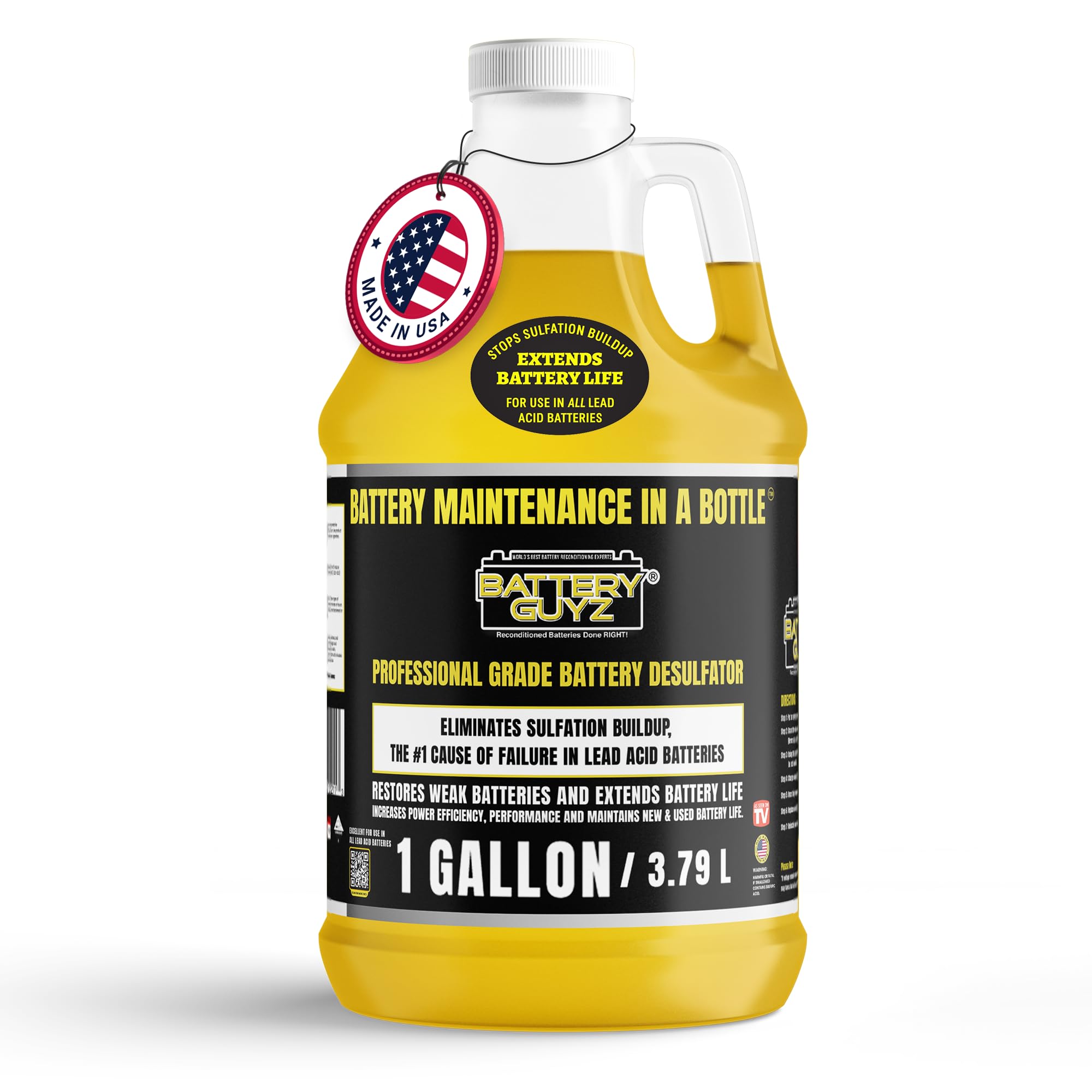
The industrial-strength gallon kit with gloves and a funnel — for those serious about fleet maintenance.
At 4.83 kilograms (over 10 pounds), versus the 4.69-pound Battery Renew bottle, this is the heaviest product in the roundup — and the only one that includes gloves and a funnel. The maker claims it can restore up to two small auto batteries or one deep-cycle battery per gallon, and says it can be used up to 10 times on the same battery. It has also been featured on USA TODAY, Bloomberg, and ABC, which lends some brand credibility. The recommended battery age window is 1-4 years, slightly tighter than the 1-5 year range of the Battery Renew solution.
Buyer reports are all over the map here. One owner says it “exceeded my expectations” and restored 8-volt golf cart batteries, saving on replacements. Another called it “Viagra for golf cart batteries.” But a different verified buyer reported the opposite: their battery tested worse after a 24-hour trickle charge, with the SOH (state of health) dropping further. That same buyer said the company ignored a refund request. That split is note — this product seems to deliver dramatically for some and fail for others, with no middle ground.
Compared to the 64-ounce Battery Renew, the gallon size here makes sense only if you maintain multiple vehicles or a whole golf-cart fleet. The included gloves are a nice touch — acid handling is genuinely risky.
Kit Highlights
- Full gallon (3.78 L) — the largest volume in this roundup
- Includes gloves and funnel for safe handling
- As Seen On TV brand with media coverage from USA TODAY
- Can be used up to 10 times on the same battery
Heads Up
- Mixed buyer experiences — some saw battery health drop after use
- One refund request was reportedly ignored
- Works only on 1-4 year old batteries; ineffective on gel, dry, or frozen cells
Best for: heavy users maintaining a fleet of golf carts or deep-cycle marine batteries who want a single-purchase, multi-battery solution.
Not for: cautious first-timers — the mixed reviews and higher cost make the 64-ounce bottle a safer bet.
4. WPS Sealed Battery Electrolyte Pack 900CC CTX

Straight fresh electrolyte for sealed AGM batteries — no additives, just the acid you need.
At 2.4 pounds, versus the Battery Renew 64-oz jug at 4.69 pounds, this is a completely different type of product: fresh sulfuric-acid electrolyte for sealed lead-acid (AGM) batteries, not a desulfator. If your battery’s electrolyte level has dropped below the plates (common in AGM batteries after years of charging), this 900CC pack is exactly what you pour in. It comes as a single-use pack designed for convenience — customers note it is “so easy to top up” and “perfect size” for a single battery.
There is an important sizing caveat from buyer reviews: one owner noted the pack shows six bottles but did not fill even one battery, which lines up with the spec — 900CC is about 30 ounces, enough to top off low cells in a single 12-volt battery but not enough to refill a fully dry battery from empty. If you are trying to fill a totally dry battery, you will need the larger WPS Acid Pack 150CC (31 oz) or something bigger. The pack is also labeled “rechargeable” as a unit, though that refers to the battery it serves, not the pack itself.
Unlike the Thermoil desulfator above, this product adds fresh acid rather than treating sulfation. If your battery’s CCA is low because the plates are sulfated (not because the electrolyte is low), this WPS pack will not fix the problem — you need a desulfator for that.
Simple & Safe
- Fresh electrolyte for sealed lead-acid (AGM) batteries needing a top-up
- Easy to pour with safe instructions
- Lightweight at 2.4 pounds compared to gallon jugs
Volume Limitation
- 900CC is not enough to fill a fully dry battery — reviewers point out needing more
- Fresh acid only — does not treat sulfation or restore lost capacity
- Single-use format; no reusable cap or funnel included
Pick this if: you have a sealed AGM battery where the electrolyte level has dropped and you just need a top-off — no chemistry experiment required.
pass on it if: your battery is low on CCA but full on fluid — you need a desulfator, not more acid.
5. WPS BATTERIES ACID PACK CONV TYPE 150CC 150CC CONV

The tiny acid bottle that brought a “dead as hell” battery back to life — but do not buy it thinking it is a full refill.
The whole package weighs 31 ounces, versus the Thermoil 12-ounce bottle, but the actual acid volume inside is just 150 CC — about 5 fluid ounces. That is roughly 10 tablespoons, so the packaging is heavier than the liquid it contains. This is a single-use acid pack meant for topping off cells or filling a small dry battery, not for refilling an empty car battery from scratch. One buyer summed it up: “Very small bottle, only buy if you need a very small amount of acid.”
Despite the tiny size, the real-world stories are remarkable. One buyer mentioned mixing the acid with distilled water and pouring it into a battery that “had been dead as hell for over 2 years.” By morning, the battery was charged and held that charge for weeks. Another buyer said it brought “a majority of my battery cells back up to acceptable readings.” Those results match what you would expect from fresh acid replacing old, weak electrolyte — but only if you have a single battery with low fluid, not a sulfated plate problem.
Compared to the WPS Sealed Battery Electrolyte Pack (900CC) above, this 150CC pack is a fraction of the volume. Use it only for emergency top-offs or to test a small battery before committing to a larger bottle.
Surprisingly Effective
- Revived a battery dead for over 2 years, per one verified buyer
- Brought multiple cells to acceptable readings
- Fast shipping and fair price for a single-use emergency refill
Volume Reality
- Only 150 CC (~5 oz) — shoppers say “not for filling empty batteries”
- Weighs 31 ounces but most of that is the container
- Single-use; you will need multiple packs for a full battery refill
Buy it for: a single-cell top-off or a small battery that just needs a splash of fresh acid to wake it up.
Don’t buy this for: restoring a sulfated battery or filling a completely dry car battery — you will run out before you finish.
Understanding the Specs
Cold Cranking Amps (CCA)
This is the number that tells you whether a battery treatment actually worked. CCA measures how many amps a battery can deliver at 0°F for 30 seconds while staying above 7.2 volts. A desulfator that raises CCA from 315 to 562 (like the Thermoil example) is doing its job. If the number stays flat or drops, the battery likely has a dead cell that no additive can fix.
Desulfator vs. Fresh Electrolyte
These are two different products for two different problems. A desulfator (like Thermoil or Battery Renew) is a chemical additive that dissolves lead sulfate crystals on battery plates — it goes into a battery that has full fluid but has lost capacity. Fresh electrolyte (like the WPS Acid Pack) is actual sulfuric acid and water — it goes into a battery where the fluid level has dropped below the plates. Pouring desulfator into a dry cell just wastes it; pouring fresh acid into a sulfated battery with full fluid can overfill and cause corrosion.
FAQ
Can I use a desulfator in any car battery?
How much desulfator do I add per cell?
Will battery acid revive a completely dead battery?
What is sulfation and why does it kill batteries?
How long does a desulfator take to work?
Is there a difference between battery acid and battery desulfator?
Can I use these products on a sealed maintenance-free battery?
Why did my battery test worse after using a desulfator?
Final Thoughts: The Verdict
For most people, the battery acid for car winner is the Battery Renew Solution 64 oz because it gives you the largest volume per dollar, works on all voltages, and has the strongest track record in verified buyer reviews. If you want a single-battery desulfator with proven CCA gains, grab the Thermoil DeSulfator 12 oz. And for fresh electrolyte to top off a low AGM battery, the standout is the WPS Sealed Battery Electrolyte Pack 900CC for simple, safe refills.
How We Picked
We do not accept paid placement. Every pick is matched to a real buyer and a real use-case; we do not hands-on test units.
Sources & Methodology
Specifications: manufacturer listings and product documentation. Review insights: verified customer reviews, as of July 2026. Pricing: not shown on this page (it changes often); check the current price via the retailer link.
As an Amazon Associate, Trending Car earns from qualifying purchases. This does not affect which products we feature.