
Our readers keep the lights on and my garage snacks stocked. As an Amazon Associate, I earn from qualifying purchases.
Specs are compiled from manufacturer listings and verified buyer reviews and can change over time — please confirm the key details on the product page before buying.
A factory-finish paint job at home is possible — but only if you choose the right spray gun. The world of automotive paint equipment is full of confusing specs (HVLP, LVLP, CFM, tip sizes) that can turn a weekend project into a messy disaster. This guide breaks down the ten most capable spray systems available, matching each one to the specific job it handles best, so you can lay down a smooth, even coat without the headache.
I’m Min Islam — the founder and writer behind Trending Car. This guide is built by comparing the manufacturers’ published specifications and the patterns across verified customer reviews, so you get each pick’s real strengths and trade-offs instead of marketing spin.
Whether you are spraying clearcoat on a bumper or priming an entire panel, these picks represent the most reliable automotive paint equipment you can buy right now — each one chosen for a specific use case and budget level.
Our Picks at a Glance


How To Choose The Best Automotive Paint Equipment
Buying a spray gun is not like buying a drill. The wrong spray gun can mean orange peel texture, runs, or paint that simply will not stick. Focus on these three decisions to get it right the first time.
HVLP vs LVLP vs Turbine: Which Air Delivery System Fits Your Compressor?
HVLP (High Volume, Low Pressure) guns are the standard for auto painting. They move a large volume of air at low pressure, which means more paint lands on the surface instead of floating away as overspray. The trade-off is that they require a big compressor — typically one delivering 7 to 12 CFM (cubic feet per minute) at 40 PSI. If you have a small home-shop compressor, an LVLP (Low Volume, Low Pressure) gun is a better match because it sips less air while still producing a quality finish. Turbine systems, like those from Fuji Spray, are self-contained — they generate their own airflow, so no compressor is needed at all, but they top out at around 9 to 10 PSI, which is fine for thinned paints but not for heavy-bodied materials.
Tip Size: The Single Spec That Controls Your Finish
The nozzle opening (measured in millimeters) dictates what you can spray. A 1.3 mm or 1.4 mm tip is ideal for thin materials like basecoats, clearcoats, and urethanes. A 1.7 mm or 1.8 mm tip is for thicker liquids — think high-build primers, 2K primers, or heavy sealers. A gun that comes with three tips (1.3, 1.5, and 1.7 mm, for instance) covers nearly every job from a candy coat to a primer layer without needing a second gun.
Material and Build: What a Duty-Cycle Gun Looks Like
A spray gun that sees regular use needs a stainless steel fluid path. Paint is corrosive, especially waterborne paints, and an aluminum or plated path will pit and clog over time. Stainless steel nozzles and needles resist that corrosion. A gun with a machined air cap (instead of a stamped one) also produces a more consistent fan pattern, so you get the same spray shape every time you pull the trigger.
Quick Comparison
| Model | Best For | Max Pressure | Weight | Tip Sizes | Amazon |
|---|---|---|---|---|---|
| Fuji Spray 2804-T75G★ Best Overall | Turbine-powered pro finish | 9 PSI | 28 lbs | Interchangeable (sold separately) | Amazon |
| BEETRO HVLP Touch UpBest Value | Small detail & touch-up jobs | 43 PSI | 0.84 kg | 1.0 mm | Amazon |
| InoKraft D1 LVLPBudget Champion | Budget-friendly all-rounder | — | 1.61 kg | 1.3 / 1.5 / 1.7 mm | Amazon |
| Tilswall Pinto LVLP | Home enthusiasts with small compressors | 70 PSI | — | 1.3 / 1.5 / 1.7 mm | Amazon |
| StartingLine HVLP Kit 802342 | Entry-level auto painting | 30 PSI | 6 lbs | 1.3 mm (included) | Amazon |
| Master Elite PRO-44 | Mid-range basecoat & clearcoat | — | 1.15 kg | 1.3 mm | Amazon |
| StartingLine HVLP Kit 802343 | Primer and full-panel work | — | 7 lbs | 2 guns (includes detail gun) | Amazon |
| Master Elite PRO-88 | Primer-to-clear versatility | — | — | 1.3 / 1.4 / 1.8 mm | Amazon |
| 3M ONE Accuspray | Fast cleanup & minimal waste | — | 1.4 lbs | 1.2 / 1.3 / 1.4 / 1.8 mm | Amazon |
| Fuji Spray 2903-T70 | Portable turbine for wood & auto | 6.5 PSI | 28.1 lbs | 1.3 mm | Amazon |
In‑Depth Reviews
1. Fuji Spray 2804-T75G Mini-Mite 4 Platinum
Our pick — over 4.5★ from 500+ verified ratings; the strongest balance of quality and price.
The self-contained turbine that delivers showroom results without a compressor in sight.
This is the setup for anyone who wants professional-grade paint without wrestling with compressor CFM ratings. The Mini-Mite 4 Platinum houses a three-stage turbine that pushes air at 9 PSI — low pressure but high volume — which is the balance for HVLP atomization. The 25-foot hose includes an air control valve that lets you dial down overspray and bounce-back right at the gun. At 28 pounds, the whole unit is portable enough to move around a garage or take to a job site, and the metal turbine case includes a built-in gun holder.
What wins people over is the quality of the finish. The crowd favorite — 4.8 stars across over 500 owners — reports that the T75G gun lays down Benjamin Moore Advance (thinned just 6% with a 1.8 mm tip) with zero atomization issues, and one professional painter finished 850 square feet of cabinets in 7.5 hours. Cleanup is faster than an airless system, and the gun itself has no plastic parts, so it holds up to daily use. The only thing to plan for is that the turbine gets warm during extended runs, but the air in the hose stays cool — a detail that keeps the paint from curing inside the cup.
What the pros love
- No compressor needed — built-in 3-stage turbine handles the air
- Professional-grade finish on everything from cabinets to cars
- Non-bleed, ergonomic Stay-Cool handle for long sessions
- Backed by a 2-year parts & labor warranty
Keep in mind
- Heavier than a standalone gun at 28 pounds
- Requires thinned paint for best atomization
- Top-end investment for occasional use
Best suited for: The dedicated DIYer or pro who wants a complete, self-powered HVLP system that produces a flawless, orange-peel-free finish straight out of the case.
Think twice if: You only need a gun for a single small repair — a turbine system is more than you need for touch-up work.
2. BEETRO HVLP Touch Up Mini Air Spray Gun
The featherweight touch-up gun that handles clearcoats as well as basecoats.
Weighing only 0.84 kilograms (under 2 pounds), this mini gun is built for precision work — spot repairs, door jams, motorcycle parts, and small clearcoat jobs where a full-size gun is overkill. The 1.0 mm stainless steel nozzle is designed specifically for clearcoats and basecoats, and The HVLP design pushes transfer efficiency up to 85%., meaning less paint floats into the air and more lands on the panel. It operates at a maximum pressure of 43 PSI, which is noticeably higher than the 9 PSI of a turbine system — a 4.8x gap — meaning it works with a standard shop compressor without demanding huge air volume.
Buyers consistently praise its build quality and how easily it atomizes paint. It includes a Type 2 adapter for disposable cups and three adjustable knobs (fluid, pattern, and air) that give you fine control over the spray. The gun is a solid step up from cheaper touch-up guns, and the no-O-ring design means chemical thinners won’t damage seals during cleaning. The only real caveat is that the included instructions are minimal — mostly a parts diagram — so it helps to have some spray-gun expertise before you start.
Reasons to grab it
- Ultra-light for one-handed detail work (0.84 kg)
- 1.0 mm stainless nozzle delivers crisp clearcoat finishes
- No-O-ring design means no seal degradation from solvents
- Includes Type 2 adapter for disposable paint cups
One watch-out
- Sparse instructions may leave first-time users guessing on setup
For the detailer: Perfect for small-area repairs, touch-ups, and projects where a full-size gun is too bulky.
Not if: You need a complete do-it-all kit — this is a dedicated mini gun, not a panel-coverage workhorse.
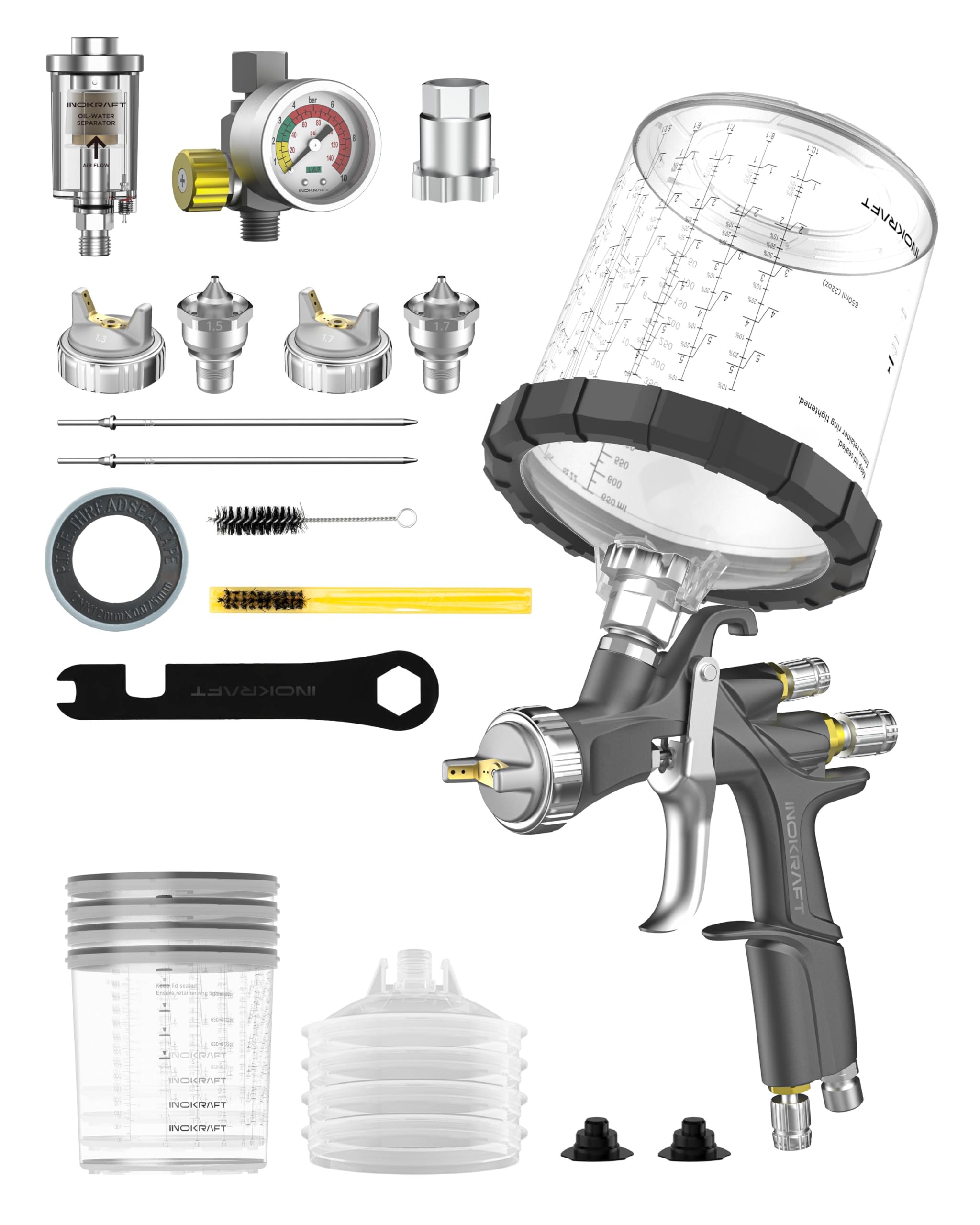
3. InoKraft D1 LVLP Spray Gun Premium Kit
An LVLP kit that pairs three tip sizes with disposable cups for the lowest entry price.
The D1 uses LVLP (Low Volume, Low Pressure) technology, which is the right choice when your compressor cannot keep up with a standard HVLP gun. It comes with three nozzles — 1.3 mm, 1.5 mm, and 1.7 mm — plus 22-ounce disposable paint cups, so you can switch between a thin basecoat and a thicker primer without having to deep-clean the cup. The whole kit weighs 1.61 kilograms, which is nearly double the BEETRO gun (a 1.9x gap), but the weight is still manageable for a full-panel spray session.
Owners say the gun works well for both primer and base applications, and the spray performance is the most-praised feature. It produces an even, flat pattern that lays down paint smoothly on first use. The build quality feels solid for the money, though it is not at the level of a premium stainless-steel gun. The main trade-off is air consumption — as one owner put it, it consumes air like any other LVLP gun, so if your compressor struggles, lean toward a true low-CFM model instead.
Why it stands out
- Three nozzle sizes (1.3, 1.5, 1.7 mm) give flexibility across coatings
- Disposable 22 oz cups cut cleanup time significantly
- LVLP design works well with smaller home compressors
- Solid first-time performance cited by multiple owners
Consider this
- Nearly 1.9x heavier than the BEETRO touch-up gun
- Not stainless steel throughout — longevity depends on care
Who it fits: The budget-conscious DIYer who needs a multi-tip setup for both primer and paint without a second mortgage.
Skip it for: Daily professional use — that demands a stainless fluid path and a higher build tolerance.
4. Tilswall Pinto LVLP Spray Gun Premium Kit
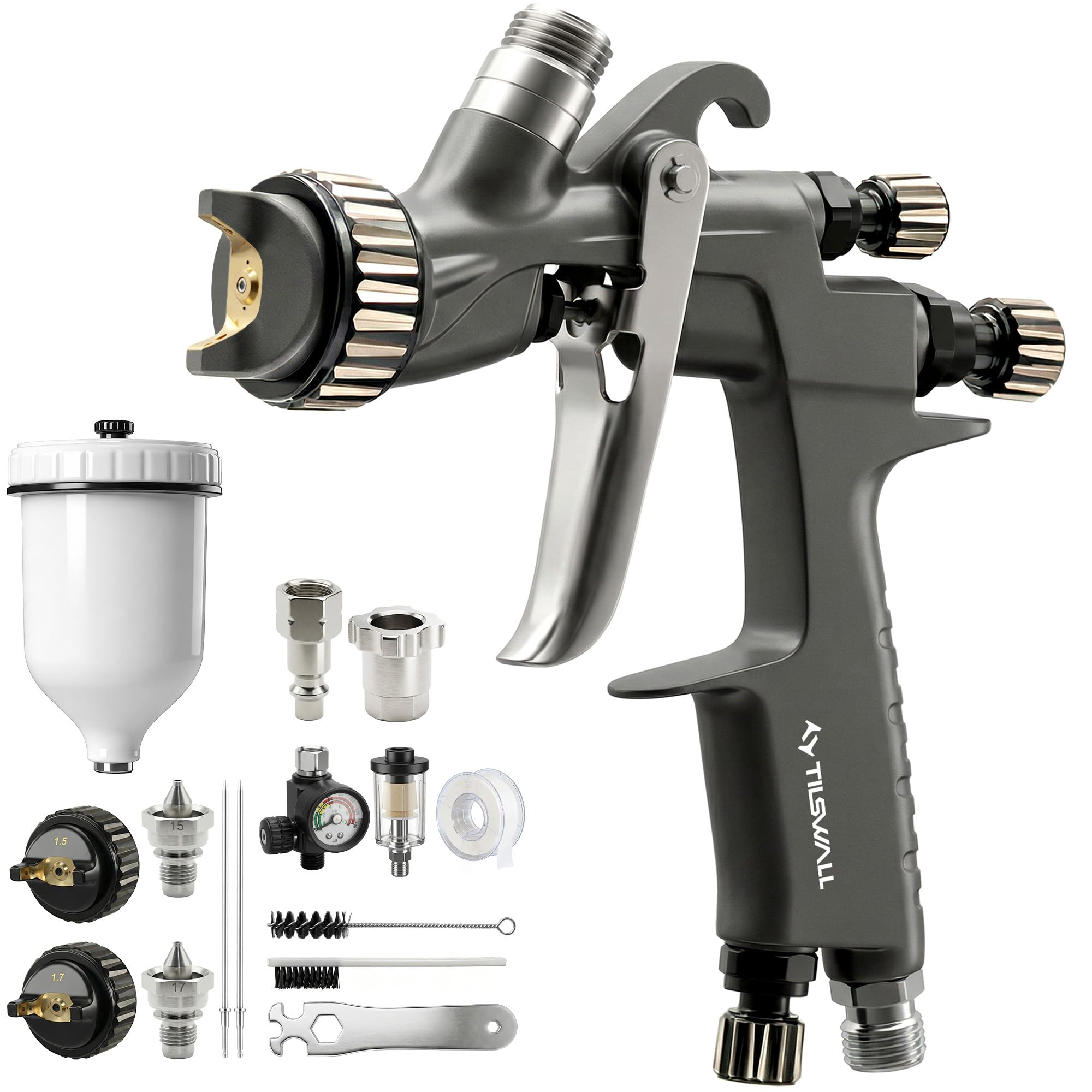
The Tilswall Pinto is a stainless-steel workhorse built to outlast cheaper rivals by a factor of 8x.
The Pinto is a serious step up for home enthusiasts who are ready to move past Harbor Freight-grade tools. It uses a full stainless steel flow path with no rubber seals, so it resists corrosion from waterborne paints and keeps spraying long after comparable guns would clog or quit. The company claims the Pinto lasts 2 to 8 times the lifespan of similar guns., and the machining and pure copper air cap back that up. It also produces an extra-wide fan pattern of 28 cm (over 11 inches), which is significantly wider than typical LVLP guns, so you cover large panels like doors and hoods with fewer passes.
The premium kit includes three precision-matched nozzle sets (1.3 mm, 1.5 mm, and 1.7 mm), an air pressure regulator with gauge, and an oil-water separator — everything except the compressor. Buyers report achieving a smooth, professional finish with a crisp, predictable spray pattern right away. A few noted that the trigger came stiff from dry grease, but a quick clean with acetone and fresh lube solved it. For the money, it is a complete, professional-feeling kit that rivals guns costing much more.
The thing everyone raves about is the smooth finish — owners call it the best paint gun they have ever used, saying it delivers “perfect” results with no orange peel. At a max pressure of 70 PSI, it has plenty of headroom for thicker materials, unlike the BEETRO gun which tops out at 43 PSI. The only minor gripe is that the 1.3 mm air cap on a few units had a slight blemish, but it did not affect the spray pattern.
The strong suits
- Full stainless steel flow path with no rubber seals — resists corrosion
- 28 cm+ extra-wide fan for fast panel coverage
- 3 nozzle sizes, regulator, and oil-water separator included
- High max pressure (70 PSI) handles a wide range of coatings
A couple of notes
- Trigger may need grease removal and re-lube from the start
- Mini touch-up gun form factor — not a full-size production gun
Reach for it if: You want a near-professional LVLP system with stainless internals and a wide fan, and you have a capable shop compressor.
Look elsewhere: If you need a standalone turbine (no compressor) — the Pinto is air-powered only.
5. DeVilbiss StartingLine HVLP Kit 802342

The DeVilbiss name at a price that gets beginners spraying immediately.
If you are new to automotive painting, this is the kit to learn on without spending a fortune. It is a gravity-feed HVLP gun with a 1.3 mm tip, designed for basecoats, clearcoats, and single-stage paints. The gun needs around 20 PSI from a compressor (owners used a 5.2-gallon unit successfully), and the settings are straightforward — fan wide open, fluid knob 1 to 2 turns out. The kit comes in a carrying case, and it includes both a standard gun and a detail gun for smaller areas.
The feedback is overwhelmingly positive from beginners: it outperforms most inexpensive guns and even outshines the DeVilbiss Plus+ model for metallic paints. Owners have used it for pearls, satin clear, and base coats on several cars per year without issues. The downsides are that the body materials feel more plastic than premium metal guns, and the nozzle can be difficult to remove after use. Leakage around the needle is rare but fixable with lube. At 6 pounds, it is noticeably heavier than the BEETRO mini gun, but for a full-size HVLP kit, that is standard.
What works
- Trusted DeVilbiss build quality at a beginner-friendly price
- Produces professional-looking results with pearls, flakes, and clears
- Includes both full-size and detail guns
- Easy to set up and tune for first-time users
What to expect
- Plastic feel and fragile-seeming tips compared to pro guns
- Occasional difficulty removing the nozzle after paint dries
Best for: The aspiring DIY painter who wants a reliable entry system and plans to paint a few cars or bikes per year.
Not for: Daily professional use — the materials will not survive that duty cycle.
6. Master Elite PRO-44 HVLP Spray Gun

A Devilbiss clone that sprays like a gun for a fraction of the cost.
The PRO-44 is the gun for painters who have outgrown entry-level tools but are not ready for a system. Its design is nearly identical to the Devilbiss Pro Lite, with machined components and a wide spray pattern that buyers describe as “lays down like glass.” The included high-flow air pressure regulator with gauge sits right at the gun, so you adjust pressure without walking back to the compressor. It comes with a 1-liter aluminum cup and an MPS adapter for disposable cups.
Owners consistently note that it is a huge improvement over budget guns — the paint lays down smoother and more uniform, requiring less sanding and buffing. The adjustability is precise: the fan pattern is wide and consistent, and the atomization handles basecoats and clearcoats beautifully. It runs on a standard compressor, and the needle/nozzle/air cap are stainless steel and fully compatible with waterborne paints. The only common issue is that the regulator gauge can arrive non-functional for a small number of buyers, but the gun itself performs without fault. At 1.15 kg, it is lighter than the InoKraft D1 and much easier to maneuver for long sessions.
The highlights
- Machined to tolerances that match guns costing 4x as much
- Wide, consistent fan pattern that reduces runs
- Stainless steel components are 100% waterborne-compatible
- 1-liter cup and MPS adapter included
What to watch
- Regulator gauge may arrive faulty in rare cases
- Relies on a compressor with adequate airflow — not for small units
Ideal for: The automotive painter who wants pro-level atomization and spray pattern without the premium brand tax.
Not a fit if: Your compressor is small — this gun needs decent CFM to perform.
7. DeVilbiss StartingLine HVLP Complete Kit 802343

A two-gun HVLP system that handles thick 2K primer and clear without changing tips.
This kit expands on the single-gun StartingLine by adding a second gun, so you can dedicate one to primer and one to paint without stopping to swap nozzles. It comes with gravity-feed guns designed for High Volume, Low Pressure operation, and it handles heavy materials like high-build 2K primer as easily as basecoat and clearcoat.
DIY painters consistently report professional results — one owner painted the trunk of his car with 2K primer, then basecoat and clearcoat, and got a finish that looked like a professional shop did it. The kit also works for classic car restorations, with owners using it on vehicles like a ’70 Barracuda. The main trade-off reported is that the metal cup fitting on some units broke on first use, and the spray pattern can be inconsistent after stopping mid-project. It also needs around 26 PSI from a commercial-grade compressor — not ideal for a tiny portable unit. For the price, it is a solid step-up kit for advancing DIYers.
Where it shines
- Two guns let you keep primer and paint separate
- Handles thick 2K primer effectively for full-panel priming
- Produces professional-grade results for home painters
- Good value for a complete multi-gun set
The downsides
- Metal cup fitting can break on first use for some units
- Needs a strong compressor (~26 PSI with good CFM)
Best used by: The DIY restorer painting a whole car — primer one gun, paint the other — who wants to minimize downtime.
Not ideal for: touch-up or detail work where a mini gun is better.
8. Master Elite PRO-88 HVLP Spray Gun Ultimate Kit

One gun body that swaps between primer, base, and clear with three complete atomizing sets.
The PRO-88 kit solves the “which gun for which material” problem by providing three full atomizing sets — 1.3 mm, 1.4 mm, and 1.8 mm — each with its own needle, fluid nozzle, and air cap. That means you can spray a thin waterborne basecoat using the 1.3 mm setup, then switch to a thick 2K primer with the 1.8 mm setup without buying a second gun. The body is precision-machined stainless steel, the air caps are high-grade copper, and the entire system is waterborne-compatible.
Owners use it for urethanes, lacquers, and metallic paints, and the most-praised feature is the build quality. The gun performs best around 30 to 31 PSI, producing a super glossy finish that rivals more expensive guns. A common theme from owners is that it delays the need for a gun — it is that good. One caution: the main paint channel inside is galvanized steel, not full stainless, so a few owners reported rust when using waterborne paints without thoroughly drying the gun afterward. Keep it dry between uses, and it will serve you well for years.
Why it wins
- Three complete atomizing sets (1.3, 1.4, 1.8 mm) cover every coating
- Excellent build quality with copper air caps and stainless components
- Delivers super-glossy, professional finishes consistently
- Includes MPS adapter for disposable cups
Heads up
- Galvanized main channel can rust with waterborne paint if not dried thoroughly
- Not a full daily-pro gun — treat it as a serious enthusiast tool
Ideal for: The enthusiast who sprays a variety of materials (primer to clear) and wants one gun that does it all without a premium price.
Avoid if: You exclusively spray waterborne paints and cannot commit to a thorough drying routine after every use.
9. 3M ONE Accuspray Spray Gun System

The 3M Accuspray system cuts cleanup time by as much as 50% — just toss the liner and keep spraying.
This is the gun for painters who hate cleaning. The 3M Accuspray uses the PPS (Paint Preparation System) disposable cup system: you mix the paint in a disposable liner, snap on a disposable lid with a built-in filter, and spray. When you are done, you toss the liner and lid, rinse the nozzle, and you are finished. 3M claims the PPS system cuts cleanup solvent use by up to 70% and shortens prep and cleanup time by as much as 50%. The 22-ounce cup lets you rotate the gun 360 degrees — even upside down — without spilling or losing pickup.
The kit comes with four atomizing heads (1.2 mm, 1.3 mm, 1.4 mm, and 1.8 mm), so you can spray anything from thin stains to heavy gelcoats. The gun body is lightweight at just 1.4 pounds, making it easy on the wrist during long sessions. Owners mention excellent results with PPG Omni and Deltron metallics using the 1.3 mm tip, and primer sprays cleanly through the 1.8 mm tip. The common feedback is that the instructions are poor — setup takes some trial and error — and the ongoing cost of disposable lids and liners adds up over time. But for anyone who values speed and consistency, it is a standout.
What makes it unique
- Disposable PPS liners mean nearly zero cleanup time
- Four atomizing heads (1.2 to 1.8 mm) cover every coating type
- 22-ounce cup sprays at any angle, even upside down
- Ultra-light weight (1.4 lbs) for fatigue-free use
Plan for this
- Ongoing cost of disposable lids and liners adds up over time
- Poor instructions — expect a learning curve on setup
Reach for it if: You value speed and hate cleaning — the PPS system is by far the fastest way to switch between colors and coatings.
Not the best: If you are on a tight budget and plan to paint only occasionally; the ongoing consumables cost may not be worth it.
10. Fuji Spray 2903-T70 Mini-Mite 3 Platinum

A bottom-feed turbine system that is portable enough for a woodshop and precise enough for auto finish.
The Mini-Mite 3 is the slightly smaller sibling to our Best Overall pick. It uses a 3-stage Platinum turbine that produces 6.5 PSI of air pressure — lower than the 9 PSI of the Mini-Mite 4 — but still enough for thinned paints, lacquers, and varnishes. It includes the T70 bottom-feed spray gun with a 1000 cc (1-liter) cup and a 25-foot hose. The turbine features a Heat Dissipation Chamber (HDC) that keeps the air temperature down, and the metal case includes a handy gun holder.
Owners praise the quality and performance, with many mentioning that it produces a professional, consistent finish on cabinets, furniture, and car parts. The bottom-feed design means the cup sits below the gun, which some painters prefer for balance. It is quieter than a compressor and significantly more portable — the entire unit is self-contained. The main gripes are that it produces significant fine overspray dust (requiring a respirator and plastic sheeting), and it cannot spray heavy-bodied materials like Sherwin Williams Extreme Bond Primer effectively. For woodworkers and auto restorers who work with thinned materials, it is a fantastic tool.
What wins fans
- Self-contained turbine — no compressor or extra hoses needed
- Professional-quality finish with thinned paints and lacquers
- Lightweight and portable for easy movement around the shop
- Includes a viscosity cup for accurate paint thinning
Limitations
- Lower max pressure (6.5 PSI) struggles with thick primers
- Produces fine overspray dust — proper ventilation is a must
- Cleaning takes more time than airless or PPS systems
A strong match for: The woodworker or auto enthusiast who sprays thinned paints and lacquers, and values portability over raw power.
Not for you: If you primarily spray high-build primers or need to lay down heavy materials without thinning.
Understanding the Specs
HVLP vs LVLP vs Turbine
HVLP (High Volume, Low Pressure) guns push a large volume of air at low pressure, typically under 10 PSI at the air cap. This means more paint sticks to the surface and less floats away, giving you a transfer efficiency of 65% or more. The catch is they need a big compressor — think 7+ CFM at 40 PSI. LVLP (Low Volume, Low Pressure) guns use less air (around 4 to 6 CFM), so they work with smaller home-shop compressors. Turbine systems generate their own air, so you do not need a compressor at all, but they top out at around 6.5 to 10 PSI, which is fine for thinned paints but not heavy primers.
Tip Size and What It Sprays
The nozzle opening (measured in millimeters) is the single most important spec for matching the gun to the material. A 1.2 mm to 1.3 mm tip is for low-viscosity coatings like clearcoats, basecoats, and stains. A 1.4 mm to 1.5 mm tip handles medium viscosity materials like single-stage urethanes and primer-sealers. A 1.7 mm to 1.8 mm tip is for thick materials like high-build 2K primers, surfacers, and heavy fillers. Using a tip that is too small for a thick material causes spitting and poor atomization; using one that is too large wastes paint and creates runs.
FAQ
Can I spray automotive paint with a small 6-gallon compressor?
What is the difference between a gravity-feed and a siphon-feed spray gun?
What does CFM mean and how much do I need?
Should I buy a turbine spray system?
What is a PPS or disposable cup system and is it worth it?
How do I know which tip size to use for my paint?
Can I use a waterborne paint in any spray gun?
What air pressure should I set for clearcoat?
Final Thoughts: The Verdict
Across the board, the automotive paint equipment winner is the Fuji Spray 2804-T75G Mini-Mite 4 Platinum because it is a complete, self-powered turbine system that delivers professional-grade finishes without needing a compressor, and because the crowd of over 500 owners ranks it at 4.8 stars. If you want the fastest cleanup and a versatile multi-nozzle system, grab the 3M ONE Accuspray. And for the best balance of stainless steel durability and wide coverage at a mid-range price, the Tilswall Pinto LVLP is the one to reach for.
How We Picked
We do not accept paid placement. Every pick is matched to a real buyer and a real use-case; we do not hands-on test units.
Sources & Methodology
Specifications: manufacturer listings and product documentation. Review insights: verified customer reviews, as of July 2026. Pricing: not shown on this page (it changes often); check the current price via the retailer link.
As an Amazon Associate, Trending Car earns from qualifying purchases. This does not affect which products we feature.