
Our readers keep the lights on and my garage snacks stocked. As an Amazon Associate, I earn from qualifying purchases.
Specs are compiled from manufacturer listings and verified buyer reviews and can change over time — please confirm the key details on the product page before buying.
You already know the wrong motor oil can shorten your engine’s life, cost you at the pump, or even void your warranty. The trick is matching a specific viscosity grade (like 5W-30) to your car’s age, your driving style, and what your owner’s manual demands — not just grabbing the cheapest jug.
I’m Min Islam — the founder and writer behind Trending Car. This guide is built by comparing the manufacturers’ published specifications and the patterns across verified customer reviews, so you get each pick’s real strengths and trade-offs instead of marketing spin.
Whether you drive a turbocharged commuter, a high-mileage truck, or a European sedan, this breakdown of the auto motor oil market focuses on the synthetic blends and full synthetics that deliver verified protection and long-term engine health.
Our Picks at a Glance


How To Choose The Best Auto Motor Oil
Motor oil is the single most important fluid in your car. Picking the wrong one accelerates engine wear, hurts fuel mileage, and can void a modern warranty. Focus on three things: the viscosity grade your owner’s manual calls for, the API service rating (SP (the newest standard that adds protection for turbo engines) is the newest standard), and whether your engine has crossed the 75,000-mile mark where seal conditioners start to matter.
Viscosity Grade — The Right Flow for Your Climate
The “5W-30” label tells you how the oil flows at cold start (the “W” winter rating) and at full operating temperature. A 5W-30 stays thin enough in freezing weather to reach valvetrain parts quickly, yet thick enough at 212°F to maintain a protective film between metal surfaces. Deviating from what your engine was designed for — using a 10W-40 when the cap says 5W-30 — can reduce oil pressure in tight modern bearing clearances.
Full Synthetic vs. Synthetic Blend vs. Conventional
Full synthetics (like Mobil 1 or Motul) use chemically engineered base stocks that resist thermal breakdown at high temperatures and flow better in extreme cold. Synthetic blends (like Pennzoil High Mileage) mix conventional oil with a percentage of synthetic for a budget-friendly middle ground that still offers some deposit protection. Conventional oil is fine for older, low-stress engines, but modern turbocharged engines practically require a full synthetic to prevent low-speed pre-ignition damage (a destructive knock that can happen in turbo engines at low RPM).
High-Mileage Additives — When Your Engine Has History
Once your odometer passes 75,000 miles, internal seals can harden and shrink, leading to small leaks and oil consumption. High-mileage oils contain seal conditioners that re-swell those seals, plus extra detergents to clean sludge and antioxidants to fight thermal degradation. Products like Valvoline High Mileage 150K with Maxlife Plus Technology take this further with molybdenum additives for engines past 150,000 miles.
Quick Comparison
| Model | Best For | Viscosity | Volume | Type | Amazon |
|---|---|---|---|---|---|
| Liqui Moly Special Tec LL 5W-30★ Best Overall | European & BMW engines | 5W-30 | 5 Liters | Full Synthetic | Amazon |
| Royal Purple HPS 5W-30Top Performer | High-performance & classic engines | 5W-30 | 1 Quart | Full Synthetic | Amazon |
| Pennzoil High Mileage 5W-30 (6 Pack) | Vehicles over 75,000 miles | 5W-30 | 6 Quarts | Synthetic Blend | Amazon |
| Valvoline High Mileage 150K 5W-30 | Engines with 150,000+ miles | 5W-30 | 5 Quarts | Full Synthetic | Amazon |
| Mobil 1 Extended Performance 5W-30 (6 Pack) | Extended drain intervals up to 20,000 miles | 5W-30 | 6 Quarts | Full Synthetic | Amazon |
| Mobil 1 ESP Formula 5W-30 (6 Pack) | VW, Audi, Porsche diesel/gas | 5W-30 | 6 Liters | Full Synthetic | Amazon |
| Motul 8100 Eco-nergy 5W-30 | Ford, Jaguar, VW & LS engines | 5W-30 | 5 Liters | Full Synthetic | Amazon |
In‑Depth Reviews
1. Liqui Moly Special Tec LL SAE 5W-30
Our pick — over 4.5★ from 900+ verified ratings; the strongest balance of quality and price.
The German full synthetic that keeps tuned BMW engines running smooth years later.
This oil is a 5W-30 full synthetic in a 5-liter jug, designed specifically for European vehicles that require LL (long-life) certification — especially BMWs and VWs. The formulation uses synthesis technology to resist viscosity breakdown under high heat, so your valvetrain stays quiet and the oil pressure stays stable even during extended highway cruising.
Buyers report that their engines “still run smooth and quiet years later, even while tuned, extra boost etc.,” which speaks to the thermal stability of this oil. The 2,249 model number is a direct OEM-spec replacement for many BMW gasoline engines from the mid-2000s onward, and owners mention it also improved cold-start smoothness in older models like a 2001 BMW X5.
One trade-off: at 9.43 pounds and a 5-liter capacity, the jug is heavier than most 5-quart competitors. It is a premium product that costs more per quart than a typical shelf oil, but the verified 4.9-star rating from nearly 1,000 buyers suggests the protection is worth the premium for European car owners. If your car is a domestic truck or non-European daily driver, this oil’s additive package is tune for European certification, so you will pay for specs you do not need.
What Owners Praise
- Top-tier thermal stability for tuned engines
- Direct BMW OEM-spec replacement
- Reported fuel economy improvement
What to Consider
- Heavy jug at 9.43 pounds
- Premium price per quart
Reach for this if: you drive a BMW, VW, or other European car and want a factory-spec synthetic that handles tuned boost without breaking down.
Look elsewhere if: your engine is a domestic truck or a non-European daily driver — this oil’s additive package is tune for European certification requirements.
2. Royal Purple 31530 HPS 5W-30 High Performance Street Synthetic Motor Oil
The high-zinc synthetic that quiets flat-tappet engines and protects high-horsepower builds.
Royal Purple HPS (High Performance Street) is a full synthetic 5W-30 that delivers maximum wear protection through its Synerlec additive technology. It carries a high zinc and phosphorous content, which is critical for classic engines with flat-tappet camshafts (like the 1973 Ford F250 360CI cited by a reviewer) because those older valvetrain designs need the extreme-pressure protection that modern low-zinc oils lack.
Customers note that this oil provides “quieter, smoother operation” in that vintage Ford V8 and that oil analysis in a 2013 Cadillac CTS-V consistently comes back great. The formula is also intended to increase horsepower and torque slightly by reducing internal friction — a claim supported by the reduced valvetrain noise reviewers point out. Unlike the Pennzoil High Mileage 6-pack that weighs 11.9 pounds, this single quart weighs just 1.96 pounds, making it a lightweight single-bottle option for topping off between changes or for a one-engine-bay test.
The catch is the liquid volume: just 1 quart. The Royal Purple’s single quart holds 32 fluid ounces, compared to the 5-quart Valvoline High Mileage 150K jug which holds 160.0 fluid ounces. You will need to buy multiple bottles for a full oil change on a standard car (typically 5-6 quarts). This is the oil for the classic car owner with a flat-tappet engine or a high-horsepower build; if your car is a modern daily driver with a catalytic converter, the high zinc levels can shorten its life, so stick with the standard Royal Purple or a low-SAPS oil like Mobil 1 ESP.
Ideal for flat-tappet classics: the high zinc/phosphorous content makes this one of the few modern synthetics that genuinely protects older cam and lifter setups.
Buy multiple bottles upfront: at 1 quart per bottle, plan on purchasing 5-6 units for a full change on most cars.
3. Pennzoil High Mileage 5W-30 Motor Oil, 1 Quart (6 Pack)
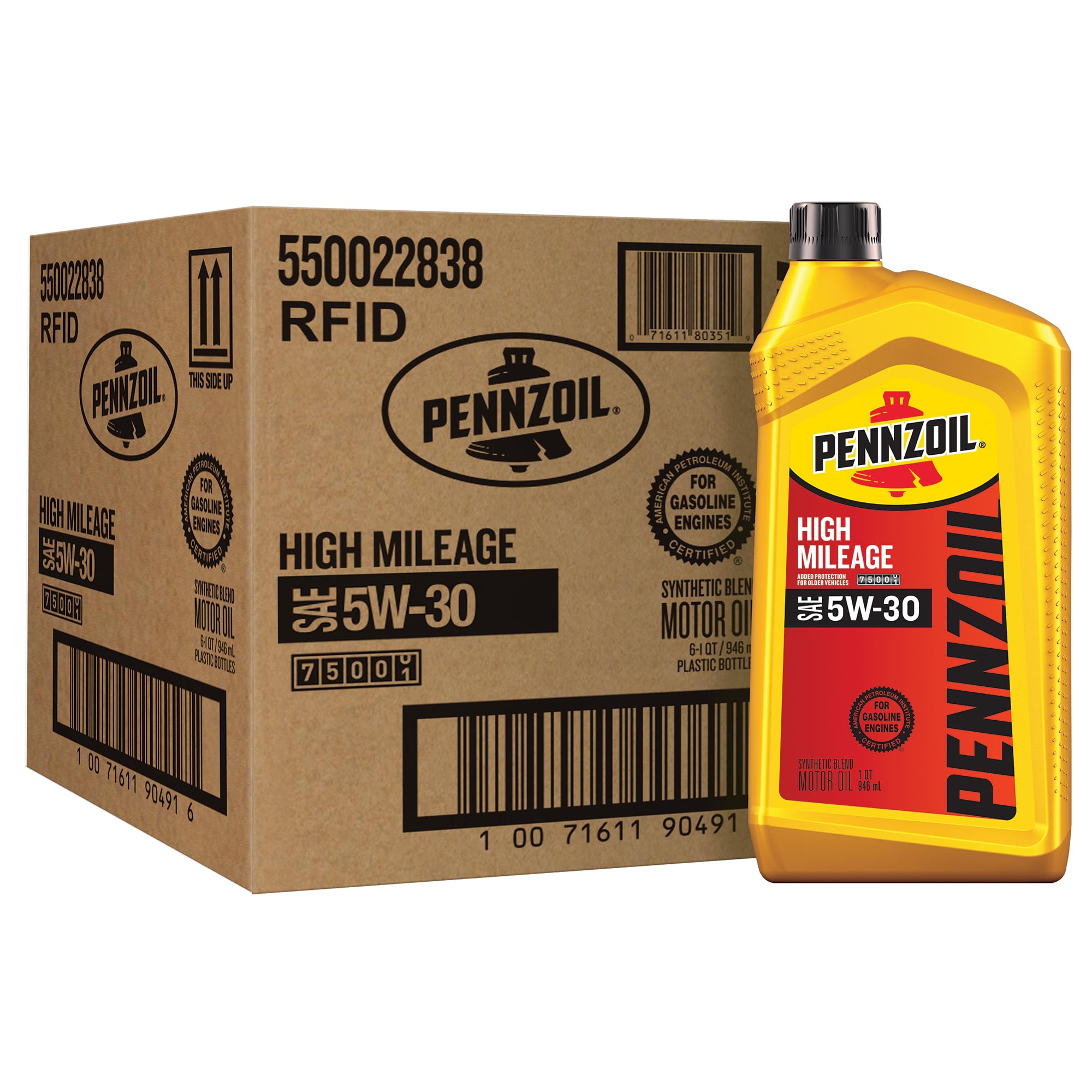
The affordable synthetic blend designed to stop leaks in engines that have crossed 75,000 miles.
Pennzoil High Mileage is a 5W-30 synthetic blend, meaning it mixes conventional oil with synthetic base stocks to offer some of the deposit protection of a full synthetic at a lower cost. The key differentiator here is the seal-conditioning chemistry: this oil is formulated to help re-swell dried-out engine seals, reducing oil consumption and stopping small leaks common in high-mileage engines.
This 6-pack delivers 6 quarts total (192 fluid ounces), so it covers nearly every car’s oil change in one box. At 11.9 pounds, the box is heavy, but that weight gets you a full change plus a spare quart for top-offs between changes. The oil is also suitable for modern turbocharged engines, providing low-speed pre-ignition protection that older blends lack.
The catch is that this is a synthetic blend, not a full synthetic. For extreme cold climates (below -20°F) or for engines that demand a full synthetic for warranty compliance, the Mobil 1 Extended Performance or Royal Purple HPS would be a better fit. Buyers describe this as “decent oil” and note it is a “good price for 6 qts,” reflecting its role as a solid mid-range value pick. If you are on a budget and your car has 75,000+ miles, this 6-quart box gives you a full change and a spare while staying affordable.
Best For
- Full 6-quart case covers most cars
- Seal conditioners help stop small oil leaks
- Budget-friendly synthetic blend
Not Ideal For
- Synthetic blend, not full synthetic
- Not the best choice for extreme cold weather
Grab this for: a high-mileage daily driver (75,000+ miles) where you are noticing minor oil seepage and want a cost-effective fix in a full 6-quart box.
Skip it for: high-performance or heavily modified engines that need the thermal stability of a 100% full synthetic.
4. Valvoline High Mileage 150K with Maxlife Plus Technology 5W-30 Motor Oil 5 Quart

The 150,000-mile formula that uses molybdenum to quiet noisy engines that burn oil.
This Valvoline oil is a full synthetic 5W-30 engineered for engines that have already passed 150,000 miles. The star of the show is the Maxlife Plus Technology with a built-in molybdenum additive — a solid lubricant that bonds to metal surfaces and stays effective even when the engine is consuming oil. A Kia Sorento V6 owner with 100,000 miles confirmed that the additive “bonds to metal parts, stays effective even if engine burns oil,” and noted it quieted rough idle and cold noise where temporary moly treatments failed.
The 5-quart jug holds 160.0 fluid ounces — enough for most 4- and 5-cylinder engines in one container, and 32 fewer ounces than the 6-quart Pennzoil box. It meets the latest API SP and ILSAC GF-6A standards, so it provides low-speed pre-ignition protection for modern turbo engines while also delivering seal conditioners to prevent oil leaks on aging gaskets. The flash point is 394 degrees Fahrenheit, giving it solid high-temperature stability.
One trade-off: the 5-quart volume means a 6-cylinder car that takes 6 quarts will still leave you one quart short, requiring a separate top-off bottle. The molybdenum additive is excellent for wear protection, but it can darken the oil faster visually, which might cause some owners to change it prematurely when the oil still has life left. If your engine is below 150,000 miles, the Pennzoil High Mileage 6-pack is a better value because it gives you seal conditioners in a larger volume at a lower price point.
Designed for the 150K+ engine: the moly additive is specifically formulated to protect engines that have passed 150,000 miles and may be consuming or burning oil.
One jug may not be enough: if your engine takes 6 quarts, you will need a separate single quart to complete the fill.
5. Mobil 1 Extended Performance Full Synthetic Motor Oil 5W-30, 6-pack of 1 quarts

The full synthetic that protects critical engine parts for up to 20,000 miles between changes.
Mobil 1 Extended Performance is a 5W-30 full synthetic rated for up to 20,000-mile oil change intervals, according to the brand’s claim, thanks to its Triple Action+ Formula that combines engine performance, wear protection, and cleanliness. It resists oxidation breakdown at internal engine temperatures up to 500 degrees Fahrenheit and stays fluid enough to flow at -40 degrees Fahrenheit, making it among the most thermally versatile oils on this list.
Shoppers say that the oil “stays clean and unburned after 5,000-7,000 mile intervals,” which confirms the additive package’s ability to resist thermal degradation. The 6-quart box uses 1-quart bottles, and the total liquid volume is 6 quarts (192 fluid ounces). It meets ILSAC GF-6 standards and provides low-speed pre-ignition protection for turbocharged engines, an important safety feature for modern direct-injection motors.
If you change oil every 3,000-5,000 miles regardless, the extended-drain capability is wasted money. This oil pays for itself only if you actually extend your drain interval to 10,000 miles or more and pair it with a high-quality filter. For the short-change crowd, the Pennzoil High Mileage 6-pack delivers a solid synthetic blend at a lower upfront cost.
Why Choose This
- Rated for up to 20,000-mile intervals
- Excellent high-heat stability (up to 500°F)
- 6-quart box covers most engines
Caveat
- Premium price — only saves money on long intervals
- Overkill for 3,000-mile change cycles
Pick this if: you want to stretch oil changes to 10,000-20,000 miles in a modern daily driver or light truck and want proven thermal protection.
Pass if: you prefer traditional 3,000-5,000 mile change intervals — the extended-drain premium is not worth it at shorter cycles.
6. Mobil 1 124044 ESP Formula Engine Oil 5W30 1 Quart Bottles Set of 6

The ESP formula that is the approved oil for VW, Audi, and Porsche diesel engines.
Mobil 1 ESP (Emissions System Protection) is a 5W-30 full synthetic engineered for modern gasoline and diesel engines that require low-SAPS (low Sulphated Ash, Phosphorus, Sulphur) oil to protect diesel particulate filters and catalytic converters. This is not a general-purpose oil — it is a specific blend that meets the factory requirements for Volkswagen, Audi, and Porsche diesel engines, as confirmed by reviewers using it in a 2015 Audi Q7 diesel and a Porsche Cayenne diesel.
This set of 6 bottles delivers a total of 6 liters (192 fluid ounces). That is 20% more total volume than the Liqui Moly 5-liter jug (which holds 5 liters) — so you get an extra liter for the same bottle count. The 6-liter volume is particularly useful for European engines that require a 6-liter fill, like some Audi V6 diesels. The ESP formulation has a low to medium viscosity level, meaning it flows well on cold starts while maintaining high-temperature film strength.
The catch is strict compatibility: ESP formula oils are not recommended for older engines that require higher levels of zinc and phosphorus for flat-tappet cam protection. If you drive a classic car or a domestic V8, this oil’s low-SAPS chemistry may actually provide less wear protection than a standard full synthetic like the Royal Purple HPS. Check your owner’s manual for the specific VW/Audi oil spec before buying.
Perfect for VW/Audi/Porsche diesels: this is the exact oil that meets the manufacturer’s low-SAPS requirements for emissions systems protection.
Not for old engines: the low zinc content makes it unsuitable for classic cars with flat-tappet camshafts.
7. Motul 8100 ECO-nergy 5W-30 Full Synthetic Motor Oil – 5 Liter
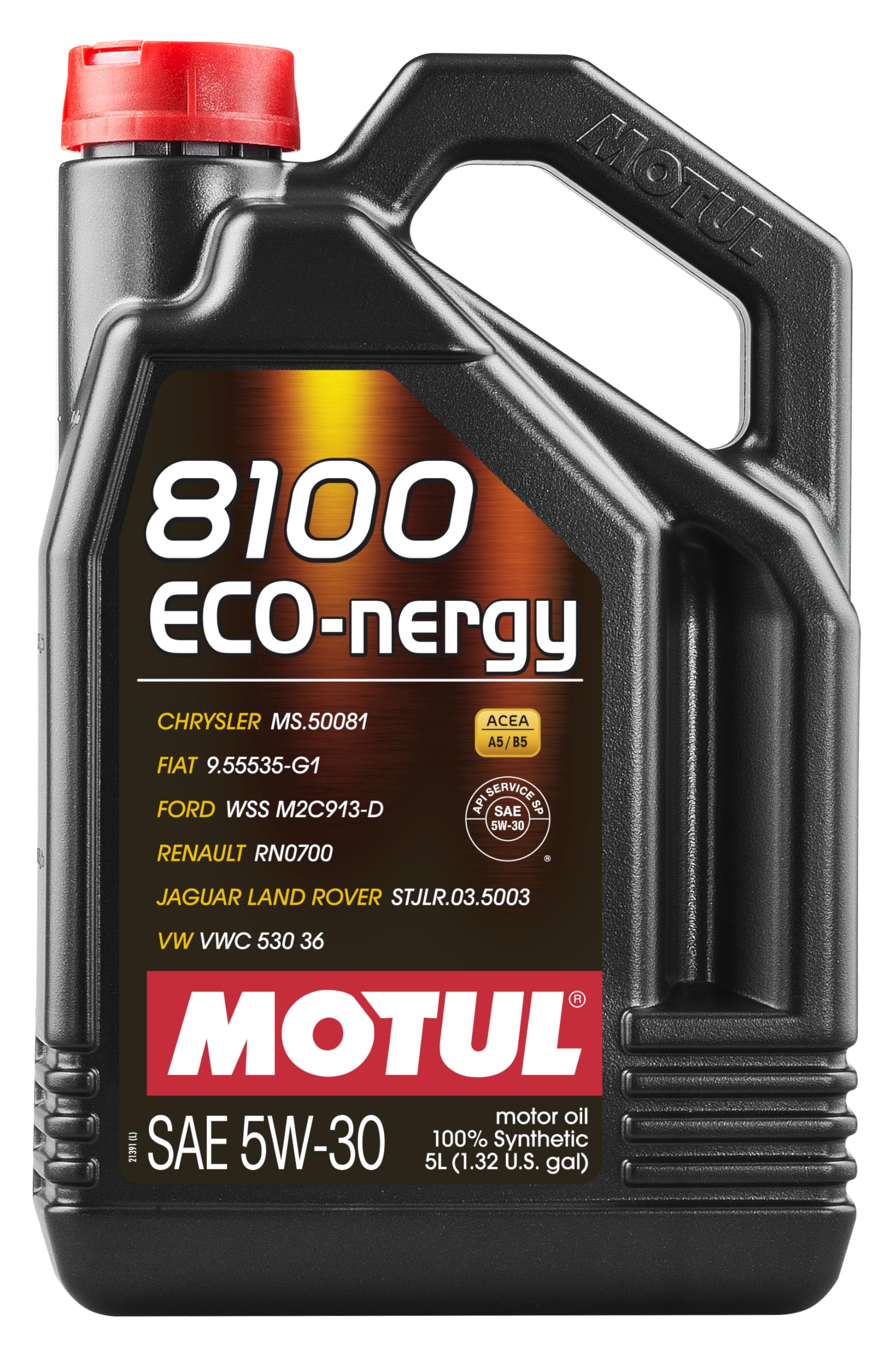
The French full synthetic that eliminates oil burn-off in LS engines and quiets Hyundai valve trains.
Motul 8100 Eco-nergy is a 5W-30 full synthetic formulated to meet the ACEA A5/B5 and API SP standards required by Ford, Jaguar Land Rover, VW, and many European applications. The advanced low-friction formula works across both gasoline and diesel engines, and its 5-liter jug (169.1 fluid ounces) is the right size for a wide range of cars.
Reviewers report impressive results across a variety of engines. One LS1 owner said it “eliminates oil burn-off,” where they previously had to add 0.5 quarts every 1,500-2,000 miles. Another owner of a 2022 Hyundai Palisade noted it “quiets noisy valve train” and improved gas mileage from 19 to 24 mpg. The 5-liter jug is the exact fill for an F-car LS1 or a VQ40DE Nissan engine, per owner reports. The Motul 5-liter jug holds 169.1 fluid ounces, while the Royal Purple HPS 1-quart bottle holds 32 fluid ounces — enough for a full change on most 4- and 5-cylinder engines without needing a second bottle.
The main trade-off is that the 5-liter jug does not quite fill a 6-quart (5.7-liter) engine. You will be about 0.7 liters short, so you may need an extra quart for cars like the 2022 Hyundai Palisade if the engine takes the full 6 quarts. Also, the 100°C flash point is noticeably lower than some competitors, so this oil is best for street-driven cars rather than track-day or endurance racing use. For the money, it offers a great balance of fuel efficiency and valvetrain quietness for Ford, Jaguar, and Hyundai drivers who want a full synthetic that stops oil burn.
Strengths
- Eliminates oil burn-off in LS engines
- Quiets valvetrain noise significantly
- 5 liters fits many European and Asian cars
Limitations
- 0.7 liters short for 6-quart engines
- Lower flash point than track-focused oils
Reach for this if: you drive a Ford, Land Rover, VW, or Hyundai/Kia that requires ACEA A5/B5 oil and want a synthetic that eliminates oil consumption.
Look elsewhere if: you need exactly 6 quarts for a full fill — the 5-liter jug will leave you 0.7 liters short.
Understanding the Specs
Viscosity Grade (5W-30)
The “5W” part (winter rating) tells you how the oil pumps at cold start. The “30” is the hot viscosity — how thick the oil stays at 100°C (212°F) operating temperature. A 5W-30 is the most common modern recommendation because it offers good cold flow without being too thin at highway speeds.
API Service Rating (SP vs SN)
The API (American Petroleum Institute) rating tells you the oil meets current industry protection standards. API SP is the newest (2020+), and it adds low-speed pre-ignition protection for turbocharged direct-injection engines and timing chain wear protection that older SN oils lack. If you drive a modern turbo car, always use an API SP rated oil. Older engines may be fine with SN or even SM, but SP is backward-compatible.
FAQ
Can I use 5W-30 in any car?
What is the difference between synthetic blend and full synthetic oil?
When should I switch to high-mileage oil?
Will Royal Purple HPS damage my catalytic converter?
Can I use Mobil 1 Extended Performance for 20,000 miles in any car?
What does low-SAPS mean in Mobil 1 ESP oil?
Which oil is best for a BMW with over 100,000 miles?
Can I mix different brands of 5W-30 oil?
Final Thoughts: The Verdict
For most people, the auto motor oil winner is the Liqui Moly Special Tec LL 5W-30 because it delivers factory-spec protection, verified thermal stability for tuned engines, and a 4.9-star rating from nearly 1,000 buyers. If you want a budget-friendly full 6-quart case for a high-mileage daily driver, grab the Pennzoil High Mileage 5W-30 6-Pack. And for the classic car owner with a flat-tappet engine or a high-horsepower build, the standout is the Royal Purple HPS 5W-30 for its high-zinc protection and verified smooth operation in vintage V8s.
How We Picked
We do not accept paid placement. Every pick is matched to a real buyer and a real use-case; we do not hands-on test units.
Sources & Methodology
Specifications: manufacturer listings and product documentation. Review insights: verified customer reviews, as of July 2026. Pricing: not shown on this page (it changes often); check the current price via the retailer link.
As an Amazon Associate, Trending Car earns from qualifying purchases. This does not affect which products we feature.