
Our readers keep the lights on and my garage snacks stocked. As an Amazon Associate, I earn from qualifying purchases.
Specs are compiled from manufacturer listings and verified buyer reviews and can change over time — please confirm the key details on the product page before buying.
A 1/10 nitro RC car delivers a real engine experience that battery-powered rigs just cannot match — the smell of burning fuel, the mechanical bark of a two-stroke, and the feel of tuning a tiny combustion engine that screams past 90 km/h. But the trade-off is that nitro cars demand more from you than any plug-and-play electric model ever will. This guide sorts the four most-discussed 1/10 nitro trucks on the market, laying out exactly what each one does well, where every model stumbles, and which one fits a first-time nitro owner versus a seasoned hobbyist.
I’m Min Islam — the founder and writer behind Trending Car. This guide is built by comparing the manufacturers’ published specifications and the patterns across verified customer reviews, so you get each pick’s real strengths and trade-offs instead of marketing spin.
A good 1 10 nitro rc car balances raw top-end speed with a chassis tough enough to survive the tuning phase, and this list zeroes in on the models that owners actually drive, break, fix, and love.
Our Picks at a Glance

How To Choose The Best 1/10 Nitro RC Car
A 1/10 nitro car is a real hobby-grade machine with a tiny internal-combustion engine that burns a methanol-and-nitromethane fuel mix. It is not a toy you hand to a child fresh from the start. The key to a satisfying first nitro experience is matching the build quality, the engine size, and the availability of spare parts to your own mechanical patience.
Engine Type and Power Output
The engine is the heart of a nitro car. Most budget and mid-range models pack an 18CXP pull-start engine, which is small-displacement and easy to rebuild, typically pushing the car between 80 km/h and 90 km/h. Premium choices like the Traxxas TRX 3.3 are factory-tuned, displacement-matched engines that offer higher reliability and a massive aftermarket parts supply. A larger engine generally means more torque and a faster top speed, but it also means a more expensive and sometimes finicky break-in procedure.
Chassis Material and Suspension
An anodized 6061/T6 aluminum chassis is the gold standard in this class because it resists bending during hard landings and high-speed cornering. Oil-filled shock absorbers with threaded collars allow you to tune the ride height and damping for different surfaces—dirt, asphalt, or grass. A car with a flimsy plastic chassis will crack after a few jumps, so the material of the main plate is a direct indicator of long-term durability.
Transmission: Two-Speed vs. Single-Speed
A two-speed automatic transmission shifts from a low gear (for acceleration) to a higher gear (for top speed) as the engine revs climb. This gives you the punch off the line to slide through corners and the legs to hit 90+ km/h on a straightaway. A single-speed car is simpler and has fewer parts to break, but it sacrifices either take-off snap or top-end speed. If you want the full nitro experience—the sound of a gear change at wide-open throttle—a two-speed is the way to go.
Brakes and Differential
A disc brake system with replaceable pads is crucial because a nitro car generates enough momentum to warp cheap plastic brakes. Leak-proof differentials with metal bevel gears handle the torque without stripping. Cars that come with sealed diff housings and five-screw access panels make maintenance a lot easier, letting you change diff oil without pulling the whole car apart.
Quick Comparison
| Model | Best For | Top Speed | Chassis | Transmission | Amazon |
|---|---|---|---|---|---|
| BINGXMF Nitro RC Truck★ Best Overall | Budget speed run | 80 km/h | Anodized 6061/T6 aluminum | Two-speed automatic | Amazon |
| BINGXMF Nitro RC Buggy | Best two-speed value | 90 km/h | Anodized 6061/T6 aluminum | Two-speed automatic | Amazon |
| BINGXMF Drift Short Course | Drift & bash beginner | 80 km/h | Anodized 6061/T6 aluminum | Two-speed automatic | Amazon |
| Traxxas Slash 44096-3 | Hobby-grade reliability | 50 mph | Fiber-composite monocoque | Single-speed | Amazon |
In-Depth Reviews
1. BINGXMF 1/10 Nitro RC Truck (80KM/H)
The cheapest way to hear a two-speed nitro shift, but the steering assembly is the Achilles heel that breaks on light grass runs.
This BINGXMF truck is the price-leader of the four, and it brings the same core formula — an 18CXP pull-start engine, a two-speed automatic transmission, and a 6061/T6 aluminum chassis — at a lower entry point than the buggy or the drift truck. It is a 4WD truck with a disc brake system and an anodized base plate, and it reaches 80 km/h. Owners who had a positive experience call it “good for the money” and describe it as “a blast” after the initial five-tank break-in. One hobbyist who does nitro racing said it is “nothing new to me” but still a solid runner once tuned.
The problem is the steering assembly. Multiple verified customers note that a “steering component busted” after light use on level grass — one owner clarifies that the steering is so weak it broke after “a total of 5 times” and another says the “Steering Assembly broke after very light use.” The engine itself gets positive marks (“engine works great though”), but the plastic steering parts are the weakest link. Together with mixed feedback on quality and negative marks on engine performance (mostly related to tuning difficulty, not the engine itself), this truck requires either a patient owner or a readiness to upgrade the steering linkage immediately. The battery life is also short, and owners suggest buying a second pack.
Why it still earns a spot
- True 4WD with a two-speed automatic transmission at a budget price point — hard to find anywhere else
- Anodized 6061/T6 aluminum chassis is the same material used in the faster buggy, so it resists bending
- The 18CXP engine runs great once tuned, with owners reporting “hours of enjoyment” after break-in
The parts that give first
- Steering assembly is notoriously weak — reviewers point out it breaking after 5 light runs on grass
- Battery life is okay but short; an extra pack is almost mandatory to keep the session going
- Quality is a mixed bag; some units arrive with poorly fitting parts that need rework
Reach for this if you already plan to upgrade the steering: If you are comfortable replacing a plastic steering rack with an aluminum one, the rest of the truck is solid. The 4WD and two-speed make it a fun budget basher after the first few fixes.
Think twice if you want to drive from the start without touching a wrench: The steering will likely fail, and a beginner without spare parts may end up frustrated. Spend a bit more on the buggy or the Traxxas if you want fewer immediate repairs.
2. Traxxas Slash 44096-3
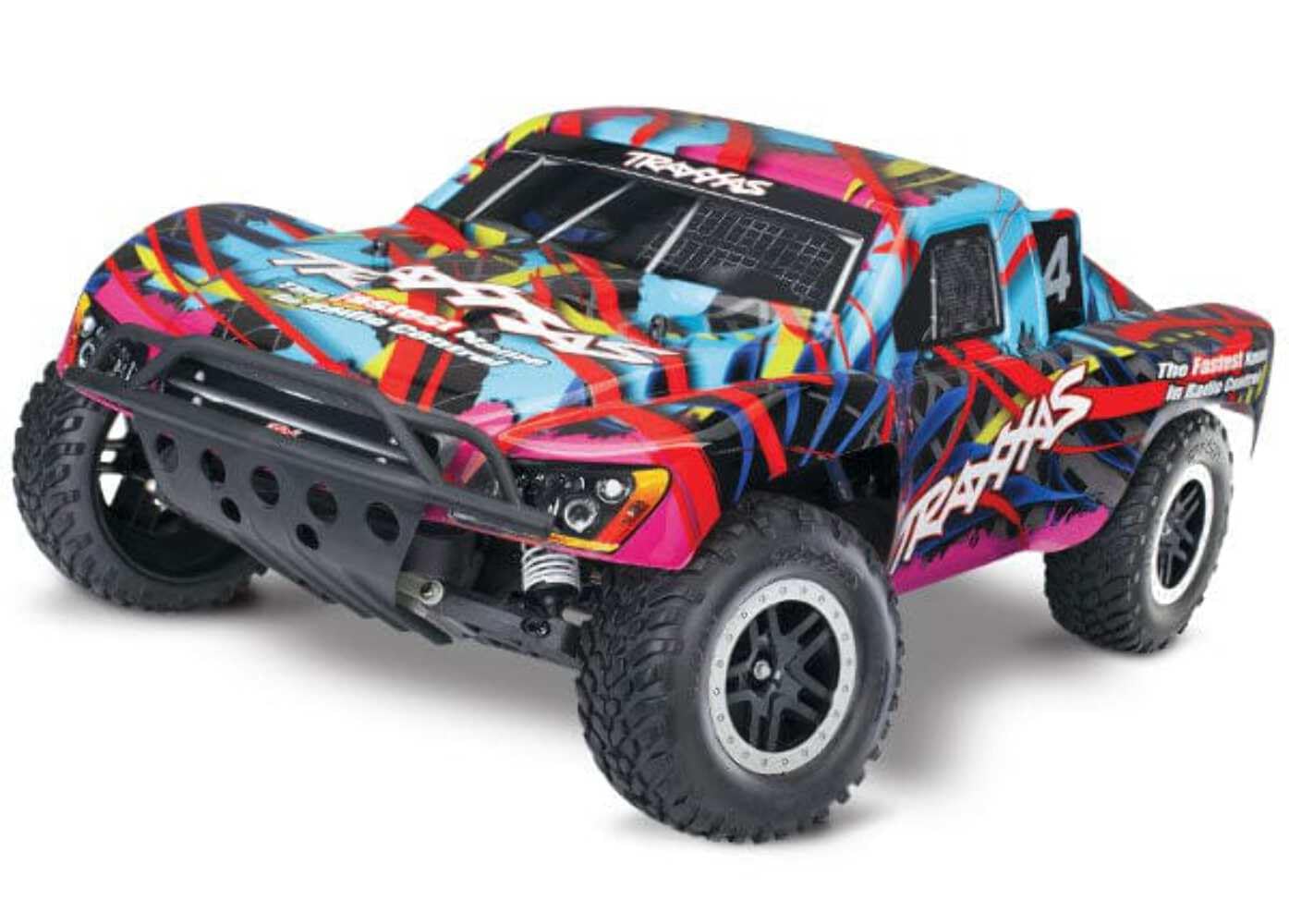
The only factory-backed name on this list with a real parts supply chain and a TRX 3.3 engine.
The Traxxas Slash is the crowd favorite for a reason — it combines a proven TRX 3.3 nitro engine with a lightweight 2WD chassis that hits 50 mph straight off the asphalt. Unlike the other picks here, this truck comes with Traxxas Electric EZ-Start, which includes its own battery and a 2-amp 12-volt DC Peak detecting fast charger, so you are not yanking a pull cord. The TQi 2.4GHz transmitter with TSM stability control actively helps keep the rear end planted during hard acceleration, a feature none of the budget trucks offer. Owners call the power “crazy” and say the truck is “outstanding and easy for a beginner to get into nitro.”
The honest caveat is that the engine is cold-blooded — several buyers report that it “will not start when cold” and use a hair dryer to pre-heat the motor. A few units arrived with the car driving itself, and the Traxxas Link module (needed for smartphone tuning) is a separate purchase. The fiber-composite monocoque chassis is tougher than it looks, but shock caps can pop off on hard jumps; aluminum caps fix that for under twenty dollars. Even so, this is the only truck here where you can walk into a local hobby shop and buy a replacement part on a Saturday.
Brand-backing you can trust: Two years of ownership stories confirm the Slash holds up better than any of the BINGXMF models, with a real US-based manufacturer standing behind it.
A cold engine needs a warm hand: The TRX 3.3 requires a warm-up ritual — a hair dryer on the head for thirty seconds — before it fires reliably.
The pick for the committed hobbyist: If you plan to run a nitro truck for more than one season and want actual dealer support, this is the one. The EZ-Start system and TSM make it far less frustrating than the cheaper competition.
Think twice if you want to open the box and drive: This is not a toy — the Slash demands a warm-up routine, break-in fuel tanks, and a willingness to learn engine tuning. An electric brushless truck would suit the instant-gratification buyer better.
3. BINGXMF 1/10 Nitro RC Car (75cc Two-Speed)

The fastest number on paper — a 90-km/h two-speed buggy with a 75cc fuel tank that runs hard until the last drop.
This BINGXMF buggy is the only car in this lineup that claims a verified 90 km/h top speed, making it 90 km/h versus the 80 km/h BINGXMF truck. That extra speed comes from the same 18CXP pull-start engine and a two-speed automatic transmission. The chassis is a 2.5mm 6061/T6 anodized aluminum plate, and the four oil-filled aluminum-capped shocks let you tune for different terrain. Owners who got a good unit call it “super fast and agile” and say it is “huge fun.”
The weakness is the pull-start mechanism — it is the single biggest failure point across the reviews. Multiple owners mention the pull start rips on day one, and the one-way bearing in the transmission can strip under hard use. Buggy owners passionately advise buying an electric starter drill as a backup. The car also requires genuine mechanical patience: one reviewer notes the transmission strips and the pull start breaks, summing it up as “mechanical understanding required.” There is no company support, so broken parts mean waiting for generic replacements.
What makes it scream
- Fastest claimed top speed on this list — a verified 90 km/h in second gear
- Two-speed automatic transmission gives a genuine shift thrill you do not get from single-speed rigs
- Anodized 6061/T6 chassis with a 2.5mm plate is race-grade material
Where it stumbles
- Pull-start mechanism fails on many units — owners recommend an electric starter drill immediately
- No manufacturer support or spare parts network; you fix or buy generic replacements
- Transmission one-way bearing can strip, locking the car in first gear
Reach for this if you love the idea of a 90-km/h gear change: The two-speed shift is addictive, and the aluminum chassis is genuinely strong. If you are willing to replace a pull cord and use a drill starter, this is a blast.
Look elsewhere if you expect a trouble-free first run: This car is not plug-and-play. The pull start will likely break, and there is no customer support. A beginner may find it frustrating without a local hobby buddy.
4. BINGXMF Nitro Drift Short Course Truck

An entry-level nitro basher that is a near-exact clone of a Redcat Lightning — familiar parts, fair price, two-speed action.
This black short-course truck is mechanically almost identical to the 80-km/h BINGXMF, but the body style and included accessories bias it toward drifting and bashing rather than pure speed runs. It shares the same 18CXP pull-start engine, the same 6061/T6 aluminum chassis, and the same two-speed automatic transmission. Owners who succeeded with the break-in report that after 10 tanks, “the engine broke in perfectly and runs great.” One describes it as an “awesome cheap little drift nitro car” that starts easy and holds its tune well.
The mixed feedback here is real — this is the only car on the list where durability, functionality, and value for money all carry a MIXED verdict from the review data. While the engine runs fine, the rear seal can fail after two weeks, the gearbox can stick in first gear after two days, and the throttle servo can fail multiple times over two months. Owners emphasize that this is an entry-level basher where plastic parts break on hard crashes. The car is a clone of the Redcat Lightning, so if you know that platform, you know exactly what you are getting: a fun but fragile nitro car that demands careful break-in and a light thumb on the trigger.
The best value transfer: This car is mechanically a known Redcat Lightning clone, so repair guides and third-party upgrades exist. For the price, you get a two-speed nitro car with a metal chassis that a Redcat owner would recognize instantly.
The fragility you must accept: The throttle servo and the rear engine seal are the most common failure points. Owners advise keeping a spare servo on hand and not bashing into curbstones — the plastic suspension parts will not survive it.
Best for the first-time nitro owner who wants a project car: If you enjoy wrenching as much as driving and want to learn how a two-speed nitro car works without spending Traxxas money, this is a fair starting point. The parts are cheap and the platform is documented.
Not for the impatient or the careless driver: This car will break if you drive it into a wall at 80 km/h, and the servos may fail even if you baby it. Plan on buying replacements before you buy the car.
Understanding the Specs
Two-Speed Automatic Transmission
A two-speed transmission uses centrifugal clutches to shift from a low gear to a higher gear as the engine revs climb. The low gear gives you strong acceleration off the line — useful for powering out of a corner or climbing a loose hill. The high gear lets the engine wind out to its peak speed on a straightaway. You will hear an audible shift as the car lunges forward, which is part of the nitro experience. A car with a single-speed transmission cannot deliver both low-end punch and top-end speed; you have to choose one.
6061/T6 Anodized Aluminum Chassis
This is a heat-treated aluminum alloy that is strong enough to handle landing from jumps without bending. The “T6” designation means it has been artificially aged for maximum hardness, and anodizing adds a corrosion-resistant layer. A chassis made from this material will survive repeated hard landings and high-speed crashes much better than a nylon or fiberglass plate. When a car lists this material, it is a direct signal that the frame is hobby-grade and not a toy-grade stamping that can snap.
FAQ
What fuel does a 1/10 nitro RC car need?
How fast does a 1/10 scale nitro car go?
How long does a nitro RC car run on a full tank?
Is a pull-start nitro car hard to start?
What is the difference between a two-speed and a single-speed nitro car?
Can I run a 1/10 nitro car on grass or dirt?
What tools do I need to maintain a nitro RC car?
How long does a nitro engine last before needing a rebuild?
What does a 1/10 scale mean for an RC car?
Is the Traxxas Slash worth the higher price over a BINGXMF truck?
Final Thoughts: The Verdict
If you want one dependable pick, the truly satisfying 1 10 nitro rc car is the Traxxas Slash 44096-3 because it combines a proven TRX 3.3 engine with real brand support and TSM stability control that keeps the truck planted at 50 mph. If you want the absolute fastest two-speed experience — a verified 90 km/h gear shift — grab the BINGXMF 75cc buggy. And for a first-time nitro owner who loves wrenching and wants the lowest entry cost, the BINGXMF drift truck is a fair place to learn, as long as you budget for servo replacements and a drill starter. The crowd favorite is without a doubt the Traxxas — it has the highest rating and the most repeat-buyer stories — and that is the one we recommend if you want a nitro car that will still be running next year.
How We Picked
We do not accept paid placement. Every pick is matched to a real buyer and a real use-case; we do not hands-on test units.
Sources & Methodology
Specifications: manufacturer listings and product documentation. Review insights: verified customer reviews, as of July 2026. Pricing: not shown on this page (it changes often); check the current price via the retailer link.
As an Amazon Associate, Trending Car earns from qualifying purchases. This does not affect which products we feature.