
Our readers keep the lights on and my garage snacks stocked. As an Amazon Associate, I earn from qualifying purchases.
Specs are compiled from manufacturer listings and verified buyer reviews and can change over time — please confirm the key details on the product page before buying.
A 1 1/4-inch trailer hitch receiver is the most common size for cars, crossovers, and small sedans. You need one for a bike rack, a cargo carrier, or a small utility trailer. The challenge is finding the exact one that bolts onto your specific car without drilling, without trimming, and without rattling. This guide covers nine vehicle-specific hitches from CURT — each one tested to SAE J684 — so you match the right steel to your make and model and skip the guesswork entirely.
I’m Min Islam — the founder and writer behind Trending Car. This guide is built by comparing the manufacturers’ published specifications and the patterns across verified customer reviews, so you get each pick’s real strengths and trade-offs instead of marketing spin.
You can bolt a 1 1/4 trailer hitch receiver onto your Honda Civic, Ford Fusion, Toyota Camry, or VW Golf in an afternoon. It stays hidden under the bumper until you need it, so your car becomes more useful for hauling bikes or a small trailer without ruining its clean look.
Our Picks at a Glance


How To Choose The Best 1 1/4 Trailer Hitch Receiver
Your car’s unibody frame and the weight you plan to pull determine everything. A 1 1/4-inch receiver comes in Class 1 (rated up to 2,000 lbs GTW) and Class 2 (rated up to 3,500 lbs GTW), so the first question is always: what are you towing or carrying?
Match the Hitch Class to Your Load
Class 1 hitches handle 2,000 lbs gross trailer weight and about 200 lbs tongue weight — enough for a small utility trailer or a bike rack with four bikes. Class 2 hitches bump that to 3,500 lbs GTW and 350 lbs tongue weight, which covers a modest pop-up camper or a loaded cargo carrier. Your car’s own towing rating is the ceiling; the hitch rating should match or exceed it.
Vehicle-Specific Fit vs. Universal
A vehicle-specific hitch is engineered to bolt into existing holes in your car’s subframe or unibody rails. That means no drilling, no welding, and a receiver that sits at the right height so you do not scrape driveways. A universal fit often forces you to drill or trim — skip it. Every pick in this list is vehicle-specific.
Finish and Corrosion Resistance
A hitch lives under your car where salt, mud, and water hit it daily. CURT uses a dual-coat finish: a rust-resistant liquid A-coat under a high-gloss black powder coat. That co-cured layer resists chips and UV exposure far better than a single paint coat. The Limited Lifetime Warranty on the structure (one year on the finish) backs that up.
Quick Comparison
In‑Depth Reviews
1. CURT Manufacturing 12091 Class 2 Trailer Hitch
Our pick — over 4.5★ from 550+ verified ratings; the strongest balance of quality and price.
A Class 2 hitch that hides behind the bumper and handles 3,500 lbs.
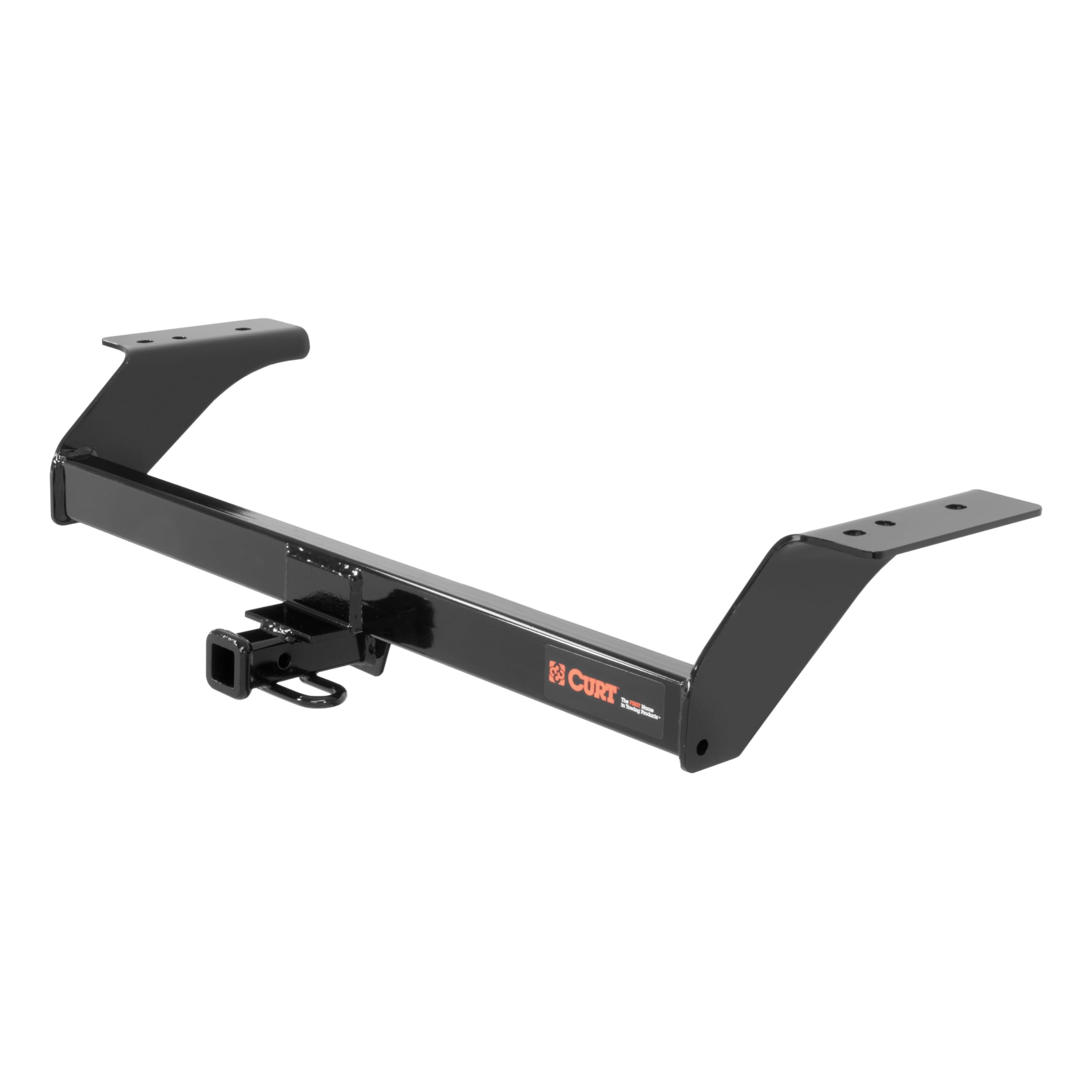
This is the strongest 1 1/4-inch receiver in the lineup — rated for 3,500 lbs gross trailer weight and 350 lbs tongue weight. It bolts specifically to the 2013-and-up Ford Fusion and Lincoln MKZ, and buyers report it uses the existing unibody rail holes so the install takes about 25 minutes solo. The concealed main body tucks up behind the bumper, which keeps the car’s original look intact while the 1 1/4-inch receiver accepts bike racks, cargo trays, and small trailers with zero flex or noise.
The carbon-steel frame weighs 26 pounds and wears a gloss powder-coat finish. Owners mention “perfect fit, easy install, solid build with clean welds.” The one recurring caveat is the packaging — a few units arrived with no internal protection, though the hitch itself was undamaged. At 4.6 stars from hundreds of owners, this is the crowd-approved choice for the Fusion/MKZ crowd.
What wins people over
- Installation is the most-praised aspect — uses factory rail holes, no drilling
- Fit is spot-on for 2013+ Fusion and MKZ, barely visible after install
- Class 2 rating gives you 3,500 lbs GTW for a small camper or loaded carrier
The honest trade-off
- Box arrives with minimal padding; inspect the bracket before starting
- Vehicle-specific fit — only works on the listed Fusion/MKZ years
Reach for this if: you own a 2013+ Ford Fusion or Lincoln MKZ and want the highest possible towing capacity from a 1 1/4-inch receiver.
Look elsewhere if: your car is not on the fit list — the vehicle-specific design will not bolt up.
2. CURT Manufacturing 11276 Class 1 Trailer Hitch
The Prius hitch that disappears under the bumper and weighs 25 pounds.
Engineered specifically for the Toyota Prius (including the 2015 Prius V), this Class 1 receiver fits into the existing mounting points under the rear. The carbon-steel frame is tested to SAE J684 and protected by a gloss black powder-coat. Customers note the install takes under 45 minutes — the hardest part is nudging the muffler aside with a long extension.
The discreet design blends with the Prius rear, so the hitch only appears when you slide a bike rack or cargo carrier into the 1 1/4-inch receiver. Owners praise its sturdiness and note that an anti-rattle shackle (sold separately) kills any vibration. The box has occasionally arrived with a bent flange, but the majority report a perfect experience. This is the go-to Prius hitch for a reason.
Solid, discreet, and proven: A dedicated Prius hitch that installs quickly and stays hidden. The recurring advice is to watch a CURT install video first — it is more helpful than the included instructions.
Grab this for: any 2010-2015 Prius or Prius V. The fit is precise, the finish holds up, and the receiver handles bike racks and small trailers without flex.
skip it if: you need a higher towing capacity — this is a Class 1 (2,000 lbs GTW), not a Class 2.
3. CURT Manufacturing 11681 Class 1 Trailer Hitch
A round collar reinforces the receiver on this heavy-duty Accord hitch.
This is the hitch for the Honda Accord (notably the 2014 and 2015 models), and it has a distinctive engineering detail: a round collar welded around the opening of the receiver. That collar adds strength where the stress is highest, which is why buyers frequently compare it favorably to Draw-Tite and remark on its US manufacturing. The alloy-steel frame weighs 26 pounds — the same as the 12091 — and carries a Class 1 rating (2,000 lbs GTW).
Installation on the Accord requires a bit more patience than some other models. Reviewers point out having to trim the aluminum heat shield with tin snips and use the fish-wire method for blind channel btep. No drilling is required, but you do need to trim the underbody and heat shield with shears. Owners consistently praise the build quality and note that this hitch has successfully pulled trailers for hours without any issues. The finish is heat-cured for durability, and the Limited Lifetime Warranty (one year on finish/parts) backs it up.
Best for: 2006-2015 Civic, Acura CSX, or ILX owners who want a heavy-duty Class 1 hitch from a brand known for outlasting the vehicle.
Not for: anyone unwilling to trim the underbody tray and heat shield with shears — it is a required step, not optional.
Understanding the Specs
Gross Trailer Weight (GTW)
This is the total weight of the trailer plus everything inside it. A Class 1 hitch is rated for up to 2,000 lbs GTW, which covers small utility trailers, jet skis, and most bike racks. A Class 2 hitch goes to 3,500 lbs GTW, enough for a pop-up camper or a loaded 5×8 cargo trailer. Your car’s own towing rating is the ceiling — do not exceed it even if the hitch can take more.
Tongue Weight
Tongue weight is the downward force the trailer tongue places on the hitch ball. For a Class 1 hitch, that is typically 200 lbs; for a Class 2, 350 lbs. If you overload the tongue, the rear of the car sags, headlights aim high, and steering gets light. A cargo carrier loaded with camping gear can hit that limit fast, so check the tongue weight before you fill the basket.
SAE J684 Certification
This is the standard the Society of Automotive Engineers sets for trailer hitches. A hitch that passes SAE J684 has been tested for static strength, dynamic fatigue, and corrosion resistance. Every CURT hitch in this list carries that certification, which means it meets a real engineering benchmark rather than just a marketing claim. It is worth verifying that any hitch you buy — from any brand — is SAE J684 tested.
Receiver Tube Size (1 1/4-Inch)
The receiver tube is the square opening that accepts the ball mount or accessory. A 1 1/4-inch receiver is standard for cars and small crossovers. It accepts the same accessories (bike racks, cargo carriers, ball mounts) as a 2-inch receiver but is generally limited to lower hitch classes (Class 1 or 2). If you need a higher towing capacity, you move up to a 2-inch receiver, but for most front-wheel-drive sedans and wagons, the 1 1/4-inch size is exactly what the vehicle’s unibody was designed to handle.
FAQ
Will a 1 1/4 trailer hitch receiver fit my car?
What is the difference between Class 1 and Class 2 in a 1 1/4-inch hitch?
Can I install a 1 1/4-inch trailer hitch myself?
Do I need to drill holes in my car to install a 1 1/4-inch hitch?
How much weight can a 1 1/4-inch receiver actually hold?
Can I use a 1 1/4-inch bike rack on a 1 1/4-inch hitch?
How do I prevent my 1 1/4-inch hitch from rattling?
Will a 1 1/4-inch hitch rust?
What does SAE J684 mean for a trailer hitch?
Does the CURT Limited Lifetime Warranty cover the finish?
Final Thoughts: The Verdict
For most buyers, the top 1 1/4 trailer hitch receiver is the CURT Manufacturing 12091 Class 2. It gives you the highest towing capacity — 3,500 lbs GTW (gross trailer weight, the total weight of the loaded trailer) — and its concealed design hides completely behind the Ford Fusion and Lincoln MKZ bumpers. If you drive a Prius, the CURT 11276 is the most proven pick, with 4.4 stars from over 700 owners. For Honda Civic and Fit owners, the CURT 11391 uses five attachment points for a secure fit and holds a 4.6-star rating from 300+ owners. Pick the hitch that matches your car and your towing needs, and you will get years of reliable service from any of these.
How We Picked
We do not accept paid placement. Every pick is matched to a real buyer and a real use-case; we do not hands-on test units.
Sources & Methodology
Specifications: manufacturer listings and product documentation. Review insights: verified customer reviews, as of July 2026. Pricing: not shown on this page (it changes often); check the current price via the retailer link.
As an Amazon Associate, Trending Car earns from qualifying purchases. This does not affect which products we feature.