
Our readers keep the lights on and my garage snacks stocked. As an Amazon Associate, I earn from qualifying purchases.
Specs are compiled from manufacturer listings and verified buyer reviews and can change over time — please confirm the key details on the product page before buying.
A 1 1/4 inch wrench is not a tool you reach for every day. But when that big nut on your trailer hitch, water pump pulley, or truck axle needs to come off, the wrong wrench means a stripped fastener and a wasted afternoon. These picks actually fit right, grab hold, and survive the torque without rounding anything off.
I’m Min Islam — the founder and writer behind Trending Car. This guide is built by comparing the manufacturers’ published specifications and the patterns across verified customer reviews, so you get each pick’s real strengths and trade-offs instead of marketing spin.
You need raw power, a tight-space angle, or a ratchet to save your knuckles. The right 1 1/4 in wrench makes a massive job feel routine.
Our Picks at a Glance

How To Choose The Best 1 1/4 In Wrench
A 1 1/4 inch wrench lives in a different world than a standard 10mm. You are not turning small bolts — you are cranking on large axle nuts, hydraulic fittings, and hitch balls that demand serious leverage. The wrong choice here leaves you with a slipped knuckle or a rounded bolt head. Here are the three factors that matter most.
Construction and Steel Type
Chrome vanadium steel (a steel alloy mixed with chromium and vanadium for hardness and rust resistance) is the benchmark for a reason. It handles high torque without bending or snapping. Chrome plating then protects against rust, which matters when this wrench sits in your toolbox for months until its one big job comes up. Forgings with raised-panel or beam designs add strength where the stress concentrates. A weaker alloy can flex and permanently twist under a heavy load. The data shows buyers consistently rate quality — meaning the steel and its heat treatment — as the top positive aspect across nearly every model.
Head Design: Offset and Ratcheting
A simple straight wrench does not work in tight engine bays. A 15-degree offset (a bend in the box end that angles the handle away from the fastener) on the box end lets you clear your knuckles against a frame rail. Some wrenches go to 45 or even 60 degrees for extreme obstructions. Ratcheting box ends (a box end with internal gears that let you turn without lifting the tool) add speed: you do not lift the tool off the fastener between turns, which is a huge relief when the swing arc is just a few degrees. The trade-off is a slightly thicker head and a mechanism that can wear over time if the internal teeth are not hardened steel. Look for 72-tooth or 90-tooth ratchets for the tightest swing — 5 degrees vs 4 degrees can make the difference in a cramped spot.
Length and Leverage
The length of the wrench dictates the torque you can apply. A 16-inch handle gives you significantly more turning force than a 13-inch one. But if every inch of clearance matters, a shorter wrench might be the only one that fits. The weight also climbs with length — 1.1 pounds to over 2 pounds — so if you plan to carry it in a trail kit or road bag, lighter steel wins. the balance for most heavy jobs around the house or truck is a 14- to 16-inch handle. That gives you enough mechanical advantage without turning the tool into an awkward sledgehammer.
Quick Comparison
| Model | Best For | Length | Weight | Head Type | Amazon |
|---|---|---|---|---|---|
| OEMTOOLS 22104★ Best Overall | Max Leverage & Torque | 16 inches | 1.7 pounds | Open End & Box End | Check |
| MAXPOWER ComboBest Value | Budget-Friendly Durability | — | — | 12-Point Box End | Check |
| HHIP 7023-1020Sturdy Workhorse | Strength for Sacrificial Mods | — | — | Open End & 15° Box | Check |
| SUNEX TOOLS 991414A | Lightweight & Dual-Angle | — | 1.1 pounds | 15°/60° Angled Open End | Check |
| TEKTON WBE23329 | Deep Clearance & Chrome Finish | — | 1.3 pounds | 45° Offset Box End | Check |
| Powerbuilt 644155 | Polished Build Quality | — | 1.9 pounds | Box End & Open End | Check |
| Meccion Ratcheting | Versatile Ratcheting Access | 15.55 inches | 2 pounds | Open End & 72-Tooth Ratchet | Check |
| TIGHTSPOT Ratcheting | Ultra-Tight Swing Arc | — | — | 90-Tooth Ratcheting Box | Check |
| GEARWRENCH 86956 | Pro-Grade Ratchet Quality | 13.56 inches | 2 pounds | 12-Point Ratcheting Box | Check |
In‑Depth Reviews
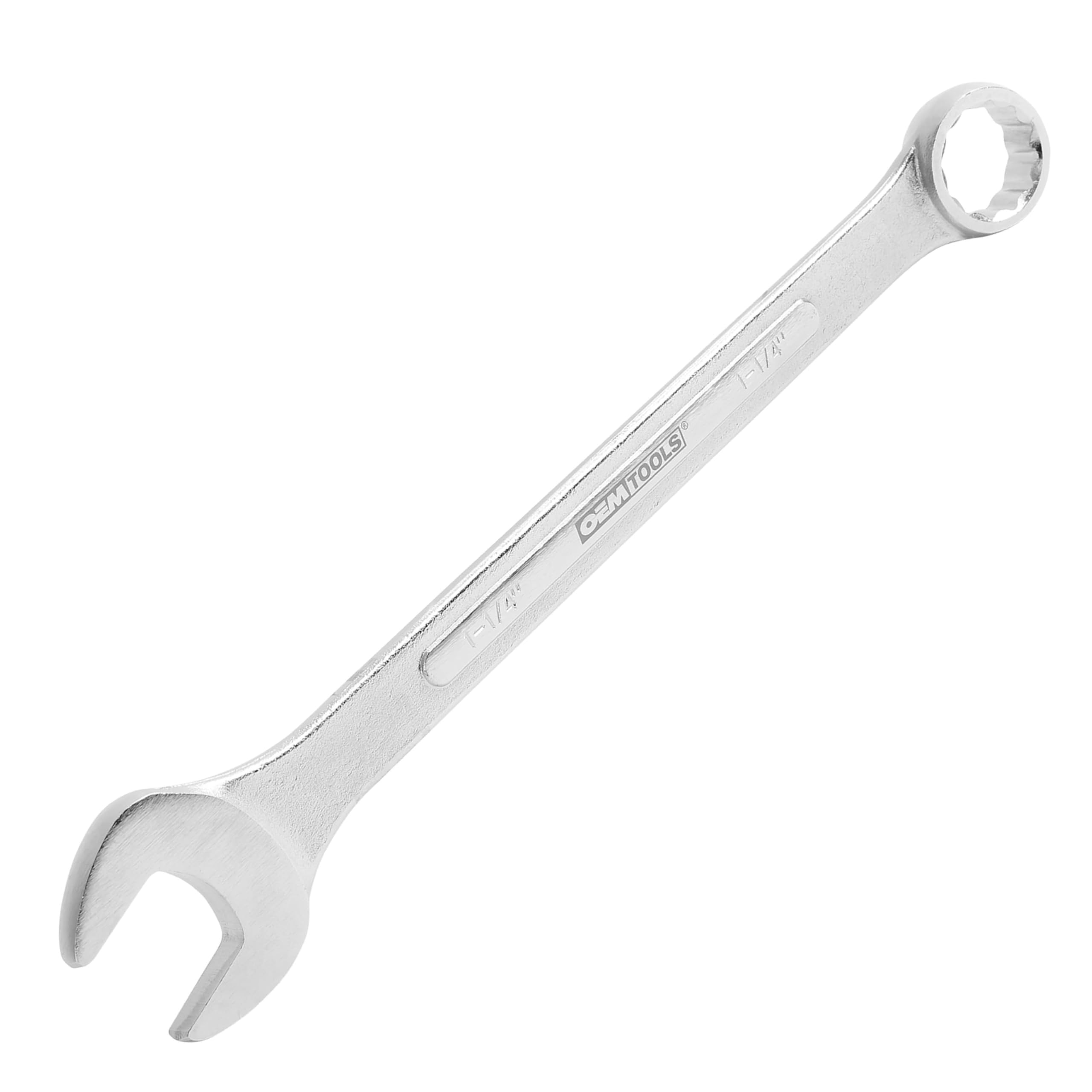
1. OEMTOOLS 22104 1-1/4″ Jumbo Wrench
Our pick — over 4.5★ from 900+ verified ratings; the strongest balance of quality and price.
The long-shaft lever arm that takes the fight out of the toughest 1 1/4 inch bolt.
What wins people over is the quality of the steel and the sheer leverage. At 16 inches long and 1.7 pounds, this alloy steel wrench gives you the mechanical advantage to crack loose a stubborn U-haul hitch ball nut or a water pump bolt without reaching for a cheater pipe. The open end features a continuous curve design that pushes stress back into the body, so you get more strength at the jaw without it spreading open under load.
The box end uses a radius corner design (a system that contacts the flat sides of the fastener, not the corners) that grabs the flats of the fastener rather than the corners. That alone provides 15 to 20 percent more torque while protecting the bolt head from rounding. Owners confirm this is a lifesaver on rear axle nuts and trailer hitches. The chrome finish keeps corrosion away, and the hard chrome plating stays clean even after messy jobs. The crowd favorite — a 4.8 star average across a massive number of owners — puts this comfortably ahead.
Leverage King: The 16-inch shaft and radius corner box end deliver remarkable torque without damaging fasteners — the single most common theme in owner feedback.
The Verdict: Brute strength to crack stubborn bolts, but skip it if you need a ratcheting action to work in a super tight swing arc.
Best for: Trailer hitch bolts, large axle nuts, and anyone who wants brute strength without rounding fasteners.
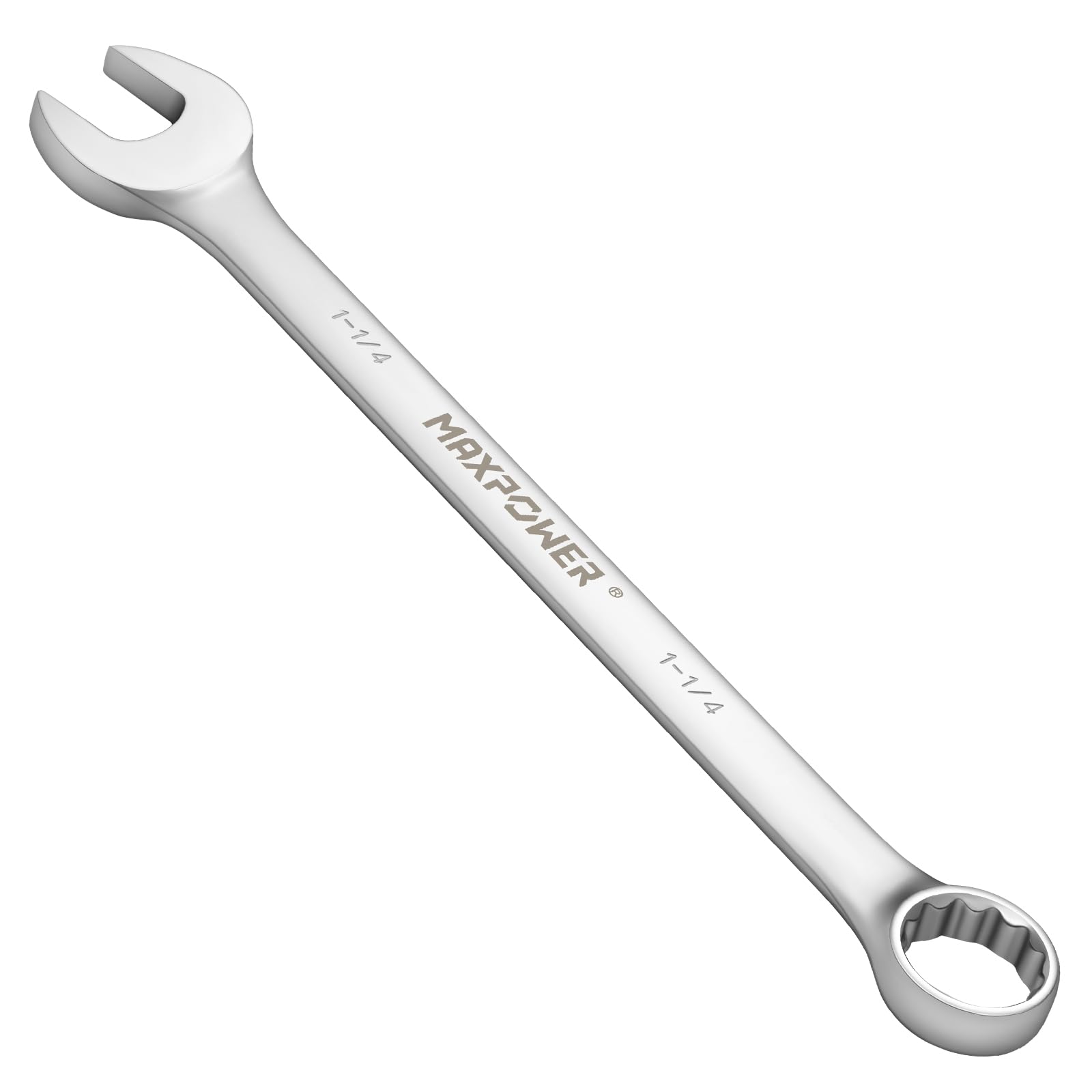
2. MAXPOWER 1-1/4 Inch Combination Wrench
Drop-forged chrome vanadium steel at a price that punches well above its class.
The build quality here is the headline: drop-forged and heat-treated chrome vanadium steel gives this wrench serious toughness for the cost. A precision-machined 12-point box end (a box end with 12 contact points that engage the fastener every 30 degrees) provides more grip and less wear than a standard 6-point, while the 15-degree offset gives your fingers clearance against obstructions. The off-corner design focuses force on the flats of the fastener, which prolongs the tool life and reduces wear on your bolts.
Buyers report it is heavy duty and fits the nut correctly. A few note the size runs very slightly large for some applications, so test-fit on your specific fastener before applying full torque. The sand-blasted, corrosion-resistant finish helps this one survive in a damp garage or truck bed tool box. The price keeps it among the most accessible options on this list without sacrificing steel integrity.
Solid Foundation: Chrome vanadium steel and off-corner loading at a very accessible price — tough to top for light to medium-duty use.
Watch For: A small batch of owners found the fit slightly loose on some fasteners, so confirm before torquing critical bolts.
Reach for this if: You want professional-grade steel and a 12-point box end without paying a premium. Look elsewhere if you need a ratcheting mechanism.
3. HHIP 7023-1020 Combination Wrench, 1-1/4″
A forged steel wrench that one owner literally threw their full body weight at and only bent 1 or 2 degrees.
The strength of this wrench is not just a claim — owners back it up. One buyer wedged the HHIP into a solid object, held the body in a vise, and pushed and pulled with their full body weight, bending it maybe a single degree or two. That is forged steel doing its job. The polished head and clear size marking make it easy to grab the right tool quickly, and the combination open end and 15-degree offset box end handle both quick slides and full-grip torque.
The general consensus among owners is that this is a solid, accurate wrench with a good finish, especially considering the price. The versatility is also praised, with one owner calling it perfect for regulating Loveland Harp Levers. The fit and size get mixed feedback — some find it right on, others say it is loose. The lack of chrome plating (brushed finish) means it may show surface rust faster than polished alternatives if left in a damp environment.
Brute Resilience: Forged steel that can handle extreme abuse without breaking — real-world tested by owners.
The Trade-Off: The brushed finish is more prone to surface rust than chrome-plated competitors; keep it in a dry drawer.
Best for: Heavy twisting where you might need to modify or abuse the tool. pass on it if you want a mirror-polish garage queen.
4. SUNEX TOOLS 991414A 1-1/4-Inch Angled Wrench
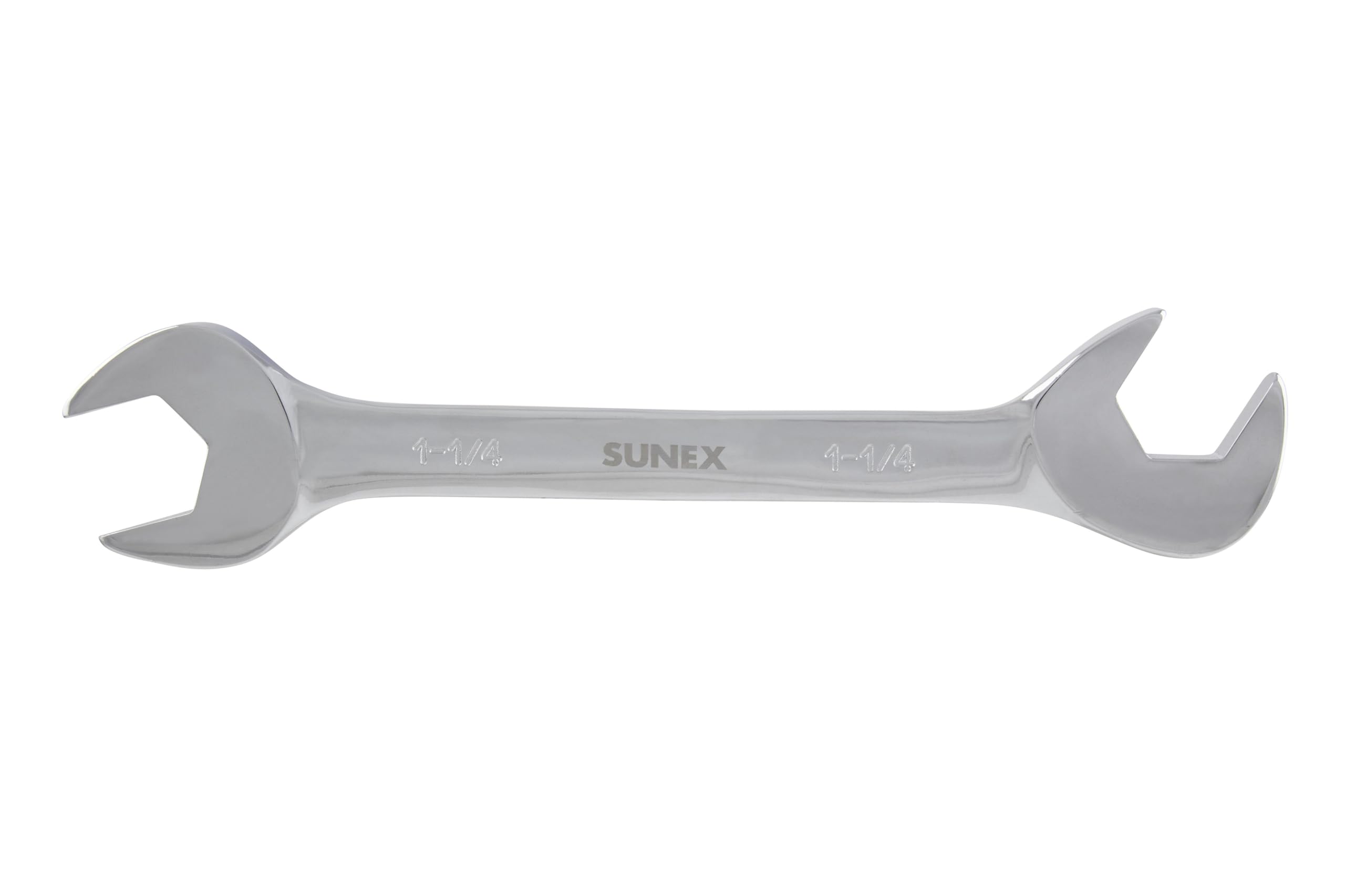
Two angles — 15 and 60 degrees — let you turn a fastener where a straight wrench cannot fit.
This is the lightest option on the list at just 1.1 pounds, compared to the OEMTOOLS at 1.7 pounds. The dual-angle design (15-degree on one end, 60-degree on the other) is what separates it. You can reach around a hydraulic line or a frame rail without needing a second tool. Owners confirm it works perfectly on marine steering systems and for changing oxygen and acetylene gouges. The polished drop-forged alloy steel resists corrosion and feels stout in the hand.
The quality and functionality earn the most praise — this is not a fragile specialty tool. Some owners mention the size runs a hair large; checking the fit before a critical job is smart. One owner cut theirs in half with a Dremel to create a custom tool for a Jeep transfer case cable, which speaks to the steel being workable if you need to modify it. The weight saving is real, and for mobile kits or tool rolls, that matters.
Dual-Angle Advantage: 15 and 60-degree ends cover two common tight-spot scenarios with one light tool.
One Note: It is not a ratcheting wrench, so you must lift and re-seat on every partial turn.
Reach for this if: You work in confined engine bays or need the lightest 1 1/4 inch tool for a travel kit.
5. TEKTON 1-1/8 x 1-1/4 Inch 45-Degree Offset Box End Wrench

The 45-degree offset that slid right onto a Ford 7.3 banjo bolt without bending anything.
The defining spec here is the 45-degree offset on both box ends. That extra clearance lets you reach around obstructions and keep your fingers away from hot or sharp components. The 12-point box end fits 6-point (six contact surfaces, maximum grip), 12-point, and even square fasteners, which adds versatility for oddball jobs. The radiused corners (rounded edges inside the box end) apply force to the flat sides of the fastener — not the corners — which is your best defense against rounding an expensive bolt.
Owners praise the polished chrome finish and the balance. One used it to remove a 7.3 Powerstroke IPR under the turbo without a struggle. Another confirmed it works perfectly for 3/8 brake bleeder valves. The dual-size head (1-1/8 x 1-1/4) gives you two sizes in one tool, which is a space saver in a crowded toolbox. The grip gets mixed feedback — some wish for a textured handle, but the satin chrome does the job. Backed by a generous warranty with no time limits and no receipt needed.
Two-Size Smart: A 1-1/8 and 1-1/4 inch box end in one tool with a 45-degree offset that clears tight engine bays.
Consider This: It is a non-ratcheting box end only — no open end for slip-on speed.
Best for: Diesel owners and anyone working around a turbo or exhaust manifold where clearance is measured in millimeters.
6. Powerbuilt 1-1/4 inch SAE Combination Wrench 644155

A mirror-polished chrome vanadium wrench that looks as good as it works on old tractor bolts.
The finish is the first thing you notice. Powerbuilt uses a mirror-polished chrome vanadium steel construction that resists corrosion and wipes clean easily. But the real engineering is the Z-Drive box end, which contacts the flat walls of the fastener — not the corners — for a stronger, safer grip. The 15-degree offset and chamfered walls (beveled edges that help the wrench slide onto the fastener) make it easy to mate the wrench to the fastener without fumbling. It meets or exceeds ANSI specifications (American National Standards Institute), so the manufacturing standard is documented.
Owners find it solid, well balanced, and fairly priced. One bought it for an old Massey Ferguson tractor and confirmed it fits almost everything on it. The weight is a substantial 1.9 pounds, which is the heaviest among the standard combination wrenches here. That heft gives confidence, but it also means this tool is not a pocket carry. Some customers note the fit can be slightly small on certain fasteners, so try it before committing to a high-torque job.
Polished Performance: Z-Drive technology prevents rounding while the chrome finish stays pristine through years of use.
The Weight Trade-Off: At 1.9 pounds, this is a bench tool, not a trail companion.
Reach for this if: You appreciate a beautiful, ANSI-spec wrench that can handle tractor, motorhome, and heavy equipment fasteners.
7. Meccion Combination Wrench 1-1/4 Inch SAE Open End Ratcheting Wrench
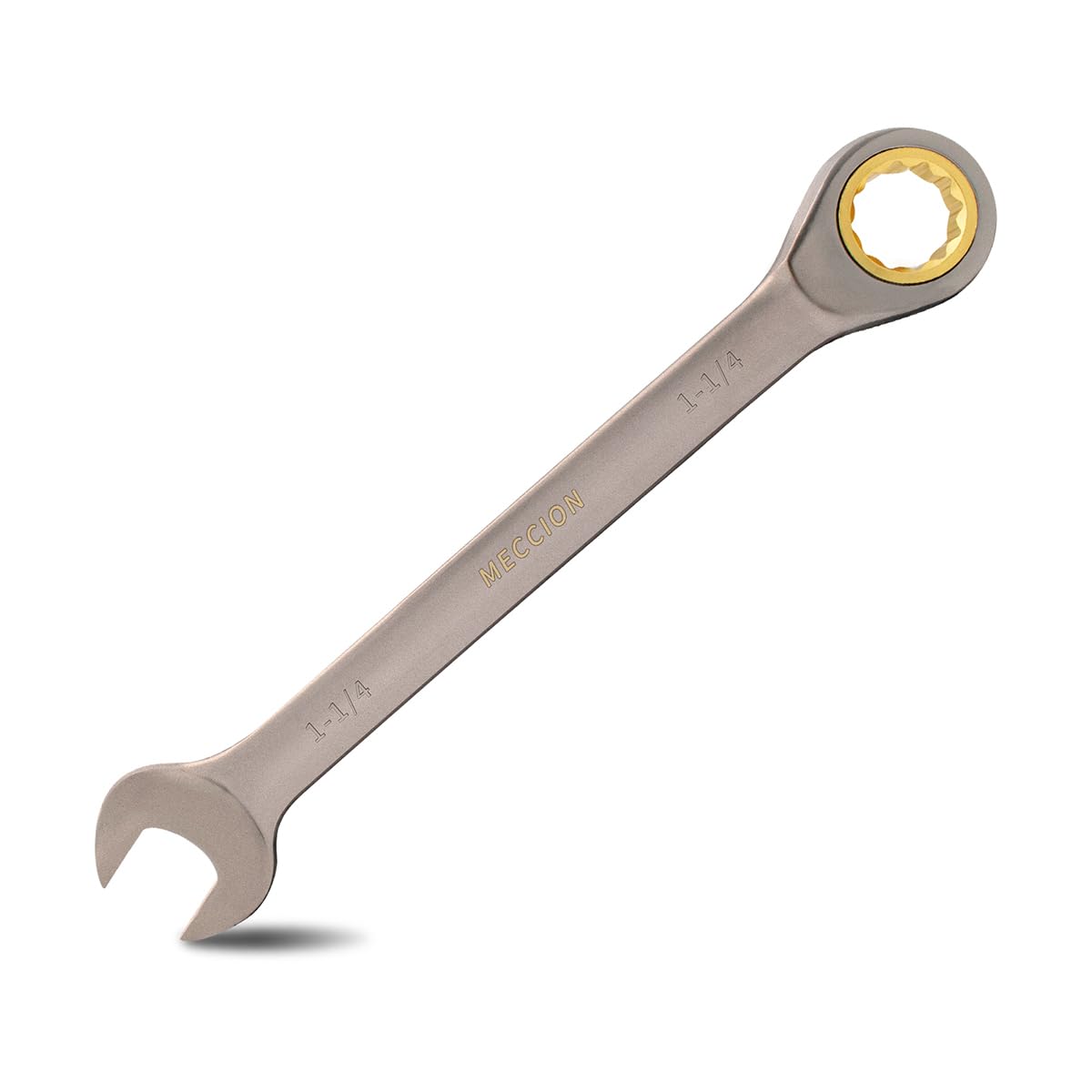
A 72-tooth ratchet that needs only 5 degrees of swing to turn the fastener.
This is for the job where you cannot swing a full arc. The 72-tooth ratchet mechanism and 12-point design mean just 5 degrees of movement gets the bolt turning — no lifting and re-seating. The open-end ratchet also works in applications where a box end cannot slip over the fastener. Made from chrome vanadium steel with a grey nickel-plated finish, it resists rust and holds up to regular use.
Owners call it a reliable tool that works as intended for infrequent heavy jobs. The quality and reliability get consistent praise. The ratchet performance and value for money receive more mixed feedback — a few owners found the mechanism not as smooth as premium brands, and some consider it a waste of money if you are a professional turning wrenches daily. At 2 pounds and 15.55 inches long, it brings both length and a ratchet mechanism in one tool. It is great for home, DIY, and automotive work.
Confined Space Hero: 5-degree ratchet swing works where a standard wrench cannot fit, and the open end gives you on-the-fly access.
Mixed Reviews: The ratchet mechanism gets mixed feedback — adequate for occasional use, but not the smoothest for daily pro work.
Best for: DIYers and weekend mechanics who need ratcheting convenience on a budget. it’s not for you if you rely on your wrench every day for a living.
8. TIGHTSPOT 1-1/4 Inch Combo Ratchet Wrench
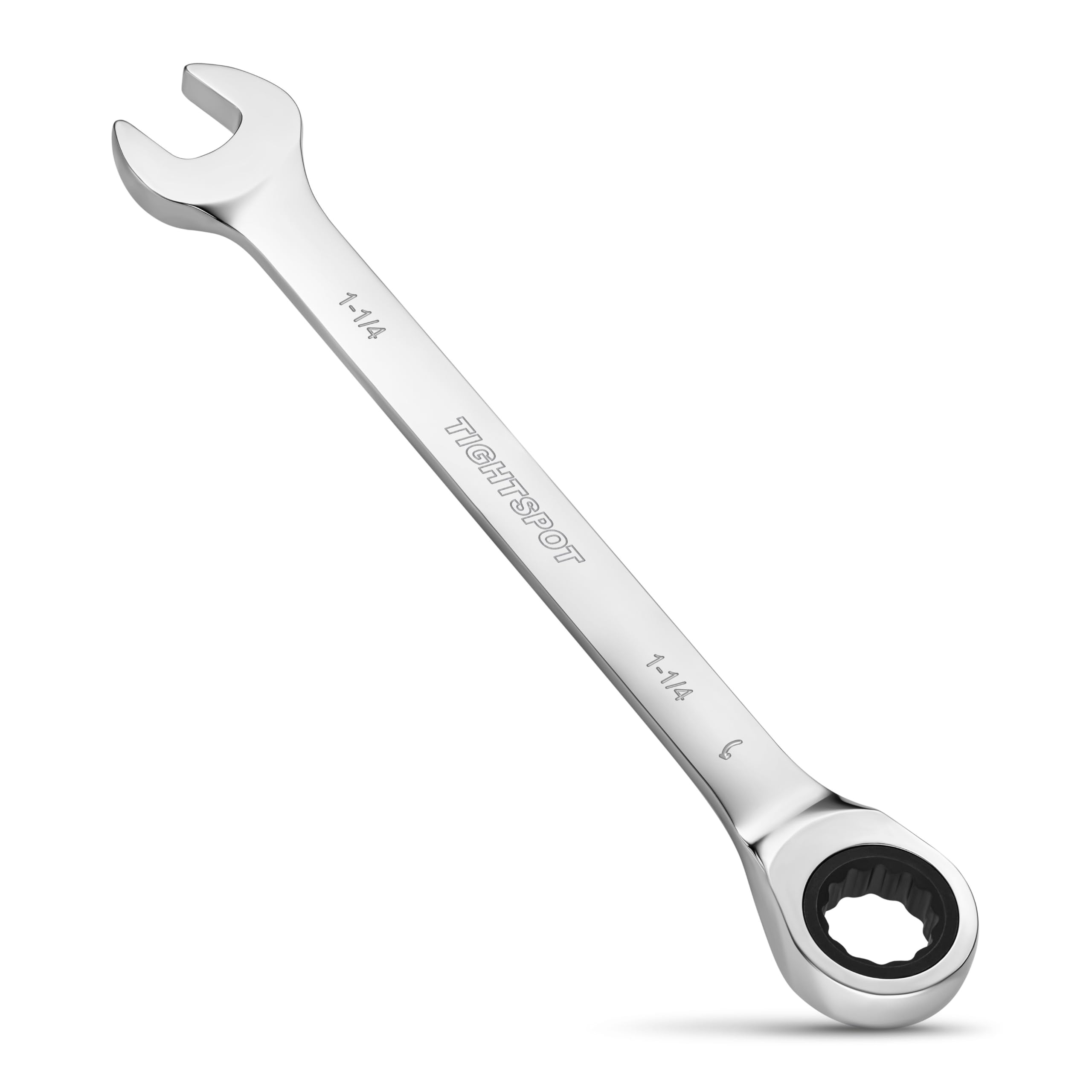
A 4-degree ratchet swing — tight enough to turn a bolt in spaces that would strand a standard wrench.
The TIGHTSPOT name is not marketing fluff. This wrench packs 90 teeth inside a 100 percent steel ratcheting box end, giving you a 4-degree swing arc. That is the tightest on this list, beating the Meccion’s 5-degree arc. You do not lift the tool off the fastener, so you stay engaged even when reaching deep into a compartment or appliance. The 7-stage construction involves drop forging and heat treating the steel alloy, with aerospace-grade vanadium added to harden it further and chromium to fight corrosion.
Owners confirm the quality is solid and the size is not too small — it fills the hand well. One uses it for bike rack installation, another keeps it in the trunk specifically for that purpose. The reinforced open end grabs hard to reduce bolt rounding. Backed by a no-questions-asked satisfaction guarantee, which adds confidence. The grip is comfortable, and the build feels ready for years of service. For the tightest possible fastener access in a 1 1/4 inch wrench, this is the specialist.
Tightest Swing on the List: 90 teeth and a 4-degree arc mean you can work in almost any pocket of space.
The Trade-Off: The premium on tight-access engineering means a higher price than most standard combination wrenches.
Reach for this if: You work in appliance repair, HVAC, or any environment where a full swing is impossible.
9. GEARWRENCH 1-1/4″ 4 Degree Swing Arch 12 Point Ratcheting Combination Wrench 86956
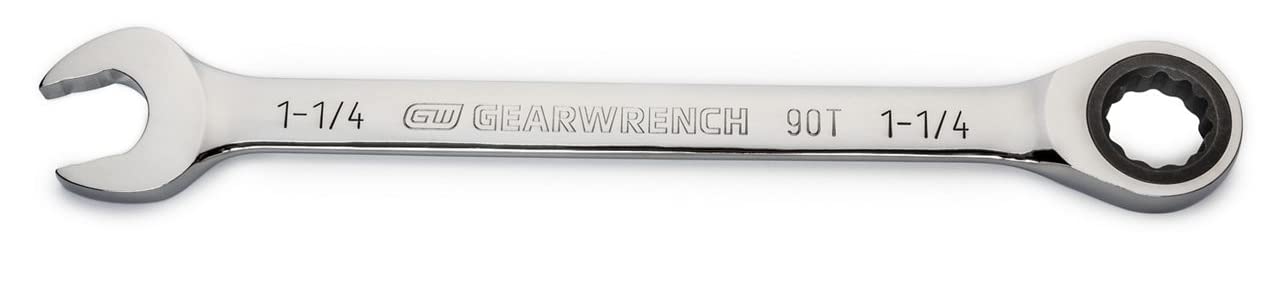
The name brand that professional mechanics trust for a fine-tooth ratchet that does not skip.
GEARWRENCH is a known quantity in professional circles, and this 1 1/4 inch single fills a gap in many sets. The 90-tooth, 12-point ratcheting box end gives a 4-degree swing and works on both 6 and 12-point fasteners. The off-corner loading design on the box end provides better grip and actively reduces fastener rounding — a feature shared with the best on this list. The open end also uses dual-direction off-corner loading, so even the open jaw grabs the flats.
Owners call it professional grade, great for both DIY and daily shop use. The quality and fine tooth ratchet earn consistent praise. At 13.56 inches long and 2 pounds, it is slightly shorter than the Meccion’s 15.55 inches but still provides ample leverage for big fasteners. The warranty is a standard limited lifetime. A few reviewers point out durability concerns with the ratchet mechanism — some internal teeth have stripped on early units, so heavy constant use may test it. But for filling a gap in a set or adding a ratcheting 1 1/4 to your box, this is the established choice.
Trusted Name: Off-corner loading on both ends and a fine 90-tooth ratchet — the professional standard for a reason.
One Caveat: Some owners note the ratchet can fail under extreme or daily industrial use; the lifetime warranty helps here.
Best for: Professional mechanics and serious DIYers who want a reliable ratcheting 1 1/4 from a brand they already trust.
Understanding the Specs
Off-Corner Loading vs Standard Contact
A standard wrench jaw grips the corners of a bolt. That concentrates all the force on the weakest part of the fastener, which is why bolts round off. Off-corner loading — sometimes called a radius corner design — pushes the force onto the flat sides of the bolt. The result is significantly more torque before the fastener rounds, and longer life for both the tool and the bolt. It is the single biggest advancement in wrench design in decades.
Ratcheting Teeth Count and Swing Arc
The number of teeth inside a ratcheting box end determines how much you need to rotate the wrench before it catches again. A standard 72-tooth ratchet needs 5 degrees of swing. A 90-tooth ratchet reduces that to 4 degrees. That one degree matters when you are working in a pocket of space between an engine block and a frame rail. More teeth also mean the mechanism engages faster, which speeds up repetitive tasks like bleeding brakes or cycling a nut on and off.
FAQ
Will a 1 1/4 inch wrench fit a standard trailer hitch ball nut?
Is a 15-degree offset enough to clear obstructions in an engine bay?
Which is better for a 1 1/4 inch wrench: chrome vanadium or alloy steel?
Can I use a 1 1/4 inch impact wrench instead of a manual wrench?
What is the difference between a 6-point and 12-point box end on a 1 1/4 inch wrench?
How do I store a large 1 1/4 inch wrench to prevent rust?
Is a ratcheting 1 1/4 inch wrench worth the extra cost over a standard combination wrench?
Will a 1 1/4 inch wrench fit a 1 1/4 inch hydraulic fitting?
How long does a quality 1 1/4 inch wrench last?
Final Thoughts: The Verdict
For the majority of shoppers, the 1 1/4 in wrench winner is the OEMTOOLS 22104 because its 16-inch shaft and radius corner box end deliver class-leading torque without rounding fasteners. If you