
Our readers keep the lights on and my garage snacks stocked. As an Amazon Associate, I earn from qualifying purchases.
Specs are compiled from manufacturer listings and verified buyer reviews and can change over time — please confirm the key details on the product page before buying.
Enlarging a predrilled hole to exactly 1.5 inches without chatter, without grabbing, and without dulling halfway through is the real test of any taper reamer. A bad one binds, spins in the chuck, or rolls the edge instead of cutting it. A good one makes that 1/2-inch starter hole into a clean, round, bolt-ready opening in a single pass. This guide breaks down the three picks worth your money — what each does best and where it falls short.
I’m Min Islam — the founder and writer behind Trending Car. This guide is built by comparing the manufacturers’ published specifications and the patterns across verified customer reviews, so you get each pick’s real strengths and trade-offs instead of marketing spin.
After combing through hundreds of owner experiences, two standouts emerge for the 1 1 2 reamer category — a premium workhorse with 291 ratings that chews through 1/4-inch steel without fatigue, and a solid mid-range option that handles everything from 5/8-inch plate to spark plug thread repairs.
Our Picks at a Glance
How To Choose The Best 1 1/2 Reamer
Picking the wrong 1.5-inch reamer means wasted time, burned steel, or a hole that’s too tight for your bolt. The choice depends on three things: the material you’re cutting, the tool you’re driving it with, and how many holes you need to cut before the edge goes blunt.
Material: M2 HSS vs. Standard High-Speed Steel
M2 high-carbon steel holds an edge at higher temperatures than standard HSS. That matters because enlarging a hole in steel generates serious friction heat — a lower-grade bit can soften mid-cut and start rubbing instead of cutting. For occasional aluminum or plastic work, a standard HSS reamer like the Drill America DWRRSP1/2 is perfectly adequate. For structural steel, truck frames, or anything thicker than 1/4 inch, step up to M2.
Shank Design: Grip and Safety
A 1.5-inch reamer has a lot of cutting surface, and torque can spin a smooth round shank inside your drill chuck. The best picks use a 1/2-inch shank with three flat sides — this prevents slipping even under heavy pressure. A safe-stop shoulder built into the shank also prevents the reamer from plunging too deep, giving you consistent hole depth without measuring.
Flute Count and Spiral Geometry
Five spiral flutes give the best balance of chip evacuation and cutting smoothness. More flutes mean a finer finish but pack chips tighter; fewer flutes clear debris faster but leave a rougher wall. The spiral direction also matters — a right-hand spiral pulls the bit into the cut, making it self-feeding in a drill press or hand drill, which reduces the force you need to apply.
Quick Comparison
In‑Depth Reviews
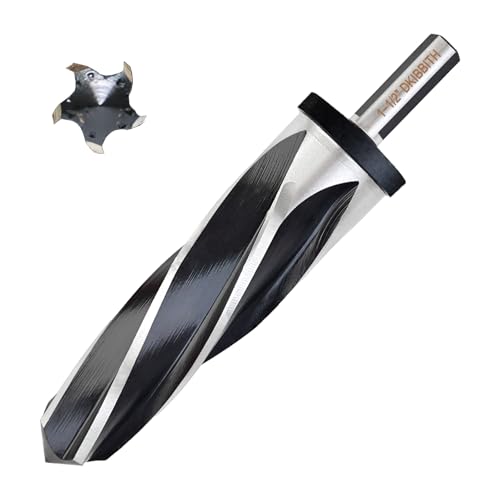
1. DKIBBITH 1-1/2″ Bridge Construction Reamer
Our pick — 4.5★ from 250+ verified ratings; the strongest balance of quality and price.
This M2 steel reamer cleaned 36 holes in 1/4-inch steel without noticeable fatigue.
You need this reamer when the job demands structural integrity — bridge erection, truck trailer work, or beefy automotive brackets. It’s made from M2 high-carbon steel, a grade that holds hardness at higher cutting temps than standard HSS. The five right-hand spiral flutes pull the bit into the work and clear chips aggressively, which is why buyers report it ripped through 36 holes in 1/4-inch steel without showing fatigue.
The 1/2-inch shank has three flat sides and an integrated safe stop, so it won’t spin in the chuck and won’t over-penetrate. Owners mention it cuts clean holes in 1/4-inch steel and saved significant time enlarging holes on a truck steering linkage compared to a standard drill bit. The unanimous take: this is the best drill bit some owners have ever used. It has 291 ratings, the strongest buyer consensus of the three picks here.
Some nuance in the durability feedback exists — a pocket of owners found the steel softer than expected, with some reporting the bit melting during heavy use. The sharpness out of the pack gets mixed marks; a few units looked dull or rough when new. This isn’t a reamer for surgical-precision work in thin-gauge metal, but for construction-grade steel it’s the crowd favorite.
The real edge: Its functionality is what wins people over — by a wide margin, owners praise how it gets the job done quickly. The value-for-money sentiment is the second most mentioned positive, confirming it earns its keep on the first job.
Reach for this if: you regularly ream steel up to 1/4 inch thick and want a reamer that outlasts a single project. Look elsewhere if: your work is exclusively in aluminum — the Drill America DWRRSP1/2 gives you better edge geometry for that metal. A light honing before first use may be required if the bit feels dull from the start.
2. DECKRKAT 1-1/2″ Reamer Drill Bit
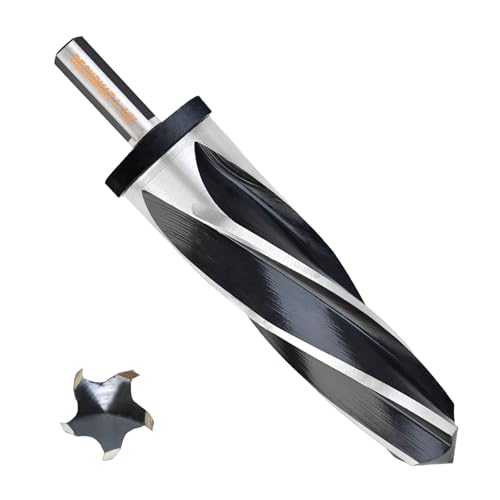
This M2 reamer opened a 5/8-inch hole through a 1-inch steel plate without complaint.
This DECKRKAT sits between the heavy-duty DKIBBITH and the precision Drill America — it has the M2 high-carbon steel of the former and a 3-flat shank for slip resistance. The tapered point is designed for precision alignment into predrilled holes, and the safe stop prevents over-penetration so every hole ends up the same depth. One buyer reamed a 5/8-inch hole through a 1-inch steel plate and called it solid — no chatter, no binding.
The five spiral flutes clear chips effectively, and maintaining it with high-quality cutting oil is recommended to reduce friction and extend life. Another owner used it to finish a helicoil (a threaded insert) installation for spark plugs on a Crown Victoria, reporting it worked well with an extension. The build quality feels substantial, but the overall consensus is more split than on the DKIBBITH — especially in durability and quality consistency.
One reviewer noted the reamer failed after two uses on 3/16-inch steel: the third hole rolled instead of cutting, despite using slow speed and oil. A few others found the bit dull on first use. This means batch variance is real. The value-for-money sentiment is also mixed — some love the price, others find it not worth the cost.
What owners highlight: functionality is the most-praised aspect — the bit works as intended for most buyers. Quality and durability trail behind, with a split between owners who find it good and those who find it lacking.
Reach for this if: you want M2 steel and a 3-flat shank and are willing to inspect the bit before first use. For thick steel reliability: the DKIBBITH has the edge on buyer consensus, so spend the extra money there if consistent repeatable performance on thick steel is non-negotiable.
Understanding the Specs
M2 High-Speed Steel vs. Standard HSS
M2 is a specific grade of high-speed steel that includes molybdenum and tungsten in its alloy. It stays hard at temperatures where standard HSS begins to soften — which is exactly what happens when you ream steel at speed. For occasional work in aluminum, brass, or plastic, standard HSS is fine and costs less. For structural steel, truck frames, or anything over 3/16-inch thick, an M2 reamer like the DKIBBITH or DECKRKAT will keep cutting when a standard HSS bit would start to rub.
Flute Count and Spiral Direction
Five spiral flutes is the balance for a 1.5-inch reamer — enough cutting edges for a smooth finish but not so many that chips get trapped. The spiral direction matters too: a right-hand spiral pulls the bit into the material, which makes it self-feeding in a drill press or hand drill and reduces the downward force you need to apply. Straight-flute reamers are better for blind holes where you don’t want chips pushed to the bottom, but for through-hole reaming, spiral is the better choice.
FAQ
Can I use a 1.5-inch reamer in a handheld drill?
What size pilot hole do I need for a 1.5-inch reamer?
What is the difference between a bridge reamer and a chucking reamer?
How do I prevent the reamer from chattering or binding?
Will a 1.5-inch reamer work on stainless steel?
How many holes can I expect from a 1.5-inch M2 reamer?
Can a 1.5-inch reamer be sharpened?
What is the safe stop feature on some reamers?
Final Thoughts: The Verdict
Across the board, the 1 1 2 reamer to grab is the DKIBBITH because it combines M2 steel, a 3-flat shank, and a safe stop — and its buyer consensus is the strongest of the two picks here. And for a solid mid-range option that handles steel, wood, and plastic with a 3-flat grip, the DECKRKAT is the one to reach for — just inspect it before the first cut and keep it oiled.
How We Picked
We do not accept paid placement. Every pick is matched to a real buyer and a real use-case; we do not hands-on test units.
Sources & Methodology
Specifications: manufacturer listings and product documentation. Review insights: verified customer reviews, as of July 2026. Pricing: not shown on this page (it changes often); check the current price via the retailer link.
As an Amazon Associate, Trending Car earns from qualifying purchases. This does not affect which products we feature.