
Our readers keep the lights on and my garage snacks stocked. As an Amazon Associate, I earn from qualifying purchases.
Specs are compiled from manufacturer listings and verified buyer reviews and can change over time — please confirm the key details on the product page before buying.
You do not reach for a 1 1/2 inch wrench often. But when you need one — to loosen a fan clutch on a Ram truck, a hydraulic line on heavy equipment, or a jam nut on a 4×4 suspension — A cheap tool can round off the fastener and leave you stuck. The real question is which design fits the nut without slipping and gives you enough leverage without fighting the tool itself. Wrenches this size sit at the intersection of brute force and precision. The seven picks here each tackle that balance from a different angle: a long combination wrench, a stubby service wrench, a ratcheting model, an adjustable jaw, and a spud wrench for structural steel. Real owners in real shops have tested every one, so you are seeing what holds up under torque, not just what looks good in a photo.
I’m Min Islam — the founder and writer behind Trending Car. This guide is built by comparing the manufacturers’ published specifications and the patterns across verified customer reviews, so you get each pick’s real strengths and trade-offs instead of marketing spin.
Whether you are a DIY mechanic or a tradesman stocking a toolbox, the right 1 1 2 inch wrench means the difference between a ten-second job and a stripped fastener that stalls your whole afternoon.
Our Picks at a Glance
How To Choose The Best 1 1 2 Inch Wrench
At this size, you are not picking up a wrench for light work. You need the right head style, the right length, and the right steel so that a tough fastener doesn’t turn into a cut knuckle or a rounded-off bolt.
Head style: service, combination, ratcheting, or adjustable
A combination wrench gives you an open end on one side and a box end on the other — the standard for most jobs. A service wrench (sometimes called an access wrench) has a much thinner jaw and a shorter handle, so it slips into gaps a standard wrench cannot reach. If you are turning the same size fastener repeatedly, a ratcheting box end saves you from having to lift and reposition the tool every time. And an adjustable wrench (a crescent style) works across multiple fastener sizes, though its jaw can slip under high torque if the mechanism is not tight.
Steel quality and finish
Chrome vanadium steel (often marked as Cr-V) is the most common alloy in mid-range wrenches — it balances strength and corrosion resistance. 4140 chromium molybdenum steel is tougher and typically found in premium, USA-made tools. A satin nickel or zinc phosphate finish resists rust better than raw polished steel, especially if the wrench lives in a damp truck box or on a farm.
Length and leverage
A longer wrench generates more torque with less effort, but it also means less room to swing in tight engine bays or machinery compartments. A 21-inch combination wrench gives you serious leverage; a 9-inch service wrench gets into confined spaces but may need a breaker bar or cheater pipe to crack a stubborn nut.
Quick Comparison
| Model | Best For | Length | Weight | Steel Type | Amazon |
|---|---|---|---|---|---|
| SUNEX TOOLS 948A★ Best Overall | High-torque combination work | 21.38 Inches | 1.4 Pounds | Chrome Vanadium Steel | Amazon |
| TEKTON WSE14338Tight-Space Specialist | Tight-space service access | — | 8.96 ounces | 4140 Steel | Amazon |
| TEKTON WSA04222 | Adjustable jaw with 3/8″ drive | 9 Inches | 0.83 Pounds | 6140 Chromium-Vanadium Steel | Amazon |
| Wright Tool 1448 | Restricted-clearance open-end | 7-11/16 Inches | — | — | Amazon |
| GEARWRENCH 9042 | Ratcheting speed on big fasteners | 19.69 Inches | — | — | Amazon |
| TIGHTSPOT T-RW112IN | 4-degree ratcheting in tight swings | — | 3.18 Pounds | Chrome Vanadium Steel | Amazon |
| KLEIN TOOLS 3224 | Structural/alignment spud work | — | 3.1 Pounds | Alloy Steel | Amazon |
In‑Depth Reviews
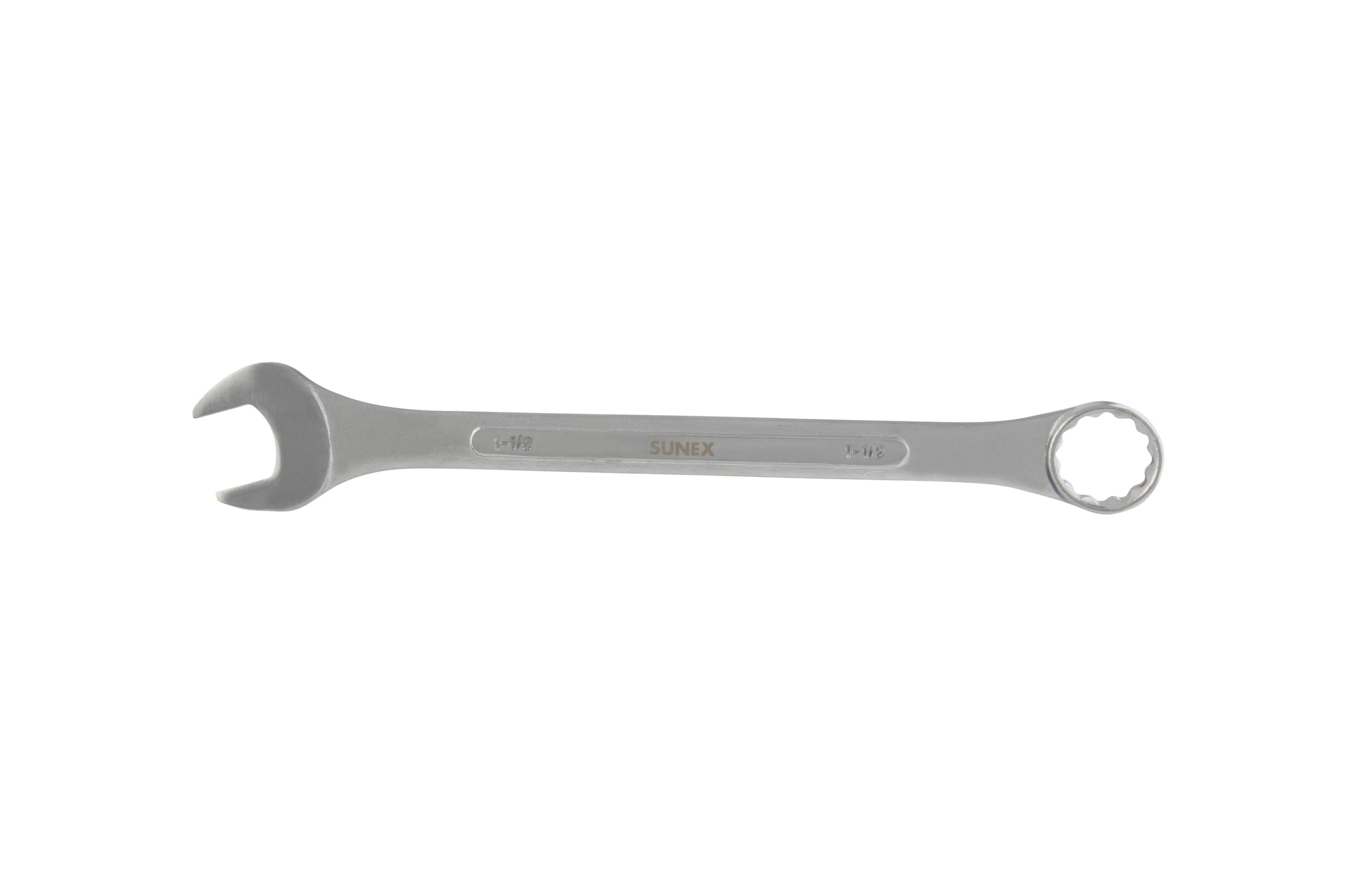
1. SUNEX TOOLS 948A 1-1/2″ Jumbo Combination Wrench CRV
Our pick — over 4.5★ from 700+ verified ratings; the strongest balance of quality and price.
A 21.38-inch forged bar that brings torque without the sticker shock.
When you need to lean into a stuck nut, the Sunex 948A gives you the leverage to break it free. At 1.4 pounds and 21.38 inches long, it delivers the reach to make a stubborn fastener feel manageable. The raised panel profile (a reinforced beam along the shaft) keeps the wrench from twisting under heavy load. Forged from chrome vanadium steel and backed by a lifetime warranty, it is the crowd favorite across more than 700 owners. Quality is what 31 owners praise most, followed by functionality and value for money.
Buyers report it “worked perfectly for removing the large nut on my 2018 Ram fan clutch” — a real-world test of both size and brute force. The polished finish and angled box end (a detail that surprises some owners who did not spot it in the listing) add everyday usability that a basic stamped wrench lacks. At this length, you won’t use it under a dashboard, but in the shop or driveway it is the right tool for the big jobs.
The only honest trade-off: the open end on some units measures a hair tight, with one owner noting they had to dress the jaw opening to get a perfect fit. That is rare — the overwhelming verdict is “much better quality than expected” — but if you need a dead-on slip-fit every time, it is worth checking yours on the first use within the return window.
Jumbo grip strength
- Serious torque from the 21.38-inch length — you get mechanical advantage without a cheater pipe
- Chrome vanadium steel with a forged raised panel feels heavy and unbreakable in hand
- Angled box end gives better knuckle clearance than flat designs
- Lifetime warranty for a price well under premium competitors
Heavy tool weight
- Rarely, the open-end jaw can be slightly undersized, needing a light file pass
- At 21.38 inches it is long — not a pocket tool for confined spaces
Big nut turner: you want a single long combination wrench that handles truck, tractor, and equipment fasteners while staying affordable.
Awkward for tight spots: your workspace is tight; at 21 inches this one needs room to swing.
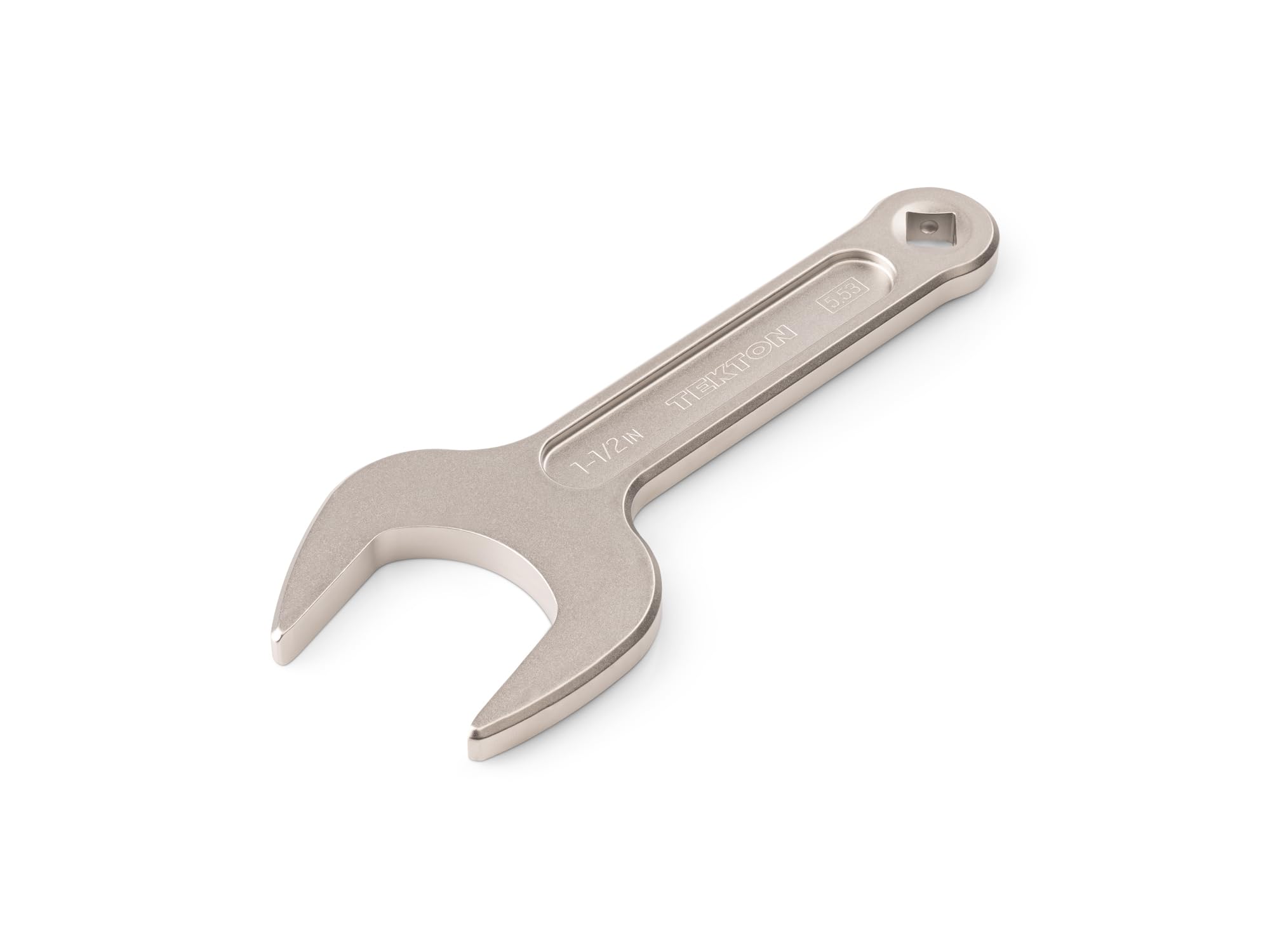
2. TEKTON 1-1/2 Inch Service Wrench | WSE14338 | Made in USA
A short, thin-jawed service wrench that reaches where combo wrenches cannot.
When a fastener is buried in a machine and a standard wrench body is too thick to fit, the TEKTON service wrench is the solution. Its jaw is thinner than a standard combination wrench of the same size — the difference between slipping onto a 1-inch Swagelok fitting or staring at it uselessly. The 15-degree angled open end on one side and a drive square on the other let you use a ratchet or breaker bar for extra torque. Owners describe it as “perfect for getting in tight spaces, and great for use with a breaker bar for stubborn to reach places.”
Made in Michigan from 4140 chromium molybdenum steel hardened to 50–53 HRC (a Rockwell hardness scale that tells you how resistant the steel is to deformation), then plated with satin nickel for corrosion resistance, this wrench feels meticulously finished. Quality is the top-mentioned positive aspect, and every single owner rates it at 5 stars. At 8.96 ounces it is notably lighter than the Sunex 948A (1.4 pounds), but that is by design: it is a reach-and-turn tool, not a hammer-through-bar.
The catch is straightfoward: this is a specialty wrench, not a general-purpose combination tool. If you need one 1-1/2 inch wrench for everything — open-end, box-end, ratcheting, long leverage — this stubby profile will not deliver the torque of the 21-inch Sunex. But for hydraulic quick connects, suspension jam nuts, and tight engine compartments, buyers confirm it is exactly right.
Precision access design: The thin jaw and drive square make it irreplaceable in tight spaces. Pair it with a breaker bar for stubborn fasteners and you have a combo no standard wrench can match.
Tight space hero: you work on hydraulic systems, heavy equipment, or any job where clearance is measured in millimeters.
Limited to service work: you want a single do-it-all wrench; this one is specialized for reach, not brute torque.
3. TEKTON 9 Inch Adjustable Wrench (1-1/2 in. Jaw Capacity) | WSA04222
An adjustable that actually stays put under torque.
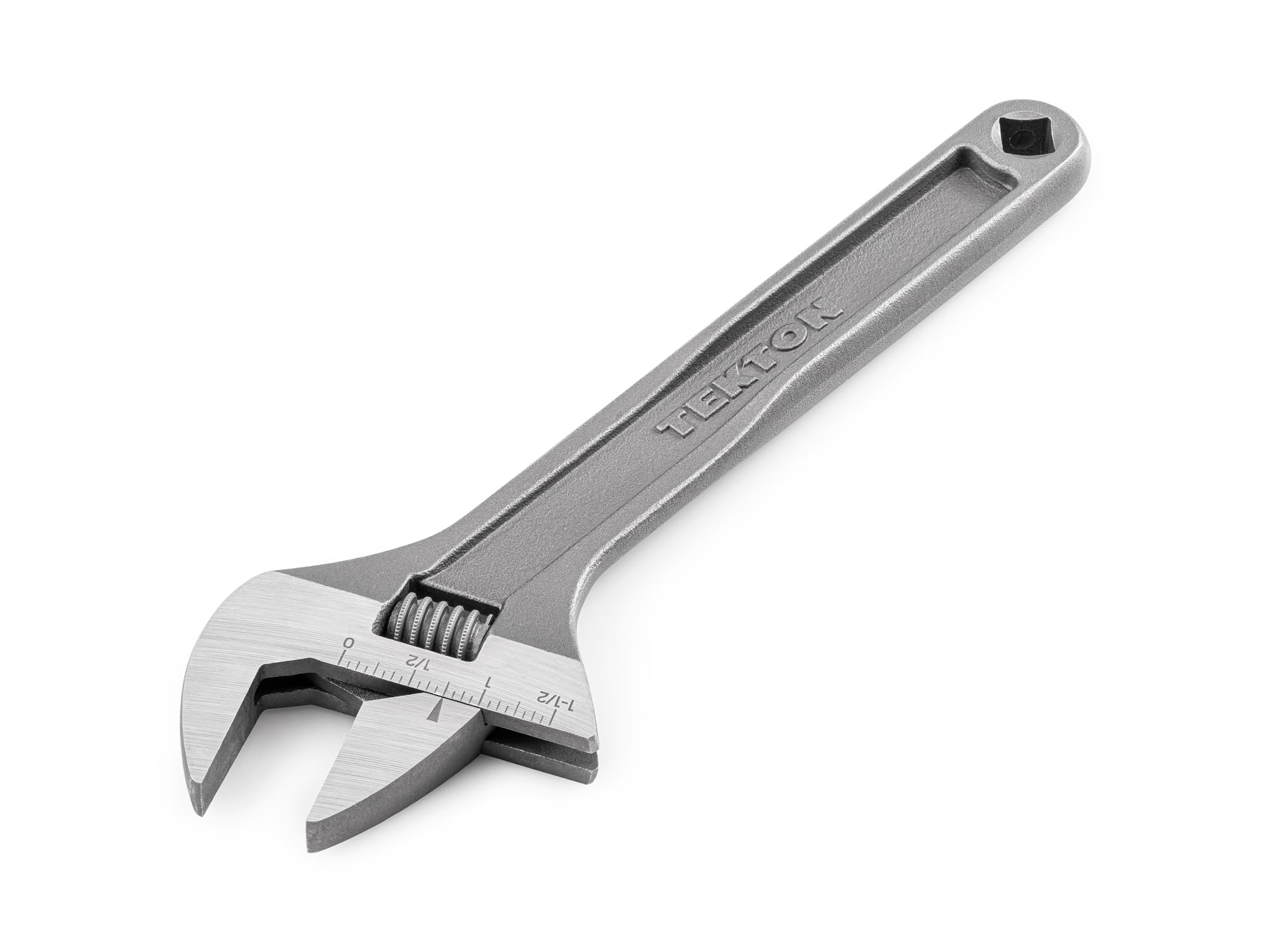
Every mechanic has a story about an adjustable wrench that loosened up mid-turn and rounded off a fastener. This TEKTON solves that with a low-pitch worm gear (the threaded mechanism that opens and closes the jaw) that fits tightly against the rack teeth, so the jaw does not back off under load. Reviewers confirm: “It genuinely doesn’t back off like every other one seems to.” At 9 inches long and 0.83 pounds, it is shorter and lighter than the Sunex 948A by a wide margin — making it a portable tool that lives easily in a service truck door pocket or a portable kit.
The jaw opens 0 to 1-1/2 inches with laser-engraved scales for precise setting, and the handle has an integrated 3/8 inch square drive that accepts a ratchet or breaker bar. That means you get adjustable versatility plus the leverage of a longer handle when you need it. The head is ground smooth and lightly oiled, and the zinc phosphate coating resists corrosion. The thing everyone raves about is the quality — it is the top-mentioned aspect by a wide margin — and the smooth worm gear adjustment gets near-equal praise.
One design detail to know: the worm gear is a pressed-pin assembly, meaning if it ever wears out, the whole mechanism needs replacing rather than just a gear swap. In practice owners mention it holding up well under serious use, but it is not a field-repairable design like some vintage-style adjustable wrenches.
Versatile jaw adjustment
- Worm gear stays locked during use — no jaw creep under heavy torque
- 3/8″ drive in the handle lets you add a breaker bar for extra leverage
- Laser-engraved jaw scale for repeatable settings
- Zinc phosphate finish resists rust in damp environments
Slower than fixed wrenches
- Pressed-pin worm gear requires full replacement if damaged — not user-serviceable
- 9-inch handle is shorter than a long combination wrench, so leverage is less on ultra-tight fasteners
All-around utility: you need one adjustable wrench that covers multiple 1-1/2 inch fasteners and stays reliable under real torque.
Not for high torque: you prefer the absolute strength of a forged fixed-size wrench; adjustable jaws by nature have more play.
4. GEARWRENCH 12 Pt. Ratcheting Combination Wrench, 1-1/2″ – 9042

A 19.69-inch ratcheting wrench that doubles fastener speed on big jobs.
If you are turning a dozen 1-1/2 inch nuts in a row, a standard open-end wrench makes you lift and reposition every half-turn. The GearWrench 9042 eliminates that cycle with a 12-point ratcheting box end that lets you keep the wrench on the fastener and just rock it back and forth. At 19.69 inches long, it gives you the reach of the Sunex 948A but with ratcheting speed. Customers note it “doubles nut removal speed when an impact gun or socket can’t be used.” The thin head and beam also help in confined areas where a bulkier wrench would bind.
The off-corner loading design (the drive surfaces contact the fastener flats rather than the corners) reduces the chance of rounding off a stubborn nut — a genuine advantage on Caterpillar filter housings or transformer bushings, where a rounded fastener becomes a major problem. Quality is the most-mentioned positive aspect, and owners consistently describe it as durable and well-built for heavy professional use.
At this length and with a ratcheting mechanism, the wrench head is larger than a standard combination wrench. If you are working in an extremely tight space where even a thin ratcheting head cannot fit, the TEKTON service wrench above would be a better fit. But for repetitive work on exposed fasteners — track tensioners, hydraulic fittings, suspension work — the speed gain is real.
Fast ratcheting action: a ratcheting box end is the fastest way through a long row of 1-1/2 inch fasteners. The off-corner loading gives you extra protection against rounding, and the 19.69-inch beam delivers leverage on par with the longest fixed wrenches.
Speed on large fasteners: speed matters — you are turning large fasteners repeatedly in exposed locations.
Overkill for small jobs: you need the thinnest possible head for extreme tight spots; a ratcheting mechanism adds bulk.
5. TIGHTSPOT 1-1/2 Inch Ratchet Combination Wrench with Precision Movement
A 90-tooth ratchet that grabs a fastener in just 4 degrees of motion.
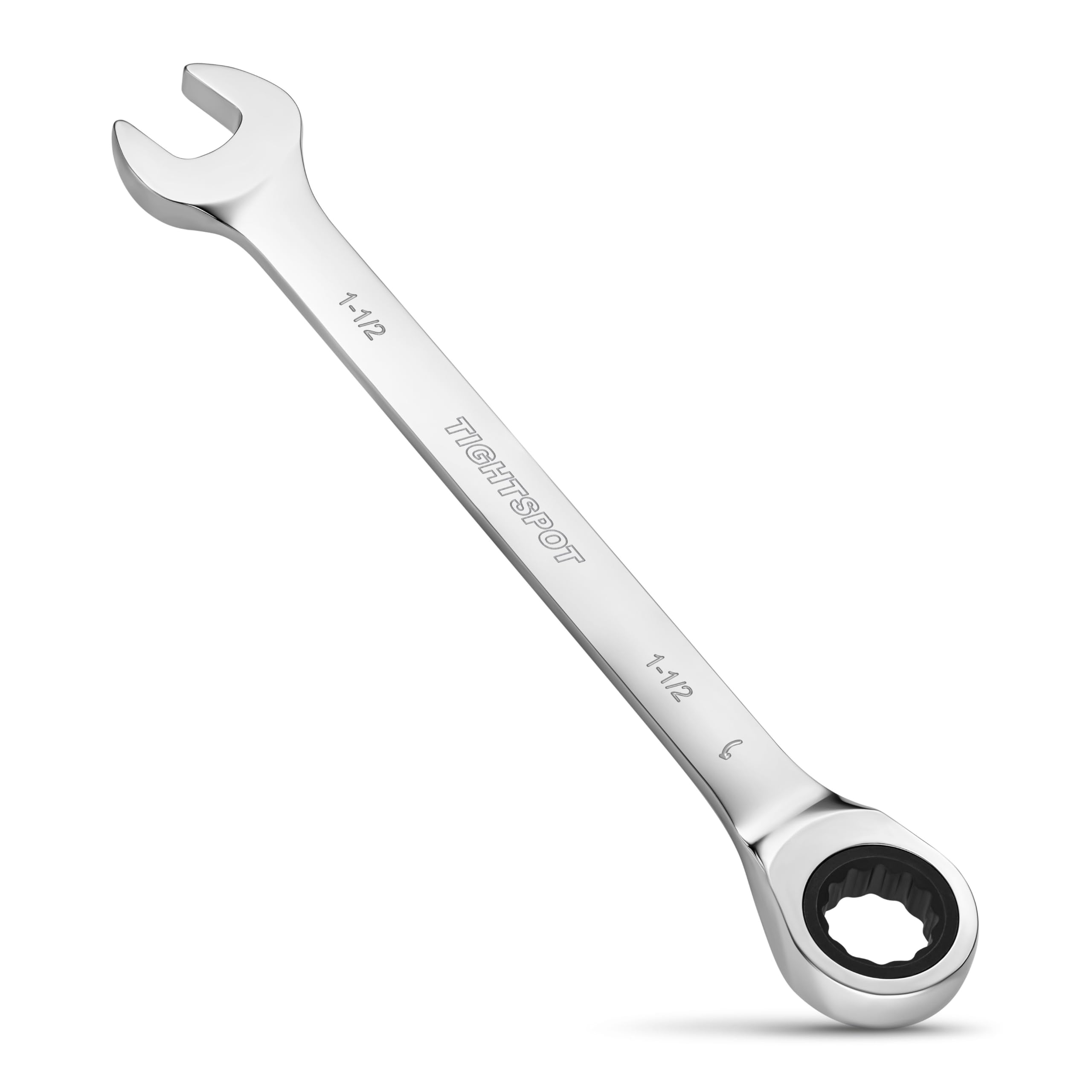
When your swing arc is blocked by a frame rail or a hydraulic line, every degree of ratchet engagement matters. The TightSpot uses 90 teeth inside the ratcheting box end, which means it needs only 4 degrees of movement to catch the next tooth — versus the 30 degrees a standard 12-point wrench requires. That is the difference between being able to work in a cramped compartment and having to remove an obstruction to get your tool in. The reinforced open end also grips fasteners tightly to reduce rounding, and owners confirm the quality and functionality are strong across the board.
At 3.18 pounds, this is the heaviest wrench in the lineup — noticeably more substantial than even the 1.4-pound Sunex. The extra heft comes from the 7-stage construction process: drop forging, heat treating, and an aerospace-grade vanadium alloy that hardens the steel while chromium fights corrosion. The polished mirror finish is both functional and eye-catching. If you are the kind of person who keeps a dedicated wrench in the truck for a specific job (trailer hitch, bike rack, tractor), this one is built to stay on the tool without rusting.
The weight is the main consideration. At over 3 pounds, it is not a wrench you carry in a pocket or a light service bag. For bench work, shop use, or a dedicated spot in the truck, the 4-degree ratchet engagement is a genuine advantage. If you need something lighter for daily carrying, the TEKTON service wrench or the GearWrench ratcheting model would be more portable options.
Narrow profile advantage
- 4-degree ratchet swing means it works where standard wrenches cannot turn
- Reinforced open end reduces fastener rounding under torque
- Drop-forged chrome vanadium with heat treatment for long-term durability
- Polished mirror finish resists corrosion and cleans easily
Heavier than standard
- At 3.18 pounds it is the heaviest pick — not ideal for portable kits
- Ratchet mechanism is bulkier than a fixed wrench head
Tight clearance champ: you work in extremely tight swing arcs where every degree of ratchet engagement matters.
Weighty for long use: weight is a concern for your tool bag; this one is notably heavy.
6. Wright Tool 1448 30° Angle Service Wrench, 1-1/2″ SAE Satin Finish

A precision thin-jaw open-end with a 30-degree angle for restricted-clearance work.
The Wright Tool 1448 is engineered for a specific kind of frustration: a fastener that you can reach, but where a standard open-end is too thick to slide onto. Its thin open-end jaw (designed for restricted clearance) combined with a 30-degree offset head means you can get onto a nut at an awkward angle without your hand hitting the surrounding structure. This is the kind of wrench that comes out for lathe faceplates, helicopter kit assembly, and Nova Comet lathe work — buyers confirm it is a “perfect fit” for removing faceplates where the stock wrench was too large. At 7-11/16 inches long, it is short, which is exactly the point for those tight environments.
Forged and machined in Barberton, Ohio, from precision heat-treated steel, it meets ASME B107 hand tool standards (the American Society of Mechanical Engineers’ specification for hand tools). The brushed satin finish (not polished) gives the handle a slightly textured grip that reviewers point out “helps prevent the wrench from slipping out of your hand in damp conditions.” Quality is the top aspect mentioned, and owners consistently describe the finish as clean, smooth-edged, and chamfered for protecting fastener finishes.
The trade-off is plain: this is a single-purpose open-end service wrench. There is no box end, no ratcheting mechanism, and the short length means you will need a separate breaker bar or cheater pipe for stuck fasteners. If you need a versatile all-rounder, the Sunex or GearWrench would serve you better. But if you have a specific clearance problem on industrial or precision equipment, this Wright Tool is likely the exact solution.
Thin jaw precision: the 30-degree offset and machined finish make this the go-to for restricted access on expensive equipment where you cannot risk damaging the fastener or the surrounding part.
Angled access wizard: you are working in a tight machine compartment or on precision equipment where a standard head is too thick.
Not for straight pulls: you need leverage; at 7-11/16 inches this is a short wrench that requires external help for stubborn nuts.
7. KLEIN TOOLS 3224 Construction Spud Wrench, Made in USA, 1-1/2-Inch Nominal Opening
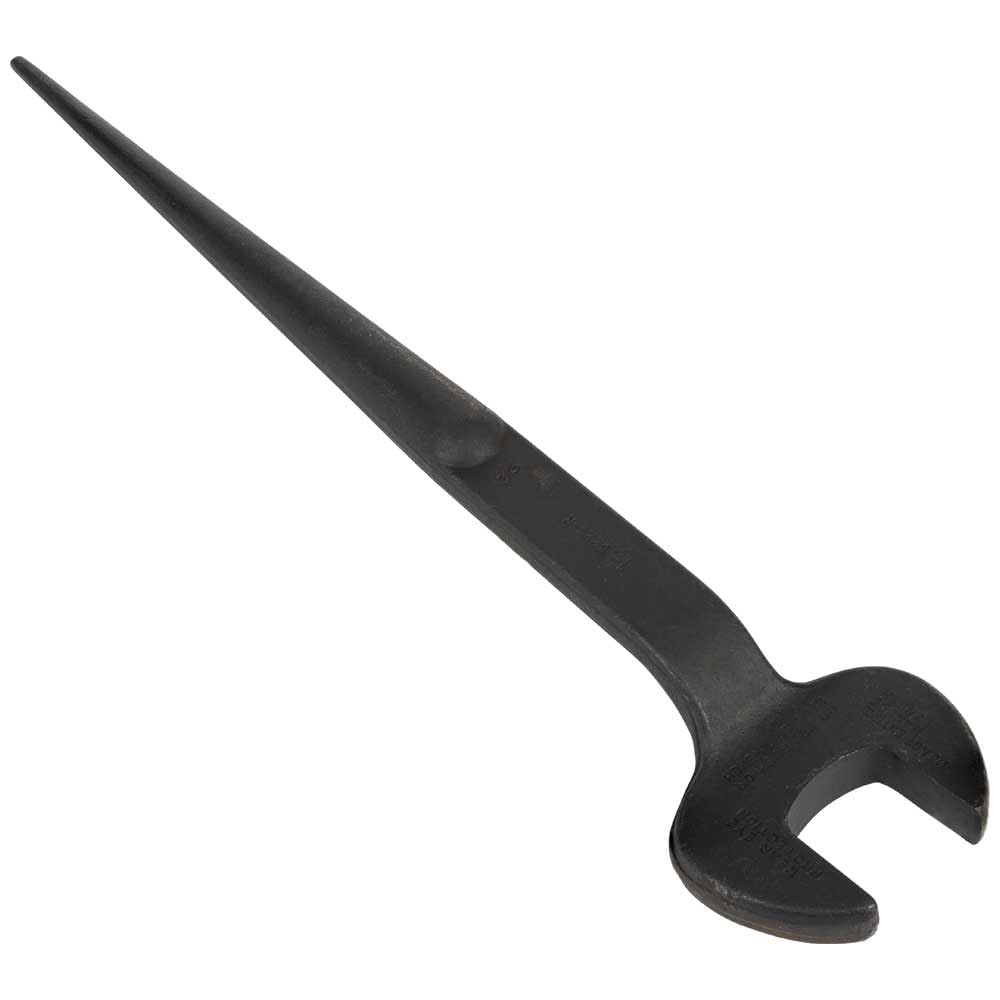
A forged steel spud wrench that aligns bolt holes and turns 1-1/2 inch nuts.
A spud wrench is a different animal. The Klein 3224 is built for ironwork and structural steel: its box end has a 1-1/2 inch nominal opening for turning regular nuts, while the tapered handle works as a drift pin to line up bolt holes in steel beams. The extra-heavy head area and continuous taper let you align holes across a range of bolt sizes without binding, then flip it over to tighten the nut. Forged in the USA from select US alloy steel, it carries the American Bridge design — a classic shape that has been on construction sites for generations. Owners confirm it is “a lineman’s go to tool” and “a must for car plants.”
At 3.1 pounds, this is a heavy tool in the same weight class as the TightSpot ratcheting wrench, but the weight is distributed differently — the long tapered handle shifts the balance for alignment work. The black oxide finish with a rust-preventative coating handles outdoor job site conditions, and every wrench has its catalog number, bolt size, and nominal opening size stamped on it for quick identification. Buyers consistently describe it as a quality made product that is “made of thick heavy steel” and great for both aligning holes and turning nuts.
The catch is specialization. If you are not aligning steel beams or working on structural applications, the spud taper and box-end-only configuration limit its everyday use. For standard automotive or equipment fastening, a combination wrench like the Sunex is more versatile. But if you work in construction, or if you maintain heavy equipment that uses structural connections, this Klein is the right tool for both jobs in one.
Dual spud-wrench function
- Box end turns 1-1/2 inch nuts; tapered handle aligns bolt holes — two tools in one
- Forged from US alloy steel for high-leverage strength on structural connections
- Extra-large hub area handles larger diameter holes than standard spud wrenches
- Stamped size identification on every wrench
Not for fine fasteners
- No open end — you are limited to the box-end function for nut turning
- At 3.1 pounds it is heavy for non-structural work
Construction multi-tool: you work structural steel, industrial construction, or heavy equipment where bolt-hole alignment is part of the job.
Overbuilt for light tasks: you only need to turn fasteners; a combination wrench is lighter and more versatile for pure wrenching.
Understanding the Specs
Steel alloys: Cr-V vs 4140 vs 6140
Chrome vanadium steel (Cr-V) is the standard in mid-priced wrenches — it is strong, corrosion-resistant, and affordable. 4140 chromium molybdenum steel is a step up in toughness, often used in premium USA-made tools like the TEKTON service wrench, and is heat-treated to a specific hardness range like 50–53 HRC. 6140 is another chromium-vanadium variant used by TEKTON in their adjustable wrench, offering a similar balance of strength and workability. For most buyers, Cr-V is perfectly adequate; 4140 is worth the premium if you expect extreme torque or daily professional abuse.
Ratcheting vs fixed-head wrenches
A ratcheting box end (like the GearWrench or TightSpot) lets you keep the wrench on the fastener and simply rock it back and forth, which speeds up repetitive work dramatically. The key spec is the number of teeth — more teeth means a smaller swing arc is needed to engage the next click. The TightSpot’s 90-tooth ratchet needs only 4 degrees of movement, making it effective in extremely tight spaces. The trade-off is that ratcheting mechanisms add bulk and weight compared to a fixed wrench, and they can jam if contaminated with grit.
FAQ
What is the difference between a combination wrench and a service wrench at 1-1/2 inches?
Will a 1-1/2 inch adjustable wrench stay tight under heavy torque?
Can I use a 1-1/2 inch wrench with a breaker bar for extra leverage?
How long does a 1-1/2 inch combination wrench typically last?
Will a 1-1/2 inch spud wrench work for automotive repairs?
What is the 4-degree ratchet movement on the TightSpot wrench?
What does “off-corner loading” mean on a ratcheting wrench?
How do I know if a 1-1/2 inch wrench is forged vs cast?
Final Thoughts: The Verdict
If you want one dependable pick, the 1 1 2 inch wrench winner is the SUNEX TOOLS 948A because it delivers the best combination of length (21.38 inches), forged chrome vanadium steel, and lifetime warranty at a price well below premium competitors — and owners consistently praise its quality and functionality across hundreds of reviews. If you need ratcheting speed for repetitive work, grab the GEARWRENCH 9042. And for tight-space access where a standard jaw is too thick, the TEKTON WSE14338 service wrench is the one to reach for.
How We Picked
We do not accept paid placement. Every pick is matched to a real buyer and a real use-case; we do not hands-on test units.
Sources & Methodology
Specifications: manufacturer listings and product documentation. Review insights: verified customer reviews, as of July 2026. Pricing: not shown on this page (it changes often); check the current price via the retailer link.
As an Amazon Associate, Trending Car earns from qualifying purchases. This does not affect which products we feature.