
Our readers keep the lights on and my garage snacks stocked. As an Amazon Associate, I earn from qualifying purchases.
Specs are compiled from manufacturer listings and verified buyer reviews and can change over time — please confirm the key details on the product page before buying.
A 1.5-inch hole in wood is a big ask — one that usually ends in a stalled motor, a shredded exit, or a bit that wanders off your mark. You need a bit that bites hard, clears the chips, and leaves a clean edge without forcing your drill to its knees.
I’m Min Islam — the founder and writer behind Trending Car. This guide is built by comparing the manufacturers’ published specifications and the patterns across verified customer reviews, so you get each pick’s real strengths and trade-offs instead of marketing spin.
Whether you are building furniture, running conduit, or boring timber, choose the bit that matches the hole you need to cut. This is the best 1 1 2 drill bit for wood for every type of job.
Our Picks at a Glance
How To Choose The Best 1 1 2 Drill Bit For Wood
A 1.5-inch bit is a heavy tool — choose the wrong type and you will fight the drill every inch of the way. Match the bit to the wood and the job.
Auger vs Forstner — the core fork
Auger bits (like the Diablo and Greycore) have a screw tip that pulls the bit into the wood, meaning you push less. They are great for deep holes in framing timber and for drilling through multiple studs. Forstner bits cut a flat-bottomed hole with a sharp outer rim — they are the choice for hinge mortises, shelf pin holes, and any spot where the hole must stop at a precise depth. Augers leave a rougher exit; Forstner bits leave a cleaner one.
Shank shape — what your chuck can grip
Most 1.5-inch bits come with either a hex shank (7/16-inch on the Diablo, 1/4-inch on the Greycore) or a round shank (3/8-inch on the HPHOPE, 10mm/2/5-inch on the MOLLOM). Hex shanks lock tighter into impact drivers and standard drills, reducing spin-out under heavy torque. Round shanks fit any standard drill chuck but can slip if the chuck is not fully tightened. If you plan to use an impact driver, pick a hex shank.
Steel type — how long it stays sharp
You get longer cutting life from bits that resist wear. The Diablo and Greycore use high-speed steel (HSS — a hard steel that stays sharp through softwood and hardwood and can be resharpened). The MOLLOM uses a YG8 carbide tip (a very hard tungsten-carbide blend) with a blade thickness of 2.0mm, which stays sharp much longer than standard 1.3mm blades — a real advantage if you are drilling abrasive materials like MDF or plywood day after day. The NICAVKIT uses ASTM 5140 alloy steel (a tough but softer steel that sharpens easily but dulls faster in dense wood).
Quick Comparison
| Model | Best For | Type | Shank | Length | Amazon |
|---|---|---|---|---|---|
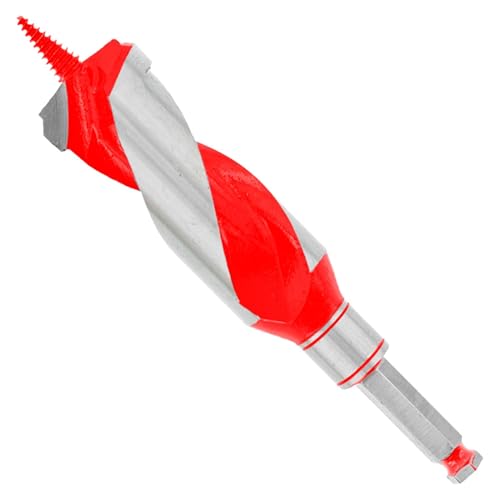
| Diablo DAG1170★ Best Overall | Nail-embedded wood, deep framing | Auger | 7/16″ hex | 7-1/2″ | Amazon |
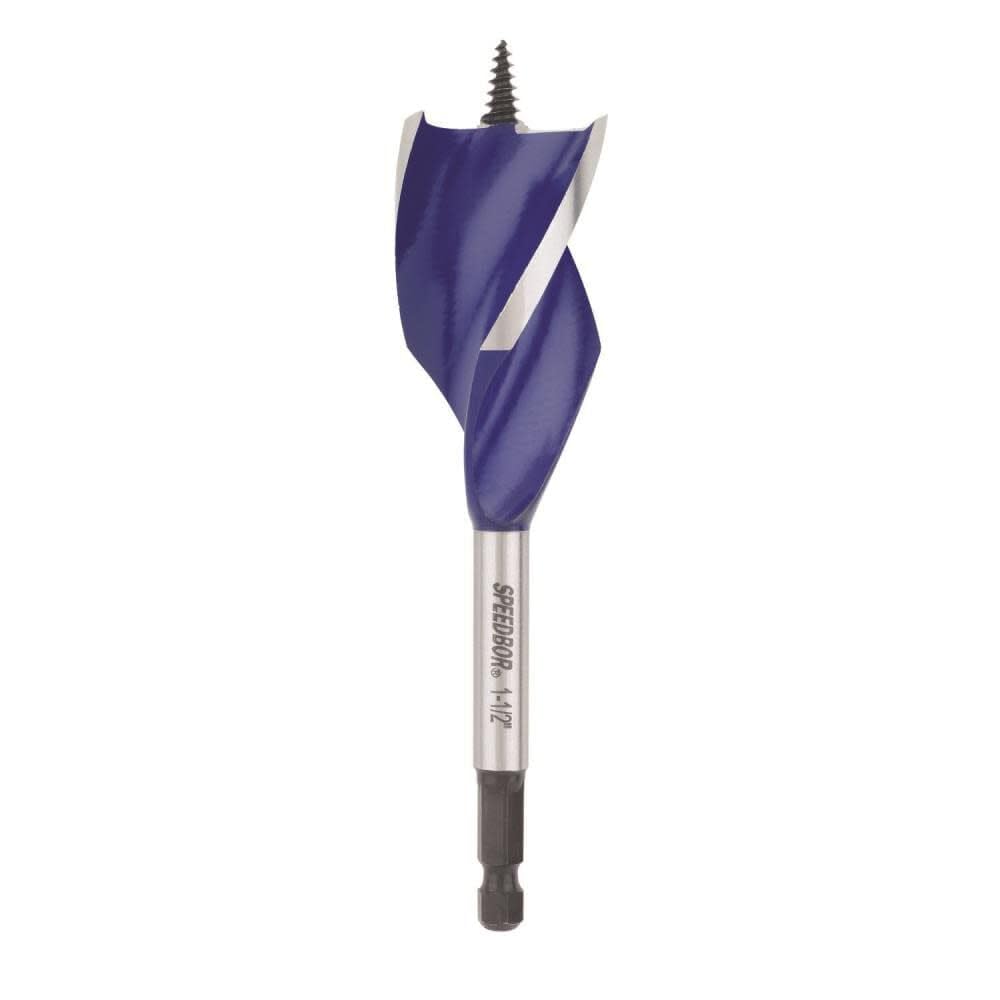
| Irwin Speedbor 3041021Top Performer | Fast rough holes, framing | Auger | Round | 6″ | Amazon |
| Irwin Ship Auger 49924 | Deep boring, LVL beams | Ship Auger | Round | 4-1/2″ twist | Amazon |
| MOLLOM Forstner | High-precision, hardwoods | Forstner | Round 10mm | 3-11/16″ | Amazon |
| HPHOPE Forstner | Clean flat-bottom holes | Forstner | Round 3/8″ | 3-9/16″ | Amazon |
| NICAVKIT Forstner | Budget hinge mortises | Forstner | Hex 1/4″ | 3-9/16″ | Amazon |
| Greycore 3-Flute | Deep holes, clog-prone woods | Auger | 1/4″ hex | 6″ | Amazon |
In‑Depth Reviews
1. Diablo Auger Bit for Wood & Nail-Embedded Wood — DAG1170
Our pick — over 4.5★ from 300+ verified ratings; the strongest balance of quality and price.
The bit that eats nails for breakfast and still slices clean wood for lunch.
The Diablo auger is the rare bit that earned its top spot by taking on the worst-case scenario — nail-embedded wood — and coming out sharp. Its Dura-Tip Technology and dual cutting edge let it blast through hidden nails without snapping, which is the exact situation that ruins a lesser bit in seconds. The two-step cutting action is why the holes stay precise and clean, even when the wood is full of surprises.
At 7-1/2 inches overall with a 5-1/2-inch working length and a 7/16-inch hex shank, this bit fits securely into both cordless and corded tools and gives you the reach to punch through thick framing in one pass. Buyers report it drilling a 1-inch hole through a 6×6 post in seconds with an 18V drill, and the deep flutes clear chips aggressively — meaning you spend less time backing out the bit and more time cutting. The only real caveat is the weight of the thing: it asks for a firm grip as the self-feeding tip pulls through, but that grip is a small price for a hole that comes out clean every time.
The thing everyone raves about is the quality — 15 owners single it out as the bit’s strongest trait. Wood compatibility follows close behind at 11 mentions. Durability gets mixed notes; some owners mention the bit snapping during heavy use, though those stories are far outnumbered by the ones who say it just blasts through everything for the entire length of the bit. If you are framing, deck building, or running cable through studs, this is the one.
The Nail-Eating Edge
- Cuts through nail-embedded wood without dulling — Dura-Tip is the real deal
- Deep flutes clear chips fast, meaning more holes per battery charge
- 7/16″ hex shank locks tight in impact drivers and standard drills
The Trade-Off
- Self-feeding screw tip pulls aggressively — requires a firm two-hand grip
- Durability is mixed; a few customers note the bit snapping during heavy use
Reach for this if: you are framing, building decks, or drilling through wood that might hide nails — the Diablo is the only auger here built to survive that.
Look elsewhere if: you need a flat-bottom hole for hinge mortises; this is a through-hole auger, not a Forstner.
2. Irwin Speedbor 3041021 — 1-1/2″ x 6″
The speed demon that trades a perfect finish for raw, aggressive pace.
The Irwin Speedbor is built for one thing: cutting fast through framing lumber. Its three-flute design and self-feeding tip pull the bit into the wood with minimal pressure, and the aggressive cutting action clears chips so well that you can keep drilling without constant retraction. It is the fastest bit in this lineup when you need to punch a hole and move on — which is why electricians and framers lean on it.
At 6 inches long and cutting a 38.1-millimeter diameter hole, the Speedbor is a workhorse, but it is not a woodworker’s bit. Reviews note that it leaves blowout on the back of plywood, unlike a Forstner-style option, making it unsuitable for finished cabinet work or exposed joinery. The self-feeding tip can grab hard if you force it — the rule is to let the tool work and only guide it. It also needs a high-torque drill; a standard 18V drill will handle it, but you will feel the strain in dense hardwood.
What this bit lacks in finesse it makes up for in raw utility. It stays sharp on framing lumber and hardwood, and it handles the occasional hidden nail far better than a spade bit ever could. If your job is quick, rough holes — think running conduit, boring through studs, or drilling LVL beams — the Speedbor gets it done and gets out of the way.
The raw speed verdict: Faster than the Diablo by feel in softwood, but the Speedbor leaves a rougher exit hole and demands a strong drill for hard wood.
Grab this for: speed through framing, rough carpentry, and jobs where the exit hole will be covered.
Pass on it if: you need a clean, chipping-free hole for visible woodworking — the Speedbor is not the tool for that finish.
3. Irwin Ship Auger 49924 — 1-1/2″ x 9-1/2″

The classic ship auger that bores deep, straight, and smooth through the toughest timbers.
The Irwin Ship Auger is the old-school workhorse designed for the thickest jobs — its solid center design provides extra rigidity while the wide lands keep the bit tracking straight as it bores. The flutes are ground behind the lands to funnel chips to the inside of the bit, away from the outside diameter, producing a faster, cleaner cut than a standard auger. That single-spur cutting edge scribes the circumference of the hole before the main cutters follow, giving a noticeably smoother finish even in hardwood.
You get serious metal behind this bit: 1.5 inches by 9-1/2 inches overall with a 4-1/2-inch twist length and weighing 16 ounces. Reviewers point out it drilling through LVL beams (laminated veneer lumber — a dense engineered beam) successfully and staying sharp through about 75 holes in the ground. The coarse screw point provides fast boring in both hard and soft woods — though that aggressive spiral can pull the bit hard into the wood, risking cracks and unclean exit holes if you do not plan the cut. A pilot hole and a careful approach (stop 1 inch before exit, drill from the other side) are the workaround.
What wins people over is the slicing action — the single spur delivers a level of smoothness you do not expect from a large auger. Quality and functionality top the aspect list at 36 and 39 mentions respectively. Sharpness and durability get mixed feedback; some owners find it the longest-lasting drill they own while others find it dulling quickly in heavy use. It is the longest and heaviest bit here, and that length is a real advantage when you need to bore through thick timber in one pass.
The shipwright’s choice: For deep, straight holes in timber beams and LVL, the Ship Auger’s single-spur edge (one sharp point that scores the wood edge) and solid center deliver a finish no other auger here can touch — provided you manage its aggression with a pilot hole.
Turn to this for: deep boring in thick timber, LVL beams, and any job requiring a straight, long hole with a smooth finish.
skip it if: you only drill shallow holes in plywood — the Ship Auger’s length and aggression are overkill and can blow out a thin panel.
4. MOLLOM 1-1/2″ Carbide Forstner Drill Bit
The carbide-tipped Forstner that delivers dead-accurate holes with no tear-out.
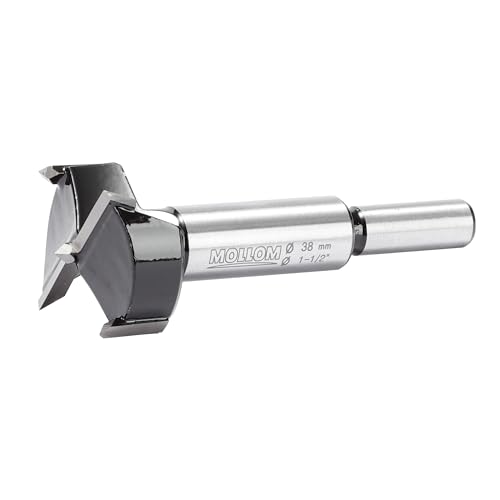
The MOLLOM Forstner is built for the woodworker who cannot tolerate a wandering bit or a chipped edge. Its YG8 carbide blade (a very hard tungsten-carbide blend), at a 2.0mm thickness, extends the service life by 10 times compared to a standard 1.3mm blade — that is a real durability advantage if you are drilling through abrasive materials like MDF or plywood repeatedly. The positioning drills and blades are made of YG8, hardness ≥ 91HRA (Rockwell hardness scale A — a measure of surface hardness), with a bending strength up to 2200N/cm2 (newtons per square centimeter — how much force it can take before bending), meaning the cutting edges hold up to heavy use without chipping.
You get a compact bit that fits a hand drill but truly shines in a drill press: cutting diameter of 38mm, a round shank of 10mm (2/5 inch), a drilling depth of 60mm (2-3/8 inches), and a total length of 94mm (3-11/16 inches). The manufacturer recommends a rotational speed of 2200-2500 RPM (revolutions per minute — how fast the bit spins) for best results, and the design demands you keep the bit vertical — a vise is strongly recommended for stability. Shoppers say that it cuts a perfect hole in hardwood with no tear-out and works well on a lathe for drilling wood blanks. The trade-off is that some owners find it tears wood during use, and the overall stability rating is negative — the bit walks if the material is not clamped.
Quality leads the praise at 57 mentions, followed by functionality at 48 and sharpness at 34. This is a serious bit for the serious woodworker who is willing to set up properly in exchange for a clean, accurate flat-bottom hole. Unlike the cheaper Forstner options here, the MOLLOM has the carbide staying power to justify the extra attention during setup.
Why It Wins for Precision
- YG8 carbide blade at 2.0mm thickness outlasts standard Forstner blades by a wide margin
- Cuts clean flat-bottom holes in hardwood with zero tear-out when set up right
- Accuracy is within 0.1mm, making it ideal for barrel hinges and precise joinery
The Setup Cost
- Requires a clamped workpiece and a slow start to prevent walking
- Stability is the most-discussed negative aspect — not for a freehand drill
Best for the bench: woodworkers who need repeatable, 0.1mm-accurate flat-bottom holes in hardwood and are willing to clamp the workpiece and use a drill press or vise.
Think twice if: you work freehand with a hand drill and need to just punch a hole fast — the MOLLOM demands stable setup to shine.
5. HPHOPE 1-1/2″ Forstner Bit for Wood
The budget Forstner that punches above its price for clean flat-bottom holes.
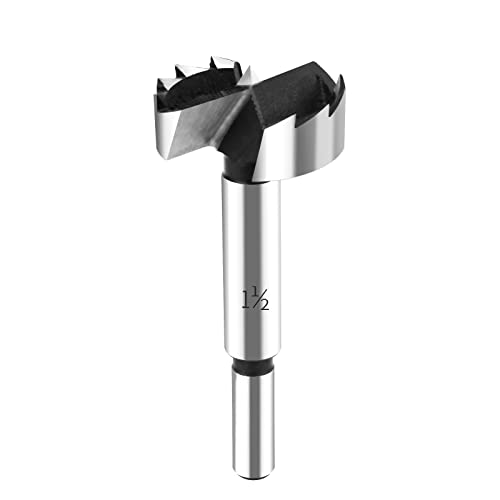
The HPHOPE Forstner is the balance for the weekend woodworker who needs a clean, flat-bottom hole at a price that does not sting. Made from high-speed carbon steel (a hard steel that stays sharp through moderate use) with a center-point design that allows precise positioning without slipping, this bit is forgiving enough for a hand drill and sharp enough for a drill press. The tooth-shaped design reduces friction and heat, and the 2-flute straight pattern (two grooves that carry chips out) clears chips effectively — not as fast as a spiral, but good enough for hinge mortises and shelf pin holes.
With a 1-1/2-inch cutting diameter, a 3/8-inch round shank, and a 3-9/16-inch overall length, this bit fits any standard 3/8-inch chuck drill or press. Buyers report using it for shallow depressions for 1-inch keyhole hangers with perfect results, and one owner drilled 35 holes through 1-inch Sapele stock — a dense African hardwood — with no issues. The catch is that quality and sharpness get mixed reviews. Some find the bit excellent and long-lasting, while others report dull edges from the start. It is a coin-flip on consistency, which is the trade-off at this price point.
Functionality leads the owner feedback at 23 mentions, with cutting performance at 12 and value at 6. The HPHOPE is a solid entry-level Forstner that gets the job done on softwood, plywood, and even some hardwoods — but check the edge before you start a critical cut, because the sharpness inconsistency is real.
The honest value take: Cheaper than the MOLLOM by a few dollars, but the HPHOPE trades carbide staying power for a price that makes it disposable-friendly. It works great on softwood and plywood; treat it as a solid bit for everyday projects rather than a heirloom tool.
Pick this if: you need a reliable Forstner for occasional hinge mortises and shelf pin holes in softwood or plywood — the price lets you buy without hesitation.
Choose the MOLLOM instead if: you are drilling into hardwoods daily and need a carbide edge that stays sharp through dozens of holes.
6. NICAVKIT 1-1/2″ Forstner Drill Bit
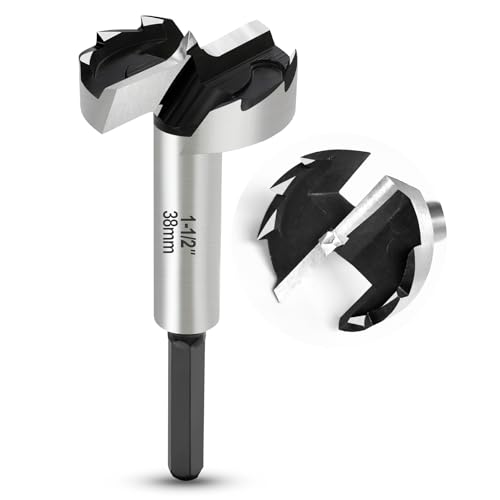
The price-conscious Forstner with a hex shank — a rare combo at this budget.
The NICAVKIT Forstner stands out from the other budget Forstners because it uses a 1/4-inch hex shank instead of a round one. That means it locks into impact drivers without slipping — a real advantage if you do not own a drill press and are working with a hand drill. Made from ASTM 5140 alloy steel with a solid hardened steel body, the bit is built to be sturdy and rust-resistant, though the uncoated finish means it does not have the slick surface of a coated bit.
The cutting diameter is 1-1/2 inches, total length is 3-9/16 inches, and the hex shank diameter is 1/4 inch — fitting all drill drivers and drill presses with a 3/8-inch chuck. The center-positioned teeth and sharp serrated edge are designed for precise flat-bottom holes with no chipping in wood. One owner reported cutting multiple 2.75-inch holes in Sapele and drilling 35 holes through 1-inch stock with no issues, calling it great value for the cost.
Where this bit falls short is consistency. Quality is mixed (19 mentions), and sharpness is mixed (16 mentions) — some owners find it excellent while others report poor quality and dull edges. Functionality leads the positive feedback at 23 mentions, with cutting performance at 12. The bit also has a tendency to walk on the start, so a slow, careful approach is necessary to keep it from wandering off your mark. For the price, it is a functional entry-level Forstner that works well when you get a good one, but the sharpness gamble is real.
The Budget Hex Advantage
- 1/4″ hex shank locks tight in impact drivers — no Chuck slippage
- ASTM 5140 alloy steel body is tough and rust-resistant
- Able to cut through dense Sapele and up to 35 holes through 1-inch stock
The Consistency Risk
- Sharpness is mixed — some units arrive dull; check the edge before a critical cut
- Tendency to walk on start requires a slow, careful entry
Reach for this if: you want a Forstner with a hex shank for impact driver use and you are on a tight budget — the hex grip is the main feature here.
Look elsewhere if: you need a guaranteed sharp edge for expensive hardwood; the MOLLOM or HPHOPE are safer bets for consistent sharpness.
7. Greycore Tools 1-1/2″ x 6″ 3-Flute Auger Bit
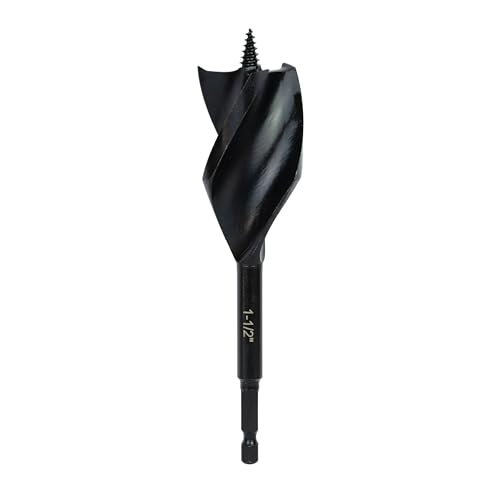
The three-flute auger that clears chips faster than a two-flute ever could.
The Greycore auger is built around a simple idea: three flutes move chips out of the hole faster than two, which means less binding and a smoother drilling experience. Made from high-speed steel (HSS) with razor-sharp cutting teeth, this 1-1/2-inch x 6-inch auger is designed for long-lasting performance in hardwood, softwood, plywood, MDF, and plastics. The 1/4-inch quick-change hex shank is compatible with most impact drills and fits standard drills and drill presses.
The spiral flute design is the key difference here — a 3-flute pattern that improves chip removal and reduces clogging, enabling faster drill speeds and leaving a clean smooth hole. One owner reported needing to bore a hole through two palm tree stumps, and the Greycore went through them like a hot knife through butter. Another noted it is a difficult size to find commercially and was pleased with the performance. The bit is 6 inches long with a 1-1/2-inch cutting diameter, giving it the reach for deep drilling in framing timber and logs.
Drilling performance leads the feedback at 19 mentions, with build quality at 16 and durability at 11 — all solidly positive. The only operational note is to remember to pull the bit out periodically to clear shavings, as the aggressive flutes can pack chips in dense wood. At this price point, the Greycore offers a unique three-flute advantage that makes it a strong alternative to the Diablo for those who prioritize chip clearance above all else.
The chip-clearance verdict: The 3-flute design gives the Greycore a real edge over the 2-flute Competition when drilling deep holes in wet or resinous wood that clogs standard augers. It is the best choice for log boring and thick timber.
Grab the Greycore if: you are drilling deep holes in logs, stumps, or thick timber where chip clogging is the main problem you face.
Stick with the Diablo if: you need a bit that can survive hitting hidden nails — the Diablo’s Dura-Tip is purpose-built for that, and the Greycore is not advertised for nail-embedded wood.
Understanding the Specs
Auger vs Forstner — The Core Choice
An auger bit (like the Diablo or Greycore) uses a screw tip that pulls itself into the wood as you drill. You apply less pressure, and the deep flutes carry chips out of deep holes. Augers are ideal for through-holes in framing timber where speed and chip clearance matter. A Forstner bit (like the MOLLOM or HPHOPE) has a flat center point and a circular rim that scribes the outer edge of the hole before the cutters follow. It leaves a flat-bottom hole with a clean rim — perfect for hinge mortises, shelf pins, and any hole that must stop at an exact depth. Forstners cut slower and clog more easily in deep holes, but the finish is superior.
Hex Shank vs Round Shank
The shank is the part your drill chuck grips. A hex shank (7/16-inch on the Diablo, 1/4-inch on the Greycore and NICAVKIT) locks tight into the Chuck with flat faces that resist spinning. This is critical for a 1.5-inch bit, which generates serious torque. A round shank (3/8-inch on the HPHOPE and MOLLOM) fits any standard chuck but can slip if the chuck is not fully tightened or if the bit catches on a knot. For an impact driver, a hex shank is mandatory. For a drill press, a round shank is fine because the Chuck holds tighter and the workpiece is clamped.
FAQ
Will a 1-1/2 inch bit work with my standard drill?
What is the difference between an auger and a Forstner bit for woodworking?
Can a Forstner bit be used in a hand drill?
How long does a 1-1/2 inch drill bit last?
What is a self-feeding tip and do I need it?
What shank size do I need for an impact driver?
Can I use a Forstner bit on plastic or MDF?
Why does my bit wander when I start drilling?
What is the difference between the Irwin Speedbor and the Irwin Ship Auger?
Are these bits resharpenable?
Final Thoughts: The Verdict
For most people, the best 1 1 2 drill bit for wood winner is the Diablo DAG1170 because it is the only bit here built to survive nail-embedded wood while delivering the clean, fast cuts that make auger drilling a pleasure. If you need precision flat-bottom holes for furniture work, grab the MOLLOM Carbide Forstner. And for deep boring through thick timber and LVL beams, the Irwin Ship Auger 49924 is the one to reach for with its single-spur smoothness and solid center rigidity.
How We Picked
We do not accept paid placement. Every pick is matched to a real buyer and a real use-case; we do not hands-on test units.
Sources & Methodology
Specifications: manufacturer listings and product documentation. Review insights: verified customer reviews, as of July 2026. Pricing: not shown on this page (it changes often); check the current price via the retailer link.
As an Amazon Associate, Trending Car earns from qualifying purchases. This does not affect which products we feature.