
Our readers keep the lights on and my garage snacks stocked. As an Amazon Associate, I earn from qualifying purchases.
Specs are compiled from manufacturer listings and verified buyer reviews and can change over time — please confirm the key details on the product page before buying.
Getting a torque wrench onto a 1-1/16 inch nut buried deep in an engine bay is the kind of job that separates a good day from a string of swear words. A crowfoot wrench solves that—it snaps onto your ratchet or torque wrench and reaches where a standard socket just will not fit. The trick is finding one that actually grips the fastener without slipping, because a rounded-off bolt turns a ten-minute job into an afternoon of extraction tools.
I’m Min Islam — the founder and writer behind Trending Car. This guide is built by comparing the manufacturers’ published specifications and the patterns across verified customer reviews, so you get each pick’s real strengths and trade-offs instead of marketing spin.
Below, find the five best options for a 1-1/16 inch crowfoot that earn their keep, whether you are wrenching on an EGR valve, installing a barrel nut, or chasing a stubborn sensor in a tight corner. This is the best 1 1 16 crows foot guide for anyone who needs a reliable grip on the next fastener.
Our Picks at a Glance


How To Choose The Best 1 1 16 Crows Foot
A 1-1/16 inch crowfoot wrench is a simple tool, but the wrong one will round a nut instantly. Here is what separates a keeper from a headache.
Drive Size — 3/8-Inch vs 1/2-Inch
Your drive size determines what ratchet or torque wrench you can attach. A 3/8-inch drive crowfoot is lighter and fits into tighter spots; a 1/2-inch drive handles higher torque without twisting. Most 1-1/16 inch nuts sit right in the middle—either drive works, but if you plan to torque a barrel nut to 50 ft-lbs, go with 1/2-inch for the extra margin.
Point Design — 6-Point vs Open End
A 6-point crowfoot grips the fastener flat on each side, which nearly eliminates the chance of slipping and rounding the corners. An open-end style slides on faster from the side, but it pinches only two flats and can slip under high torque. For rusted or tight bolts, 6-point is the safer call.
Material and Finish
Chrome vanadium steel and 4140 steel are the common choices here. Both resist bending under load. A polished or nickel-plated finish fights rust and is easier to wipe clean after an oily job—important if the wrench lives in a tool bag with other gear.
Length and Access
Crowfoot wrenches range from roughly 3 to 4 inches long. A shorter tool fits into narrower gaps, while a longer one gives you more leverage and reach. Check the space you are working in before you pick.
Quick Comparison
| Model | Best For | Drive Size | Material | Length | Amazon |
|---|---|---|---|---|---|
| TEKTON WCF15227★ Best Overall | Anti-slip Flare Nut Work | 3/8-Inch | 4140 Steel | 4 Inches | Amazon |
| Titan 61041Torque Specialist | High-Torque 1/2-Inch Use | 1/2-Inch | Chrome Vanadium Steel | — | Amazon |
| SUNEX TOOLS 97734A | Budget-Friendly Jumbo | 1/2-Inch | Alloy Steel | 3 Inches | Amazon |
| RBP 61041 | Simple No-Frills Wrench | 1/2-Inch | Chrome Vanadium Steel | — | Amazon |
| Williams 10711 | Tight-Spot Open-End Access | 3/8-Inch | Alloy Steel | 6.1 Inches | Amazon |
In‑Depth Reviews
1. TEKTON 3/8 Inch Drive x 1-1/16 Inch Flare Nut Crowfoot Wrench | WCF15227
Our pick — over 4.5★ from 250+ verified ratings; the strongest balance of quality and price.
The 6-point jaw that refuses to let a bolt round.
This is the crowfoot that gets the job done without drama. The deep 6-point design (meaning it contacts the fastener across all six flats) gives you a slip-proof grip that open-end wrenches cannot match. Buyers report it as a “perfect clearance” for Ford EGR valve connectors, where a standard wrench would spin right off and round the bolt. The reinforced jaw area prevents spreading under load, so it keeps its shape job after job.
At 4 inches long, it is the deepest reach in this roundup—a full inch longer than the Sunex jumbo, giving you a 4-inch versus 3-inch length advantage in leverage and access. The entire tool is machined from 4140 steel and finished with electroless nickel plating. That plating matters because, unlike conventional chrome, it deposits a uniform coating across every surface, so the fit stays consistent and corrosion has nowhere to hide. The 15-degree offset on the jaw lets you flip the wrench over for a second access angle in tight bays.
The thing owners praise most is the build quality—42 separate mentions of it in the feedback—and the functionality follows close behind. Build-quality is what wins people over here; the wrench feels solid in the hand and fits snug on the nut. The only recurring note is that the offset jaw design takes a second to get used to, but it is a trade-off that buys you real access flexibility. If you face rusted 1-1/16 inch bolts often, this is the one to reach for.
Why It Wins
- Deep 6-point grip eliminates bolt rounding on rusty fasteners
- 4140 steel with electroless nickel finish resists corrosion uniformly
- 4-inch length and 15-degree offset provide superior reach and angle options
The Adjustment
- Offset jaw takes a short learning curve for new users
- 3/8-inch drive requires an adapter for 1/2-inch torque wrenches
Reach for this if: you work on stubborn, rusty, or hard-to-reach 1-1/16 inch fasteners and want the most slip-resistant jaw on the list.
Look elsewhere if: you need a 1/2-inch drive for higher-torque applications like barrel nuts.
2. Titan 61041 1/2-Inch Drive 1-1/16-Inch Full Polish Crowfoot Wrench
The heavy-duty 1/2-inch drive built for torque-spec work.
Where the TEKTON focuses on tight-jaw grip, the Titan focuses on raw torque handling. With a 1/2-inch drive (versus the TEKTON’s 3/8-inch), this crowfoot mates directly to common 1/2-inch torque wrenches. Owners mention using it “to install barrel nut for torque wrench with 1/2″ drive tighten down to 30 to 40 ft. Lbs or 50 ft. Lbs max.” That is a 1/2-inch drive versus the TEKTON’s 3/8-inch drive—meaning more surface area on the drive square and less chance of twisting the adapter.
The body is forged from chrome vanadium steel with a mirror polish finish. Quality is the most-discussed aspect here—31 mentions—and it shows in the thick steel walls that resist flex. It weighs 6.7 ounces, making it the heaviest in this lineup, which gives confidence when leaning into a tight fastener. The recurring trade-off is size perception: because the steel walls are thick, it can feel bulky in narrow spaces. Some owners note it is “too big” for certain confined work, so check your clearance before you commit.
For anyone installing barrel nuts, torqueing to spec, or removing oil pressure sensors where you need the drive to match your wrench, this pick delivers a secure connection that the 3/8-inch options cannot match without an adapter.
What Stands Out
- 1/2-inch drive pairs directly with standard torque wrenches up to 50 ft-lbs
- Thick chrome vanadium steel walls resist flex under load
- Mirror polish finish cleans easily and resists surface rust
The Trade-Off
- Thick walls can feel bulky in tight, confined engine spaces
- Size is occasionally called “too big” for some specific applications
Best suited for: anyone who needs a 1/2-inch drive crowfoot for torque-spec work on barrel nuts or suspension components.
Not ideal if: your workspace is extremely tight and every millimeter of clearance counts.
3. SUNEX TOOLS 97734A 1/2″ Dr. 1-1/16″ Jumbo Crowfoot Wrench CRV

The affordable jumbo that buyers call “heavy duty” for the price.
This SUNEX jumbo crowfoot gets the job done at a fraction of the cost of premium brands, and the feedback backs it up as a “heavy duty quality tool.” It is a fully polished, drop-forged alloy steel wrench with a 1/2-inch drive and a compact 3-inch length—the shortest in this list, which is a real advantage when you need to squeeze into a cramped corner. Functionality is the top-mentioned aspect here, with 29 buyers calling it effective for their need.
The short length means less leverage than the 4-inch TEKTON, but it also means it fits in spaces where longer tools simply will not go. The mixed feedback centers on fit: some owners find it slightly smaller than nominal size on certain nuts, and a few note the walls are too thick for narrow applications like a Noveske NSR barrel nut. That said, for a standard 1-1/16 inch job on an EGR tube or a 27mm metric equivalent, it “worked perfectly” per the reviews.
Think of this as the no-regret backup wrench. It earns its place in the toolbox for occasional use where a premium tool is overkill, but customers note you want to check the fit on your specific nut before leaning hard on it.
What Works
- 3-inch short length slides into the tightest spaces
- Drop forged alloy steel with polished finish at a budget-friendly tier
- Durable enough for repeated heavy use per owner feedback
Heads Up
- Fit is occasionally snug or off-nominal on some fasteners
- Short length provides less leverage than longer alternatives
Grab this if: you need an occasional-use jumbo crowfoot for tight access and do not want to overspend.
Think twice if: you need a guaranteed precision fit on critical or high-torque fasteners.
4. RBP 1-1/16″ SAE JUMBO CROWSFOOT WRENCH (61041)

The no-frills 1/2-inch driver that buyers call “rugged.”
This RBP wrench is a straightforward tool—1/2-inch drive, 1-1/16 inch SAE, made from chrome vanadium steel with a powder-coated finish. Reviewers point out it works well for specific jobs, describing it as “accurate and rugged” and noting it “successfully removed EGR valve on Mercury Mountaineer.” The powder-coated finish is less shiny than polished alternatives but holds up fine in a garage drawer.
The honest caveat here is the fit. One owner reported having to grind the wrench down to get it to seat properly on their fastener. When a single-digit percentage of owners encounter a fit issue, it is note, but the majority of buyers found it worked exactly as needed. With a 1/2-inch drive, it pairs with standard torque wrenches without an adapter.
For a straightforward crowfoot on a common SAE job—brake lines, EGR valves, suspension nuts—this RBP is a solid, no-surprises option. The powder coating makes it easy to spot in a messy toolbox too.
One-line verdict: Uncomplicated tool for uncomplicated jobs; test the fit on your specific fastener before applying full torque.
Ideal for: a budget-friendly 1/2-inch drive crowfoot for occasional EGR valve or brake line work.
Skip if: you need guaranteed precision fit on every fastener without the possibility of grinding.
5. Williams 3/8″ Drive SAE 1-1/16″ Open-End Crowfoot Wrench (10711)
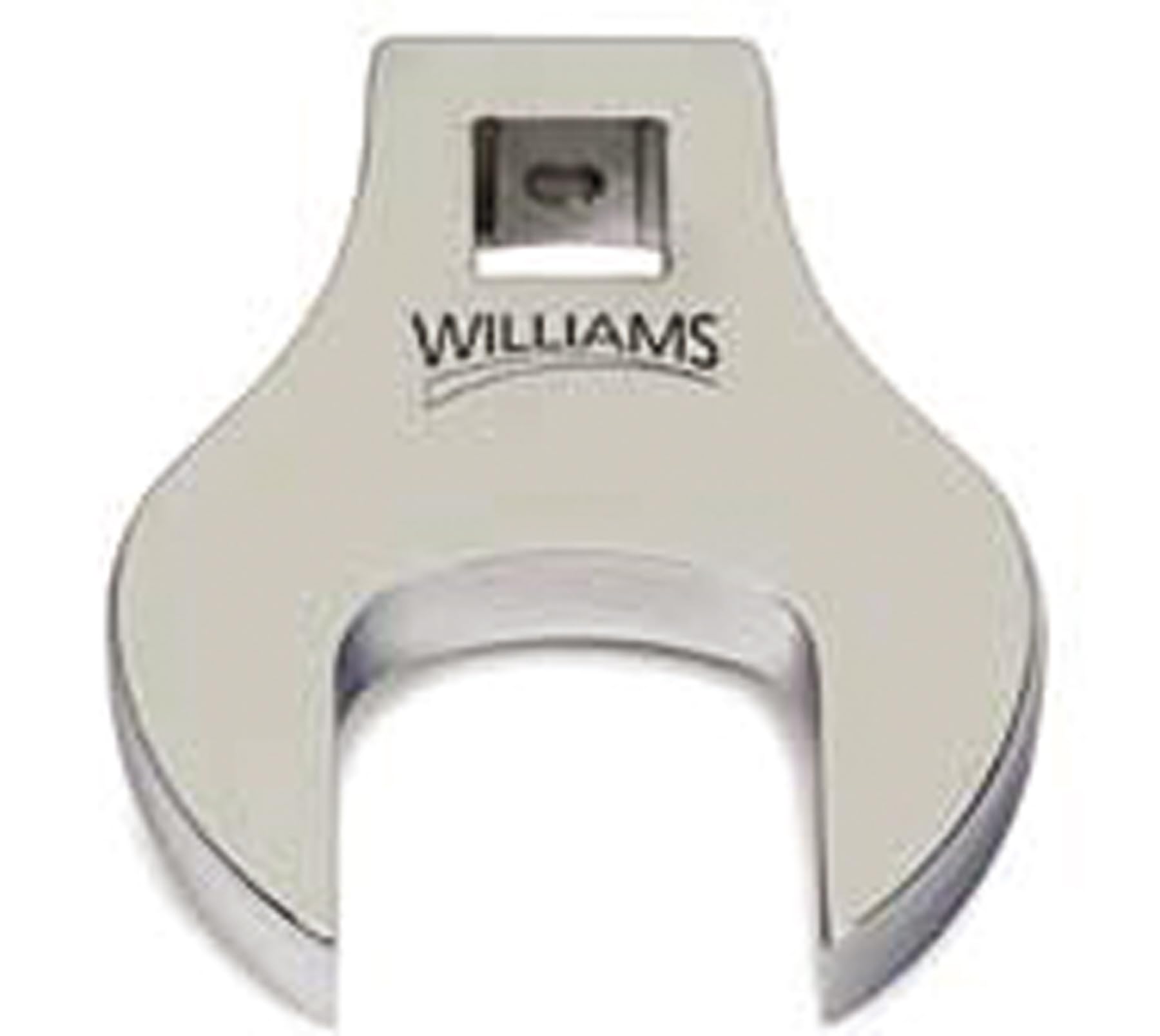
The open-end design that slides onto fasteners from the side.
Every other wrench here uses a closed jaw that you must slip over the fastener end-on. The Williams is an open-end crowfoot—it hooks onto the nut from the side, which is a lifesaver when a line or bracket blocks the end of the bolt. The 3/8-inch drive and high-polish chrome finish are classic Williams hallmarks, and shoppers say it “works great for a specific procedure on a repair I had to complete where the metric size fits snug.”
Functionality and quality each get 16 mentions in the feedback, tied as the most-discussed aspects. The open-end does sacrifice some grip security compared to a 6-point closed jaw—it only contacts two flats instead of six—so it is not the tool for a seized, rusted bolt. Owners also note the fit can be inconsistent: some find it perfectly snug, while others call the size non-standard for a 1-1/16 inch nut. The chrome finish, however, gets consistent praise for durability.
This Williams is the specialist—perfect for that one repair where nothing else fits because the fastener is side-access only. For general use, a closed-end wrench is a safer bet, but when you need the open-end, this is the one.
The bottom line: Open-end design buys access that closed wrenches cannot reach; the trade-off is less grip security on high-torque or rusted fasteners.
Reach for this if: you are dealing with a side-access fastener where a closed jaw cannot even reach the nut.
Look elsewhere if: you need maximum grip to avoid rounding a stubborn or rusty bolt—choose a 6-point closed design.
Understanding the Specs
6-Point vs Open-End Crowfoot
A 6-point crowfoot wraps around the fastener and contacts all six flats of the nut or bolt head. This spreads the force evenly and dramatically reduces the chance of slipping and rounding the corners—critical on rusty hardware. An open-end design hooks on from the side, which is useful when a pipe or bracket blocks the end of the fastener, but it only grips two flats and can slip under higher torque. For most jobs, a 6-point closed jaw is the safer choice.
Drive Size — 3/8-Inch vs 1/2-Inch
Drive size refers to the square hole on the crowfoot that connects to your ratchet or torque wrench. A 3/8-inch drive is lighter and fits into tighter spaces, but it has less torque capacity—a 1/2-inch drive has a larger square cross-section and can handle higher loads without twisting. If you are using a 1/2-inch torque wrench, you want a 1/2-inch drive crowfoot to avoid the weak link of an adapter. For moderate hand-tightening with a ratchet, 3/8-inch is often more convenient.
FAQ
Can I use a crowfoot wrench with a torque wrench?
Will a 1-1/16 inch crowfoot fit a 27mm nut?
What is the difference between a flare nut crowfoot and a regular crowfoot?
Can I use a 3/8-inch drive crowfoot on a 1/2-inch ratchet?
How do I prevent a crowfoot from slipping off the fastener?
What does “jumbo” mean in the context of a crowfoot wrench?
Is a polished finish better than a powder-coated finish?
Do I need a 1/2-inch or 3/8-inch drive crowfoot for brake line work?
Final Thoughts: The Verdict
The best 1 1 16 crows foot for most people is the TEKTON WCF15227—its 6-point jaw and reinforced 4140 steel construction give the strongest anti-slip grip on rusted fasteners in this roundup. If you need a 1/2-inch drive for direct torque-wrench use, the Titan 61041 is the specialist with thick chrome vanadium steel. And for a budget-friendly jumbo that fits tight spaces, the SUNEX TOOLS 97734A delivers heavy duty quality at a price that leaves room in the budget for other tools.
How We Picked
We do not accept paid placement. Every pick is matched to a real buyer and a real use-case; we do not hands-on test units.
Sources & Methodology
Specifications: manufacturer listings and product documentation. Review insights: verified customer reviews, as of July 2026. Pricing: not shown on this page (it changes often); check the current price via the retailer link.
As an Amazon Associate, Trending Car earns from qualifying purchases. This does not affect which products we feature.