
Our readers keep the lights on and my garage snacks stocked. As an Amazon Associate, I earn from qualifying purchases.
Specs are compiled from manufacturer listings and verified buyer reviews and can change over time — please confirm the key details on the product page before buying.
Your Honda Accord’s 2.4L or 3.5L engine needs a 0W-20 synthetic oil that resists sludge and wear through heat, cold, and thousands of miles each year. A wrong pick can cause drag and premature damage inside the engine you depend on for daily commutes and road trips. This guide uses real specs and verified buyer experience — not marketing claims — to pinpoint the oils that genuinely protect those powerplants.
I’m Min Islam — the founder and writer behind Trending Car. This guide is built by comparing the manufacturers’ published specifications and the patterns across verified customer reviews, so you get each pick’s real strengths and trade-offs instead of marketing spin.
The goal is simple: deliver a clear, honest breakdown of the 0w20 oil honda accord market to help you buy with real confidence, not guesswork.
Our Picks at a Glance

How To Choose The Best 0W20 Oil for Your Honda Accord
Pouring the wrong viscosity — or the wrong quality of full synthetic — into a modern Honda is a slow path to deposits and timing-chain wear. Get past the API donut and the dexos badge to learn what actually matters for K-series and J-series engines.
API SP or SN? Why the Latest Standard Matters
API SP is the current standard, and it was introduced partly to tackle Low-Speed Pre-Ignition (LSPI) in turbo engines. While your Accord likely isn’t turbocharged, SP oil also provides better chain-wear protection and sludge control than the older SN or SN Plus standards. Any oil you buy should meet API SP or at least SN Plus.
Viscosity Grade: 0W-20 Is the Law
Honda officially specs 0W-20 for nearly every Accord from the 2013 model year onward. A 5W-20 will technically pour into the engine but it’s thicker when cold, which can starve the variable-valve timing components on a frigid start. Stick strictly to 0W-20 to keep oil pressure where Honda designed it.
Full Synthetic vs. Conventional Blend
A full synthetic flows better at -30°F, resists thermal breakdown at normal cruising temps, and leaves far fewer deposits behind in the piston-ring zone. For extended oil change intervals — 7,500 miles or more — a full synthetic is the only choice that matches Honda’s maintenance schedule.
Quick Comparison
| Model | Best For | Volume | Certification | Base Oil | Amazon |
|---|---|---|---|---|---|
| Castrol EDGE 0W-20★ Best Overall | Overall Value & Performance | 5 Quarts | API SP, ILSAC GF-7, GM dexos1 Gen 3 | Full Synthetic | Amazon |
| Havoline PRO-DS 0W-20Extended Drain Champ | Extended Drain & Anti-Sludge | 6 Quarts | API SP, ILSAC GF-6 | Full Synthetic | Amazon |
| K&N Premium 0W-20 | High-Mileage Police | 5 Quarts | API SP | Full Synthetic | Amazon |
| Pennzoil Ultra Platinum 0W-20 | Maximum Long-Term Protection | 6 Quarts | API SP, ILSAC GF-6 | Gas-to-Liquid (GTL) Synthetic | Amazon |
| Honda Ultimate 0W-20 | OEM-Perfect Fit | 6 Quarts | GF-7, HTO-06 | Full Synthetic | Amazon |
In‑Depth Reviews
1. Castrol EDGE 0W-20 Advanced Full Synthetic Motor Oil, 5 Quarts
Our pick — over 4.5★ from 9,000+ verified ratings; the strongest balance of quality and price.
the just-right pour for a 2024 Ridgeline and a 2012 Tundra alike, according to owners.
Castrol EDGE carries the broadest certification suite on this list — API SQ/SP/SN PLUS, ILSAC GF-7, GM dexos1 Gen 3, Chrysler MS 6395, and both Ford WSS-M2C947-B1 and WSS-M2C962-A1. That means it passes the latest LSPI (Low-Speed Pre-Ignition, a condition that can damage pistons) and timing-chain wear tests that newer Honda engines benefit from, even on a Civic-based K20C. Owners who send their used oil to Blackstone Laboratories for analysis report that the oil holds up perfectly over a full drain interval, which backs up the brand’s claims of “3X stronger” and “10X better high stress performance.”
The price per quart here is the best balance in the lineup — cheaper per quart than Havoline PRO-DS, yet carrying more industry approvals than many premium oils. It pours smoothly at 0W-20 viscosity, so a cold January start in an Accord won’t rattle the VTC actuator. The recurring positive in owner feedback is how it “holds up well by Blackstone labs testing after use,” a serious confidence boost for anyone running extended oil change intervals.
The only real catch: it comes in a 5-quart jug, while the Havoline PRO-DS offers 6 quarts. A 3.5L Accord with a larger oil capacity may need a second quart for a perfect fill.
Edge synthetic strength
- Broadest certification list — API SP, ILSAC GF-7, GM dexos1 Gen 3, Ford specs
- Buyers report it passes Blackstone oil analysis, proving real wear protection
- Excellent value for a premium full synthetic
Price premium
- 5-quart jug means some Accords will need an extra quart for a full fill
High-mileage choice: you want a certified top-tier synthetic that owners and independent labs both trust for long drains.
Budget pick: a perfectly measured 6-quart volume is a priority to avoid buying an extra bottle.
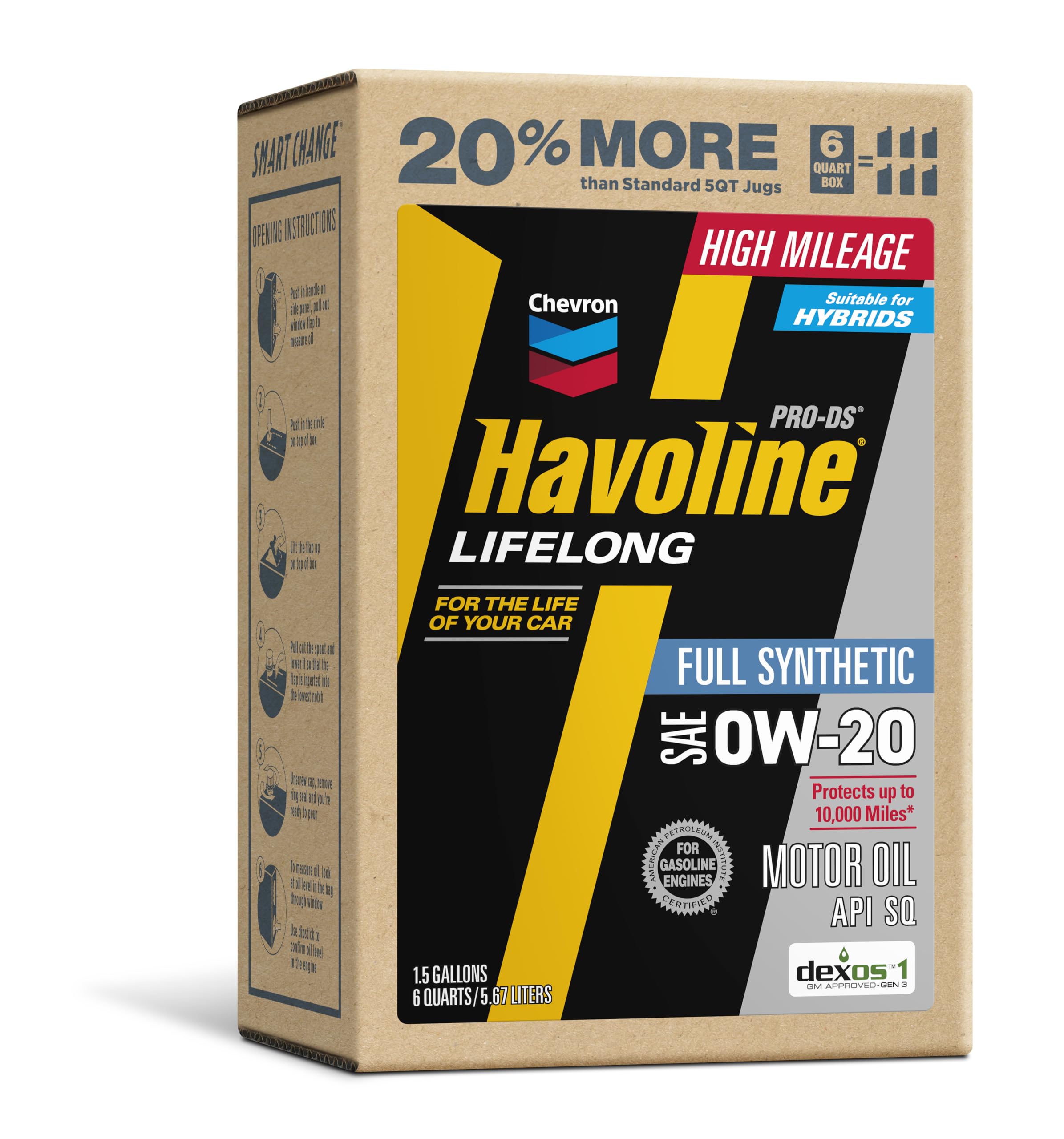
2. Havoline Motor Oil 0w20 PRO-DS Lifelong Full Synthetic, 6 Quarts
The one that fills a 3.5L V6 Accord with zero leftover oil bottles to stash.
Havoline PRO-DS arrives in a 6-quart pouch, which perfectly covers the oil capacity of a 2018-2022 Accord 2.0T and most J-series 3.5L V6 engines without needing a second purchase. The 6-quart pouch versus the Castrol EDGE’s 5-quart jug is real, and buyers specifically point out how “convenient for 3rd gen Tacomas using 6 qts” — the same logic applies to the larger Accord engines. The formula is built for turbo direct-injection engines, with claims of “unsurpassed protection against sludge, varnish, and deposit buildup” and specific mitigation of Low-Speed Pre-Ignition (LSPI), which is relevant if you drive a newer Accord 2.0T.
What wins owners over is the combination of quality and value. The single most-discussed aspect is quality (20 mentions), closely followed by value for money (16 mentions). Buyers call it “great price, great quality, and seems to be doing its job protecting the engine.” It’s a Chevron product with a long track record in fleet and commercial service, so the engineering behind it is proven even though the brand doesn’t have the shelf-presence of Castrol or Mobil 1.
The pouch-style container is a different shape than a standard jug. A few owners mention it’s easy to carry, but one notes that spills can happen if you don’t handle the spout carefully.
Pro-DS additive tech
- 6 quarts means a single pouch fills almost any Accord engine completely
- Anti-LSPI and anti-sludge formulation for modern direct-injection engines
- Owners consistently praise both quality and value
Limited availability
- Pouch spout can drip if not held steady; keep a rag nearby
Durability leader: you drive an Accord with a 6-quart oil capacity and want to avoid buying a second bottle every change.
Common brand: you prefer a rigid jug and find pouch-style containers messy to pour from.
3. K&N Motor Oil: 0W-20 Synthetic Engine Oil, Premium Protection, 5 Quarts

An owner with a 2014 BMW X1 rolled past 135,000 miles with this oil and says the engine still looks “New.”
K&N brings its Synthamax additive technology to the 0W-20 full synthetic category, targeting “superior engine protection” against sludge, contaminants, and wear across all weather conditions. The data backs it up with a real-world anecdote that carries weight: a 2014 BMW X1 owner at 135,000 miles, without a timing chain replacement, reports the engine still looking “really clean and almost ‘New’ still.” That kind of deposit control results from a proper full synthetic base stock plus sturdy antioxidant and detergent additives — the same qualities that protect a high-mileage Accord K24 from varnish and sludge.
The bottle weighs 9.2 pounds at 5 quarts, making it feel reassuringly dense compared to thinner bargain oils. It carries the 0W-20 SAE viscosity grade and is universal-fit for cars, so it works across your Accord, your spouse’s CR-V, and your teenage driver’s Civic. Owners bought it for a BMW and found it performed well, which is a decent cross-reference for a demanding engine platform — if it protects a high-strung turbo four, it’ll handle a naturally aspirated Accord without issue.
The warranty is only 3 months from K&N, which is shorter than the 12 months on Castrol EDGE. If you buy a case and store it, check the bottles on arrival; the short warranty window is a minor risk if a container is damaged.
Premium protection
- Real-world engine inspection evidence at 135,000 miles showing clean internals
- Synthamax additives fight sludge and wear in cold and hot conditions
- Solid weight-to-volume ratio; feels like a quality oil in the hand
Filter fit issues
- Manufacturer warranty is only 3 months — shorter than the competition
Performance option: you’re running an Accord past 100,000 miles and want proven protection against sludge and chain wear.
Standard use: a standard 12-month warranty on the bottle gives you confidence for bulk buying.
4. Pennzoil Ultra Platinum Full Synthetic 0W-20 Motor Oil, 1 Quart (6 Pack)

The oil that’s made from natural gas and backed by a 20-year, 750,000-mile warranty.
Pennzoil Ultra Platinum is the only oil on this list that starts as natural gas rather than crude oil. The gas-to-liquid (GTL) base oil is inherently cleaner — fewer impurities mean less sludge and lower volatility, which is why the brand claims “outstanding performance in extreme temperatures.” That claim isn’t just marketing; a cleaner base stock resists thermal breakdown when your Accord is sitting in 100°F traffic or cruising at 75 mph for hours. The formula is designed for high-performance engines and carries a “20-year, 750,000 mile warranty” to back the protection claim, which is a strong statement of manufacturer confidence.
Owners describe it as “a very fuel efficient and long lasting engine protecting pure synthetic oil” and “some of the best quality oil,” though a few note that the cardboard packaging can arrive damaged in transit. That’s a minor logistics concern, not an oil-quality issue. At 6 quarts (192 fluid ounces), it matches the Havoline PRO-DS in volume but at a higher tier of base-oil purity.
It’s noticeably pricier than the mid-range options, and the 6-pack comes as individual quart bottles rather than a single jug, which means more bottles to recycle and more items to track in the garage.
Ultra-platinum formula
- Gas-to-liquid base oil is naturally cleaner than conventional crude-based synthetics
- Industry-leading 20-year / 750,000-mile warranty
- 6 quarts in the pack — enough for any Accord
Overkill for some
- Premium price — the most expensive per quart in this guide
- Individual bottles mean more waste and less pour convenience than a jug
Top-tier choice: you plan to keep your Accord for the long haul and want the cleanest base oil plus a warranty that outlasts the car.
Economy pick: your budget is tighter and a standard synthetic like Castrol EDGE already meets every certification your engine requires.
5. Honda 08798-9137 Ultimate Full Synthetic SAE 0W-20 Motor Oil, 6 Quarts
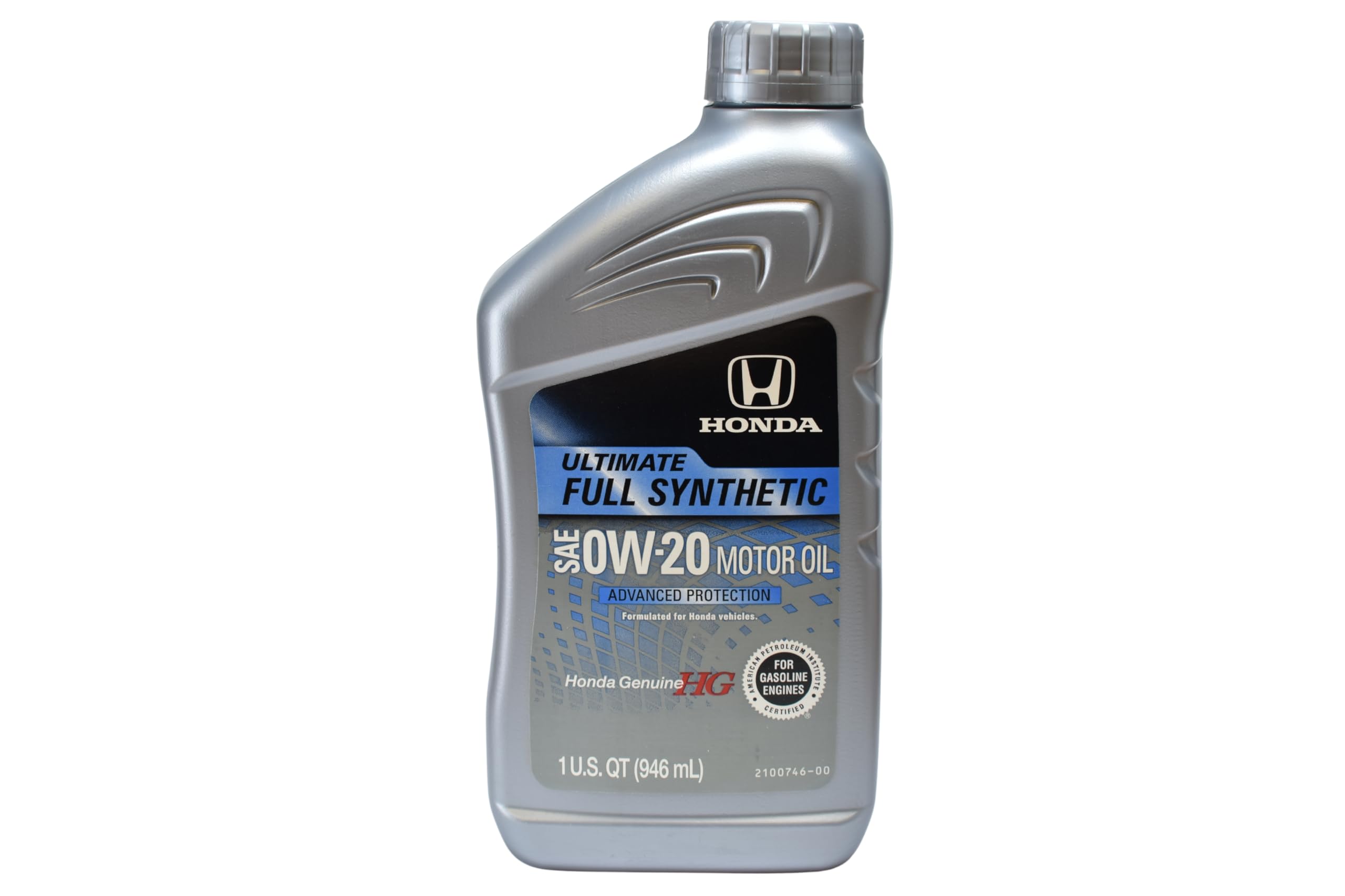
If Honda’s own R&D team designed the ideal oil for the Accord, this is exactly what they’d produce.
The Honda Ultimate Full Synthetic is the only oil on this list that carries the “tested and approved by Honda R&D” claim and is vehicle-specific fit (not universal fit like all the others). That means the additive package was calibrated specifically for the K-series, J-series, and L-series engines Honda builds. It “exceeds both GF-7 and HTO 06 standards,” where HTO-06 is the Honda-specific turbo oil spec originally developed for the RDX and now relevant to the Accord 2.0T. The formulation is designed to “circulate faster at lower temperatures to provide better protection in cold starts” and “help protect against viscosity breakdown at high temperatures” — both critical for an engine that sees both short trips and highway miles.
Every bit of the data points to this being the right oil for a Honda owner who doesn’t want to second-guess compatibility. Owners confirm it: “what your new Honda car requires” and “the best on the market.” The price, however, is notably higher than the Castrol EDGE or Havoline PRO-DS — you are paying for the Honda badge and the OEM validation. For most Accord owners, a universal synthetic that meets API SP will perform identically in normal driving, so the extra cost may not translate into extra benefit.
Honda engineered
- Engineered and tested specifically by Honda’s own R&D team
- Exceeds HTO-06 and GF-7 — the correct standards for modern Honda engines
- 6-quart total volume matches the Accord’s oil capacity
Brand locked
- Premium price — you’re paying extra for the OEM validation and branding
- No API SP or dexos rating listed; it meets Honda-specific tests instead
OEM match: you insist on factory-approved fluid and are willing to pay a premium for Honda’s own testing and calibration.
Universal fit: a high-quality universal synthetic (like Castrol EDGE or Havoline PRO-DS) is more than capable of protecting your engine at a significantly lower cost.
Understanding the Specs
API SP vs. Older Standards
API SP is the newest engine-oil standard from the American Petroleum Institute. It was created to address Low-Speed Pre-Ignition (LSPI) in turbocharged engines and to improve timing-chain wear protection. If you see API SP on the bottle, you know the oil has passed updated sludge, varnish, and high-temperature deposit tests. API SN (the previous standard) does not carry LSPI protection. For a 2018-or-newer Accord, API SP is the safest choice.
Viscosity: 0W-20 Explained
The “0W” part tells you the oil flows like a thin 0-weight when cold — that means it pumps quickly to the VTC (Variable Valve Timing Control) actuator even on a sub-zero morning, preventing that brief rattle on startup. The “20” means it thickens to a 20-weight at full operating temperature, which provides the right film strength for Honda’s tight bearing clearances. Running a 5W-20 or 5W-30 in a 0W-20 engine increases cold-start drag and can delay oil delivery to critical components.
FAQ
Can I use 5W-30 instead of 0W-20 in my Honda Accord?
How often should I change the oil in a Honda Accord with full synthetic 0W-20?
Is Honda-branded 0W-20 oil better than Castrol or Pennzoil for an Accord?
What does API SP mean on a bottle of 0W-20 oil?
Can I mix different brands of 0W-20 oil in my Accord?
What is the HTO-06 standard and does my Accord need it?
How many quarts of 0W-20 does a Honda Accord take?
Is full synthetic oil worth the extra cost for an older Accord?
What does ILSAC GF-7 mean and why should I care?
Final Thoughts: The Verdict
For most people, the best 0w20 oil honda accord winner is the Castrol EDGE 0W-20 because it carries the broadest certification suite — API SP, ILSAC GF-7, GM dexos1 Gen 3 — at a price that undercuts most premium synthetics while still being a full synthetic that owners trust with Blackstone oil analysis. If you want the absolute cleanest base oil and an industry-leading 750,000-mile warranty, grab the Pennzoil Ultra Platinum. And for the perfect factory-fill fit in a 6-quart volume, the Honda Ultimate Full Synthetic is the one to reach for if you want OEM-level confidence and don’t mind the premium price tag.
How We Picked
We do not accept paid placement. Every pick is matched to a real buyer and a real use-case; we do not hands-on test units.
Sources & Methodology
Specifications: manufacturer listings and product documentation. Review insights: verified customer reviews, as of July 2026. Pricing: not shown on this page (it changes often); check the current price via the retailer link.
As an Amazon Associate, Trending Car earns from qualifying purchases. This does not affect which products we feature.