
Our readers keep the lights on and my garage snacks stocked. As an Amazon Associate, I earn from qualifying purchases.
Specs are compiled from manufacturer listings and verified buyer reviews and can change over time — please confirm the key details on the product page before buying.
A P0420 code means your catalytic converter isn’t cleaning emissions efficiently, and the dealership’s first suggestion is usually a replacement that can easily run over. Before you commit to that bill, a catalytic converter cleaner is the smart, cheap first move—it dissolves the soot and carbon clogging the honeycomb inside, which restores flow and often turns the check engine light off for good. The catch is knowing which ones actually work on a coated converter versus a physically broken one, and that’s exactly what this guide breaks down.
I’m Min Islam — the founder and writer behind Trending Car. This guide is built by comparing the manufacturers’ published specifications and the patterns across verified customer reviews, so you get each pick’s real strengths and trade-offs instead of marketing spin.
So if your scan tool keeps flashing that catalyst efficiency code, here is the honest, hands-on breakdown of the catalytic converter cleaner for p0420 worth pouring in your tank.
Our Picks at a Glance


How To Choose The Best Catalytic Converter Cleaner for P0420
Before you pour anything in your tank, you need to know whether your converter is actually cleanable. A P0420 code (a diagnostic code that means the rear oxygen sensor detects the catalytic converter isn’t cleaning exhaust efficiently) can be caused by carbon buildup, a failing O2 sensor, or a physically melted unit. A cleaner only helps with the carbon.
Look for the right active approach
A catalytic cleaner works by carrying a detergent solvent through the fuel system, where it eventually reaches the converter’s honeycomb and breaks down the soot deposits restricting exhaust flow. The best products name their targets — injection system, combustion chamber, oxygen sensors — so you know the cleaning isn’t just happening in the fuel line.
Check the application process
Most formulas ask you to add the bottle to a nearly empty tank, drive at highway speeds to get the converter hot, then refill with fresh gas. Some need more patience: it can take 2-3 tank refills before the code clears permanently. If you’re expecting the light to shut off in 20 minutes, you’ll be disappointed — that’s rare and vehicle-dependent.
Know the limit before you buy
A cleaner is a maintenance fix, not a miracle cure. If your converter is cracked, melted, or structurally damaged, no additive will repair it — one owner on a GMC Terrain found this out the hard way when a cleaner actually clogged an already-failing system. If the cleaner doesn’t work after a full treatment cycle, the honest next step is a converter replacement or a proper diagnosis of the O2 sensors.
Quick Comparison
| Model | Best For | Bottle Size | Target Codes | Engine Support | Amazon |
|---|---|---|---|---|---|
| Liqui Moly 7110★ Best Overall | A complete fuel system flush | 10.14 Fl Oz | P0420 / P0430 | Gasoline | Amazon |
| Solder-It CAT-1Budget Champion | A budget first attempt | 16 Fl Oz | P0420 / P0430 | Gasoline | Amazon |
| BlueDevil 70523Direct-Injection Pick | Direct injection engines | 16 Fl Oz | P0420 | Gasoline / Hybrid | Amazon |
| MotorKote MK-10351 | High-mileage daily drivers | 16 Fl Oz | P0420 | Gasoline / Hybrid | Amazon |
| Lucas 10715 | Quick code clearing | 16 Oz | O2 code | Gasoline | Amazon |
| Cataclean 120007 | Emissions inspection prep | 500 ml | P0420 / P0430 | Gasoline / Diesel / Hybrid | Amazon |
| Nitrox NPC500 | Cleaning that activates instantly | 17 Fl Oz | P0420 / P0430 | Gasoline | Amazon |
| MotorPower Care 7001-2 | A two-tank treatment cycle | 8.45 Fl Oz x2 | P0420 / P0430 | Gasoline / Hybrid | Amazon |
| OXICAT 43243-13 | Preventive maintenance | — | O2 / Cat | Gasoline / Diesel | Amazon |
In‑Depth Reviews
1. Liqui Moly Catalytic System Clean 300 ml 7110
Our pick — over 4★ from 3,500+ verified ratings; the strongest balance of quality and price.
The patient German formula that cleans the whole combustion path, not just the cat.
Liqui Moly approaches the P0420 from the root: it doesn’t just scrub the catalytic converter, it also cleans the injection system and the combustion chamber while protecting the cat from clogging with soot. You pour the whole 10.14 oz bottle in, and the payoff shows up over time — buyers report that a 2005 Honda CR-V’s P0420 cleared permanently, but only after a full bottle, 93-octane fuel, and 2-3 tank refills. It is genuinely not instant, so treat this as a weekly patience project, not a 20-minute fix.
The real insight from owners is that it works best when your converter is still fundamentally healthy. One long-time user cleared a P0430 code for about 1,000 miles — enough to pass emissions — though the code did return. The consensus warning is to follow the instructions exactly, and specifically to avoid an aggressive “Italian tune-up” (high-RPM driving) if your valve cover gaskets leak, since that combination caused an oil mist problem for one owner.
At the mid-range price point, this is the most complete cleaning package for a gasoline engine with a catalytic converter, and the non-toxic formula makes it safe to handle. The trade-off is that it demands more patience and fuel than a pour-and-go competitor, so it suits someone willing to drive a few tanks before judging the result.
What makes it the top pick
- Cleans the injection system and combustion chamber, not just the cat
- Non-toxic formula is safe to handle
- Proven to clear P0420 codes permanently on older Hondas
Where it asks for patience
- Needs 2-3 tank refills to permanently clear the code
- Works best only when the converter is still physically intact
Reach for this if: you want a complete fuel system cleaning that targets the cat as part of a bigger picture.
Look elsewhere if: you need a code cleared tonight — this one rewards a week of driving.
2. Solder-It Catalytic Converter Cleaner and Deodorizer (16 fl oz)
Budget-priced, and it cleans O2 sensors plus that rotten-egg exhaust smell.
Solder-It has been on shelves since 2005, and it’s built for the driver who wants a cheap first shot at clearing a P0420 before spending real money. Beyond the catalytic converter, it targets the oxygen sensors and the EGR valve, and it’s honest about a side benefit: it helps eliminate that foul rotten-egg odor from your exhaust. At 16 oz, it’s a bigger pour than most at this price, and it supports emissions testing by promoting carbon-cleaning effects that can cut emissions.
The results are genuinely mixed, which is the honest story here. On one end, owners mention P0420 codes — including permanent ones — clearing after about 200 miles, with fuel economy climbing from 25 to 27 mpg and a quieter running engine. On the other end, a common story is the light going off after a one-hour highway drive on about 4 gallons, only to return roughly 500 miles later. The pattern is clear: it’s a fantastic value if your converter is mildly sooted, but it won’t hold a badly degraded cat.
Compared to the Liqui Moly above, this is less thorough — it doesn’t claim to clean the combustion chamber — but it’s also a fraction of the commitment. For the cost of a single bottle, it’s a reasonable maintenance habit that also keeps the exhaust smelling neutral between tune-ups.
Best value play: It clears mild P0420 codes and improves fuel economy by about 2 mpg for some owners, making it a smart budget-first experiment.
Know the limit: If your converter is heavily clogged, the light can return within a few hundred miles — treat this as a maintenance tool, not a permanent fix.
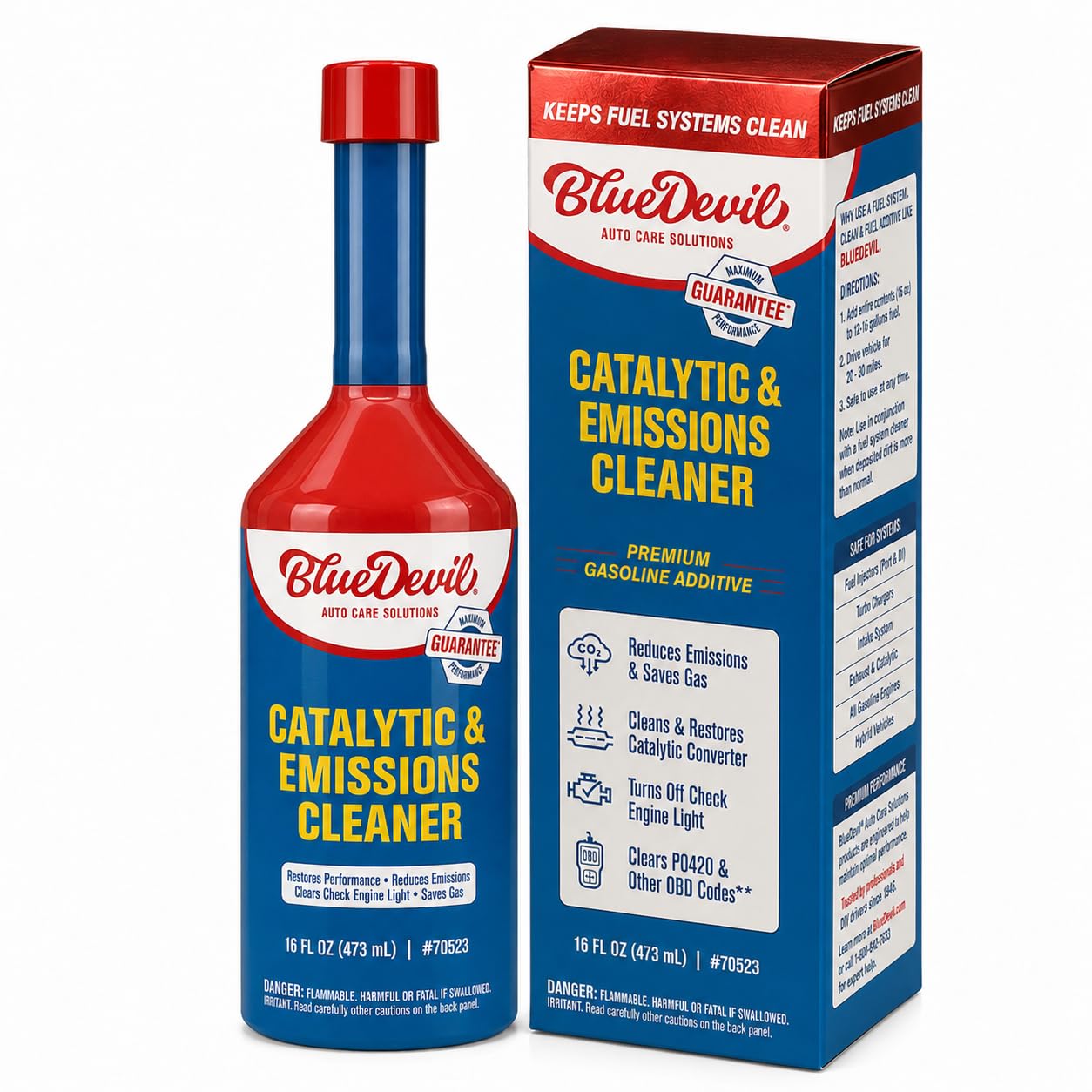
3. BlueDevil Catalytic & Emission System Cleaner | 16 oz. | 1 Pack
A detergent-based cleaner that handles direct-injection engines and hybrids.
BlueDevil is the one to grab when your ride uses direct injection — the fuel system that tends to build carbon on intake valves over time. It’s formulated specifically for Fuel Injected (Direct & Port), Direct Injection, Turbo, EcoTech, EcoBoost, and even hybrid vehicles, which is a rare compatibility list. The 16 oz bottle uses a detergent-based formulation (meaning it works chemically rather than abrasively) to attack carbon deposits across the fuel system, targeting injectors, intake valves, combustion chambers, and the emissions system.
Real-world results skew toward it working when the converter is soot-coated rather than damaged. An owner of a 2013 Cruze added it to a quarter tank, drove 30 highway miles, and the scanner passed with margin; a Mazda 3 with direct injection had its code cleared entirely. The honest fit-note is that effectiveness is the most-discussed topic and opinions split — some see immediate results in a Ford F150 and BMW X3, while others with a melted honeycomb found no improvement. The brand is trusted, but it expects you to follow the directions to the letter.
Compared to the Liqui Moly, BlueDevil is more aggressive on the direct-injection carbon problem and less about the combustion chamber. It’s a solid mid-range pick for newer engines, with a clear message: it cleans the cat, it won’t rebuild it.
Strong suit: The broadest engine compatibility in this guide — direct injection (fuel sprayed straight into the cylinder), turbo, EcoTech, EcoBoost, and hybrids all covered.
The honest caveat: Effectiveness is split among owners, so it shines on soot-coated cats and falls flat on physically broken ones.
4. MotorKote Catalytic and Exhaust Treatment | 16 oz., Single

Engineered to dissolve carbon and soot in both gasoline and hybrid fuel systems.
MotorKote is built for the high-mileage daily driver whose converter is clogged with years of carbon, soot, and general exhaust gunk. The advanced formula dissolves those deposits, which restores exhaust flow, reduces backpressure, and improves fuel combustion — a chain reaction that shows up as better efficiency and smoother performance. The bottle is pre-measured for a single-use application, so there’s no guessing about how much to pour.
The proof is in the high-milers. A 2010 F150 with 244,000 miles and original O2 sensors finally cleared its check engine light after using 6 bottles over 3 tanks; a 1991 Nissan Hardbody with over 200,000 miles passed smog with flying colors. That said, a few owners with high-mileage MOPARs saw no effect, and one 2006 Honda Insight with over 220,000 miles ran much better after treatment without fully resolving the issue. The pattern is clear: it gives tired cats a second wind, but it can’t fix a mechanically failed unit.
Among the mid-range options, MotorKote stands out for its smoothness-focused results — owners consistently describe vehicles running smoother with better mileage after treatment. It’s the pick for someone trying to squeeze a few more years out of a high-mileage car before committing to an expensive converter replacement.
The big win
- Pre-measured single-use bottle simplifies the process
- Proven on 200k+ mile vehicles with original exhaust systems
- Works with ethanol-blended fuels, not just pure gasoline
The fair warning
- Some high-mileage owners saw no change at all
- May need repeat treatments for a full cleaning
Reach for this if: your car is past 200,000 miles and you want to avoid a costly cat replacement.
Look elsewhere if: you need a quick code clear — this one rewards repeated use over time.
5. Lucas Oil 10715 Emissions Clear, 16 Ounces (Pack of 1)
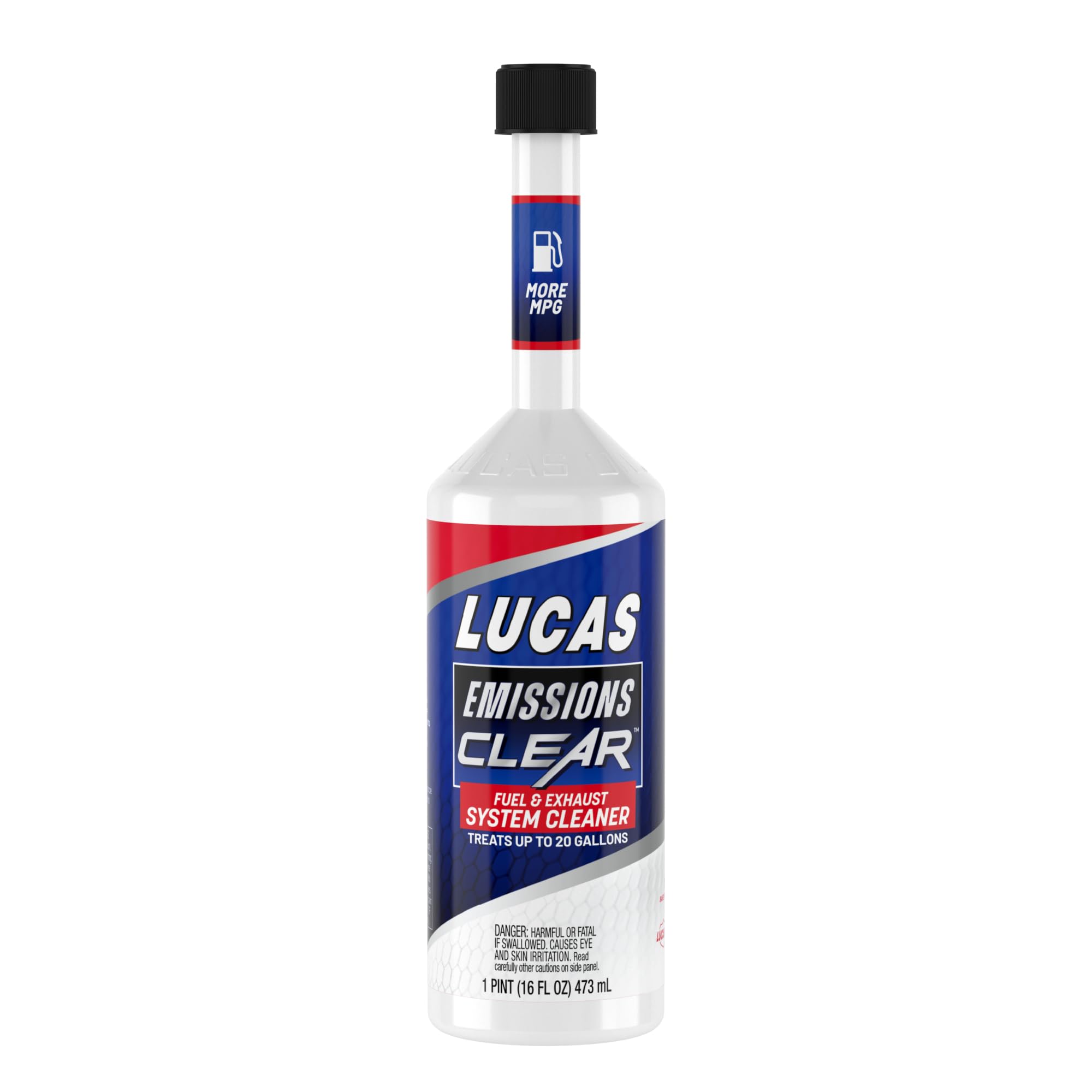
A Lucas formula that cleans the delivery system so less soot reaches the cat.
Lucas takes a preventative angle: instead of just scrubbing the converter, Emissions Clear cleans the entire fuel delivery system to reduce the particulate matter that gets sent to the catalytic converter in the first place. That upstream approach prolongs converter life and improves engine efficiency. It effectively removes carbon deposits from the engine and emissions system to support optimal combustion, which is why owners describe cars running “as good as new” afterward.
The standout real-world result is a 2016 Subaru Forester with 123,000 miles where a whole bottle cleared an O2 code that never came back. A 2005 Ford Escape V6 with 100,400 miles ran noticeably better after treatment. The honest caveat: a few owners using it purely for maintenance without an active code found it hard to tell if it worked, though the car did run smoother after a long highway drive. For inspection-bound drivers, one owner reset the codes, drove 75 miles, and passed inspection — though the light did return soon after, hinting at a converter past saving.
Compared to the MotorKote above, Lucas is lighter on the “dissolve soot” claim and heavier on prevention. It’s the smart buy for someone whose converter is still okay and who wants to keep it that way, or who needs a quick code clear before an inspection window.
Why it stands out: It cleans the fuel delivery system so less soot ever reaches the cat, addressing the cause rather than just the symptom.
The honest note: Results are easiest to see when you have an active code; for pure maintenance, the improvement is subtle.
6. Cataclean Fuel & Exhaust System Cleaner for Gasoline Engines, 16 oz

The emissions-inspection specialist that reduces hydrocarbons and clears P0420 codes.
Cataclean is the heavy-hitter for anyone staring down a smog test. The company’s claim is bold — reducing hydrocarbon emissions on gas motors by up to 50% — and it’s formulated to clean catalytic converters, injectors, and oxygen sensors. It directly targets the common check engine light codes P0420, P0430, P0171, P0174, P0300, and P0401, and it’s 50-state legal, which matters if you live in a strict emissions state. The 500 ml bottle is safe for gasoline, diesel, and hybrid engines.
This one has saved real drivers real money. An owner facing a converter replacement tried it first and passed a New York inspection with the light staying off after one bottle. The consensus is that results vary by vehicle — one owner needed 150 miles of driving before the light cleared, and some see the code return after 50-100 miles, often tracing back to a bad O2 sensor rather than the converter itself.
The honest trade-off is that a small minority report rough idle and new codes after use, suggesting it dislodges enough gunk to occasionally upset an already-sensitive system. It’s still the most proven emissions-passing formula on this list, and the crowd favorite by a wide margin in terms of owner volume.
What wins people over
- Targets multiple codes: P0420, P0430, P0171, P0174, P0300, P0401
- 50-state legal and safe for gasoline, diesel, and hybrid
- Proven to pass strict inspections and save on cat replacement
The recurring gripe
- Code can return after 50-300 miles if the O2 sensor is the real culprit
- Occasional rough idle right after treatment
Reach for this if: you have an inspection deadline and want the highest-probability pass.
Look elsewhere if: your car already has a rough idle — treatment can temporarily unsettle it.
7. Nitrox Clean Cat Catalytic Converter Cleaner for Gasoline Engines, 17 fl oz
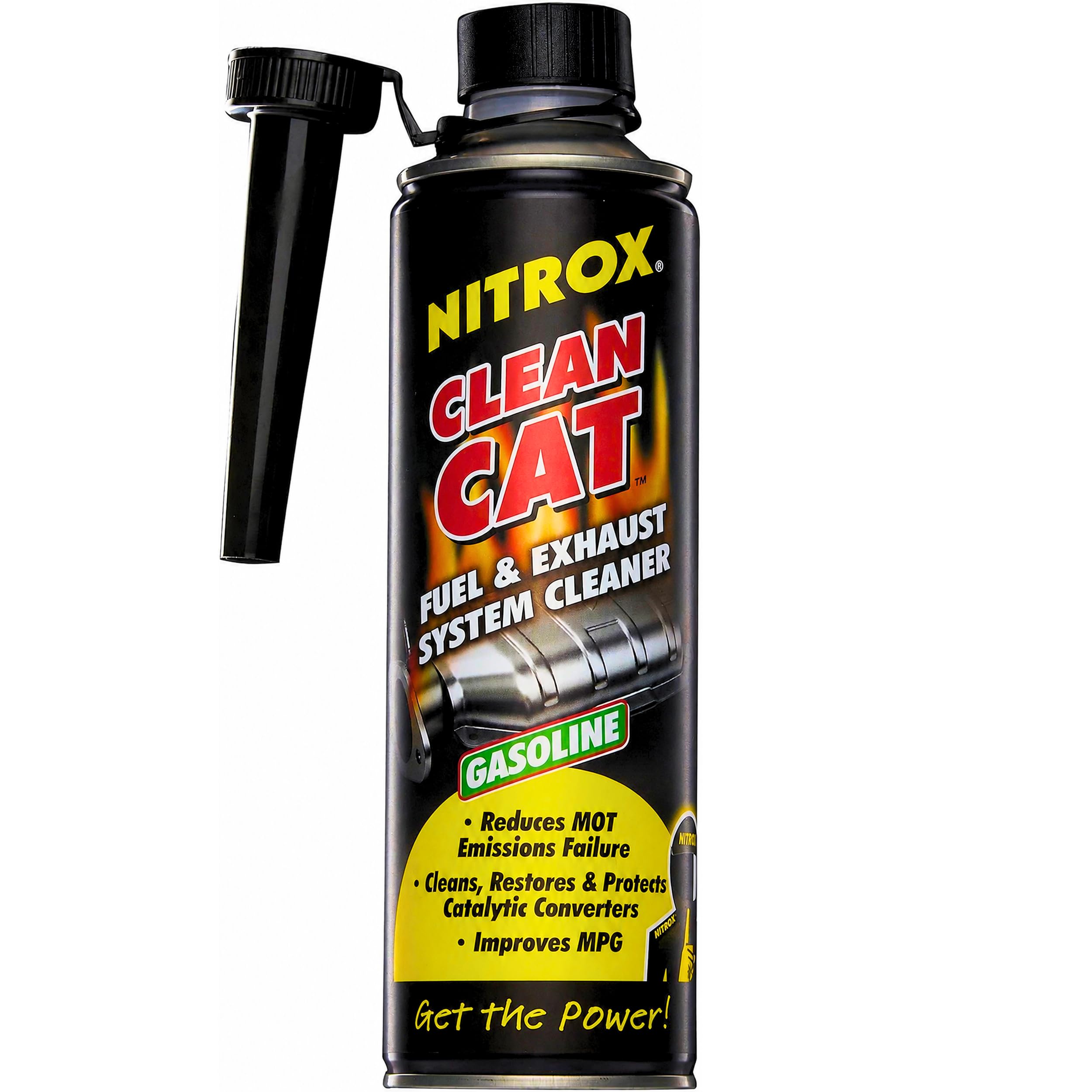
A 17 oz pour that tackles carbon and resin buildup to restore peak performance.
Nitrox Clean Cat markets itself as working instantly — you just pour it into the fuel tank with the included spout, and it gets to work cleaning fuel injectors, the combustion chamber, and the catalytic converter. It’s scientifically formulated to remove carbon and resin buildup, which is the specific gunk that clogs a converter and trips P0420 or P0430. At 17 oz, it’s the largest single bottle on this list, and the brand suggests regular use 3-4 times a year to prevent failures before they start.
The user experience is genuinely split down the middle. On the positive side, customers note the check engine light going out within the first day of use, and one driver saw it off for months after two cans — a strong result for a Honda with a persistent cat code. The advice from experienced users is to use it promptly after the light appears and on newer cars (under 15 years old), because an older, heavily clogged system is far less likely to respond. The negative end is stark: one GMC Terrain owner reports the cleaner actually plugged the converters within two weeks, causing a power loss over 75% and requiring replacement.
This is the pick for a relatively modern car with a fresh P0420 code, where instant action gives it the best shot. It’s not the one for a neglected, high-mileage system that’s been running with the light on for months.
Fastest-acting option: Reviewers point out positive results almost instantly, with the engine check light often clearing within the first day.
The honest caveat: On older or heavily neglected cats, it can push a failing system over the edge — use it promptly after the code appears.
8. MotorPower Care Catalytic Converter Cleaner 2-Pack

A two-bottle system for the stubborn codes that need a full treatment cycle.
MotorPower Care comes as a 2-pack, which is a deliberate strategy: many P0420 codes need more than one treatment to fully clear, and this gives you exactly that without a second purchase. Each 8.45 oz bottle is designed for a gasoline or hybrid vehicle, and the brand is upfront that it cleans rather than repairs — it will not fix a cracked, broken, or melted catalytic converter. It restores engine performance, improves gas mileage, and makes the car run smoothly with better acceleration, according to the owner consensus.
The success stories here are the most detailed in this guide. A Honda Ridgeline at 140,000 miles saw no effect from the first can on a half tank, but the second can cleared the light entirely — a textbook case for why the 2-pack exists. A skeptical owner who had already failed with Cataclean and an Autozone cleaner used both bottles in a near-empty tank, did a highway hot-soak drive, and cleared both P0420 and P0430 codes. One long-term test shows the light still off after 4,000 miles, beating DuraLube (800 miles) and Cataclean (300 miles) in staying power.
Compared to the single-bottle options above, this is the most practical for a truly stubborn code because it anticipates the need for a second application. The one catch: it expects you to complete a proper OBDII drive cycle after treatment, which means a 200-mile drive for some — so it’s not a five-minute fix.
Why two bottles win: Real-world reports show the first can often does nothing while the second clears the code — this pack is built for that reality.
Know before you buy: You’ll need to run a proper drive cycle afterward, sometimes 200 miles, so plan the timing around your inspection date.
9. OXICAT- Oxygen Sensor & Catalytic Converter Cleaner, Pack of 2

A German-made, TUV-certified twin-pack built for annual exhaust maintenance.
OXICAT is explicitly positioned as a preventive maintenance routine rather than a rescue cure. It’s engineered to clean the entire exhaust system with regular use, and it’s safe for both gasoline and diesel vehicles — a wider net than most on this list. The clever part is its activation mechanism: OXICAT is only activated when the catalytic converter reaches its required working temperature, which means the cleaning happens exactly where and when it’s needed. It’s TUV certified and made in Germany, which gives it a quality pedigree few competitors match.
The real-world guidance is consistent: use it soon after the check engine light appears, not on a converter that’s been bad for months. The best application method reported is a two-can sequence — one can with high-test gas, a second can with high-test gas, then back to regular fuel. The dramatic success story is a truck with a rough idle and a cylinder 3 misfire that barely ran; after one can and a 60-mile freeway drive, it ran smoothly with codes cleared, and it stayed that way for about 1,400 miles.
The less rosy side is that a few owners see the light return 3-4 days after each can, suggesting the cleaner is only masking a deeper converter issue. This is the pick for someone who wants to prevent P0420 from ever appearing and doesn’t mind a two-step treatment as part of an annual maintenance habit.
The unique edge: It activates only at working temperature and works on diesel too, making it the most versatile preventive option.
The honest note: For a months-old bad converter, results are temporary — this excels as a yearly maintenance step, not a rescue.
Understanding the Specs
What P0420 actually means
P0420 is the diagnostic code for “catalyst system efficiency below threshold” — it means the rear oxygen sensor sees that the catalytic converter isn’t cleaning exhaust as well as it should. It’s triggered by carbon buildup blocking the honeycomb, a failing O2 sensor, an exhaust leak, or a physically melted converter. A cleaner only addresses the carbon buildup, so diagnosing the actual cause before pouring anything in is the difference between a fix and a wasted.
Detergent vs. solvent formulas
Catalytic cleaners work in two main ways. Detergent-based formulas (like BlueDevil) chemically break down carbon deposits without abrasion, making them safe for sensitive systems. Solvent-based formulas dissolve soot and resin more aggressively but can sometimes dislodge large chunks that stress a weak converter. Both are poured into the fuel tank, but the key spec to check is whether the product also cleans injectors and O2 sensors — a whole-system cleaner is more likely to resolve the code permanently than one that only scrubs the cat.
FAQ
Will a catalytic converter cleaner fix my P0420 code permanently?
How long does a catalytic converter cleaner take to work?
Can I use a catalytic converter cleaner in a hybrid or diesel car?
Is a catalytic converter cleaner the same as a fuel injector cleaner?
How often should I use a catalytic converter cleaner?
Will a cleaner help if my catalytic converter is completely clogged?
Do I need to drive aggressively after adding a cleaner?
What’s the difference between a P0420 and a P0430 code?
Will a catalytic converter cleaner fix a bad oxygen sensor?
Do I need to reset the check engine light after using a cleaner?
Final Thoughts: The Verdict
For most drivers facing a P0420, the winner is the Liqui Moly Catalytic System Cleaner because it treats the whole combustion path rather than just the converter, and it’s proven to clear the code permanently on older engines with patience. If you want the single highest-probability pass before an emissions deadline, grab the Cataclean — it’s the crowd favorite for inspections. And for a stubborn code that fought off other brands, the MotorPower Care 2-Pack is the one to reach for, since real-world results show it often takes a second can to finish the job.
How We Picked
We do not accept paid placement. Every pick is matched to a real buyer and a real use-case; we do not hands-on test units.
Sources & Methodology
Specifications: manufacturer listings and product documentation. Review insights: verified customer reviews, as of August 2026. Pricing: not shown on this page (it changes often); check the current price via the retailer link.
As an Amazon Associate, Trending Car earns from qualifying purchases. This does not affect which products we feature.