
Our readers keep the lights on and my garage snacks stocked. As an Amazon Associate, I earn from qualifying purchases.
Specs are compiled from manufacturer listings and verified buyer reviews and can change over time — please confirm the key details on the product page before buying.
Washing your car with a garden hose barely tickles the dirt, but grabbing the wrong gas pressure washer can blast straight through your clear coat and into the paint. The fix is a gas washer with a 40-degree nozzle and at least 2.5 GPM for safe, thick foam. This guide covers gas models that balance 3000–3500 PSI with paint-safe flow rates.
I’m Min Islam — the founder and writer behind Trending Car. This guide is built by comparing the manufacturers’ published specifications and the patterns across verified customer reviews, so you get each pick’s real strengths and trade-offs instead of marketing spin.
For a safe wash, choose a unit with 2.3–2.6 GPM and a 40-degree nozzle for foam, rinse, and spot-cleaning. Here is the honest breakdown of the gas pressure washer for car detailing market to help you choose wisely.
Our Picks at a Glance

How To Choose The Best Gas Pressure Washer for Car Detailing
Choosing a car washer isn’t about max PSI—it’s about matching pressure and flow to clear coat. A house-stripping machine needs different specs than one for clear coat—aim for 3200 PSI and 2.5 GPM. You need enough power to lift grime but a wide nozzle to avoid etching paint.
Match the pressure to the surface
For car detailing, you rarely need the maximum pressure a gas engine can produce. A 0-degree nozzle (a pinpoint jet) can cut through dirt but also through paint if held too close. Look for a machine where you can switch to a 25-degree or 40-degree nozzle (wider spray patterns that spread the force over a larger area) for body panels, and save the narrow jets for wheels, tires, and undercarriage grime where tougher cleaning is needed.
Check the flow rate for foam and rinsing
While PSI (the force of the water) gets the headlines, GPM (the volume of water flowing per minute) is what actually carries soap and rinses away loosened dirt. A higher GPM, like 2.5 gallons per minute, means you can lay down a thick layer of foam from a cannon and then rinse the entire panel quickly. A machine with high pressure but low flow will clean slower and leave soap residue longer.
Consider the engine and pump reliability
A gas engine lets you wash anywhere without an outlet—ideal for driveways or remote spots. The engine’s displacement, usually measured in cubic centimeters (cc), tells you about its power and smoothness. For consistent water pressure, an axial cam pump (a common, compact pump design) is fine for residential use, while a triplex pump (a heavier-duty, more durable design) is what professionals expect for constant, long service life.
Quick Comparison
| Model | Best For | Max Pressure | Flow Rate | Hose Length | Amazon |
|---|---|---|---|---|---|
| Westinghouse WPX3200★ Best Overall | Overall versatility | 3200 PSI | 2.5 GPM | 25 feet | Amazon |
| BILTHARD 3500 PSIBest Value | Budget value | 3500 PSI | 2.6 GPM | 25 feet | Amazon |
| Genkins GPW3200Compact Pick | Compact storage | 3200 PSI | 2.5 GPM | 27 feet | Amazon |
| Mutaomay 3500 PSI | Quick start | 3500 PSI | 2.3 GPM | 25 feet | Amazon |
| PowerSmart DL1034A | Build quality | 3400 PSI | 2.5 GPM | 27 feet | Amazon |
| Westinghouse WPX3000 | Lightweight handling | 3000 PSI | 2.3 GPM | 25 feet | Amazon |
| Ezasin 3500 PSI | Residential reliability | 3500 PSI | 2.3 GPM | 25 feet | Amazon |
| DeWalt DXPW3300-S | Brand trust | 3300 PSI | 2.4 GPM | 25 feet | Amazon |
| Simpson PS3228 | Professional durability | 3300 PSI | 2.5 GPM | 25 feet | Amazon |
In-Depth Reviews
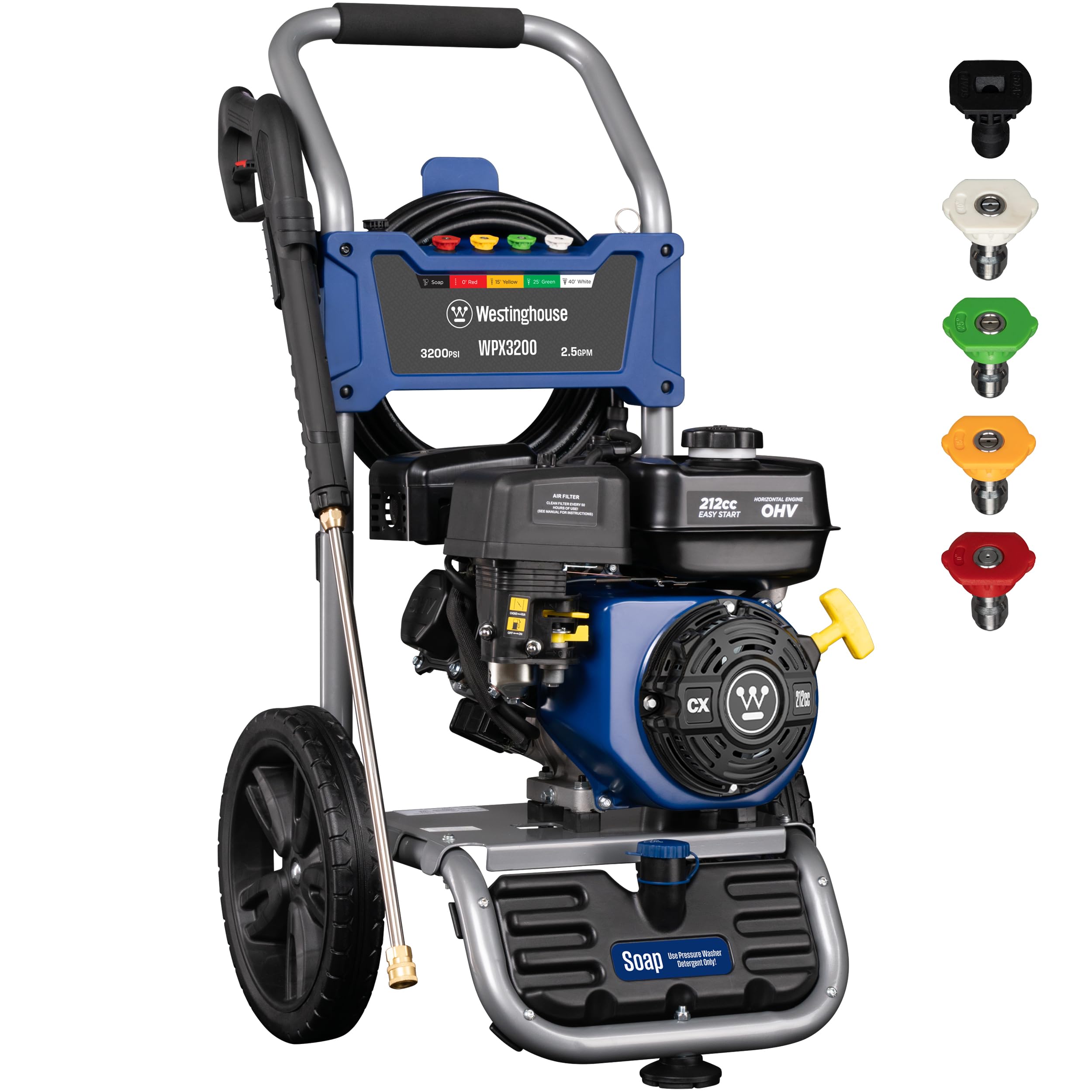
1. Westinghouse WPX3200 Gas Pressure Washer
Our pick — over 4.5★ from 11,000+ verified ratings; the strongest balance of quality and price.
A first-pull starter that rinses like a commercial bay.
You get 3200 PSI and 2.5 GPM of cleaning force here, backed by a 212cc 4-stroke engine that owners describe as starting on the very first pull. The steel frame rolls on 12-inch never-flat wheels, so it glides over uneven driveway concrete without you wrestling it. For detailing, the half-gallon onboard soap tank means you can pour in your favorite car shampoo and lay down suds without dragging out a separate bucket.
The 25-foot abrasion-resistant hose reaches around your car without moving the machine, and the five quick-connect nozzles (0, 15, 25, 40 degrees, plus soap) give you the full range from gentle wide rinsing to focused wheel cleaning. Buyers report the stream is “powerful stream comparable to commercial car wash,” which tells you it rinses road film off panels in a single pass. The 0.9-gallon gas tank means fewer trips to refuel mid-detail.
Assembly is genuinely simple — most owners have it running within about 30 minutes, and the included 10W30 oil, tools, and quick start guide cover you from the start. The recurring gripe is the oil fill cap, which sits shallow with a small opening and makes spills easy during top-ups. It’s a minor design quirk, not a dealbreaker, and the 3-year limited service coverage offers confidence that few competitors match.
What wins owners over
- First-pull starts and consistent pressure across long sessions
- Onboard soap tank makes foam application easy
- Large wheels and sturdy frame for easy maneuvering
The honest trade-offs
- Oil fill cap is shallow and easy to spill from
- Pump output is partially obstructed by the handle upright, limiting quick-connect use for some
Reach for this if: you want a proven, reliable gas washer for cars plus the whole house — this is the balanced all-rounder.
Keep a rag nearby: the awkward oil cap means you’ll want a funnel and a steady hand during oil changes.
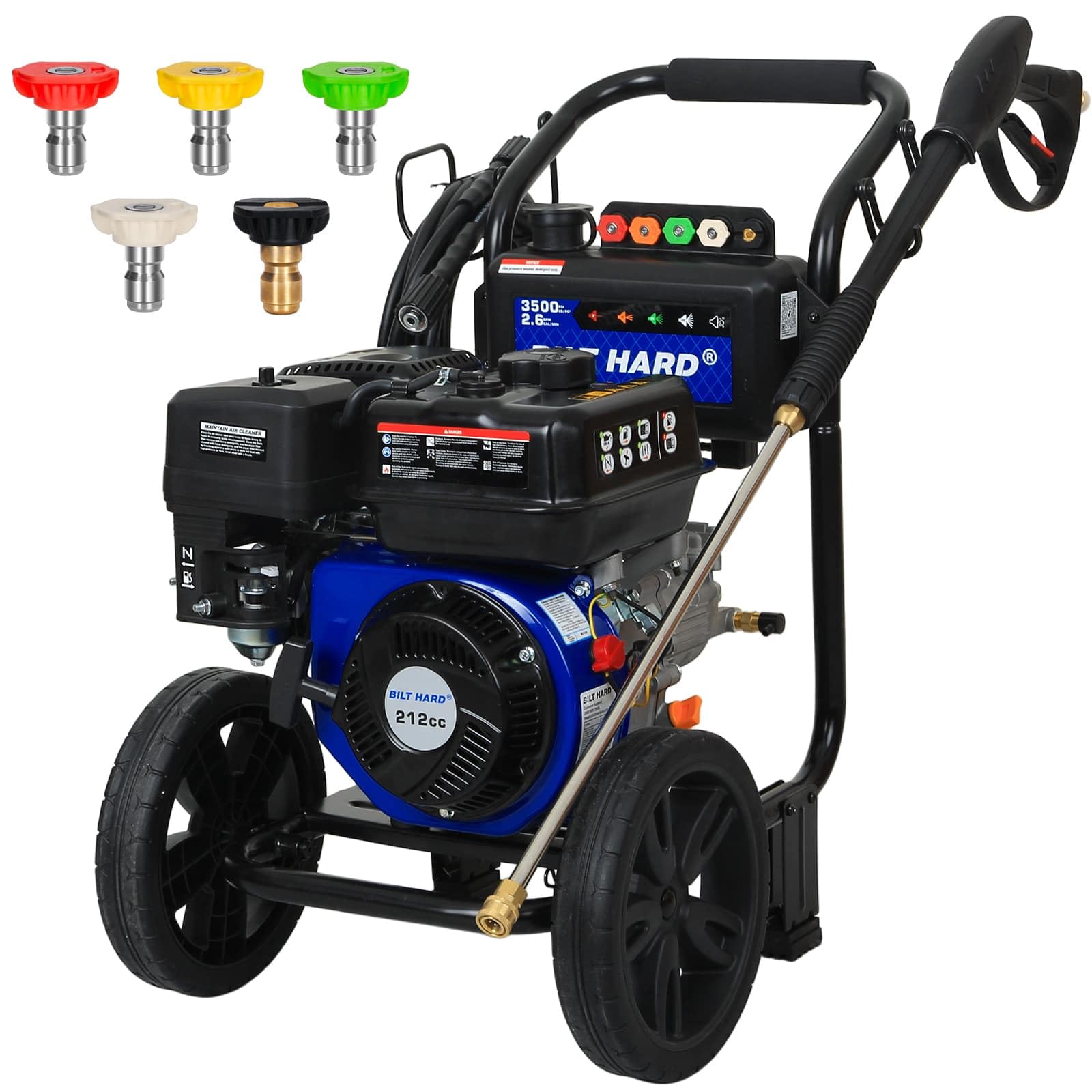
2. BILTHARD 3500 PSI Gas Pressure Washer
The value king that stacks 3500 PSI and a 30-foot steel braided hose for less.
This BILTHARD throws down 3500 PSI and 2.6 GPM — the highest pressure and flow combo in this lineup for a budget-friendly price. That extra punch over the 3200 PSI standard models shows up when you’re blasting caked-on mud from wheel wells or stripping old wax before a paint correction. It’s powered by a 212cc 4-cycle OHV engine that delivers the muscle without the maintenance headaches of cheaper designs.
What separates this from the pack is the 30-foot steel braided pressure hose, which resists kinking and abrasion far better than the rubber hoses on most competitors. The 2.0x gap in tank volume over the foldable Genkins — 1 gallon versus 0.5 gallons — means you can finish an entire driveway or a full detail before refueling. It also sits more compact than the Westinghouse at 27.36 inches long versus 19.7 inches for the foldable, but the 10-inch never-flat wheels and soft-grip handle keep it easy to move across gravel and grass.
Owners consistently point to performance as the standout — the single most-praised feature — noting it handles low-flow backyard faucets without complaint and delivers plenty of pressure for cars and patios. The integrated 1-gallon soap tank works well, though the hose kinks easily if you’re not careful while winding it up. Assembly is quick, with one owner noting a handle arrived bent but was easily straightened, so it’s more a minor cosmetic hiccup than a functional flaw.
Bang for buck: you’re getting near-premium power output at an entry-level price — the best raw specs per dollar here.
Watch the hose: treat the 30-footer gently when coiling to avoid kinks that restrict flow.
3. Genkins GPW3200 Gas Powered Foldable Pressure Washer
The garage-saver that folds flat but still fires 3200 PSI at your dirt.
If storage space is your real enemy, this Genkins solves it with a foldable handle that collapses the frame down to 19.7 inches long — the most compact footprint in this list and 39% smaller than the BILTHARD’s 27.36 inches. You still get a serious 3200 PSI and 2.5 GPM from the 212cc Genkins OHV engine, so the foldable design costs you nothing in cleaning power. The 27-foot hose is the longest here, beating the Westinghouse’s 25 feet so you can walk a full loop around an SUV without repositioning.
The built-in 0.5-gallon detergent tank means you can pour soap directly in and generate thick foam for the pre-wash stage of a detail. The five quick-change nozzles (0, 15, 25, 40 degrees, and soap) switch fast between heavy blasting and gentle rinsing. A low-oil auto-shutoff protects the engine when oil runs low, and all switches — power, choke, and fuel shutoff — sit within easy reach.
This one gets the most mixed owner feedback in the lineup, so it’s a fit-based choice rather than a universal pick. Some owners mention it cleans a house and deck for three hours straight with easy starts and a user-friendly layout, while others hit pump failures after a few uses — including one who got a replacement unit sent. The oil fill sits at an awkward 45-degree angle that requires lifting the machine, and non-ethanol gas is recommended to keep the pump healthy. Think of it as the space-saving option for someone who washes occasionally and values a tidy garage over brute-force longevity.
Best for tight spaces: this is the one when your garage is packed and you need the washer to fold away neatly.
Not for heavy daily use: the pump is the weak point, so treat it gently with proper fuel and water flow to boost its life.
4. Mutaomay 3500 PSI Gas Pressure Washer
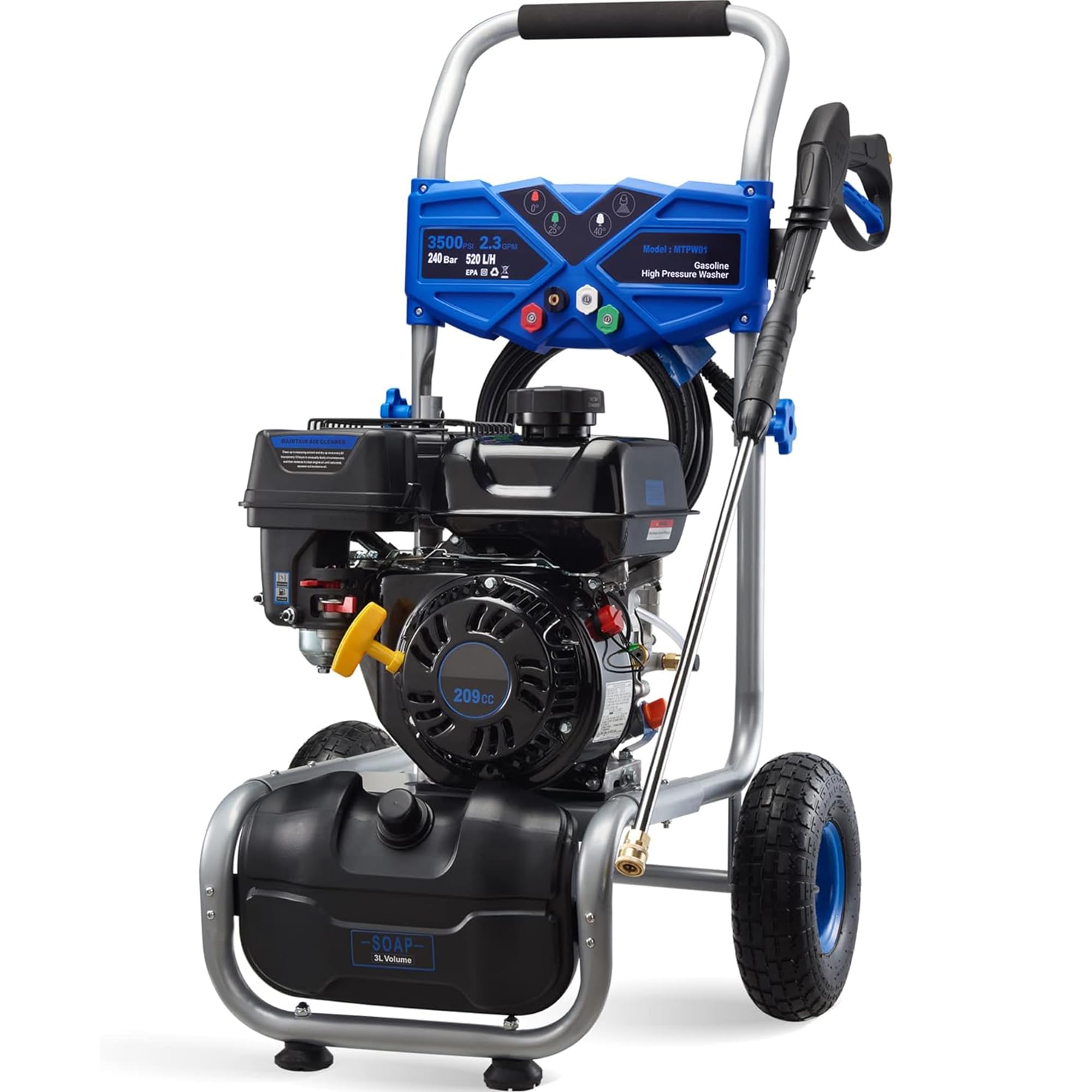
First-pull starts every time — a 209cc 7HP engine that fires up like it’s eager to work.
This Mutaomay is built around one defining trait: it starts right up on the first pull, every time, according to the overwhelming pattern in owner experiences. The 7HP 4-stroke OHV 209cc engine with recoil start is the reason — it’s a proven design that turns over reliably even after sitting. You get 3500 PSI and 2.3 GPM, which owners say is enough to remove rust from a driveway and clean an RV effectively without breaking a sweat.
The 25-foot high-pressure hose covers plenty of ground, and the four quick-connect nozzles (0, 25, 40 degrees, and soap) give you the essentials. The 40-degree nozzle is your paint-safe friend for car bodies, spreading the force so you can rinse off grime without etching. A 16-inch wand length keeps your hand at a comfortable distance. The rugged steel frame with corrosion-resistant coating rolls on 10-inch pneumatic tires that handle dirt and grass smoothly.
Assembly is genuinely simple — owners describe adding oil and gas, then pulling the cord once. The exact numbers tell the story: 3500 PSI versus the standard 3200 PSI models means noticeably stronger cleaning for stubborn algae and road grime. There’s a small 0.2-gallon tank volume here, which is the smallest in the lineup, so you’ll refuel more often on marathon driveway sessions. The factory-tested engine may carry a slight fuel odor initially, and Mutaomay advises using SAE 10W-30 oil and 87+ octane gasoline for optimal performance.
First-pull reliability: the defining strength is the eager 209cc engine that owners consistently report starting on the first attempt.
Small tank, more trips: with a 0.2-gallon tank, plan for refueling stops during longer washes.
5. PowerSmart Gas Pressure Washer DL1034A
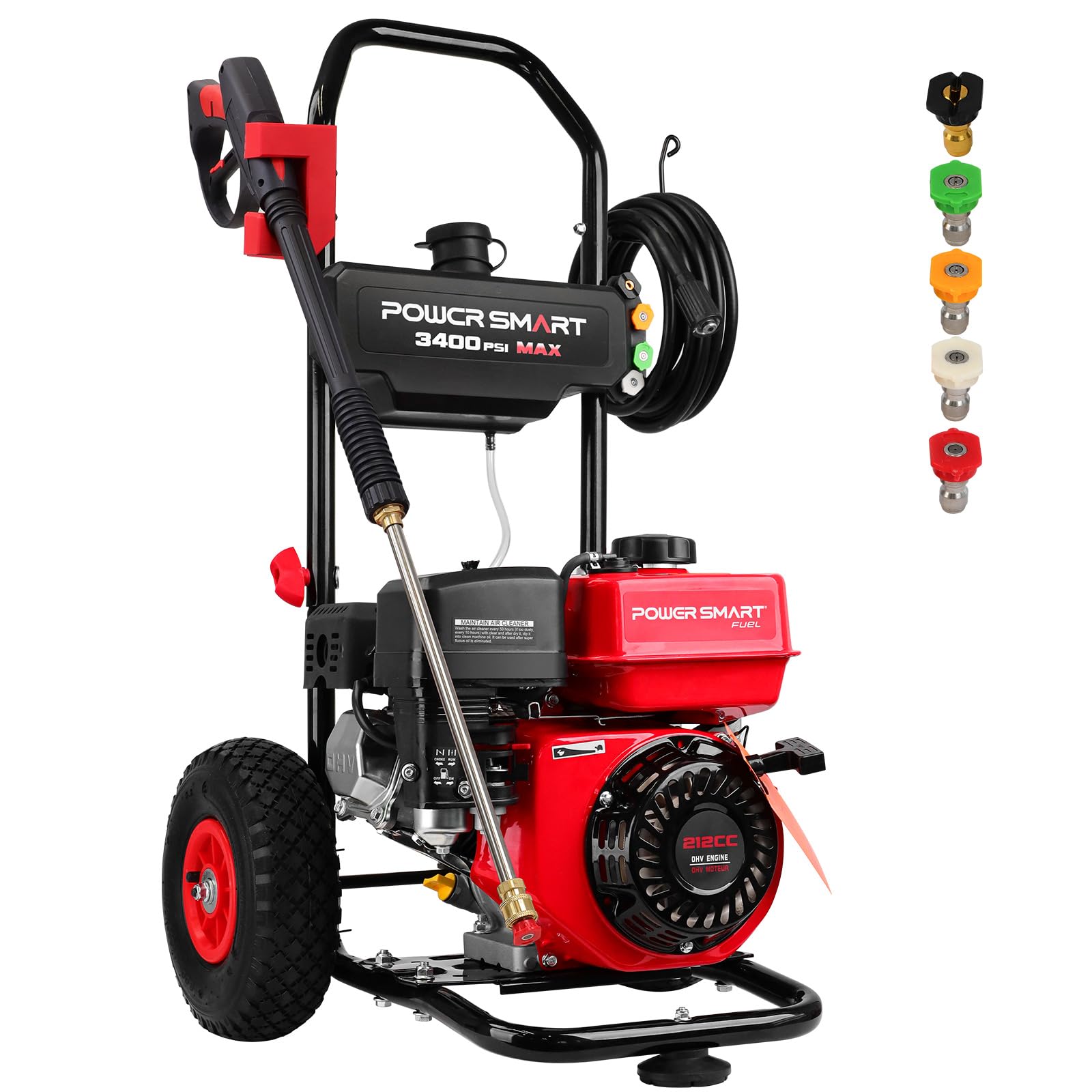
A rugged steel frame, 10-inch pneumatic tires, and a quality feel that punches above its tier.
The PowerSmart comes from the start 95% assembled, and customers note going from crate to cleaning in about ten minutes flat. That ease of setup is backed by a 212cc OHV engine delivering 3400 PSI and 2.5 GPM — enough reach to hit a second-story window from the ground. The rugged steel frame with 10-inch pneumatic tires is what owners praise most, calling out the build quality as the standout feature with consistency across long sessions.
For detailing, the onboard soap tank makes pre-foaming simple, though owners note the dispenser lacks a shutoff valve so it runs until the tank empties. The 27-foot hose gives you solid reach, and the five quality nozzle tips (0, 15, 25, 40 degrees, plus soap) plus a metal spray wand add a professional feel. The hook and sling for organized storage keeps the hose and wand tidy when you’re done.
There’s a real durability caveat here that you should size honestly. While most owners have nothing but praise for the power and ease of use, a small number report the recoil starter failing after a couple of uses — one owner got it fixed under the manufacturer’s support. The consistency of the positive feedback on power and quality outweighs the occasional failure, but it’s worth knowing the cheap price point comes with a slightly wider reliability spread than premium options. For a weekend detailer who wants a quality-feeling machine that’s ready fast, this fits well.
Why owners stick with it
- Nearly ready to use from the start — 95% pre-assembled
- Rock-solid steel frame and smooth-rolling pneumatic tires
- Powerful enough to reach second-story surfaces
What to know going in
- Soap dispenser has no shutoff, so it runs until empty
- Recoil starter is the occasional weak point, though support covers it
Choose this for: quick setup and a sturdy frame that feels more expensive than the price suggests.
Think twice if: you plan to run it hard every single week — the cheaper starter mechanism is the part most likely to need attention.
6. Westinghouse WPX3000 Gas Pressure Washer
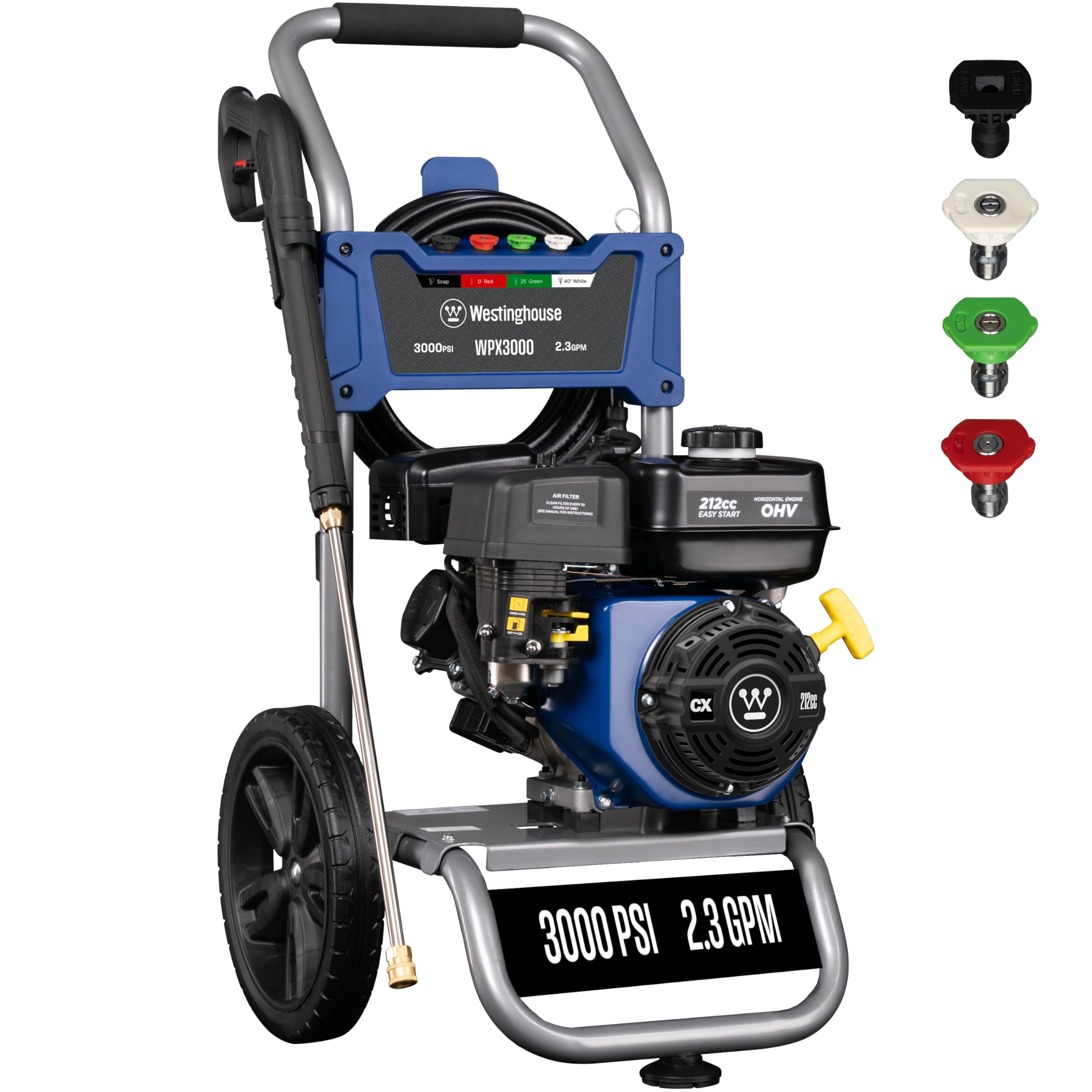
The 50.7-pound frame an 78-year-old can still roll around with ease.
This Westinghouse trims the power to 3000 PSI and 2.3 GPM, but that reduction buys you the lightest, most maneuverable machine in the lineup at 50.7 pounds. One owner, aged 78, specifically picked it for the large wheels and sturdy frame that make movement easy — a theme that runs through the feedback. If you have limited strength or mobility, this is the gas washer that won’t feel like a workout to position around your car.
You’re not sacrificing much capability. The 212cc 4-stroke Westinghouse OHV engine starts in one to two pulls, and reviewers point out it cleans concrete, patios, and siding with real authority. The 25-foot abrasion-resistant super-flex hose pairs with a lightweight spray gun and four quick-connect nozzles (0, 25, 40 degrees, and soap). There’s also a detergent siphon hose for extra cleaning power on tough grime, and the 0.95-gallon gas tank keeps you running through a full detail.
The performance is the most-praised aspect here — owners call it a strong performer that’s suitable even for small business use. The trade-offs are minor setup quirks: the included guide is tiny, oil isn’t included, and the supplied hose can stiffen and kink, leading some owners to swap in an aftermarket hose. A couple of owners found the hose wore from wheel vibration after 30 minutes of use, so it’s worth routing it carefully. This is the sensible pick for someone who wants Westinghouse reliability but values easy movement above raw maximum pressure.
Easiest to move: the lightest frame here with large wheels, ideal for anyone who struggles with heavier equipment.
Setup quirks: bring your own oil and be ready to reroute or replace the hose for a cleaner setup.
7. Ezasin 3500 PSI Gas Pressure Washer
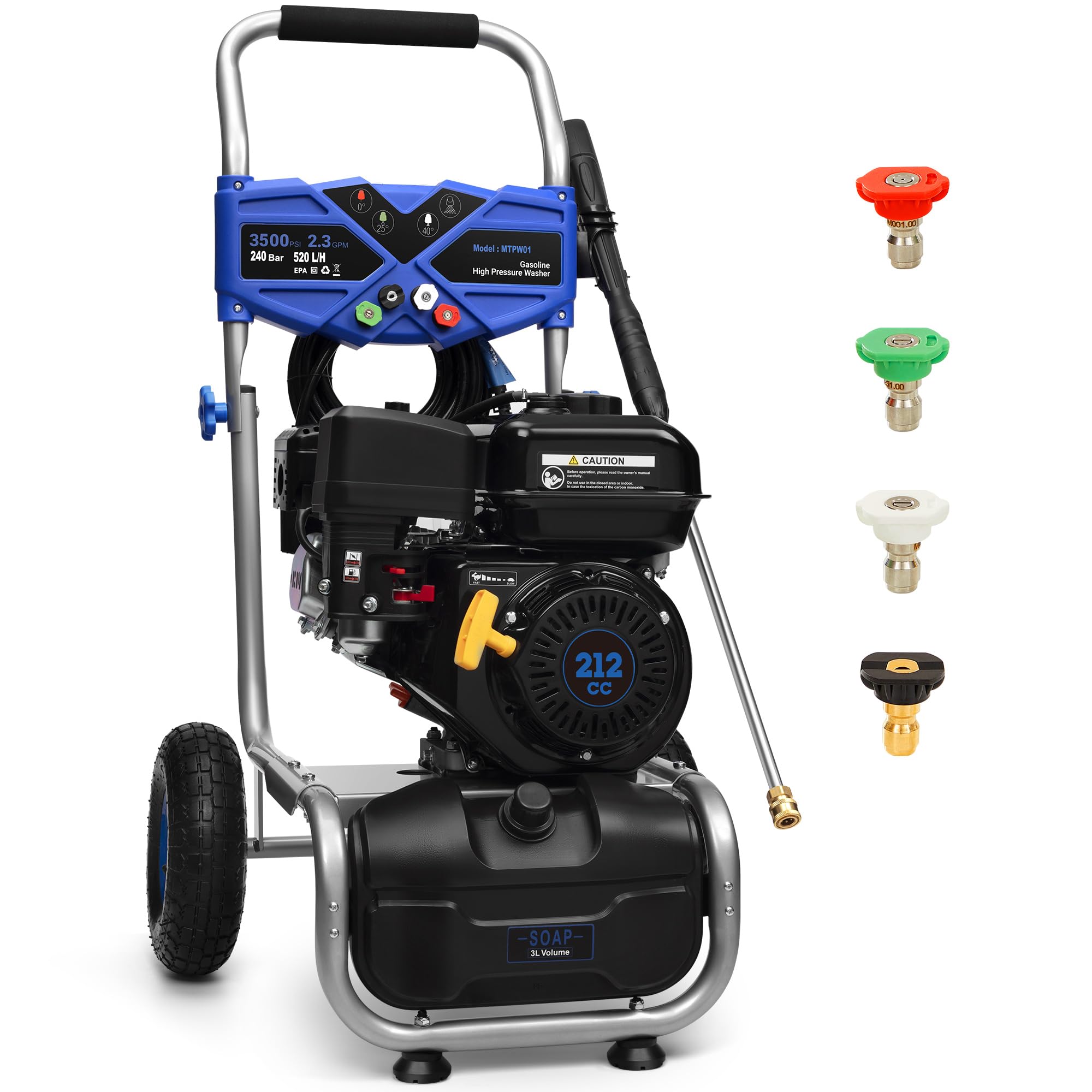
A 212cc engine with an axial aluminum pump built for steady, low-maintenance home duty.
This Ezasin is the “set it up and forget it” residential option, powered by a heavy-duty 7HP 4-stroke OHV 212cc engine that owners say starts in one to two pulls and runs with a Honda-like smoothness. The axial aluminum pump is the key durability feature — it’s designed for minimal maintenance and long service life, which is exactly what you want from a machine that sits in the garage between washes. You get 3500 PSI and 2.3 GPM for stripping dirt and grime from any surface.
Performance is what owners praise most here, with feedback noting it’s fuel-efficient — one owner ran three car washes in 45 minutes on minimal gas. The four quick-connect nozzles (0, 25, 40 degrees, and soap) cover the detailing essentials, and the 10-inch tires navigate gardens with stability. A pair of dual front rubber pads on the frame adds balance and protects against collisions and vibration during operation. The 25-foot hose extends your working radius well.
The thoughtful design details stand out: a thermal switch prevents starting in extreme heat (above 90°F), which protects the engine but means you’ll wait for it to cool on hot days. Owners note the soap only works with the black tip, and there’s a learning curve around the tip and temperature sensors. It’s not heavy-duty, as one owner put it after 20 uses, but it does a good job and holds up with proper care — warm it up, cool it down, never run it dry, and change the oil after the first run.
Steady and efficient: the fuel-sipping 212cc engine and aluminum pump make this a low-cost-per-wash residential machine.
Sensor quirks: the thermal and tip sensors add protection but require reading the manual and adjusting your habits.
8. DeWalt DXPW3300-S Gas Pressure Washer
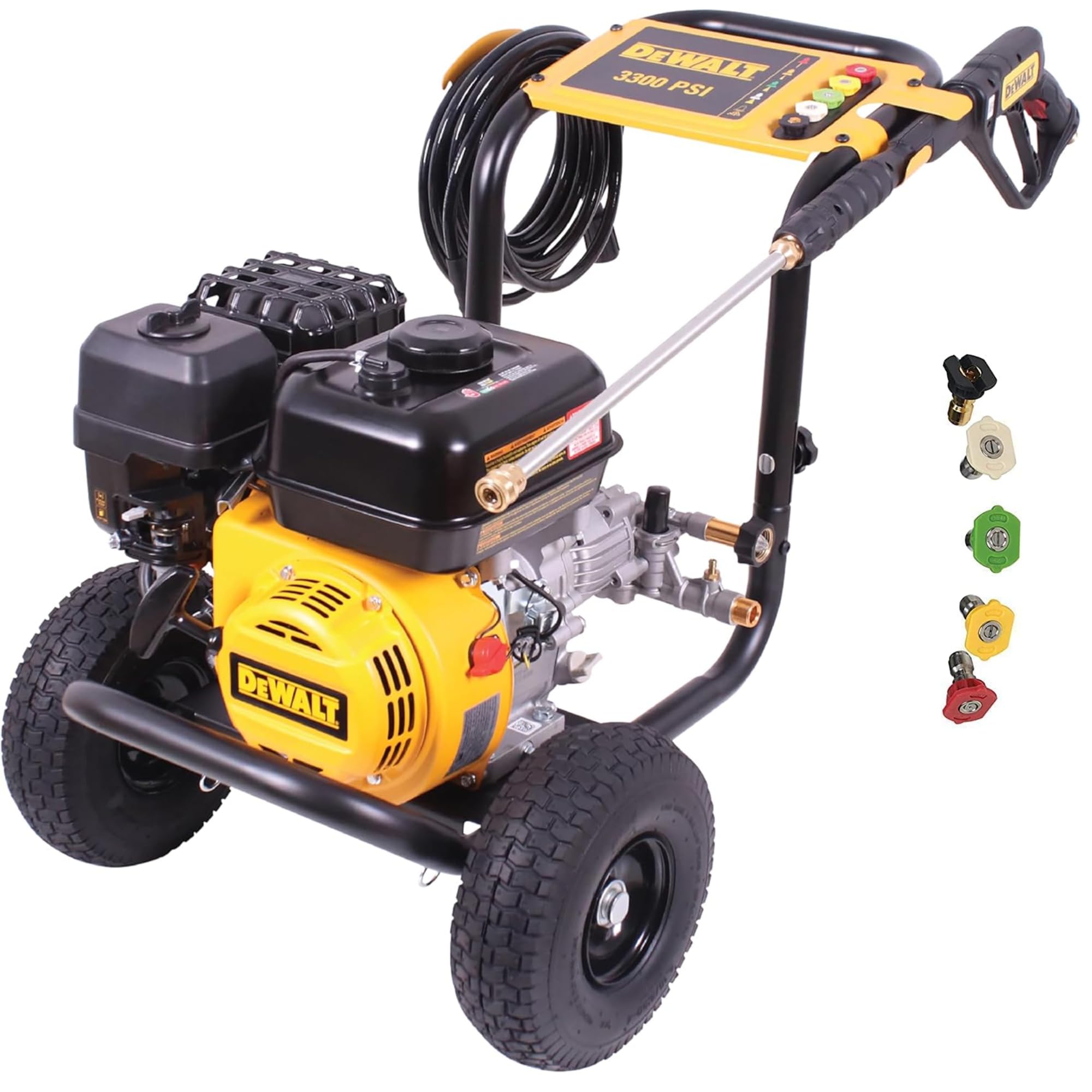
Brand-name muscle from the DeWalt 208cc engine, backed by a two-tier frame warranty.
You know exactly what you’re getting with the DeWalt badge: a 208cc engine that shoppers say starting on the first pull even after sitting for a month, and a cleaning force that strips mildew from vinyl siding without scrubbing. The OEM Technologies axial cam pump delivers 3300 PSI at 2.4 GPM, and a thermal relief valve prevents overheating during long sessions. It’s a dependable middleweight that handles decks, patios, and cars with conviction.
The 25-foot abrasion-resistant hose and five quick-connect nozzles (0, 15, 25, 40 degrees, plus soap) give you full detailing flexibility, and the 16-inch steel wand keeps your hand comfortably away from the spray. The welded steel frame with a powder-coated finish resists rust, and the 10-inch pneumatic tires roll smoothly over uneven terrain. It’s compact enough to store in a small space, which several owners specifically call out as a plus.
The warranty structure is the quiet hero here: 5 years on the frame, 3 years on the pump, and 2 years on the engine — a tiered commitment that shows confidence in the build. The honest downsides are the stiff hose that doesn’t swivel well (one owner called it junk and swapped it out), and reports that the wand can fall out of its holder during use. There are also durability concerns scattered through longer-term feedback, so this isn’t a buy-and-ignore machine. It’s for someone who wants DeWalt’s reputation and warranty protection and is willing to replace the hose for a better experience.
The brand promise
- First-pull starts even after long storage
- Two-tier warranty: 5-year frame, 3-year pump, 2-year engine
- Compact footprint for easy garage storage
The reality checks
- Stiff hose that resists swiveling — many owners replace it
- Wand holder doesn’t secure the wand well
Pick this for: the confidence of a major brand name and the best warranty coverage in this lineup.
Budget for a hose: the included hose is the weak link, so plan to upgrade it for the best experience.
9. Simpson PowerShot PS3228 Gas Pressure Washer
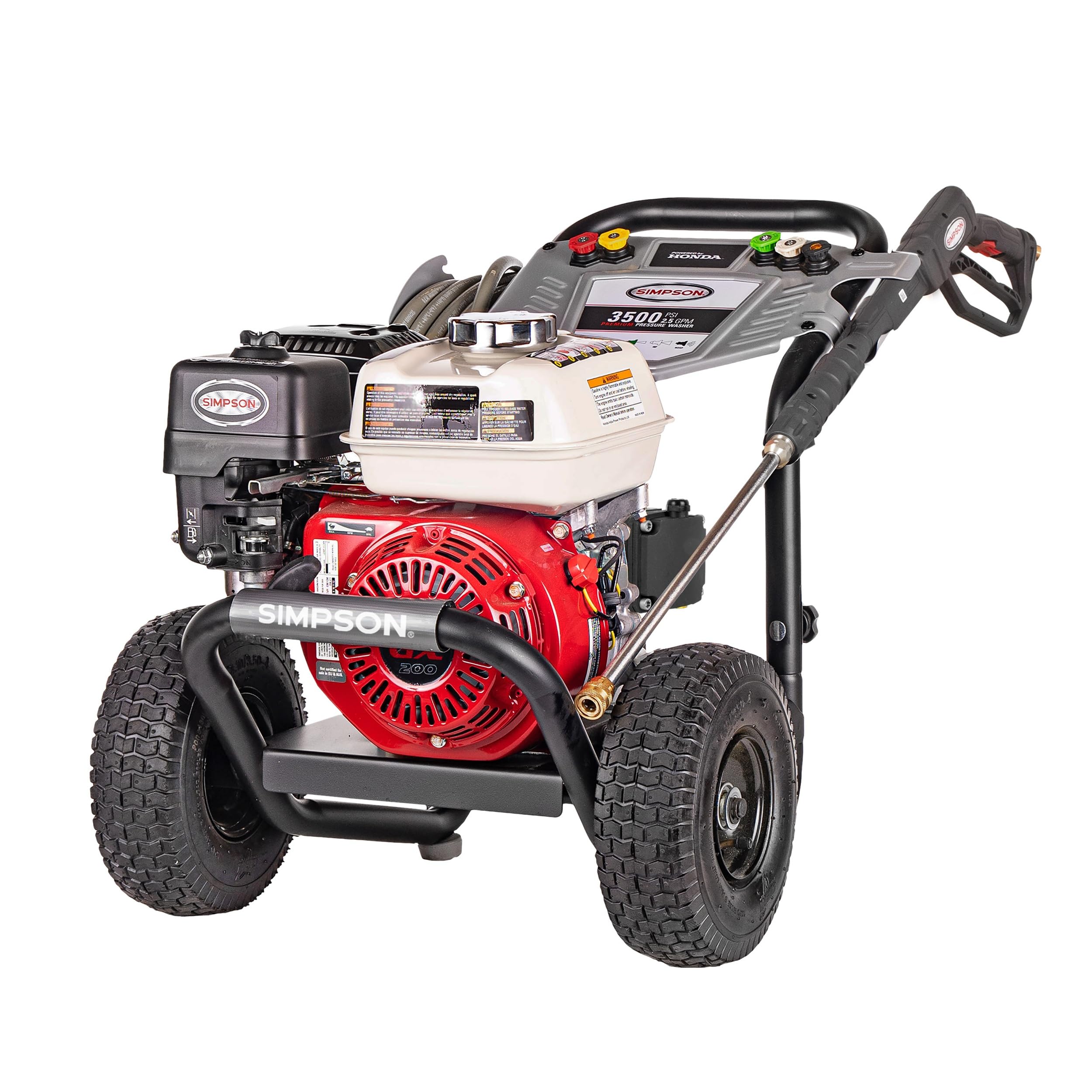
The professional’s choice — a Honda GX200 engine and AAA triplex pump built for years of daily abuse.
This is the machine you buy when “good enough” isn’t in your vocabulary. The premium Honda GX200 engine is the gold standard for small engines — it starts on the first pull every time and includes low-oil shutdown to protect itself. Paired with an AAA triplex pump (a heavier-duty three-piston design, unlike the simpler axial pumps on most residential units), the Simpson delivers 3300 PSI at 2.5 GPM with an integrated unloader and thermal relief that keep it cool during marathon sessions. This is contractor-grade equipment.
Quality and reliability are the two most-praised aspects in owner feedback, with the Honda engine drawing consistent “starts first pull, runs strong” reactions. The 25-foot MorFlex hose resists kinks and abrasion, and its non-marring polyurethane jacket protects finished surfaces — a thoughtful touch for car detailing. The 10-inch pneumatic tires roll smoothly over gravel and curbs, and the welded steel frame with powder-coated finish resists corrosion. Five quick-connect tips (0, 15, 25, 40 degrees, plus soap) plus a 16-inch spray wand cover everything from paint stripping to car cleaning.
The honest trade-offs are weight and noise — at 72.8 pounds, it’s the heaviest machine here, and it vibrates at idle, which owners note. It’s also the premium-priced option, sitting clearly at the top of the range. The engine ships without oil (only 16 ounces included when it needs 20), so you’ll need to top up before first start. But for someone who details professionally, or wants a machine that will outlast every other purchase on this list, the Simpson’s reputation and build quality justify the premium. It’s the one to reach for when your car is your pride and the wash has to be perfect every single time.
Why pros choose it
- Honda GX200 engine with low-oil shutdown — legendary reliability
- AAA triplex pump designed for continuous, long service life
- MorFlex hose with non-marring jacket protects car paint
The cost of professional grade
- Heaviest unit here at 72.8 pounds
- Vibrates noticeably at idle
- Premium price over all other picks
Step up to this if: you want the most reliable, longest-lasting gas washer for serious detailing or light commercial use.
Stay away if: budget is the priority — the cheaper units will wash your car fine, just with less longevity and refinement.
Understanding the Specs
PSI vs GPM
PSI (pounds per square inch) measures the force of the water — how hard it hits the surface. GPM (gallons per minute) measures the volume — how much water flows. For car detailing, a balance is key: enough PSI to lift dirt, but enough GPM to rinse soap away thoroughly. A machine with high PSI but low GPM will clean slowly and leave residue.
Axial Cam vs Triplex Pump
The pump is the heart of a pressure washer. An axial cam pump (a compact, single-piston design) is common on residential units — it’s affordable and fine for occasional use, but wears faster under heavy load. A triplex pump (a three-piston design) is heavier, smoother, and built for continuous professional use. If you detail cars frequently, the triplex is worth the premium.
Engine Displacement (CC)
The engine size, measured in cubic centimeters (cc), roughly correlates with power and smoothness. A 212cc engine is the standard for residential gas washers, offering a good balance of power and fuel efficiency. Larger engines tend to run smoother and start easier, but add weight and cost. For car detailing, a 200cc+ engine is plenty.
Nozzle Angles
The nozzle tip determines the spray pattern and intensity. A 0-degree tip is a pinpoint jet that can damage paint if held too close. A 40-degree tip spreads the water into a wide fan, making it safe for paint and general rinsing. For detailing, you’ll use the 25-degree for wheels and the 40-degree for body panels. Soap tips apply foam at low pressure.
FAQ
Will a 3200 PSI pressure washer damage my car’s paint?
Which is more important for car washing, PSI or GPM?
Can I use a foam cannon with any of these gas pressure washers?
How long does a gas pressure washer engine last?
What is the difference between an axial cam pump and a triplex pump?
Do I need to winterize a gas pressure washer?
How much oil does a new gas pressure washer need?
Why does my new pressure washer smell like gas or oil?
Is a gas pressure washer better than an electric one for cars?
What’s the ideal PSI for a foam cannon on a car?
Final Thoughts: The Verdict
For the majority of shoppers, the gas pressure washer for car detailing winner is the Westinghouse WPX3200 because it balances 3200 PSI, 2.5 GPM, an onboard soap tank, and first-pull starts with a price that feels fair — with thousands of owners behind it, this is the crowd favorite for a reason. If you want the absolute best power for the money, grab the BILTHARD 3500 PSI. And for the professional detailer who demands maximum longevity, the Simpson PS3228 with its Honda GX200 engine and AAA triplex pump is the one to reach for.
How We Picked
We do not accept paid placement. Every pick is matched to a real buyer and a real use-case; we do not hands-on test units.
Sources & Methodology
Specifications: manufacturer listings and product documentation. Review insights: verified customer reviews, as of August 2026. Pricing: not shown on this page (it changes often); check the current price via the retailer link.
As an Amazon Associate, Trending Car earns from qualifying purchases. This does not affect which products we feature.