
Our readers keep the lights on and my garage snacks stocked. As an Amazon Associate, I earn from qualifying purchases.
Specs are compiled from manufacturer listings and verified buyer reviews and can change over time — please confirm the key details on the product page before buying.
Your dirt bike’s engine, gearbox, and clutch all share the same oil, so picking the wrong one can make gears feel notchy or let metal parts grind together. The right oil handles heat, protects the clutch, and lasts through hard rides. Here are the top options, judged on heat resistance, clutch compatibility, and protection longevity.
I’m Min Islam — the founder and writer behind Trending Car. This guide is built by comparing the manufacturers’ published specifications and the patterns across verified customer reviews, so you get each pick’s real strengths and trade-offs instead of marketing spin.
The best dirt bike oil protects your engine under extreme heat, and our top pick drops oil temperatures by nearly 100°F, extending rebuild intervals dramatically.
Our Picks at a Glance


How To Choose The Best Dirt Bike Oil
Because one oil lubricates your engine, gearbox, and clutch simultaneously, it must perform three jobs at once. The right specs prevent wear and keep your shifts crisp, so you can ride hard without worrying about damage.
Look for the JASO MA2 rating
This certification is the most important thing to check. It means the oil’s friction is tuned for a wet clutch (a clutch that runs in the same oil bath as the engine), so it won’t cause the plates to slip. Oils with friction modifiers meant for cars can ruin a bike’s clutch.
Match the viscosity to your conditions
The numbers in a grade like 10W-40 tell you how the oil flows in cold and hot weather. The “10W” handles cold starts, and the “40” (or “50”) handles high heat. For extreme riding, a 10W-50 offers a thicker film at high temperatures, while a 10W-40 is a great all-rounder for most riders.
Decide between synthetic and blends
Full synthetic oils handle extreme heat better and last longer, but they cost more. Semi-synthetic blends offer a good middle ground for casual riders. If you ride hard in the desert, a full synthetic’s resistance to breakdown is worth the extra money.
Quick Comparison
| Model | Best For | Viscosity | Type | Flash Point | Amazon |
|---|---|---|---|---|---|
| Royal Purple Max Cycle★ Best Overall | Hardcore riders seeking max cooling | 10W-40 | Full Synthetic | 204 °C | Amazon |
| Valvoline 4-Stroke PowersportBest Value | UTV and ATV owners on a budget | 10W-40 | Full Synthetic | 394 °F | Amazon |
| Kawasaki K-TechOEM Choice | Kawasaki owners wanting OEM confidence | 10W-40 | Mineral | 471.2 °F | Amazon |
| Yamaha Yamalube 4T | Yamaha riders needing certified protection | 10W-40 | Full Synthetic | — | Amazon |
| TRIAX XTerra 4T | Versatile use across many bike brands | 10W-40 | Full Synthetic | — | Amazon |
| Motul 5100 4T | Riders wanting long drain intervals | 10W-50 | Semi-Synthetic | 270 °C | Amazon |
| Liqui Moly 4T Street | Buying in bulk for multiple bikes | 10W-40 | Synthetic Technology | 230 °C | Amazon |
| Castrol Actevo 4T | Budget-conscious riders needing a 6-pack | 10W-40 | Synthetic Blend | — | Amazon |
| Motorex Cross Power 4T | KTM and motocross riders | 10W-50 | Full Synthetic | — | Amazon |
In‑Depth Reviews
1. Royal Purple 01315 Max Cycle 10W-40
Our pick — over 4.5★ from 950+ verified ratings; the strongest balance of quality and price.
The heat-slayer that turns a screaming desert single into a cool, quiet cruiser.
The biggest difference you will feel is under your right thigh. On a heavily modified 675cc XR650L riding in 105°F Arizona heat, buyers report oil temps dropping from above 300°F down to the 210-225°F range. That kind of cooling is what lets them stretch rebuild intervals from 5,000 out to 7,000-10,000 miles.
Smooth operation is what wins people over here — over two dozen owners single it out. The Synerlec additive technology (their proprietary blend of friction modifiers) makes gear changes feel buttery. One owner with a 16,000 rpm ZX4RR ran it through two oil changes with zero clutch issues.
It also carries the highest customer satisfaction in this lineup, holding a 4.9-star average from a crowd of nearly a thousand owners. The purple color makes it easy to spot on the dipstick, and riders report it quiets down the valve train.
Why riders rave
- Drops oil temps nearly 100°F in extreme heat
- Dramatically smoother gear shifts
- Quieter engine operation
Trade-offs to know
- Sits at a premium price point
- One-Quart bottles mean more purchases for big bikes
Top pick for: riders who push bikes hard in heat and want the best thermal protection available.
Consider something else if: you are on a strict budget and ride casually — the cost is harder to justify.
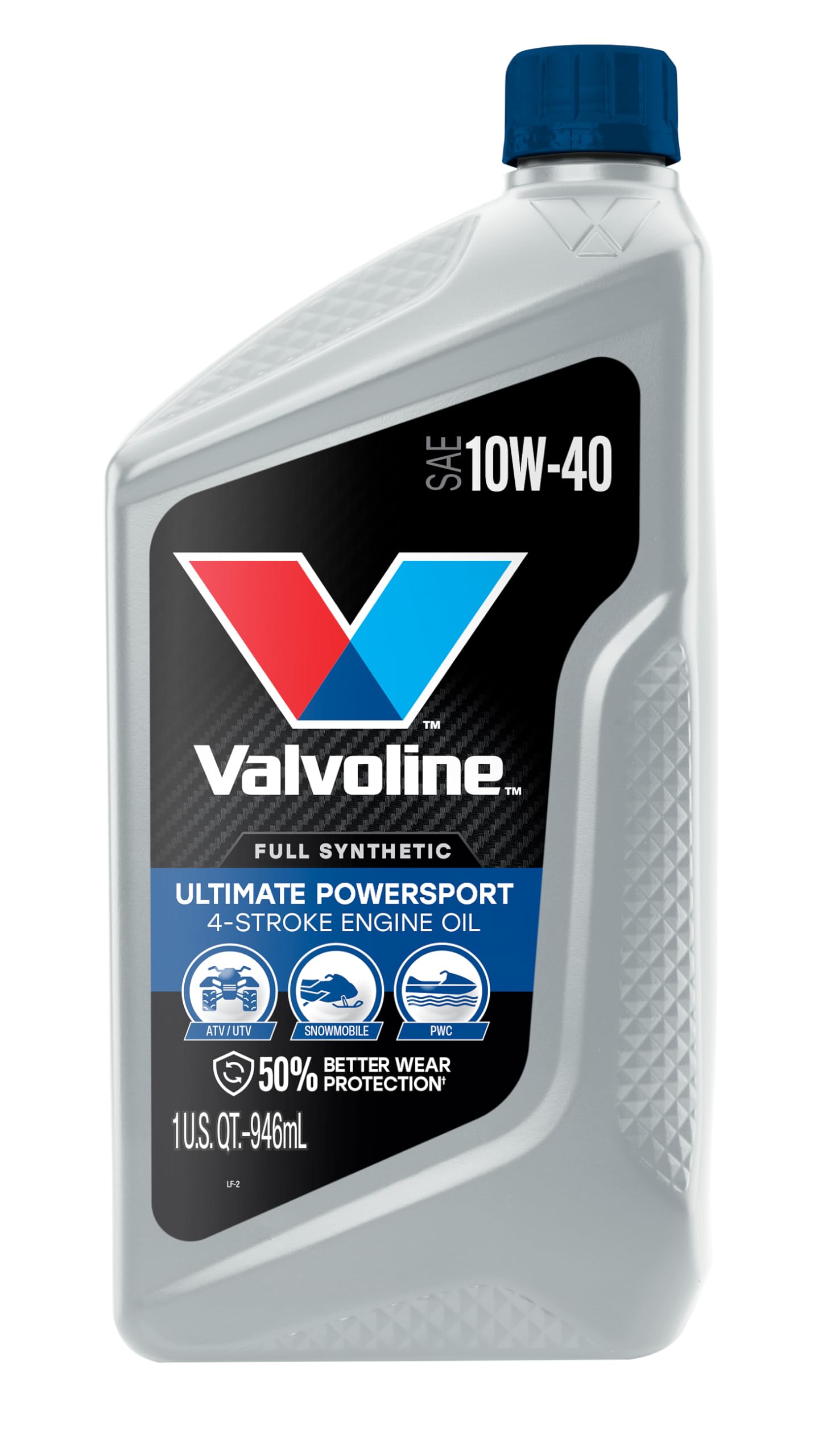
2. Valvoline 4-Stroke Powersport Full Synthetic
The budget-friendly full synthetic that performs like a premium without the premium price.
This is a full synthetic oil that outperforms pricier rivals for the price. The maker claims it delivers 50% stronger wear protection and up to 8X better rust defense compared to conventional oils — serious claims for a bottle at this price point. It is formulated specifically for ATVs, UTVs, personal watercraft, and snowmobiles, not just street bikes.
Owners mention it performs particularly well in UTVs during winter, holding its viscosity year-round. The secure cap design prevents spills in the garage, which is a small detail that gets genuine appreciation. It also holds a 4.9-star average from over 270 buyers, with quality being the most-praised aspect.
One owner notes it’s the “next best thing” to the Kawasaki KPO oil, which is high praise from someone who clearly compares options. While a few find it pricier than conventional oil, most agree the protection justifies the cost.
Smart money move: Full synthetic protection at a price that undercuts most rivals — the 394 °F flash point means it resists burning off in hard use.
Reach for this if: you own an ATV, UTV, or snowmobile and want full synthetic protection on a budget.
Look elsewhere if: you specifically need a 10W-50 grade for extreme high-temp racing.
3. Kawasaki K-Tech SAE 10W-40
The factory fill that proven rebuilds show — years of hard miles, minimal wear inside.
There is a reason this is the oil Kawasaki puts in its own bikes. The K-Tech formula contains a zinc additive specifically designed to prevent excess wear on engine parts at high temperatures. That isn’t just marketing — an owner who had to rebuild a motor after years of using this oil reported the insides showed very little wear on the moving parts.
It carries a 4.8-star average from nearly a thousand ratings, and quality is the overwhelming theme. Riders running the 2023 Ninja 400 non-ABS model report excellent performance, and it’s confirmed to be wet clutch compatible. It also holds the highest flash point in this comparison at 471.2 °F, beating the Valvoline’s 394 °F by a significant margin.
Owners note it’s the same oil the dealer sells but typically a couple dollars cheaper here. One rider waiting for their warranty to expire to switch to an aftermarket brand says it all — this is the safe, reliable choice while you’re covered.
Factory confidence: This is the highest flash point in the group at 471.2 °F, meaning it resists vaporizing under extreme heat better than most.
Best for: Kawasaki owners who want the exact spec the factory recommends without the dealership markup.
skip it if: you prefer a full synthetic for extended drain intervals.
4. Yamaha Yamalube 10W-40 4T Full Synthetic

The long-haul specialist that survives 40,000 miles of mixed terror without a hiccup.
This oil is certified to JASO MA and API SL specifications, which is the formal way of saying it is engineered for today’s high-performance engine parts and wet clutches. The thermal stability of the full synthetic formula is its standout trait — it helps engines run efficiently under demanding conditions without breaking down.
The proof is in the mileage. A 2017 Yamaha FJ-09 owner ran nothing but this oil for 40,000 miles on 3,500-mile intervals, through temperatures from 110°F down to 30°F, without any issues. They noted a slight clutch slip at 3,000+ miles on aggressive shifts, but that resolved after an oil change — a useful signal that the oil was telling them it was time for service.
Quality is what owners praise most, with the 4.8-star average backed by nearly 450 ratings. It’s also worth buying in gallon form, as some owners note that saves money compared to buying individual quarts.
Strong suits
- Certified JASO MA and API SL for modern engines
- Proven across 40,000 miles of hard use
- Versatile across on-road and off-road applications
Watch out for
- Price has crept up slightly over time
- Clutch slip can signal it’s time for a change around 3,000 miles
Pick this for: Yamaha owners who want a certified full synthetic with proven long-term reliability.
Think twice if: you ride a different brand and prefer to match the factory recommendation exactly.
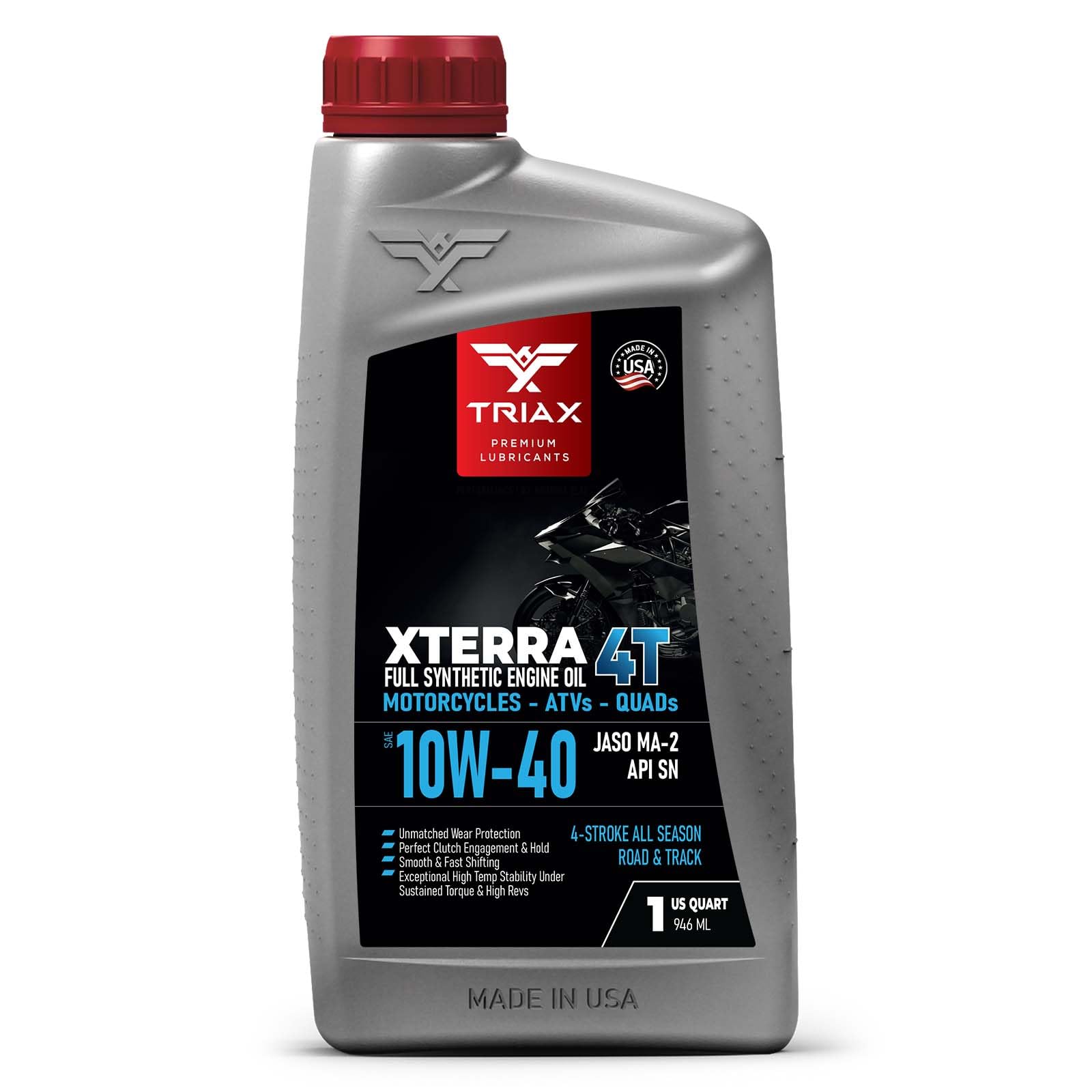
5. TRIAX XTerra 4T 10W-40
The brand-agnostic workhorse that keeps a 102k mile engine shifting like new.
If you own more than one machine, this is the oil that covers them all. TRIAX claims complete OEM compatibility with Honda, Kawasaki, Yamaha, Suzuki, Can-Am, Polaris, and a host of others — the full list is a who’s who of the powersport world. It exceeds JASO MA-2 and API SL/SN standards, so it meets the warranty requirements for most Japanese machines.
The 100% synthetic ester formulation is the secret sauce here. Ester molecules cling to metal surfaces, providing a durable film under high thermal stress. A rider with a 102,000-mile ZX-14 reports it keeps the bike running and shifting like new.
Owners praise the quality most — it’s the top-mentioned aspect here — and the built-in pour spout makes oil changes less messy. It carries a 4.8-star average from over 400 ratings.
One oil, many bikes: The unusually long OEM compatibility list means you can stock one bottle for the whole garage.
Choose this if: you have multiple bikes or ATVs from different brands and want a single oil to cover them.
Maybe not for: riders who specifically need a 10W-50 for extreme high-temperature racing.
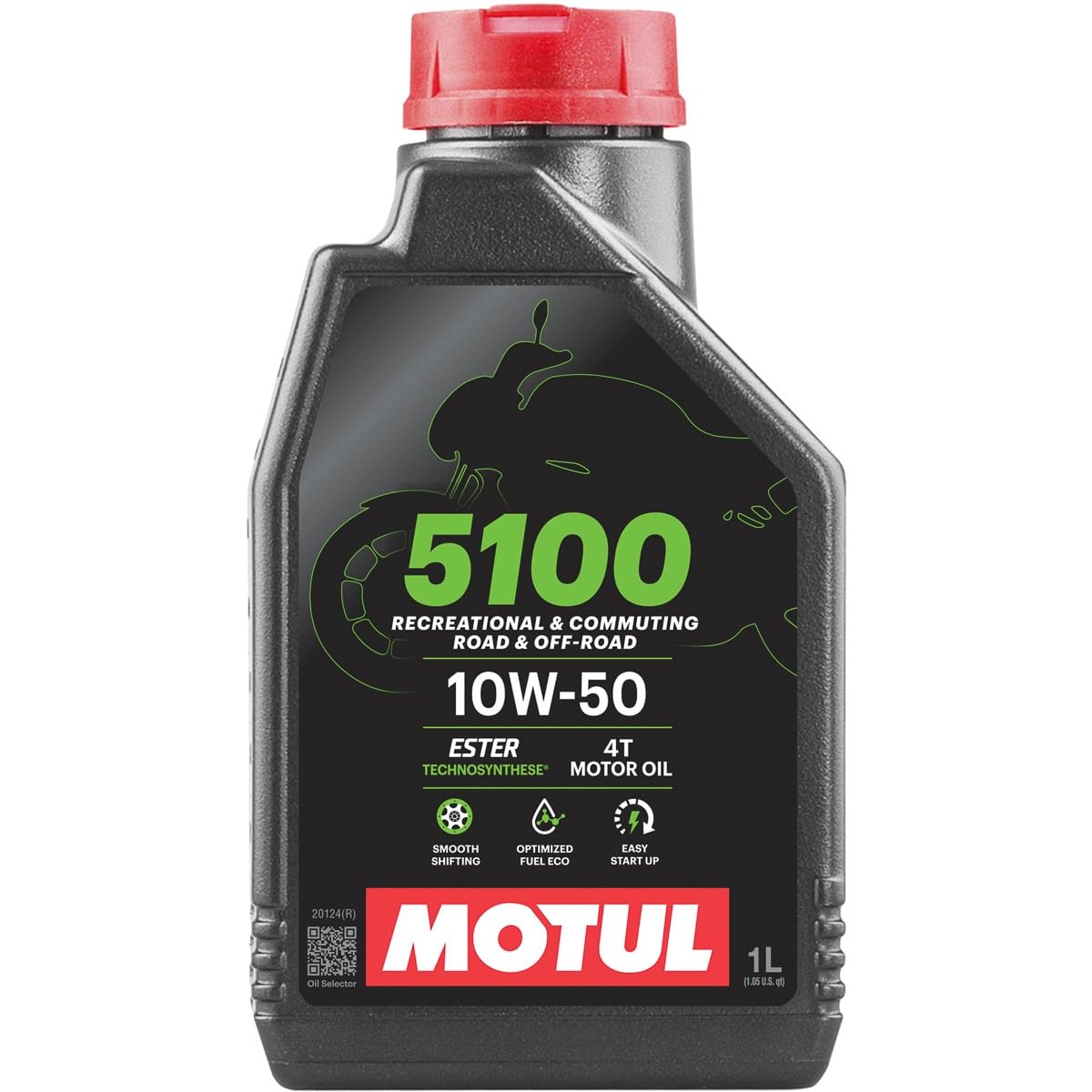
6. Motul 5100 4T 10W-50
The lacquer-ester blend that stretches intervals to 16,000 km and quiets the engine.
This semi-synthetic oil with ester chemistry is built for riders who hate frequent oil changes. The maker supports a recommended drain interval of up to 16,000 km (about 10,000 miles) depending on your manufacturer’s guidelines and riding conditions. The Technosynthese base stocks resist oxidation, so the oil protecting your engine at 15,000 km still holds its viscosity grade.
For hot-running engines, the 10W-50 viscosity stays thicker at high temperatures than a 10W-40, so it keeps protecting moving parts when things get scorching. It carries JASO MA2 certification (a standard ensuring the oil is safe for wet clutches, where the clutch runs in the same oil as the engine) and API SP certification (a standard for modern emission-controlled engines), so it also shields your catalytic converter. Its flash point—the temperature at which the oil can ignite—is a sturdy 270 °C, meaning it resists burning off even under extreme heat.
Opinions split on value — some call it worth the cost, others find it pricey. But there’s clear consensus on the quality, which is the most-praised aspect across roughly 880 ratings.
What stands out
- Up to 16,000 km drain interval saves time and money
- JASO MA2 wet clutch certified
- Built-in spout for easy pouring
Be aware
- Some owners find it expensive
- 10W-50 grade may be overkill for stock, street-only bikes
Best for: riders who put on serious miles and want to extend the time between oil changes.
Look elsewhere if: your bike’s manual specifies only a 10W-40 grade.
7. Liqui Moly 4T 10W-40 Street 4-Liter

The German bulk jug that made one rider ditch Valvoline after one shift.
Sometimes a single ride changes your mind. A 2023 Kawasaki Vulcan S650 owner used Valvoline 10W-40 synthetic twice with mediocre shifting, then switched to this Liqui Moly 10W-40 and immediately noticed smoother shifting, more power, and a steadier idle. That’s the kind of real-world switch that shows what this oil does.
The 4-liter jug (about 135 ounces) is the real value story here — it’s enough for multiple oil changes, making the premium German formulation more affordable per use. It’s built on synthetic technology and works for both air-cooled and water-cooled 4-stroke engines, with or without a wet clutch. The flash point sits at a secure 230 °C.
Quality is the dominant theme across the nearly 770 ratings, and a long-time rider noted it keeps a 2002 Triumph Triple running smoothly. The integrated funnel design on the jug makes pouring into tight oil tanks easier — a genuinely useful detail.
Buy once, ride long: The 4-liter size means you’ll likely have enough on hand for the whole season, and it’s cheaper per quart than buying singles.
Grab this for: riders who want a premium European oil and the convenience of buying in bulk.
pass on it if: you only need a single quart for a one-off change.
8. Castrol Actevo 4T 10W-40 Synthetic Blend

The Trizone triple threat that shields engine, clutch, and gearbox in one pour.
Castrol designed this synthetic blend with Trizone technology to protect all three critical zones in a motorcycle: the engine, the clutch, and the gearbox. The Active Protection Molecules (APM) cling to vital engine components, ensuring lubrication kicks in before the engine hits 51°C — the temperature where the most wear typically occurs.
The six-pack format delivers the best value: buying 6 quarts costs less per bottle than buying singles, so you save money on every oil change. With a 4.7-star average from over 900 ratings, buyers consistently praise the price—nearly a hundred owners specifically call out the value. It exceeds both API SG and JASO MA-2 standards (both are industry certifications for engine oil quality and wet-clutch safety), so your clutch stays protected.
Real-world reports back up the claims. A Ninja 300 with 44,000 miles on it survived a 1,400-mile mountain trip without overheating or power loss, shifting smoothly with no ticking noise. Owners also note it holds up well past 4,000 miles in 100°F+ heat.
Why it’s a favorite
- Six-pack format delivers the best per-quart value
- Trizone tech protects engine, clutch, and gearbox
- Proven in 100°F+ heat with low consumption
Consider this
- Synthetic blend, not full synthetic
- Occasional units arrive with damaged packaging
Perfect for: riders who want solid, reliable protection and want to stock up for multiple changes.
Not ideal if: you demand the absolute highest performance of a full synthetic oil.
9. Motorex Cross Power 4T 10W-50

The chosen oil for KTM race bikes, trusted by owners who have never lost a motor.
When a factory picks an oil for its race bikes, that’s a serious endorsement. Motorex Cross Power is the oil selected by KTM for all of their 4-stroke motorcycles, and it’s built to survive motocross and supercross conditions. The 10W-50 viscosity offers a thicker protective film at extreme temperatures compared to a 10W-40.
The loyalty here is telling. An owner who runs it in all KTM products says they’ve never had a motor go bad. Another with a small oil capacity engine trusts it to keep everything inside safe. Across nearly a thousand ratings, it holds a 4.8-star average with value for money being the top praise.
The 4-liter jug format means you’re buying enough for the season, which helps justify the premium positioning. It specifically prevents wet clutch slipping, which is critical for motocross riders who abuse the clutch constantly.
Race-bred trust: This is the oil KTM literally chooses for its 4-stroke race machines — a statement that beats any marketing claim.
Top choice for: KTM owners and motocross racers who demand extreme temperature and shear protection.
Probably too much for: casual trail riders on stock bikes who don’t push oil temps to the limit.
Understanding the Specs
JASO MA2 Certification
This standard confirms the oil’s friction properties are correct for a wet clutch — a clutch that bathes in the same oil as your engine. An oil without this rating can cause your clutch plates to slip, which robs power and wears them out fast. Always check for JASO MA2 on a dirt bike oil.
Viscosity Grade (10W-40 vs 10W-50)
The number before the W (winter) is about cold-start flow, and the number after is about high-temperature thickness. A 10W-40 is a versatile all-rounder. A 10W-50 flows thicker at high heat, offering more protection for hard-charging bikes, but it may feel slightly less responsive in cold weather.
Flash Point
This is the temperature at which the oil’s vapors can catch fire. A higher flash point (like Kawasaki’s 471.2 °F or Royal Purple’s 204 °C) means the oil resists burning off under extreme heat. If you ride hard in hot conditions, a higher flash point means less oil consumption and better protection.
Full Synthetic vs Semi-Synthetic
Full synthetic oils are engineered in a lab for maximum thermal stability, lasting longer under extreme conditions but costing more. Semi-synthetic blends mix synthetic base stocks with mineral oil for a solid middle ground. For casual riders, a blend like Castrol’s Actevo offers great value; for racers, a full synthetic like Motorex is the safer bet.
FAQ
Can I use car oil in my dirt bike?
What is the difference between 10W-40 and 10W-50 oil?
How often should I change my dirt bike oil?
What does JASO MA2 mean for my wet clutch?
Is full synthetic oil worth the extra cost for a dirt bike?
Will the wrong oil make my gears hard to shift?
Can I mix different brands of motorcycle oil?
How do I know if my dirt bike needs a 10W-50 instead of a 10W-40?
Final Thoughts: The Verdict
For most riders, the dirt bike oil winner is the Royal Purple Max Cycle because its proven ability to drop oil temperatures by nearly 100°F in extreme heat directly translates to longer engine life and smoother shifts. If you want certified, factory-recommended protection, grab the Yamaha Yamalube. And for the budget-conscious rider who still wants full synthetic performance, the Valvoline 4-Stroke Powersport is the one to reach for.
How We Picked
We do not accept paid placement. Every pick is matched to a real buyer and a real use-case; we do not hands-on test units.
Sources & Methodology
Specifications: manufacturer listings and product documentation. Review insights: verified customer reviews, as of August 2026. Pricing: not shown on this page (it changes often); check the current price via the retailer link.
As an Amazon Associate, Trending Car earns from qualifying purchases. This does not affect which products we feature.