
Our readers keep the lights on and my garage snacks stocked. As an Amazon Associate, I earn from qualifying purchases.
Specs are compiled from manufacturer listings and verified buyer reviews and can change over time — please confirm the key details on the product page before buying.
You want a tailgate generator that lets you hear the pre-game show, won’t strain your back when you lift it, and can power the TV, fridge, and coffee maker together. That means choosing an inverter generator (a type that runs quieter and produces stable electricity safe for your devices) — the only kind you’d want near a crowd.
I’m Min Islam — the founder and writer behind Trending Car. This guide is built by comparing the manufacturers’ published specifications and the patterns across verified customer reviews, so you get each pick’s real strengths and trade-offs instead of marketing spin.
Whether you’re grilling for four or hosting a fifty-person lot party, the right generator for tailgating keeps the party loud while staying quiet itself — here are the models that earn their spot in your truck bed.
Our Picks at a Glance


How To Choose The Best Generator for Tailgating
Your three buying questions are: how quiet it is, how much it weighs, and how long it runs per tank. Inverter generators beat older open-frame models on all three, so every pick here uses inverter technology.
Match the wattage to your actual setup
Add up what you’ll plug in — a 60-inch TV pulls around 300 watts, a mini fridge about 100 watts, and a coffee maker needs a burst of 800 watts or more when it heats up. That burst is the starting wattage, and it’s always higher than the steady running wattage. A 2,000-watt running generator handles TVs, fridges, and small appliances easily, while a 3,000-plus watt unit is what you want if you’re also running an air conditioner or an electric grill.
Weight is a real back issue, not a luxury
A tailgate generator gets loaded, unloaded, and moved around a parking lot more than any other portable unit you’ll own. Sub-50-pound inverter models can be carried with one hand, while anything pushing 80 pounds feels like a workout by the third game of the season. If you don’t want wheels and a handle in your way, keep the weight under 50 pounds.
Fuel runtime decides your game-day plan
Long runtimes mean you fill the tank once before kickoff and don’t think about gas again until the final whistle. Look for at least 8 hours at a 25% load — that covers a full tailgate plus the ride home. Some models stretch to 10 or even 22 hours, which makes them just as useful for camping trips and power-outage backups.
Quick Comparison
| Model | Best For | Running Watts | Weight | Runtime | Amazon |
|---|---|---|---|---|---|
| Champion 4000-Watt Inverter★ Best Overall | Whole-RV power | 3000W | 48.1 lbs | 10 hours | Amazon |
| AIVOLT 1600W InverterBest Value | Compact light duty | 1260W | 28 lbs | 8 hours | Amazon |
| GENKINS 2300W InverterBudget Champion | First-time owners | 1900W | 48 lbs | 8 hours | Amazon |
| PowerSmart 2500W Inverter | Sensitive electronics | 1900W | 39.7 lbs | 7.5 hours | Amazon |
| A-iPower SUA2600i | Long single-tank runtimes | 2000W | 38.7 lbs | 9 hours | Amazon |
| Pulsar PGD40ISCO | AC units up to 13,500 BTU | 3200W | 47.3 lbs | 4 hours | Amazon |
| Westinghouse 2550W | Dual fuel flexibility | 1900W | 43.2 lbs | 11 hours | Amazon |
| WEN 56360i | Quiet RV-friendly power | 2900W | 46 lbs | — | Amazon |
| Champion 4250-Watt Dual Fuel | Gas or propane flexibility | 3500W | 79 lbs | 22 hours | Amazon |
| WEN 56477i | Whole-camper power | 4000W | 72.7 lbs | 8 hours | Amazon |
In‑Depth Reviews
1. Champion Power Equipment 4000-Watt RV Ready Portable Inverter Generator
Our pick — over 4.5★ from 350+ verified ratings; the strongest balance of quality and price.
The 4,000-watt heavyweight that still lifts like a featherweight at 48.1 pounds.
The Champion 4000-Watt tops this list for raw power: 4,000 starting watts and 3,000 running watts can run a 15,000 BTU air conditioner, lights, and a 12V fridge together, per 55 hours of owner testing. You can’t run the AC and microwave at once, but that’s a rare tailgate combo. At 64 dBA from 23 feet (about the volume of a normal conversation), it stays neighbor-friendly.
Owners rave about the reliability and build quality above everything else — this is the most-praised aspect of the unit, and it shows in the way it starts easily and runs smoothly season after season. The 149 cubic centimeter engine sips fuel efficiently, with one buyer noting a roughly 6-liter fill lasts days when running 4-5 hours a day for essentials. At under 49 pounds, it’s among the lightest 4000-watt inverters in the industry, which makes the one-arm carry from truck to tailgate surprisingly doable.
Its clean power (less than 3% THD, or total harmonic distortion — a measure of electrical stability) protects your phone, laptop, and TV from surges. You get a 120V 25A TT-30R outlet for RV hookups, a 120V 20A household duplex outlet, and a 12V automotive-style outlet. The CO Shield system (a carbon monoxide detector that auto-shuts off the engine) adds safety when running it near a crowd.
What Wins Owners Over
- Reliability is the #1 praised aspect — owners trust it to start and run every time
- 3,000 running watts handles a full RV or tailgate setup including a 15K BTU AC
- 3-year warranty with free lifetime technical support
Real Trade-Offs
- Cannot run AC and microwave at the same time
- At 48.1 lbs, it’s not the lightest option for repeated loading
Reach for this if: you want one generator that powers your whole camper or a serious tailgate setup with AC — this is the crowd favorite at 4.6 stars.
Look elsewhere if: you only need to run a TV and mini fridge, where a lighter 2,000-watt class unit will do.
2. AIVOLT 1600W Super Quiet Inverter Generator
A 28-pound feather that handles a 1,500W startup surge without breaking a sweat.
The AIVOLT is the lightest generator here at just 28 pounds — that’s 20% lighter than similar models, and it shows when you’re carrying it from the parking lot to the grass. Its 60cc engine delivers 1,600 starting watts and 1,260 running watts, which is enough for small appliances and charging stations. One buyer notes it handles a 1,500W startup and a 400W running AC unit without issue, making it more capable than its size suggests.
At 57 dBA from 23 feet, this is quieter than a normal conversation — the quietest rating on this list. Owners consistently describe it as quieter than pricier brands like Honda or Yamaha. The 8-hour runtime at 25% load in ECO mode means you can set it up before the game and forget about it until the final whistle.
The inverter tech keeps power clean at under 3% THD, so it’s safe to plug in your phone, laptop, or small tools. It comes with two 120V outlets and two USB ports (Type-A and Type-C), plus indicator lights and an hour meter so you can monitor it at a glance. The CO Alert system auto-shuts down the unit if unsafe carbon monoxide levels are detected, and it meets EPA and ANSI/PGMA G300-2018 standards.
Why It Earns Its Spot
- 28 lbs is the lightest — easy one-hand carry all day
- 57 dBA is the quietest rating on this list
- 2-year warranty with lifetime support
Know Before You Buy
- 1,260 running watts won’t handle a large AC unit or electric grill
- Some owners measure noise higher than the 57 dBA spec at close range
Grab it if: portability and silence are your top priorities and you’re powering small essentials, not a full RV.
Pass on it if: you plan to run a 13,000 BTU AC unit — you’ll want the higher-wattage picks later in this list.
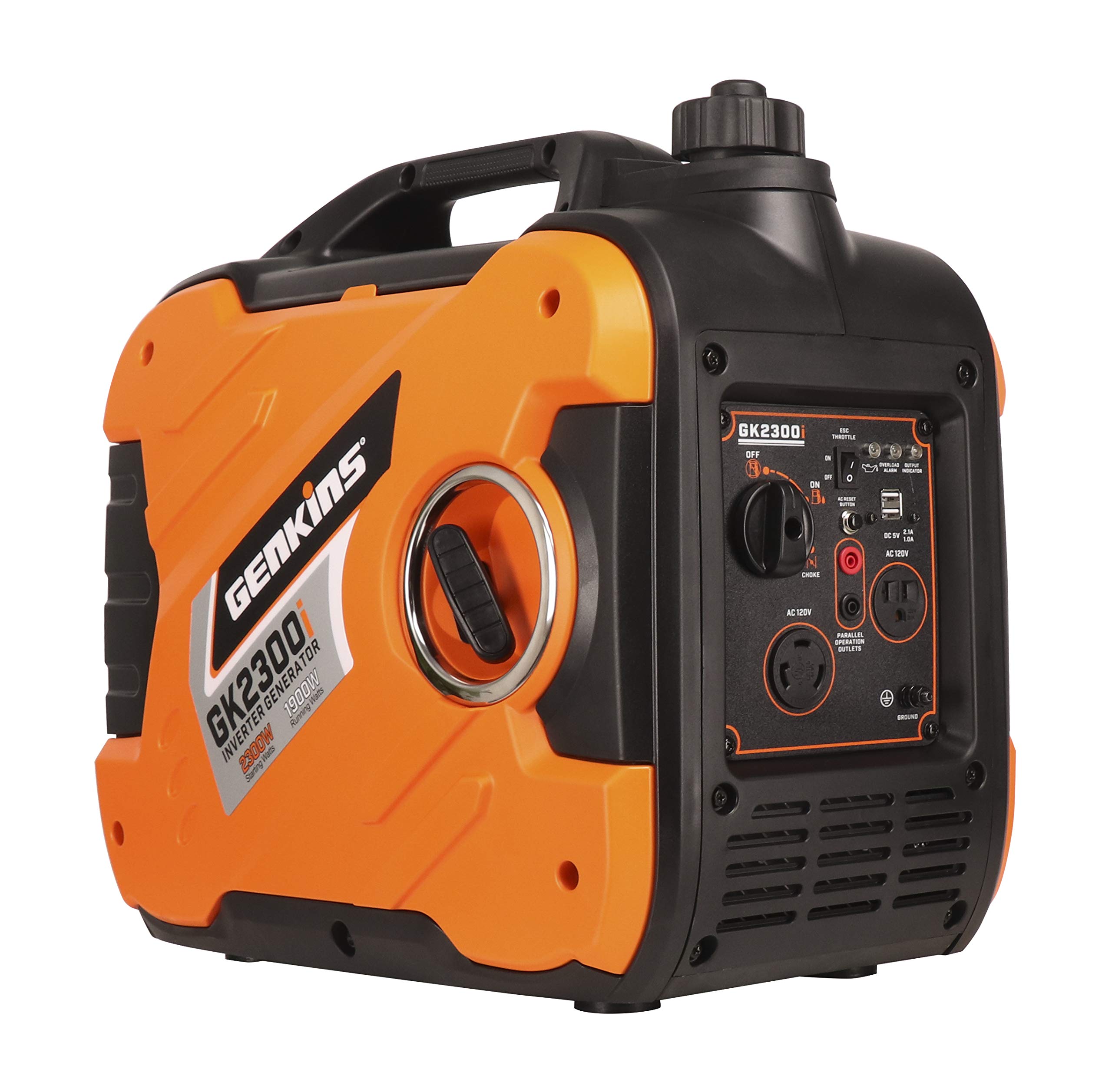
3. GENKINS 2300 Watt Portable Inverter Generator
A first-pull starter with Honda-like quiet that fits right in the budget tier.
For budget-minded tailgaters, the GENKINS 2300W delivers reliable power without the premium price. Its 79cc 4-stroke OHV engine (a standard overhead-valve design) produces 2,300 peak watts and 1,900 rated watts with pure sine wave output at under 2% THD — the cleanest rating here, so your phone and laptop are safe. The LBSC technology (a load-sensing system) adjusts engine speed automatically, cutting fuel use by up to 25% while keeping noise between 53 and 57 dB.
The 1.36-gallon tank delivers up to 8 hours of runtime at 50% load. Owners describe it as starting on the first or second pull every time, with one buyer noting it powered all their 110V appliances through a 3-day camping trip. The 48-pound weight is on the higher side for this class, but the ergonomic design makes it manageable for loading and unloading.
Safety is covered with a built-in CO sensor that shuts the unit off automatically if carbon monoxide spikes, plus low-oil, overload, overheat, and short-circuit protection. The outlet panel includes one 120V NEMA 5-20R household outlet, one 120V NEMA L5-20R outlet, and two USB ports. It’s also parallel ready, so you can double your output with a second GENKINS unit down the road. One honest trade-off: it can run a small AC fan, but the unit shuts down when a compressor kicks in.
The Reliability Story
- Reliability is the most-praised aspect — buyers report first-pull starts
- 2% THD is the cleanest power on this list for sensitive electronics
- 8-hour runtime at half load covers a full tailgate
Where It Falls Short
- Shuts down when an AC compressor kicks in
- At 48 lbs, it’s not the lightest for its size class
Best suited for: budget-conscious tailgaters who want a reliable workhorse for TVs, fridges, and small appliances — the 4.5-star consensus backs it up.
Think twice if: you need to run an air conditioner with a compressor start.
4. PowerSmart 2500 Watt Portable Inverter Generator
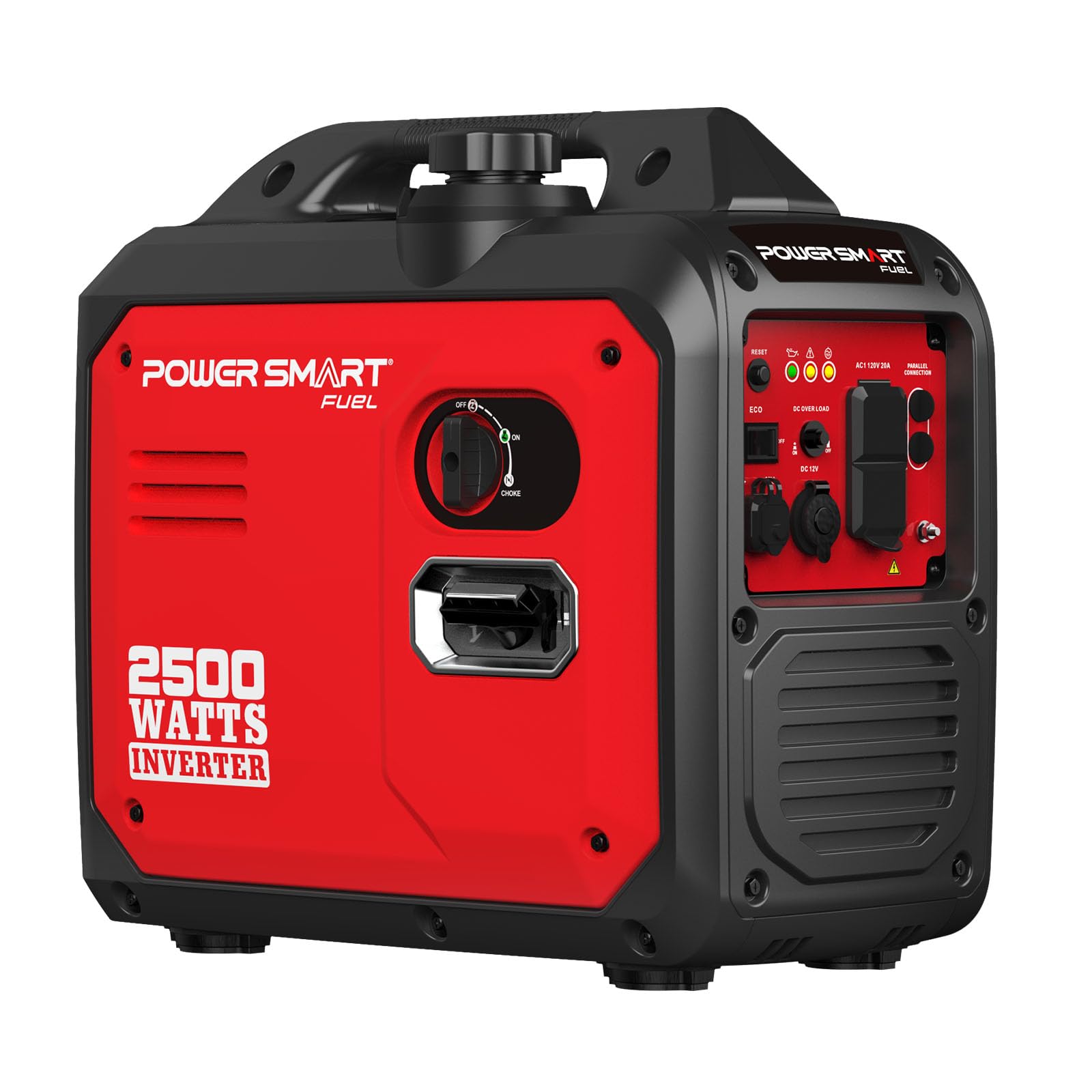
Half the weight of a standard generator with nearly the same output — the smart middle-ground pick.
The PowerSmart 2500W splits the difference between the tiny AIVOLT and the beefy Champion. It delivers 2,500 starting watts and 1,900 running watts, and at 39.7 pounds you can lift it with one hand into your vehicle — a feature owners call out as a major win. Its 79.8cc engine runs at just 59 dBA from 23 feet, quiet enough to keep the pre-game commentary audible.
Its 1.06-gallon fuel tank provides 7.5 hours of runtime at 25% load. The pure sine wave output makes it safe for sensitive electronics like phones and tablets — a detail one owner credits as the reason they trust it with their gear. The control panel features a 120V 20A duplex household outlet, a 12V 8A DC port, and two 5V USB ports with Eco mode to stretch fuel.
A 2-year limited warranty with free lifetime technical support backs this mid-range buy. Owners say it runs home appliances without issues and starts on the first pull. The honest trade-off: wattage ratings can feel optimistic — some buyers recommend buying more than double the rated wattage if you’re running heavy appliances.
The Balanced Verdict: A 39.7-pound mid-weight that runs quietly at 59 dBA and powers phones, coffee pots, and fans — the 4.4-star owner consensus says it just works.
The Honest Catch: For a big AC unit or simultaneous heavy appliances, step up in wattage or you’ll hit the overload limit.
5. A-iPower SUA2600i Quiet Inverter Generator
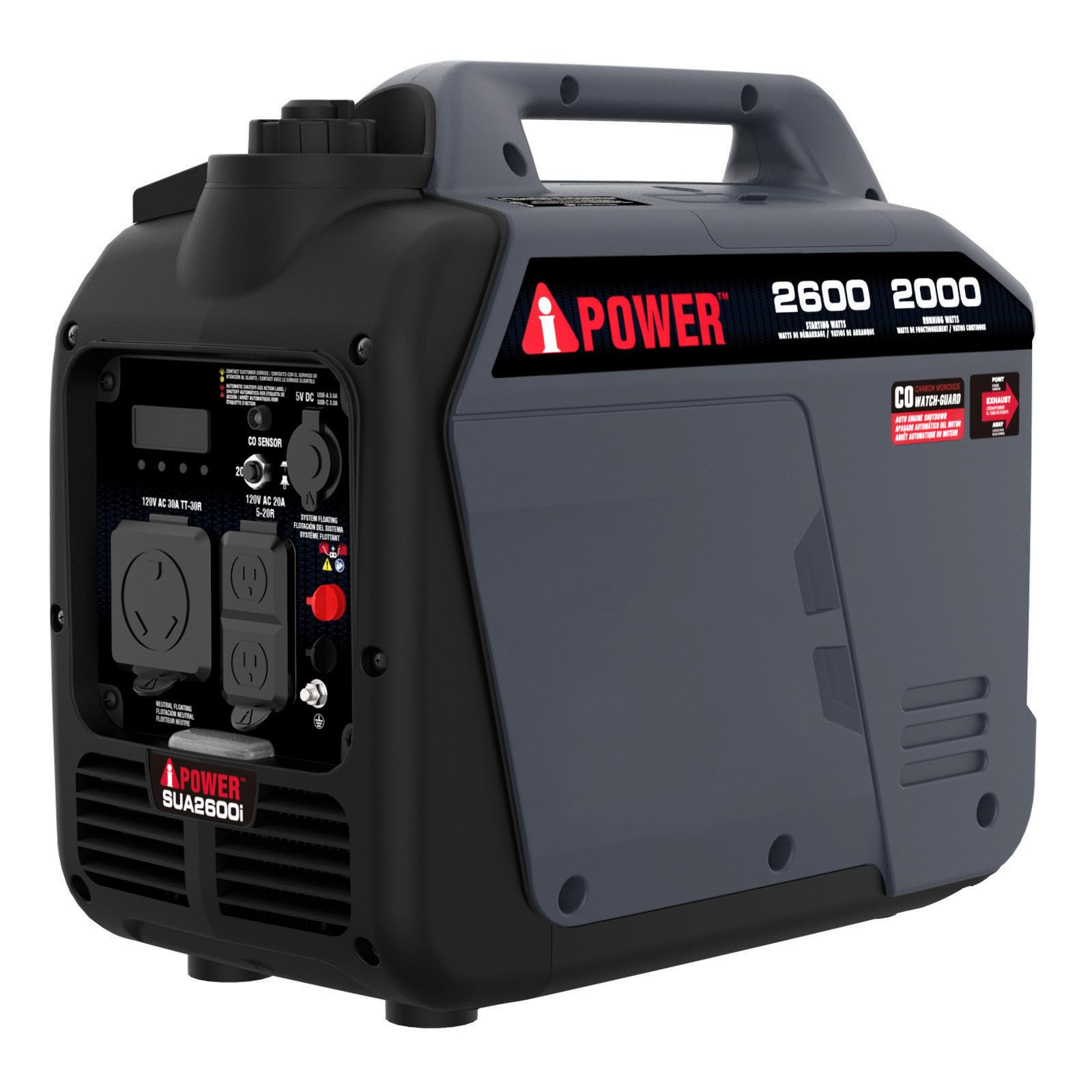
A 38-pound traveler that sips fuel for 9 hours straight — built for the all-day lot party.
The A-iPower SUA2600i is the fuel-efficiency champion of this list. Its 80cc engine delivers 2,600 starting watts and 2,000 running watts, and the 0.9-gallon tank stretches to 9 hours of runtime at 25% load. That means you fill up once before kickoff and don’t touch the gas cap again until you’re packing up after the final whistle. The low idle technology automatically conserves fuel and reduces noise when demand drops.
At 38.7 pounds, it’s one of the easiest units to stow in your trunk, RV compartment, or garage — owners highlight how light it feels to carry. The inverter output stays under 3% THD, making it safe for laptops, tablets, CPAP machines, and other sensitive electronics. At 62 dBA, it runs about as quietly as a normal conversation.
This model is EPA and CARB compliant, which means it’s legal in all 50 states including California — a detail that matters if you travel with your generator. It comes with a generator, owner’s manual, quick-start guide, and toolkit. One recurring note from owners: some units need a carburetor tweak after shipping to start smoothly, but the support team helps resolve it quickly.
The Fuel-Sipper: 9 hours on 0.9 gallons at 25% load — the longest per-gallon runtime in this class, ideal for a full day of tailgating without refueling.
The Fit Check: EPA and CARB compliant for all 50 states; just be ready to drain the carb float bowl if the unit sits too long before first use.
6. Pulsar PGD40ISCO Ultra Light Quiet 4000W Portable Gas Inverter Generator

4,000 peak watts of AC-ready power that you can still carry with one hand.
When the temperature climbs and your tailgate needs air conditioning, the Pulsar PGD40ISCO delivers. It produces 4,000 peak watts and 3,200 rated watts, and owners confirm it powers 13,500 BTU AC units — one buyer reports running the AC and a microwave together using a soft start, with over 400 hours of use across three summers and zero issues. The 145cc engine maintains that output while keeping the unit surprisingly carryable at 47.3 pounds.
The 1-gallon tank provides 4 hours of runtime at half load, which is on the shorter side — expect to refuel if you’re running the AC all day. It’s rated at 59 dB, putting it in the quiet zone, though a few owners note it’s not the quietest inverter they’ve heard compared to premium Hondas. The unit is parallel ready, so you can pair a second unit to double your output.
It includes a 120V 30A RV outlet and is ideal for emergency power, RV use, sensitive electronics, and AC units up to 13,500 BTU. The auto voltage regulation keeps your gear safe. One useful owner tip: the fuel cap can vapor-lock in extreme heat, so crack it open occasionally during long runs. The 4.5-star rating across nearly 500 owners confirms this is a solid workhorse.
The AC-Buster: 3,200 rated watts handles a 13,500 BTU air conditioner — the balance for hot-weather tailgates and RV boondocking.
The Trade-Off: 4 hours at half load means packing a spare gas can if you’re running the AC all afternoon.
7. Westinghouse 2550 Peak Watt Super Quiet Portable Inverter Generator

The dual-fuel premium that runs as low as 52 dBA — the quietest on this entire list.
The Westinghouse 2550W is the premium pick for tailgaters who want gas and propane flexibility. It runs on either fuel, and the propane option is a standout — no gas smell, indefinite storage, and longer runtime, as long-time Westinghouse owners point out. It delivers 2,550 peak watts and 1,900 rated watts at under 3% THD, and the “Economy Mode” pushes the noise down to as low as 52 dBA, the lowest rating on this list.
On a 1.16-gallon gas tank, it runs up to 11 hours at 25% load — the longest runtime in the 1,900W class. The 43.2-pound weight keeps it manageable, and owners describe it as light and easy to transport. The plug-and-play setup includes oil, an oil funnel, a tool kit, and a user’s manual, so you’re ready to go right from the start.
It features one RV-ready TT-30R outlet, two 120V 20A outlets, and two USB outlets. The CO sensor adds built-in safety. One thing to note: the included oil bottle may be slightly insufficient — owners recommend having a bit extra on hand for the first fill. The 3-year limited service, labor, and parts coverage is among the best in this class.
The Dual-Fuel Advantage: Gas or propane means you can stash a propane tank for storage and never deal with stale gas — plus ECO mode drops noise to 52 dBA.
The Setup Note: Read the documentation carefully before the first start; a few owners needed extra oil beyond what’s in the bottle.
8. WEN 3600-Watt Portable Inverter Generator (56360i)

A 149cc engine mated to a 46-pound frame that starts on the first pull, every time.
The WEN 56360i is the quiet workhorse of the WEN lineup, delivering 3,600 surge watts and 2,900 rated watts from its 149cc engine. Owners single out its remarkably quiet operation, especially in eco mode, and one buyer reports it running a large portable AC unit for hours on a single tank. The 46-pound weight earns the “ultralight” label honestly — you can carry it without a struggle.
A standout feature is the fuel shutoff, which runs the carburetor dry before shutdown, extending the generator’s lifespan by preventing stale fuel buildup. The clean power output protects sensitive electronics like smartphones, tablets, and laptops. The outlet panel includes two three-prong 120V receptacles, one TT-30R RV receptacle, one 12V DC receptacle, and two 5V USB ports.
It ships with a three-year warranty. The 4.4-star rating across over 600 owners reflects strong reliability — that’s the most-praised aspect, with 114 owners calling it out specifically. One owner notes it fits neatly under a bunk in a camper, which speaks to its compact footprint. The honest trade-off: at 46 pounds dry (around 68 pounds with a full tank and oil), it’s not the lightest for repeated hauling.
The Long-Haul Facts
- Reliability is the #1 praised aspect — 114 owners flag it as the unit’s best quality
- Fuel shutoff preserves the carburetor and extends lifespan
- Runs a large portable AC for hours on one tank
The Weight Reality
- Tops 68 lbs wet, which is heavy for repeated stairs
- Oil changes needed every 25 hours
Choose it for: dependable RV-friendly power with first-pull starts and a fuel shutoff that makes off-season storage low-maintenance.
skip it if: you’ll be carrying it up stairs often — the 68-pound wet weight gets old fast.
9. Champion Power Equipment 4250-Watt Dual Fuel RV Ready Portable Open Frame Inverter Generator

A 4,250-watt dual-fuel beast with a 22-hour tank — the marathon runner of tailgates.
The Champion 4250-Watt is the endurance king. Its 224cc engine produces 4,250 starting watts and 3,500 running watts, and it runs up to 22 hours on a full gas tank — that’s an entire weekend of tailgating on one fill. The dual-fuel design lets you switch between gasoline and propane, which owners love for long-term storage since propane doesn’t go stale. It’s EPA compliant and includes a propane hose right in the box.
Champion’s advanced digital hybrid design makes this 50% quieter and 20% lighter than a traditional 3,500-watt generator, yet it still tips the scales at 79 pounds. That’s the trade-off for this much power and runtime — you’ll want the wheel kit (sold separately) or a strong buddy. It runs at a quiet 64 dBA, and owners describe a “quiet subdued rumble” that’s easy to live with, even moving the unit within 100 feet of a campsite.
The outlet panel includes a 120V 30A RV outlet, two 120V 20A household outlets, and a 12V DC outlet with a dual USB adapter. Owners have powered Starlink, computers, printers, and small AC units with it, and one reports it handling a two-week off-grid RV trip flawlessly. The 3-year limited warranty with free lifetime technical support from Champion rounds out the package.
The Endurance Pitch
- 22-hour runtime on gas — two full weekends of tailgating on one tank
- Dual fuel flexibility with propane hose included
- 50% quieter and 20% lighter than traditional 3,500W units
The Weight Reality
- 79 pounds demands a wheel kit or a second person to move
- Propane operation takes 5-10 pulls to start
Best if: you run a serious multi-day tailgate or RV setup and want gas-or-propane flexibility plus marathon runtime.
Reconsider if: you’re solo-loading the truck — 79 pounds is a two-person job without wheels.
10. WEN 4800-Watt RV-Ready Portable Inverter Generator (56477i)

4,000 running watts that powers a whole 35.5-foot camper, with wheels to haul itself.
The WEN 56477i is the biggest, baddest unit on this list — a 224cc engine generating 4,800 surge watts and 4,000 rated watts. It’s the only pick here with onboard wheels and a telescoping pull handle, which makes the 72.7-pound weight a non-issue since you roll it instead of carrying it. Owners have run their entire 35.5-foot camper with this unit, plus fridges, freezers, and full appliance setups during 9-day power outages.
Noise is the most-praised aspect here, with 93 owners highlighting how quiet it runs, especially in eco mode. The WEN Watchdog CO Shutdown Sensor automatically turns the unit off if dangerous carbon monoxide levels are detected — a serious safety feature for a generator this powerful. The fuel shutoff runs the carburetor dry before shutdown, preserving the engine for years of tailgate seasons.
The outlet panel includes four three-prong 120V receptacles, one TT-30R RV receptacle, one 12V DC receptacle, and two 5V USB ports — more outlets than any other pick here. Owners mention 8 hours of runtime per tank, and the 4.5-star rating confirms it’s a dependable choice. The honest note: a few owners find it occasionally hard to start after it’s been running a while, so let it cool before the restart.
Why It’s The Big Rig
- 4,000 rated watts runs an entire 35.5-foot camper
- Wheels and telescoping handle make the 72.7 lbs rollable
- CO Shutdown Sensor adds real safety for a powerful unit
The Only Complication
- Occasionally hard to restart after long runs
- Couldn’t power a water heater — check your load before committing
Reach for this if: you want a rolling power station for a big camper or a full home-backup setup, not just a tailgate.
Look elsewhere if: your tailgate fits in a sedan trunk — this one belongs in a truck bed or RV bay.
Understanding the Specs
Starting Watts vs. Running Watts
Starting watts (sometimes called surge watts) is the brief burst of power a device needs to turn on — think of a fridge compressor or AC unit kicking in. Running watts is the steady power it draws afterward. You need a generator whose starting watts cover your biggest appliance’s surge and whose running watts cover everything you’ll have on at once. A 2,000-watt running unit handles TVs, fridges, and small appliances; a 3,000-plus watt unit is needed for AC or electric grills.
THD and Pure Sine Wave Output
Total Harmonic Distortion (THD) measures how clean the electricity is. Quality inverters keep THD under 3%, which matters because “dirty” power can damage sensitive electronics like phones, laptops, and CPAP machines. Every pick on this list is an inverter generator, so all of them produce the clean power your modern gear needs.
FAQ
How many watts do I need to run a TV and a mini fridge at a tailgate?
Can I run an air conditioner with a portable tailgate generator?
What does “parallel ready” mean and do I need it?
Is a dual fuel generator worth the extra cost for tailgating?
How long will a generator run on a full tank?
Where should I place my generator at a tailgate?
What is an inverter generator and why should I choose one for tailgating?
How do I know if my generator will start my RV air conditioner?
Can I connect two generators together if I need more power?
What maintenance does a tailgate generator need between games?
Final Thoughts: The Verdict
The best generator for tailgating overall is the Champion 4000-Watt Inverter because it pairs class-leading 3,000 running watts with a featherweight 48.1-pound frame and 10-hour runtime — the crowd favorite at 4.6 stars. If you want the quietest and lightest option for small setups, the AIVOLT 1600W at 28 pounds and 57 dBA is the one to reach for. And for dual-fuel flexibility with propane’s storage convenience, the Westinghouse 2550W at 52 dBA is the premium pick worth the money.
One honest nudge: the Champion 4000-Watt outranks the AIVOLT on power by a 2.5x starting-watt gap (4,000 vs 1,600 watts) and a 2.4x running-watt gap (3,000 vs 1,260 watts), yet it still carries the higher owner satisfaction score — that combination of power, weight, and reliability is why it leads this list. Whichever you choose, keep the dBA under 65, THD under 3%, and the weight under 50 pounds for easy one-hand loading.
How We Picked
We do not accept paid placement. Every pick is matched to a real buyer and a real use-case; we do not hands-on test units.
Sources & Methodology
Specifications: manufacturer listings and product documentation. Review insights: verified customer reviews, as of August 2026. Pricing: not shown on this page (it changes often); check the current price via the retailer link.
As an Amazon Associate, Trending Car earns from qualifying purchases. This does not affect which products we feature.