
Our readers keep the lights on and my garage snacks stocked. As an Amazon Associate, I earn from qualifying purchases.
Specs are compiled from manufacturer listings and verified buyer reviews and can change over time — please confirm the key details on the product page before buying.
Every police radar detector on the market can beep. The hard part is making it beep only when it matters — not every time you pass a Honda with blind-spot sensors or a supermarket automatic door. The real winners here pair long detection range with smart filtering and GPS that learns your commute, so you get a genuine warning and not a constant false-alarm chorus.
I’m Min Islam — the founder and writer behind Trending Car. This guide is built by comparing the manufacturers’ published specifications and the patterns across verified customer reviews, so you get each pick’s real strengths and trade-offs instead of marketing spin.
You want the best police radar detector for your driving style, and the right one balances warning time, false-alert filtering, and price without overcomplicating your windshield.
Our Picks at a Glance
How To Choose The Best Police Radar Detector
Pick a detector that matches where you drive. City drivers need noise suppression; highway cruisers need sheer miles of Ka-band reach. Choose your priorities before you look at a price tag.
Range: The Miles Between You and the Trap
Long range is the headline spec for a reason. A detector that catches a Ka-band signal from a mile or more away gives you real time to react. Shorter-range units still alert you, but the warning window can shrink to seconds — enough if you were near the limit, not enough if you were pushing.
Filtering: The Real Daily Test
Modern cars are full of radar emitters. Blind-spot monitors, collision avoidance systems, and even automatic doors at storefronts all broadcast in the same K band as some police radar. A detector with weak filtering will beep constantly. The best units use digital signal processing and GPS lockouts to recognize these nuisances and silence them automatically.
GPS and Cameras: Fixed Traps Don’t Need Radar
Red-light cameras and speed cameras don’t emit radar. They use sensors or photography, so a detector could never detect them. Built-in GPS databases solve this — the unit knows where fixed cameras sit and warns you as you approach, even with zero radar signal present.
Quick Comparison
| Model | Best For | Weight | Display | Bands Supported | Amazon |
|---|---|---|---|---|---|
| Escort iXc★ Best Overall | Quiet city driving | 8 ounces | OLED | X, K, Ka | Amazon |
| Cobra RAD 490iSmartphone Sync | Phone-connected commuters | 4.8 ounces | LED | X, K, KA | Amazon |
| Whistler CR93360° GPS | No-subscription GPS users | 12 ounces | OLED | X, K, Ka, Ku | Amazon |
| Cobra RAD 700i | Long-range highway trips | 6.4 ounces | OLED | X, K, Ka | Amazon |
| Escort MAX 3 | App-savvy daily drivers | 0.23 kg | OLED | K, KA, X, M, POP | Amazon |
| Radenso DS1 | Motorcyclists & tuners | — | OLED | X, K, Ka, Gatso, MRCD, MRCT, Laser | Amazon |
| Uniden R4w | Value long-range hunters | — | OLED | Ka, K, X | Amazon |
| Valentine One V1 Gen 2 | Situational awareness purists | — | LCD | X, K, Ka, Ku, Laser | Amazon |
| Uniden R8w | Maximum arrow-equipped coverage | — | OLED | X, K, Ka, Gatso | Amazon |
In‑Depth Reviews
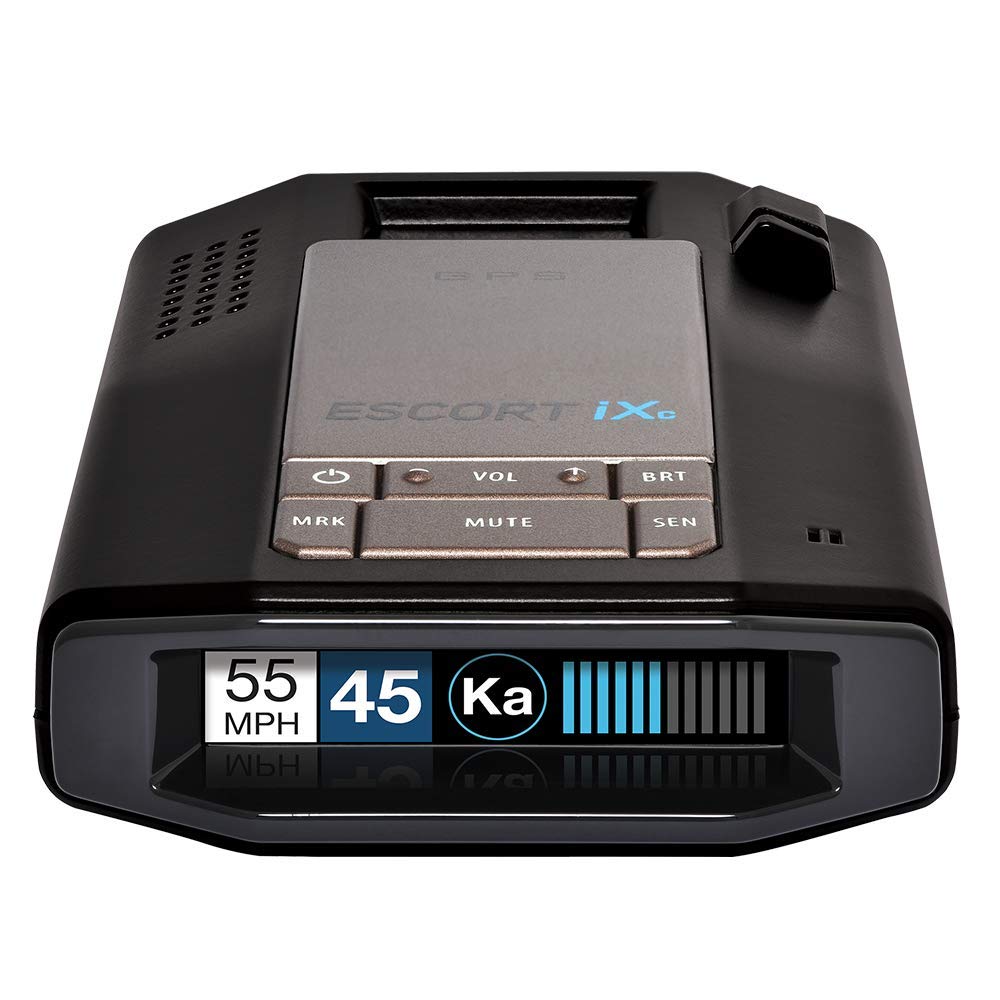
1. Escort iXc
Our pick — 4.5★ from 400+ verified ratings; the strongest balance of quality and price.
The quiet commuter’s champ that refuses to cry wolf at every modern car.
The iXc earns its top spot by doing the two hardest jobs well: detecting real threats and ignoring everything else. Buyers report it “detects all bands including laser from 1/2 mile away,” strong range for a detector that stays quiet. The AutoLearn Technology marries GPS intelligence, IVT filtering, and AutoSensitivity to adapt to your driving style — so repeat false sources along your route get locked out over time.
Pair it with the Escort Live App and you tap into a community sharing over 100 million alerts a year, covering red-light cameras, speed cameras, and live police radar. Clear voice alerts keep your eyes on the road, and the multi-color OLED display is easy to read at a glance. The 8-ounce weight makes it one of the heftier units here, but that solid feel translates to build quality.
The one honest caveat is reliability — feedback is split, with some units working flawlessly for years while a few fail to detect anything. There’s also no directional arrow, so you won’t know if the threat is ahead or behind. For most buyers, the combination of range, app integration, and near-silent commuting makes it the strongest all-rounder.
Why It Wins Commuters Over
- AutoLearn silences repeat false alerts on your route
- Crowdsourced alerts through the Escort Live app
- Voice warnings keep hands on the wheel
Where It Asks for Patience
- Reliability reports are mixed — some units arrive faulty
- No directional arrows for front-versus-rear threats
Your daily escort: choose the iXc if you want the best blend of range, filtering, and app support for everyday driving.
Think twice if: you need directional awareness — this one tells you something is there, not where.
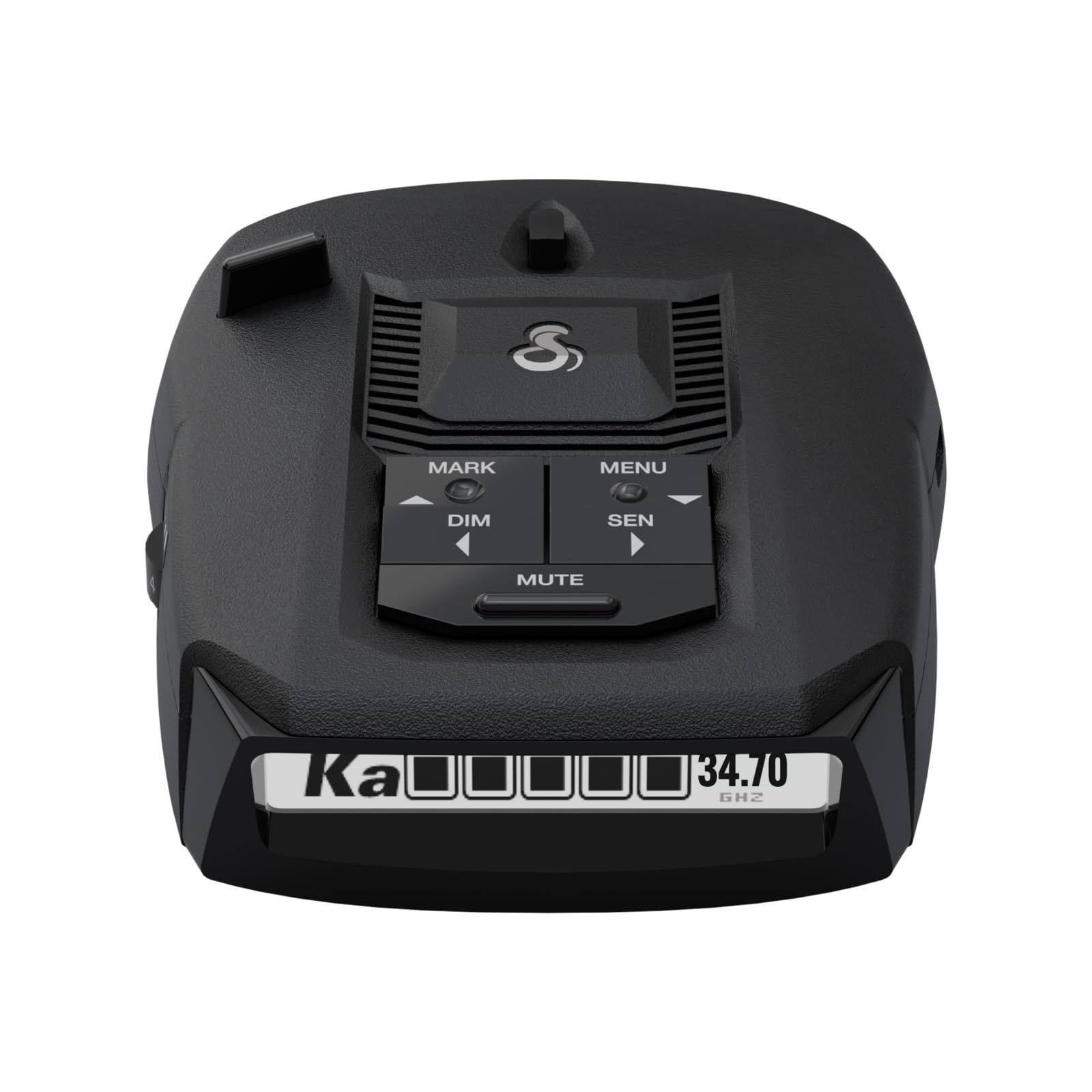
2. Cobra RAD 490i
A featherweight 4.8-ounce unit that puts live alerts right on your dashboard screen.
The RAD 490i is built for drivers who already live inside their phone’s ecosystem. Apple CarPlay and Android Auto compatibility let you see your route and interact with Drive Smarter community alerts on your vehicle’s own display. At 4.8 ounces versus the Escort iXc’s 8 ounces, it’s easy to forget it’s on the windshield.
Digital Signal Processing (DSP) — a chip that rapidly processes incoming radar signals — gives earlier warnings, while the updatable IVT filter cuts false alerts from blind-spot monitoring systems. LaserEye technology detects laser from both front and rear, covering threats from all directions. Firmware updates keep the unit current, and the USB-C power cord is a modern touch.
The honest note: one buyer reports the unit “randomly goes off” and misses real threats while chirping at automatic doors. That’s a single voice among mostly positive feedback praising reliability, quality, and range. The trade-off is that budget-tier filtering sometimes needs manual sensitivity tuning to behave.
Dashboard-native alerts: the 490i shines when paired with CarPlay or Android Auto, putting warnings where you already look.
Set sensitivity wisely: Extreme Mode maxes range but invites false alarms, so stick to filtered modes for city driving.
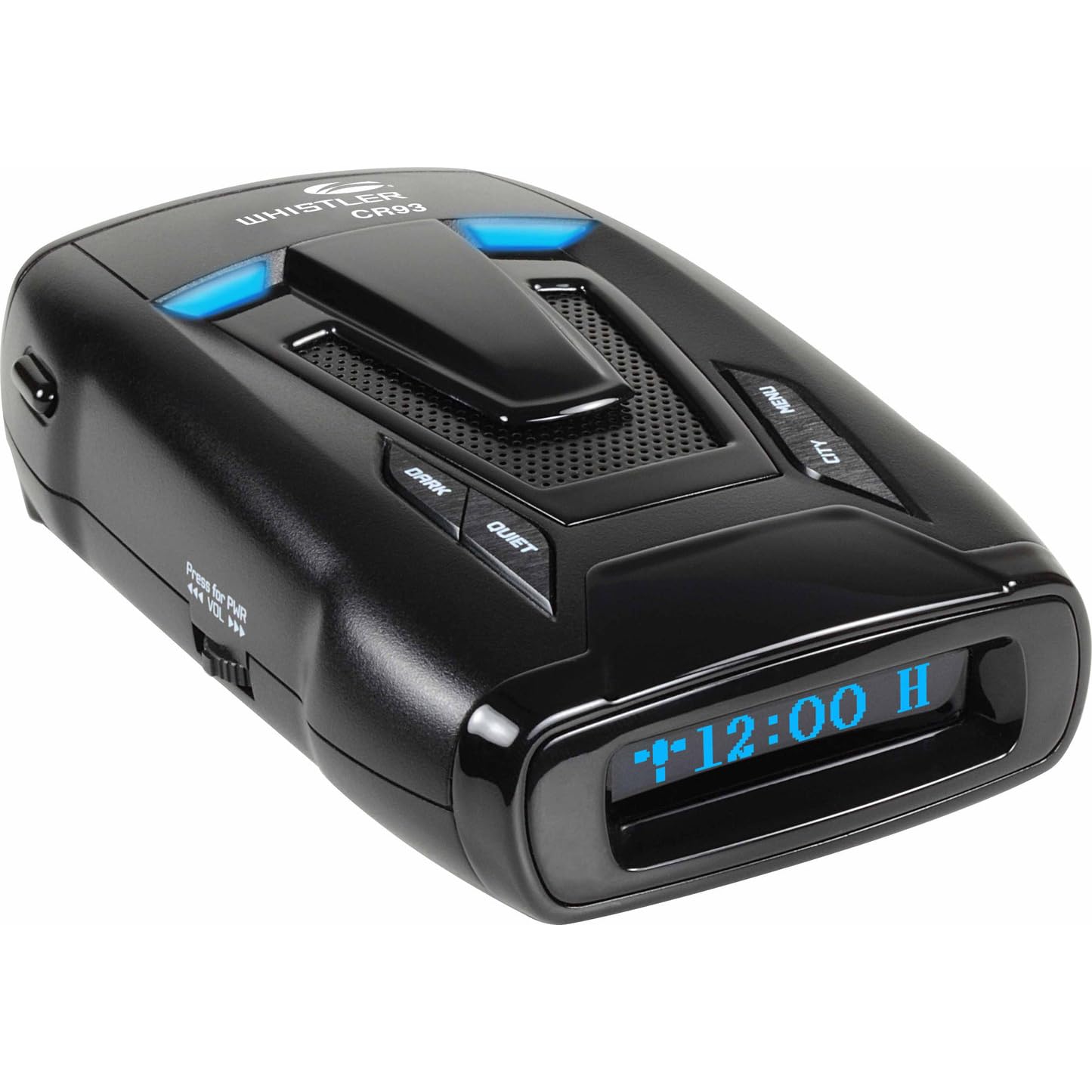
3. Whistler CR93
The all-in-one with internal GPS and no subscription fees, ever.
The CR93 stands out because its GPS is baked in — no phone app required. It automatically marks red-light cameras, speed cameras, and known speed trap locations, alerting you before you arrive even when no radar signal is present. The “no subscription required” promise means what you pay is what you get, with no ongoing costs.
It sweeps X, K, Ka, and Ku bands with 360° total band protection and POP mode coverage, catching threats from all angles. The FDSR and TFSR filtering suppresses blind-spot monitors, collision avoidance, and automatic doors so alerts mean something. A bilingual OLED display delivers spoken English or Spanish alerts, and GPS-assisted City Mode automatically reduces sensitivity at lower speeds to cut urban chatter.
The recurring trade-off is the build — several owners note it “feels flimsy” despite working well, and the compass display is considered near-useless. At 12 ounces it’s also the heaviest pick here. But for a feature-packed unit with free GPS updates, it’s a strong value for moderate speeders who want set-and-forget protection.
Set-and-forget GPS: if you refuse to fiddle with apps, the CR93’s internal database handles fixed cameras on its own.
Handle with care: the plastic housing feels lighter-duty than rivals, and the compass adds little real use.
4. Cobra RAD 700i

State-trooper reach with a display you can color-match to your interior.
The RAD 700i is Cobra’s mid-range standout, with an “all-new antenna platform” and Digital Signal Processing aimed squarely at long-range performance. One owner reports picking up a state trooper’s 34.7GHz Ka band from about a mile away. That’s the kind of early warning that turns a would-be ticket into a smooth slow-down.
Built-in GPS and AutoLearn Intelligence work together to get smarter over time, recognizing and reducing false signals so you only hear accurate alerts. LaserEye Protection detects radar and laser from both front and rear. The 5-color OLED display lets you customize colors to match your vehicle’s interior lighting, and the magnetic mount is widely praised. At 6.4 ounces, it’s a middleweight that sits securely on the glass.
The honest caveats: accuracy feedback is mixed, with reports it “picks up radar well down the road” but occasionally misses, and noise levels draw the most negative comments. One unit arrived dead on arrival and a firmware update failure bricked it — a rare but frustrating outcome. For the price, the range and build quality make it a compelling daily companion.
The Long-Range Payoff
- Antenna platform tuned for early Ka-band warnings
- AutoLearn GPS quiets familiar false sources
- Magnetic mount is quick and reliable
Occasional Rough Edges
- Some units arrive dead and fail firmware updates
- Noise level draws the most negative comments
Highway warrior: reach for the 700i when your drives are long, fast, and full of state troopers.
Buyer beware: if you get a defective unit, the firmware update path can be a dead end — test it early.
5. Escort MAX 3

The app-pairing performer that displays alerts right on your car’s head unit.
The MAX 3’s a neat extra is its Bluetooth pairing with the Escort app, letting you toggle bands on and off to eliminate false alerts and send alerts straight to your car’s display. Variable Speed Sensitivity automatically adjusts based on your speed — more sensitive on the highway, quieter in town.
AutoLearn Intelligence uses GPS to learn your route and reject false alerts from specific locations over repeat trips. The Defender Database supplies up-to-date red-light and speed camera info. It’s also M2 dash cam compatible, so you can pair it with Escort’s M2 camera for full HD video capture alongside your alerts. At 0.23 kg, it’s a substantial unit with a premium feel.
The weak point is the mount — one owner’s unit “falls off more and more frequently” from a cleaned windshield, ending up on the dash. The detector itself works great and has saved plenty of tickets, but the suction cup needs patience. For app-savvy drivers, the customization depth is a genuine edge.
Band-by-band control: the app lets you kill specific false-prone bands, keeping only the alerts you need.
Mount patience required: the suction cup can struggle on textured or curved glass — a dash rest may be the workaround.
6. Radenso DS1

The motorcycle-friendly extreme-range detector with a 3.5mm audio jack.
The DS1 is engineered for riders and drivers who need flexibility. The 3.5mm headphone jack routes alerts straight into a helmet or earphones — a feature almost no other windshield detector offers. USB-C power and updates replace the old RJ11 jacks, and the USB-A port on the power adapter charges other accessories like your phone. A 1/4-20 threaded hole opens mounting options for bikes and angled windshields.
Range is the headline: owners mention warnings “several miles out” and caught police Ka band far ahead. It detects X, K, Ka, MRCD, MRCT, Gatso, and laser (LIDAR) — covering radar types most rivals ignore. GPS auto-lockouts remember stationary false alerts, with memory for an impressive 16,500 auto lockouts. The 1.6″ full-color OLED display auto-dims and lets you pick 8 colors per alert band.
The trade-off is complexity. Setup can stump novices, and the suction mount is large enough to obstruct the windshield view. USA phone and email support from Cincinnati, Ohio, is a genuine plus if you need help. This is a tinkerer’s detector — best for those who’ll invest time to tune it.
Built for Riders and Tuners
- Headphone jack keeps alerts audible at speed
- Catches Gatso, MRCD, and MRCT radar
- 16,500 auto-lockout memory for quiet routes
Setup Demands Attention
- Complex menus need tuning to reduce false alerts
- Large suction mount can block windshield visibility
Rider’s choice: choose the DS1 if helmet audio or unusual mounting is part of your daily setup.
Novices note: expect a learning curve — this one rewards time spent in the settings.
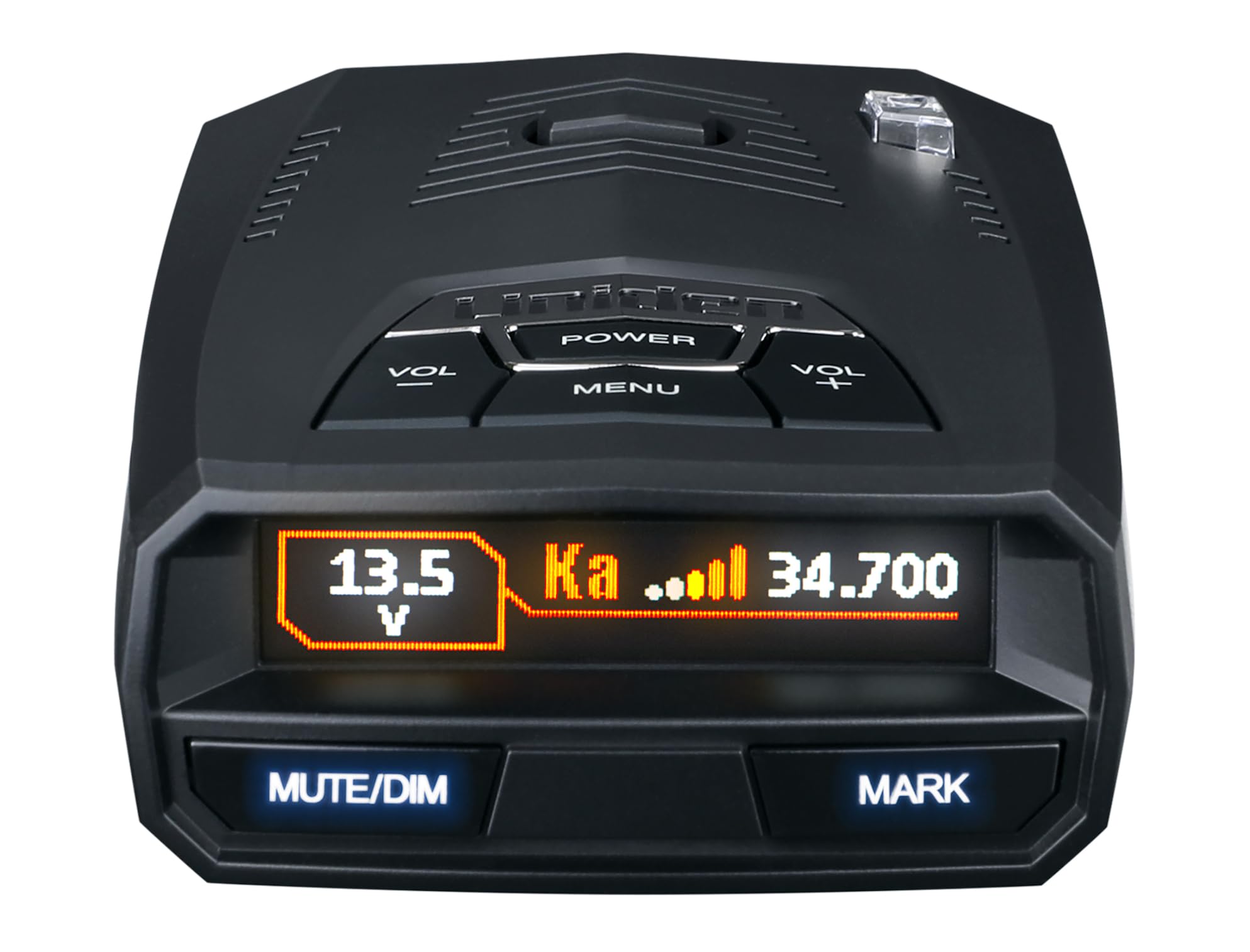
7. Uniden R4w
Flagship-class reach at a price that undercuts the big names.
The R4w delivers “extreme long-range record-shattering performance” via a Blackfin DSP, pulling alerts from over a mile ahead. Customers note it catches hidden traps on cross-country drives and paid for itself on a single LA-to-TN trip. The 4.5-inch body is compact, yet the range rivals detectors costing far more.
Built-in GPS with Auto Mute Memory is the crowd favorite — it remembers and automatically silences false alerts like retail door alarms along your routes, so you never hear the same nuisance twice. Voice alerts are programmable, and the multi-color OLED display shows speed, direction, and signal strength in bright daylight. Wi-Fi and Bluetooth connect to the R/TACH app for updates and customization.
The honest caveat: it needs a proprietary USB-C adapter to save 12V port space, and a high-powered 12V adapter is required if you’re running multiple devices at startup. One owner calls it “flagship performance” — a hard value to beat for budget-conscious long-range hunters.
Value hunter: grab the R4w if you want near-flagship range without the flagship bill.
Check your power: multi-device setups need a beefy 12V adapter to avoid startup hiccups.
8. Valentine One V1 Gen 2

The arrow-toting icon that tells you exactly where the threat sits.
The V1 Gen 2 is famous for one thing: directional arrows. A rear radar antenna picks up threats from behind, and the LCD display shows whether the signal is ahead, beside, or behind you. One owner loves knowing “signal strength and direction of radar” — priceless when a trooper creeps up from behind. It detects X, K, Ka, Super Wideband Ka, Ku, and 360° laser.
Range is “shockingly good,” detecting always-on radar from 1-2 miles away. The unit is silent around town, so when it does alert, drivers know it means business. An 80-in-a-65 anecdote sums it up: alert, slow down, and the patrolman passes harmlessly. Reliability is the top praise, with multiple owners saying it’s saved them from tickets.
The catch is the price — it’s the second most expensive unit here — and the JBV1 app (an advanced Android app) has a steep learning curve for those who want its full power. One owner notes it missed instant-on and laser that a previous detector caught. For directional awareness and build quality, it remains a legend.
Know the direction: if knowing whether the cop is ahead or behind matters to you, no other unit does arrows this well.
Premium price tag: you pay a serious premium, and the advanced app setup isn’t plug-and-play.
9. Uniden R8w
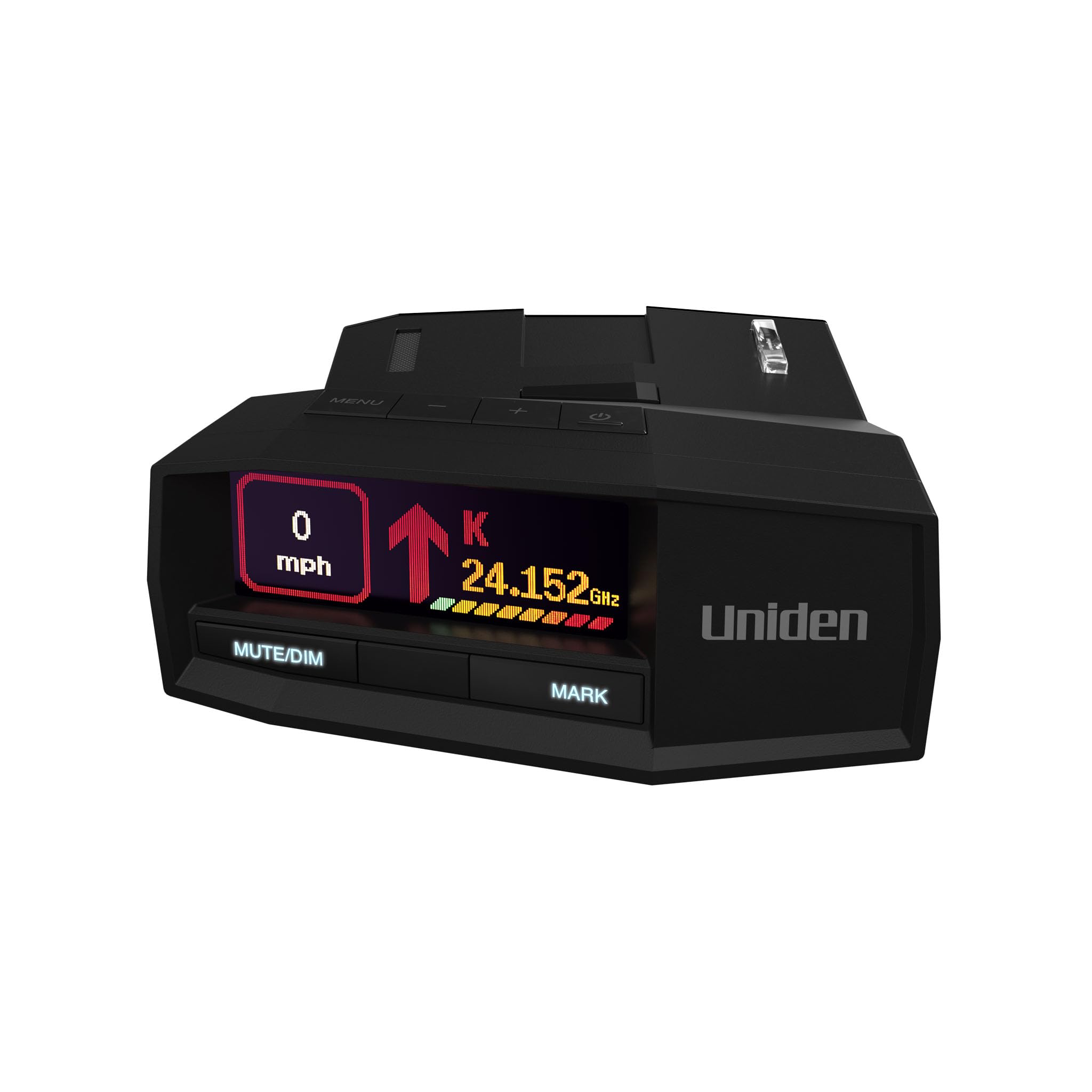
The dual-antenna flagship that sweeps all four directions at once.
The R8w is Uniden’s best portable windshield-mount detector, with dual antennas giving full 360° directional awareness. Dual Blackfin DSPs process signals with speed and accuracy, and voice alerts tell you the threat’s direction, band type, and signal strength. For maximum coverage, nothing here matches its four-direction sweep.
It detects Gatso 3/4 radar — a speed camera system common in Europe — plus standard bands, and the pre-loaded red-light and speed camera database updates free via Wi-Fi. Bluetooth and the R/TACH app add camera alerts and settings control. The auto-mute memory silences repeat false alerts on familiar routes. Owners call it “better than the regular R8” thanks to the Wi-Fi making updates much easier.
The honest trade-offs: a weak mounting clip, a plastic body that “feels cheap,” and a chatty default behavior if left unadjusted. One unit arrived dead on arrival, which stings at this price. But for extreme long-range, directional arrows, and feature depth, it’s the ultimate coverage machine for those who want everything.
The 360° Arsenal
- Dual antennas detect threats from all four directions
- Catches Gatso 3/4 radar cameras
- Free Wi-Fi database and firmware updates
Flagship Frustrations
- Weak mounting clip and plastic build quality
- Chatty until you tune the settings
Maximum-coverage buyer: pick the R8w if you want every radar type, every direction, and the latest camera database.
Quality-control gamble: the premium price comes with occasional dead-on-arrival units — buy from a flexible return policy.
Understanding the Specs
Radar Bands: X, K, Ka
These are the frequencies police radar guns use. X band is older and rarer, K band is common in speed signs and door sensors (hence false alerts), and Ka band is what most modern police radar uses — so Ka range and filtering matter most. Some detectors also scan Ku band, MRCD, MRCT, and Gatso, which are regional or emerging threats.
False Alert Filtering and GPS Lockouts
Blind-spot monitors and collision systems broadcast K-band signals that trigger naive detectors. Good filtering (IVT, DSP, FDSR) suppresses these. GPS auto-lockouts go further — the detector remembers a stationary false source’s location and silences it automatically on future passes, learning your route over time.
FAQ
Are radar detectors legal in all states?
What does a detector do against laser and instant-on radar?
Why does my detector go off for no reason?
Does a radar detector catch red-light and speed cameras?
How much range do I actually need?
Is a windshield mount or a hardwired detector better?
What is DSP in a radar detector?
Should I rely on my detector or use a phone app too?
Final Thoughts: The Verdict
For most people, the police radar detector winner is the Escort iXc because it pairs genuine long-range detection with the quiet, app-connected driving experience that everyday commuters actually need. If you want directional arrows and don’t mind a premium ticket, the Valentine One V1 Gen 2 tells you exactly where threats sit. And if you’re chasing maximum coverage of every radar type, including Gatso cameras, the Uniden R8w is the ultimate four-directional flagship to reach for.
How We Picked
We do not accept paid placement. Every pick is matched to a real buyer and a real use-case; we do not hands-on test units.
Sources & Methodology
Specifications: manufacturer listings and product documentation. Review insights: verified customer reviews, as of July 2026. Pricing: not shown on this page (it changes often); check the current price via the retailer link.
As an Amazon Associate, Trending Car earns from qualifying purchases. This does not affect which products we feature.