
Our readers keep the lights on and my garage snacks stocked. As an Amazon Associate, I earn from qualifying purchases.
Specs are compiled from manufacturer listings and verified buyer reviews and can change over time — please confirm the key details on the product page before buying.
The best car video camera is the one that actually captures the license plate when it matters — at dusk, in rain, or in the sudden glare of headlights. This guide breaks down seven front-and-rear models, focusing on real recording clarity, night vision, and how easy they are to live with every day.
I’m Min Islam — the founder and writer behind Trending Car. This guide is built by comparing the manufacturers’ published specifications and the patterns across verified customer reviews, so you get each pick’s real strengths and trade-offs instead of marketing spin.
You never know when you’ll need proof of what happened on the road, and a car video camera gives you that evidence the moment you need it—whether you drive for work or just want confidence.
Our Picks at a Glance
How To Choose The Best Car Video Camera
When you pick a dash cam, focus on three things: night clarity, coverage area, and how easy it is to pull the footage off. A blurry night feed or clunky controls render a dash cam useless in an accident.
Clarity is king, especially after dark
Unreadable night footage is the top complaint among dash cam owners. Look for a large aperture — a measurement like F1.8 or F1.6, where a lower number means the lens opens wider and pulls in more light. Paired with night vision and WDR (Wide Dynamic Range, which balances bright and dark areas), this is what makes plates readable in low light.
Coverage: front only, or a full 360°
Today’s best dual-camera systems record the road ahead and behind you simultaneously. Triple-channel models add an interior camera, which is particularly useful for rideshare drivers. The field of view — measured in degrees, like 170° — tells you how wide the lens sees, but a wider angle can make far-away plates look smaller.
Quick Comparison
| Model | Best For | Front Resolution | Field of View | Included Card | Amazon |
|---|---|---|---|---|---|
| TERUNSOUl 4K★ Best Overall | Full 3-channel coverage | 4K UHD | 170° Front / 165° Rear & Cabin | 128GB | Amazon |
| Yonvim 2.5KBudget Champion | Budget dual-camera value | 2.5K | 160° | 64GB | Amazon |
| WOOLAACOO C5 | Compact screen-free 4K | 4K + 1080P | 170° | 64GB | Amazon |
| FAIMEE 4K | Wide 6-lane coverage | 4K UHD + 2K Rear | 170° | 64GB | Amazon |
| 70mai T800E | Rideshare 3-channel 4K | 4K + 1080P + 1080P | Ultra-wide | 64GB | Amazon |
| VIOFO A119M Pro | Compact single-lens clarity | 4K 30FPS | 130° | Not Included | Amazon |
| ROVE R2-4K PRO | Premium dual STARVIS sensors | 4K + 2K Rear | 150° Front / 140° Rear | 128GB | Amazon |
In‑Depth Reviews
1. TERUNSOUl 4K Dash Cam Front and Rear
Our pick — over 4.5★ from 450+ verified ratings; the strongest balance of quality and price.
The full-picture pick: front, rear, and cabin covered at once with a wide 170° view.
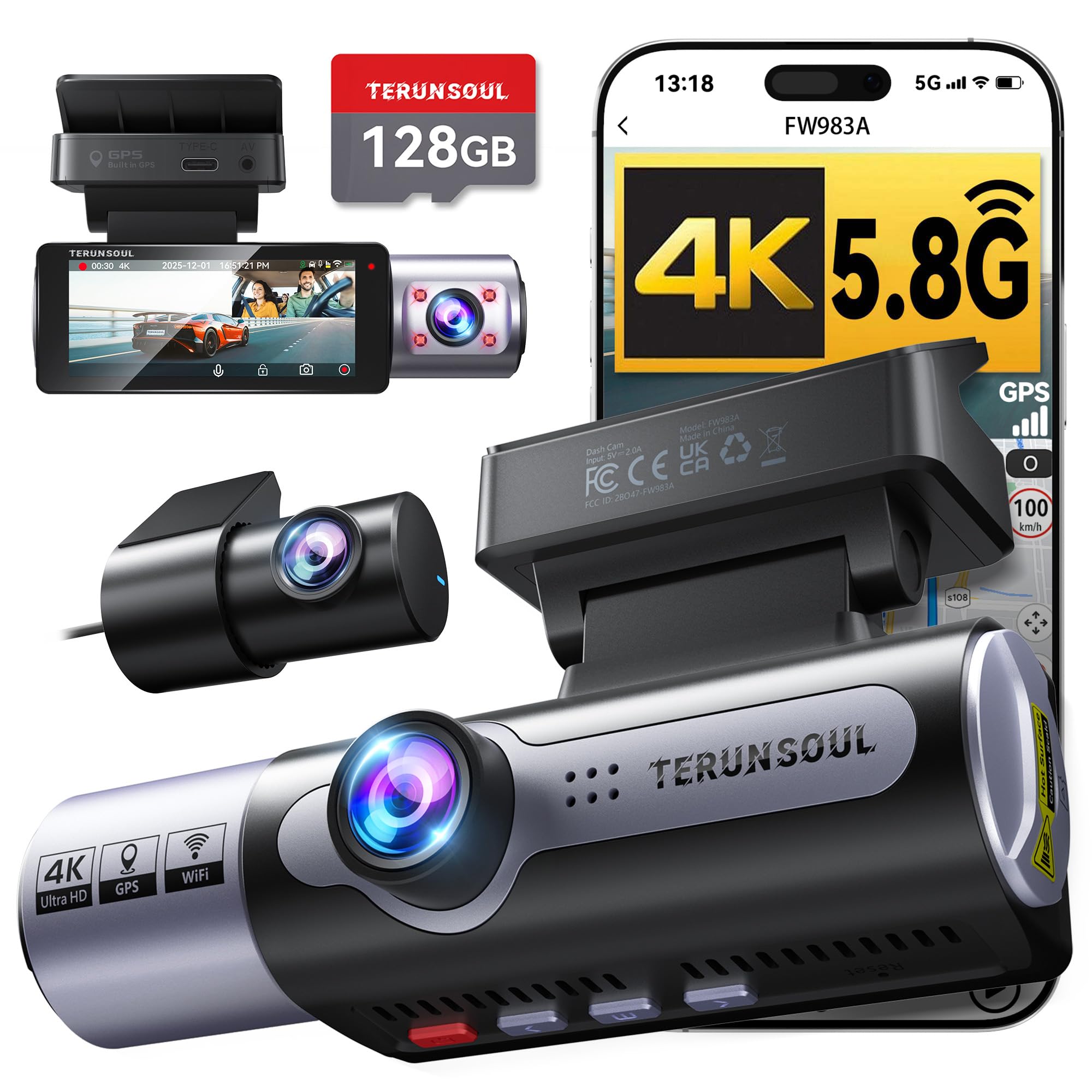
This is the rare dash cam that watches inside your car, not just the road. The front records in UHD 4K, while the rear and cabin cameras each capture 1080P — so rideshare drivers and families get near-360° coverage in one unit. A 3.16″ IPS screen (a sharp, wide-view display) sits on the unit for live viewing.
It comes ready to record with a pre-installed 128GB memory card, and the collision sensor locks footage if it detects a severe impact. Loop recording overwrites the oldest clips when storage fills, so you never have to manage files manually. Built-in GPS embeds your route, speed, and location into the video — useful evidence if you ever need it.
The front lens reaches a 170° ultra-wide angle, while the rear and cabin both see 165°, and the starlight-grade five-layer lens with an F1.6 aperture is built for low light. The 5.8GHz dual-band Wi-Fi connects to the TERUNSOUl app for quick downloads. Any claims buyers make are echoed in the reviews, which routinely praise sharp day and night footage and how fast the whole thing is to set up.
Why it wins the top spot
- 3-channel coverage captures front, rear, and cabin simultaneously
- Pre-installed 128GB card means no extra purchase
- Built-in GPS attaches speed and route data to every clip
- Backed by an 18-month full warranty
What to weigh first
- Parking mode requires a separate hardwire kit you buy yourself
- The 250g body is a touch more substantial than slimmer rivals
Reach for this if: you want one system that watches every angle of the car, including the cabin.
Keep in mind: the included card covers you from the start, but heavy 3-channel recording fills storage faster than a single lens.
2. Yonvim Dash Cam 2.5K Front Rear
Budget-friendly proof that a lower price does not have to mean blurry night video.
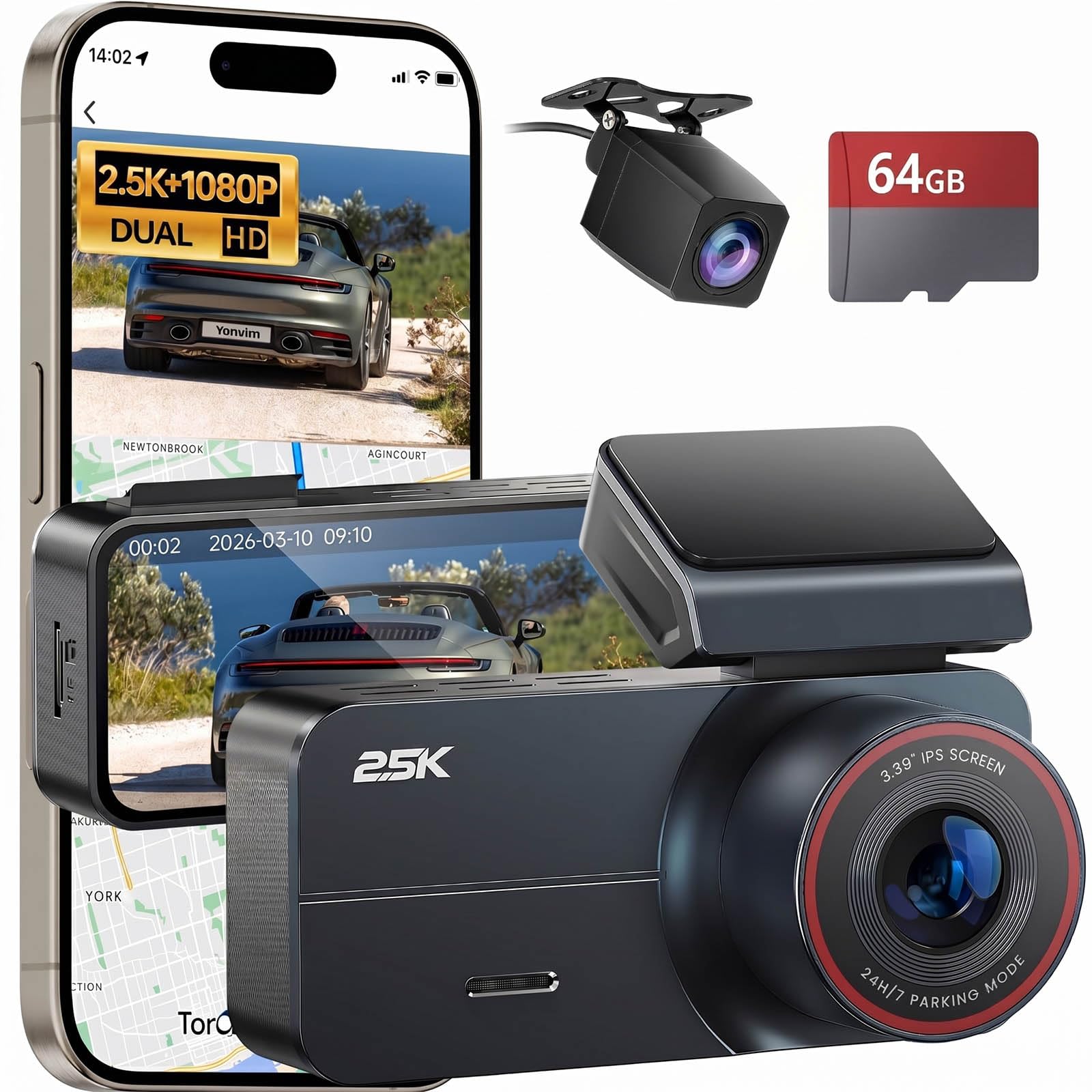
This dual-camera set proves a modest budget still gets you sharp footage. The front camera records 2.5K, and the package includes a rear camera plus a pre-installed 64GB microSD card. You will be up and recording in about 30 minutes thanks to the adhesive mount — no wiring wizardry required.
Night vision is where this one quietly impresses. The F1.8 aperture pulls in more light than a standard f2.0 lens, and its 8-layer glass lens cuts glare from headlights and streetlights, so plates stay readable at dawn and dusk. The 3.39-inch IPS screen makes live viewing and menu changes simple.
The compact head unit measures just 0.78″D x 3.62″W, so it sits unobtrusively on the windshield. Easy-to-use is what owners praise most, edging out overall quality as the most-cited upside. The recurring note is the adhesive mount: one owner shared that after three months the camera “occasionally falls, hangs on cord; still functional,” so treat the stick-on mount gently. Changing the card is simple, and loop recording handles file management for you.
Honest value read: the 2.5K front and 160° angle deliver well above what the price suggests. The trade-off is the mounting tape, which a few owners found unreliable over time — a fresh stick-on pad is an easy fix.
Best for: anyone who wants dependable dual-camera coverage without spending for extra channels they do not need.
Think twice if: you plan to leave it in a hot climate — the maker suggests upgrading to a high-endurance card within the first month for best long-term performance above 90°F.
3. WOOLAACOO C5 Dash Cam Front and Rear
A screen-free 4K front camera that hides behind the mirror and stays out of sight.
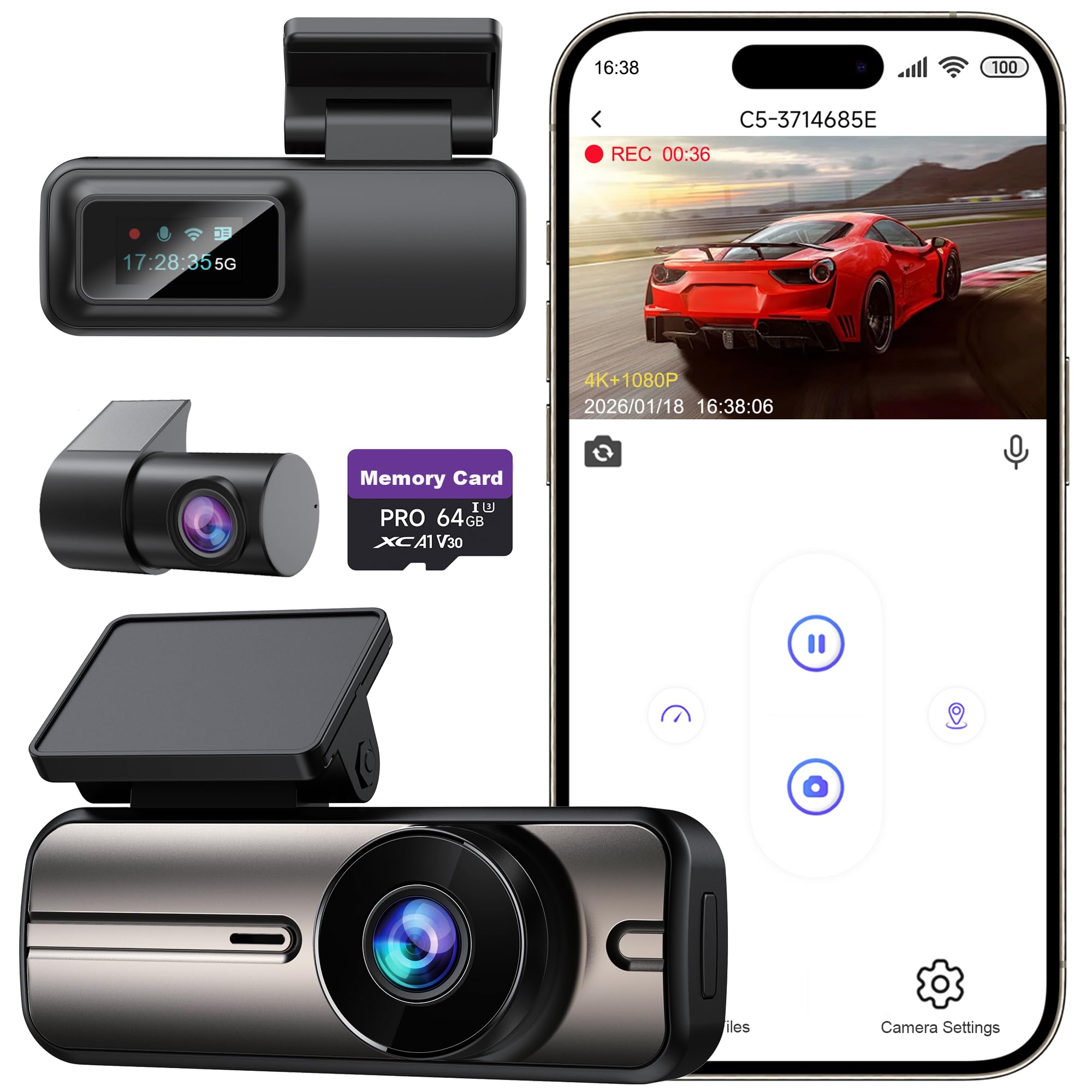
If you do not want a screen cluttering your windshield, this is the design for you. The front camera records 4K ultra-high-definition video, the rear captures 1080P, and the whole unit weighs just 65g — light enough that the included adhesive mount holds it securely without impeding your view. The compact body measures 0.78″D x 3.35″W, so it tucks away discreetly.
An F1.8 large aperture powers the night vision, which the maker says captures clear details even in darkness or rain. A built-in 64GB SD card is included and ready for immediate use, and the extra USB port lets you charge a phone while recording — a small but genuinely handy touch on long trips.
The 5GHz Wi-Fi connects to a dedicated iOS and Android app for viewing and sharing clips. What sets this apart from the pack is the video transfer speed: faster than older Wi-Fi standards, so pulling a clip is less of a wait. The one thing to know is that the app requires a membership for viewing your videos and timeline — owners flagged this as disappointing after purchase, so factor that into your decision.
What wins people over: the sharp 4K video and quick Wi-Fi transfer, plus the included 64GB card that saves you an extra purchase. The honest catch: you need an app membership for basic playback.
Pick this one for: a clean, screen-free install that still records true 4K up front. skip it if you want free, unlimited app access to your video library.
4. FAIMEE 4K Dash Cam Front and Rear
4K definition up front, 2K in the rear, and a 170° lens that sees across six lanes.
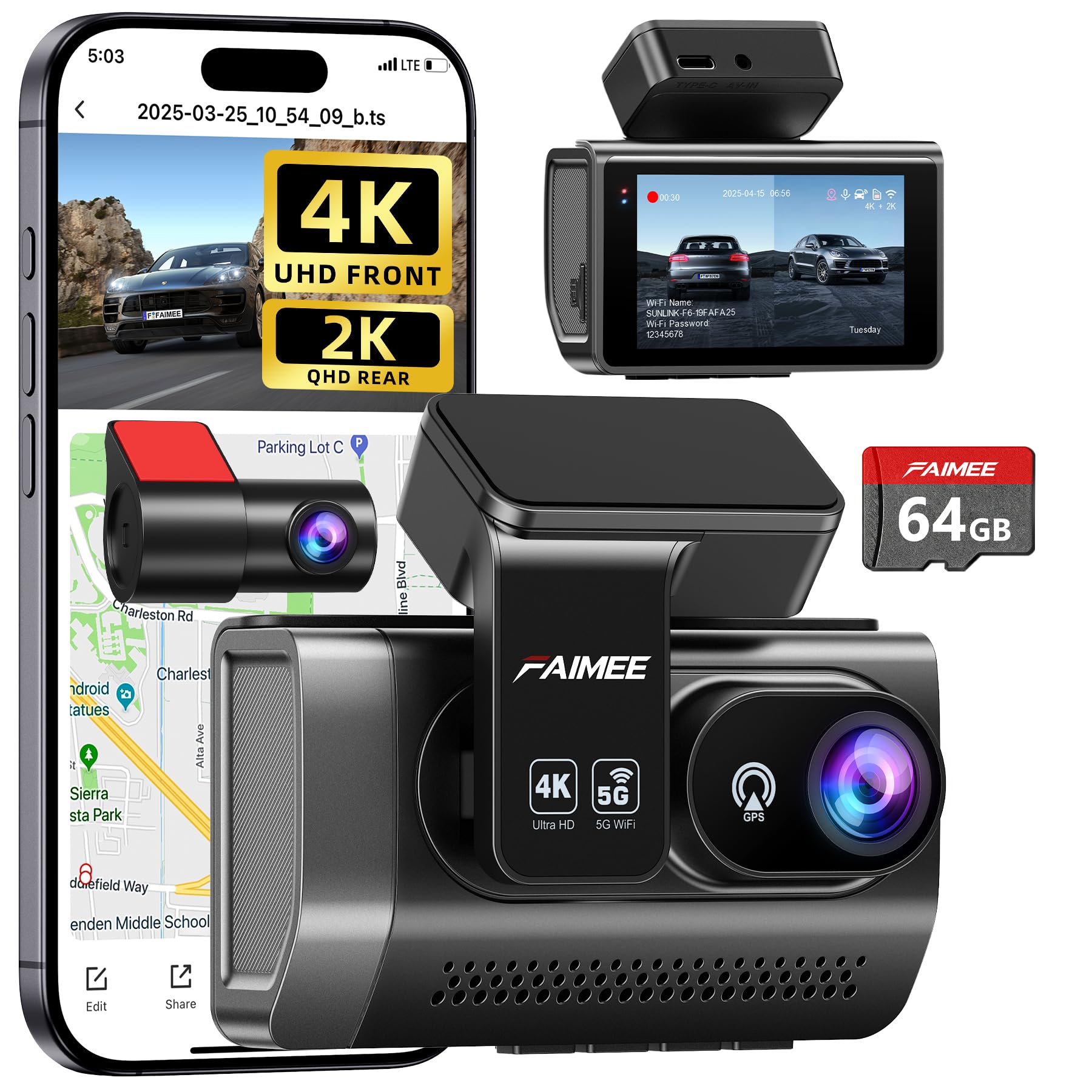
The headline here is the view. Both lenses open to a 170° ultra-wide angle that the maker says spans up to six lanes of traffic, with the front recording 4K UHD (3840×2160P) and the rear at 2K (2304x1296P). An F1.8 ultra-large aperture and enhanced WDR keep footage balanced in low light or high-contrast conditions, so you are not squinting at a washed-out frame.
You get a 64GB high-endurance memory card right in the box, and you can expand up to 256GB if you need more space. If the G-sensor (a small motion sensor that detects a bump) feels a sudden collision, it locks the current video so the evidence stays safe; loop recording then overwrites the oldest footage when the card fills up. The compact 3-inch IPS screen (a type of display with wide viewing angles) fits discreetly behind your rearview mirror, so it won’t block your view.
Build quality and overall quality are what owners praise most, with that vote edging out ease of installation as the most-cited strength. The dual-band 5.8GHz/2.4GHz Wi-Fi connects to the FAIMEE app for live view and instant downloads, and the camera includes built-in GPS that logs real-time speed and route history. An 18-month warranty backs the whole package.
Strengths to lean on: the 4K+2K recording and the wide 170° coverage are the standout reasons people choose it. It is also sold as an ideal Father’s Day gift — a nice touch if you are buying for someone else.
Choose this for: highway drivers who want the widest possible view of surrounding traffic. The limitation is parking mode, which needs a hardwiring kit you purchase separately.
5. 70mai T800E 4K Dash Cam

The 3-channel setup built for Uber and Lyft drivers who need to capture every fare.
This 3-channel camera watches the road ahead in 4K, plus the interior and rear in 1080P, with ultra-wide lenses and an F1.55 aperture. The interior camera has switchable infrared recording — turn on IR for clearer night footage inside the cabin, or turn it off when you prefer privacy. It is the pick for rideshare, family, or semi-truck drivers seeking total protection.
Built-in 5-mode GPS tracks location, speed, and route, while Wi-Fi 6 transfers files at up to 10 MB/s through the 70mai App. Hands-free voice control lets you take photos, start recording, or lock important footage without taking your eyes off the road. A 64GB SD card ships in the box, and the camera supports cards up to 512GB.
Owners consistently praise the clear 4K front footage and excellent night vision, and overall quality is the most-cited positive, just ahead of how easy the setup is. The super capacitor keeps performance stable in extreme temperatures from 14°F to 140°F — no lithium battery to worry about in a hot car. The honest caveat: connectivity draws mixed feedback, with some owners noting the app can drop the connection, so the hardwire kit is a smart add for parking mode.
Built for the daily grind
- 4K front plus 1080P interior and rear in one unit
- Switchable infrared for clear cabin footage at night
- Voice control keeps your hands on the wheel
- Super capacitor handles 14°F to 140°F extremes
The fair warning
- App connectivity gets mixed feedback from owners
- All three channels fill the 64GB card in under half a day
Grab this if: you drive passengers professionally and want a record of every trip, inside and out. Look elsewhere if a rock-solid phone connection is your top priority.
6. VIOFO A119M Pro 4K HDR Mini Dash Cam
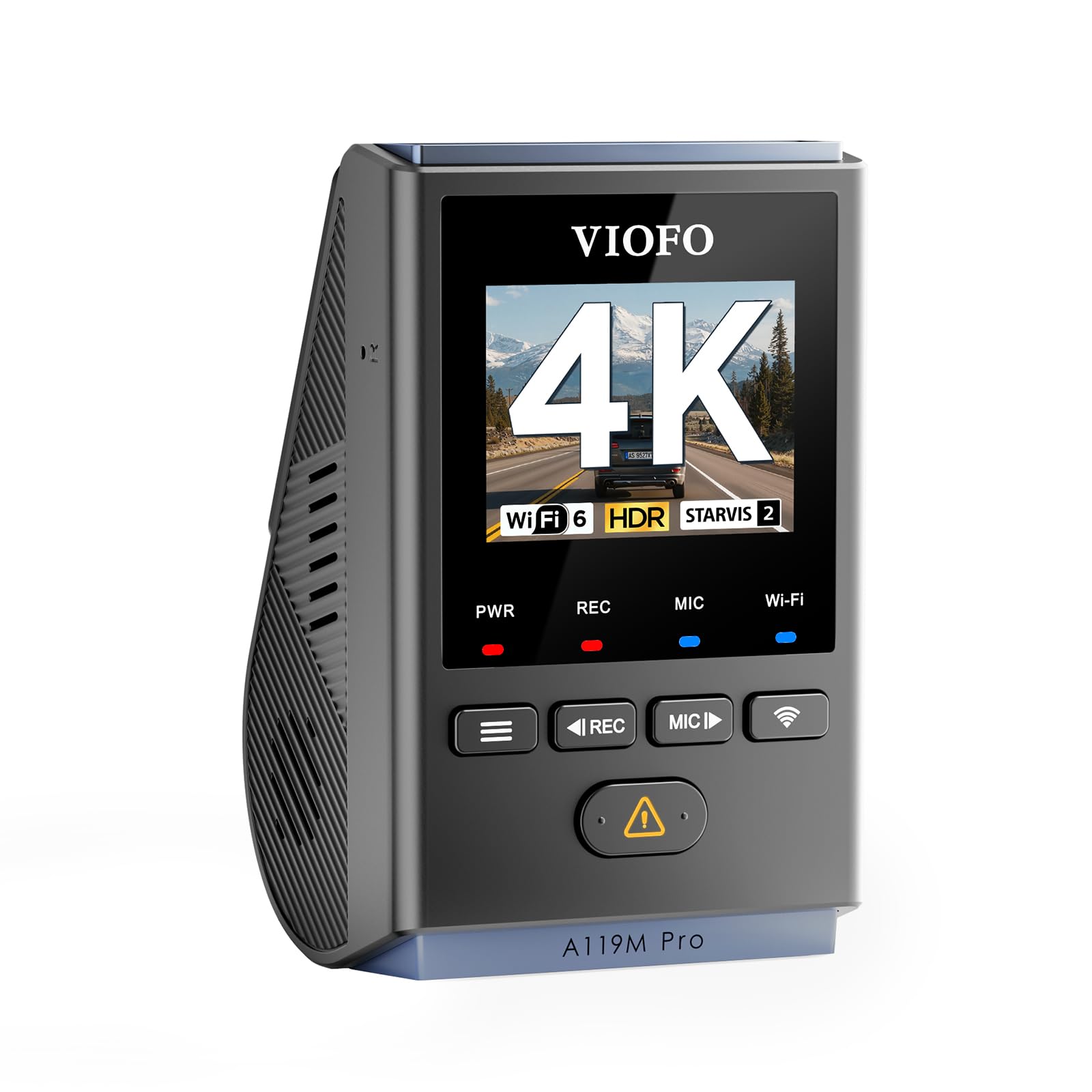
A single-lens specialist with a STARVIS 2 sensor that outshines far pricier setups.
If you want the sharpest possible front view without a second camera, this mini dash cam is a legitimate contender. It records 4K at 30FPS using a STARVIS 2 IMX678 sensor — a Sony chip built for low-light sensitivity — so license plates and road signs stay clear at speed or after dark. Its compact, low-profile design mounts discreetly behind the rearview mirror.
Night Vision 2.0 with HDR balances the brightest and darkest parts of the frame, maintaining natural color in tunnels, rain, or night driving. It ships with a CPL (Circular Polarizing Lens) filter that reduces windshield glare and headlight reflections. Wi-Fi 6 enables ultra-fast file transfers up to 30 MB/s to the VIOFO App, and the Quad-Mode GPS (GPS, BeiDou, Galileo, GLONASS) stamps precise location and speed data on every trip.
Buffered parking mode is a standout: it records 15 seconds before and 30 seconds after an event, so you catch the moments leading up to a bump. The supercapacitor handles extreme temperatures from 5°F to 149°F. Two things to know before buying: it is front-only (no rear camera), and it does not include a microSD card — the maker recommends its industrial-grade cards, as third-party cards can fail in heat. Owners call the video quality its top strength, with the compact size a close second.
The standout spec: the STARVIS 2 sensor and buffered parking mode put this ahead of most single-lens models. The catch is that you must budget for a card, and reliability draws mixed reviews for some units.
Go with this for: a tiny, high-clarity front-only camera with pro-grade night vision. pass on it if you need rear coverage or want a camera ready to go with no extras to buy.
7. ROVE R2-4K Dual PRO Dash Cam
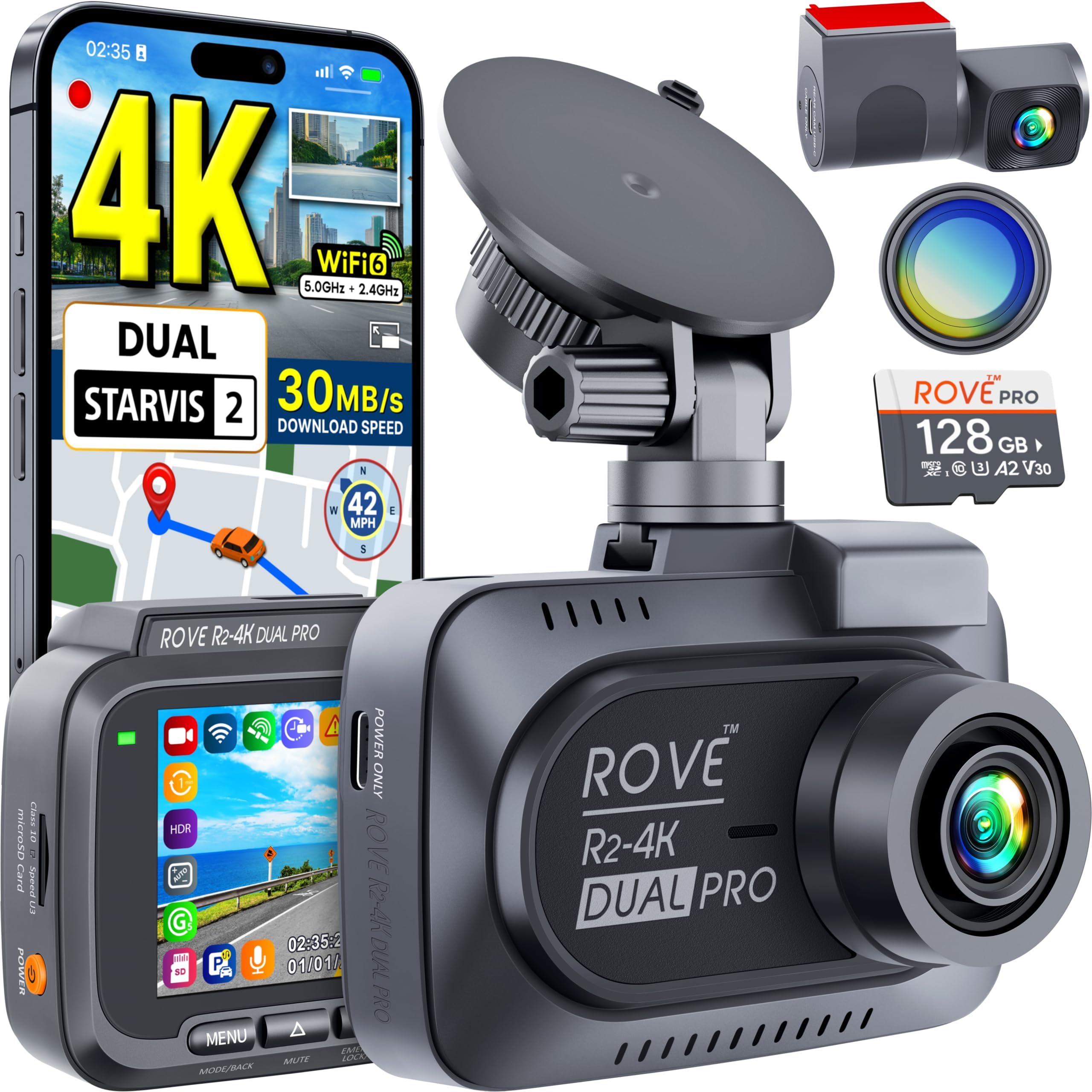
Dual STARVIS 2 sensors deliver true 4K front and 2K rear clarity that holds up at night.
This is the premium option that spares no expense on the parts that matter. It pairs Sony’s STARVIS 2 IMX678 sensor (8MP) up front with the IMX675 (5MP) in the rear, recording 4K at 30fps up front and 2K at 30fps behind. With an F1.7 front and F1.55 rear aperture plus a 150° front and 140° rear angle, footage stays sharp in tunnels, rain, or sudden glare.
The box is genuinely generous: a free 128GB ROVE PRO microSD card, a CPL filter to cut windshield glare, a suction mount plus a spare 3M sticky mount, an installation tool, and both front and rear electrostatic films. It even supports cards up to 1TB for long, uninterrupted recording. Dual-band Wi-Fi 6 transfers clips at up to 30 MB/s through the ROVE app.
Quad-Mode GPS — covering GPS, BeiDou, Galileo, and GLONASS — logs your precise route, speed, and location, and the free ROVE GPS Player replays trips with a full overlay. The 24-hour parking mode offers three options: time-lapse, motion detection, and collision detection, each recording a full 1-minute event into a locked folder with a voice alert when you return. Owners rank both overall quality and video quality at the top, with installation ease close behind, and the generous cable length gets frequent praise.
What the premium buys you
- Dual STARVIS 2 sensors for front and rear clarity
- 128GB card and CPL filter included in the box
- Quad-Mode GPS with free GPS player software
- Supports up to 1TB microSD cards
Before you commit
- Rear camera cable runs short for larger SUVs
- Parking mode needs a hardwire kit sold separately
Worth it for: drivers who want the clearest possible night footage on both ends of the car and do not mind paying for the best sensors. Just check your SUV’s size against that rear cable.
Understanding the Specs
Resolution and Sensor
Resolution — like 4K, 2.5K, or 1080P — tells you how many pixels make up each frame, and higher numbers mean sharper detail. But the sensor matters just as much. A STARVIS 2 sensor, for example, is a Sony chip designed for low-light sensitivity, which is why two cameras with the same 4K resolution can look very different at night. Higher resolution numbers don’t guarantee clearer night footage.
Aperture and Night Vision
The aperture — written as F1.6, F1.8, or F2.0 — is how wide the lens opens to let in light. A lower number like F1.6 pulls in more light than F2.0, which is the single biggest factor in readable night video. Night vision and WDR (Wide Dynamic Range) build on that by balancing the brightest headlights and darkest shadows into one clear frame, so a plate does not get blown out by glare.
Parking Mode and Hardwire Kits
Parking mode lets the camera keep watch while your car is off, but almost every dash cam needs a separate hardwire kit connected to your fuse box to run 24/7. Without it, the camera turns off when the engine does. Some kits record continuously, others only on motion or impact — look for buffered parking that records the moments before an event is triggered.
Wi-Fi and Transfers
Built-in Wi-Fi lets you pull clips to your phone through a companion app instead of removing the memory card. Faster standards like Wi-Fi 6 or dual-band 5GHz transfer big 4K files in seconds rather than minutes. Before buying, check whether viewing your videos requires an app membership — a few models gate basic playback behind a paid plan.
FAQ
Do I need a hardwire kit for parking mode?
Will a dash cam drain my car battery overnight?
What does a G-sensor do and do I need one?
How much memory card capacity do I need?
Is 4K worth it over 2.5K or 1080P?
What is a supercapacitor and why does it matter?
Can I use any microSD card in my dash cam?
What is the difference between front-only and 3-channel coverage?
Do dash cams record audio?
Will a dash cam obstruct my view while driving?
Final Thoughts: The Verdict
For most buyers, the car video camera winner is the TERUNSOUl 4K because triple-channel coverage with a pre-installed 128GB card covers every angle from the start. If you want the fastest wireless transfers and voice control, grab the 70mai T800E. And for the clearest night footage on both ends of the car, the ROVE R2-4K PRO with its dual STARVIS 2 sensors is the one to reach for.
How We Picked
We do not accept paid placement. Every pick is matched to a real buyer and a real use-case; we do not hands-on test units.
Sources & Methodology
Specifications: manufacturer listings and product documentation. Review insights: verified customer reviews, as of August 2026. Pricing: not shown on this page (it changes often); check the current price via the retailer link.
As an Amazon Associate, Trending Car earns from qualifying purchases. This does not affect which products we feature.