
Our readers keep the lights on and my garage snacks stocked. As an Amazon Associate, I earn from qualifying purchases.
Specs are compiled from manufacturer listings and verified buyer reviews and can change over time — please confirm the key details on the product page before buying.
An uninsulated garage laughs at most heaters. The walls are basically a sieve, and the cold air floods back in the second the fan stops. You need serious heat output — measured in BTUs for gas or watts for electric — and a plan for ventilation, not a tiny space heater from the hardware store aisle.
I’m Min Islam — the founder and writer behind Trending Car. This guide is built by comparing the manufacturers’ published specifications and the patterns across verified customer reviews, so you get each pick’s real strengths and trade-offs instead of marketing spin.
If your garage is uninsulated, you need raw power matched to square footage—here’s what actually works in the field for the best heater for uninsulated garage options.
Our Picks at a Glance

How To Choose The Best Heater for an Uninsulated Garage
The mistakes buyers make usually come from underestimating how much heat is actually lost through bare walls and a thin roof. A heater that works fine in a finished living room will struggle to make a dent in a freezing, uninsulated shop. Your first move is to calculate the space you need to heat and then pick a fuel type that matches your setup.
Match fuel type to your situation
Propane and natural gas units deliver intense heat fast — think 30,000 BTUs and up — which is what you need when there’s no insulation holding warmth in. They need ventilation to clear combustion gases, so you must run them with a door cracked or an exhaust vent open. Electric heaters are cleaner and easier to place, but they demand a serious 240V circuit to push out the wattage a big garage needs, and they warm up more slowly.
Understand the Burn: BTU and Watts
BTU (British Thermal Unit) measures how much heat a fuel-based unit produces, while watts measure the electrical input of a plug-in or hardwired unit. As a rough rule of thumb, you want about 30,000 BTUs for a 1,000-square-foot drafty space, and an electric heater will need around 5,000 watts to make a comparable impact. The larger the gap between your space and the heater’s rating, the longer you’ll wait for any real warmth.
Choose your heat delivery method
Forced-air heaters blow hot air across the room, which gets a big space warm quickly but comes with loud fan noise. Radiant heaters throw heat directly at whatever is in front of them — great for working near the unit, but the space beyond the beam stays cold. Convection heaters work like a central furnace, warming the air gently and evenly, but that gentle pace is a slower fit for a freezing garage.
Quick Comparison
| Model | Best For | Heat Output | Heating Coverage | Fuel Type | Amazon |
|---|---|---|---|---|---|
| DEWALT 68,000 BTU★ Best Overall | Best Overall | 68,000 BTU | 1,700 sq ft | Propane | Amazon |
| Comfort Zone 5,000WBest Value | Ceiling-Mount Value | 17,065 BTU | 1,000 sq ft | Electric | Amazon |
| Remington 60,000 BTUTop Performer | Portable Propane | 60,000 BTU | 1,500 sq ft | Propane | Amazon |
| VEVOR 5,000W | Remote & Timer | 17,064 BTU | 50 sq m | Electric | Amazon |
| InoKraft 5,000W | Smart Control | 5,000 watts | 750 sq ft | Electric | Amazon |
| DEWALT 45,000 BTU | Radiant, Quiet | 45,000 BTU | 1,125 sq ft | Propane | Amazon |
| Dyna-Glo 30,000 BTU | Vent-Free Wall Heat | 30,000 BTU | 1,000 sq ft | Propane/Gas | Amazon |
| Mr. Heater 170,000 BTU | Massive Spaces | 175,000 BTU | 4,250 sq ft | Propane | Amazon |
| Dyna-Glo 150,000 BTU | Oversized Garages | 150,000 BTU | 3,500 sq ft | Propane | Amazon |
| Mr. Heater 80,000 BTU | Hardwired Comfort | 80,000 BTU | 2,667 sq ft | Natural Gas | Amazon |
| Dyna-Glo 15,000W | Clean Electric Giant | 51,180 BTU | 1,000 sq ft | Electric | Amazon |
In-Depth Reviews
1. DEWALT 68,000 BTU Forced Air Propane Heater
Our pick — over 4.5★ from 250+ verified ratings; the strongest balance of quality and price.
The 68,000-BTU brute that goes anywhere a cold, uninsulated shop needs it, even without a wall outlet nearby.
This pick tackles drafty garages with 68,000 BTU of forced-air heat covering 1,700 square feet—about 11 times the reach of the 60,000-BTU portable Remington below. Buyers report it warmed a 2.5-stall garage from 30°F to 70°F in about an hour, and they praise its fuel economy.
You get dual power: run it on a DEWALT 20V battery (an 8Ah pack lasts most of a working day even in the teens) or plug into AC, so it’s truly cordless for barns and job sites without outlets. At 13.2 pounds, it’s the heavier of the two portable propane units here, but that weight lets you skip the extension cord.
Owners praise its consistent heat output and reliable cold-weather starts. Its other advantage is the noise profile: run it on low and it’s remarkably quiet with very little odor, though cranking it to high does get loud. There’s no thermostat, so you manage the temperature with the fuel setting, and it needs a 10-foot hose and regulator setup — both included — before first use.
Where It Shines
- Battery or AC power means true cordless use anywhere
- Heat output and quick warm-up are the most-praised traits
- Starts right up in cold weather with minimal odor on low
What To Know
- High setting gets noisy for close-quarters use
- No built-in thermostat to hold a set temperature
- Heavier than other portable propane options at 13.2 pounds
Best for: anyone who needs powerful, portable heat in a big uninsulated shop or barn with no convenient outlet nearby.
Think twice if: you want set-and-forget temperature control, since this one has no thermostat and takes a bit of dialing in.
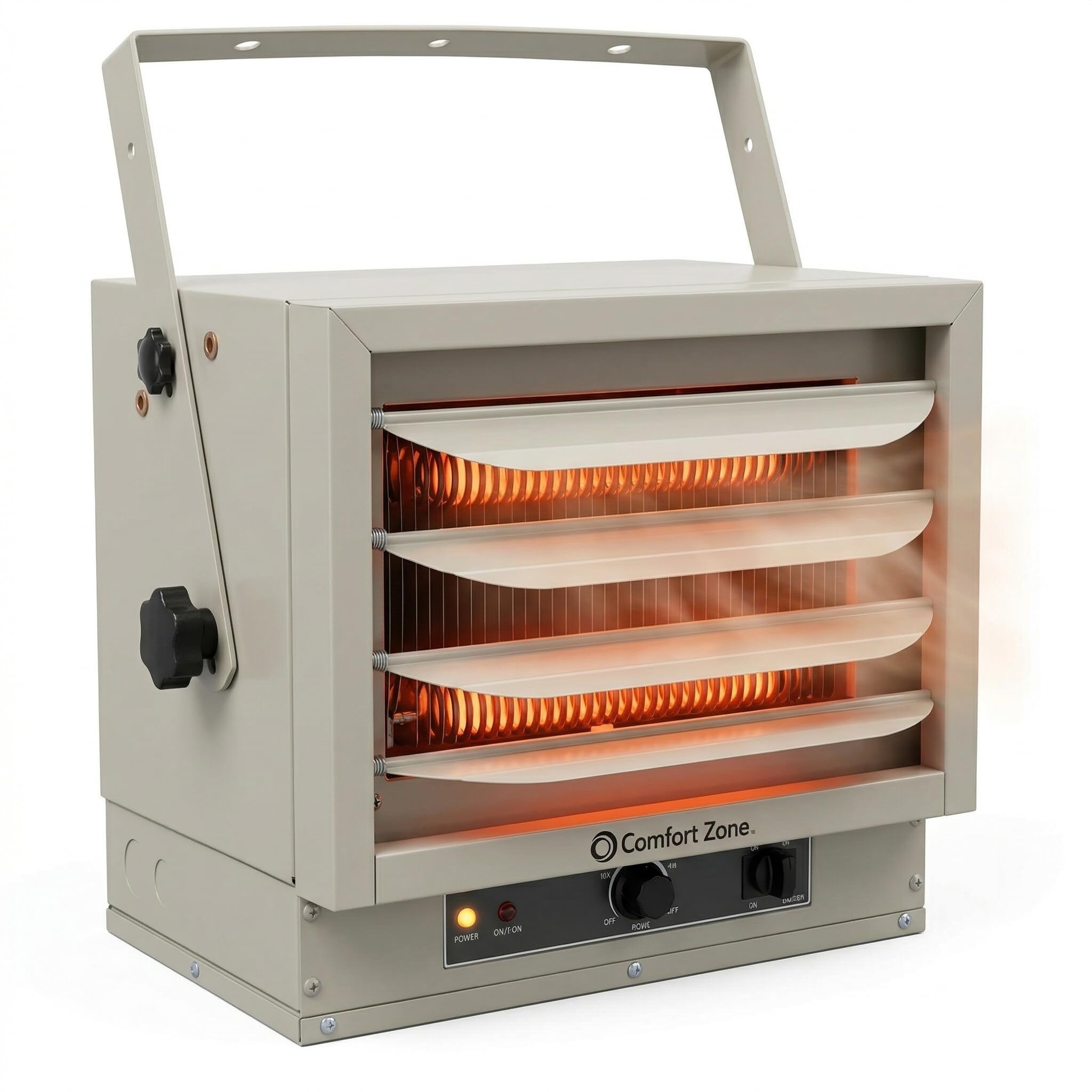
2. Comfort Zone 5,000W Ceiling Mount Garage Heater
A ceiling-mounted electric workhorse that frees your floor space and holds a drafty shed at a livable temperature all day.
If you want steady, safe, clean heat without the propane tank and ventilation dance, this hardwired electric unit is the smart play. It delivers 17,065 BTU of fan-forced warmth across 1,000 square feet, with three power settings — 3,000, 4,000, and 5,000 watts — so you dial in exactly how much heat you need. Owners mention it pushed a drafty 16×16-foot shed to 70°F even in freezing outside temps.
The ceiling-mount design is the real space-saver. It bolts overhead with heavy-gauge steel construction, keeping your valuable floor space clear for cars, tools, or workbenches. The dual-knob thermostat and adjustable mounting angle let you point the airflow right where you’re working, and it draws 20.83 amps on a 240V circuit — you’ll want a 30-amp breaker and 10-gauge wire, per owner advice.
Hundreds of owners praise its value and effective heating for small to medium spaces. The trade-offs are honest ones: the fan can be a little noisy for some, and quite a few buyers noted the fan assembly arrives needing a bit of reassembly, with loose nuts and washers to tighten before mounting. It’s not a hard fix, but it’s worth knowing before you start.
The High Points
- Heavy-gauge steel build holds up in cold, uninsulated spaces
- Three power levels plus a thermostat for flexible control
- Ceiling mount keeps all floor space clear
The Fine Print
- Needs professional 240V wiring on a 30A circuit
- Fan assembly can arrive loose and need tightening
- Noise splits opinions — some find it quiet, others not
Reach for this if: you have a 240V circuit and want clean, low-maintenance electric heat that stays out of your way.
Look elsewhere if: you expect plug-and-go install; this one demands hardwiring and a careful once-over of the fan before mounting.
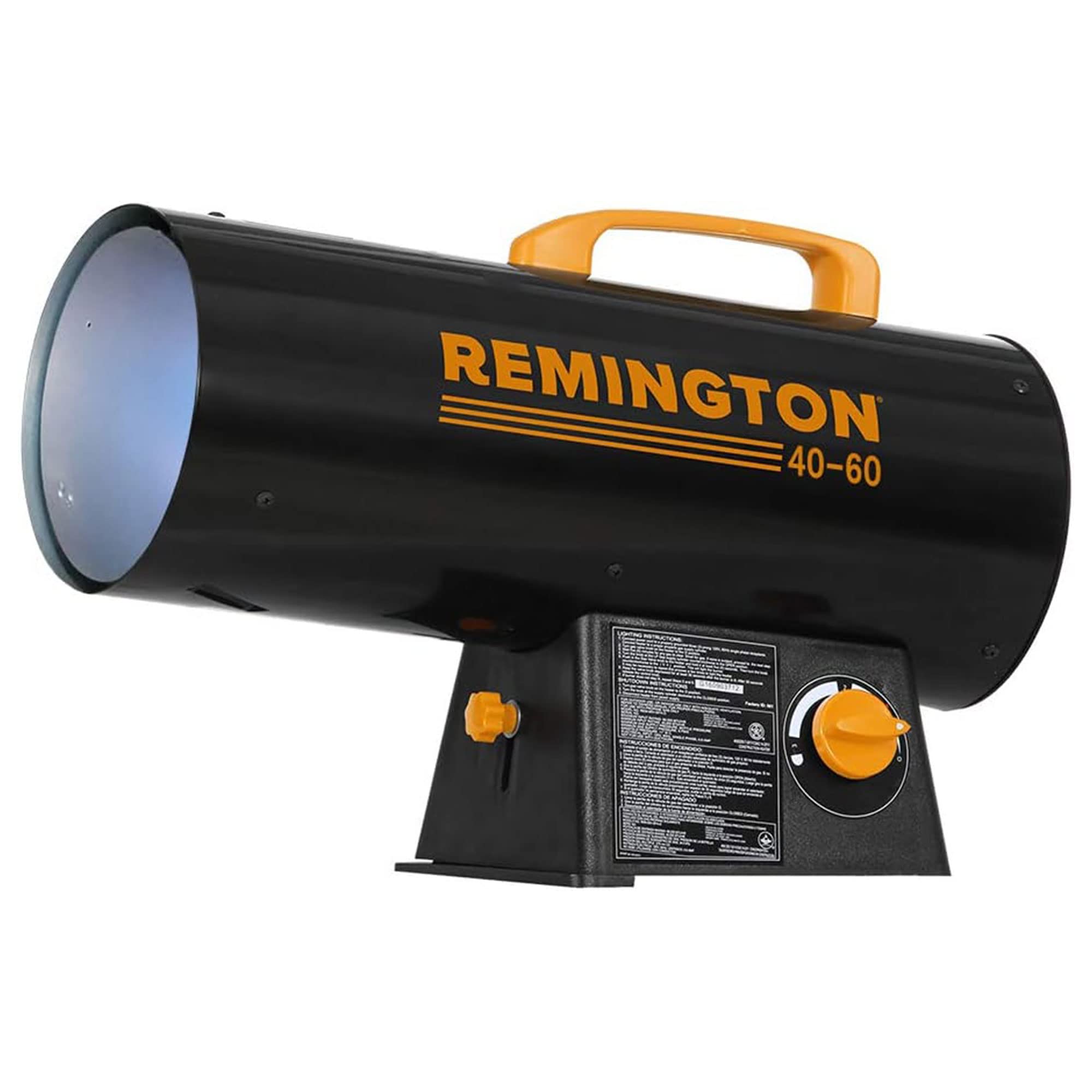
3. Remington 60,000 BTU Portable LP Heater
A featherweight 11-pound propane cannon that throws 60,000 BTU across 1,500 square feet of open shop space.
This is the portable propane option for anyone who carries their heat from the garage to the job site or the barn. At just 11 pounds, it’s 2.2 pounds lighter than the DEWALT forced-air unit above, and that portability is the whole point. The heavy-duty steel body and pedestal form factor are built for construction sites, and it runs on a standard 20-pound propane tank — not included.
Turn the knob and the electronic ignition fires up fast, with variable heat settings and an adjustable height so you can aim the warmth where you’re standing. The 60,000 BTU output warms up to 1,500 square feet, and owners note it can heat an insulated two-car garage in about 10 minutes with real force. The included 10-foot LP cylinder hose and regulator make hookup straightforward — just screw the gas hose on counter-clockwise.
Buyers praise its powerful output for emergency or garage use. The catch is the noise: this is a genuinely loud unit, with a sound level that a few owners found too much and one even returned. There’s also no fine-grained temperature control — the heat adjustments are fairly blunt. If you value quiet over raw output, note that before you buy.
The Appeal
- Light 11-pound build is easy to carry anywhere
- Quick electronic ignition and easy LP tank hookup
- Powerful forced-air heat for large open areas
The Trade-Offs
- Loud operation is the most common complaint
- Heat adjustments are coarse, not precise
- Propane tank is not included
Grab it if: you want a budget-friendly, portable propane blaster that you can haul around and fire up in minutes.
skip it if: noise bothers you — this one is built to roar, not whisper.
4. VEVOR 5,000W Digital Fan Forced Wall Mount Heater

The 5,000-watt electric wall mount with a remote, a 9-hour timer, and temperature control tight enough to hold within 2°F.
This is the electric heater for the buyer who wants modern convenience bolted to the wall. It pushes 17,064 BTU of fan-forced air across 50 square meters, and the digital thermostat holds your chosen temperature within a 2°F window — a level of precision most garage units can’t match. That steady heat is exactly what you want in a 1.5-car garage that’s not insulated, and owners confirm it does the job.
The remote control is the standout feature here. Adjust the heat or switch the fan without walking across a cold garage, and the 9-hour timer lets you set it to warm the space before you even step inside. Mount it on the wall or hang it from the ceiling, adjust the angle at install, and aim the louvers to spread heat evenly. It runs on the same 240V circuit and 20.83 amps as other big electrics, so plan for a 30-amp breaker.
Buyers praise its strong heat throw and quiet, air-conditioner-like operation. A couple of owners wished the controls were more intuitive, and one noted the default 3,000W setting near the target temp caused the fan to cycle constantly. For a drafty garage in a cold state like Wisconsin, the consensus is it’s plenty.
What Stands Out
- Tight 2°F thermostat precision holds steady warmth
- Remote and 9-hour timer add real convenience
- Quiet, strong fan with good heat throw
What To Expect
- Controls take a moment to learn, some say
- Requires professional 240V hardwired install
- Fan can cycle near the set temperature
Pick this for: precise, remote-controlled electric heat that hums along quietly in a mid-size uninsulated garage.
Choose the other one if: you want the simplest possible controls and don’t mind a louder fan.
5. InoKraft 5,000W Electric Garage Heater
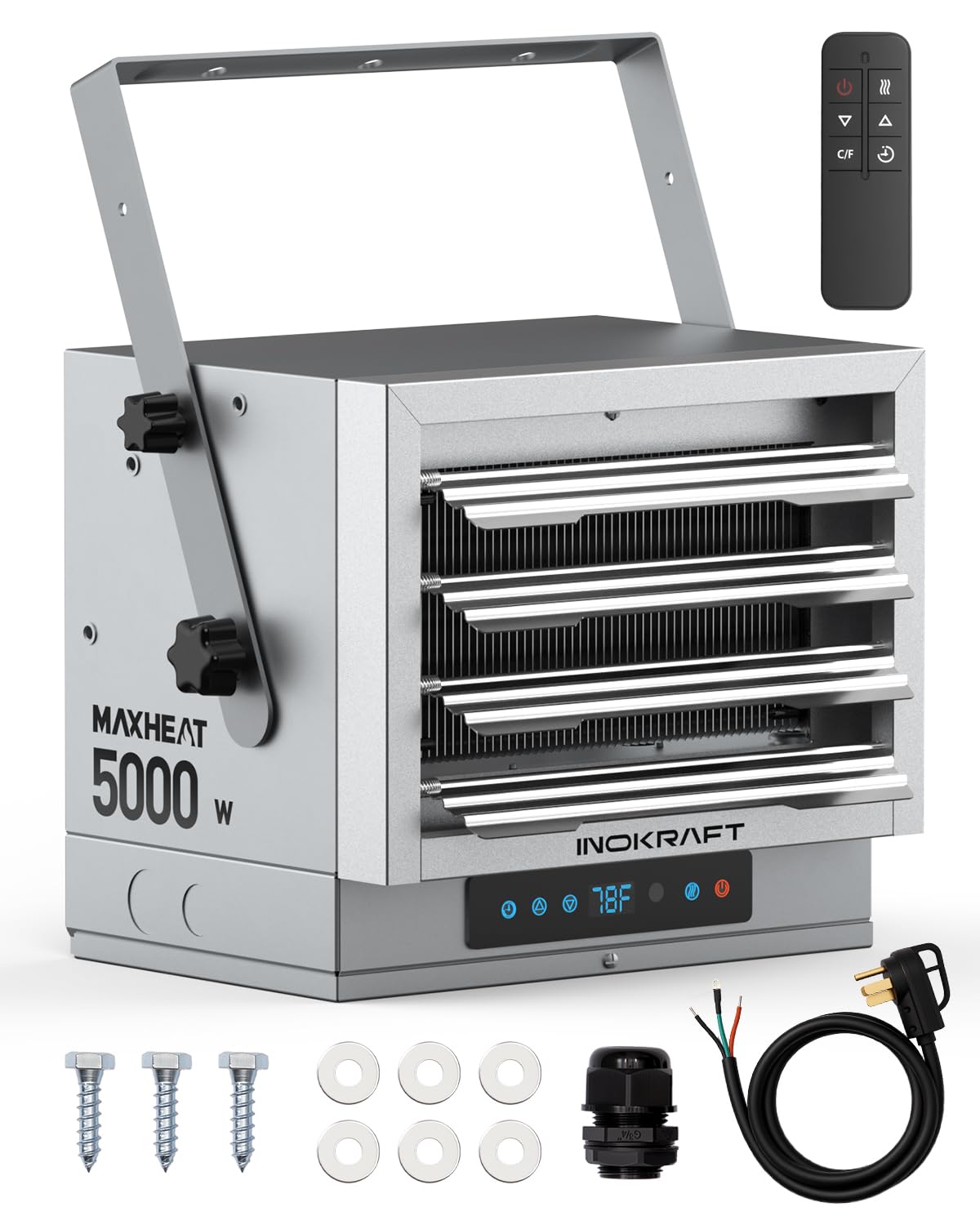
The wall-mounted 5,000-watt heater with a 40°F-99°F digital thermostat and an ECO mode that trims power when it can.
This is the electric option for the owner of a smaller detached garage who wants fine-grained temperature control without the noise of a propane blower. It puts out 5,000 watts of forced air over 750 square feet, and the built-in digital thermostat lets you set anything between 40°F and 99°F, with a 1-24 hour timer for scheduled warmth. Owners with a 400-plus-square-foot detached garage call it a perfect fit that heats flawlessly.
The ECO mode is the differentiator. It watches the ambient temperature and automatically adjusts heat output, even shutting off entirely when no heat is needed — a clever way to avoid wasting electricity holding a setpoint in a drafty space. It mounts to the wall or ceiling with five angle adjustments at install, and the louvers spread warmth evenly. Unlike many hardwired units, this one can plug into an existing NEMA 14-50R outlet, which is often the same receptacle an EV charger uses.
The build quality and even heat get consistent praise, and the installation is straightforward thanks to the plug-in design. The honest caveats: one owner found it louder than the older propane heater it replaced, and another received one unit with an error code — though the brand’s customer service quickly sent a replacement. The 3,000W vs 5,000W power step is there, but you’ll want the full 5,000W for a truly uninsulated space.
The Perks
- Digital thermostat from 40°F to 99°F for precise control
- ECO mode saves energy by adjusting output automatically
- Plugs into an existing NEMA 14-50R outlet
The Caveats
- Louder than some heaters, per one buyer
- Mixed luck with one unit arriving with an error code
- Coverage tops out at 750 sq ft
Best for: anyone with a smaller garage who wants set-and-forget temperature control and energy-saving smarts.
Think twice if: your space exceeds 750 square feet or you need whisper-quiet operation.
6. DEWALT 45,000 BTU Radiant Propane Heater
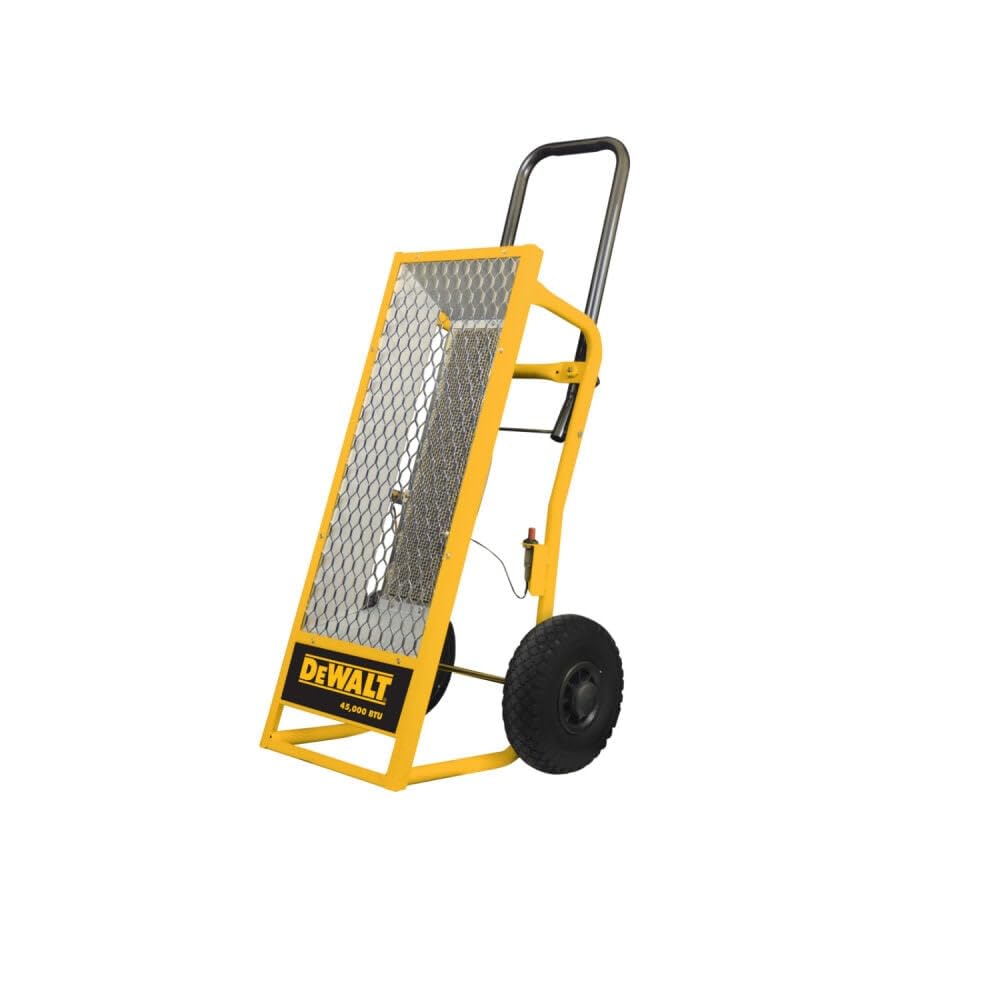
The radiant propane heat source that’s dramatically quieter than a torpedo blower and rolls right where you need it.
If fan noise drives you crazy, this is the heater that changed the game for owners coming from loud torpedo-style blowers. It uses radiant heat instead of forced air — the 45,000 BTU output warms objects and people directly, which makes it feel warmer faster even though the air itself takes longer to heat. Coverage runs 1,125 square feet, so it’s a solid middle-ground fit for a typical uninsulated garage or workshop.
The no-electricity design is a huge plus for emergency use. Piezo ignition (a push-button spark, no battery or outlet required) starts it instantly, and the heavy-duty cage and frame roll around on foam-filled flat-free tires with a fold-down transport handle. At 12.8 pounds and roughly 34 inches tall, it’s compact enough to move from the shop to the garage or even take RVing, which a long-time owner reports doing for four-plus years.
Heat output is what owners single out most, calling it a “tremendous heat” pump that keeps a garage just as warm as a 50,000 BTU torpedo without the roar. There’s no thermostat — it’s on or off — which fine for a workshop you’re actively in. The one thing to know: the first burn-off can smoke and smell as the factory paint and oil cure, so run it with heavy ventilation before regular use.
The Strengths
- Much quieter than forced-air torpedo heaters
- No electricity needed with push-button piezo ignition
- Rolls easily on flat-free tires with fold-down handle
The Facts
- First use produces smoke and odor as paint burns off
- No thermostat — just on or off
- Tank not included
Reach for this: for quiet, no-power radiant warmth that follows you around the shop, garage, or campsite.
Look elsewhere if: you want thermostat-controlled, set-and-forget heating for hours at a time.
7. Dyna-Glo 30,000 BTU Blue Flame Wall Heater

A vent-free wall unit running on propane or natural gas that heats like a central system and needs no electricity at all.
This is the permanent-wall solution for the garage or pole barn where you don’t want a portable blower taking up space. It uses blue flame convection technology — heating the air the same way a central heating system does — rather than blasting one zone with forced air. At 30,000 BTU it covers up to 1,000 square feet, and the thermostatic control knob automatically cycles the unit on and off to hold your target temperature.
Dual-fuel flexibility separates it: it runs on liquid propane or natural gas, so you use whichever supply you have. Vent-free and needing no electricity, it works as an emergency heater during outages. Customers note warming an insulated pole barn from 54°F to 68°F in about 30 minutes, and they love the matte black finish—”very good looking and working heater” is a common refrain.
Owners praise its quiet operation, effective heating, and easy installation. The 28.1-pound unit is a permanent mount, so installation takes some effort. The auto shut-off gets mixed feedback: most like it, but a few had trouble with the pilot light not lighting properly on some units. It’s a great shop heater, but the auto shut-off is worth testing thoroughly during setup.
The Wins
- Dual fuel — runs on either propane or natural gas
- Vent-free, no electricity, works in power outages
- Quiet convection heating like a central system
The Considerations
- Heavier permanent wall mount at 28.1 pounds
- Auto shut-off behavior can be finicky for some
- Convection warms more slowly than forced air
Best for: a semi-permanent, dual-fuel heating setup that won’t touch the floor and works during blackouts.
Think twice if: you need instant blast heat — this warms gently, not like a blowtorch.
8. Mr. Heater 170,000 BTU Forced Air Propane Heater
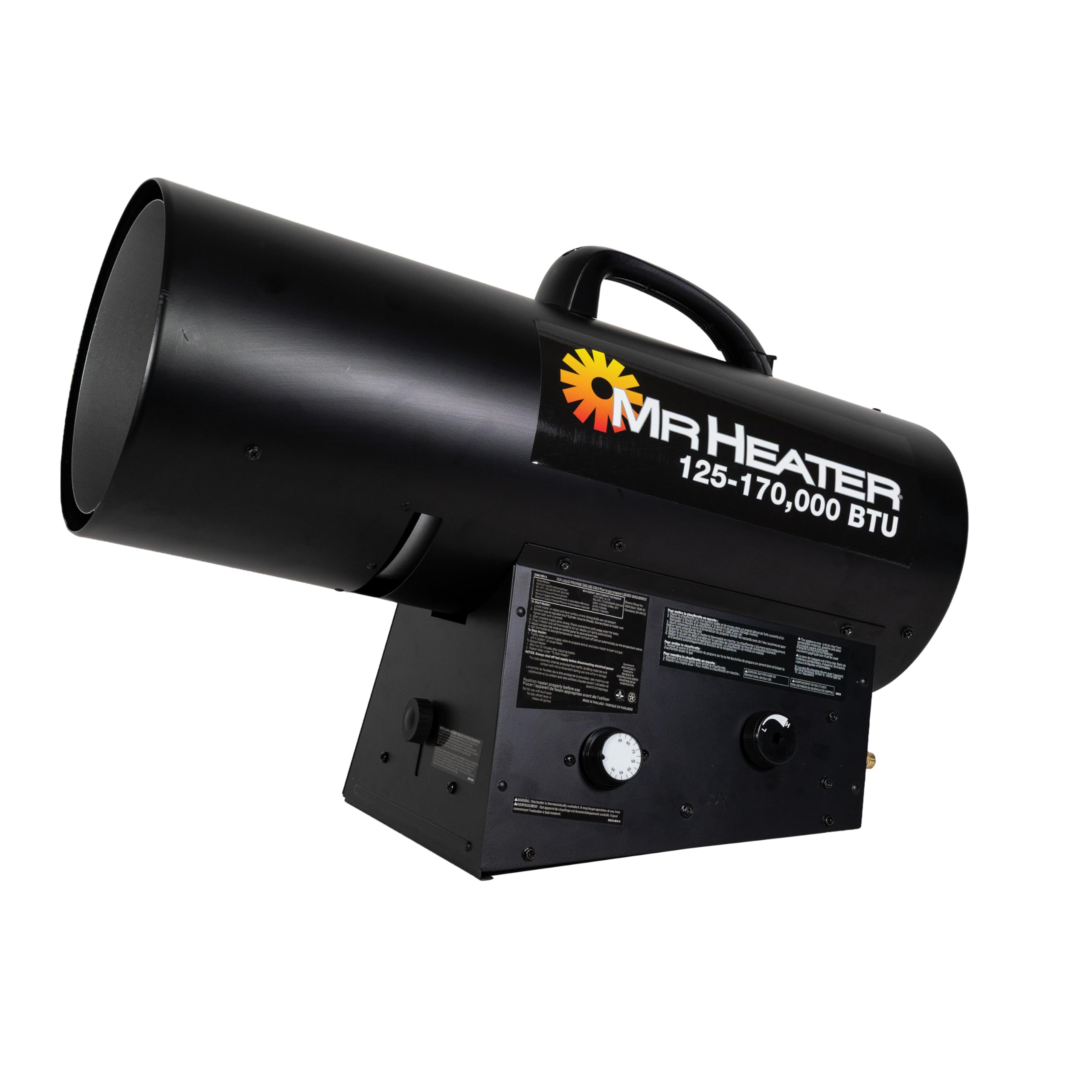
The monster that turns a 30×30 shop at 16°F into an 80°F workspace, with up to 17 hours of run time on a full tank.
For the largest uninsulated spaces — think 4,250 square feet of open shop, barn, or warehouse — this is the one. It cranks out a staggering 175,000 BTU of forced-air heat, and the built-in thermostat automatically cycles it on and off as needed. Reviewers point out taking a 30×30 shop from 16°F outside to a toasty 80°F inside, and heating a 40×80 tent with sides effectively.
Quiet Burner Technology is the defining feature. Unlike the shrieking torpedo heaters you might be used to, this unit runs noticeably quieter while delivering industrial-grade output, and it’s cleaner than diesel burners with no kerosene smell. The variable heat output and adjustable height let you position and tune it for the job. It’s compatible with standard 100-pound propane tanks as a minimum — smaller BBQ-style tanks simply can’t supply enough gas pressure for long.
Owners consistently praise its quiet operation, thermostat, and lack of odor versus diesel. The catch: at 20.1 pounds and this power, it needs a big fuel supply—a 20-pound tank lasts just 4-5 hours of continuous run time. It also requires good ventilation; owners measured 1-2 ppm of carbon monoxide with a 6-inch door gap, which is safe but not zero. Its 175,000 BTU output dwarfs the 80,000 BTU Mr. Heater below for truly huge spaces.
The Powerhouse Wins
- Massive 175,000 BTU heats up to 4,250 sq ft
- Quiet Burner Technology reduces the roar
- Built-in thermostat cycles on and off automatically
The Heavy Lifting
- Requires a big 100-lb propane tank minimum
- Needs serious ventilation for safe operation
- Loud but acceptable, per owner reports
Get this for: huge open spaces where only massive forced-air output and long run time will do the job.
Pass on it if: you only have small 20-pound tanks or your garage is under 1,000 square feet.
9. Dyna-Glo 150,000 BTU Forced Air Propane Heater

The 150,000-BTU propane blaster that grabs an uninsulated 2,000-square-foot metal shop and drags it from the 40s to the 60s in half an hour.
This is the middleweight champ for oversized garages and metal workshops that need intense, immediate heat. With a variable output of 120,000 to 150,000 BTU, it covers up to 3,500 square feet, and the continuously variable adjustment lets you dial the fire down to hold a temperature once you’re warm. Owners replacing older kerosene torpedo heaters report the 150,000 BTU setting warms a 2,000-square-foot insulated metal shop from the 40s to the 60s in about 30 minutes.
Safety features drive much of the appeal: continuous electronic ignition prevents the dangerous delayed ignition of older designs, and overheat auto-shut-off adds confidence. The adjustable heat angle and included 10-foot hose with regulator make it job-site ready. It runs clean with no odor, and the exterior stays cool even when the output is hot.
Owners praise its fast warm-up and clean burn compared to kerosene. The honest trade-offs: on high it sounds like a jet engine, there’s a faint propane smell while running, and it is fuel-hungry — you’ll want at least a 40-pound tank, per the manual, not a 20-pounder. There’s no thermostat, just manual controls, which some prefer for reliability.
The Advantages
- Variable 120K-150K BTU output for big, adjustable heat
- Clean burn with no kerosene smell
- Continuous electronic ignition prevents delayed ignition
The Realities
- Jet-engine loud on the highest setting
- Needs a large 40-lb+ propane tank
- No thermostat — manual controls only
Choose this for: a large metal shop or oversized garage where rapid, powerful heat matters more than quiet.
Consider the other Dyna-Glo if: you want a vent-free wall mount instead of a roaring portable blower.
10. Mr. Heater 80,000 BTU Forced-Air Unit Heater
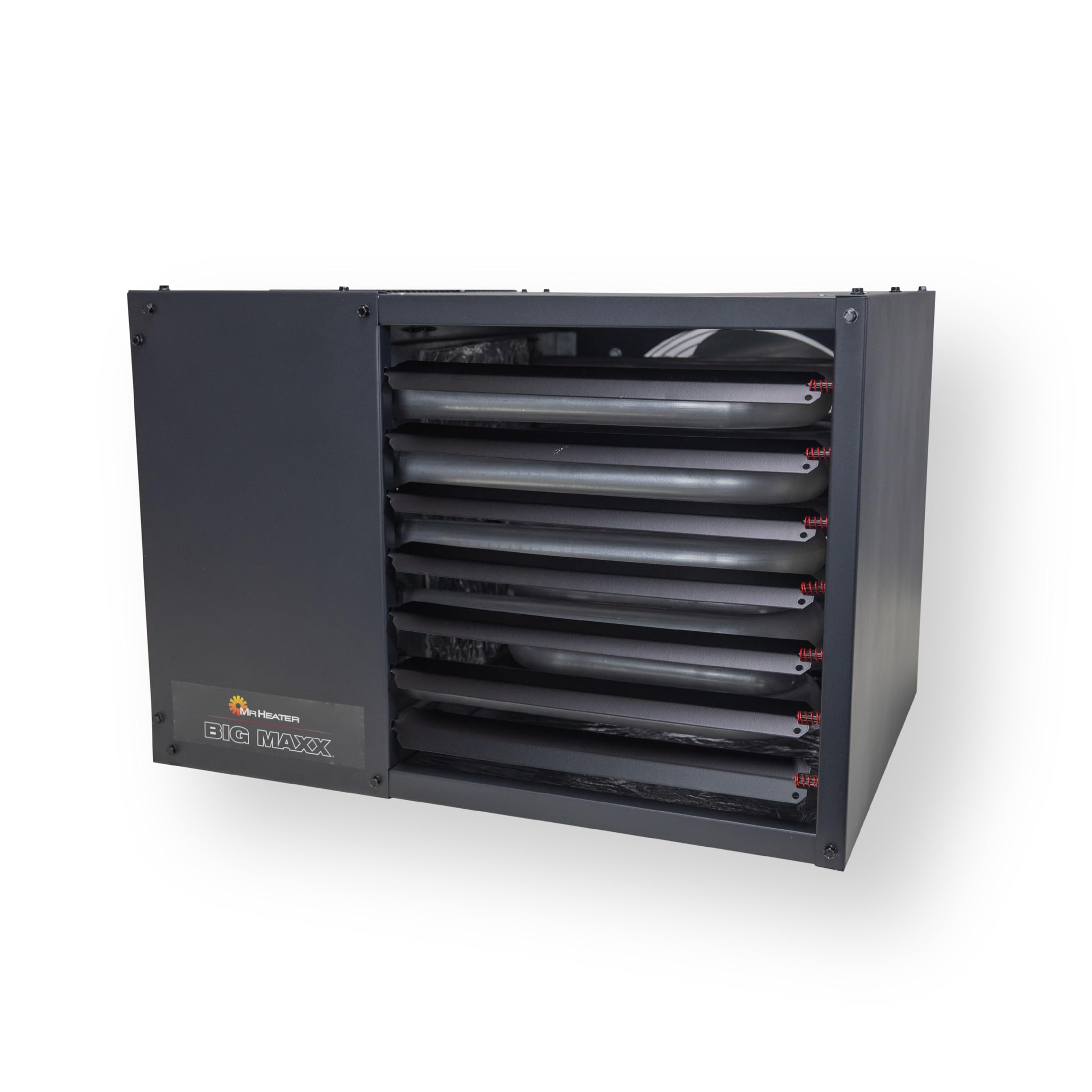
The ceiling-hung, gas-fired unit heater that quietly holds a 24×36 shop at 40°F when it’s 10°F outside.
This is the closest thing to a home furnace for your garage. It’s a ceiling-mounted unit heater that runs on natural gas or liquid propane (a conversion kit is included for the LP route), pushing 80,000 BTU across 2,667 square feet. Owners with a 24×36 shop with R-13 insulation and a 12-foot ceiling report it maintains 40°F even when outside temps drop to 10°F — with low fuel use.
The low-profile design keeps it out of the way overhead, but it demands serious headroom: you need a 10-foot minimum ceiling height with 8 feet of clearance from the base of the heater to the floor. The big win is convenience — it’s compatible with standard 24-volt thermostats, including Wi-Fi-enabled ones sold separately, so you can warm the garage with a tap on your phone. A former propane installer and lifelong owner gave it an approving review for its efficient, heavy-duty build.
Reliability is the most-praised trait here, with dozens of owners celebrating how consistently it works in garages and hunting shacks, maintaining 60°F easily. Installation is straightforward for a gas unit but needs two people, and it should be professionally vented. The noise level splits opinions — many find it very quiet, while others find it noticeable. Also, shipping can take a toll on the metal body, so inspect the cabinet carefully on arrival.
The Highlights
- Efficient gas heat with low fuel consumption
- Works with standard 24V and Wi-Fi thermostats
- Sturdy, reliable construction praised by owners
The Requirements
- Needs a 10-ft ceiling and professional install
- Natural gas or LP hookup with venting required
- Heavy unit — installation takes two people
Perfect for: a large, high-ceilinged garage or workshop where you want furnace-like, thermostat-controlled gas heat.
Not for: renters or anyone who can’t commit to a permanent, professionally installed unit.
11. Dyna-Glo 15,000W Dual Power Electric Garage Heater

The 15,000-watt electric behemoth that took an uninsulated 36×26 room from 30°F to 65°F in 30 minutes with zero fumes.
For the buyer who wants electric’s clean heat but refuses to compromise on power, this is the endgame. It’s a dual-power unit pushing 15,000 watts and 51,180 BTU — comparable raw output to a mid-size propane blower but with no exhaust, no odor, and no carbon monoxide worries. Shoppers say heating an uninsulated 36×26-foot room from 30°F to 65°F in just 30 minutes.
The dual power settings are the defining feature. Run it at 11,300 watts (38,556 BTU) for everyday warmth, or kick it to the full 15,000 watts (51,180 BTU) when the cold is bitter. There are 24 heat settings ranging from 50°F to 95°F, giving you far more fine control than most electrics. In the summer, you can run it as a fan-only unit for air circulation, and the adjustable angles with safety lock let you direct airflow horizontally or vertically.
Owners praise its solid build and effective performance, with a reliable remote. The serious caveat is the electrical demand: at 62.5 amps, this needs a 70-amp breaker and heavy 4 AWG SEU cable. That’s a major installation project, and the running cost is steep — owners in New Hampshire estimate around per hour at full tilt. It’s quiet, but not silent, and priced accordingly as a premium investment.
The Strengths
- Huge 15,000W output rivals propane without fumes
- 24 heat settings from 50°F to 95°F for fine control
- Fan-only mode works as summer circulation
The Real Costs
- Needs a heavy70-amp circuit with 4 AWG cable
- Runs about per hour at full power.
- Heavy 56.6-pound unit requires careful placement
Reach for this if: you have the electrical infrastructure and want propane-level heat with zero combustion concerns.
Look elsewhere if: your panel can’t handle a 70-amp breaker or you want something less demanding to install.
Understanding the Specs
BTU Output and Square Footage
BTU (British Thermal Unit) is the standard measure of heat output for gas and propane heaters. It tells you how much heat the unit produces per hour. As a rough guide, an uninsulated garage needs about 30 BTU per square foot to stay comfortable in freezing weather. That means a 1,000-square-foot drafty space needs around 30,000 BTU minimum, and a larger shop needs proportionally more. Undersizing is the most common mistake — the heater runs constantly, never catches up, and wastes fuel.
Wattage and 240V Wiring
Electric garage heaters are rated in watts, and the serious ones all run on 240V circuits — the same voltage as an electric dryer or oven. A 5,000-watt heater draws about 20.8 amps, which means you’ll need a dedicated 30-amp breaker and 10-gauge wire. The biggest electric unit here, at 15,000 watts, draws a massive 62.5 amps and demands a 70-amp breaker with 4 AWG cable. If you’re not sure your panel can handle it, budget for an electrician before you buy.
Forced Air vs. Radiant vs. Convection
Forced-air heaters use a fan to blow hot air across the room — they warm a big space fast but make noise. Radiant heaters beam heat directly at whatever faces them, which feels warm instantly but leaves the air behind you cold. Convection heaters warm the air gently like a central furnace, which is even but slow. For a drafty, uninsulated garage, forced air is usually the practical choice because it moves heat into every corner quickly.
Ventilation and Fuel Safety
Propane and natural gas heaters consume oxygen and produce carbon monoxide as they burn. In an uninsulated garage, you have natural air leakage, but you still need to crack a door or window while running a vent-free or portable gas unit. Vent-free wall heaters are designed for indoor use but still benefit from some airflow. Electric heaters produce no combustion gases, which makes them simpler and safer for enclosed spaces, though they cost more per hour to run.
FAQ
How many BTUs do I need for an uninsulated garage?
Can I use a propane heater indoors in my garage?
What size breaker do I need for a 5,000-watt garage heater?
Is electric or propane better for an uninsulated garage?
How long does a propane tank last with a garage heater?
Can I run a 240V garage heater on a standard outlet?
What is the difference between forced air and radiant garage heaters?
Can a vent-free heater be used as a primary heat source?
Final Thoughts: The Verdict
For the majority of shoppers, the heater for uninsulated garage winner is the DEWALT 68,000 BTU—it pairs massive coverage with cordless battery freedom, and real owners took a 2.5-stall garage from 30°F to 70°F in about an hour. For clean, set-and-forget electric heat that stays out of your way, choose the Comfort Zone 5,000W. For a huge shop needing instant blast heat, the Mr. Heater 170,000 BTU is the one to grab.
How We Picked
We do not accept paid placement. Every pick is matched to a real buyer and a real use-case; we do not hands-on test units.
Sources & Methodology
Specifications: manufacturer listings and product documentation. Review insights: verified customer reviews, as of August 2026. Pricing: not shown on this page (it changes often); check the current price via the retailer link.
As an Amazon Associate, Trending Car earns from qualifying purchases. This does not affect which products we feature.