
Our readers keep the lights on and my garage snacks stocked. As an Amazon Associate, I earn from qualifying purchases.
Specs are compiled from manufacturer listings and verified buyer reviews and can change over time — please confirm the key details on the product page before buying.
Choosing your first orbital polisher can feel risky — one wrong move on the trigger and you picture your clear coat ruined. A dual-action machine’s orbital motion makes paint burn virtually impossible. A dual-action (DA) polisher spins the pad in an orbit while also rotating it, which spreads the cutting action out. This design is why dual-action polishers are the go-to for both novices and professionals.
I’m Min Islam — the founder and writer behind Trending Car. This guide is built by comparing the manufacturers’ published specifications and the patterns across verified customer reviews, so you get each pick’s real strengths and trade-offs instead of marketing spin.
From a 1000-watt flagship to mini cordless wands for tight spots, this breakdown of the best orbital polisher options helps you match power, pad size, and ergonomics to your actual detailing goals.
Our Picks at a Glance


How To Choose The Best Orbital Polisher
Before you click buy, you need to match the machine to the damage you are fixing and the size of the surfaces you will tackle. A polisher built for a 10-inch floor pad will feel clumsy on a car door, while a mini 3-inch wand will take all day on a hood. Start by thinking about the paint condition and the panel sizes you work on most.
Pad Size Determines Your Reach
Larger pads, typically 5 to 6 inches, cover big flat areas like hoods and roofs quickly. Smaller pads, around 2 to 3 inches, are made for bumpers, A-pillars, mirrors, and other tight curves where a big pad cannot sit flat. A pad that cannot sit flat vibrates instead of cutting, which wastes time and can leave uneven results.
Throw Length Controls Cutting Speed
The “throw” is the diameter of the orbit the pad makes. A longer throw, like 15mm, moves the pad in a wider circle. That wider circle covers more surface per second and cuts faster, but it can feel more aggressive. A standard 8mm or 9mm throw is gentler and easier to control, which is why it suits beginners and lighter correction jobs.
Variable Speed Respects the Paint
Speed control lets you start slow to spread product, then ramp up to cut. Lower speeds are for applying wax or sealant, while higher speeds are for removing scratches and oxidation. Without a variable-speed dial, you lose the ability to fine-tune the heat and pressure, which is the difference between a swirl-free shine and hazing.
Quick Comparison
| Model | Best For | Power | Pad Size | Speed Range | Amazon |
|---|---|---|---|---|---|
| Griot’s Garage G9★ Best Overall | Overall paint correction | 1000 watts | 6″ | 2000–6400 OPM | Amazon |
| ZOTA Mini BufferBudget Champion | Tight spaces & budgets | 380 watts | 2″/3″ | 3000–7200 RPM | Amazon |
| CRAFTSMAN CMEE100Large Surface Pro | Large flat surfaces | 1 A | 10″ | 2800 OPM | Amazon |
| VERVEWAVE Cordless | Mobility & convenience | Brushless | 6″ | 1800–5500 RPM | Amazon |
| SPTA Mini 3″ | Detail work & buffing | 780 watts | 3″/4″ | 2000–5500 OPM | Amazon |
| SPTA Cordless Mini | Micro detailing & emblems | 12V battery | 25–80mm | 2000–4500 OPM | Amazon |
| Meguiar’s MT300 | Balanced pro results | 4.5 A | — | — | Amazon |
| Maxshine M15 Pro | Long-throw efficiency | 1000 watts | 5″ | 2500–5000 OPM | Amazon |
In-Depth Reviews
1. Griot’s Garage G9 Random Orbital Polisher
Our pick — over 4.5★ from 500+ verified ratings; the strongest balance of quality and price.
A 1000-watt workhorse that corrects like a pro yet stays forgiving for novices.
The G9 earns its top spot with a 1000-watt motor and a 9mm orbit throw — a pairing that cuts through scratches, swirls, and oxidation efficiently. The motor pulls 8.5 amps, giving it serious muscle for a machine that stays easy to handle. That is 8.5 times the amperage of the CRAFTSMAN 10-inch model below, which tells you where the real cutting power lives.
You get a polisher that feels solid and performs well, even if you have never used one before. Reviewers often say, “I am a first time user for polishers,” yet still find it easy to use without burning paint. The low vibration and a comfortable double-shot rubber grip (a two-layer rubber handle) keep your hands less tired during long detailing sessions.
Six variable speed settings from 2000 to 6400 OPM let you match the machine to the task, whether that is spreading wax at low speed or correcting paint at high speed. It ships with a 6-inch vented backing plate, and you can swap to a 5-inch system with an optional plate for tighter control. At 5.3 pounds it is heavier than the ZOTA mini, but the weight translates into stability on flat panels.
What Wins Owners Over
- Powerful 1000-watt motor corrects heavy defects
- Low vibration and comfortable grip for long use
- Constant speed control prevents bogging under pressure
Consider This First
- Heavier than mini polishers at 5.3 pounds
- Slow work on very tight curves without a smaller pad
Reach for it if: you want one machine that safely handles full paint correction on a daily driver.
Look elsewhere if: your work is mostly bumpers and mirrors where a 3-inch pad fits better.
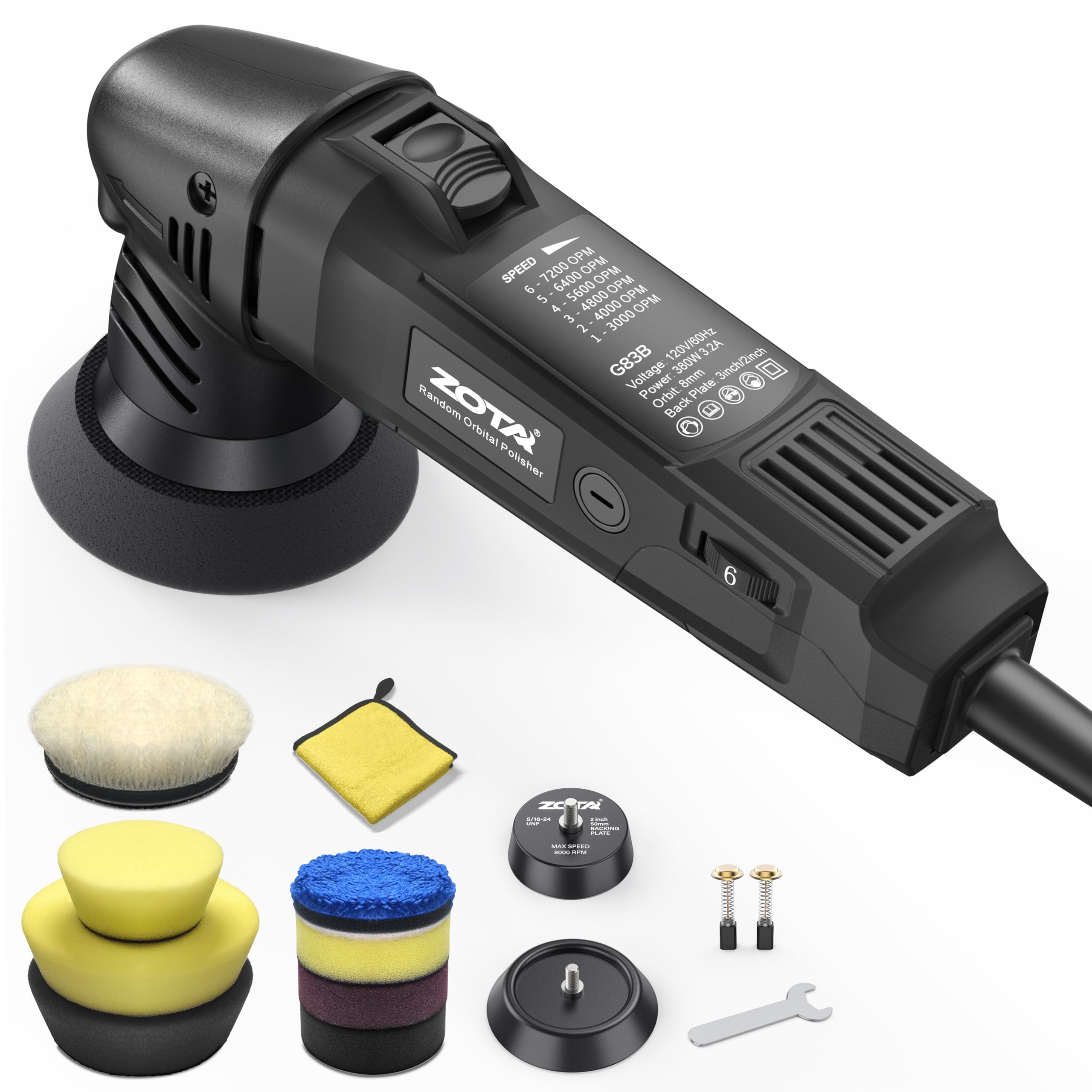
2. ZOTA Mini Buffer Polisher
A 3.7-pound mini that reaches door jambs and headlights with ease.
The ZOTA mini is the most-discussed pick here for one simple reason: effectiveness in tight spaces. Its 3-inch and 2-inch pads reach the curves and contours that full-size polishers cannot touch, and its 8mm random orbital action removes swirls without the risk of holograms. Weighing just 3.7 pounds, it is noticeably lighter than the 5.3-pound Griot’s G9, making it far less tiring for overhead and awkward-angle work.
A 380-watt motor drives speeds from 3000 up to 7200 RPM — a 12% higher top speed than the G9’s 6400 RPM, so it spins faster even though it lacks the big machine’s brute power. Buyers report it “works well with SPTA pads on 22.5ft boat; no overheating if used gently,” which tells you it handles marine work fine as long as you respect its limits. The variable speed dial and quiet Grissom gears make it a comfortable daily companion.
What surprises owners most is the sheer value. It arrives with two sponge pads, a wool pad, four 2-inch pads, a microfiber finishing pad, carbon brushes, and a wrench — everything needed to start detailing immediately. The included pads are not the highest quality, so many upgrade those over time, but the machine itself feels durable and balanced.
The Verdict: The most-liked aspect is effectiveness, with owners praising how it gets into small areas. The trade-off is that some find the 3.7-pound weight a bit heavy for a tool this small — a fit note, not a flaw — so lighter-duty users might prefer a true micro wand.
Best for: boat owners, motorcycle riders, and anyone who details tight curves on a budget.
Skip if: you only polish large flat hoods and want maximum coverage per pass.
3. CRAFTSMAN Polisher, 10 inch, 2800 OPM
A 10-inch-pad specialist for floors and large panels that veterans trust.
This CRAFTSMAN is a different breed from the car-focused polishers above — its 10-inch pad and 2800 OPM rating are built for big, flat surfaces like floors and large-bodied vehicles. It is the throwback choice: a longtime owner who used a 7-inch model for 20 years took a chance on this 10-inch version and found the adjustable speed dial a genuine upgrade. At just 1 amp, it is a light-duty machine by spec, but its job is spreading product over huge areas, not heavy correction.
The contoured overmolded grip adds comfort, and the red plastic body keeps weight down even though the listed weight of 3.04 kg is substantial for a handheld tool. Because it spins at a fixed 2800 OPM, you get a consistent swirl-free finish on large panels — the trade-off is that it cannot ramp down for fine waxing work the way variable-speed DAs can.
That vibration is the predictable result of a 10-inch pad on a single-speed machine, so it suits broad polishing jobs better than precision detailing. The durability complaints, including one unit breaking after 5 months, mean this is best treated as a budget-friendly bulk polisher rather than a daily pro tool.
The Strong Suit
- Huge 10″ pad covers large surfaces fast
- Variable-speed dial adds control
- Contoured overmolded grip is comfortable
The Honest Limit
- Vibrates more than it spins at full speed
- Durability is a concern for heavy daily use
Choose it for: maintaining large flat areas where a 6-inch machine would take far too long.
Think twice if: you need swirl removal on modern car clear coats, where a dual-action with a longer throw is safer.
4. VERVEWAVE Cordless Buffer Polisher Kit
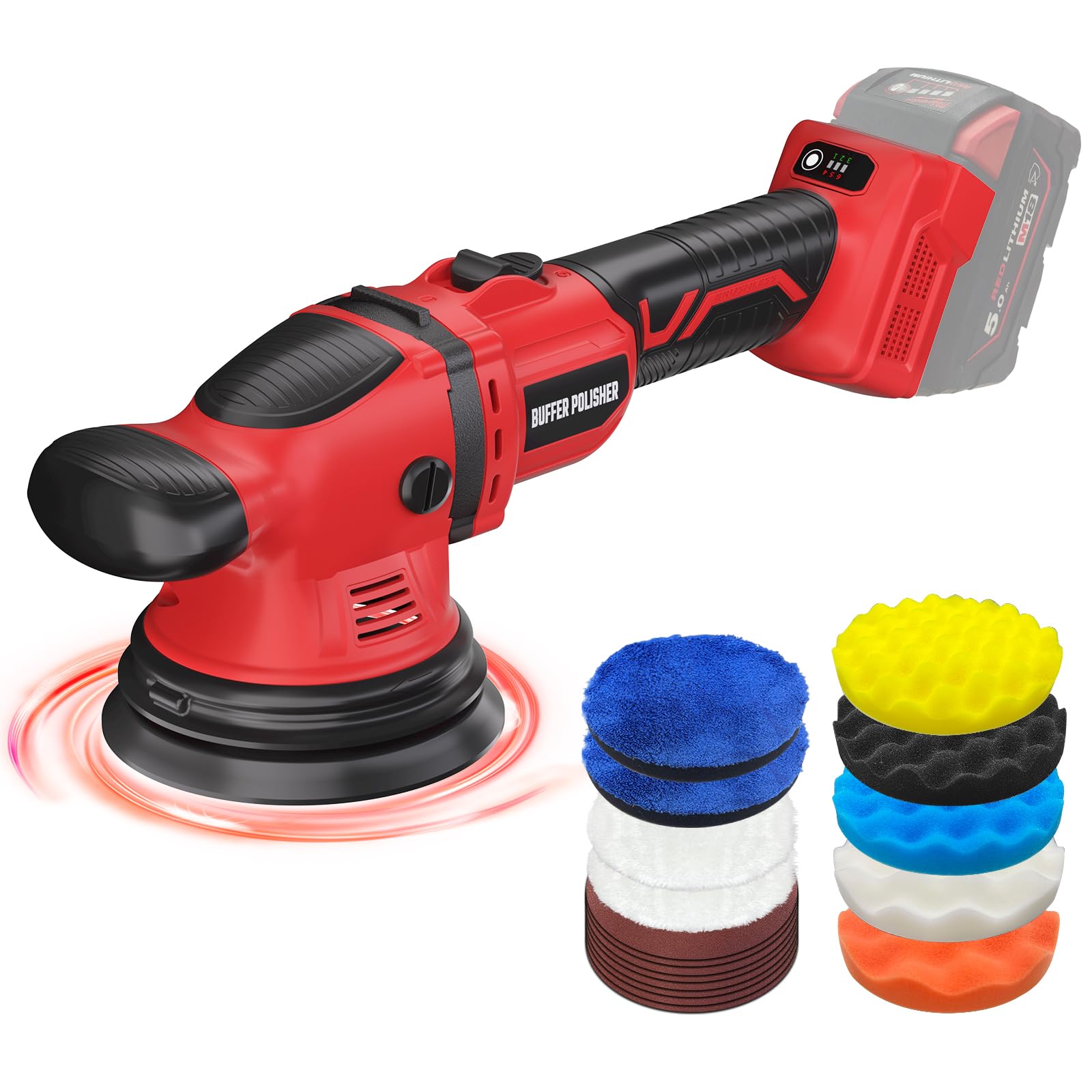
Cordless freedom with six speeds and a 17-piece kit that covers all tasks.
If you already own Milwaukee 18V or M18 batteries, this VERVEWAVE tool-only polisher becomes an instant value play — it runs on your existing cells, with no charger or battery cost. The upgraded brushless DC motor delivers more power and less noise than a brushed unit, and owners mention it holds speed consistently even under pressure. It is important to note the battery is not included, so this only makes sense if you are already in the Milwaukee ecosystem.
Performance is the aspect owners praise most, with buyers noting it works great with DeWalt batteries too, running consistently across variable speeds from 1800 to 5500 RPM. One detail job on a sun-faded boat with marine compound came out so well the owner ceramic-coated it afterward. The 17-piece kit includes five foam pads, two wool pads, two waxing pads, and sanding discs, so you can compound, polish, and wax without buying extras.
The 6-inch pad size matches the Griot’s G9 for coverage, but the cordless design removes the tether entirely. Battery life is a real highlight — one report describes 1.5 hours of use with more than 50% remaining, and a 6Ah battery completed a full car on a single charge. The lock switch is a thoughtful safety touch, preventing the machine from starting unexpectedly next time you grab it.
Editor’s Read: The strongest praise centers on performance and build quality, with value for money close behind. The catch is that you must supply the battery, and it is only sensible for Milwaukee or DeWalt owners. For anyone else, the battery investment tips the value equation.
Best suited to: Milwaukee or DeWalt tool owners who want one polish machine without another charger on the wall.
Not for: first-time buyers without a compatible battery system already sitting in the garage.
5. SPTA Mini Orbital Polisher 3″

Big-machine power in a 3-inch body, ready for post-paint buffing and motorcycle chrome.
The SPTA mini packs a serious 780-watt motor into a compact 3-inch frame with a 10mm throw — a longer orbit than the ZOTA’s 8mm, so it cuts faster on tight panels. This makes it the natural upgrade pick for detailers who found the budget mini underpowered. Owners highlight its ability to reach tight areas without fatigue, and one full cut-and-buff after a fresh paint job produced a professional glossy finish. Customers note it works well on boats too, keeping fiberglass bright with no overheating.
Build quality is the #1 praised aspect, which is saying something for a machine at this price point. The extended front handle grip and mid-body thumb dial make it comfortable to operate, and the soft-start motor prevents paint splatter on start-up. It comes with an unusually complete kit: polishing pads, wool pads, sanding discs, a pad conditioning brush, microfiber towels, scratch remover, and even a tool bag and apron.
The honest trade-off is ergonomics. The weight is listed at 3.2 kg, which makes it noticeably heavier than the ZOTA’s 3.7 pounds, and owners are split on ease of operation. The lock/start button is the recurring gripe — it works fine but feels awkward until you get used to it. This is a small footnote on an otherwise strongly recommended machine.
Why It Stands Out
- 780-watt motor with 10mm throw cuts fast
- Complete kit with pads, discs, and towels
- Solid build quality praised by owners
The Caveat
- Heavier than other mini polishers at 3.2 kg
- Lock/start button feels awkward at first
Grab this if: you do serious paint correction on motorcycles, boats, or post-bodywork panels.
Pass if: you want the lightest possible tool for occasional wax application.
6. SPTA Cordless Mini Polisher 12V
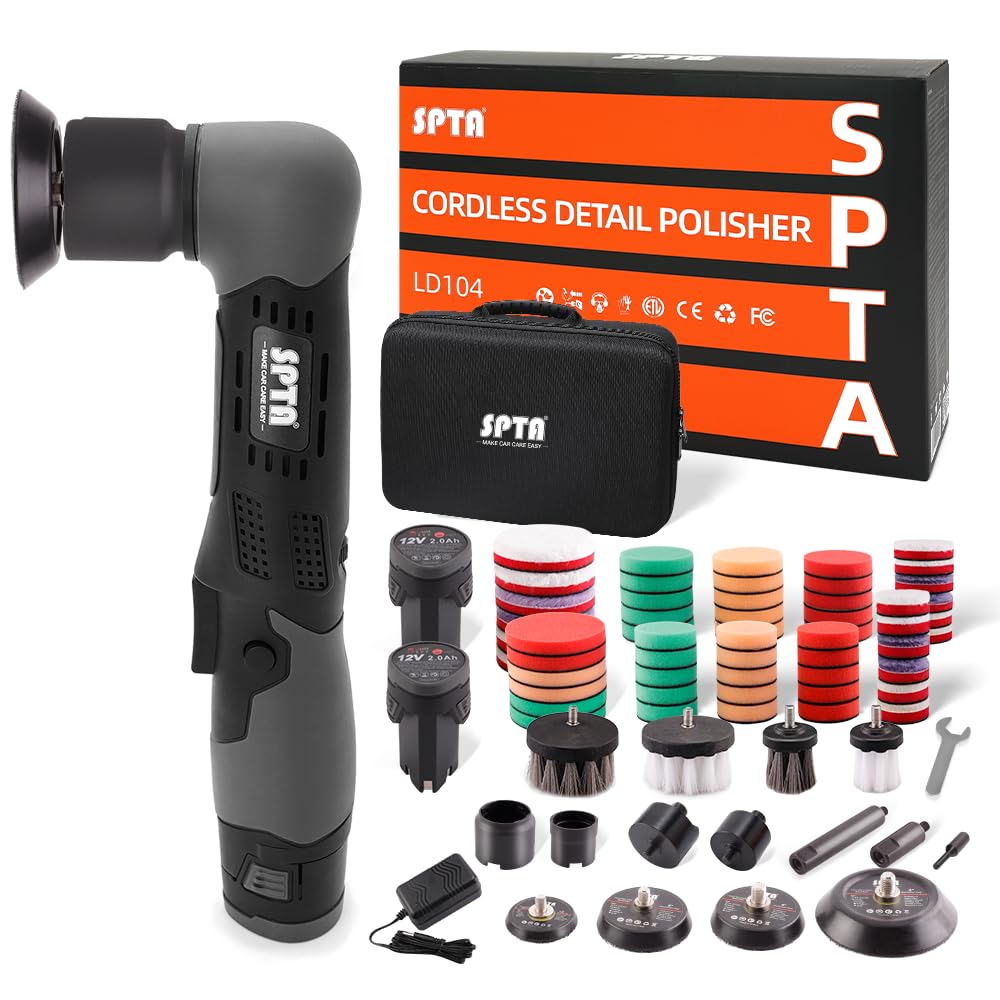
A palm-sized wand that perfects emblems, body lines, and glass without hunting for an outlet.
Reach the final 10% of a detail—emblems, mirrors, headlights, and tight body lines—that a full-size polisher cannot touch. The 2000 mAh battery (a rechargeable power pack) drives a double-action free-spinning rotation at up to 4500 rpm, so you can work on curves without burning paint. SPTA packs in 91 pieces: two batteries, two extension shafts, four support plates, and dozens of polishing pads in 25mm, 50mm, and 76mm sizes. Reviewers point out great results on motorcycles, windshields, and even large glass shower panels.
Cordless freedom is the defining feature. You can polish anywhere without an extension cord, and the second battery keeps you running while the first recharges. The variable speed switches between 2000 and 4500 oscillations per minute smoothly, and the rotary attachment provides the full 4500 OPM when you want a heavier cut.
The honest limitation is battery runtime — owners note the fully charged batteries do not last as long as hoped, and there is no corded option to plug in when they run dry. The case is also too small, requiring full disassembly of the tool to store it. These are minor complaints for a machine that otherwise earns strong praise for professional-quality results on small projects.
The Take: Quality and functionality are what owners praise most, making this an excellent finishing tool for detailers. The battery life is the compromise, so treat it as a detail finisher rather than a full-car machine. It shines for motorcycle and emblem work where its micro size is an advantage.
Best for: weekend detailers perfecting emblems and trim, and motorcycle owners who want chrome-shine without a cord.
Not for: correcting large scratched panels, which needs a bigger pad and longer battery runtime.
7. Meguiar’s MT300 Variable Speed Dual Action Polisher

The torque-managed pro that keeps its speed steady when the paint fights back.
The MT300’s a neat extra is Digital Torque Management — it electronically adjusts torque to maintain the loaded speed level no matter how much pressure you apply. That means you can push harder on a stubborn scratch without the motor bogging down, which is the difference between a quick correction and a frustrating one. The billet counterweight keeps vibration and wobble down, and the soft start prevents paint splatter when you pull the trigger.
Owners describe it as professional-grade, with one noting it beats the long-standing Porter Cable 7424XP because the torque management allows more pressure on scratches safely. It handles everything from compounding to finishing wax, and a 9-year-old weathered black clearcoat came back flawless when paired with Meguiar’s compound kit. At 5.4 pounds it sits at the heavier end, but the multi-position D-handle spreads the weight for better control.
The catch is reliability. While quality and ease of use earn top praise, some shoppers say the motor stopping after about 10 minutes of continuous use, and one found a nearly sheared wire inside the cord near the trigger. This mixed durability record means it performs well when healthy, but it may not survive full-time professional abuse.
What You Gain
- Torque management maintains speed under pressure
- Soft start prevents splatter on start-up
- Billet counterweight reduces vibration
What To Weigh
- Reliability is mixed, with some stopping after 10 minutes
- Requires a separate backing plate and pads
Reach for it if: you want pro-level steady speed for correction jobs and value torque control over raw wattage.
Look elsewhere if: you need a machine that works all day, every day without any risk of downtime.
8. Maxshine M15 Pro Dual Action Polisher
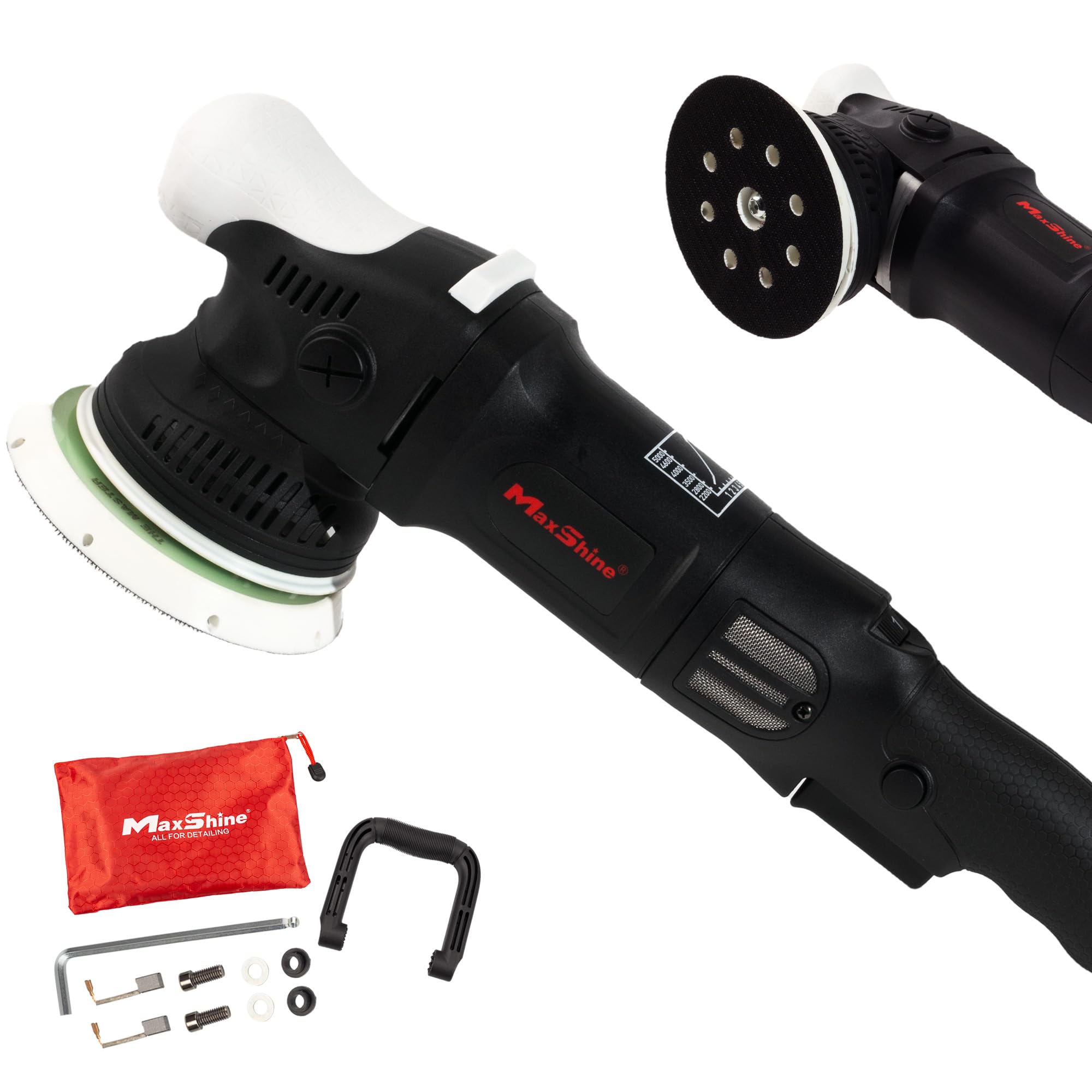
Long-throw speed that rivals premium brands while keeping the price grounded.
The M15 Pro leads on efficiency with its 15mm long throw — the widest orbit in this lineup — which covers more surface per pass and cuts faster than standard 8mm or 9mm machines. The 1000-watt motor matches the Griot’s G9 for power, and the 5-inch backing plate is a sweet balance between coverage and maneuverability on curves. Owners upgrading from a basic Porter Cable describe better paint correction with less effort, reporting roughly 90% correction on a neglected 2014 CRV.
What impresses most is the value: at its price point, this machine is frequently compared to Rupes long-throw polishers that cost twice as much. The variable speed from 2500 to 5000 OPM covers cutting, polishing, and finishing, and the ergonomic low-vibration grip keeps fatigue down during extended sessions. Owners consistently note it is lighter and quieter than a Porter Cable while delivering a factory-like finish.
The honest trade-off shows up on curves: the machine has a tendency to stall on edges and curved panels, which some owners describe as a safety feature. One user found a spacer helps prevent the stalling. Vibration and stability are the most-discussed negative aspects, but for flat panels and large surfaces, this polisher is hard to fault at the price.
The Advantage
- 15mm long throw cuts faster than standard DAs
- 1000-watt motor with consistent torque
- 5″ pad handles curves better than 6″ models
The Watch-Out
- Tends to stall on sharp edges and curved panels
- Vibration is noticeable at higher speeds
Best for: detailing enthusiasts who want pro-level speed and are ready to manage a long-throw machine.
Skip if: most of your work is on bumpers and heavily curved panels where stalling becomes a nuisance.
Understanding the Specs
Throw Length and Pad Size
The throw is the diameter of the orbit the backing plate makes. A longer throw, like 15mm, moves the pad in a wider circle, covering more surface per second and cutting faster. Pad size works alongside this—a bigger pad covers more area, while a smaller pad fits tight curves. For most cars, a 5-inch or 6-inch pad is the balance.
OPM and RPM Speed Ratings
Speed is measured in OPM (orbits per minute) or RPM (rotations per minute), and higher numbers mean faster pad movement. Variable speed is key: low speeds apply wax, mid speeds polish, and high speeds correct paint defects. The best machines let you adjust on the fly with a thumb dial rather than forcing one fixed speed.
FAQ
Can a dual-action polisher burn my car’s paint?
What is the difference between a 3-inch and a 6-inch polisher pad?
Is a cordless polisher as powerful as a corded one?
Why does my polisher vibrate so much?
Can I use a polisher to apply wax, or is it just for scratches?
What does OPM mean on a polisher spec sheet?
Does a longer throw mean better results?
Do I need to buy pads separately, or do they come included?
Final Thoughts: The Verdict
If you want one dependable pick, the best orbital polisher is the Griot’s Garage G9 because its 1000-watt motor and 9mm throw deliver safe, effective correction that beginners and pros both rave about. If you want cordless convenience with your existing tool batteries, grab the VERVEWAVE — its brushless motor and complete kit make it a standout. And for tight curves, emblems, and motorcycle chrome, the ZOTA Mini is the one to reach for.
How We Picked
We do not accept paid placement. Every pick is matched to a real buyer and a real use-case; we do not hands-on test units.
Sources & Methodology
Specifications: manufacturer listings and product documentation. Review insights: verified customer reviews, as of August 2026. Pricing: not shown on this page (it changes often); check the current price via the retailer link.
As an Amazon Associate, Trending Car earns from qualifying purchases. This does not affect which products we feature.