
Our readers keep the lights on and my garage snacks stocked. As an Amazon Associate, I earn from qualifying purchases.
Specs are compiled from manufacturer listings and verified buyer reviews and can change over time — please confirm the key details on the product page before buying.
Sliding under a car on a cold concrete floor is a miserable experience if your creeper is flimsy, narrow, or has wheels that catch on every crack. The right one supports your back, rolls where you point it, and gets you out from under the truck before your arms give out. This guide breaks down the nine creepers that earn their spot in a home garage or pro shop.
I’m Min Islam — the founder and writer behind Trending Car. This guide is built by comparing the manufacturers’ published specifications and the patterns across verified customer reviews, so you get each pick’s real strengths and trade-offs instead of marketing spin.
You need a creeper that fits your car’s height, your body, and your storage space. This guide breaks down the best car creeper choices by what they actually do for you: which low-profile design clears hoses, which padded deck saves a sore back, and which fold-up model fits in a trunk.
Our Picks at a Glance

How To Choose The Best Car Creeper
Your choice depends on three things: how low your car sits, how much you weigh, and if you need to move it between jobs. A creeper that fits a lowered sports car will feel wrong under a lifted pickup, and a heavy-duty steel model is overkill if you only do oil changes twice a year.
Low Profile vs. Standard Height
A low-profile creeper sits closer to the ground, which gives you more working room under the car but less space to slide over cords and air hoses. Standard-height models roll over obstacles more easily but leave you less headroom under a low chassis. Measure the clearance under your vehicle before you choose — if you can barely fit a floor jack, you want the slimmest profile you can find.
Body Support and Weight Capacity
Your lower back carries the load of every repair session, so a contoured deck with lumbar support is worth paying for. Check the rated capacity too — a 300-lb creeper is the common baseline, but if you are heavier or work on your knees, look for a 440-lb or 450-lb rating. A wider deck also spreads your weight better; a 17.5-inch width feels noticeably more stable than a 16-inch one.
Wheels and Casters
The wheels decide how much effort you burn just getting into position. Small 2-inch rollers are fine on smooth garage concrete, while 5-inch all-terrain casters roll over gravel, cracks, and debris without stopping you cold. Ball-bearing swivel casters let you change direction with a nudge of your hip, and lockable casters keep you still when you are torquing a bolt.
Quick Comparison
| Model | Best For | Weight Capacity | Deck Length | Caster Size | Amazon |
|---|---|---|---|---|---|
| Lisle 97102 Low Profile Plastic★ Best Overall | All-around comfort and durability | 300 lbs | 38 inches | 2 inches | Amazon |
| Lisle 95002 Fold-UpCompact Pick | Portable pads and knee support | — | 23.9 inches | — | Amazon |
| JEGS 2-in-1 Creeper & SeatMost Versatile | Switching between lying and sitting | 300 lbs | 36 inches | — | Amazon |
| Omega 91900 Plastic | Ready-to-use budget pick | 300 lbs | 36 inches | 3 inches | Amazon |
| Pro-Lift C-6048 48-Inch | Tall and heavy-duty mechanics | 440 lbs | 48 inches | 3 inches | Amazon |
| Traxion ProGear Wide Body | Rough driveways and wide comfort | 400 lbs | — | 5 inches | Amazon |
| Traxion King Crawler | Flat padded comfort with big wheels | — | 40 inches | 5 inches | Amazon |
| VEVOR Topside Engine Creeper | Standing-height engine bay work | 400 lbs | 42.5–64.8 inches | — | Amazon |
| Omega 91452 Z-Creeper | Convertible seat with premium build | 450 lbs | 40 inches | — | Amazon |
In‑Depth Reviews
1. Lisle 97102 Black Low Profile Plastic Creeper
Our pick — over 4.5★ from 700+ verified ratings; the strongest balance of quality and price.
The low-profile body that spares a recovering back and still rolls like a dream.
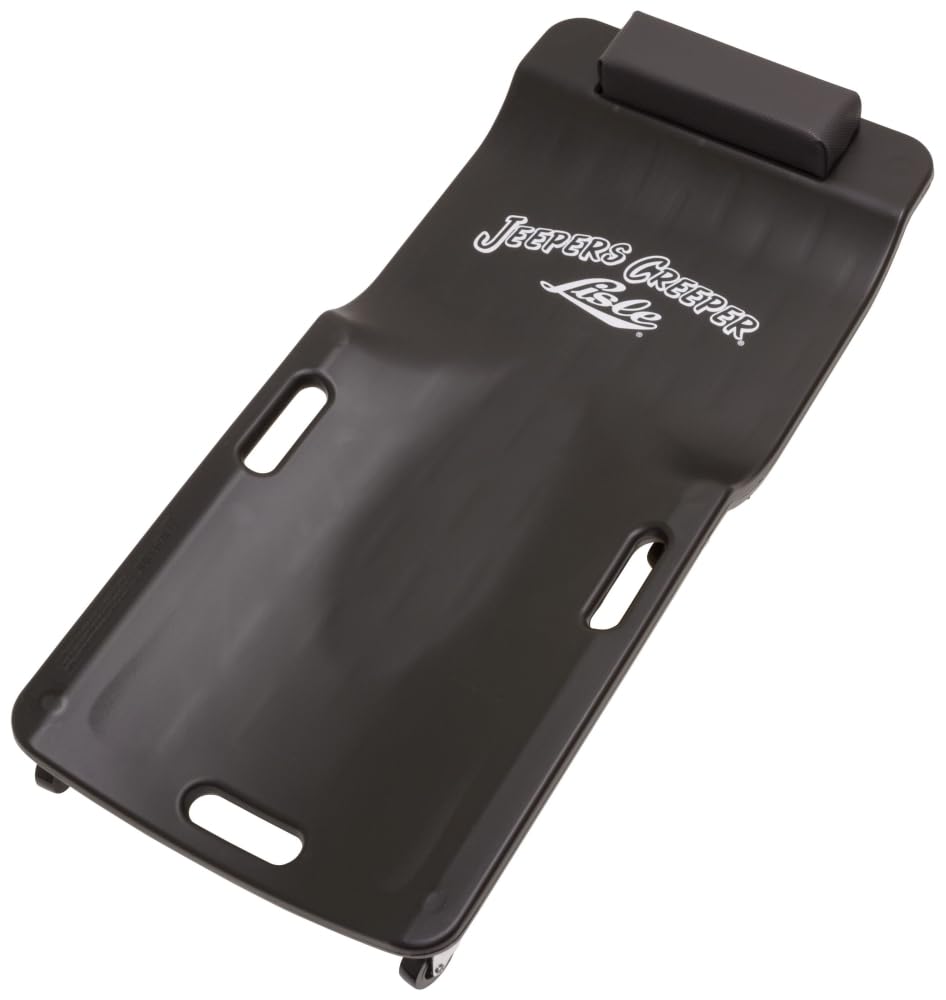
If you have ever winced getting up from a floor creeper, this Lisle is the one that changes the math. Its ergonomic, body-fitting shape was tested on many body types and includes built-in lumbar support, plus a padded headrest that keeps you in a working position while you are under the car. On a 7/8-inch floor clearance, it slides right under a low chassis while still clearing air hoses and cords — the exact balance home mechanics want.
The shell is one piece of high-density polyethylene plastic, blow-molded so the top and bottom are bonded permanently together by internal ribs. That construction is why sturdiness is the single most-praised trait in the owner feedback — it holds a 300-lb capacity across a 38-inch length and 17.5-inch width without flexing. Buyers report that “for a guy who is on his second back surgery, this is super super comfortable to lay on,” which is about the strongest endorsement a creeper can get.
Six 2-inch ball-bearing swivel rollers pop in and out for easy replacement, and the urethane wheels sit in metal bushings molded right into the body. The black finish hides grime, and the surface shrugs off solvents, greases, and fuels, so a quick wipe keeps it looking new.
What wins people over: the sturdiness is the runaway favorite — over 60 owners single out how solid it feels — and mobility runs a close second, with the deck gliding easily on concrete garage floors.
Reach for this if: you want one creeper that does everything — comfortable enough for long jobs, low enough for tight cars, and tough enough to outlast the cheap alternatives.
Know before you buy: at 11.1 pounds it is not the lightest board to lug around, and the wheels can occasionally roll a little uncoordinated on rough surfaces.
2. Lisle 95002 Fold-Up Creeper
The folding pad that rides in your trunk and saves your knees on gravel.
This is not a rolling board at all — it is a foldable kneeling pad, and that is its superpower. It folds down to a 23.9 x 18.1 x 2.8-inch package that fits behind a seat or in a trunk, so you can take it when Jeeping or fixing a tractor in a field. Owners mention it saves knees and backs from the stones of a gravel driveway, a job no wheeled creeper can handle.
Owners praise the quality heavily — the consensus is great value, with one buyer noting they bought a second one six years after the first because the original “is still functional just worn now.” It doubles as a kneeling pad or a fender cover, and it cleans up easily after pressure washing. Reviewers mention functionality and build quality most often, with comfort a close third.
There is a trade-off to know: the padding is on the thin side, and some owners say it is too thin for lying under a vehicle on its own, needing two or three stacked for cushioning. For quick under-hood work or kneeling on rough ground, it is ideal.
The honest catch: padding is the most mixed trait here — plenty of owners want a thicker, wider version for heavy-equipment work, so treat this as a knee-saver rather than a full under-car mattress.
Best for: the portable fix-it kit — gravel driveways, trailside repairs, and anyone who wants to keep a pad in the truck at all times.
Look elsewhere if: you need a full-length rolling deck for serious under-vehicle sessions.
3. JEGS 2-in-1 Folding Creeper & Z-Seat
Flip the locking pin and your rolling board becomes a shop stool in seconds.
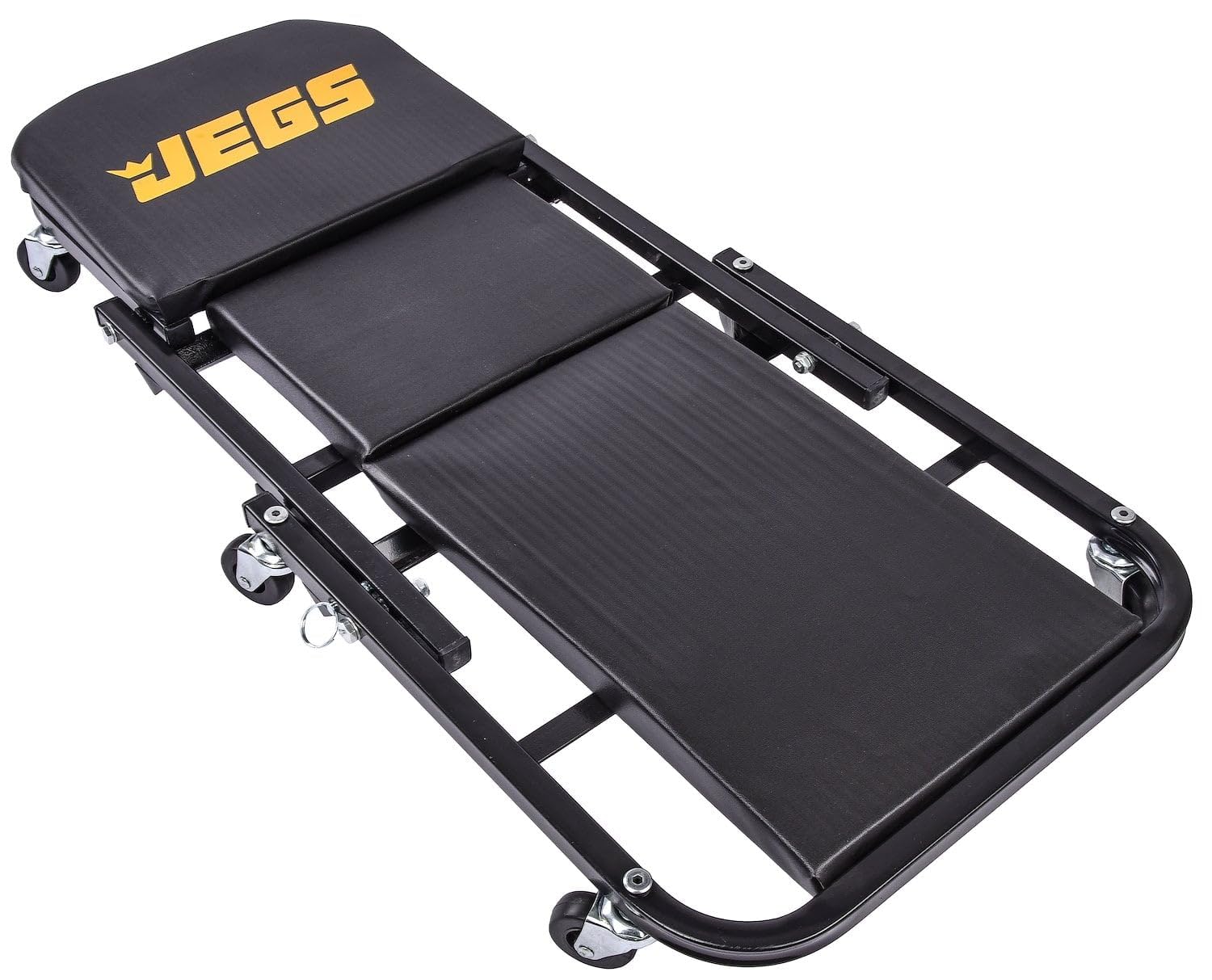
Some jobs need you flat on your back, and some need you sitting upright at wheel height — this JEGS does both with one convenient locking pin. In creeper mode it measures 36 inches long by 17 inches wide, and in seat mode it stands 15 inches high, so you can roll from under the car to the brake job without standing up. The six caster wheels make it easy to glide around, and the padded body and headrest keep you comfortable for longer stretches.
The frame is heavy-duty black steel built to support up to 300 lbs, and owners praise it as “cheap in price but not cheap in quality” — high praise from people who have used it daily at work. Assembly is easy, and the versatility gets the most positive mentions, with the mobility of converting from a seat to a flat surface called out specifically. A gift-buyer noted it “has saved his back working under cars.”
At 15.52 pounds it is a fair amount heavier than a simple plastic board — a 40% weight gap versus the Lisle 97102’s 11.1 pounds. The recurring complaint in the feedback is that the wheels work themselves unscrewed from the seat over time, which is fixable with a wrench but worth knowing. Comfort is also a mixed topic, and several owners note it runs small for people over 5’8″.
Why it wins fans
- Converts between flat creeper and 15-inch seat with a locking pin
- Padded body and headrest for extended sessions
- Owners call the value unbeatable against alternatives
Where it trips up
- Wheels tend to unscrew from the seat and need periodic tightening
- Size gets mixed feedback from taller mechanics over 5’8″
- Heavier to carry than a plain plastic board at 15.52 lbs
Grab it for: the do-it-all home mechanic who is tired of standing up between every task under the car.
Think twice if: you are tall, you have steep driveways, or you want a board you can sling over your shoulder.
4. Omega 91900 Plastic Creeper

The one-piece board that arrives fully assembled and rolls uphill on rough concrete.
No tools, no assembly, no fuss — this Omega comes from the start ready to slide under the truck. It is one piece of blow-molded HDPE plastic with a 300-lb capacity across a 36-inch length and 16-inch width, making it a solid fit for most users. The six 3-inch multi-terrain swivel casters are oil-, chemical-, and grease-resistant, and owners say it rolls easily even uphill on rough concrete — a compliment most creepers never earn.
Functionality and value for money are the two most-praised aspects in the feedback, with quality, comfort, and mobility all close behind. “Works and looks just like the retail store products,” is the kind of verdict that repeats through the reviews. The ergonomic design lets you sit on the end and lay back onto the padded headrest, and two molded-in tool trays keep a wrench within reach while you work.
At just 9.7 pounds it is the lightest board in this lineup, which makes it the easiest to carry between garage and driveway. The trade-offs are small but real: the yellow wheel bolt caps pop off easily and can be lost, and the hard plastic wheels need a flat, smooth surface — they struggle on pebbles and chips.
The standout: value for money is the thing owners mention most alongside functionality — this is the budget pick that does not feel like a budget pick.
Choose this if: you want a no-thought, ready-to-roll board that is light enough to carry and cheap enough to replace without guilt.
skip it if: your work surface is gravel or dirt — this one wants smooth concrete to shine.
5. Pro-LifT C-6048 48-Inch Plastic Creeper
The 48-inch deck that finally fits a 6’4″ diesel mechanic without sag.
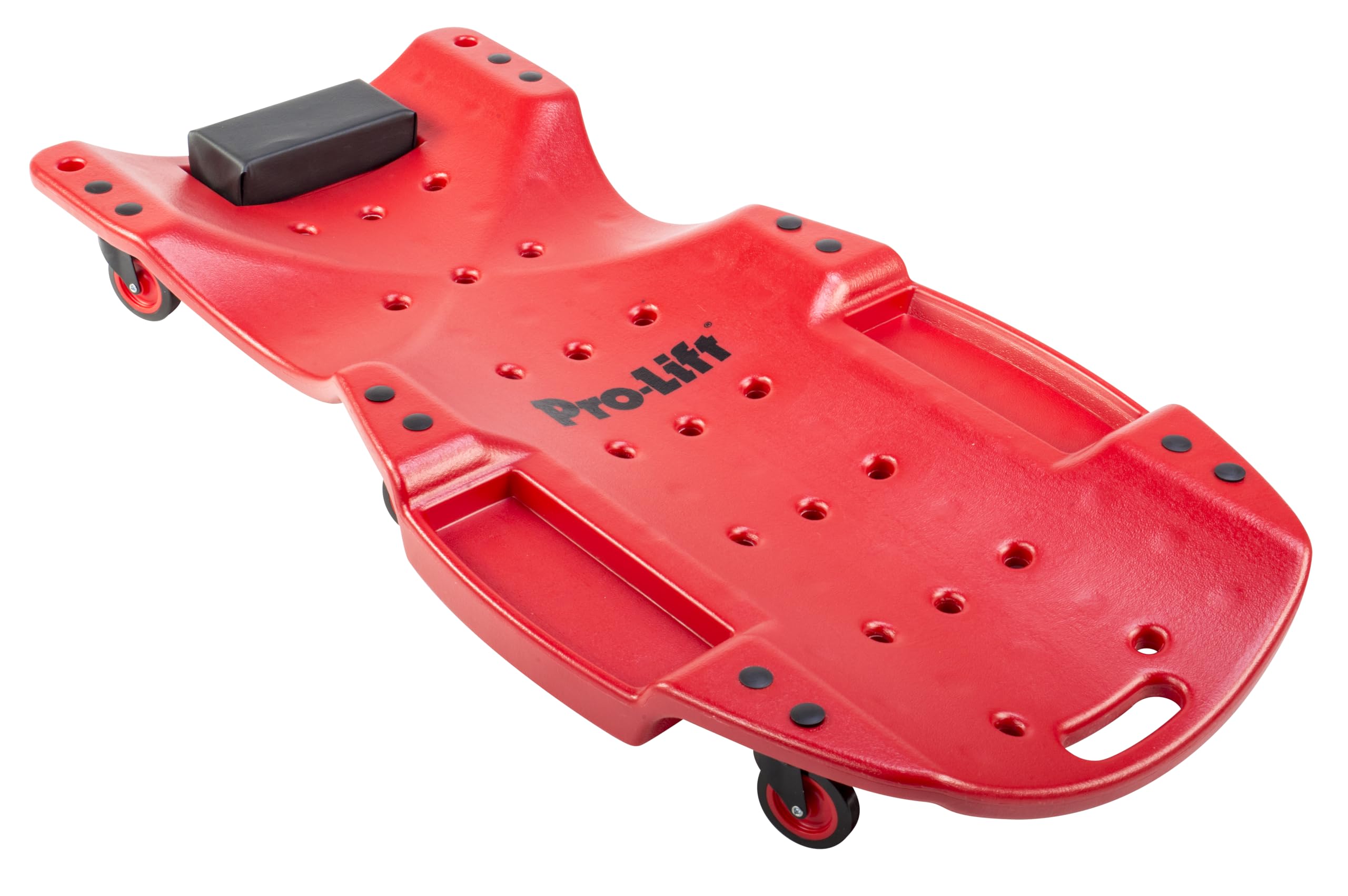
If every creeper you have tried leaves your legs hanging off the end, this Pro-LifT is built for you. It stretches 48 inches long and 23 inches wide — the biggest deck in this roundup — with a 440-lb capacity that beats the 300-lb standard. Owners who are 6’4″ and 280 lbs report it is “roomy, comfy, and doesn’t sag or bend” when they use it, and a diesel mechanic at 300 lbs and 6’4″ calls it the only creeper large enough for him. One heavier user around 350 lbs comfortably swapped a transmission on it.
Like the Omega, it is one piece of blow-molded HDPE plastic with six 3-inch multi-terrain swivel casters that resist oil, chemicals, and grease. The ergonomic shape includes a padded headrest and two molded-in tool trays, plus a carry handle for positioning. Sturdiness is the headline trait in the feedback, with owners calling the casters tough and the build quality “heavy” in the best way.
The weight is the honest trade-off: it runs approximately 16 lbs, so this is not the board you want to haul across a parking lot every day. It also wears a one-year limited warranty covering defects in material or workmanship under normal use.
Who it is for: big-framed mechanics and anyone who has ever felt a 36-inch board end mid-thigh — this is the roomiest, highest-rated-capacity deck here.
Best for: tall, heavy, or professional users who need full-body support and a 440-lb rating they will never stress.
Not for: anyone who wants a lightweight board to carry around — at roughly 16 lbs, it stays in the shop.
6. Traxion ProGear Wide Body Low Profile Creeper

The wide-body deck with 5-inch casters that roll over a rough driveway like it is glass.
Most creepers give up the moment they hit a crack or a pebble — this Traxion treats rough concrete like a minor suggestion. The huge 5-inch casters are made of hard TPR synthetic rubber, and owners say it “rolls better over my rough driveway” than anything they have used. One A&P mechanic with 50 years of experience rates it the best he has owned, noting the large wheels roll easily and don’t hinder clearance.
The wide contoured deck is designed for extra comfort and stability, with a 400-lb weight capacity and a drop-deck design that has no pinch points. A 6’2″ user at 235 lbs reported zero pressure points after a 4.5-hour session, and the lack of side rails lets you kneel or sit on the edge when the job calls for it. A built-in back support adds another layer of lower-back relief.
This one is honest about its limits: it is a low-profile design that works well on concrete, but owners confirm it rolls poorly on sand, gravel, or leaves. It also runs slightly above average height, so it is worth checking clearance if you work on very low cars.
The big wins
- 5-inch all-terrain casters roll over debris and rough driveways
- Wide contoured deck with no pressure points after hours of use
- No side rails — kneel or sit on the edges freely
The honest limits
- Not for sand, gravel, or leaf-covered surfaces
- Height runs slightly above average for very low cars
Reach for it if: your driveway is cracked concrete and you are tired of dragging yourself over every seam.
Look elsewhere if: you park on gravel or work exclusively on slammed, low-clearance builds.
7. Traxion King Crawler Rolling Mechanic Creeper

A flat, fully padded deck that rolls over cracks and cables without a fight.
Some mechanics prefer a concave bucket shape; this Traxion gives you a flat, durable padded deck that measures 40 inches in length — long enough to support most of the body. The X-frame design completely conceals the steel frame while adding strength, so you get a smooth lying surface with nothing digging into your back. Owners who switched from concave bone-style creepers say they prefer the flat layout for comfort.
The 5-inch hard TPR synthetic rubber casters are the same all-terrain design as the ProGear, and the feedback confirms they roll over debris and cracks that stall other creepers. One owner called it “the best creeper I’ve ever had,” praising the large wheels for easy mobility. It is built with easy-to-clean materials, which matters when you are rolling through grease and grime all day.
The reality check: this model sits higher than others, so it needs a vehicle with enough clearance, and there is no brake — owners note it can slide on driveways or when you are loosening nuts. Assembly can also be fiddly, with one owner reporting the frame arrived in pieces and needed filing to fit. The headrest is fixed, and a few owners wish it were adjustable.
What owners love: the big casters roll in any direction over debris, and the flat padded deck is comfortable for long sessions — mobility and comfort are the consistent praise points.
Best for: flat-deck fans on limestone or cracked driveways who want big wheels and easy rolling.
Think twice if: you work on low cars, need a parking brake, or want a low-maintenance assembly from the start.
8. VEVOR Topside Engine Creeper

The topside platform that stands you at the perfect height for engine bay work.
This is not a lie-down creeper at all — it is a topside platform that lifts you up to work on engines, and it is the answer for anyone tired of leaning over a fender. A 9-stage height adjustment ranges from 42.5 to 64.8 inches (1080–1645 mm) with 3 angle options, so you can set it to exactly the height that keeps your arms from overstretching. It is built for trucks, pickups, and Jeeps where the engine bay sits high.
The 400-lb capacity rides on a heavy-duty 3mm-thick steel frame with an H-shaped stable base and reinforced high-strength bolts, so the platform stays put while you lean on it. Two lockable swivel casters and two 360° casters let you roll it into position, then lock the brakes so it does not slide while you work at height. Owners call it “more solid than expected” and say it makes working on trucks and vans genuinely easier.
The 2-inch-thick, 12.4×18-inch cushion adds comfort for long jobs, and a tool pouch keeps your essentials within reach. The honest drawbacks: the assembly instructions are vague, the platform welds and foam pad quality get mixed marks, and it is not foldable as shipped — though owners say it is modifiable with a pin. At 61.3 pounds, it is a permanent shop fixture, not a portable tool.
Why it earns its spot
- 9-stage height adjustment from 42.5 to 64.8 inches fits any truck or van
- Lockable casters keep the platform stable at height
- Owners say the steel frame feels sturdy and solid
What to plan around
- Assembly instructions are vague — rely on the pictures
- Heavy at 61.3 lbs and not foldable without modification
- Foam and vinyl pad quality is a mixed point in the feedback
Get this for: the home shop that works on tall trucks and vans and wants to stop straining over engine bays.
Pass if: you work on cars, want something portable, or expect a plug-and-play assembly experience.
9. Omega 91452 Black Low Profile Z-Creeper

The four-position creeper that folds from a flat board into a chair with back support.
This Omega is the most versatile creeper you can buy, and owners say it will be “the last creeper I’ll own.” The foldable body adjusts into four positions — flat, stool, and full or half back chair — so you can lie down for a brake job, then fold it up to sit upright with back support for a transmission swap. The cushion measures 39 x 13 inches on a 40 x 26 x 4-1/4-inch frame, all rated for a hefty 450 lbs.
The durability here is the stuff of legend in the feedback — it is the single most-praised trait, with over 150 owners calling the construction solid and noting the wheels simply haven’t broken. Quality runs a strong second at 123 mentions. Owners repeatedly call it the smoothest-rolling creeper they have used on rough asphalt, and the high-quality wheels are a recurring compliment. One owner noted it handles a 4ft MaxJax lift while allowing sitting with back support under the car.
At 27 pounds, this is a heavy, serious piece of equipment, and the one consistent gripe is that it sits tall — you have to lift your car higher than with a cheap plastic low-profile board. There is no side tool tray, which a few owners wish existed. But for anyone who wants one tool that covers lying, sitting, and everything between, this is the endgame.
The thing everyone raves about: durability — 150+ owners single out how solidly it is built, and the wheels earn their own round of praise for lasting.
Choose this if: you want one creeper that replaces both a board and a shop stool, and you have the jack height to clear it.
Look elsewhere if: you work on very low cars or want a lightweight board you can carry one-handed.
Understanding the Specs
Weight Capacity and Deck Size
The capacity rating tells you the maximum weight the deck is built to support, and it matters more than most buyers think. A 300-lb rating is the standard baseline, but if you are heavier, work on your knees, or put tools on the deck, a 440-lb or 450-lb creeper gives you real headroom. Deck length and width determine whether your legs and shoulders stay supported — a 48-inch deck fits a 6’4″ mechanic, while a 36-inch deck is fine for most average builds.
Casters and Floor Clearance
The wheels are the difference between gliding and dragging. Small 2-inch rollers are fine on smooth concrete, while 3-inch multi-terrain casters handle light debris, and 5-inch all-terrain casters roll over cracks and rough driveways without stopping you. Low-profile clearance — like the Lisle’s 7/8-inch gap — decides whether you can slide under a low car and over cords, but it also means less room for big wheels. Match the caster size to your floor surface first.
FAQ
Is a low-profile creeper worth it over a standard one?
What weight capacity do I actually need in a creeper?
Can a creeper really help with back pain?
What is the difference between a creeper and a topside creeper?
Are larger wheels always better on a creeper?
How do convertible creeper seats work?
Which creeper is best for a tall or heavy mechanic?
How do I keep creeper wheels from coming loose?
Can I use a creeper on gravel or dirt?
What is the most durable creeper material?
Final Thoughts: The Verdict
For most buyers, the car creeper worth buying is the Lisle 97102 — the crowd favorite at 4.8 stars across 700+ owners — because it nails the balance of low-profile clearance, lumbar support, and body-fitting comfort. If you want the versatility of switching between lying and sitting as you work, grab the JEGS 2-in-1. And for the tall or heavy mechanic who has never felt a deck long enough, the Pro-LifT C-6048 with its 48-inch, 440-lb platform is the one to reach for.
How We Picked
We do not accept paid placement. Every pick is matched to a real buyer and a real use-case; we do not hands-on test units.
Sources & Methodology
Specifications: manufacturer listings and product documentation. Review insights: verified customer reviews, as of August 2026. Pricing: not shown on this page (it changes often); check the current price via the retailer link.
As an Amazon Associate, Trending Car earns from qualifying purchases. This does not affect which products we feature.