
Our readers keep the lights on and my garage snacks stocked. As an Amazon Associate, I earn from qualifying purchases.
Specs are compiled from manufacturer listings and verified buyer reviews and can change over time — please confirm the key details on the product page before buying.
An onboard battery charger ends the ritual of hauling heavy batteries out of your boat or RV just to plug them in. It stays mounted, wired directly to your battery bank, and tops everything off whenever you connect to shore power or a garage outlet. Match the charger’s bank count, amp output, and battery chemistry to your setup, or you risk a battery that never fully charges.
I’m Min Islam — the founder and writer behind Trending Car. This guide is built by comparing the manufacturers’ published specifications and the patterns across verified customer reviews, so you get each pick’s real strengths and trade-offs instead of marketing spin.
Here’s the short version before the details: buy the charger that matches your battery chemistry and bank count, then match amp output to your battery size. Finding the right onboard battery charger is about matching those two specs to your rig, and this guide breaks down the best options.
Our Picks at a Glance
How To Choose The Best Onboard Battery Charger
The first decision is always the same: count your batteries. A single-engine boat with one starting battery only needs a 1-bank unit, but add a trolling motor or a house battery and you are looking at a 2-bank or 3-bank charger. Each bank is an independent output, so a 2-bank charger can fill two separate batteries at the same time without mixing them.
Match the battery chemistry
Most chargers handle standard flooded lead-acid, but AGM and lithium batteries charge at different voltages and need specific profiles. If you run LiFePO4 cells, look for a charger that names lithium explicitly — charging a lithium pack with a lead-acid profile can leave it short of a full charge or stress the cells.
Check the water resistance
Check the charger’s IP rating to ensure it survives splashes or submersion in your mounting location. IP67 means the unit can survive immersion in water up to a meter, while IP65 handles splashes and rain but is not meant to be submerged. For an open boat, a higher IP rating like IP67 provides confidence against water exposure.
Quick Comparison
| Model | Best For | Banks | Amperage | Water Rating | Amazon |
|---|---|---|---|---|---|
| Guest 2707A★ Best Overall | Reliable dual-bank boats | 2 | 8 A | IP67 | Amazon |
| FirstPower Pro 10X1Best Value | Budget single-bank | 1 | 10 A | IP68 | Amazon |
| NOCO GEN5X2 | Compact dual-bank | 2 | 10 A (5 per bank) | IP68 | Amazon |
| Guest 2711A | Higher-amp dual-bank | 2 | 10 A | — | Amazon |
| LiTime 2-Bank | Lithium battery owners | 2 | 10 A | IP65 | Amazon |
| ProMariner ProSport HD | Triple-bank setups | 3 | 20 A | — | Amazon |
| Minn Kota MK 330D | Trolling motor rigs | 3 | 10 A | — | Amazon |
In‑Depth Reviews
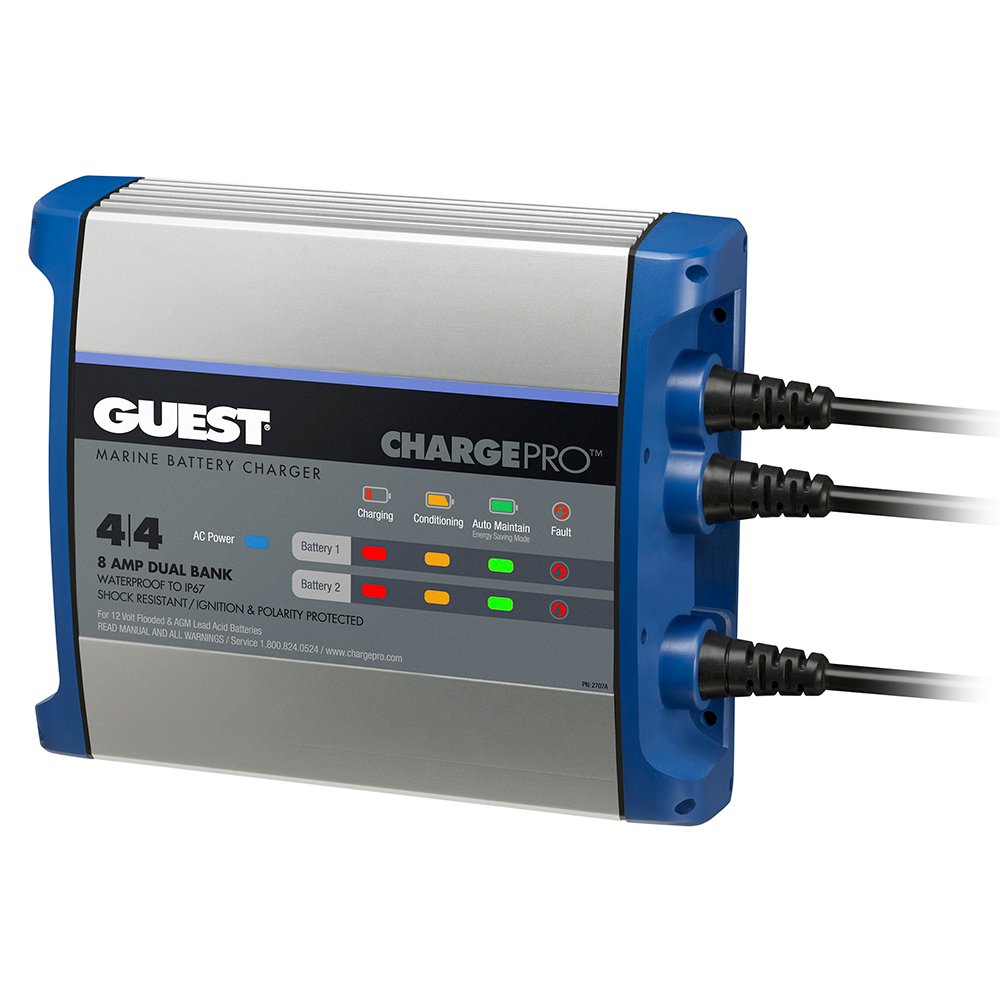
1. Guest 2707A Guest On-Board Battery Charger 8A / 12V, 2 Bank, 120V Input
Our pick — over 4.5★ from 800+ verified ratings; the strongest balance of quality and price.
The dependable twin-bank workhorse that keeps two boat batteries full without fuss.
The Guest 2707A charges two batteries independently, so a starting battery and a house battery each get their own attention. It runs on 120-volt input and pushes 8 amps total, which is plenty for keeping a typical weekend boat topped off between trips. Buyers report that the dual-bank design handles both batteries without the intermittent “bad battery” warnings they saw from a previous charger.
What makes this a standout for marine duty is the IP67 waterproof rating, meaning the sealed case can survive being submerged in up to a meter of water. That pairs with a shock-resistant housing and an in-line fuse, plus built-in protection against reverse polarity, over-current, over-voltage, over-temperature, and ignition events. It handles 12-volt flooded and AGM lead-acid batteries, which covers most standard boat setups.
Owners praise its simple installation and clear LED indicators that show charge status at a glance. It is slightly heavier than the NOCO at 4.5 pounds compared to 4.2, a negligible difference for a mounted unit. The crowd favorite here holds a 4.7 rating across hundreds of owners, and the consensus is that it simply does its job season after season.
Easy living: LED lights and simple wiring mean you can install it on a Saturday and stop worrying about dead batteries at the dock.
Know the pairing: This is built for lead-acid and AGM — if you run lithium, you will want a charger with a dedicated lithium mode.
Reach for it if: you have two 12-volt lead-acid or AGM batteries and want a proven, waterproof charger that owners describe as reliable for years.
Think twice if: your bank includes LiFePO4 batteries, since this unit does not list a lithium charging profile.
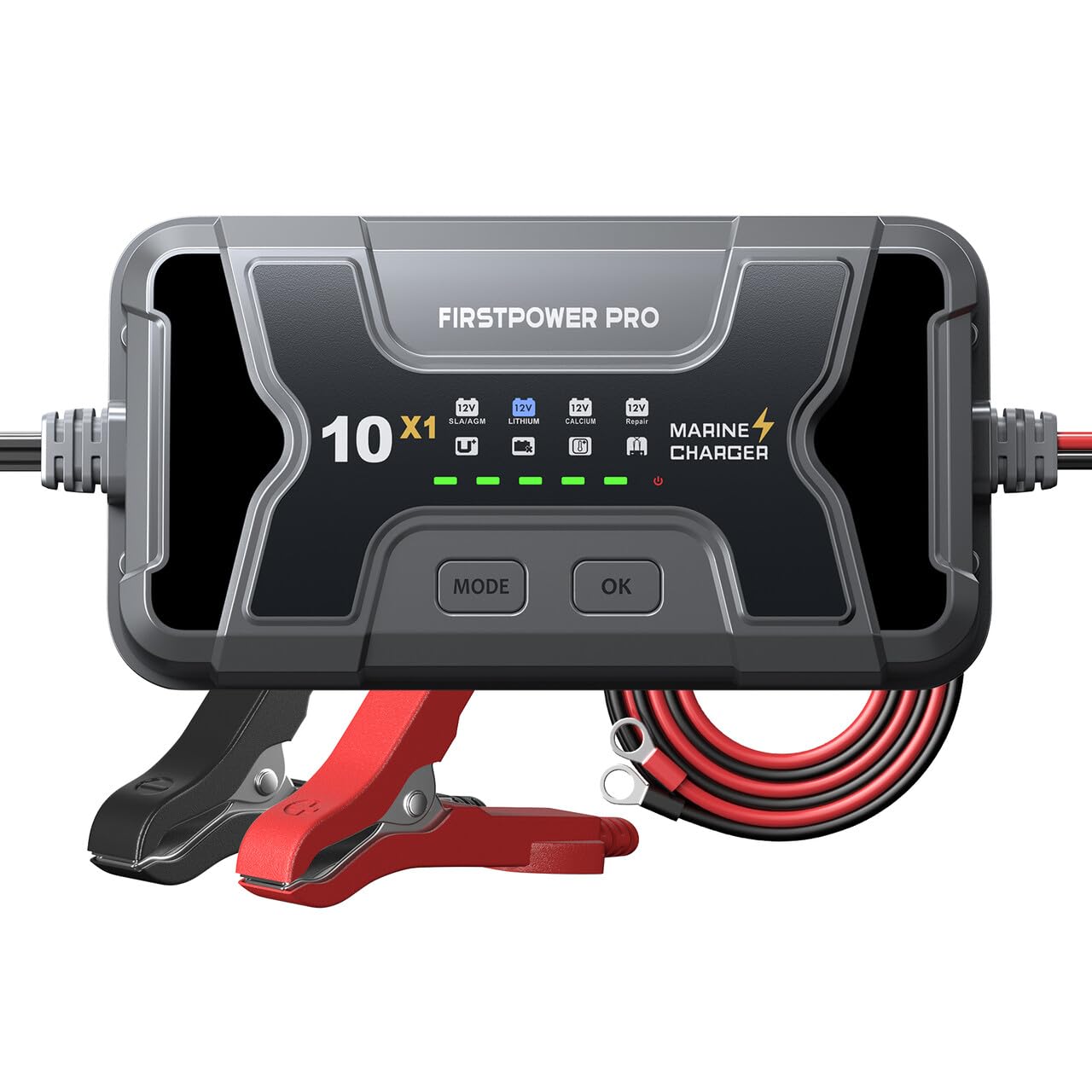
2. Marine Battery Charger 10X1: 1-Bank 10A Onboard Battery Charger | 12V Waterproof Boat Battery Charger
The single-bank budget pick that charges lead-acid and lithium with a push of a button.
If you only have one battery to maintain, the FirstPower Pro 10X1 is a budget-friendly way to get a smart charger without paying for banks you will not use. It delivers 10 amps to a single 12-volt battery and pushes an IP68 rating — the fully sealed case is built to handle submersion, so it is safe to leave mounted in a wet bilge. At 120-volt input, it is a straightforward shore-power or garage plug-in.
The standout feature is its three selectable charging modes: 12V SLA/AGM for lead-acid, 12V LITHIUM for LiFePO4, and 12V CALCIUM, each running a multi-stage charge. Press “MODE” to match your battery type. For a battery sitting below 1 volt, Force Mode lets you hold the “OK” button for 3 seconds to start a recovery charge. There is also an auto-repair mode plus diagnostics for over-voltage, bad battery, over-temperature, and reverse connection — a strong safety net at this price tier.
Reliability is what owners praise most, and the charger has proven itself with both AGM and lithium setups, including a 3-battery backup power supply. It is a bit larger and heavier than the dimensions might suggest, so check your mounting space before committing. One honest caveat from the review pages: the battery-life display does not work when the charger is unplugged, so do not buy it expecting a standalone battery monitor.
What wins people over
- Three charging modes cover lead-acid, AGM, and lithium
- Fully sealed IP68 case handles submersion
- Force Mode revives deeply discharged batteries
- 3-year warranty backs the unit
Reality checks
- Larger and heavier than expected, so verify fit
- Display only shows battery life while plugged in
- Single bank means one battery at a time
Pick it if: you have one 12-volt battery, want lithium compatibility, and do not need multi-bank charging.
Look elsewhere if: you need to charge a starting and a house battery at the same time — this one only handles one.
3. NOCO Genius GEN5X2: 2-Bank, 10A Onboard Battery Charger – 5A Per Bank

The most compact dual-bank charger here, engineered to mount in tight, wet spaces.
The NOCO GEN5X2 splits 10 total amps across two banks, giving you 5 amps per battery for handling a main and a house battery. NOCO claims this model is compact, and the compact footprint is real — it fits where bulkier chargers will not. It accepts 240-volt input and weighs 4.2 pounds, slightly lighter than the Guest equivalent, so mounting it upside down or in a cramped compartment is genuinely easier.
Each bank has selectable modes for 12V, 12V AGM, 12V Lithium, and 12V Repair, so you can run different battery chemistries on the same unit. The integrated thermal sensor adjusts charge based on ambient temperature to prevent overcharging in heat and undercharging in cold. It can even start charging a battery from as low as 1 volt, or use Force Mode to recover batteries down to zero volts. The IP68 rating means the sealed case survives brutal underwater testing.
There is one installation quirk owners flag: do not cut the wire before the rubber boot on the leads, because it contains the temperature sensor — the charger will not work without it. Beyond that, the GEN5X2 is widely praised for its rugged build, clear per-battery LED indicators, and reliable off-season maintenance. The 72-inch DC cables give you plenty of reach when mounting.
Space saver: its compact size and secure mounting make it the best fit for tight engine bays, even mounted upside down.
Handle with care: respect the temp sensor in the leads during install, and this charger will serve you for years.
Best for: boaters who want a compact, feature-rich dual-bank charger that handles multiple battery chemistries in one unit.
Not for: anyone who needs more than 5 amps per bank — the total output caps at 10 amps.
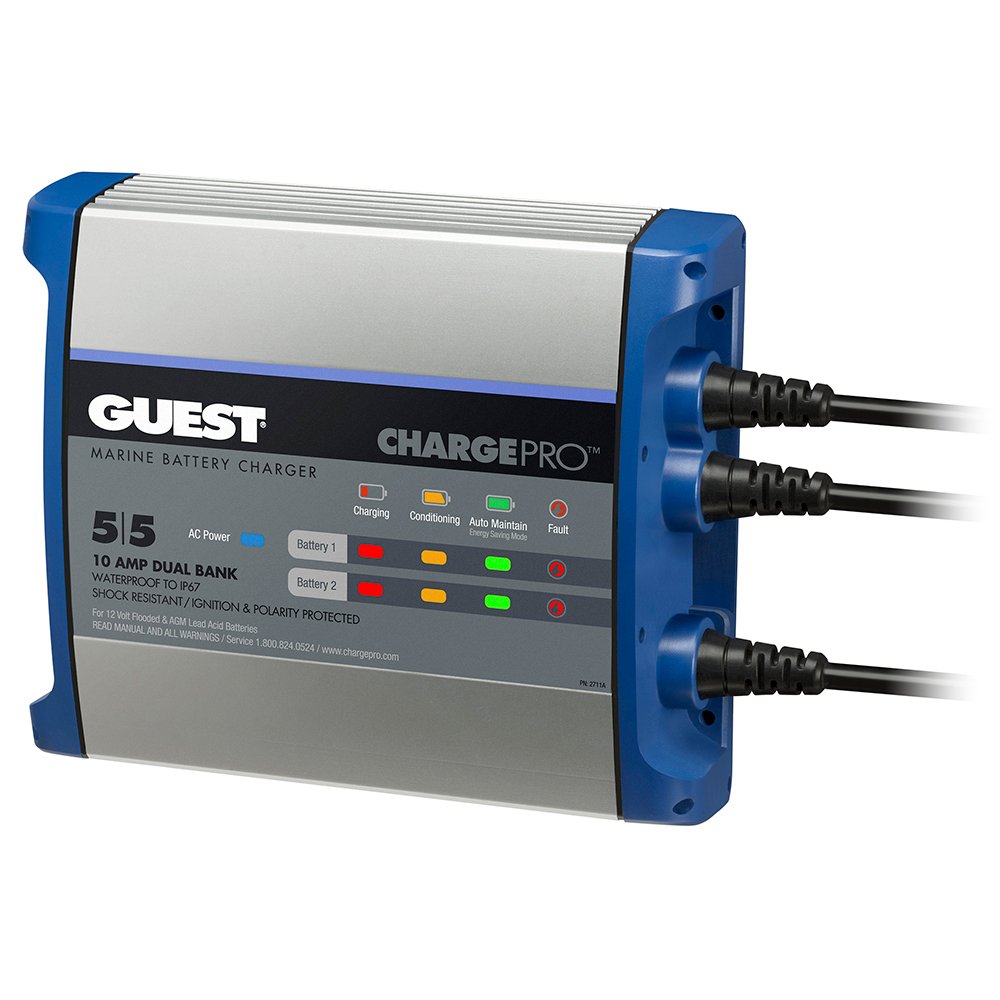
4. Guest 2711A Guest On-Board Battery Charger 10A / 12V, 2 Bank, 120V Input
The step-up dual-bank charger that delivers 10 amps to keep bigger batteries fully loaded.
If the 2707A is the standard-bearer, the Guest 2711A is its higher-amp sibling, pushing a full 10 amps to two banks instead of 8. That extra output matters when you have larger batteries or want a faster recovery after a long day on the water. At 4.7 pounds with 120-volt input, it is built to the same rugged standard as its smaller sibling and shares that familiar gray-and-blue case.
Owners are quick to point out that this charger does not cook batteries — the auto-maintain mode keeps a dual lead-acid setup topped off without boiling the cells. The LED status lights are more informative than older models: green for good, red for bad, flashing red for a warning, and blue for AC-only power. One owner logged nine years on a previous Guest dual-bank charger, which says a lot about the brand’s longevity.
Its solid functionality and easy installation are the top reasons owners recommend it. It charges and maintains two batteries independently, and owners mention it runs and charges two batteries in parallel without issue. The recurring caveat is that cable length and overall durability draw mixed feedback, so plan your mounting spot near the battery bank to keep the leads short.
Higher output: 10 amps total gives you faster top-ups than the 8-amp Guest, ideal for bigger dual-battery setups.
Watch the leads: cable length gets mixed reviews, so mount it close to your batteries.
Go with this if: you want the proven Guest reliability but need more charging muscle than the 2707A provides.
skip it if: your battery bank is lithium — this unit is built for lead-acid and AGM only.
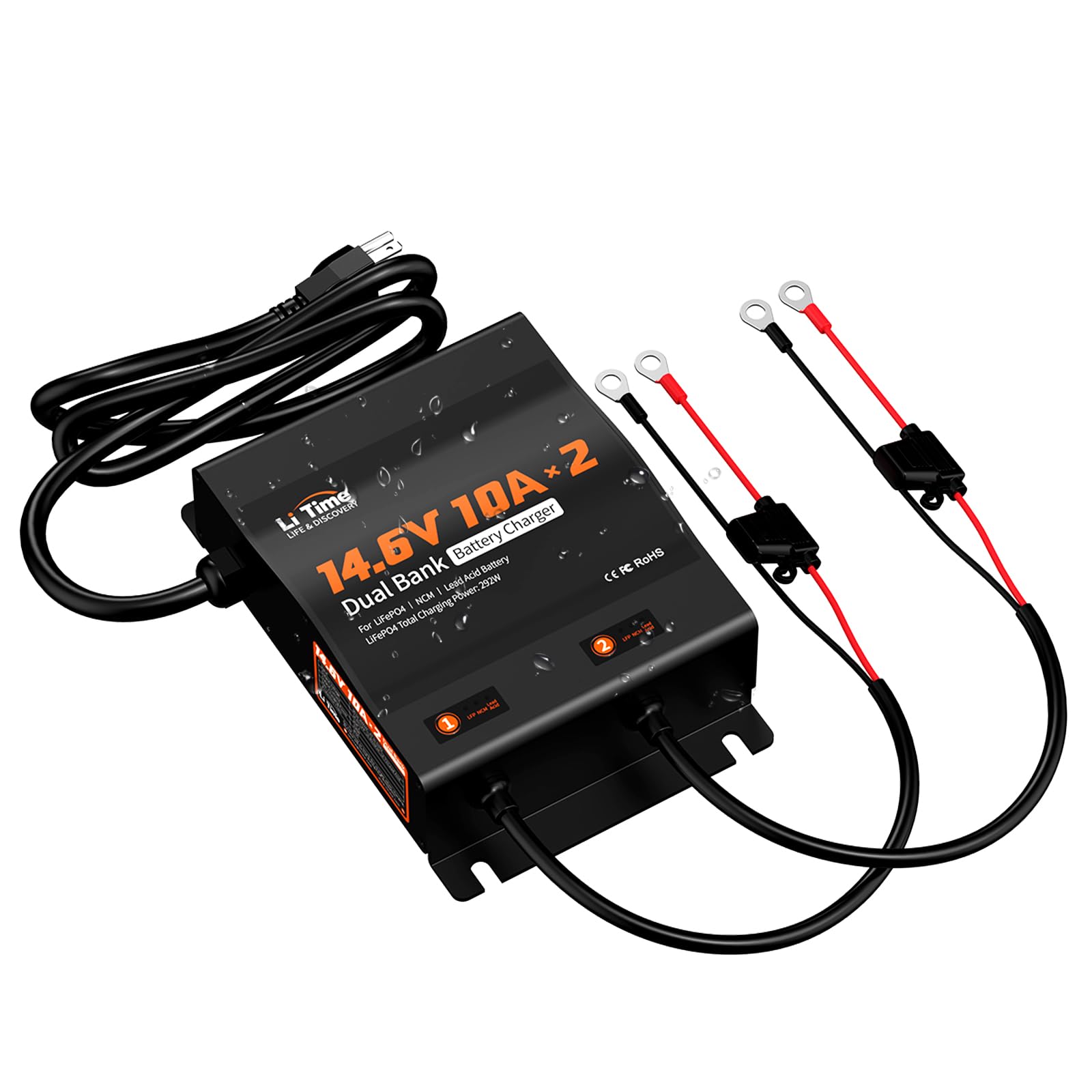
5. LiTime 2 Bank 12V 10A LiFePO4 Battery Charger, Waterproof, 14.6V Output
The dual-bank charger built specifically for LiFePO4 lithium batteries, with a 14.6-volt finish.
If you’ve switched to lithium batteries, the LiTime 2-Bank is the one to grab because it outputs 14.6 volts, the correct target for LiFePO4 packs (a type of lithium battery), and delivers 10 amps per bank to charge two batteries at once. You won’t have to trust a lead-acid charger with your expensive cells. It accepts a wide 90V-260V AC input, so it works across different shore-power standards.
The wall cord comes with 15A fuses for safety, and the unit carries CE, FCC, and RoHS certifications. Its IP65 waterproof rating handles splashes and rain, though it is not built for full submersion like the IP68 units higher up this list. Multi-level protections guard against over-temperature, over-current, reverse polarity, output short-circuit, and output over-voltage, with an M8 terminal connection that makes wiring clean and secure.
Customers note it slowly and safely charges two 12V 300Ah lithium iron phosphate batteries overnight, and several note that the gentler charge rate feels safer than fast charging. Owners praise its functionality most, with charging speed a close second. The trade-off is the 6.6-pound weight — it is the heaviest dual-bank unit here — and the IP65 rating, so keep it out of the bilge water.
Why lithium owners love it
- 14.6V output is the correct profile for LiFePO4 batteries
- 10 amps per bank charges two batteries at once
- Wide 90V-260V AC input for flexible power sources
- M8 terminals make a clean, secure connection
Keep in mind
- IP65 resists splashes but not full submersion
- Weighs 6.6 pounds, the heaviest dual-bank pick
Reach for it if: your boat or RV runs LiFePO4 lithium batteries and you want a charger that matches their exact voltage.
Look elsewhere if: you need a charger that can be fully submerged — the IP65 rating does not cover that.
6. ProMariner 44021 ProSport HD Waterproof Marine Battery Charger, 20 Amp, 3 Bank
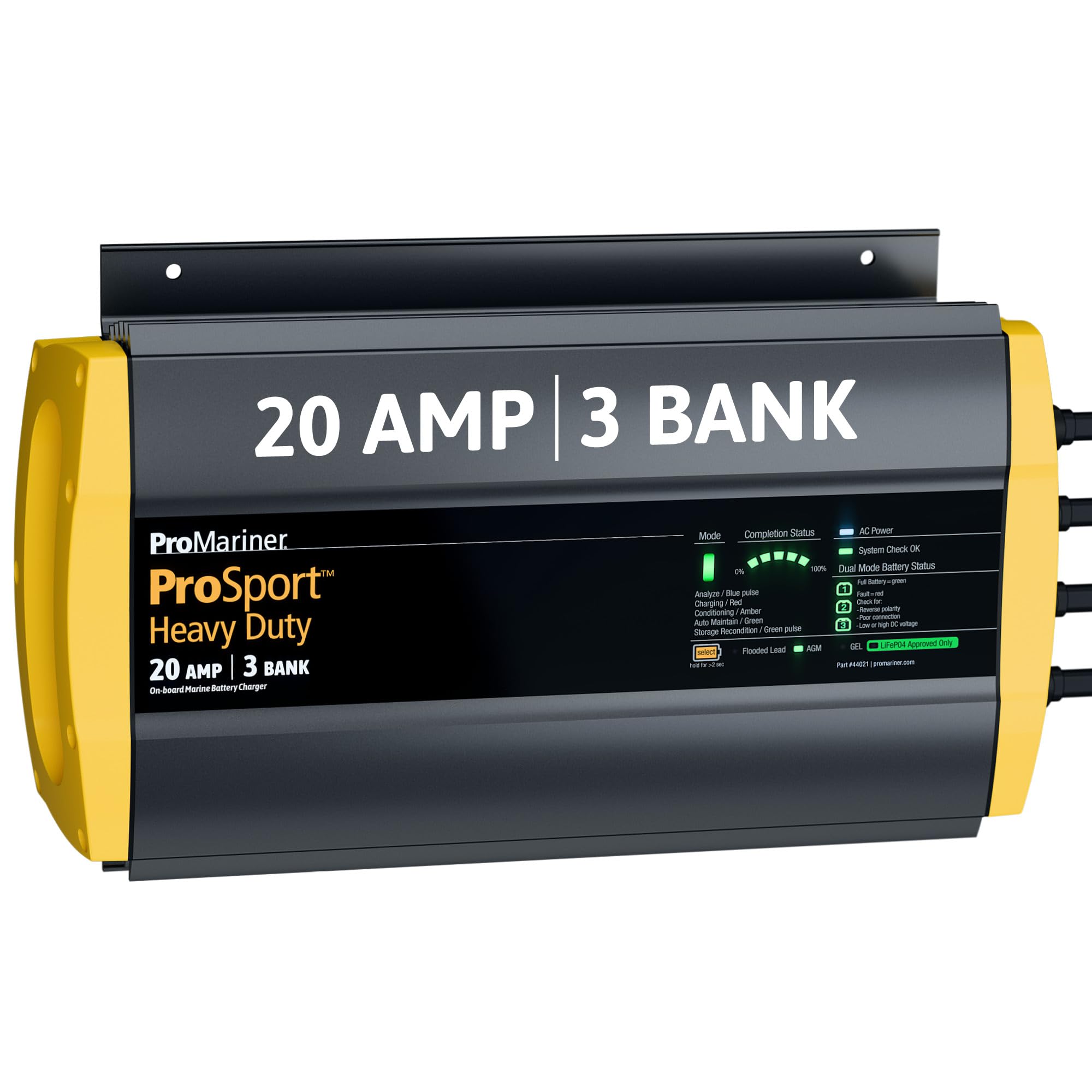
The 20-amp triple-bank powerhouse that distributes unused power wherever your batteries need it.
Three batteries on board — maybe a starting battery, a house bank, and a trolling motor pack — need a charger with three independent outputs, and the ProMariner ProSport HD delivers 20 amps across them. Its Distributed-On-Demand Technology takes all available charging amps and sends them to any one or combination of batteries as needed, so a depleted bank can pull the full 20 while the others sit at float. ProMariner rates a full charge in about 5 hours.
You get true rated constant current during both charge modes because the heavy-duty tri-surface extruded heat sink pulls heat away from the case on upper, lower, and rear surfaces. That matters on a boat where the charger lives in a cramped compartment without much airflow. An expanded LED display shows a fuel-gauge-style completion status, a multi-stage mode bar, system check, individual battery status, and battery type indication — among the most informative readouts in this lineup.
Reviewers point out this unit has run flawlessly for over five years, even through -20°F winters, keeping gel batteries healthy all season. It is a repeat purchase for many — several buyers are on their second or third unit across different boats. The trade-off is size and weight: at 7.2 pounds with a 16.4-inch width, it needs a solid mounting spot, and the battery clamps mean you will want to swap in ring terminals for a permanent install.
Smart distribution: unused amps shift to the batteries that need them, making this the most efficient triple-bank pick.
Plan the install: its larger footprint and 7.2-pound weight demand a sturdy mounting surface.
Best for: boats with three batteries where you want smart amp distribution and a clear digital readout.
Not for: tight compartments — this is a big unit that needs real mounting space and airflow.
7. Minn Kota 1823305 MK 330D Digital On-Board Marine Battery Charger, 3 Bank x 10 Amps

The three-bank workhorse for trolling motor rigs, delivering a reliable 10 amps per battery.
If you run a 24-volt trolling motor, you have multiple batteries wired together, and the Minn Kota MK 330D is built exactly for that job. It charges three banks at 10 amps each, which is why it is a favorite among anglers who need two batteries for the trolling motor plus a third for the starting battery. It accepts 240-volt input and uses a microprocessor-based digital design for a fast, precise charge. Minn Kota rates a full charge in about 8 hours.
Automatic temperature compensation adjusts the charge based on ambient temperature, keeping the output accurate whether the boat sits in summer heat or cold storage. The automatic multi-stage charging controls the voltage and current throughout the cycle. LED indicator lights tell you the charge stage, maintenance mode status, error notifications, and when your battery is full. The waterproof, shock-resistant, vibration-resistant build is standard for the category.
This charger carries a serious reputation: several shoppers say their previous Minn Kota unit lasted 14 years before needing replacement, and the brand earns strong loyalty. Functionality earns the top praise by a wide margin, with build quality close behind. The honest caveats are its 13.5-pound weight — by far the heaviest unit here — and mixed feedback on battery life maintenance, so expect a substantial, solidly built box that needs a beefy mounting location.
Built for anglers
- 10 amps per bank handles 24V trolling motor rigs
- Temperature compensation keeps charge accurate in any weather
- Clear LED indicators for charge stage and errors
- Proven longevity, with owners logging 14 years of service
Heads up
- At 13.5 pounds, it demands a strong mounting surface
- Not compatible with gel batteries
Pick it if: you run a 24-volt trolling motor setup and want the trusted brand for multi-bank charging.
Think twice if: weight is a concern or you use gel batteries — this unit is heavy and does not support gel.
Understanding the Specs
Banks and Amps
Banks are separate charging outputs — a 2-bank charger fills two batteries independently, and a 3-bank handles three. Amps measure how fast the charger works; more amps means faster charging, but the right number depends on your battery size. A 10-amp charger suits most standard marine batteries, while a 20-amp unit can top off a larger bank more quickly.
Water Resistance Ratings
You want a charger that won’t die from a splash or a dunking, so check its IP rating (a standard that measures how well the sealed case keeps out moisture). IP67 means the charger survives submersion in up to a meter of water, ideal for open boat compartments. IP65 handles splashes and rain but is not built for full submersion. For a wet bilge, a higher IP rating like IP67 provides confidence against water exposure.
FAQ
How many banks do I need for my boat or RV?
Can I leave an onboard charger plugged in all the time?
Will a lead-acid charger work with a lithium battery?
What is the difference between IP65 and IP67 waterproof ratings?
How long does an onboard charger take to charge a battery?
What does “per bank” amperage mean?
Why does my charger need temperature compensation?
Can I mount the charger upside down or in a tight compartment?
Final Thoughts: The Verdict
For most people, the onboard battery charger winner is the Guest 2707A because it pairs proven dual-bank reliability with a fully submersible IP67 case and safety protections that cover the common failure points. If you run lithium batteries, grab the LiTime 2-Bank for its correct 14.6-volt profile. And for a three-battery trolling motor rig, the ProMariner ProSport HD is the one to reach for thanks to its smart amp distribution and clear digital readout.
How We Picked
We do not accept paid placement. Every pick is matched to a real buyer and a real use-case; we do not hands-on test units.
Sources & Methodology
Specifications: manufacturer listings and product documentation. Review insights: verified customer reviews, as of August 2026. Pricing: not shown on this page (it changes often); check the current price via the retailer link.
As an Amazon Associate, Trending Car earns from qualifying purchases. This does not affect which products we feature.