
Our readers keep the lights on and my garage snacks stocked. As an Amazon Associate, I earn from qualifying purchases.
Specs are compiled from manufacturer listings and verified buyer reviews and can change over time — please confirm the key details on the product page before buying.
Mounting a camera to your bars or helmet is the easy part. The real challenge is picking one that actually keeps your ride footage watchable when the pavement gets rough, and that lasts longer than your ride. The wide world of cycling cameras splits into three simple camps: action cams that shoot what’s ahead, rear view systems that show what’s behind you, and safety radars that record and warn you about approaching traffic. This guide sorts through each type using real specs and genuine owner experiences so you can pick the one that fits how you actually ride.
I’m Min Islam — the founder and writer behind Trending Car. This guide is built by comparing the manufacturers’ published specifications and the patterns across verified customer reviews, so you get each pick’s real strengths and trade-offs instead of marketing spin.
These picks cover everything from 4K helmet footage to radar that spots cars 153 yards out, so you get the full picture on the best cycling cameras for your bike, your budget, and your safety.
Our Picks at a Glance


How To Choose The Best Cycling Camera
Start by deciding what the camera is actually for. Do you want to relive your descents with cinematic footage? Or are you more concerned about having video evidence if a car cuts you off? That single decision points you toward a forward-facing action camera or a rear-facing safety system.
Stabilization Is Everything on a Bike
A camera mounted to a handlebar or helmet picks up every vibration from the road. Without good stabilization, your footage looks like a home movie shot during an earthquake, no matter how many pixels the sensor has. Look for cameras that advertise advanced stabilization features, like horizon leveling, which keeps the video steady even when you lean into corners. Some cheaper units skip this entirely, and buyers report the bouncing image makes riding footage hard to watch.
Choose Your View: Front, Back, or All Around
Most action cameras point forward to capture the trail or road ahead. A dedicated rear view camera mounts to your seatpost and feeds a live image to a handlebar screen, giving you a constant look at traffic behind you. The most advanced option is a rear radar, which actively detects cars approaching from behind and alerts you before you even hear them. Decide which view fills the gap in your current setup.
Quick Comparison
| Model | Best For | Video Resolution | Stabilization | Battery Life | Amazon |
|---|---|---|---|---|---|
| DJI Osmo Action 5 Pro★ Best Overall | All-round premium action | 4K/120fps | 360° HorizonSteady | 4 hours | Amazon |
| GoPro Hero12 BlackTop Performer | Reliable action video | 5.3K60 | HyperSmooth 6.0 | 70 minutes | Amazon |
| Garmin Varia RCT715Safety First | Rear safety & radar | 1080p at 30fps | — | 4-6 hours | Amazon |
| GoPro HERO13 Black | High-end action bundle | 5.3K60 | HyperSmooth 6.0 | 1.5 hours | Amazon |
| AKASO 360 | rich 360° footage | 5.7K | 360-SuperSmooth | ~1 hour per battery | Amazon |
| PARKVISION Rear View | Live rear view screen | 1080P | — | 9 hours | Amazon |
| AKEEYO AKY-710S | Budget dash-cam style | 4K 28fps | — | — | Amazon |
| AKASO EK7000 | Entry-level value | 4K30fps | — | — | Amazon |
| 4K Mini Body Camera | Discreet & lightweight | 4K | — | 5.5 hours | Amazon |
In‑Depth Reviews
1. DJI Osmo Action 5 Pro Adventure Combo
Our pick — over 4.5★ from 900+ verified ratings; the strongest balance of quality and price.
The all-day workhorse that keeps your horizon level through every rough patch.
This is the pick for riders who want one camera to do everything, from dawn commutes to steep descents, without worrying about battery or water. It records 4K video at 120fps, which means you can slow the action down to a smooth crawl and still get crisp detail. The 1/1.3″ sensor with 2.4 µm pixels is what gives it that strong low-light performance, so your pre-sunrise rides don’t come out as grainy silhouettes.
The Adventure Combo is built around long rides, shipping with three 1950mAh batteries and a multifunctional case. That setup delivers up to 4 hours of recording on a single battery, and the whole kit keeps you shooting far longer than any single-cell camera. It’s also IP68 rated for 20m underwater use, so a sudden downpour or a splash through a puddle is never a reason to stop filming. The dual OLED touchscreens make it easy to frame a shot from either side, and the voice control is a nice touch when you’re gloved up.
Owners who push this camera hard report impressive endurance, with the phrase “2 years, hundreds of hours, zero failures” coming up from a professional user. The 360° HorizonSteady stabilization is the standout feature for cyclists, eliminating roll-axis shake so your footage stays level even when the bike doesn’t. The digital zoom here is 2x, which is more modest than some rivals, but with a 40MP effective still resolution, you have plenty of detail to crop into later.
Why it leads the pack
- 4-hour battery life per cell beats most rivals, and you get two spares in the combo
- Subject tracking keeps you centered in frame automatically
- Waterproof to 20m without a housing, so weather is never a concern
Worth knowing before you buy
- The extension rod has no shutter button when extended, so you’ll rely on the app or start recording first
- It generates noticeable heat after a few minutes of recording, though owners call it manageable
Reach for this if: you want a premium, do-it-all action camera with class-leading stabilization and battery endurance for long rides.
Look elsewhere if: you’re after a simple rear-facing safety camera, because this is built to film what’s in front of you.
2. GoPro Hero12 Black
An Emmy-winning stabilizer that turns bumpy trail rides into cinematic shots.
When you want the most forgiving footage possible, the HERO12 Black brings GoPro’s HyperSmooth 6.0 stabilization, an Emmy Award-winning system that smooths out the shakiest conditions. It shoots 5.3K video at 60fps, giving you 91% more resolution than 4K to play with when cropping or zooming in post. The 1/1.9″ image sensor captures 27MP photos and supports HDR for truer colors in bright and shadowy scenes.
The Enduro battery is rated for up to 70 minutes of continuous recording at 5.3K60, which is solid for a single-cell setup. It’s waterproof to 33ft (10m) without a housing, so a surprise rain shower won’t cut your session short. The 360° Horizon Lock keeps your footage level even if the camera rotates fully, which is a lifesaver on technical terrain. Bluetooth audio connectivity lets you pair wireless mics or earbuds for cleaner sound than the built-in mic alone.
The main trade-off owners highlight is heat, as the camera runs warm during use, though short recording sessions under 10 minutes avoid overheating issues. The battery is the other recurring topic, with some riders noting it only lasts about half a ride when recording continuously. If you’re doing long tours, you’ll want spare batteries, but for a full day of 5-minute clips, owners say it holds up fine. It’s a dependable choice that pairs with the massive GoPro accessory ecosystem.
Star of the show: HyperSmooth 6.0 stabilization and 5.3K resolution combine for footage that looks professional even off a bumpy mountain path.
A confident pick for: riders who want top-tier video quality with proven stabilization from the market leader.
Just note: continuous 5.3K recording drains the battery in about 70 minutes, so plan for spares on long rides.
3. Garmin Varia RCT715
A rearward radar and camera that warns you about cars before you hear them.
This is the pick for riders who see a camera as a safety tool, not just a toy. The Varia RCT715 combines a rearview radar, a built-in camera, and a bright tail light into one unit that mounts to your seatpost. The radar detects vehicles approaching from behind up to 153 yards (140 meters) away and sends alerts to your Garmin Edge computer, select wearables, or the Varia app on your phone. For riders with hearing loss or on loud, windy roads, this early warning is invaluable.
The built-in camera records sharp 1080p video at 30fps, and it automatically saves footage if it detects an incident. It captures video before, during, and after an event, which owners say is great for catching license plates clearly. You can manage footage and settings easily through the Varia mobile app. A 16GB SD card is included, so it’s ready to use from the start.
Battery life is smartly managed with three modes: always-on, lights-and-radar only, or radar-activated, which turns the camera on when a car approaches. Runtime reaches up to 4 hours with radar and tail light on solid high or night flash, up to 5 hours on solid low, and 6 hours on day flash, all with the camera recording at 1080p. Owners call it a “life saver” and a top safety investment, though some note it’s a bit heavy and draws enough power that you’ll want to charge it after every ride.
Why it’s a standout: You get rear-end protection that works even when you can’t hear a car coming: the radar (a sensor that detects vehicles approaching from behind) picks up cars beyond your hearing range, and the camera automatically saves the footage if you’re in an incident, so you have proof without touching a button.
The honest catch: It requires a compatible Garmin head unit to open up the full radar alert experience, which is an extra investment.
A must-have for: safety-focused roadies and commuters who want to know what’s coming from behind and record it automatically.
Think twice if: you’re on a strict budget, as the full setup with a Garmin head unit is a significant investment.
4. GoPro HERO13 Black Bundle

The newest GoPro with HDR video and a huge accessory kit to mount it anywhere.
For riders who want the latest features and everything they need to mount it, this HERO13 bundle is tough to beat. The camera shoots up to 5.3K60 video with HDR/HLG options and a 1/1.9″ sensor, capturing 27MP photos. It also supports 4K120 and 2.7K240 for up to 8x slow-motion playback, letting you turn a fast corner into a dramatic, frame-by-frame sequence. Advanced GP-Log color depth gives editors more flexibility in post-production.
HyperSmooth 6.0 with AutoBoost keeps footage steady even in extreme conditions, and the 360 Horizon Lock keeps your video level no matter how the camera rotates. The 1900mAh Enduro battery provides up to 1.5 hours of 5.3K recording, a step up from the Hero12’s 70-minute runtime. It’s waterproof to 33 feet without a housing, making it ready for wet rides. Wi-Fi 6 support speeds up wireless file transfers to your phone or laptop.
The bundle adds a 50-piece accessory kit and a 64GB microSDXC card, covering nearly every mounting scenario you can imagine. Owners appreciate the quality and dependability of the HERO13 itself, though some note the included third-party accessories feel a bit cheap compared to the camera. If you want the newest GoPro tech without buying mounts separately, this bundle delivers the essentials.
What the bundle gets you
- Longer 1.5-hour battery life at 5.3K than the previous generation
- 50-piece accessory kit covers helmet, handlebar, and chest mounts
- 64GB memory card included, so it’s ready to shoot immediately
Keep in mind
- Some owners find the included third-party accessories lower quality than GoPro’s own
- At this price, it’s an investment for serious riders and creators
Reach for this if: you want the newest GoPro with HDR and a complete mounting kit in one box.
Look elsewhere if: you’re happy with the previous generation and want to save money, as the core specs are similar.
5. AKASO 360 Action Camera Cycling Combo
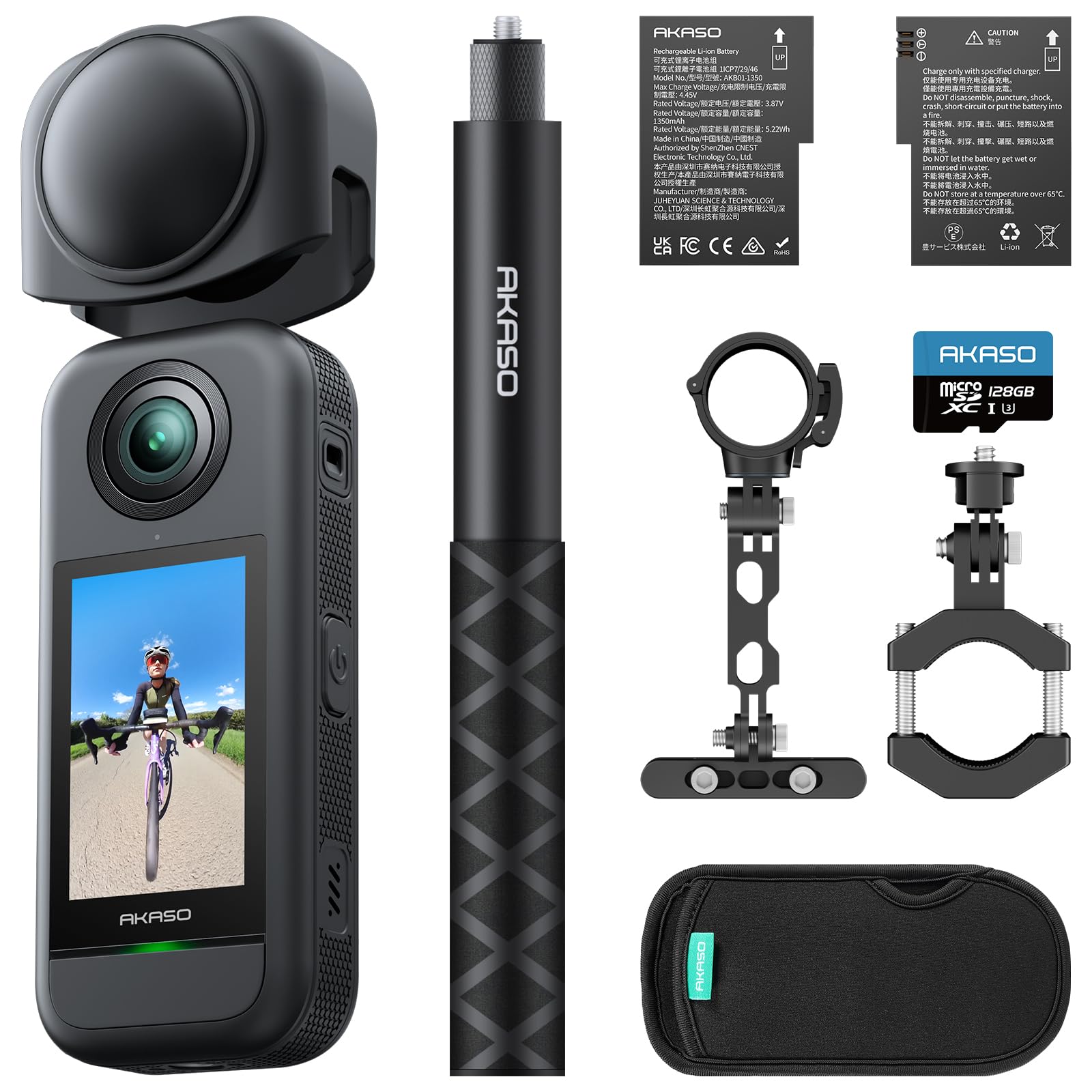
Shoot everything around you and pick your perfect angle after the ride.
If you love capturing everything around you, this camera records fully rich 5.7K 360° video (a resolution that captures a complete sphere around you), so you never miss action happening off to the side. It uses dual 1/2″ 48MP sensors (two image sensors that each capture 48 megapixels) to stitch together that full sphere of footage. The “shoot first, frame later” approach means you just hit record and pick the best angle when you get home—a liberating way to ride and film.
The 360° Horizon Lock and 360-SuperSmooth stabilization keep your footage level and steady, even if you flip or spin the camera. The invisible selfie stick effect creates amazing third-person shots of yourself riding, as if someone else were filming you. It also captures 72MP 360° photos and supports DNG8 RAW for crisp detail and rich tones, even in low light. AI subject tracking can keep you centered in the frame automatically.
Owners consistently praise the video quality and portability, and find the app makes editing easy. The main trade-off is battery life, with one owner noting it lasted only 54 minutes on a ride, so long tours require battery swaps or a battery selfie stick. It’s also weatherproof but lacks a waterproof case, so it’s not for full submersion. For the price, it’s a fantastic entry into 360° video without the premium Insta360 tag.
Best for: riders who love creative shots, want to capture the whole scene, and don’t want to fiddle with framing while riding.
Reach for this if: you want to capture the entire ride, including the scenery beside and behind you, and reframe later on your phone.
Be prepared for: swapping batteries on rides longer than an hour, as the internal battery runs down quickly.
6. PARKVISION Bicycle Rear View Camera

A constant digital eye on the traffic behind you, with battery life for the longest tours.
If you’ve ever been surprised by a car passing too close, this system gives you constant visual awareness of what’s behind you. It’s a dedicated rear view camera that streams a live 1080P image to a 4.3-inch handlebar monitor. The 110° wide-angle lens covers more blind spots on the sides and rear than a traditional mirror ever could. It’s perfect for commuters, e-bike riders, and anyone who values situational awareness.
The standout spec here is the 8000mAh battery, which supports approximately 9 hours of continuous operation on a full charge. That’s enough for almost any long-distance ride, weekend outing, or daily commute without worrying about recharging. The 0.01 Lux night vision technology maintains clear images in low light, and the screen auto-dims based on ambient light to keep it readable. The camera head swivels 360° so you can find the perfect angle for your riding posture.
Installation is tool-free and takes just minutes, with the camera mount fitting seatposts from 17–38mm and the screen mount fitting handlebars from 18–38mm. The detachable screen is a clever anti-theft feature, letting you take the expensive display with you when you park. Owners praise the clarity, night vision, and build quality, though a few note the screen brightness can struggle in very sunny conditions. It’s a wired connection, which ensures a stable signal and reliable power delivery.
Why commuters love it
- 9-hour battery life covers even the longest rides
- 0.01 Lux night vision keeps traffic visible after dark
- Detachable screen prevents theft when parked
The trade-off
- It’s a live view system, not a recorder, so it doesn’t save footage of incidents
- Screen brightness has mixed reviews in direct sunlight
Reach for this if: you want constant awareness of traffic behind you without turning your head, especially for commuting.
Look elsewhere if: you need video evidence after a crash, since this doesn’t record or save footage.
7. AKEEYO AKY-710S Bike Camera

A purpose-built bike dash cam with loop recording and a G-sensor for incident evidence.
Think of this as a dash cam for your bike, designed to document incidents on the road continuously. It records smooth 2K video at 55fps, upgradable to 4K at 28fps, using a Starvis IMX335 sensor that performs well in low light. The 142-degree wide-angle lens captures a broad view of the road ahead, giving you solid evidence coverage. The included 32GB SD card provides ample space for extended recordings.
The key features for evidence are loop recording and a G-sensor (a small motion sensor that detects a bump). Loop recording continuously overwrites old footage, so you never run out of space, while the G-sensor automatically secures crucial footage if it detects an impact. It also has a parking monitor mode for 24-hour protection of your bike when you’re not riding. The custom bike mount with quick-release makes it easy to attach and detach, and it’s theft-resistant.
Owners praise the build quality and clear video for documenting incidents, but note the trade-offs. Some find the software image stabilization isn’t enough to smooth out shakiness in 4K, and there are mixed reports on reliability with intermittent shut-offs. The mounting brackets are also described as weak plastic by a few. It’s a solid value for cyclists who want a dedicated evidence camera with a proper bike mount system.
Built for evidence: The G-sensor and loop recording work together to continuously capture and protect critical footage of any incident.
Reach for this if: you want a purpose-built dash cam with automatic incident protection and a secure bike mount.
Be aware: stabilization is weaker than action cameras, and reliability has mixed reports, so mount it securely.
8. AKASO EK7000 4K Action Camera
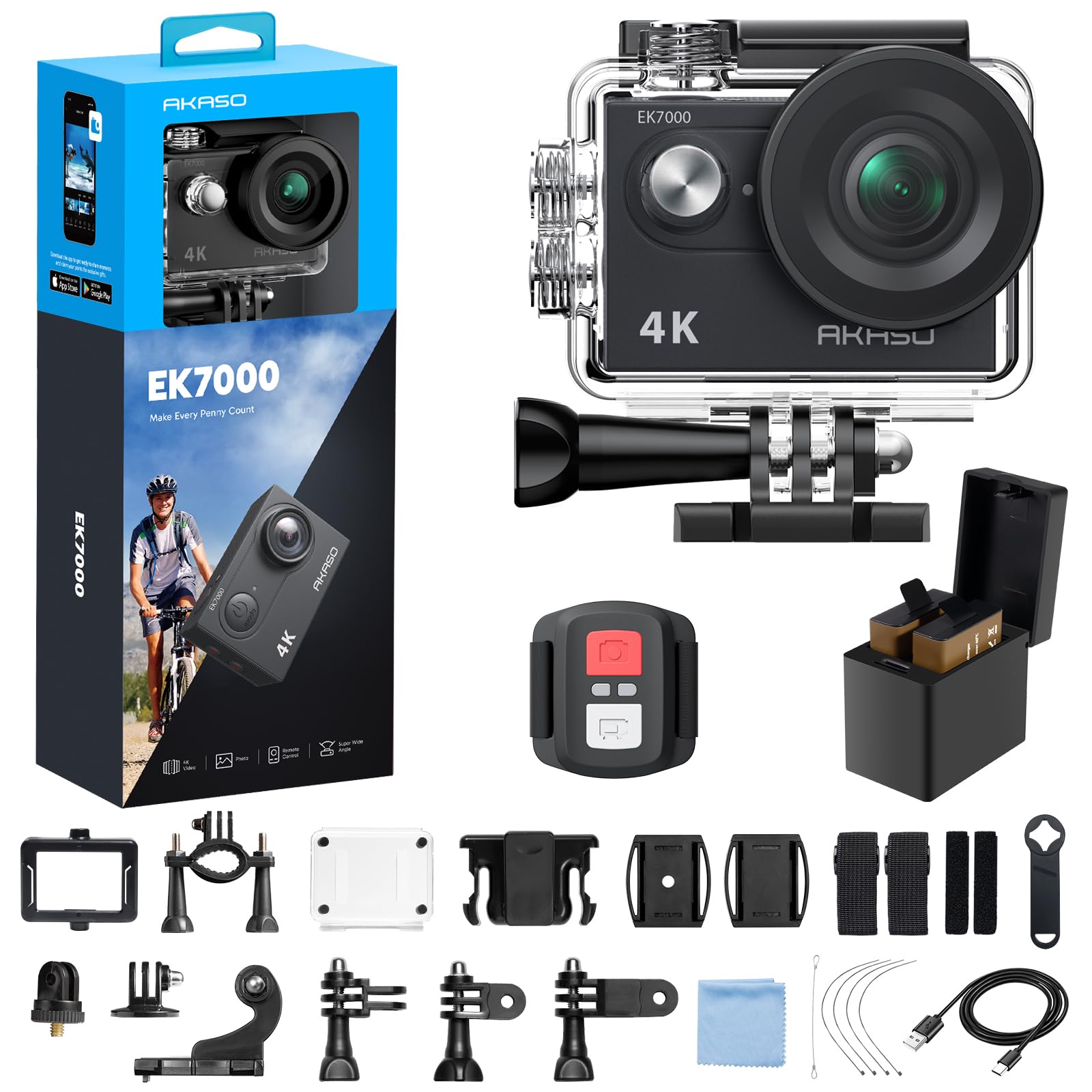
A feature-packed, budget-friendly starter camera that’s ready for the trail or the water.
This is the entry-level pick that punches far above its price tag, making it a great first camera for new riders. It shoots professional 4K30fps and 2.7K30fps video with 20MP photos, which is 4 times the resolution of traditional HD cameras. The included waterproof case makes it submersible down to 131 feet, so it’s equally at home on a rainy road ride or a kayak trip. A wrist 2.4G remote control lets you start and stop recording without reaching for the camera.
The digital zoom goes up to 4x, which is double what you get on the premium DJI pick above, giving you more flexibility to zoom into distant scenery from the handlebar. It has built-in Wi-Fi so you can connect to the AKASO GO app on your phone or tablet to preview and share footage, with a signal range up to 10 meters. The bundle includes a huge accessory kit with mounts for helmets, handlebars, and more. Owners use it for MTB and kayaking, calling it a “good little camera” and a great value for the price.
Customers note it’s “Fairly good camera. Used on my kayak to record catches. Does a good job.” The trade-offs are typical for the budget tier: it’s not a touchscreen, there’s no status light in bright sun, and the app’s photo access can be unreliable. The mount system is also a bit tight. For its price, though, it’s a fantastic starting point for casual riders who want 4K footage without a premium investment.
What you get for the price
- 4K30fps video and 20MP photos at an entry-level price
- Waterproof to 131 feet with the included case
- Wrist remote and a huge accessory kit for any mount
Budget trade-offs
- No touchscreen and no status light in bright sun
- Stabilization is limited, so footage can be shaky on rough terrain
Perfect for: beginners and casual riders who want a cheap, capable 4K camera to see if they like filming their rides.
skip it if: you need smooth, stabilized footage for serious content creation.
9. 4K Mini Body Camera 128GB

A thumb-sized camera that hides on your helmet or magnetically clips to your frame.
This is the pick for riders who want a discreet, ultra-lightweight camera that’s barely noticeable while riding. It’s literally thumb-sized, making it ideal for clipping onto a helmet, jersey, or dog collar for hands-free POV recording. The built-in 128GB storage means you’re ready to shoot immediately without buying a separate memory card. A built-in microphone captures high-fidelity audio to match the 4K video.
The all-day power is a big selling point, with a dedicated 2500mAh charging case providing three full charges for the 600mAh camera. That delivers approximately 5.5 hours of continuous recording time, which beats the DJI pick’s 4 hours by a significant margin. The magnetic attachment securely adheres to metal surfaces like your bike frame, and the included helmet mount offers another versatile option. Wi-Fi connectivity lets you preview, edit, and share footage instantly with the app.
Owners are impressed with the surprisingly clear video quality and solid build for such a tiny device. The most-discussed praise centers on video and camera quality, and many find it great value for money. The main limitation is the lack of image stabilization, so footage can bounce when you’re moving fast on rough surfaces, as one owner noted. It’s also not fully waterproof, so avoid swimming with it. For a discreet, affordable way to document rides, it’s a clever little tool.
The big win: 5.5 hours of recording from the charging case setup rivals cameras costing several times more.
Reach for this if: you want maximum battery life and a super discreet, lightweight camera for casual ride documentation.
Look elsewhere if: you’re doing high-speed or bumpy rides where image stabilization is essential for watchable footage.
Understanding the Specs
Image Stabilization
This is the single most important feature for cycling footage. Mounted cameras pick up every vibration from the road, which translates to shaky, unwatchable video. Look for named stabilization systems like DJI HorizonSteady or GoPro HyperSmooth, which keep the horizon level and smooth out bumps. If a camera lacks stabilization entirely, you’ll only get smooth footage on glass-smooth pavement.
Field of View
This is how much of the scene the lens captures, measured in degrees. A wider field of view, like 142°, captures more of the road and surroundings, which is great for evidence and context. A very wide angle can also distort the edges of the image. For a rear view camera, a wider angle like 110° helps cover blind spots on both sides.
FAQ
What is the best mounting position for a cycling camera?
Is image stabilization really necessary for cycling cameras?
How long should a cycling camera battery last?
Can I use a regular action camera as a rear view camera?
What is the difference between loop recording and a G-Sensor?
What does field of view mean for a cycling camera?
Is a 4K resolution necessary for a bike camera?
How does the Garmin Varia radar system work?
Final Thoughts: The Verdict
For most riders, the best all-around cycling cameras pick is the DJI Osmo Action 5 Pro because it combines professional-grade stabilization, class-leading 4-hour battery life, and waterproof durability in a single package. If your priority is safety and knowing what’s behind you, grab the Garmin Varia RCT715 for its radar and automatic incident recording. And for those just starting out on a budget, the AKASO EK7000 delivers impressive 4K footage without a premium price tag.
How We Picked
We do not accept paid placement. Every pick is matched to a real buyer and a real use-case; we do not hands-on test units.
Sources & Methodology
Specifications: manufacturer listings and product documentation. Review insights: verified customer reviews, as of August 2026. Pricing: not shown on this page (it changes often); check the current price via the retailer link.
As an Amazon Associate, Trending Car earns from qualifying purchases. This does not affect which products we feature.