
Our readers keep the lights on and my garage snacks stocked. As an Amazon Associate, I earn from qualifying purchases.
Specs are compiled from manufacturer listings and verified buyer reviews and can change over time — please confirm the key details on the product page before buying.
Factory speakers are built to a budget, so they distort and lose clarity as soon as you raise the volume. You don’t need an audio engineering degree—just a pair of aftermarket speakers that turns muddy, flat sound into clear, detailed audio. The real question is which models deliver that clarity without requiring a trunk full of amplifiers.
I’m Min Islam — the founder and writer behind Trending Car. This guide is built by comparing the manufacturers’ published specifications and the patterns across verified customer reviews, so you get each pick’s real strengths and trade-offs instead of marketing spin.
We have matched the best car speakers for sound quality to real driving scenarios, separating true upgrades from simple volume boosts so your next purchase is a lasting one.
Our Picks at a Glance


How To Choose The Best Car Speakers for Sound Quality
Choosing speakers for better sound means matching the hardware to your car’s electrical system and your listening habits. A speaker that sounds incredible on a huge amplifier can sound worse than stock if you’re still running the factory head unit.
Understand RMS vs. Max Power
RMS is the continuous power a speaker can handle, while max is a brief burst. A speaker rated at 75 Watts RMS per speaker will play cleanly all day, whereas one rated only by max wattage may distort when pushed. Match the speaker’s RMS to what your stereo or amplifier actually delivers.
Coaxial vs. Component Design
Coaxial speakers combine the woofer and tweeter in one unit, making them a simple drop-in replacement. Component systems split them apart for better sound staging, but require more installation work, including mounting tweeters separately.
The Role of Impedance and Sensitivity
Impedance, measured in ohms, affects how much current the speaker draws. A 3-ohm speaker can pull more power from a factory stereo than a 4-ohm one, often making it louder. Sensitivity, measured in decibels, tells you how efficiently the speaker turns power into volume — a higher number means louder with less wattage.
Quick Comparison
| Model | Best For | Power (RMS/Peak) | Impedance | Type | Amazon |
|---|---|---|---|---|---|
| Rockford Fosgate T1650★ Best Overall | Overall clarity upgrade | 75W / 150W per speaker | 4 Ohm | 6.5″ Coaxial | Amazon |
| Infinity Reference REF-3032CFXCompact Upgrade | Dash & small spaces | — | 3 Ohm | 3.5″ Coaxial | Amazon |
| CT Sounds Meso 6.5Budget Champion | Budget bass response | 75W / 150W per speaker | 4 Ohm | 6.5″ Coaxial | Amazon |
| JBL GTO629 | Aimable tweeter placement | — | 3 Ohm | 6.5″ Coaxial | Amazon |
| Rockford Fosgate P165-SI | Separate tweeter staging | 60W / 120W per speaker | 4 Ohm | 6.5″ Component | Amazon |
| Infinity Kappa 62IX | High-volume clarity | 75W / 225W per speaker | — | 6.5″ Coaxial | Amazon |
| Focal 165 AS Access | Warm, musical character | 6-60W (120W peak) | 4 Ohm | 6.5″ Component | Amazon |
| Infinity Kappa 63XF | Detailed highs | — | — | 6.5″ Coaxial | Amazon |
| AudioControl PNW Series | Precision midrange | 100W (125W max) | 3 Ohm | 6.5″ Component | Amazon |
In‑Depth Reviews
1. Rockford Fosgate T1650 Power 6.5″ 2-Way Coaxial Full Range Speakers (Pair)
Our pick — over 4.5★ from 700+ verified ratings; the strongest balance of quality and price.
The drop-in factory upgrade that finally makes vocals and instruments sound real.
The Rockford Fosgate T1650 leads this list because it nails the hardest part of any car audio upgrade: making music sound clear without making you work for it. These are 6.5″ 4-ohm coaxial speakers rated at 75 Watts RMS and 150 Watts Max per speaker, a honest power figure that handles an aftermarket stereo’s output without breaking a sweat. The bridge-mounted 1″ treated aluminum dome tweeter with an integrated concealed crossover delivers the crisp, clean highs that separate a real upgrade from a louder version of the same old mud.
If you want sound quality that survives the daily commute, this 6.5″ speaker earns its spot because owners consistently praise its clarity and build. Across hundreds of verified reviews, the same two strengths come up: clarity that beats any other 6.5″ speaker in its class, and a build that feels like it will outlast your car. One auto technician with 12 years of installs put it: “I think these are the best sounding six and a half inch speaker for the money they are a lot more clear and have more mid and a little more bass than any other six and a half inch speaker I’ve installed.”
The catch is physical, not sonic. These speakers need a mounting diameter of 5.51″ and a mounting depth of 2.52″, so you must measure your door or dash space before buying. Owners who added 1″ spacers in deeper locations reported a night-and-day improvement with tight bass and even mids, but that extra work is worth planning for.
What Owners Praise
- Crisp, detailed highs from the aluminum dome tweeter
- More midrange and bass than comparable 6.5″ options
- Genuine 75W RMS rating that handles real power
What To Measure First
- Requires 5.51″ mounting diameter and 2.52″ depth
- May need spacers in deep or odd-shaped locations
Grab these if: you want a straightforward factory replacement that makes every genre sound noticeably better, backed by a 1-year warranty.
Think twice if: your door pockets only fit shallow speakers — check that 2.52″ depth first.
2. Infinity Reference REF-3032CFX 3-1/2″ 2-Way Car Speakers – Pair
The small dash speaker that fixes the glaring, harsh treble in factory systems.
Not every sound upgrade needs a 6.5″ speaker. The Infinity Reference REF-3032CFX is a 3-1/2″ 2-way speaker built for the dash locations that many factory systems fill with weak, muddy drivers. Its edge-driven textile tweeter plays smooth and never harsh regardless of output level — exactly the fix for the brittle highs that make stock dash speakers fatiguing. The 3-ohm impedance lets it draw more current from a factory stereo, so it plays louder without needing an amplifier.
The real-world proof is in how easily it drops into modern vehicles. Buyers report hooking it up with basic adapters into 2024 Subaru Imprezas, 2020 Rams, and even 2025 Ford F-150s, with one noting: “They plugged in and fit perfectly. Sound is crisp and bright. Well worth the money!” Across the board, owners mention it is a significant improvement over factory speakers, with a perfect fit reported in most cases and installation that takes minutes rather than hours.
Where this Infinity wins is its Plus One woofer cone architecture, which packs more cone area into the same footprint for higher sensitivity and greater low-frequency output. That means a small speaker that still delivers musical character instead of thin, tinny sound.
Why It Fits So Many Cars
- Compact 3.5″ design slots into most dash locations
- 3-ohm load boosts volume on factory stereos
- Non-harsh tweeter suits long listening sessions
Keep In Mind
- Best paired with new door speakers for full-range sound
- Not designed for deep bass reproduction
Reach for these if: your dash tweeters are the weak link and you want a painless, perfectly fitting swap for your 3.5″ locations.
Look elsewhere if: you need a full-range door speaker — this one shines in the dash role.
3. CT Sounds Meso 6.5″ 300 Watt 2-Way Premium Coaxial Car Speakers, Pair
The value pick that brings real mid-bass punch to an entry-level budget.
The CT Sounds Meso 6.5″ is what happens when you skip the fancy branding and put the engineering budget into the parts that matter. Each 4-ohm speaker handles 75W RMS and 150W Max, with the pair rated at 300W Max total — placing it on even footing with the Rockford Fosgate T1650 on paper, but at a friendlier price. The high-quality fiberglass cone with a nitrile butadiene rubber surround is built for crisp, clear sound, while the attached silk-dome tweeters with CCAW voice coils recreate vocals and high frequencies with surprising detail.
Value is the most-praised aspect by far across hundreds of owners. The consensus: this is an underrated brand delivering clean, punchy sound for the money. Owners run them on simple aftermarket radios and report: “I just have a aftermarket radio and then hooked these up and they sound great!” One owner even used four of them in a jet boat alongside a Rockford subwoofer and came away impressed with how clean they sounded on a budget marine head unit.
The honest trade-offs are about fit and durability. The magnet is notably large, which gives it that mid-bass authority but means you need to check your mounting depth, and some owners needed minor adjustment to make them fit. There are occasional reports of units failing, so treat the large magnet as a sign to measure twice before buying.
The Value Case
- Fiberglass cone delivers clean, punchy mid-bass
- Silk dome tweeter keeps highs smooth
- Includes premium wire, screws, and grilles
The Fit Reality
- Large magnet can complicate tight installations
- Occasional durability complaints in the mix
Buy for: the best bass-per-dollar in a 6.5″ coaxial, especially if you run an aftermarket radio and want instant improvement.
Skip for: shallow door cavities — the big magnet needs room to breathe.
4. JBL GTO629 Premium 6.5-Inch Co-Axial Speaker – Set of 2
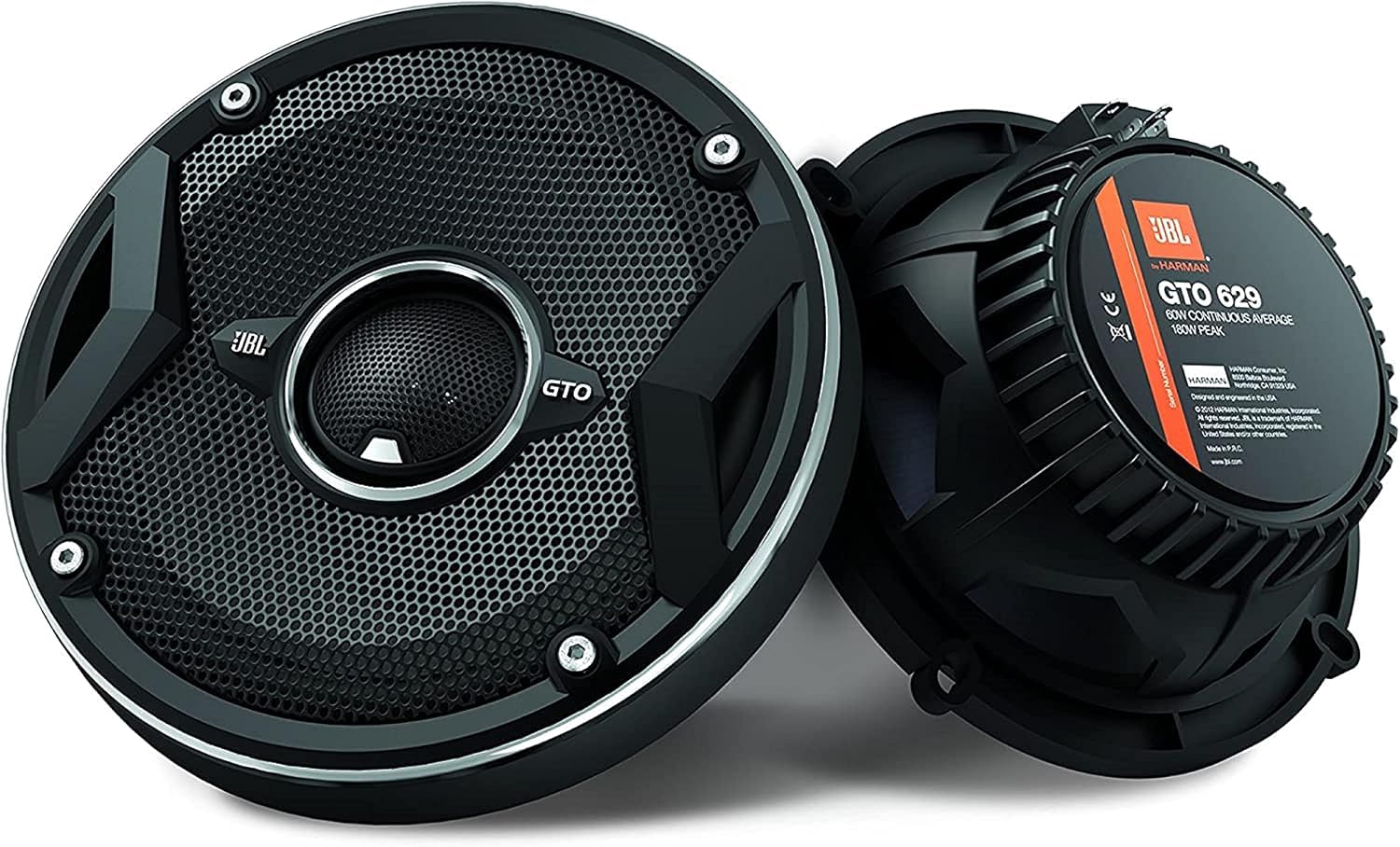
The coaxial with an aimable tweeter that puts the sound stage right at ear level.
The JBL GTO629 solves the oldest problem in car audio: speakers mounted low in the doors firing at your shins. Its patented UniPivot tweeter lets you aim the high frequencies directly at your ears, creating a much more lifelike sound stage even from a low mounting position. Add a dual-level tweeter volume adjustment, and you can compensate for imperfect placement or simply tune the treble to your taste — a level of control rare in a drop-in coaxial.
Underneath, the carbon-injected Plus One cones are larger than others in their size class, so they move more air and produce more bass. The 3-ohm low impedance compensates for the undersized wires found in many modern cars, making the most of every watt your stereo delivers. With a mounting depth of just 2 inches, these fit where many deeper speakers will not, which is why customers note easy installs in everything from old Chevy trucks to 2024 Ram ProMaster EVs.
The praise centers on crisp sound quality and straightforward installation, with owners calling them a worthwhile upgrade over factory units. The honest caveat is durability — a handful of reviewers point out speakers lasting about a year, so this is a strong first upgrade rather than a lifetime purchase.
The Flexible Strengths
- UniPivot tweeter aims sound at your ears
- 2-inch depth fits tight door panels
- 3-ohm design boosts output on stock wiring
The Honest Trade-off
- Durability reports are mixed over the long term
- Fit can need slight modification in some vehicles
Choose this if: your speakers sit low in the doors and you want to aim the sound back up to your ears.
Pass on it if: you want a set-and-forget speaker that will outlast the car itself.
5. Rockford Fosgate P165-SI Punch 6.5″ 2-Way Component Speaker System (Pair)

The component system that separates tweeter from woofer to build a true sound stage.
When you are ready to move beyond drop-in coaxes, the Rockford Fosgate P165-SI is the logical next step. This component system splits the pair of 6.5″ midrange drivers from the pair of 1″ tweeters, letting you mount each where it performs best — tweeters up high on the dash or pillars, woofers in the doors. Each 4-ohm speaker handles 60 Watts RMS and 120 Watts Max, and the PEI dome tweeters with built-in crossovers deliver the signature Rockford clarity that owner reviews rave about.
The sound quality is the standout, with owners praising the amazing tweeters and a balanced profile that handles all genres without harsh treble. One owner who compared them directly against JBL GT7 speakers found these cleaner with fuller mids. The FlexFit2 basket design uses a slot-mounted frame pattern for variable adjustment, which helps when factory holes are slightly off.
The trade-off is the installation. Separating the tweeters means running wire and placing crossovers, which owners describe as a harder install — some needed fish tape to route the internal crossover wiring. The larger tweeters also will not fit factory grilles, so you use the included flush and surface (angled) mounts instead. For the effort, you get the kind of imaging a coaxial simply cannot reproduce.
The Staging Advantage
- Separate tweeters create a real sound stage
- Integrated concealed crossovers for clean signal split
- FlexFit2 basket adjusts to imperfect holes
The Install Effort
- Tweeters need careful placement and mounts
- Wiring the crossover takes more time than a coaxial
Step up to this if: you want proper sound staging and are comfortable with a more involved install.
Stay with a coaxial if: you want the easiest possible swap without running extra wires.
6. New Infinity Kappa 62IX 6.5″ 225 Watts Max (75 Watts RMS) 2-Way Coaxial Car Audio Stereo Multi Element Speakers with UniPivot Tweeters with Oversized Voice Coils – Pair with Alphasonik Earbuds

The high-output coaxial that stays crisp when you crank it on the highway.
If you refuse to turn the volume down, the Infinity Kappa 62IX is built for you. Each speaker handles 75 Watts RMS and 225 Watts Max, driven by a carbon-injected glass fiber cone and a 1″ soft dome edge-driven fabric tweeter. The oversized voice coils handle heat without losing composure, so shoppers say crisp vocals with no distortion even at maximum volume — one owner described running them at 80 mph with a 600W Kenwood amp and still getting full-range clarity.
This is among the most-reviewed speakers in this list, and the consensus is overwhelming: it is a huge improvement over stock, with particularly strong praise for its clarity and value. Owners have put them in Tesla Model S doors, 1500 Rams, and Honda Ridgelines, often pairing them with Rockford Fosgate amps with great results. The Plus One cone technology gives them more cone area than rivals, which means higher sensitivity and greater low-frequency output.
The main thing to plan for is protection from moisture. Several owners recommend adding baffles and sound deadening to keep the deeper-fitting woofer safe from door water and to prevent rattles. No speaker wire is included either, so budget for that. The shallow depth does make it a surprisingly good fit for tight factory door locations.
The Performance Edge
- No distortion at very high volumes
- Oversized voice coils shrug off heat
- Shallow depth fits tight factory doors
Plan For This
- Baffles recommended to protect from moisture
- No speaker wire included in the box
Pick this for: loud, clear listening — the kind where you want vocals to stay intelligible at highway speed.
Look past it if: you are not ready to add baffles and sound deadening for a longer-lived install.
7. Focal Mobile 165 AS Access 6-1/2″ 2-Way Component Speakers
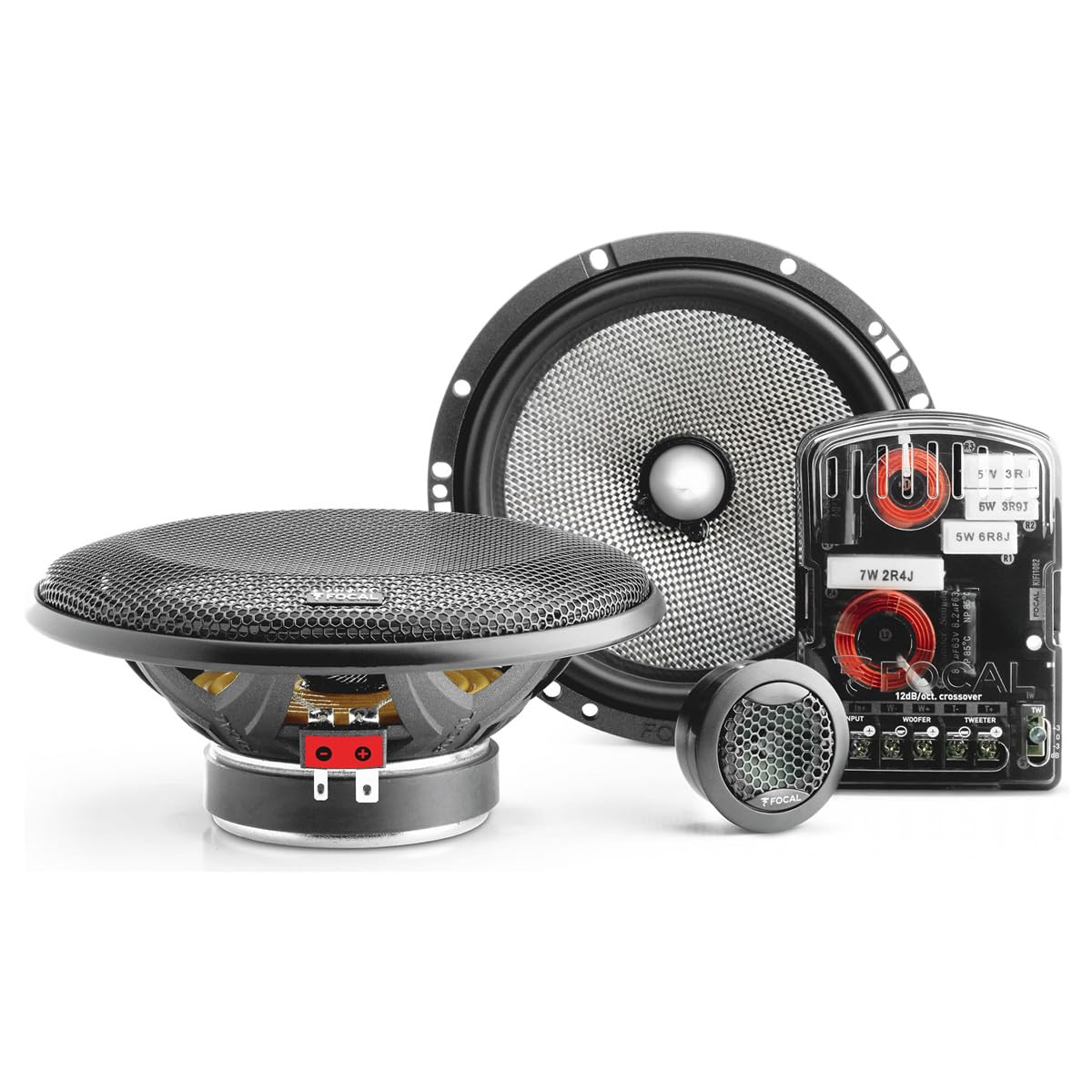
The Focal component set that brings a warm, easy musical character to your drive.
Focal is a name audiophiles know, and the 165 AS Access is the entry point into that heritage. This 6.5″ component system handles a 6-60 watt RMS power range with 120 watts peak, and its 91.3 dB sensitivity means it converts small amounts of power into impressive volume — an ideal match for a quality head unit without a large amplifier. The frequency response spans 60-20,000 Hz, covering the tonal range where music actually lives.
Owner feedback is character-driven. One truck owner distilled it perfectly: “Made my truck sound crispy.” The general consensus is of really good, warm sound that retains Focal’s signature clarity. Installation notes from owners confirm it pairs well with proper mounting rings for specific vehicles like the Suzuki Vitara, and the included standard accessories cover most basic setups.
The honest counterpoint is that this signature sound is not for everyone. One detailed critical review on a JL Audio amp found the tweeters bright and the overall character thin and fatiguing for long listening — a reminder that Focal’s tuning is a taste, not a universal truth. If you prefer a very neutral, laid-back sound, this may not be the match.
The Musical Strengths
- 91.3 dB sensitivity plays loud on modest power
- 60-20,000 Hz covers the full musical range
- Warm character with crisp detail
The Tuning Caveat
- Tweeter character reads bright to some ears
- Not a neutral, laid-back tuning
Reach for the Focal if: you value a lively, detailed musical signature and run a capable head unit.
skip it if: you are sensitive to bright treble and prefer a darker, more relaxed voicing.
8. Infinity Kappa 63XF 6-1/2″ (165mm) Two-way Car Speaker – Pair

The Kappa that pulls out micro-detail in recordings you never noticed before.
The Infinity Kappa 63XF is a masterclass in high-frequency reproduction. Its edge-driven silk dome tweeters come equipped with oversized voice coils that deliver silky smooth highs with impressive thermal power handling and up to 40kHz of resolution — far beyond the 20kHz limit of human hearing, which means the top end never feels strained or rolled off. This is the speaker for the listener who wants to hear the breath of the vocalist and the shimmer of the cymbal.
Owner reviews circle the same words: clarity, detail, efficiency. One owner called it “absolutely fantastic clarity and efficiency,” noting that with a bit of EQ tuning it became their ideal speaker. The glass fiber woofer cones are lighter and stiffer with more cone-area than the competition, boosting low-frequency output and overall efficiency. A push-button on the angled tweeter lets you toggle output between 0dB or -3dB to fine-tune based on where you mount it.
The feedback is nearly unanimous on fit as well, with owners reporting a perfect fit in vehicles like the 2003 Dodge Durango. The one thing to know is that these reward a little time with an equalizer — owners say they need some EQ work to sound their absolute best, which makes them a better fit for listeners who enjoy tuning than for pure drop-in users.
Why Detail Lovers Choose It
- 40kHz tweeter resolution reveals subtle detail
- Glass fiber cone is lighter and stiffer
- Adjustable tweeter output for placement
The Tuning Requirement
- Needs EQ time to sound its best
- Best for those who enjoy dialing in their system
Pick this for: the pursuit of detail — hearing elements in your music you did not know were there.
Look elsewhere if: you want a set-and-forget speaker with zero tuning required.
9. AudioControl PNW Series 6.5″ Component Car Speakers Set (Pair) with 1″ Tweeters, 125W, 3 Ohm, Rear or Front Door Speakers & Truck or Car Audio Systems, HPF/LPF Crossovers, Premium High Fidelity

The component system built for the midrange that ties your whole sound system together.
The AudioControl PNW Series is the specialist pick for a very specific problem: your system has thumping bass and sparkling highs, but the vocals and instruments in between sound hollow. This 6.5″ component set is engineered around the midrange, using a rigid poly-mica coated cone and a linear double-roll rubber surround for crisp, precise reproduction. With 100W RMS recommended amplifier power (up to 125W max) and a 3-ohm load, it is built to be driven properly.
What sets these apart is the crossover engineering. The included second-order Linkwitz-Riley high-pass and low-pass filters tune sound output, reduce distortion, and improve clarity while protecting the drivers from damage. The 1″ rear-dampened hybrid silk dome tweeters extend the frequency response upward, and the complex FEA-designed motor with a black anodized voice coil former handles heat for impressive volume without strain.
Owner feedback is uniformly enthusiastic about the mids — one owner who added these to a system that already had bass and highs called them the missing link that brought everything together. Another called them the best car speakers they had ever owned, beating out a set of MBQuart speakers. The build quality is a consistent theme, with the edge-enhanced steel frame and rugged grille providing real protection for daily use.
The System Builder’s Pick
- Linkwitz-Riley crossovers for clean signal split
- Poly-mica cone excels at midrange detail
- Steel frame and grille for durability
Who Should Skip It
- Needs a quality amplifier to shine
- Overkill for a basic factory stereo setup
Buy this if: you are building a full system and want the midrange anchor that makes it all sound like one cohesive unit.
pass on it if: you are running a stock head unit with no amp — this speaker wants real power to perform.
Understanding the Specs
RMS vs. Peak Power
RMS is the continuous power a speaker can handle without damage — the number that actually matters for daily listening. Peak or Max wattage is a brief burst figure that manufacturers use to make their speakers look more powerful. A speaker rated at 75W RMS will play cleanly at high volume all day, while one rated only by peak wattage may distort or fail when pushed hard.
Impedance and Sensitivity
Impedance, measured in ohms, controls how much current the speaker draws from your stereo. A 3-ohm speaker pulls more power than a 4-ohm one, often playing louder on the same factory head unit. Sensitivity, measured in decibels, tells you how efficiently the speaker turns watts into volume — a 91.3 dB speaker like the Focal plays loud with far less power than an 87 dB speaker.
FAQ
Will 6.5 inch speakers fit in my car without modification?
What is the difference between coaxial and component speakers?
Does a 3-ohm speaker sound better than a 4-ohm speaker?
How much power do I need for aftermarket car speakers?
Why do my new speakers sound harsh or bright?
Will aftermarket speakers work with my factory stereo?
Why does my new speaker have less bass than the old factory one?
Is it worth upgrading dash speakers separately from door speakers?
Do I need to install crossovers with coaxial speakers?
How long do aftermarket car speakers typically last?
Final Thoughts: The Verdict
For most people, the car speakers for sound quality winner is the Rockford Fosgate T1650 because it delivers the most balanced leap in clarity, midrange, and bass in a simple drop-in package backed by a 1-year warranty. If you want a loud, high-output system that stays clean at highway volume, grab the Infinity Kappa 62IX. And for the builder perfecting a full system, the AudioControl PNW Series is the midrange anchor worth reaching for.
How We Picked
We do not accept paid placement. Every pick is matched to a real buyer and a real use-case; we do not hands-on test units.
Sources & Methodology
Specifications: manufacturer listings and product documentation. Review insights: verified customer reviews, as of August 2026. Pricing: not shown on this page (it changes often); check the current price via the retailer link.
As an Amazon Associate, Trending Car earns from qualifying purchases. This does not affect which products we feature.