
Our readers keep the lights on and my garage snacks stocked. As an Amazon Associate, I earn from qualifying purchases.
Specs are compiled from manufacturer listings and verified buyer reviews and can change over time — please confirm the key details on the product page before buying.
Walking out to a car covered in spiderweb scratches after a wash is frustrating. The right buffer kit removes swirls instead of just hiding them.—but choosing between a rotary and a dual-action (a safer, less aggressive spinning pattern) machine is the first real decision. This guide compares the best kits by their motor power, speed range, and what pads come in the box, so you can match the machine to your skill level and job size..
I’m Min Islam — the founder and writer behind Trending Car. This guide is built by comparing the manufacturers’ published specifications and the patterns across verified customer reviews, so you get each pick’s real strengths and trade-offs instead of marketing spin.
We break down the top contenders in the car buffer kit space to help you match a machine to your paint and your experience.
Our Picks at a Glance

How To Choose The Best Car Buffer Kit
Before you pick a kit, you need to know the two main types of machines. A rotary buffer spins the pad in a circle on one axis—it cuts fast and removes deep scratches, but it can easily burn through the paint if you hold it still too long. A dual-action (DA) machine spins the pad while also moving it in a random orbit, which makes it much safer for beginners because the motion spreads the heat and reduces the risk of damaging the clear coat.
Match the Power to the Job
The motor’s strength, measured in amps or watts, tells you how hard the machine can work without slowing down. A 12-amp motor, like the one in the DEWALT, holds its speed even when you press the pad into the paint. A lower-amp motor might bog down under pressure, which makes polishing take longer and feel less smooth. If you are only waxing a small car occasionally, a lighter machine is fine; if you are removing oxidation from an old boat, you want the higher amperage.
Count the Speeds, Not Just the Max
Variable speed settings are what let one machine do many jobs. Low speed is for spreading wax, medium is for polishing, and high speed is for removing defects. A kit with 6 or 7 speeds gives you fine control so you don’t have to guess. Look for the number of speed settings and the range—like 800 to 3500 RPM for a rotary, or up to 6500 OPM (orbits per minute) for a dual-action—so you can match the machine’s pace to the work.
Quick Comparison
| Model | Best For | Type | Speed Range | Amperage | Amazon |
|---|---|---|---|---|---|
| DEWALT DWP849X★ Best Overall | Heavy-duty rotary correction | Rotary | 0-3,500 RPM | 12 A | Amazon |
| Adam’s Polishes 9mm DATop Performer | Safe, long-throw correction | Dual-Action | Up to 6500 OPM | — | Amazon |
| BATOCA DA PolisherBest Value | Beginner-friendly kit | Dual-Action | 2500-5500 RPM | — | Amazon |
| SPTA 7″ Rotary | Full kit with many pads | Rotary | 500-3000 RPM | — | Amazon |
| THINKWORK 20V Cordless | Portability and reach | Dual-Action | 1500-3600 RPM | — | Amazon |
| GEVEELIFE 1600W | Strong rotary for home use | Rotary | 1000-3500 RPM | — | Amazon |
| KITLUCK 12Amp | Budget rotary with many pads | Rotary | 800-3500 RPM | 12 A | Amazon |
| AVID POWER DA | Entry-level dual-action value | Dual-Action | 2700-6500 OPM | 5 A | Amazon |
In‑Depth Reviews
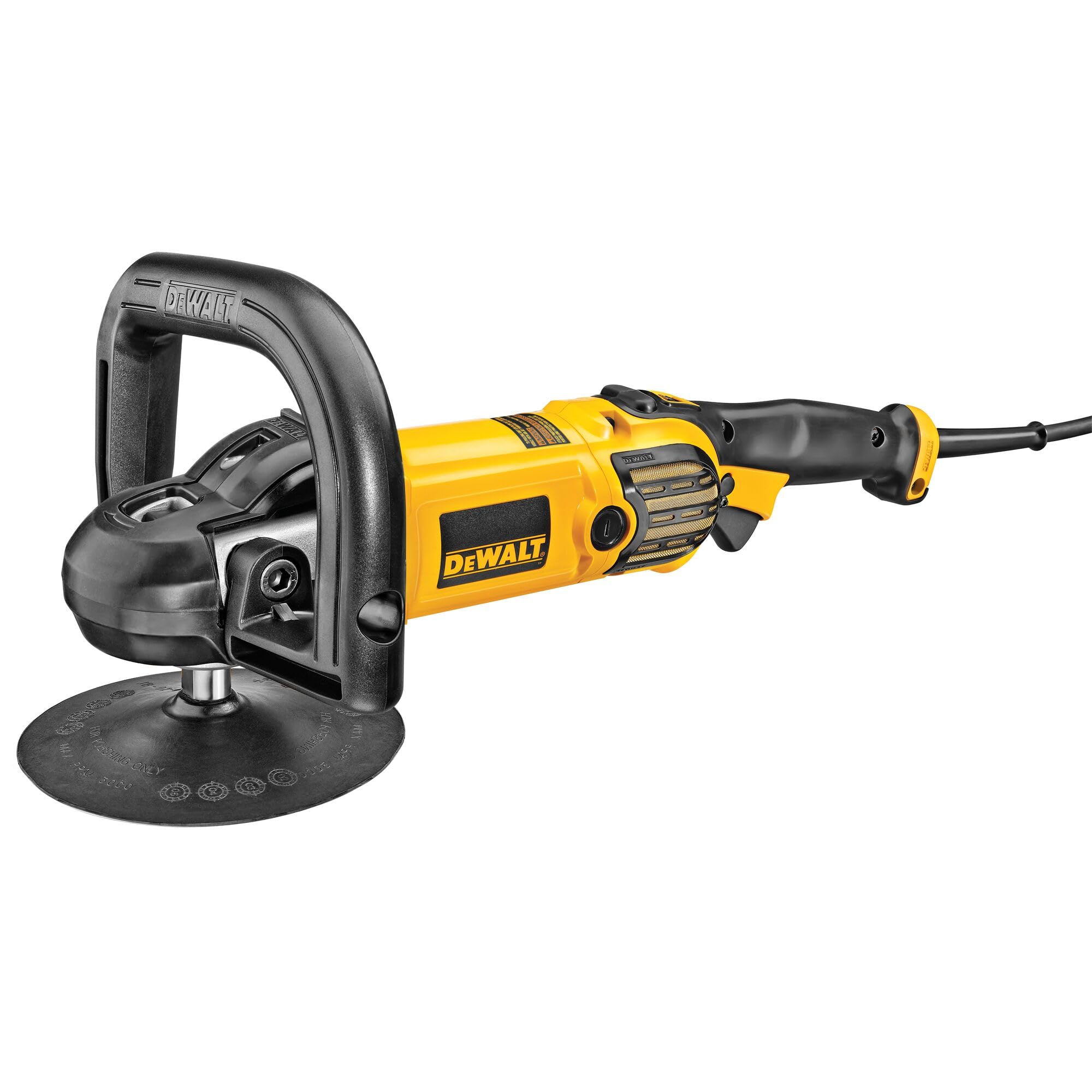
1. DEWALT DWP849X
Our pick — over 4.5★ from 6,500+ verified ratings; the strongest balance of quality and price.
The pro-grade rotary that holds its speed even when you lean into the paint.
The 12-amp motor delivers immediate confidence under load.. With a 12-amp motor pushing 1440 watts—the most powerful in this lineup—the DEWALT simply does not bog down. Buyers report it “holds 1000rpm exactly,” running cool and smooth with no gear noise, even after hours of work on a 45-foot canoe or a 4-year-old black car full of scratches.
This is a rotary, so it demands respect: you need to keep the pad moving to avoid burning the clear coat. The soft-start feature (the motor ramps up gently instead of jerking) and a variable speed trigger let you control the power with your finger, while the large speed dial goes from 0 to 3,500 RPM. The rubber-overmolded gearcase gives you a comfortable grip, and the replaceable wool ingestion shield stops fibers from getting sucked into the motor.
It comes with both a bale and a straight side handle plus a hook-and-loop backing pad, so you can run foam or wool pads right away. The recurring note from owners is that it is slightly heavier than some rivals at 6.7 pounds, and the soft-start means rapid trigger pulls can overshoot the RPM you want. This rotary suits users ready to master proper technique for pro-grade results..
Why it wins
- 12A motor holds RPM under load, per buyers
- 0-3,500 RPM dial plus variable trigger
- 3-year warranty on material and workmanship
Consider this
- Rotary style needs practice to avoid burning paint
- Heavier than some at 6.7 pounds
Reach for this if: you are correcting real scratches or oxidation and want a machine that will last years.
Practice first: the raw power of a rotary is too much for a total beginner to start on.
2. Adam’s Polishes 9mm DA Polisher
The beginner-friendly dual-action that delivers pro correction without the burn-through risk.
Its random-orbit design makes it the safest choice for first-time users.. The 9mm dual-action design spins the pad in a random orbit, so the risk of burning through paint is dramatically lower than with a rotary. The 1000W motor pushes up to 6500 OPM at maximum speed, which means it covers surface area fast while laying down compound evenly.
At under 5.5 pounds with a 16-foot cord, it is noticeably easier to handle than the heavier DEWALT—buyers mention the balanced feel and the concave rubber contact points that soak up vibration. One owner used it to prep a 20-year-old Lexus for a ceramic coating and reported great results on the first try. The kit includes a polish, a compound, and pads, so you have everything to start correcting paint right from the start.
The main caveat is the included compound—owners note it is very light and only removes the lightest scratches. If your paint has deeper defects, you will want a more aggressive compound separately. It’s the balance for DIYers wanting swirl-free results without clear-coat risk..
Why it clicks: the forgiving DA motion plus a 1000W motor means beginners get pro results, and the 5.5-pound weight keeps your arms fresh for a full 4-hour detail.
Best if: you are doing your own paint correction and want a safe, effective tool that is simple to master.
Look elsewhere if: you need deep scratch removal—the included compound is quite light.
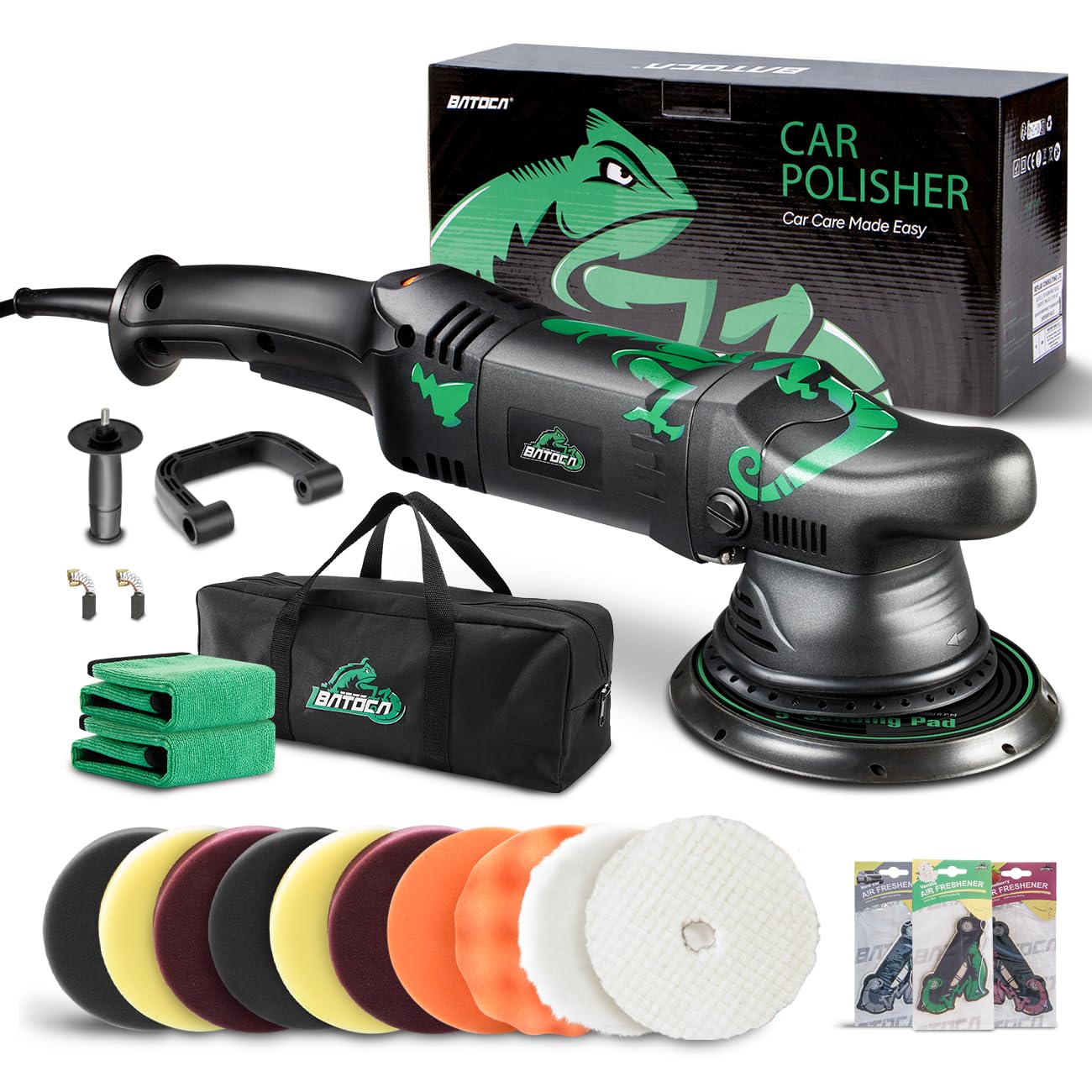
3. BATOCA Dual Action Polisher
A complete kit with a chameleon-cool look and beginner-friendly dual-action safety.
The eccentric shaft design here is what makes it a dual-action—the pad moves in random orbits, so beginners can work fast without worrying about harming the paint. The 1100W motor runs on a 6-speed dial from 2500 to 5500 RPM, letting you drop to low speed for waxing and crank it up for removing defects. The single standout review detail: one owner detailed three cars over eight hours and it worked flawlessly without overheating.
This kit is genuinely complete. You get 6-inch flat foam pads, wool pads, polishing bonnets, sanding papers, a wash microfiber towel, a tool bag, and even a pair of disposable gloves. Buyers praise the adjustable speeds and how easy the pads are to swap, and the green chameleon design is a fun talking point. The cord length is also noted as nicer than some competing machines.
The one honest gripe is that the included pads start stiff and need breaking in before they perform at their best. If you want a stater kit that includes nearly everything you need for your first full detail, this is it.
What you get
- 1100W motor, 2500-5500 RPM range
- Full kit: foam, wool, sandpaper, bag, gloves
- Runs 8 hours straight per buyer reports
The trade-off
- Included pads are stiff and need breaking in
Who it suits: the first-time buyer who wants one box with everything needed to detail a car safely.
Keep in mind: budget a little patience for the pads to soften up before they work their best.
4. SPTA 7″ Rotary Polisher

A rotary tank with a digital speed readout and the largest accessory bundle in this list.
Owners call this thing “a tank”—and they mean it as a compliment. The 1200W motor with all ball-bearing construction has been used consistently for about a year on big and small projects without a complaint. The digital screen showing your exact speed is a rare feature at this price, and the 6-speed dial ranges from 500 to 3000 RPM for different materials.
You get a complete kit: three sizes of polishing pads (3″, 5″, 6″), wool pads in 5″, 6″, and 7″, four backing plates, sandpaper, two compounds, a wash dish brush, microfiber cloths, an artificial wool washing glove, an apron, and a large carry bag. It even comes with both a side handle and a D-handle so you can choose the grip that feels right. Detailing companies use this for wash-and-wax work and find it sturdy and easy to use.
Because it is a rotary, it is more aggressive than a dual-action—owners mention it splatters compound and that you may prefer to remove wax by hand. At 6.6 pounds, it is on the heavier side, but the power makes up for it. It’s for hobbyists or pros wanting a complete toolkit in one box..
The standout: the digital speed screen plus a 24-piece accessory set means you get pro flexibility the moment you open the bag.
Pick this if: you want a rotary that is built to last and hate buying accessories separately.
Note: expect some compound splatter; a soft rubber guard helps.
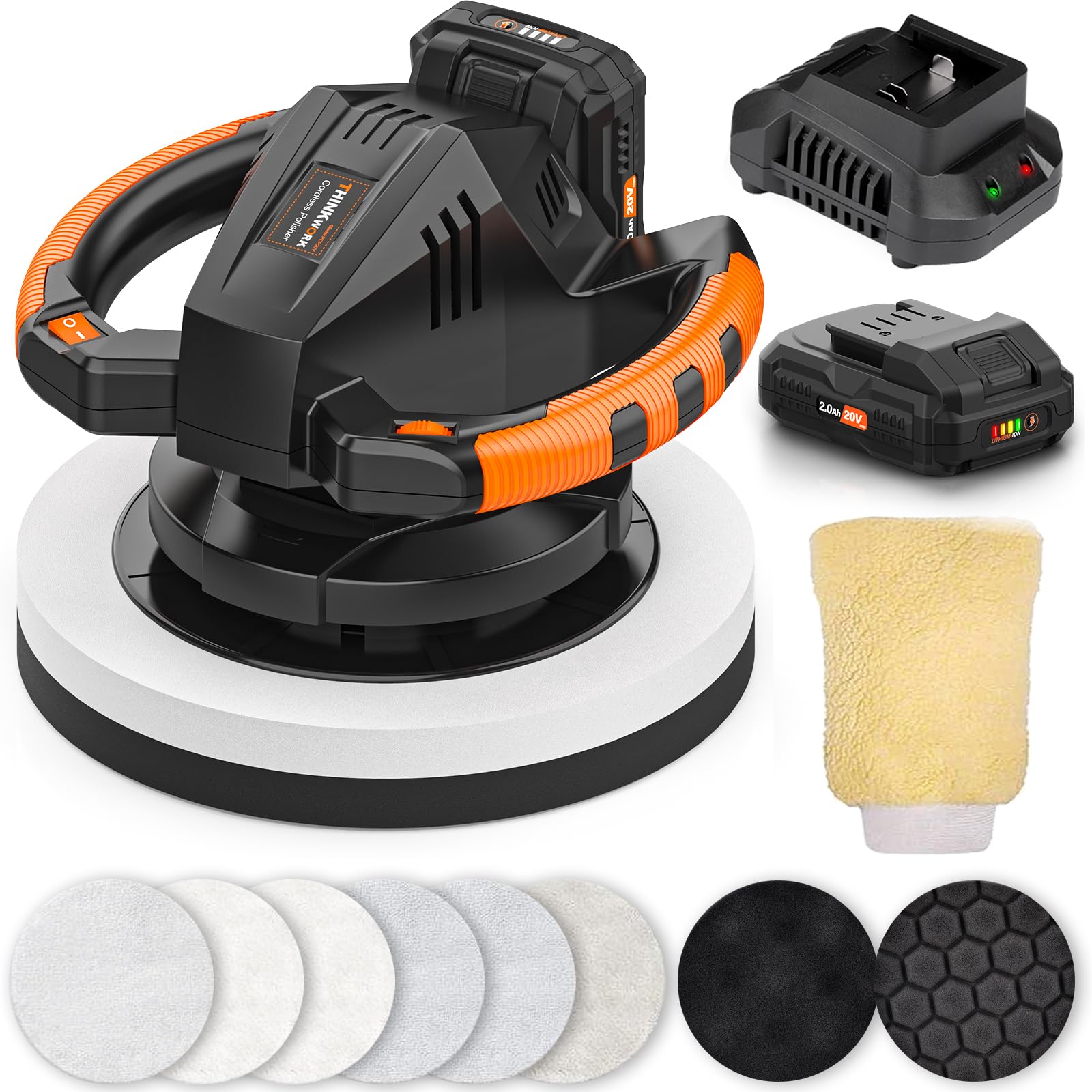
5. THINKWORK 20V Cordless Buffer
The cordless machine that frees you from outlets—perfect for boats, driveways, and odd angles.
Tired of fighting a cord that wraps around mirrors and gets caught under tires? This 20V cordless design runs on a 2000mAh lithium battery that delivers up to 30 minutes of continuous use—enough to wax a full car without plugging in. The rechargeable battery charges fully in about 1 hour, and battery power indicators let you know when it is time to recharge.
The 6-speed dial ranges from 1500 to 3600 RPM, and the dual-action random orbit makes it safe for beginners. It has two handles to reduce hand fatigue, and the pure copper bipolar motor runs quietly. Owners love the lightweight, balanced feel—one buyer rated it “fantastic” for waxing, noting the battery easily lasted through both applying and removing wax.
The catch is durability: multiple customers note the pads ripping off after about three car applications. If you plan to use it weekly for heavy correction, this might disappoint. But for quick wax jobs, sofa and glass polishing, or detailing a boat at the dock with no outlet nearby, the cordless freedom is a real advantage.
Why go cordless
- 20V battery with 30 minutes of runtime
- Two handles for comfort and control
- 1500-3600 RPM, 6 speeds
Watch out
- Pads may rip off after a few uses
- Not for heavy, frequent correction work
Reach for this if: you need portability—boats, RVs, or anywhere an extension cord is a hassle.
Think twice if: you are a pro who needs constant, heavy-duty use
6. GEVEELIFE 1600W Rotary

The most powerful motor in the mid-range group, with a constant-power board for long sessions.
With a 1600W motor, this rotary has the highest wattage of any machine on this list except the DEWALT—and it costs a fraction of the price. The built-in constant-power control board keeps the machine working for extended hours without overheating, which addresses the heat complaint you see on cheaper rotaries. The 7-speed adjustment covers 1000 to 3500 RPM, so you can go from delicate sanding to powerful polishing.
Buyers who used it for cutting and buffing new clearcoat said it feels solid and powerful, with one noting it was “better than a Dewalt that I had that costs 3x more.” It comes with sponge pads, wool pads, and sandpapers, and the detachable handle makes it easier to maneuver around tight spots. The low vibration and stable operation get frequent praise.
Here is the compatibility catch: it is designed for M14 caliber polishing discs only, not the 5/8-11 caliber some other machines use. That means you need to buy pads that match the M14 thread, which limits your options. Also, the cord is noted as short, so keep an extension cord handy.
The smart buy: 1600W of constant power with 7 speeds makes this a pro-grade performer at a mid-range price.
Best for: budget-conscious owners who still want serious cutting power for compound and polish work.
Double-check: make sure your pads use the M14 thread before buying.
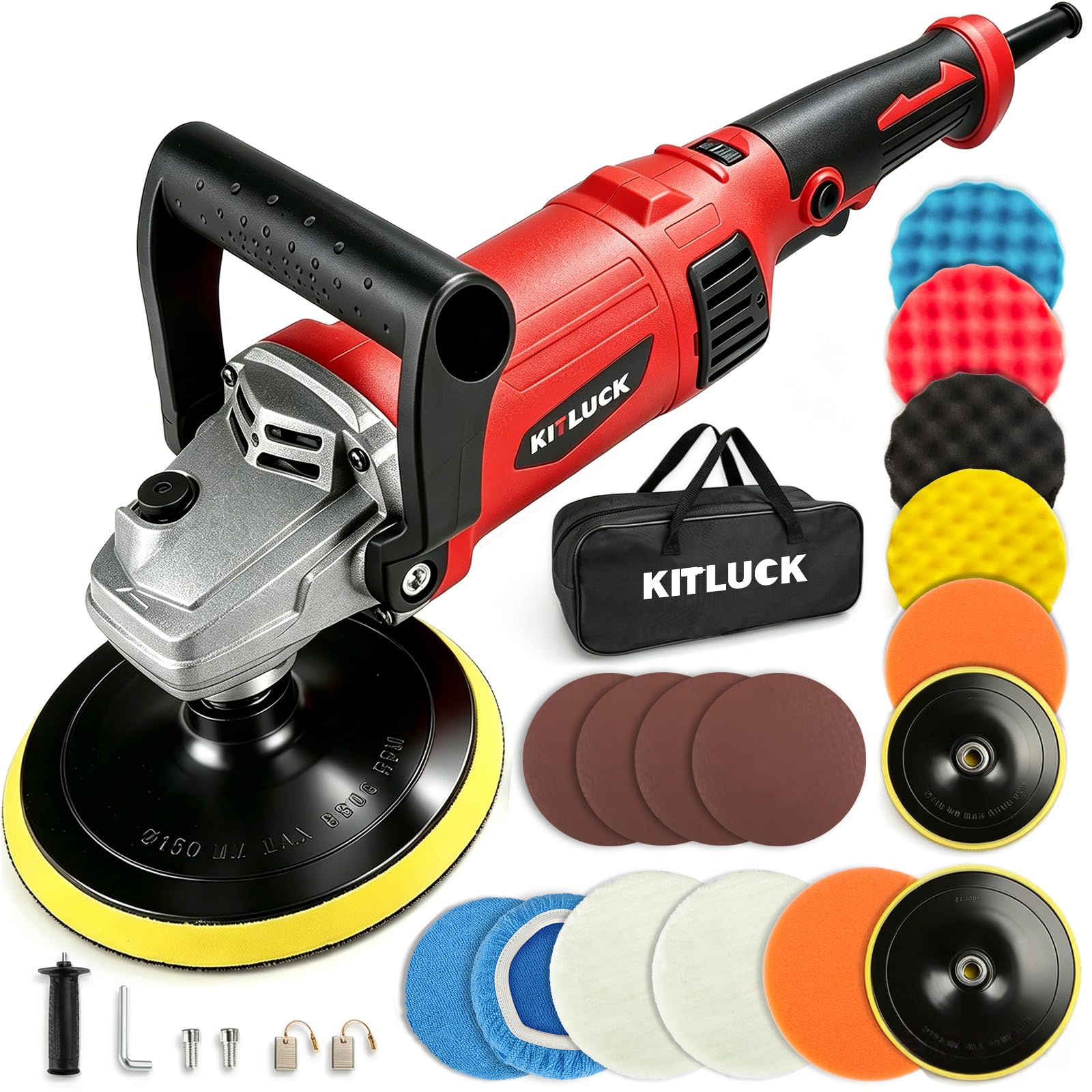
7. KITLUCK 12Amp Rotary
A surprisingly complete budget rotary with 5.3 pounds of easy-to-handle weight.
At just 5.3 pounds, this is the lightest rotary in the lineup—a full 1.4 pounds lighter than the DEWALT. That weight difference matters when you are working on vertical panels or overhead surfaces where arm fatigue sets in fast. The 1400W pure copper motor delivers power similar to the DEWALT’s 1440W, but at a budget price, and the 7-speed dial spans 800 to 3500 RPM.
The kit is generous: a 7-inch and a 6-inch hook-and-loop base pad, wave foam pads, flat foam pads, two wool bonnets, microfiber bonnets, sandpaper, a D-handle, a side handle, a thickened tool organizer bag, and two replaceable carbon brushes. That storage bag with fixed cloth tape is a thoughtful touch that keeps everything together. Owners say it works great for its price and is ridiculously lower than the big names.
This is a rotary, so it is not the safest choice for a first-time user—reviewers point out it gets hot to the touch quickly and the two-part trigger takes getting used to. It is also best for detail work and hard-to-reach areas rather than buffing entire panels. If you are a beginner, consider a dual-action machine instead.
What stands out
- 12A / 1400W motor, 7 speeds
- Lightest rotary at 5.3 pounds
- Huge accessory kit with storage bag
Know before you buy
- Runs hot to the touch quickly
- Better for details than whole panels
Who this fits: budget buyers who want pro power and a full pad selection without the pro price tag.
skip it if: you have never used a rotary—start with a dual-action to protect your paint.
8. AVID POWER 5″/6″ DA Polisher

The cheapest way into dual-action safety, with 4 pads and a detachable handle included.
For around the price of a tank of gas, you get a genuine dual-action polisher—the safest type of buffer for your paint. The 5-amp motor runs from 2700 to 6500 OPM (orbits per minute) across 6 speeds, giving you the control to wax at low speed and remove defects at high speed. Buyers were honestly shocked by the value: one owner “restored a 10-year-old boat gel coat, saved shop quote” using the included wool bonnets.
The kit includes two 5-inch foam pads, two 6-inch foam pads, a 5-inch and 6-inch foam disc, a detachable D-handle that adjusts to 5 positions, a spanner, and a hex wrench. The rubberized body provides a non-slip grip, and owners compare the feel to machines costing three times as much. It even works on furniture, ceramic, and wood, not just cars.
The 5-amp motor is the weakest in this lineup—noticeably less powerful than the DEWALT’s 12 amps. Shoppers say it can struggle with speed maintenance under heavy pressure. This is the right tool for light polishing and waxing, not for cutting out deep scratches on hard clear coat. If you are doing your first-ever detail and want to learn without fear, this is a smart, low-risk place to start.
The honest take: the dual-action motion makes this forgiving for beginners, but the 5-amp motor means it will run out of steam on heavy correction work.
Reach for this if: you are brand new to buffing and want a safe, cheap machine to practice waxing and light polishing.
Move up if: you need real cutting power for deep scratches on factory clear coat.
Understanding the Specs
Dual-Action vs Rotary
The single most important choice you will make. A rotary spins the pad in one direction and cuts aggressively—it is fast but can burn paint if you are careless. A dual-action (DA) machine adds a random orbital motion that spreads heat and reduces risk, making it the right choice for most home users. The spec to check is the OPM (orbits per minute) on a DA versus RPM (revolutions per minute) on a rotary.
Amperage and Wattage
These numbers tell you how hard the motor can work. A 12-amp motor (like the DEWALT and KITLUCK) holds its speed under pressure, which means smoother polishing. A 5-amp motor (like the AVID POWER) is fine for light waxing but will bog down when you press hard. Wattage is the same story—1600W is plenty for most jobs, while a 1000W machine like the Adam’s is enough for its dual-action design.
FAQ
Is a dual-action buffer safer than a rotary for beginners?
What is the difference between RPM and OPM on a buffer?
Will a 5-amp buffer be powerful enough for my car?
How many speeds do I really need on a car buffer?
Can I use a car buffer on a boat or other surfaces?
How long does a cordless buffer battery last?
What pads should I use for polishing versus waxing?
Why does my buffer get hot during use?
Final Thoughts: The Verdict
For most buyers, the car buffer kit winner is the DEWALT DWP849X because its 12-amp motor holds speed under pressure and the soft-start dial gives pro-grade control. If you want a beginner-safe dual-action that still corrects paint well, grab the Adam’s Polishes 9mm. And for a complete kit that will not break the bank, the BATOCA Dual Action is the one to reach for. Choose the machine that matches your skill level and the condition of your paint, and you will get the showroom shine you are after.
How We Picked
We do not accept paid placement. Every pick is matched to a real buyer and a real use-case; we do not hands-on test units.
Sources & Methodology
Specifications: manufacturer listings and product documentation. Review insights: verified customer reviews, as of August 2026. Pricing: not shown on this page (it changes often); check the current price via the retailer link.
As an Amazon Associate, Trending Car earns from qualifying purchases. This does not affect which products we feature.