
Our readers keep the lights on and my garage snacks stocked. As an Amazon Associate, I earn from qualifying purchases.
Specs are compiled from manufacturer listings and verified buyer reviews and can change over time — please confirm the key details on the product page before buying.
Faded paint and spiderweb swirls are the reason most people finally shop for a polisher. The right one cuts through oxidation and light scratches without the risk of burning through your clear coat. This guide breaks down the best car buffer for scratches by matching each tool to a specific job, from a quick cordless wax-up to a full 22-foot boat restoration.
I’m Min Islam — the founder and writer behind Trending Car. This guide is built by comparing the manufacturers’ published specifications and the patterns across verified customer reviews, so you get each pick’s real strengths and trade-offs instead of marketing spin.
Picking the right car buffer for scratches depends on what you value most: portability, correction speed, or beginner safety. The pad size, power rating, and motion type each change how the tool performs on your paint.
Our Picks at a Glance


How To Choose The Best Car Buffer for Scratches
Before you buy, decide how the pad moves, how fast it spins, and if you want to be tethered to a wall outlet. Match those three choices to your car’s condition and your experience level, and the rest is just extra pads and accessories.
Dual-Action vs Rotary Motion
A dual-action (DA) polisher moves the pad in a random orbit, so the pad never stays in one spot. That makes it forgiving and beginner-friendly, with a low risk of burning the paint. A rotary spins in a fixed circle and cuts faster, but it can damage paint if you linger too long in one area. Every product in this list uses dual-action motion for safety.
Speed Range and Pad Size
Most polishers offer around six speed settings. Low speed is for applying wax, medium for polishing, and high speed for removing deep defects and oxidation. Pad size matters too — a 6-inch pad covers large hoods quickly, while a 3-inch pad reaches into tight curves and around headlights.
Quick Comparison
| Model | Best For | Power Source | Max Speed | Pad Size | Amazon |
|---|---|---|---|---|---|
| VERVEWAVE Cordless Buffer★ Best Overall | Portable freedom | Battery | 5500 rpm | 6 inch | Amazon |
| AVID POWER DA KitValue Powerhouse | Boat restoration | Corded | 6500 rpm | 5/6 inch | Amazon |
| SILVEL 1600WHeavy Duty Pick | Heavy compounding | Corded | 3300 RPM | 6/7 inch | Amazon |
| SPTA Mini Orbital | Motorcycles | Corded | 5500 OPM | 3/4 inch | Amazon |
| ZOTA Mini Polisher | Tight body panels | Corded | 7200 RPM | 2/3 inch | Amazon |
| BATOCA 1100W | Complete kit value | Corded | 5500 RPM | 6 inch | Amazon |
| Meguiar’s MT300 | Consistent pressure | Corded | — | 6 inch | Amazon |
| Griot’s Garage G9 | First-time correction | Corded | 6400 rpm | 5/6 inch | Amazon |
In‑Depth Reviews
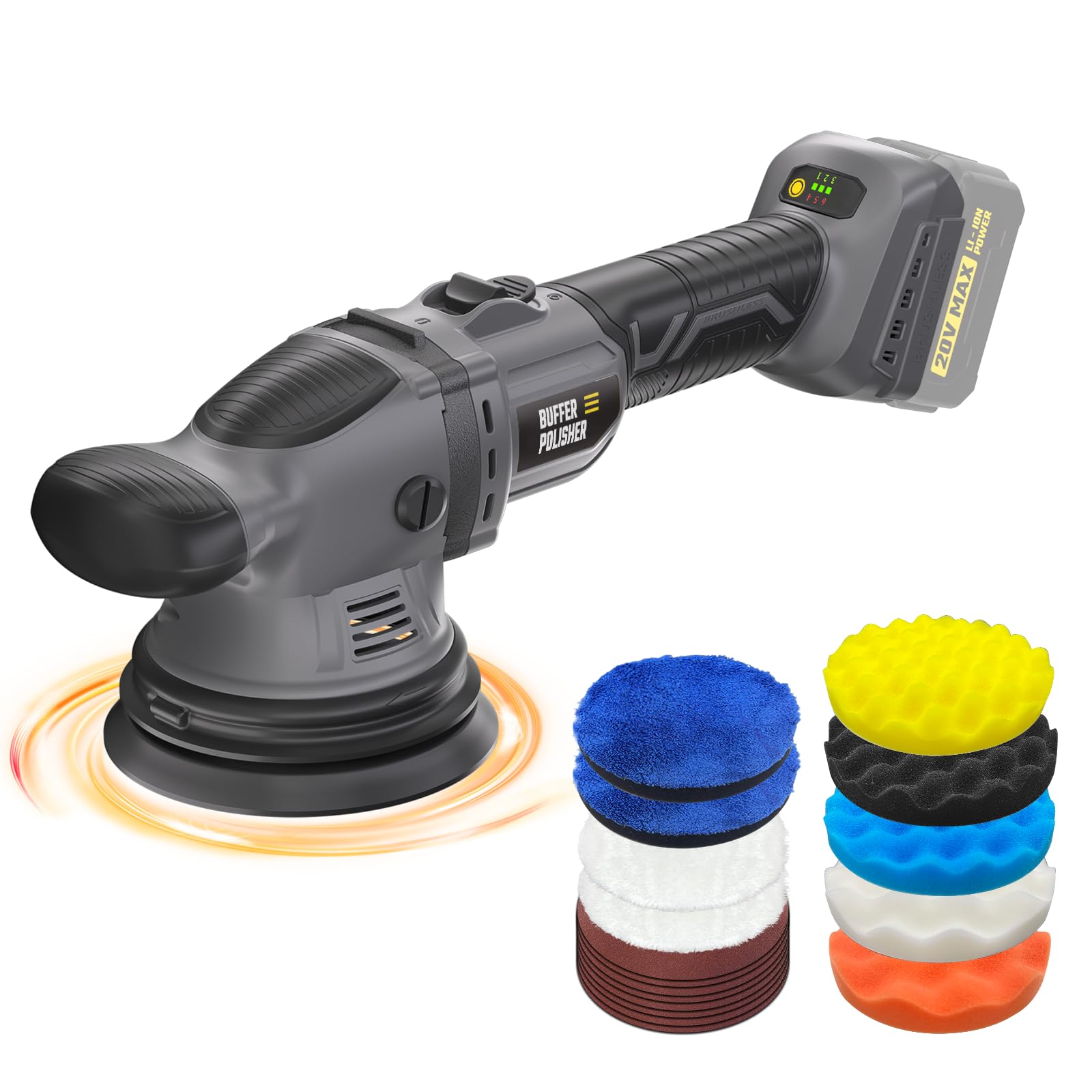
1. VERVEWAVE Cordless Buffer Polisher Kit
Our pick — over 4.5★ from 450+ verified ratings; the strongest balance of quality and price.
Unplugged freedom that finishes a whole car on one charge.
The standout feature here is the total lack of a cord, which changes how you work around a vehicle. It uses DeWalt 20V lithium-ion batteries, so if you already own DeWalt tools, you share the same battery and charger. Note the battery is not included — the kit ships tool-only and expects you to bring your own.
The brushless motor delivers consistent power, and the eccentric random-orbital motion prevents over-polishing glare. Six speeds from 1800 rpm up to 5500 rpm let you dial in waxing at the low end and paint-defect removal at the top. Buyers report 1.5 hours of use with over 50% battery left, enough for a full car.
The kit bundles 5 foam pads, 2 wool pads, 2 waxing pads, plus #80 and #120 sandpapers — enough to start correcting and finishing immediately. The lock switch is a thoughtful safety touch, stopping the machine from suddenly restarting next time you grab it.
cordless freedom
- Cordless design reaches every panel without a lead
- Strong performance reputation across owners
- Complete pad and sandpaper kit included
battery limits runtime
- Battery and charger sold separately entirely
- Only suits DeWalt 20V battery owners
reach for it: you already own DeWalt 20V batteries and want cordless convenience.
look elsewhere: you are starting from zero and have no compatible batteries yet.
2. AVID POWER 5″/6″ Dual Action DA Polisher Kit
A 6500 rpm workhorse that restored a 10-year-old boat in hours.
This dual-action kit is the pick of the budget tier for serious correction work. Its 5-amp motor spins from 2700 to 6500 OPM with a 6-level dial, and the low-speed range handles wax while the top end grinds through oxidation. Owners say it feels like a polisher costing three times as much.
Buyers restored a 22-foot boat’s 10-year-old gel coat in about 3 hours, saving on pro fees. That kind of result comes from the wool bonnets and the controlled variable speed working together.
It ships with both 5-inch and 6-inch backing plates plus four foam pads and two foam discs, so you can switch between tight work and large flat surfaces. The adjustable D-handle locks into five positions, and the rubberized body keeps it from rolling off your workbench.
dual-action versatility
- Pro-level correction power at a friendly price
- Both 5-inch and 6-inch backing plates included
- Dual-action motion is safe for beginners
vibration on long jobs
- Handle requires an Allen wrench to adjust
- Occasional reports of speed maintenance issues
best for: weekend restorers with oxidized paint or stubborn swirls.
not for: those who want a tool ready to wax from the start without adjusting.
3. SILVEL 1600W 7″/6″ Buffer Polisher
This 1600W brute cuts faster but demands more respect on paint.
The SILVEL brings real muscle with a 1600-watt pure copper motor, making it the highest-wattage option in this lineup. Its 7-speed dial runs from 500 to 3300 RPM, and buyers successfully removed water spots and scratches from boats and trucks with it. The included 10 sheets of 1000-grit sandpaper hint at its correction intent.
The dual front grip and curved body help manage the fatigue, but it is a tool for committed work sessions rather than quick touch-ups.
You get a generous kit: 6 foam pads, 3 wool pads, two handles, two carbon brushes, and a carry bag. For heavy compounding on large panels, this power-to-price ratio is tough to match.
high torque power
- 1600W motor is the most powerful here
- Complete pad, brush, and bag package
- 7 speeds give fine control
heavy to handle
- Noticeably heavier than cordless rivals
- Lower speeds reported as less effective
choose it for: big jobs and heavy oxidation where power wins.
skip it if: you prefer a lighter tool for frequent small details.
4. SPTA Mini Orbital Polisher 3 Inch

Small pads that slip into motorcycle fairings and tight body lines.
This mini polisher uses 3-inch and 4-inch pads with a 10mm orbital throw, built specifically for areas a full-size buffer cannot reach. Its 780-watt motor spins from 2000 to 5500 OPM, and motorcycle owners especially love how it fits between frame gaps and around exhausts.
This package is the most complete in this guide: 2 bottles of car scratch remover, a cleaning glove, 2 microfiber towels, 12 sanding discs, a pad conditioning brush, an apron, and a tool bag. Owners call it a Rupes-style clone with a 10mm throw, praising its build and correction, but note it’s heavy at 3.2 kg.
It is loud enough that ear protection is recommended, but the smooth operation and absence of vibration fatigue make it a favorite for post-paint cut and buff work.
best for: motorcycle detailing and tight-space correction.
think twice: you need a do-everything large-surface polisher.
5. ZOTA Mini Polisher 2″/3″

A lightweight 3.75 lb tool built for headlights and A-pillars.
The ZOTA is the specialist for awkward geometry: headlights, A-pillars, mirror housings, and motorcycle panels. Its 380-watt motor reaches up to 7200 RPM across 6 speeds, and the 8mm orbit removes swirls while staying safe on clear coat. The high-impact nylon shell keeps it durable at just 3.75 lb.
It ships with both 3-inch and 2-inch backing plates, along with sponge pads, wool pads, and a microfiber fast pad in each size. Owners note the pad swap between 3-inch and 2-inch is quick and tool-free, which keeps you moving between panel types.
The grip is balanced and the noise level is lower than expected for its size. Buyers polished an entire truck and small parts, but the included pads are low quality—upgrade for serious work.
reach for this: you obsess over door jambs, pillars, and bumper details.
look elsewhere: you mostly polish large flat hoods and roofs.
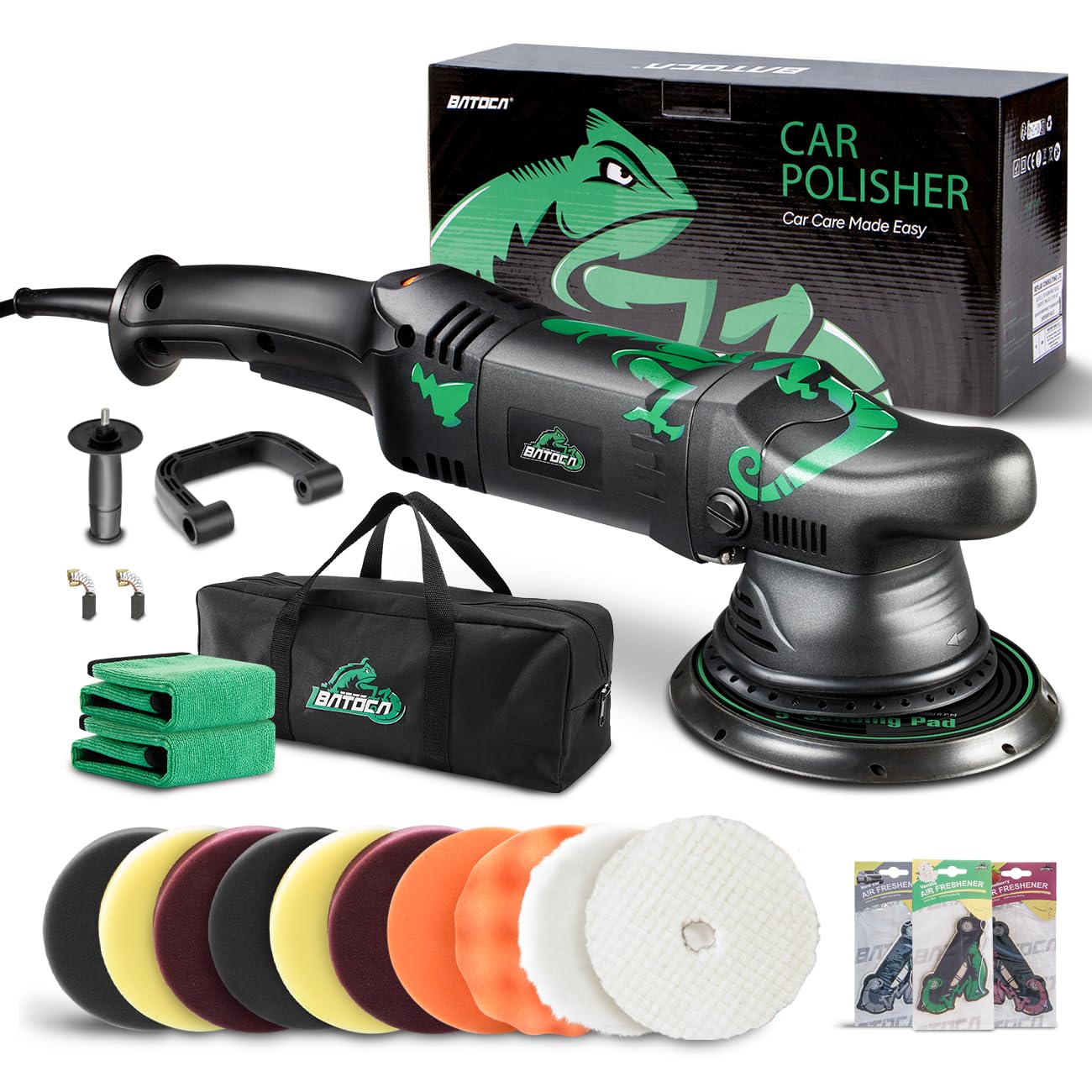
6. BATOCA 1100W Dual Action Polisher
An 1100W all-rounder that detailed three cars for eight hours straight.
This mid-range premium pick pairs an 1100-watt motor with a 2500 to 5500 RPM speed dial, covering waxing, polishing, and defect removal. The eccentric shaft design keeps it gentle for beginners, and Buyers confirmed it ran 8 straight hours detailing three cars without issues.
The kit is the real story here — it includes 6-inch flat foam pads, wool pads, polishing bonnets, sanding papers, a microfiber towel, a tool bag, disposable gloves, and replacement carbon brushes. That makes it a true starter package with almost nothing left to buy.
The green chameleon design is a fun visual break from the usual black tools. The included pads start stiff and need breaking in, and some owners mention the head attachment can loosen, so check it occasionally during use.
best for: beginners who want one box with all the pads and tools.
not for: those who want premium pad quality straight from the start.
7. Meguiar’s MT300 Dual Action Polisher

Digital torque management keeps speed steady even under heavy pressure.
Meguiar’s built the MT300 around one clever feature: Digital Torque Management. It electronically adjusts torque to hold your chosen speed steady, so the pad does not bog down when you press harder. That consistency makes compounding safer and more predictable than a basic polisher.
The soft-start technology eases the machine into motion instead of jerking at startup, which prevents polish splatter and reduces motor strain. A billet counterweight keeps vibration low, and the multi-position D-handle suits all skill levels. Owners corrected 9-year-old faded clear coat and restored RV fiberglass to a bright white shine.
This is a tool-only purchase — you supply the backing plate and pads separately. It runs on 4.5 amps and weighs 5.4 pounds, making it one of the lighter full-size options here.
choose it for: consistent speed under pressure and professional-grade results.
pass on it if: you want a ready-to-run kit without buying pads separately.
8. Griot’s Garage G9 Random Orbital Polisher

A fan-cooled counterbalance keeps this 1000W polisher smooth for hours.
First-time users are the clear target for the G9, and they respond well to its forgiving nature. The 1000-watt motor with a 9mm orbit throw and 6-inch vented backing plate corrects scratches, swirls, and oxidation without the worry of burning paint. Customers note pulling deep scratches out without issues.
The machine’s defining trait is its smoothness. A fan-cooled counterbalance and premium bearings keep vibration minimal, and the double-shot rubber grip with contoured shroud stays comfortable for extended sessions. Six speeds from 2000 to 6400 OPM cover waxing through heavy correction.
It comes with a 10-foot quick-connect power cord and rest pads for stable placement. The speed dial is accessible for both left- and right-handed users, and you can convert it to a 5-inch system with an optional backing plate.
best for: first-timers wanting an easy, low-vibration learning tool.
think twice: you need maximum correction speed for deep defects.
Understanding the Specs
Dual-Action vs Rotary Motion
The single most important safety feature is the motion type. A dual-action polisher moves the pad in a random orbit, so the pad never stays in one position long enough to burn the clear coat. This makes it ideal for beginners. A rotary polisher spins continuously in one spot and cuts faster, but it requires skill to avoid damaging paint.
Speed Range and Torque
Polishers typically offer six or seven speeds. Low speeds around 1800-2500 rpm are for applying wax. Medium speeds suit polishing and cleaning. High speeds above 5000 rpm remove paint defects and oxidation. Some premium models add digital torque management, which holds the speed constant even under pressure — preventing the pad from bogging down mid-stroke.
FAQ
What is the difference between dual action and rotary polishers?
Will a car buffer remove deep scratches from my paint?
Can I use a 6-inch polisher on small body panels?
How long does a cordless car polisher battery last?
What speed should I use for polishing versus waxing?
Is it safe for a beginner to use a dual action polisher?
What pads do I need for scratch removal?
How heavy is too heavy for a car polisher?
Final Thoughts: The Verdict
For the majority of shoppers, the car buffer for scratches winner is the VERVEWAVE Cordless Buffer because it pairs cordless freedom with a complete pad kit and a strong performance reputation from over 450 verified owners rating it 4.6 stars. If you need maximum correction power for heavy oxidation, grab the AVID POWER DA Kit — its 6500 rpm top speed and dual backing plates make it the standout value. For a first-time buyer wanting the safest learning curve, the Griot’s Garage G9 is the one to reach for, thanks to its low vibration and constant speed control.
How We Picked
We do not accept paid placement. Every pick is matched to a real buyer and a real use-case; we do not hands-on test units.
Sources & Methodology
Specifications: manufacturer listings and product documentation. Review insights: verified customer reviews, as of August 2026. Pricing: not shown on this page (it changes often); check the current price via the retailer link.
As an Amazon Associate, Trending Car earns from qualifying purchases. This does not affect which products we feature.