
Our readers keep the lights on and my garage snacks stocked. As an Amazon Associate, I earn from qualifying purchases.
Specs are compiled from manufacturer listings and verified buyer reviews and can change over time — please confirm the key details on the product page before buying.
Your van floor needs a panel that won’t sag between the ribs, won’t soak up moisture, and will hold screws for years of road vibration. The thickness, grade, and surface coating of the plywood decide all of that before you lay a single plank. The real question is if you need a slick phenolic surface or a natural birch face for your subfloor.
I’m Min Islam — the founder and writer behind Trending Car. This guide is built by comparing the manufacturers’ published specifications and the patterns across verified customer reviews, so you get each pick’s real strengths and trade-offs instead of marketing spin.
We compared three birch panels built for heavy use to find the best plywood for vanlife floors if you want a coated surface or a bare wood face.
Our Picks at a Glance
How To Choose The Best Plywood for Vanlife Floors
Your van floor takes a beating from boots, spills, and constant road flex, so the panel you pick needs to be rigid enough to span the metal ribs below. Think of the plywood as the structural base for whatever finish you install over it, whether that is vinyl, carpet, or a hard floor.
Thickness and rigidity
Thicker plywood resists sagging between the van’s floor supports, which is why 3/4-inch panels are the usual choice for a subfloor. A thinner 1/2-inch panel works for lighter builds, but it will flex more when you step between the ribs.
Coating and moisture resistance
A phenolic coating on the plywood surface blocks moisture from the road and from wet gear, which helps prevent the wood from swelling or delaminating over time. Bare birch faces look great, but they need a sealant before they go into a damp environment.
Grade and screw holding
Baltic birch plies are known for dense, void-free layers that hold screws firmly and cut cleanly without tear-out. A B/BB grade gives you one smooth face and a back with small patches, which is plenty for a floor that gets covered anyway.
Quick Comparison
| Model | Best For | Thickness | Dimensions | Weight | Amazon |
|---|---|---|---|---|---|
| Woodpeckers Baltic Birch★ Best Overall | Lighter builds and shelves | 0.5 inches | 36 x 24 inches | 9.6 pounds | Amazon |
| MakerStock Black Phenolic | Moisture-resistant subfloor | 0.75 inches | 48 x 24 inches | 25 pounds | Amazon |
| Falken Design Birch Panel | Small precise panels | 0.5 inches | 24 x 24 inches | 6 pounds | Amazon |
In-Depth Reviews
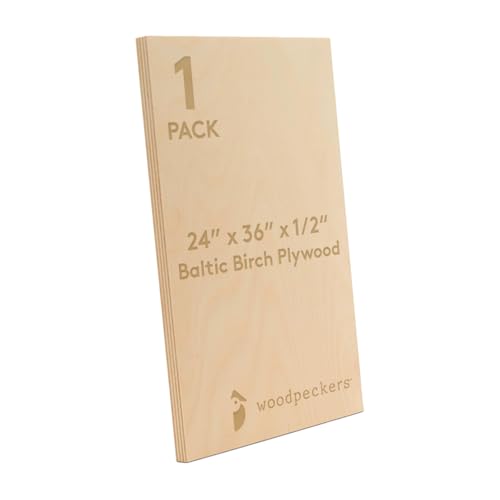
1. Baltic Birch Plywood 24 x 36 x 1/2 Inch – 12 mm Craft Wood, Pack of 1
Our pick — 4.5★ from 60+ verified ratings; the strongest balance of quality and price.
The manageable 0.5-inch sheet that keeps a light build light.
If your van build is more about keeping weight down than bracing against heavy loads, this Baltic birch panel gives you a beautifully grained face at a practical 9.6 pounds. The 36 by 24 inch sheet is a comfortable size for a small floor section or for building cabinets and shelves above the floor line, and the B/BB grade means one smooth face with a back that has a couple of small color-matched patches.
The honest trade-off against the MakerStock panel is thickness: at 0.5 inches this is 50% thinner than the 0.75-inch phenolic panel, so it will flex more when you step between floor ribs unless you add extra support. But for a desk, a worktable, or a lightweight floor base over a well-supported frame, the dense birch plies hold screws firmly and glue up cleanly.
Buyers report that the piece has a beautiful lengthwise grain that takes oil and stain well, with one owner finishing it in Danish Wood Oil and turning it into a rolling bed tray that spans the bed for a larger work surface. The recurring complaint is slivers when you pick it up by the bare edges, which leather work gloves solve in a second.
Quality First: the strongest talking point is the quality of the wood itself, which is what owners praise most in their feedback.
Weight Trade-off: the 0.5-inch thickness keeps this easy to handle, but plan extra support under any large spans.
Grab this if: you are building shelves, desks, or a lighter floor base and want a clean birch face that takes finish beautifully.
skip it if: you are laying a main subfloor over wide van ribs where the extra rigidity of 0.75-inch material wins.
2. 3/4″ / 18mm Black Phenolic Baltic Birch Plywood (24″ x 48″)

The coated workhorse that shrugs off moisture and road grit.
This is the panel that makes the most sense for a van subfloor, and the reason is the black phenolic overlay bonded to the 0.75-inch baltic birch core. That slick, dense surface blocks moisture from the road and from wet boots, which is exactly the kind of protection a floor needs before you cover it with vinyl or a hard finish.
At 25 pounds for a 48 by 24 inch sheet, this is no featherweight — it is nearly four times the weight of the 6-pound Falken panel below, which tells you how much denser and sturdier it is. The 0.75-inch thickness gives it a real advantage over the 0.5-inch panels on this list, offering 50% more material to resist flex when you step between the floor ribs.
Woodworkers who build cabinets for a living have put this through table saws and router tables, and they report zero chipping on the cuts and a surface that stays flat even in humidity. The few complaints center on the painted black edges hiding the natural birch layers and the rare unit arriving with a smashed corner, so it is worth checking the edges on delivery.
Moisture Armor
- Slick phenolic coating shrugs off spills and humidity
- Resists splitting when you drive screws and fasteners
- Stays flat and cuts clean with zero chipping
Heft To Know
- 25 pounds per sheet makes it a two-person lift
- Black painted edges hide the natural birch look
- Phenolic layer measures slightly thin on some units
Reach for this if: you want a durable, moisture-blocking subfloor that will hold up to years of van life without swelling.
Look elsewhere if: you need a bare birch face for a visible finished floor, since the black coating covers the wood grain entirely.
3. Falken Design Birch Plywood Project Panel Grade B3(D/E) 24 in. x 24 in. x 1/2 in. Thick

The square, flat, precisely cut panel for tight van fitments.
This Falken panel is a 24 by 24 inch square in 0.5-inch birch plywood, and its defining trait is how flat and true it arrives. Owners mention it comes from the start square with no warping at all — several note it is better than what you typically grab at a home center, which matters when you are scribing a floor piece into an awkward van corner and cannot afford a twist.
At just 6 pounds, this is the lightest panel here, and at 24 by 24 inches it covers only 4 square feet, so you will need several to cover a full floor. The B3(D/E) grade gives you a clean, sanded face that works for laser cutting and fine woodworking, and the core is stable enough for professional use, but the 0.5-inch thickness means the same flex consideration as the Woodpeckers sheet.
Keep the stickers in mind: a couple of buyers found the adhesive labels hard to remove cleanly, and one return happened over a quality concern, so inspect the face before you cut. For small precision pieces, scribed panels, and laser-cut accents that need a dead-flat start, this square sheet is a solid pick.
Dead Flat Start
- Arrives square and straight with zero warping
- 6-pound weight is easy to handle and mark up
- Smooth birch face ideal for laser cutting
Small Footprint
- Covers only 4 square feet per panel
- Sticker adhesive can be tough to remove cleanly
- 0.5-inch thickness needs support for wide spans
Choose it for: small, precise, dead-flat floor pieces where square edges save you from scribing a twisted panel.
Pass it by: when you need to cover a large floor quickly, since its small footprint means many panels and more seams.
Understanding the Specs
Thickness
Thickness is the single biggest factor in how a floor feels underfoot. A 0.75-inch panel resists flexing between the van’s metal floor ribs, while a 0.5-inch panel is lighter but will bounce if the supports are far apart. For a full subfloor you step on daily, 0.75-inch material is the safer structural bet.
Phenolic Coating
A phenolic overlay is a dense, smooth resin layer bonded to the wood surface, and it acts like a raincoat for the plywood. It blocks moisture from the road and from wet gear, so the wood does not swell or delaminate over time. Bare birch faces need a sealant to get similar protection.
FAQ
Is 3/4 inch plywood necessary for a van floor?
What is the difference between phenolic and bare birch plywood?
Will baltic birch hold screws well in a van floor?
Does a phenolic surface need a finish before installing?
How much does a 48 by 24 inch sheet of phenolic plywood weigh?
Is laser-cut plywood the same as floor plywood?
Will a 0.5 inch panel sag between van floor ribs?
How many panels do I need to cover a van floor?
Final Thoughts: The Verdict
For the majority of shoppers, the plywood for vanlife floors winner is the MakerStock Black Phenolic Baltic Birch because the 0.75-inch thickness and slick phenolic coating give you the rigidity and moisture protection a subfloor needs to last. If you want a bare birch face for a lighter build, grab the Woodpeckers Baltic Birch at a practical 9.6 pounds. And for small, precise panels that arrive dead flat, the Falken Design Birch is the one to reach for.
How We Picked
We do not accept paid placement. Every pick is matched to a real buyer and a real use-case; we do not hands-on test units.
Sources & Methodology
Specifications: manufacturer listings and product documentation. Review insights: verified customer reviews, as of August 2026. Pricing: not shown on this page (it changes often); check the current price via the retailer link.
As an Amazon Associate, Trending Car earns from qualifying purchases. This does not affect which products we feature.