
Our readers keep the lights on and my garage snacks stocked. As an Amazon Associate, I earn from qualifying purchases.
Specs are compiled from manufacturer listings and verified buyer reviews and can change over time — please confirm the key details on the product page before buying.
Camping power is a trade-off: you want the comfort of a fridge, a fan, or even an air conditioner, but you don’t want to listen to a lawnmower engine roar all weekend. The good news is that modern inverter generators solve both sides of that equation, delivering clean, quiet electricity that is safe for your phone and laptop. This guide breaks down the top portable power options, from fuel-sipping gas generators to silent battery stations, so you can match the right one to your campsite setup.
I’m Min Islam — the founder and writer behind Trending Car. This guide is built by comparing the manufacturers’ published specifications and the patterns across verified customer reviews, so you get each pick’s real strengths and trade-offs instead of marketing spin.
Whether you boil coffee with a 1500-watt station or run an RV air conditioner with a 4000-watt inverter, the best portable generators for camping come down to matching wattage, noise, and weight to your real weekend routine.
Our Picks at a Glance


How To Choose The Best Portable Generators for Camping
Choosing a camping generator starts with one question: what are you actually powering? A small fan and some phone chargers need far less juice than a 13,500 BTU roof air conditioner. Nail down your wattage needs first, and the rest of the decision becomes much clearer.
Starting Watts vs. Running Watts
Every motor-driven appliance — think fridges, air conditioners, and sump pumps — has a brief power spike when it first kicks on. That spike is the starting wattage, and it is always higher than the steady running wattage. A generator rated for 2500 starting watts might only deliver 1900 running watts, so you need headroom above your appliance’s combined load or the unit will strain or trip.
Fuel Type: Gas vs. Battery
Gas generators offer long runtimes and easy refueling, but they need ventilation, produce fumes, and require oil and maintenance. Battery power stations are silent, fume-free, and safe to run inside a tent or RV, but you must recharge them with solar, a wall outlet, or a car. Think about if you want endless fuel or zero noise and zero smell.
Noise: The Campsite Courtesy Factor
Most campgrounds enforce quiet hours, and a loud generator ruins the experience for everyone. Look for inverter generators with a decibel (dB) rating around 58-64 dB at a distance — roughly the level of a normal conversation — so you can run essentials without being that campsite. Battery stations, meanwhile, are effectively silent, humming at less than 30 dB when charging.
Quick Comparison
| Model | Best For | Running Watts | Weight | Runtime | Amazon |
|---|---|---|---|---|---|
| Jackery Explorer 1000 v2★ Best Overall | Silent, fume-free campsite power | 1500W | 23.8 lbs | ~1,070Wh capacity | Amazon |
| POXURIO 2450WBudget Champion | Budget gas power for RV AC | 2450W | 43 lbs | 8.3 hrs / tank | Amazon |
| AIVOLT 1600WCompact Pick | Ultra-light backpacking gas | 1260W | 28 lbs | 8 hrs (ECO) | Amazon |
| PowerSmart 2500W | Reliable mid-size camp power | 1900W | 39.7 lbs | 5.5 hrs (50% load) | Amazon |
| WEN 56360i | RV-ready with TT-30R plug | 2900W | 46 lbs | — | Amazon |
| Champion 4000W | Heavy duty RV AC + home backup | 3000W | 48.1 lbs | 10 hrs | Amazon |
| Jackery Explorer 2000 v2 | High-capacity silent power | 2200W | 39.5 lbs | ~2,042Wh capacity | Amazon |
| Honda EU1000i | Whisper-quiet minimal power | 900W | 29 lbs | 6.8 hrs | Amazon |
| Honda EU3000iS | Long-run electric-start power | 3000W | 144 lbs | 19.6 hrs | Amazon |
In‑Depth Reviews
1. Jackery Explorer 1000 v2 Portable Power Station
Our pick — over 4.5★ from 3,500+ verified ratings; the strongest balance of quality and price.
The silent, fume-free power station that runs a campsite without waking a soul.
The Jackery Explorer 1000 v2 is the crowd favorite for a reason — it delivers 1500W of AC output with a 3000W surge peak, yet weighs just 23.8 pounds with a foldable handle. That is a fraction of the weight of comparable gas generators, and it produces zero fumes, zero smell, and almost no noise, so you can run it inside a tent vestibule or an RV without worry. The 1,070Wh capacity is enough to keep a fridge cold for a full weekend, and buyers report it powers everything from espresso machines to 1,100-watt microwaves without breaking a sweat.
Charging is where this station really shines: hit 0% to 100% in just one hour with the emergency charge mode activated through the Jackery App, or default to a gentler 1.7-hour charge that protects battery health. ChargeShield 2.0 tune charging to extend battery health., and the LFP battery maintains over 70% of its original capacity even after 4,000 charge cycles — a lifespan exceeding 10 years. For camping, that means this is not a disposable gadget; it is a long-term investment in quiet power.
The port selection covers every need: two USB-C ports, one USB-A port, one DC car port, and three pure sine wave AC ports. The 100W USB-C PD fast charging tops up a modern laptop or tablet at full speed, no extra adapter required. Owners mention it runs a kitchen fridge for 8 hours from 100% to 53% — roughly 14 hours total — and one camper noted it “Runs kitchen fridge 8hrs from 100% to 53% (~14hrs total)” while the compressor draws just 132W. This is the pick for anyone who values silence and safety over raw fuel-burning grunt.
Silent powerhouse: A 1500W output in a 23.8-pound frame with a 10-year battery lifespan is the best overall balance of power, portability, and peace.
Plan ahead: Battery capacity is finite — you must recharge via the app-controlled AC input, solar panels, or a car outlet, so it suits short trips or paired-with-a-generator setups.
Reach for this if: you want silent, fume-free power for a fridge, phones, and small appliances without ever touching gasoline.
Look elsewhere if: you need to run a rooftop RV air conditioner all day — that is gas-generator territory.
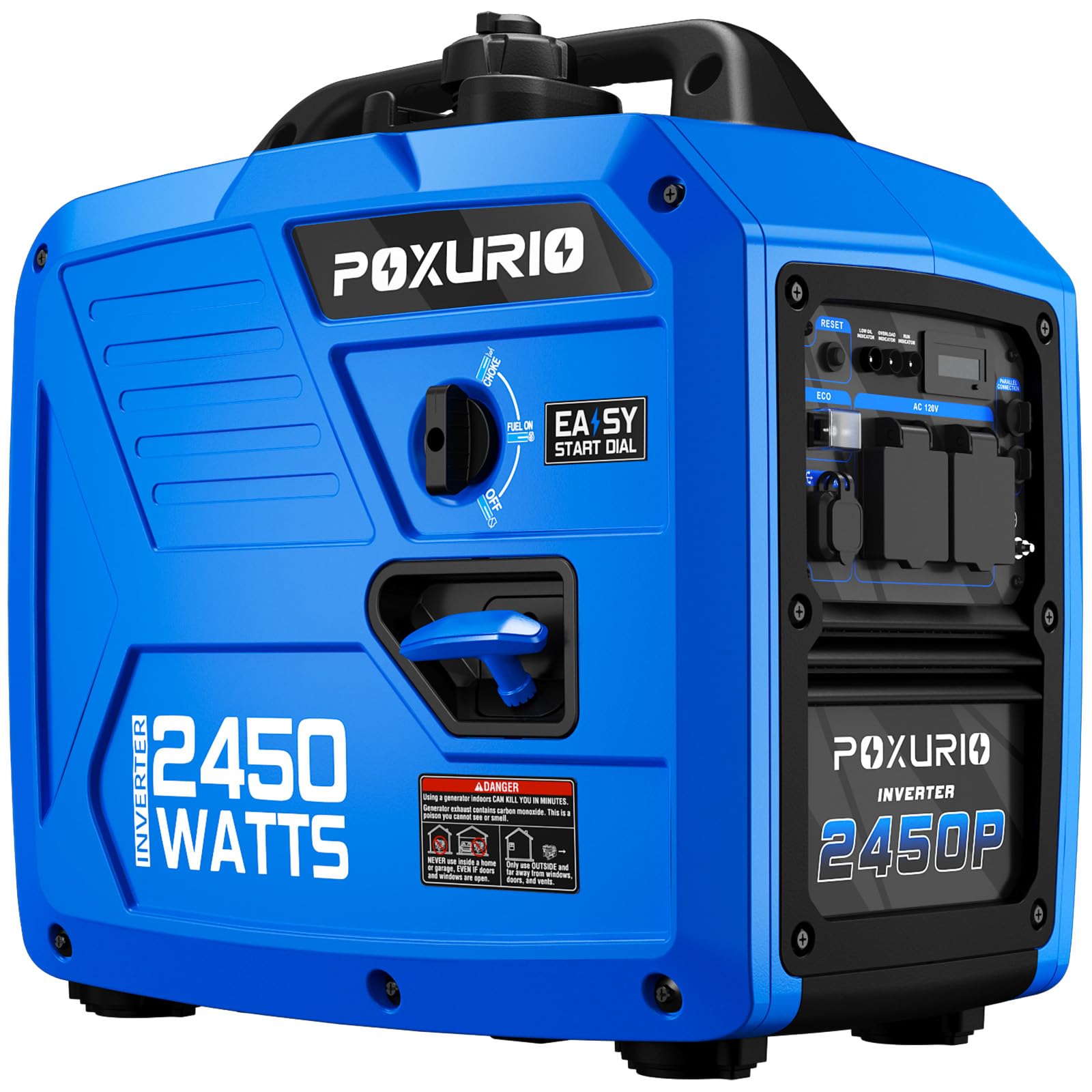
2. POXURIO 2450-Watt Portable Inverter Generator
The budget gas generator that punches far above its price for RV air conditioning.
The POXURIO 2450W delivers 2450 watts of clean inverter power with a 6L fuel tank that runs up to 10 hours at 25% load — and customers note it “Ran 12 hours under light load on one tank.” That is serious endurance for a budget-friendly machine, and its 59 dB noise output (quieter than a normal conversation) keeps you welcome at any campsite. Its inverter outputs clean sine wave power, protecting phones and laptops.
Where this generator really flexes is its versatility. Reviewers point out it handles an RV air conditioner and water heater without overload, runs a 5,000 BTU AC in a semi truck, and powers tools on a job site. The 43-pound weight and ergonomic handle make it genuinely portable, and gasoline is easy to store, affordable, and convenient to obtain. The engine is a 4-stroke with electronic ignition, starting reliably when you need it.
The chatter around this unit is consistently positive: noise level tops the list of what owners praise most, followed closely by ease of use and build quality. It is EPA compliant, so it is legal in the vast majority of US states. For campers who need real gas-powered grunt without paying premium prices, this is the value king of the list.
Endurance bargain: A 2450W inverter that runs a tank for 12 hours under light load at a budget-friendly price is exceptional value.
Watch the surge: The ECON mode can trip on high-startup tools like a circular saw — flip it off for heavy motor loads.
Grab it if: you want gas-powered reliability for RV AC or tools without emptying your wallet.
Think twice if: you need a featherweight for backpacking — 43 pounds is manageable but not light.
3. AIVOLT 1600W Super Quiet Inverter Generator
The featherweight 28-pound gas generator that whispers at 57 dBA and slips into any trunk.
The AIVOLT 1600W is built for campers who want gas power without the back strain. At just 28 pounds — noted as 20% lighter than similar models — it is easy to carry to a campsite or a job site, and it produces a super-quiet 57 dBA at 23 feet, quieter than a normal conversation. The 60cc 4-stroke OHV engine delivers 1600 starting watts and 1260 running watts, with a clean output under 3% THD — safe for your phones, laptops, and small tools.
Fuel efficiency is the headline here: the ECO mode intelligently adjusts consumption to enable up to 8 hours of continuous operation at 25% load. Shoppers say it powers a 34-foot camper perfectly and handles a 1500W startup surge comfortably. The panel includes two 120V outlets and two USB ports (Type-A and Type-C), so you can charge phones while running a camping fridge. Need more power? Connect two AIVOLT units via a parallel kit (not included) to double your output.
Safety is baked in: a built-in CO Alert tech auto-shuts down when unsafe carbon monoxide levels are detected, plus low-oil auto-shutdown and overload protection. It is EPA approved, though not legal in California. The 2-year manufacturer warranty and free lifetime technical support back it up, and owners consistently report “Supper light and supper quiet, started right up after adding oil and fuel.”
Why it wins campers
- 28-pound frame is genuinely easy to carry
- 57 dBA rivals the quietest in its class
- 8-hour ECO runtime sips fuel
- Parallel capability doubles output
Where it’s honest
- Some owners measure higher real-world noise under load
- A rare unit struggled past 750W despite the rating
Perfect for: tent campers and tailgaters who want light, quiet gas power for phones, fans, and small fridges.
Not for: heavy RV AC duty — the 1260 running watts leaves little headroom for big compressors.
4. PowerSmart 2500 Watt Portable Inverter Generator
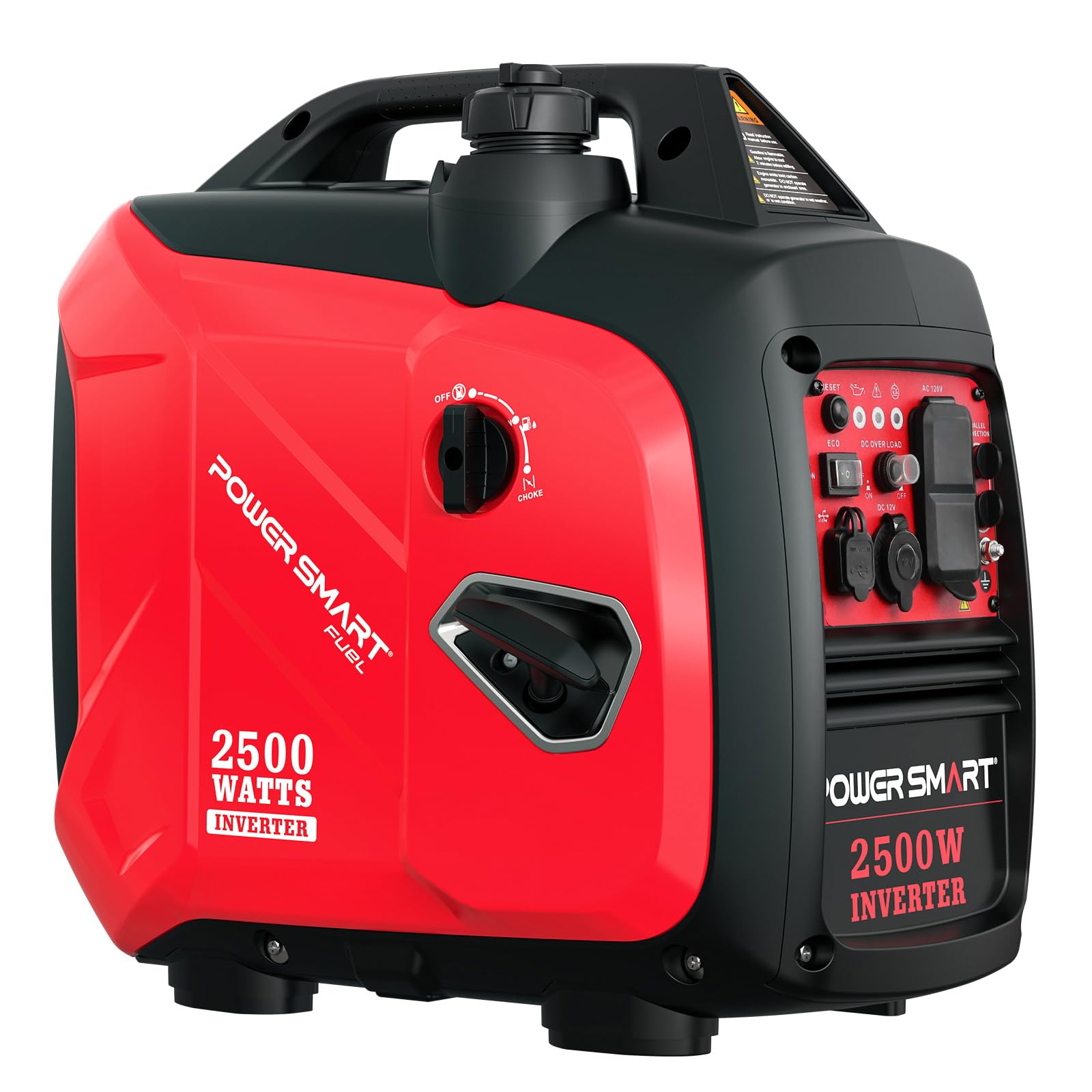
The dependable mid-size inverter that campers describe as compact, quiet, and easily easy.
The PowerSmart 2500W hits the balance between portability and output: 2500 starting watts and 1900 running watts of clean power, perfect for sensitive electronics. Its 59 dBA noise level at 23 feet keeps the peace at any campground, and the 1.06-gallon fuel tank provides 5.5 hours of runtime at 50% load — enough to get through a full night of essentials without a refuel. The 79.8cc 4-stroke engine starts easily with the recoil pull.
Reliability is the thing owners praise most — it tops the list of positive aspects by a wide margin, followed closely by quiet operation. Campers report using it to charge phones, run a small coffee pot, power a fan, and blow up an air mattress simultaneously: “Wow, what a great option for camping! It’s compact, quiet and so easy to use. We charged phones, used it for a small coffee pot, run our fan and blow up our air mattress.” The control panel includes a 120V 20A duplex household outlet, a 12V 8A DC port, and two 5V 2.1A USB ports, plus an Eco mode for fuel savings.
At 39.7 pounds, it is heavier than the AIVOLT above but still reasonable for car camping, and owners note it is “half the weight of standard generators with almost the same output.” Pure sine wave output keeps laptops and tablets safe. A 2-year limited warranty with free lifetime technical support adds confidence, and the cold start technology plus low-oil shutdown round out a thoughtfully built package.
Reliable all-rounder: With reliability as the top praised aspect, this is the quiet, easy-to-start workhorse for weekend campers.
Mind the surge: One owner found the wattage rating optimistic under heavy AC loads — give yourself headroom for motor startups.
Best for: families and small groups who want a trustworthy, quiet generator for coffee, fans, and device charging.
skip it if: you need RV AC power — the 1900 running watts is better suited to smaller loads.
5. WEN 3600-Watt Portable Inverter Generator (56360i)

The RV-ready inverter that plugs straight into your camper’s 30-amp port.
The WEN 56360i is built for RV owners who want to plug directly into their camper without adapters. Its 149cc engine generates up to 3600 surge watts and 2900 rated watts, and the panel includes a TT-30R RV receptacle alongside two three-prong 120V outlets, a 12V DC receptacle, and two 5V USB ports. That RV-ready plug is the standout feature — you connect your camper’s shore power cord and go. Clean sine wave output safeguards smartphones, tablets, and laptops.
Quiet operation is the other big win. Buyers report it runs a large portable air conditioner for several hours on one tank of gas, and it “Starts up on first pull every time.” Reliability tops the list of what owners praise most — nearly double the mentions of the next aspect — with noise level close behind. A camper notes it fits “under bunk,” runs a 13K BTU AC, and gets roughly 4 hours per tank with the AC on a hot day, with no gas smell to deal with.
The fully enclosed design keeps it compact at 17.9 x 11.6 x 19.7 inches and weighs a mere 46 pounds — particularly light for a 3600-watt unit. The fuel shutoff feature boost lifespan by using up the remaining fuel in the carburetor before shutdown, preventing gummed-up fuel lines. It comes with a three-year warranty, and owners call it “quiet and reliable,” starting in 2 pulls even at 14°F.
Direct RV hookup: The TT-30R receptacle means no adapter hassle — just plug in your camper’s cord.
Expect real-world limits: A single owner found the wattage rating optimistic at high AC loads — size up if you plan to run two big appliances.
Reach for this if: you own an RV or camper trailer and want clean, quiet 30-amp power without adapter headaches.
Look elsewhere if: you need to run a heavy 3600-watt load — the rated 2900 running watts is your real ceiling.
6. Champion Power Equipment 4000-Watt RV Ready Inverter Generator

The lightest 4000-watt inverter you can buy, ready to run your RV’s rooftop AC all day.
The Champion 4000W is a heavyweight performer in a surprisingly light frame — at less than 49 pounds, the brand claims it is one of the lightest 4000-watt inverters in the industry. It delivers 4000 starting watts and 3000 running watts, with up to 10 hours of runtime, making it the most powerful gas pick on this list. The 64 dBA noise level from 23 feet is perfect for camping or tailgating, and the clean electricity (less than 3% THD) is safe for sensitive electronics.
Owner reports are emphatic about its capability: one camper’s 55-hour test ran a 15k BTU AC, lights, and a 12V fridge continuously, with “no oil burn” and easy starting. Another notes it “runs a 15k AC unit without issues,” and a boondocker reports it “worked perfectly” for their camper all season. Reliability tops the praised-aspect list, with quality and quiet operation close behind. The engine is a 149cc 4-stroke that starts with a recoil pull.
Safety is comprehensive: the built-in CO Shield carbon monoxide auto-shutoff system protects your family, and the low-oil shutdown adds another layer. The panel includes a 120V 25A TT-30R outlet for direct RV hookup, a 120V 20A household duplex outlet (5-20R), a 12V automotive-style outlet, and parallel outlets — so you can connect a second Champion 4000W to double your output. It comes with engine oil and an oil funnel, plus a 3-year limited warranty with free lifetime technical support.
The muscle list
- 3000 running watts handles rooftop RV AC
- 48.1-pound frame is light for its class
- TT-30R outlet plugs straight into RVs
- Parallel capability doubles output
The honest trade
- One owner wished for a larger gas tank — refills come often
- Not enough to run AC plus microwave simultaneously
Grab it if: you boondock with a rooftop air conditioner and want a powerful yet portable gas inverter.
Think twice if: you plan to run AC and a microwave at once — that combo needs more than 3000 running watts.
7. Jackery Explorer 2000 v2 Portable Power Station

The 2kWh silent giant that keeps a fridge cold for a day and a half without a drop of fuel.
The Jackery Explorer 2000 v2 is the answer for campers who want near-gas-level power with zero noise, zero fumes, and zero maintenance. Its 2,042Wh capacity and 2200W AC output (across three AC ports) can run a fridge for over 21 hours — owners mention exactly that: “Fridge ran 21.3h.” Despite the massive capacity, it weighs just 39.5 pounds, which the brand notes is 41% lighter and 34% smaller than typical 2kWh LiFePO4 stations, thanks to the same CTB (Cell-to-Body) technology used in EVs.
Charging is remarkably fast: go from 0 to 80% in just 66 minutes with AC Fast Charging, or reach a full charge in 102 minutes using the Emergency Super Charging mode through the app. Silent Charging mode delivers a full charge in 5 hours at just 30dB — quieter than a whisper — perfect for sleeping. The USB-C PD 100W port fast-charges devices without an extra adapter, and solar charging takes as few as 6 hours with 400W panels. Quality tops the praised-aspect list, with charging speed close behind.
The LiFePO4 battery holds over 70% capacity after 4,000 cycles, a 10-year lifespan., and the 20ms smooth switching provides uninterruptible power through outages — it is UL1778 test certified for UPS use. Customers note it “kept Wi-Fi running for remote work through rain” off-grid in Belize and ran a 1500W heater at 1438W with a fan that was noticeable but not noisy. The built-in light offers dim, bright, and SOS modes. For a premium camping power solution that doubles as serious home backup, this is the one.
Capacity champion: Over 21 hours of fridge runtime in a 39.5-pound, near-silent package is exceptional for a battery station.
Recharge reality: The battery is finite — plan your trips around solar panels, wall charging, or a car outlet.
Perfect for: off-grid campers and remote workers who need laptop-grade power for days without ever hearing an engine.
Not for: continuous high-load RV AC — 2200W output has limits where gas generators cruise.
8. Honda EU1000i 1000 Watt Inverter Generator
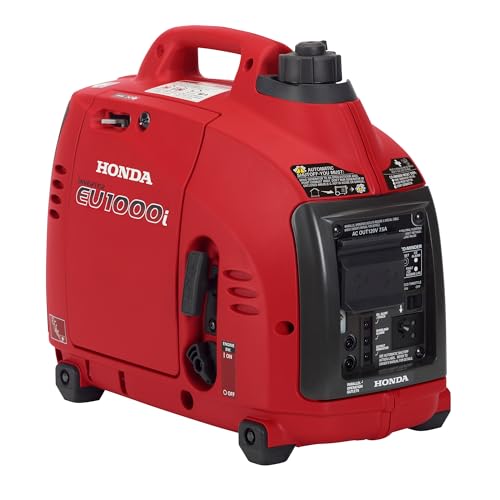
The legendary Honda that runs at 42-50 dB(A) — less noise than a conversation, and virtually invisible at 100 feet.
The Honda EU1000i is the gold standard for whisper-quiet camp power, operating at just 42 to 50 dB(A) — quieter than a normal conversation, and reviewers point out it is “barely audible at 100ft.” Weighing only 29 pounds, it is incredibly portable, and the Eco Throttle System delivers impressive fuel efficiency: up to 6.8 hours of runtime on a 0.6-gallon tank. Its inverter delivers clean power safe for computers and sensitive gear.
Real-world owners confirm the Honda magic: one camper powers an induction cooktop and a 600-900W heater with it, while another notes it “handled 22 CF fridge, lamp, router, charging.” Its favorite use case is exactly what the specs suggest — fans, TV, lights, small power tools, and laptop charging. The quality is what owners praise most, with quiet operation and power close behind. An external BERG tank extends runtime well beyond the standard 3 hours on half a gallon.
The compact size is a double-edged sword, though — it is incredibly small, but some owners find it “not quite big enough” for their needs, like the one who plugs in a 30-gallon air compressor and watches it die. This is not a criticism of the machine; it is a sizing reality. The EU1000i is a precision instrument for light duty, not a workhorse. It comes with a 3-year residential warranty, and this model is not available in California (see the EU1000T1AG instead).
Quiet royalty: At 42-50 dB(A) and 29 pounds, this is the benchmark for peaceful, portable camp power.
Size honestly: The 900 running watts is perfect for small loads but will not run big motors or RV AC — right-size your expectations.
Best for: minimalist campers who want a featherweight that charges phones, runs lights, and sips fuel for days.
pass on it if: you need to run a refrigerator and an air conditioner — step up to the 3000W class.
9. Honda EU3000iS 3000 Watt Inverter Generator
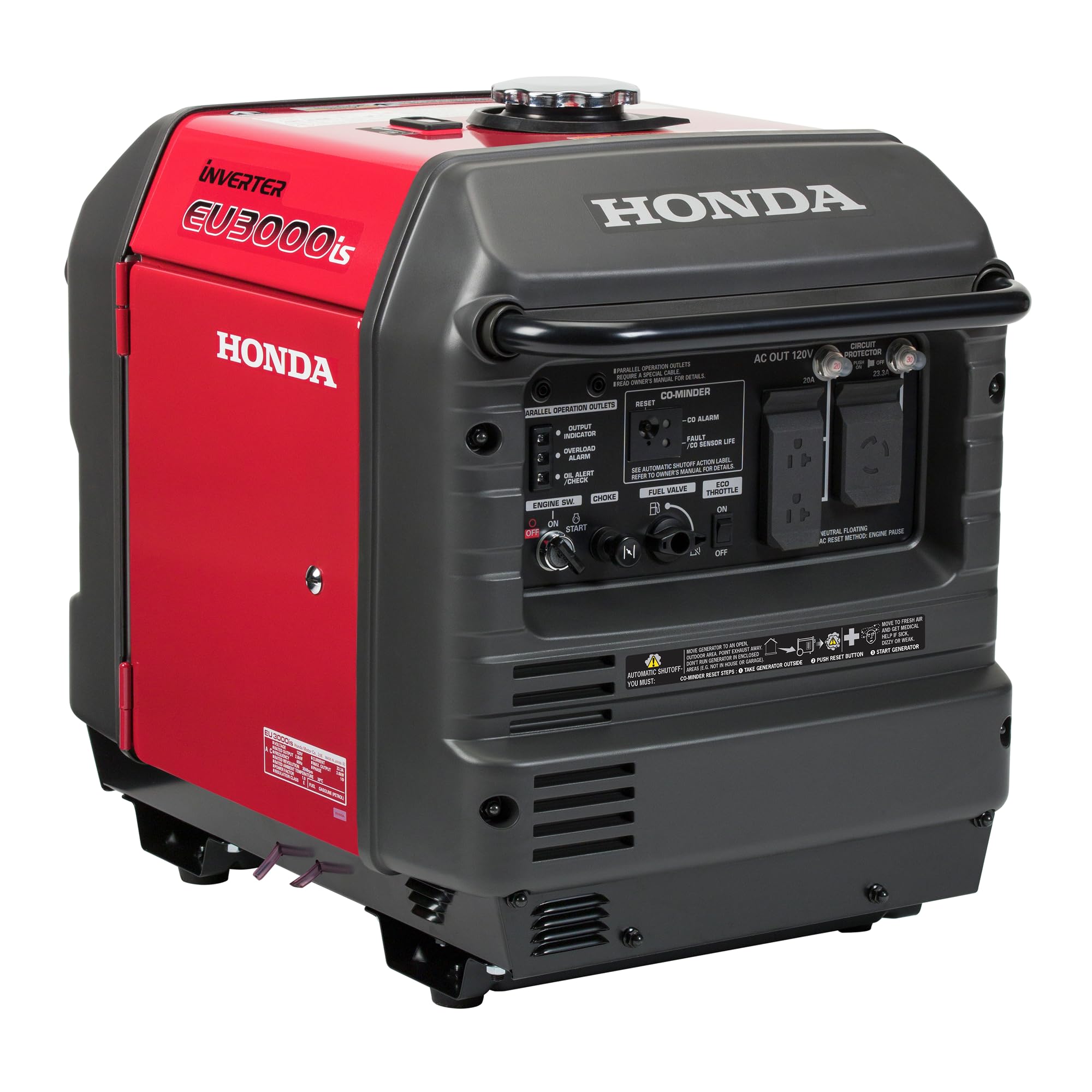
The electric-start Honda that runs up to 19.6 hours on a single 3.4-gallon tank — overnight power, no refueling.
The Honda EU3000iS is the endurance king of this list, engineered to run 6.9 to 19.6 hours on a single 3.4-gallon fuel tank with its Eco Throttle System. That means a full night of power for a furnace, fridge, or most 13,500 BTU RV AC units without a single refuel. The electric start eliminates the pull-cord dance, good news for anyone who has struggled with recoil starters in the dark. It operates at 50 to 57 dB(A) — quieter than a normal conversation — and supplies inverter-clean power safe for computers.
Owners are emphatic about its quality. “Honda makes the best generator! If you need power this is definitely the generator you need,” reads a common sentiment, and another calls it “one of the best investments we’ve made this last year. Very handy when camping. Very fuel efficient especially in eco mode.” The 418cc 4-stroke engine delivers 3000 watts of clean power, enough to run a fridge, TV, and other appliances “without fear of hurting your appliances.”
The built-in CO-MINDER system continually monitors carbon monoxide levels and automatically shuts down the generator before CO becomes dangerously high — a critical safety feature for RV and camper use. The recurring honest note is weight: at 144 pounds, this is not a carry-it-yourself machine. It is cart-worthy, not backpack-worthy, and owners flag it as “heavier than expected.” The 3-year residential warranty and this model’s unavailability in California (see the EU3200IAC2 instead) round out the picture.
Endurance machine: A 19.6-hour runtime with clean 3000W output makes this the go-to for long boondocking stays and home backup.
Weight reality: At 144 pounds, plan for a wheel cart or a strong helper — this is stationary camping power, not throw-in-the-trunk power.
Reach for this if: you want premium Honda reliability with electric start and enough fuel to run all night without touching the tank.
Look elsewhere if: portability is your priority — the 28-pound AIVOLT or 29-pound EU1000i is far easier to move.
Understanding the Specs
Starting vs. Running Watts
Starting watts (also called surge watts) is the brief power spike a motor needs to kick on — think a fridge compressor or AC starting up. Running watts is the steady draw once it is humming. A 2500W starting / 1900W running generator handles that initial surge but settles to 1900W for continuous use. Match your appliance’s combined running wattage plus a 20-30% margin for the startup spike.
Decibels and Distance
Noise is measured in decibels (dB), and most inverter generators quote a rating at a set distance, usually 23 feet. For context, a normal conversation sits around 60 dB, so a generator rated 57-64 dB at 23 feet is roughly conversation-level. Battery power stations are dramatically quieter — Jackery’s Silent Charging mode runs under 30 dB, essentially a whisper. Always check the distance in the rating, since dB readings close up are much higher.
FAQ
Can I run my RV air conditioner with a portable generator?
What is the difference between a gas generator and a battery power station for camping?
How many watts do I need to power a camping fridge?
Is clean power really necessary for my laptop and phone?
Can I charge a Jackery power station from a gas generator?
How long will a camping generator run on one tank of gas?
Are these generators legal in California?
What is a parallel kit and do I need one?
How do I maintain a gas camping generator?
Final Thoughts: The Verdict
For the majority of shoppers, the portable generators for camping winner is the Jackery Explorer 1000 v2 because it delivers 1500W of silent, fume-free power in a 23.8-pound frame with a 10-year battery lifespan — perfect for car campers and RV owners who value peace and quiet. If you want gas-powered grunt for a rooftop AC, the Champion 4000W is the one to reach for with its 3000 running watts and TT-30R RV hookup. And for the strictest budget, the POXURIO 2450W delivers endurance and quiet operation at a fraction of the premium price — the crowd favorite for value seekers.
How We Picked
We do not accept paid placement. Every pick is matched to a real buyer and a real use-case; we do not hands-on test units.
Sources & Methodology
Specifications: manufacturer listings and product documentation. Review insights: verified customer reviews, as of August 2026. Pricing: not shown on this page (it changes often); check the current price via the retailer link.
As an Amazon Associate, Trending Car earns from qualifying purchases. This does not affect which products we feature.