
Our readers keep the lights on and my garage snacks stocked. As an Amazon Associate, I earn from qualifying purchases.
Specs are compiled from manufacturer listings and verified buyer reviews and can change over time — please confirm the key details on the product page before buying.
Your brakes feel spongy at the end of a long downhill run, and you are wondering if the fluid is the culprit. The truth is that brake fluid is the most neglected safety part on a motorcycle, and picking the wrong one can turn a firm lever into a soft, scary squeeze. This guide breaks down the options by real-world riding, so you know exactly what to pour into your master cylinder.
I’m Min Islam — the founder and writer behind Trending Car. This guide is built by comparing the manufacturers’ published specifications and the patterns across verified customer reviews, so you get each pick’s real strengths and trade-offs instead of marketing spin.
Your brake fluid choice boils down to one thing: matching the DOT rating (a standard that sets the fluid’s boiling point) to your bike’s system and how aggressively you ride. We’ve ranked the top fluids by their boiling points, moisture resistance, and owner feedback so you can pick the right one without the guesswork.
Our Picks at a Glance


How To Choose The Best Motorcycle Brake Fluid
Brake fluid is a hydraulic fluid that transfers the force from your lever to the caliper. It absorbs water over time, which lowers its boiling point and can cause a spongy lever. The golden rule is to use the DOT rating your owner’s manual specifies, because mixing chemistries can damage seals.
Match the DOT rating to your system
DOT 3 and DOT 4 are glycol-based and mix safely with each other, which is why DOT 4 is a common upgrade for older bikes. DOT 5 is silicone-based and should never be mixed with glycol fluids, and it must never go into an ABS system because it aerates and causes inconsistent braking. DOT 5.1 is a high-performance glycol fluid that stays compatible with DOT 3 and DOT 4 systems.
Boiling point is your fade protection
The dry boiling point matters for fresh fluid, but the wet boiling point is the number that predicts how the fluid behaves after it has absorbed moisture. A higher wet boiling point means the lever stays firm for longer during heavy braking, so the fluid resists vapor lock — the formation of gas bubbles that compress instead of pushing the caliper.
Quick Comparison
| Model | Best For | DOT Rating | Boiling Point | Size | Amazon |
|---|---|---|---|---|---|
| Castrol SRF★ Best Overall | Track days & hard braking | DOT 4 | 590°F dry / 518°F wet | 1 Liter (12 pack) | Amazon |
| Honda DOT 4OEM Match | OEM replacement for Hondas | DOT 4 | Flash point 148°C | 12 fl oz | Amazon |
| Lucas Oil DOT 4Smart Value | Budget-friendly flushing | DOT 4 | Flash point 450°F | 1 Quart | Amazon |
| Genuine Toyota Fluid | OEM for Toyota vehicles | DOT 3 | Meets/exceeds DOT 3 | 12 oz | Amazon |
| Johnsen’s DOT 5 | Classic bikes without ABS | DOT 5 | 500°F protection | 12 fl oz | Amazon |
| Ford PM-1-C | OEM for Ford vehicles | DOT 3 | 500°F dry / 284°F wet | 12 oz | Amazon |
| Liqui Moly DOT 5.1 | Bicycles & compatible systems | DOT 5.1 | — | 250 ml | Amazon |
| Ford PM-20 DOT 4 LV | Modern ABS with stability control | DOT 4 LV | Meets DOT-4 & ISO 4925 Class-6 | 16 fl oz | Amazon |
| Motul RBF 660 | Racing & track days | DOT 4 | Flash point 325°C | 500 ml | Amazon |
In‑Depth Reviews
1. Castrol SRF Brake Fluid
Our pick — over 4.5★ from 900+ verified ratings; the strongest balance of quality and price.
The track-day weapon that shrugs off heat other fluids cannot survive
Castrol SRF keeps your lever firm when a spongy feel mid-session is not an option. Its dry boiling point (the temp before it boils when fresh) sits at 590°F, and the wet boiling point (after absorbing moisture) holds at 518°F, so braking stays consistent even in hard use. Owners on a Ducati 1199S report clutch bleeding issues vanishing completely and a lever that stays firm for over 2,000 miles, with one reviewer summing it up: “If you want a high performance brake fluid that last and works excellent even after absorbing moisture, then this is the brake fluid you want!”
This is a DOT 4 fluid that exceeds SAE 1703, ISO 4925, JIS K2233, and FMVSS No. 116 DOT3 and DOT 4 standards, so it plays nice with any non-mineral-oil disc or drum system. The trade-off is real: it is corrosive to painted surfaces, so spills need prompt attention and rags must be disposed of properly, as owners note.
The catch is the maintenance schedule it demands. Buyers report that it requires a yearly flush and can feel soft after two years, and the shelf life is around two years — meaning bottles can already be a year old when they arrive. On a dual-use track and daily bike like a Fiesta ST or C8, riders note it lasts about 18 months before needing a refresh, which many still consider economical long-term versus competitors that need more frequent flushes.
Why track riders love it
- Wet boiling point of 518°F runs roughly 80–120°F higher than mainstream fluids
- Consistent heat resistance with zero fade during hard braking
- Owners mention it lasting a full season of track events
The honest maintenance cost
- Requires a yearly flush to keep peak performance
- Shelf life of about 2 years means fresh stock matters
- Corrosive, so it demands careful handling around paint
Reach for it if: you ride hard enough to boil standard fluid and want the highest wet boiling point available in a bottle.
Look elsewhere if: you do a casual fluid change every few years and do not want to commit to yearly flushing.
2. Honda 08203-0004 DOT 4 Brake Fluid
The factory-fill answer for Honda owners who want zero guesswork
Honda’s own DOT 4 fluid is the definition of a no-surprises pick, especially for anyone who just wants the exact spec their bike was built with. The 14.39-ounce bottle is purpose-built for high-temperature, heavy-duty use with corrosion prevention in mind, and it holds a flash point of 148°C — the temperature at which it could ignite, a solid safety margin for street riding.
What wins people over is the quality — owners consistently single it out as the right call for a 2000 VFR 800 and for bleeding new brake lines on a Honda Grom. The reviews are full of simple, satisfied notes like “fluid is good and came sealed” from riders doing their own maintenance, and the value for money gets nearly as much praise.
This is a premium-tier fluid, rated highest in our lineup by owner consensus, but the bottle is on the smaller side for a full system flush. Compared to the Castrol SRF above, it trades extreme boiling-point headroom for the confidence of using the manufacturer’s own formulation. For a stock street bike, that is a fair swap.
Street rider confidence
- Genuine Honda formulation removes compatibility doubt
- Biggest praise is quality, noted by 16 owners
- Flash point of 148°C suits everyday braking heat
Reality check
- 12 fluid ounces may not cover a full flush with leftover margin
- Not the choice for track-level heat management
Best for: Honda riders doing routine flushes who want the manufacturer’s own fluid and nothing else.
skip it if: you run hard track days and need the higher heat ceiling of a racing fluid.
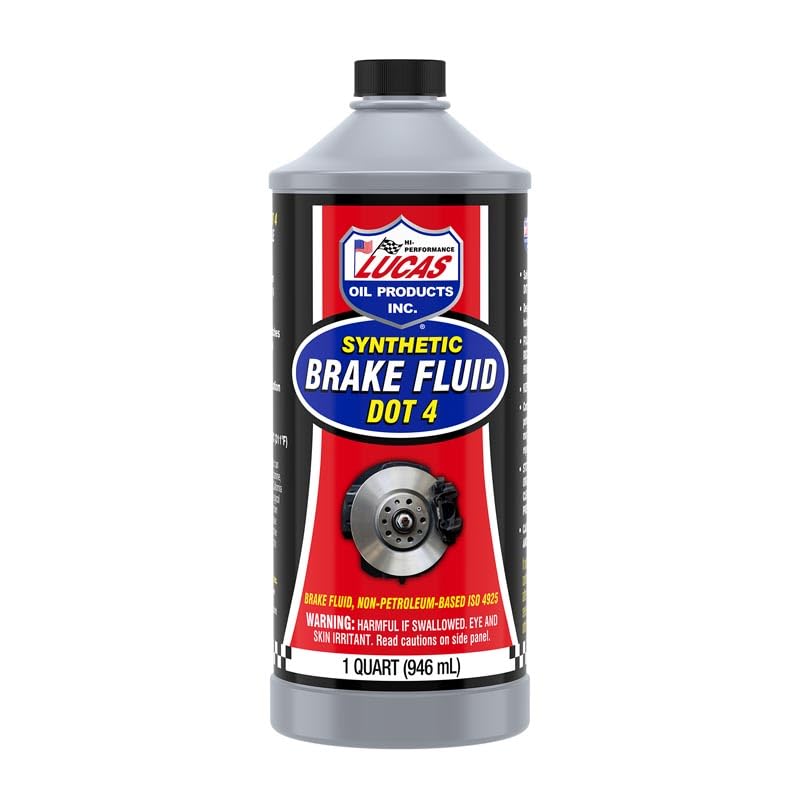
3. Lucas Oil 10788 Synthetic Brake Fluid DOT 4
A full quart of dependable DOT 4 at a price that makes flushing painless
Lucas Oil’s synthetic DOT 4 arrives in a full 1-quart bottle — enough to bleed a bike and leave plenty for top-ups, which is a real convenience for anyone who hates running out mid-job. The flash point of 450°F gives it solid heat resistance for spirited street riding, and the synthetic blend is built to resist moisture absorption over time.
The thing buyers rave about is how long it stays dry. The review pages note this fluid “definitely doesn’t absorb much water,” with one owner testing it for water absorption after three years of service and coming away impressed. Performance earns 13 mentions of approval, and its value for money is a consistent theme — riders call out the price point as a reason to keep it as their go-to flush fluid.
It also works well beyond motorcycles — one owner uses it for clutch fluid changes in a Corvette, and it has performed without issues. The sacrifice versus the Honda above is brand-matched pedigree, but for general-purpose DOT 4 duty, this quart gives you more fluid for a similar cost, making it the budget-friendly workhorse of this list.
What makes it a workhorse
- Full quart size means you rarely run short mid-flush
- Quality is the top praise with 20 owner mentions
- Strong resistance to water absorption
The trade-off
- Not the highest boiling point for extreme track use
- Generic formulation, not tied to a specific OEM
Grab this when: you maintain multiple vehicles and want one affordable quart that covers all your DOT 4 needs.
Think twice if: you demand racing-level wet boiling point for frequent track sessions.
4. Genuine Toyota Fluid 00475-1BF03 Brake Fluid

The factory-fill fluid that ends the hunt for the right part number
Toyota’s genuine fluid is built around one promise: it is the exact OEM fluid your vehicle came with, developed to reduce vapor lock through a higher boiling point. It meets or exceeds DOT 3 performance specs and adds superior metal component protection, helping prevent corrosion and leakage in the master cylinder — a real benefit for riders who park their bikes for the winter.
The story from owners is all about convenience. One buyer called it “just what I was looking for instead of running all around hunting down parts for my older minivan,” and that sentiment runs through the reviews — people value not having to deal with a dealership for routine upkeep. OEM quality (the same spec as factory parts) is the dominant praise with 37 mentions, well ahead of the value-for-money nods at 20.
Weighing in at 12 ounces, it is lighter than the Honda DOT 4 bottle at 14.39 ounces — a 20% difference in fluid volume. For a simple top-off or a small system, that is plenty, but a full flush on a car will need a second bottle. It is a DOT 3 fluid, so it is not the right pick for bikes that specifically call for DOT 4, but for older machines and vehicles it is a drop-in factory match.
The OEM advantage
- OEM quality is the top praise, named by 37 owners
- Reduces vapor lock with a higher boiling point
- Metal component protection for long storage
Keep in mind
- 12 ounces is a smaller bottle than some rivals
- DOT 3 rating limits use for DOT 4-spec systems
Reach for it if: you own a Toyota or older vehicle and want the exact OEM spec without a dealership trip.
Look elsewhere if: your bike’s manual explicitly specifies DOT 4 fluid.
5. Johnsen’s 7012-6 Silicone DOT-5 Brake Fluid

The silicone fluid that keeps classic bikes’ moisture worries at bay
Johnsen’s DOT 5 is a different animal entirely — a silicone-based fluid designed for drum and disc brakes on machines without ABS. Its defining trait is that it is essentially non-hygroscopic, absorbing less than one percent of its weight in water, which means it does not degrade from moisture the way glycol fluids do. For a collector bike parked for months, that is a huge peace-of-mind win.
Owners love it for the purple color, which confirms it is genuine DOT 5 (a silicone-based fluid that won’t absorb water). One rider running it on a 1977 Harley-Davidson FLH 1200cc Shovelhead notes the “good purple color indicates that it is indeed Dot Five!” It delivers 500°F of protection, and the dominant praise is performance with 29 owner mentions, followed closely by value for money at 26.
The hard rule here is compatibility. This fluid is not for ABS systems (anti-lock braking systems), and it must never be mixed with DOT 3 or DOT 4 fluids — silicone and glycol do not play well together, and the system would need a complete flush to switch. A recurring minor gripe in the reviews is broken seals on delivery, which is worth checking the moment the bottle arrives, but it is not a reflection of the fluid’s performance.
Why classic owners choose it
- Absorbs less than 1% water by weight, resisting moisture buildup
- Performance is the top praise, with 29 owner mentions
- 500°F protection suits vintage braking systems
The compatibility warning
- Never use in ABS systems
- Cannot be mixed with DOT 3 or DOT 4 fluids
- A few bottles arrive with broken seals
Best for: older motorcycles and classic cars without ABS where moisture resistance matters more than racing heat.
pass on it if: your bike has ABS or your system was previously filled with glycol-based DOT 4.
6. Ford Genuine PM-1-C DOT-3 Brake Fluid

A factory-fill DOT 3 with a dry boiling point that punches above its class
Ford’s PM-1-C is a DOT 3 fluid that works across disc, drum, and ABS systems, making it a versatile spare for a multi-vehicle household. Its factory-fill formulation delivers a minimum dry boiling point of 500°F and a wet boiling point of 284°F, which is respectable heat protection for a standard DOT 3 — enough to handle aggressive street riding without drama.
Owners consistently call out the quality, with 14 mentions, and the functionality earns 9 more. One F-150 owner noted the 12-ounce size “has more than enough fluid to fill a standard master cylinder with plenty to spare for future top-offs,” which speaks to how far a single bottle goes. The OEM purity is a draw for buyers who prefer factory parts and fluids across their vehicles.
Weighing 14.4 ounces, it is nearly the same physical bottle as the Honda DOT 4 at 14.39 ounces — but they serve different systems. This is a DOT 3 fluid, so it is the right call for vehicles that specify DOT 3, while the Honda above is built for DOT 4 duty. For a bike that calls for DOT 3, this is a solid factory-grade pick.
Factory-fill benefits
- Works with disc, drum, and ABS systems
- Dry boiling point of 500°F for solid heat resistance
- Quality is the top praise, with 14 owner mentions
Limits to know
- DOT 3 rating caps it for DOT 4-spec systems
- 12 ounces is modest for a full car flush
Reach for it if: you keep a mix of Ford vehicles or any system that specifies DOT 3 fluid.
Look elsewhere if: your motorcycle requires DOT 4 and you want the higher wet boiling point.
7. Liqui Moly Brake Fluid DOT 5.1

A made-in-Germany DOT 5.1 that bridges the gap to modern braking
Liqui Moly’s DOT 5.1 fluid is the high-performance glycol answer for riders who want racing-grade boiling points while staying compatible with DOT 3 and DOT 4 systems. Made in Germany, the 250 ml bottle is compact but effective — owners note it is more than enough to fill both brakes on an SRAM-equipped bike, even with spillage.
The standout praise is the build quality of the bottle itself. One owner switched from a Finishline brand and prefers this “because the bottle doesn’t leak and it has a nice wide base,” which sounds minor until you have had a tip-over spill a bottle of corrosive fluid. The wide base and leak-free design are thoughtful touches for garage work.
The honest downside is value perception: the 250 ml bottle looks bigger than it is, and a few buyers felt the price point did not match the volume once it arrived. It is a premium-priced small bottle, so it suits top-offs and small systems better than a full flush on a large car. For a motorcycle or bicycle hydraulic system, the size is actually well-matched.
The German build
- DOT 5.1 stays compatible with DOT 3 and DOT 4 systems
- Wide-base, leak-free bottle design praised by owners
- Enough fluid to fill both SRAM bike brakes with margin
Watch the volume
- 250 ml is a small bottle for the price
- Not ideal for a full automotive system flush
Best for: riders with DOT 3 or DOT 4 systems who want an upgrade to a higher-performing DOT 5.1 fluid.
Think twice if: you need a full quart for a large vehicle flush and want maximum value per ounce.
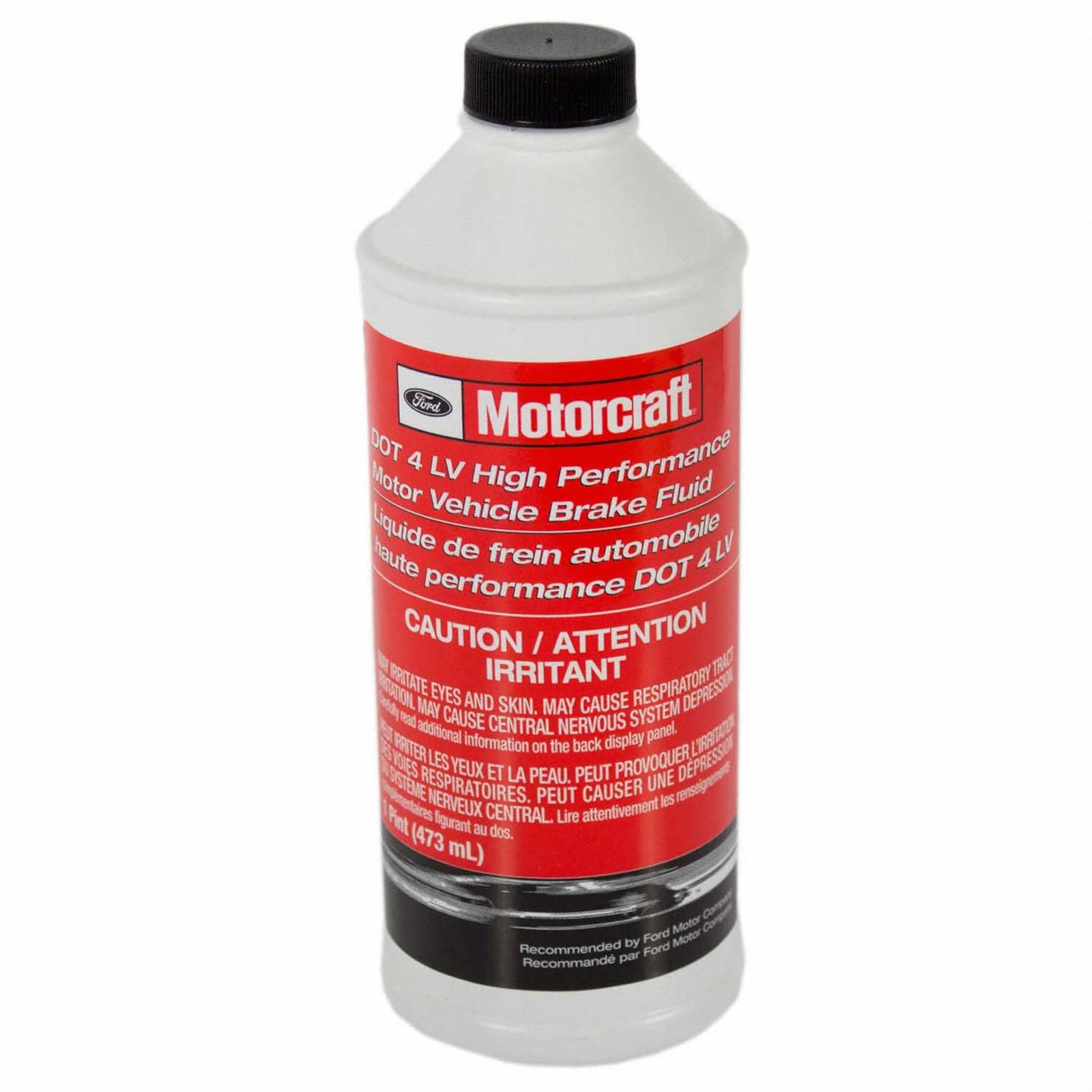
8. Ford Genuine PM-20 DOT-4 LV Brake Fluid
The low-viscosity DOT 4 that modern ABS systems are designed around
Ford’s PM-20 is a low-viscosity DOT 4 fluid engineered for new ABS brake systems with stability control — the kind of electronics that demand fast hydraulic response even in cold weather. This “LV” formulation delivers quicker response at lower temperatures, which is exactly what a stability-control computer needs to pulse the brakes effectively in slippery conditions.
It meets both FMVSS DOT-4 and ISO 4925 Class-6 standards, making it the required fluid for certain vehicles from the 2012–2013 model years onward. The 16-ounce bottle is generous, and owners highlight the quality with 20 mentions. A 2018 Ford Explorer Sport owner confirms it is the correct fluid for a rear brake assembly replacement and system bleed, advising a fresh sealed bottle to avoid moisture contamination.
What stands out in the feedback is the trust in the factory spec. Owners of a 2015 Ford Fiesta and a 2016 Explorer note the manual explicitly recommends this fluid and warn against substitutes, so the purchase is about compliance as much as performance. The higher price reflects that OEM pedigree, but for a bike or car with modern ABS, it is the fluid the system was validated with.
The modern engineering
- Low-viscosity formula responds faster in cold temperatures
- Meets FMVSS DOT-4 and ISO 4925 Class-6 standards
- Quality is the top praise with 20 owner mentions
The premium cost
- Priced higher than standard DOT 4 fluids
- Needed only for vehicles that specify DOT 4 LV
Reach for it if: your bike or vehicle has modern ABS with stability control that specifies DOT 4 LV.
Look elsewhere if: your system runs standard DOT 4 and you do not need the low-viscosity cold-weather behavior.
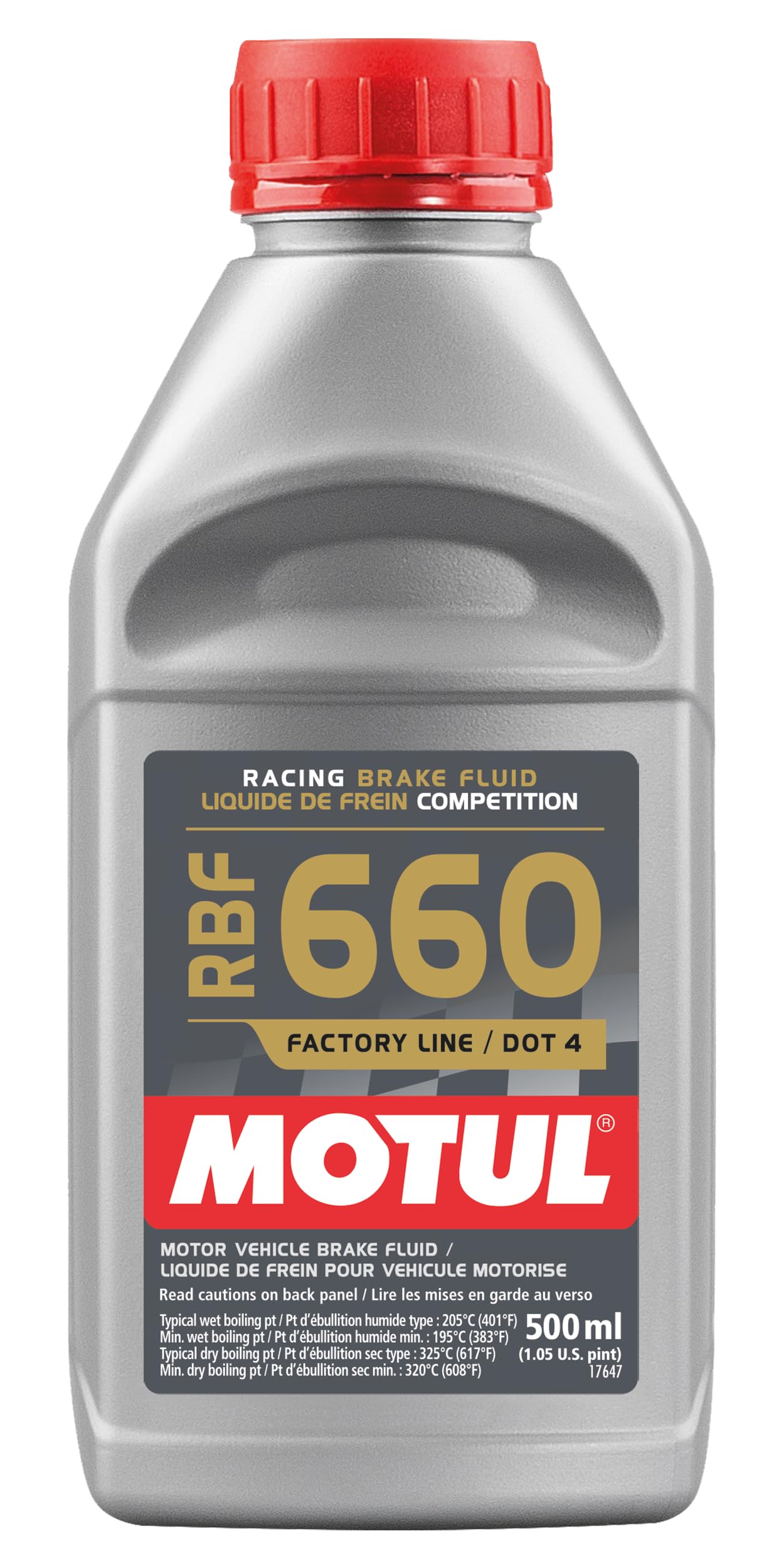
9. Motul RBF 660 Factory Line DOT-4 Racing Brake Fluid
The 100 percent synthetic racing fluid that turns a soft lever firm
Motul RBF 660 is built for one job: resisting boiling under intense brake temperatures so the lever stays consistent when it matters most. Its flash point sits at 325°C, a towering number that suits track days and competitive events, and the 100 percent synthetic formula is designed to reduce wear on brake components from heat and moisture.
The owner feedback is emphatic — “there is nothing better for your bike than this” is the kind of verdict riders give after a season of hard use. A track-day rider notes consistent pedal feel under heavy late-session braking with no fade, directly contrasting the spongy feel of regular fluid. Even on a heavy 2013 F-150 Ecoboost at 7,200 lbs, customers note superior braking versus stock DOT 4, including in snow and ice.
The single note of caution is the boiling-point discussion, which gets mixed reviews — some riders appreciate the higher ceiling while others find it overkill for street use. The 500 ml bottle is a practical size for a motorcycle flush, and quality is the dominant praise with 25 owner mentions. If you ride a sportbike hard or hit the track, this is the fluid that keeps the lever where you expect it.
The racing formula
- Flash point of 325°C resists boiling under extreme heat
- Quality is the top praise with 25 owner mentions
- Consistent pedal feel in late-session track braking
The honest trade-off
- Boiling point is overkill for casual street riding
- Premium price versus standard DOT 4 fluids
Best for: sportbike and track-day riders who demand a firm lever through repeated hard braking.
it’s not for you if: you do gentle street commuting and simply need a reliable DOT 4 fluid.
Understanding the Specs
Dry vs Wet Boiling Point
The dry boiling point measures fresh, moisture-free fluid straight from the bottle, and it is the headline number most brands advertise. The wet boiling point matters more over time — it is the temperature at which fluid that has absorbed moisture begins to boil. A higher wet boiling point means your lever stays firm for longer as the fluid ages, which is why racing fluids are judged on this number.
DOT Ratings and Compatibility
The DOT rating tells you the fluid’s chemical base. DOT 3, DOT 4, and DOT 5.1 are all glycol-based and can be mixed in most cases. DOT 5 is silicone-based and must never be mixed with the others, and it is not for ABS systems. DOT 4 LV is a low-viscosity glycol fluid designed for modern ABS with stability control, responding faster in cold weather.
FAQ
How often should I flush my motorcycle brake fluid?
Can I mix DOT 4 with DOT 3 brake fluid?
Why is DOT 5 not recommended for ABS motorcycles?
What is the difference between DOT 4 and DOT 4 LV?
Does a higher wet boiling point really matter for street riding?
Can I use car brake fluid in my motorcycle?
How do I know which DOT rating my bike needs?
Is silicone DOT 5 worth it for a classic motorcycle?
Why does brake fluid feel spongy after a few years?
Does a full quart matter for a motorcycle flush?
Final Thoughts: The Verdict
For most riders, the motorcycle brake fluid winner is the Honda DOT 4 because it delivers the factory-spec quality owners trust, backed by the highest owner satisfaction in this group. If you ride hard and want the ultimate fade protection, grab the Castrol SRF with its 590°F dry boiling point. And for a budget-friendly flush that resists moisture well, the Lucas Oil DOT 4 quart is the one to reach for.
How We Picked
We do not accept paid placement. Every pick is matched to a real buyer and a real use-case; we do not hands-on test units.
Sources & Methodology
Specifications: manufacturer listings and product documentation. Review insights: verified customer reviews, as of August 2026. Pricing: not shown on this page (it changes often); check the current price via the retailer link.
As an Amazon Associate, Trending Car earns from qualifying purchases. This does not affect which products we feature.