
Our readers keep the lights on and my garage snacks stocked. As an Amazon Associate, I earn from qualifying purchases.
Specs are compiled from manufacturer listings and verified buyer reviews and can change over time — please confirm the key details on the product page before buying.
The single most important decision with an inline fuel filter isn’t the brand — it’s the micron rating. That number decides whether microscopic grit reaches your carburetor or injectors and turns a part into a repair. This guide sorts through the real-world trade-offs of six filters engineered for everything from 26hp lawn tractors to resto-mod classics, so you match the right filtration to your fuel system without guesswork.
I’m Min Islam — the founder and writer behind Trending Car. This guide is built by comparing the manufacturers’ published specifications and the patterns across verified customer reviews, so you get each pick’s real strengths and trade-offs instead of marketing spin.
To keep your engine running clean, you need an inline fuel filter that matches your fuel line’s micron size (the tiny particle size it traps), fitting diameter, and material durability — so it filters properly without leaking or clogging.
Our Picks at a Glance

How To Choose The Best Inline Fuel Filter
An inline fuel filter is a small component with one big job: trapping dirt, rust, and sediment before they reach the delicate passages inside your carburetor or fuel injectors. The right one prevents hard starts, rough idling, and costly rebuilds. The wrong one either starves your engine of fuel or lets particles straight through.
Match the micron rating to your engine type
The micron number tells you the size of particle the filter catches. A 12-micron filter is very fine — it catches tiny particles, ideal for protecting sensitive carburetors. A 100-micron screen is much coarser, better suited for high-flow EFI systems where you want big chunks out but need maximum fuel delivery. You generally want finer filtration for carbureted engines and coarser for high-volume injected setups.
Measure your fuel line diameter before buying
Inlet and outlet barbs come in standard sizes like 1/4″, 5/16″, and 3/8″. Measure the inside diameter of your fuel hose — not the outside — so the barbs slide in snug. The most common frustration in owner feedback is ordering a filter that doesn’t match the hose, leading to leaks or a sloppy fit that requires adapters.
Decide between disposable and serviceable elements
Plastic inline filters are cheap and easy to swap, making them great for small engines like lawn mowers. Aluminum billet housings with sintered bronze elements cost more upfront but can be taken apart, cleaned, and reused many times — a better long-term value for cars, motorcycles, and boats where you want a permanent installation.
Quick Comparison
| Model | Best For | Micron Rating | Fitting Size | Material | Amazon |
|---|---|---|---|---|---|
| EVIL ENERGY 100 Micron★ Best Overall | High-flow AN setups | 100 micron | 6AN / 8AN / 10AN | Aluminum & Stainless Steel | Amazon |
| WIX 33031Finest Filtration | Filtration perfection | 12 micron | 1/4″ | Stainless Steel | Amazon |
| AloneGoer 12-Pack | Small engine fleets | 40 micron | 1/4″ | Plastic | Amazon |
| Podavelle Billet 30 Micron | Serviceable performance | 30 micron | 3/8″ | 6061-T6 Aluminum | Amazon |
| EVIL ENERGY 3/8″ Billet | EFI and E85 support | 30 micron | 3/8″ | Metal | Amazon |
| CarBole 9748 5-Pack | Visual fuel inspection | 200 mesh / 5-50 micron | 3/8″ | Chrome & Glass | Amazon |
In-Depth Reviews
1. EVIL ENERGY Inline Fuel Filter 100 Micron
Our pick — over 4.5★ from 250+ verified ratings; the strongest balance of quality and price.
The high-flow aluminum filter that brings factory-AN fittings to a universal install.
This is the filter for builds running braided -6AN lines, because it ships with three adapter sizes — 6AN, 8AN, and 10AN — so you can match it to your existing plumbing instead of hunting for adapters. The aluminum alloy body and stainless steel element handle gasoline and diesel (not E85), and the 100-micron screen catches contaminant particles while keeping flow high for performance setups. At 0.55 kg it’s a solid, substantial piece of metal, not a flimsy throwaway.
The removable design is the standout feature: unscrew the end cap and you can clean or replace the filter element whenever you want, making it a true long-term part rather than a disposable. Owners praise the build quality above everything else, and the installation is quick, especially with the included mounting bracket that keeps the engine bay looking tidy. The filtration is 8.3x coarser than the WIX 33031’s 12-micron rating, so this is aimed at high-flow systems, not carburetor protection.
The one honest warning is the fittings — several buyers report leakage issues around the AN fittings, so it’s worth snugging everything down and checking for leaks after installation. There’s also some confusion over the filter size in reviews, so confirm the micron rating fits your needs before you buy. Owners mention, “mounting was quick and easy with ‘evil energy’ Bracket and ‘evil energy’s -6AN fittings and fuel line make that 100 Micron Fuel Filter look pretty damn good.”
What Wins People Over
- Three AN adapter sizes included (6AN, 8AN, 10AN) for flexible installs
- Removable, cleanable stainless steel element saves money long-term
- Quality construction at a fraction of big-name brand cost
Where To Be Careful
- Fittings need a careful check — leakage is the most-cited concern
- Not compatible with E85 fuel
- Coarse 100-micron screen, not for fine carburetor protection
Reach for this if: you’re running AN braided lines and want a cleanable, high-flow filter with adapters built in.
Look elsewhere if: you need fine filtration for a carburetor — the 100-micron screen is too coarse for that job.
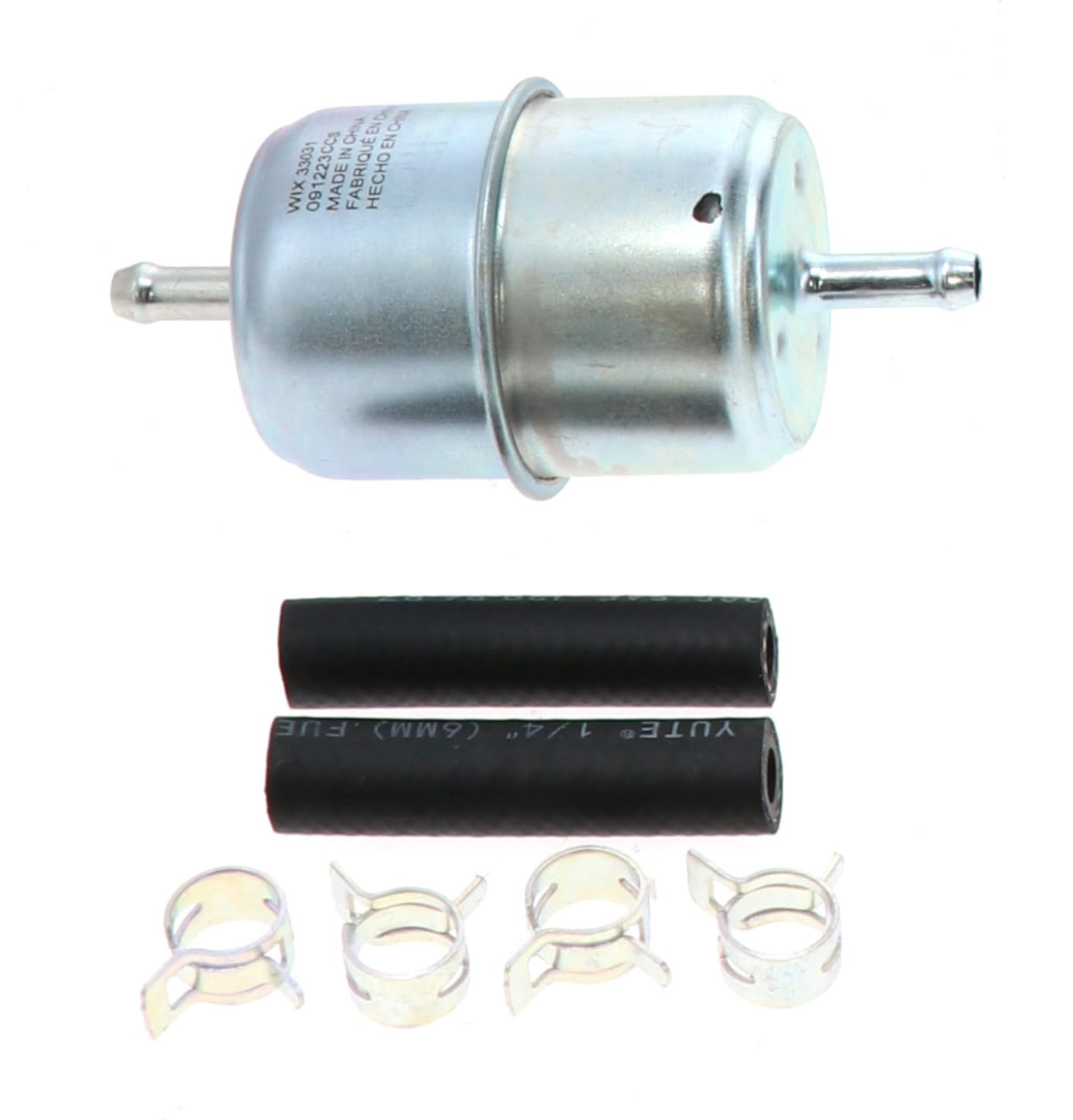
2. WIX 33031 In-Line Fuel Filter
The stainless-steel workhorse with a 12-micron screen that keeps carburetors spotless.
If you want the finest protection available, this is it — the WIX traps particles down to 12 microns, which is 8.3x finer than the EVIL ENERGY filter’s 100-micron screen. That level of filtration makes it a favorite for carbureted engines and small machines where even tiny grit can clog a jet. The stainless steel outer body is a huge upgrade over the plastic filters most small engines ship with, and the 1/4″ barbs fit snugly into standard fuel hose.
Filtration is what buyers praise most about this filter, and the value is right behind it — it’s a premium brand part at a budget price. Owners have fitted it to everything from a 26hp Craftsman lawn tractor to an ’86 Virago motorcycle and a 1965 VW Bus, which tells you how versatile a simple 1/4″ filter can be. As one buyer put it, “way better than the plastic garbage, cant go wrong with Wix.”
The trade-off is that it’s a disposable filter — when it’s full, you replace the whole unit rather than cleaning it. The inlet and outlet are just 1/4″, a 3.0x narrower opening than the 3/8″ billet filters on this list, so it’s not built for high-volume fuel delivery. It’s also gasoline-only, so don’t run diesel through it. The recurring note in reviews is that it works exactly as intended, which is really all you want from a filter.
Perfect carburetor guard: the 12-micron element is the finest on this list, making it the one to pick when you want maximum protection over maximum flow.
Disposable by design: replace the whole filter rather than cleaning it, and stick to gasoline with 1/4″ hoses.
Grab this for: carbureted engines, lawn tractors, motorcycles, and any small engine where fine filtration beats flow.
Think twice if: you run a high-volume EFI system or need a cleanable element — the 1/4″ barbs and disposable design won’t suit.
3. AloneGoer 12-Pack 40 Micron Inline Fuel Filter

A dozen 40-micron filters that keep an entire small-engine fleet running clean.
When you maintain multiple mowers, tractors, or small engines, a 12-pack of filters at this price is the smart play. Each filter is a 1/4″ inline unit rated at 40 microns — a middle-ground screen that’s fine enough to protect carburetors but still allows good flow for small engines. The 0.25-inch diameter means it’s built for compact fuel lines, and the plastic housing is lightweight and easy to swap when it gets dirty.
Quality is the top thing owners praise, which says a lot for a multi-pack at this price point. They fit Kawasaki FH and FX series engines among others, and the OEM-equivalent numbers (49019-0027, 691035, 493629) make matching simple. Customers note, “They work great on my craftsman lawn tractor they don’t leak the size is just right for my fuel line” — exactly the real-world confirmation you want. The 40-micron rating splits the difference between the ultra-fine WIX and the coarse EVIL ENERGY, making it versatile across equipment types.
The honest caveat is durability and leakage get mixed feedback — some filters are fine while others show housing leaks, and a few reviewers point out they run smaller than expected. With 12 in the box, you have spare capacity to swap out any that give trouble, which softens the risk considerably. The size is a genuine consideration: at 0.25 inches diameter, it’s a 52% smaller opening than the 3/8″ Podavelle billet filter, so it’s strictly for smaller fuel lines.
Fleet-friendly value: 12 filters for the price of one premium unit means you’re always stocked up for mower season.
Size check required: the 1/4″ fittings suit small engines only — measure your hose before ordering.
Best for: anyone maintaining multiple small engines who wants a bulk supply of reliable 1/4″ filters.
Skip if: you need a single heavy-duty filter for a car or boat — the plastic housing and small size aren’t built for that.
4. Podavelle 3/8″ Billet Inline Fuel Filter 30 Micron

The featherweight billet filter that flows 900 liters per hour without starving your EFI.
At just 0.09 kg, this is noticeably lighter than the EVIL ENERGY 100-micron filter — a 6.1x weight gap — which makes it ideal for setups where you don’t want heavy hardware hanging off your fuel lines. The 6061-T6 billet aluminum body is anodized black for corrosion resistance, and inside sits a 30-micron sintered bronze element that you can remove, clean, and reuse. It’s built for high-volume EFI or carb systems, flowing 900 ltrs/hr with a pressure drop of less than 1 PSI.
The 3/8″ barb inlet and outlet solve a real problem: finding a filter in that hose diameter is genuinely tough, since most options are 1/4″ or 5/16″. That 3/8″ opening is a full 3.0x wider than the WIX filter’s 1/4″ barbs, so it’s the right choice for bigger fuel lines. The compact 52.6mm housing length means it fits in tight engine bays, and the black anodized finish looks sharp in any build. Quality is the top praise from owners, with the flawless finish getting specific callouts.
There’s honest disagreement among buyers about how well it filters — some find it exceptional at capturing pollutants, which is a strong sign for a serviceable filter. It’s a little pricier than a basic disposable, but the reusable element means you won’t buy another one. The trade-off is the serviceable nature: you do need to take it apart and clean it periodically, which is more effort than swapping a disposable. Shoppers say taking it apart and finding it does an “exceptional job at capturing pollutants,” with a whole car club adopting it.
Why It Stands Out
- Cleanable sintered bronze element removes the need for constant replacement
- Ultra-light 0.09 kg billet aluminum construction
- High 900 ltrs/hr flow with minimal pressure drop for EFI
The Trade-Offs
- Costs more upfront than a disposable plastic filter
- Requires periodic disassembly for cleaning
- Effectiveness at filtering gets mixed feedback from owners
Choose this if: you want a lightweight, cleanable filter for a 3/8″ line on a performance car or truck.
Not for you if: you prefer set-and-forget disposable filters or run 1/4″ fuel lines.
5. EVIL ENERGY 3/8″ Barb Billet Inline Fuel Filter 30 Micron
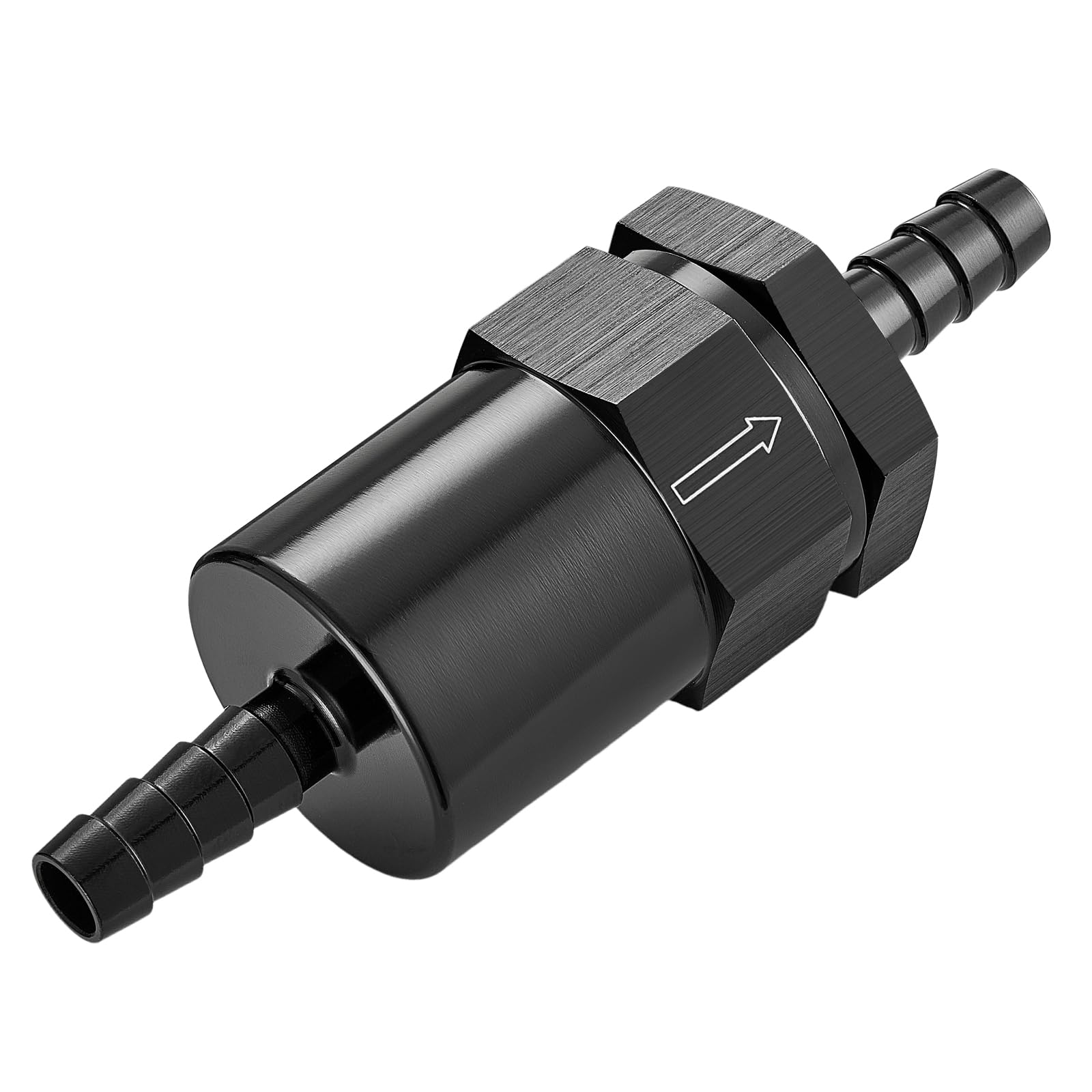
The 2.07-inch billet filter that hides in tight engine bays while feeding EFI systems.
This compact billet filter measures just 2.07 inches in housing length, making it the one to reach for when space is tight in the engine bay. The 3/8″ barb inlet and outlet feed both EFI and carb systems up to 900 liters per hour with a pressure drop of less than 1 PSI, so it won’t restrict fuel delivery. The 30-micron sintered bronze element withstands high temperatures and corrosive environments, and it can be cleaned and reused.
This filter stands out because it handles gasoline, diesel, E85, and other common fuels — so if you run E85, you can use this one instead of the EVIL ENERGY 100-micron filter, which isn’t E85-compatible. It fits cars, motorcycles, and boats, so one filter can serve multiple vehicles. Owners praise the build quality first, then compatibility; buyers report it works “smoothly with most A/N fittings” (standard threaded fuel-line connectors) once you swap the barbs.
The rubber O-ring seal is designed to provide a leak-free connection between fittings and end caps, and owners confirm it performs. One note: it’s a 3/8″ filter, so unlike the AloneGoer’s 1/4″ size, it’s meant for larger fuel lines. The 0.38-inch diameter is a 52% larger opening than the AloneGoer’s 0.25 inches, suiting it to bigger engines. Owners mention it’s an easy install, taking maybe 10 minutes, and the black finish matches engine bay details nicely.
Space-saver with flow: the 2.07-inch length fits where bulkier filters won’t, while the 900 ltrs/hr flow keeps EFI systems fed.
Fuel-flexible choice: handles E85, diesel, and gasoline — rare versatility for a billet filter.
Ideal for: tight engine bays, E85 users, and anyone running a 3/8″ line on a car, bike, or boat.
Pass on this if: you have 1/4″ hoses or need a finer-than-30-micron screen.
6. CarBole 9748 Clear View Fuel Filter 5-Pack

The chrome-and-glass filter that lets you see exactly what’s flowing to your carb.
This is the filter for anyone who’s ever wondered whether their fuel tank was sending sediment downstream — the transparent glass casing gives you a constant visual check of fuel condition. The chrome-plated metal body with 200 mesh screen (rated 5-50 micron) traps particles while you watch the fuel flow and color through the glass. It fits 3/8″ inside diameter hoses and measures 4.20 inches in overall length, with barbed ends for positive fuel line retention.
The visibility feature is what owners single out most — being able to see fuel moving to the carburetor helped one buyer diagnose a hard-starting issue directly. Quality earns the top praise, and the appearance is a close second, with the chrome finish looking sharp on classic cars like a 65 Mustang. The 5-pack means you get spare filters for multiple vehicles, and the universal compatibility list is enormous, spanning cars, trucks, lawn mowers, motorcycles, ATVs, and even go-karts.
The honest downsides are worth knowing. The hose barbs are reported as very short, which makes getting a tight, secure hose connection tricky. The included hose clamps are the weak point too — multiple owners recommend upgrading them for a proper seal, and leakage gets mixed feedback. It’s also a glass body, so inspect for cracks before installation and make sure the pieces are threaded tight, since it can unscrew and leak. Customers note you can see fuel flow and color clearly through the glass, calling it “great for quick inspection of fuel system.”
What Stands Out
- See-through glass lets you monitor fuel condition in real time
- Five filters in one pack for multiple vehicles or spares
- Chrome finish looks great on classic and modern builds
Watch Out For
- Very short hose barbs make secure connections a challenge
- Included clamps are weak — plan to upgrade them
- Glass body needs a careful hand to avoid cracks and leaks
Pick this if: you want to visually monitor fuel cleanliness and have the patience to upgrade the clamps.
Choose another if: you need a rugged all-metal filter or have standard-length hose barbs in mind.
Understanding the Specs
Micron Rating
The micron number is the size of particle the filter catches — smaller numbers mean finer filtration. A 12-micron filter traps very tiny particles, ideal for protecting delicate carburetor jets. A 100-micron screen is much coarser, built for high-flow systems where you want maximum fuel delivery over maximum filtration. Match the rating to your engine’s sensitivity.
Fitting Size and Flow Rate
Barb fittings come in standard diameters like 1/4″, 5/16″, and 3/8″ — measure your fuel hose inside diameter to match. Bigger barbs support higher fuel flow, which matters for EFI systems. Flow rate, measured in liters per hour, tells you how much fuel the filter can pass; a 900 ltrs/hr rating with low pressure drop suits high-volume setups without starving the engine.
FAQ
What micron rating should I use for a carbureted engine?
Will a 1/4 inch filter fit my fuel hose?
Can I clean and reuse a metal inline fuel filter?
Is a 100-micron filter too coarse for my engine?
Will these filters work with E85 fuel?
How do I stop my inline fuel filter from leaking?
What’s the difference between a 200 mesh and a 30 micron filter?
Can I use a car inline fuel filter on a lawn mower?
Final Thoughts: The Verdict
For the majority of shoppers, the inline fuel filter winner is the EVIL ENERGY 100 Micron because it pairs three AN adapter sizes with a cleanable stainless steel element, making it the most versatile high-flow option for performance builds. If you want maximum carburetor protection, grab the WIX 33031 with its fine 12-micron screen. And for a budget-friendly way to keep a fleet of small engines running, the AloneGoer 12-pack is the one to reach for. Each of these earns its place by matching a specific fuel system need — measure your hose, know your micron requirement, and you’ll pick the right one the first time.
How We Picked
We do not accept paid placement. Every pick is matched to a real buyer and a real use-case; we do not hands-on test units.
Sources & Methodology
Specifications: manufacturer listings and product documentation. Review insights: verified customer reviews, as of August 2026. Pricing: not shown on this page (it changes often); check the current price via the retailer link.
As an Amazon Associate, Trending Car earns from qualifying purchases. This does not affect which products we feature.