
Our readers keep the lights on and my garage snacks stocked. As an Amazon Associate, I earn from qualifying purchases.
Specs are compiled from manufacturer listings and verified buyer reviews and can change over time — please confirm the key details on the product page before buying.
An electric longboard is the fastest way to turn a boring commute into the best part of your day. But the real question every first-time buyer asks is simple: how far will it actually go, and how fast will it actually feel? The answer splits into two camps—cheerful street cruisers that top out around 15-20 mph, and serious machines that push past 30 mph and eat hills for breakfast. Your weight, road surface, and riding style determine whether a 15-20 mph cruiser or a 30+ mph machine fits.
I’m Min Islam — the founder and writer behind Trending Car. This guide is built by comparing the manufacturers’ published specifications and the patterns across verified customer reviews, so you get each pick’s real strengths and trade-offs instead of marketing spin.
You need an electric longboard that matches your weight, your commute length, and your nerve for speed — this breakdown separates the honest performers from the spec-sheet dreamers.
Our Picks at a Glance
How To Choose The Best Electric Longboard
Before you fall for a headline top speed, remember that every board here is a real, rideable product with a genuine trade-off. Match the board to your weight and terrain, not the highest spec sheet number. Here are the four decisions that actually matter.
Match the motor to your weight and hills
Motor power is measured in watts, and two wheels usually means two motors. A lighter rider under 160 lbs gets away with 500W per wheel, while a heavier rider near 200 lbs needs more grunt to climb the same slope. If your route has any real incline, look for a board whose motor wattage comes with a tested slope rating — and check whether that rating was measured with a rider near your weight.
Read the range claim with suspicion
Advertised range is always measured at low speed on flat ground with a light rider. The moment you ride at top speed, weigh more than the test rider, or hit hills, that number shrinks — sometimes by half. A board claiming 20 miles might realistically deliver 10-15 miles of mixed riding. Buy for your real commute distance plus a safety margin to avoid pushing a dead board home.
Choose your wheel and drive system
Hub motors hide inside the wheels for a quiet, low-maintenance ride that suits smooth pavement. Belt and gear drives deliver more torque and let you swap wheels for different surfaces, but they add noise and need occasional maintenance. Wheel size matters too: bigger pneumatic wheels like 155-175mm roll over cracks and potholes like a dream, while smaller urethane wheels give a livelier feel on clean asphalt.
Check the deck, the ply, and the flex
Deck length, width, and flex determine your comfort and stability on every ride. A longer deck of 38-43 inches gives you a stable stance at speed, while a wider deck of 10-12 inches catches your feet during hard carving. More plies of maple or bamboo means a stiffer, more durable board; a flexible deck soaks up vibration and reduces fatigue on longer commutes.
Quick Comparison
| Model | Best For | Top Speed | Range | Weight | Amazon |
|---|---|---|---|---|---|
| ASKATE A1★ Best Overall | First-time riders on smooth flat roads | 34 mph | 17 miles | 9 kg | Amazon |
| MEEPO Campus V3 | College commuters wanting a carry handle | 28 mph | 11 miles | 8 kg | Amazon |
| MEEPO Voyager X | Speed junkies and long-distance tourers | 34 mph | 30 miles | 23.8 lbs | Amazon |
In-Depth Reviews
1. ASKATE A1 Electric Skateboard
Our pick — over 4★ from 100+ verified ratings; the strongest balance of quality and price.
The beginner-friendly cruiser that swallows long flat commutes without emptying your wallet
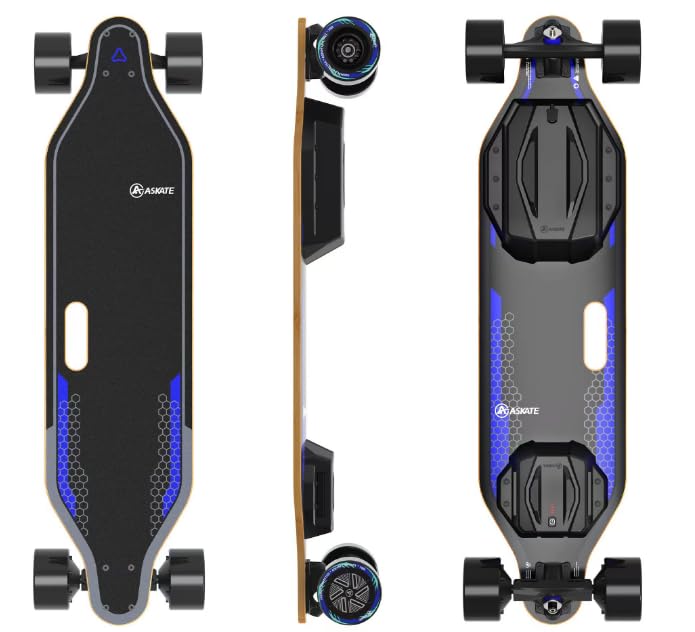
For a first-time rider, the ASKATE A1 is the smartest place to start because its 38-inch drop-deck gives you a low, stable stance that builds confidence quickly. The 8-ply Canadian maple deck flexes just enough to soften rough concrete, and the built-in handle plus one-swipe activation means you can grab it and go without fumbling. Buyers report it “lasts 2hrs at full capacity without a recharge,” which matches real-world expectations for a lively daily ride.
The dual 750W motors sound ferocious on paper with a 34 mph top speed, but the honest feedback is that this board shines as a flat-road commuter rather than a hill-climber. One practical note: the same 38-inch deck measures 9.8 inches wide, which is noticeably slimmer than the 12.13-inch platform on the MEEPO Bamboo above — so heavier riders over 200 lbs may want the extra footprint. Battery charge time runs 3 hours for a full fill, and the 50.4V 2A charger keeps the turnaround reasonable.
What wins people over is the size and speed for the money — the most-cited praise by a wide margin — with riders calling it “scary fun” once they step past the beginner modes. The S1 smart remote gives you 4 speed and brake modes, 4 LED themes, and real-time tracking, plus a remote-controlled brake light with 3 modes for night visibility. Battery life and durability get mixed reviews, and heavier riders report weaker motor power, so treat the 330 lbs max load as a ceiling, not a comfort zone.
Why riders grab it
- Beginners find the low drop-deck easy to learn on
- Dual motors deliver a genuine 34 mph top speed
- Remote-controlled brake light adds night safety
- Flexible maple deck cuts fatigue on long rides
Where it stumbles
- Hill climbing is steady but slow on steeper grades
- Battery life reads mixed — expect less than 2 hours at full throttle
- 3-hour charge time feels long if you ride daily
Reach for it if: you are a first-timer on smooth flat roads who wants speed headroom to grow into.
Look elsewhere if: your commute is all hills — the motors climb steadily, not strongly.
2. MEEPO Campus V3 Series

The carry-handle commuter that locks to a bike rack and zooms through downtown streets
The MEEPO Campus V3 is built around a clever idea: a deck with a grip handle so you can carry it into class, onto a train, or through a store without it dragging. The 8 layers of Canadian maple keep it flexible yet durable, and at 8 kg it is the lightest board in this lineup — a full 4 kg lighter than the 12 kg MEEPO Bamboo off-roader above. That weight saving is exactly why college commuters keep choosing it for daily carry.
Owners mention the board “works great from the start” and that it “goes fast” even at 160 lbs, which speaks to the 500W x2 hub motors delivering a 28 mph top speed and an 11-mile range. The hub motor design means no belts to maintain and a quieter ride, while the IPX5 waterproofing handles light rain and puddles that would end a ride on lesser boards. Charging is genuinely quick — the 1.5A charger takes roughly 2.8 hours to go from zero to full, faster than the ASKATE’s 3 hours.
The thing everyone raves about is overall quality, with the fun factor and ride quality close behind, and the carry handle earns its keep by enabling a bike lock through the deck. The M6C remote’s sensitive control delivers smooth braking across 4 settings including an easy LO mode. Durability is the most-cited negative, and battery life varies—some customers note it dying after roughly 15 minutes of hard use. Real-world range on high speeds lands closer to 4-5 miles than the advertised 11.
Smart buy for: students and city riders who want a light, fast board that locks up outside and charges quickly. The catch is honest expectations — heavy-throttle riding drains that 11-mile claim fast, and a few reviewers point out parts wearing out within months.
Verdict: the most portable pick here, and the best value in a carry-friendly package.
Best if: you ride downtown, need to carry it indoors, and want IPX5 rain protection without the weight.
Think twice if: you expect the full 11-mile range at top speed — plan around 4-5 miles of spirited riding.
3. MEEPO Voyager X
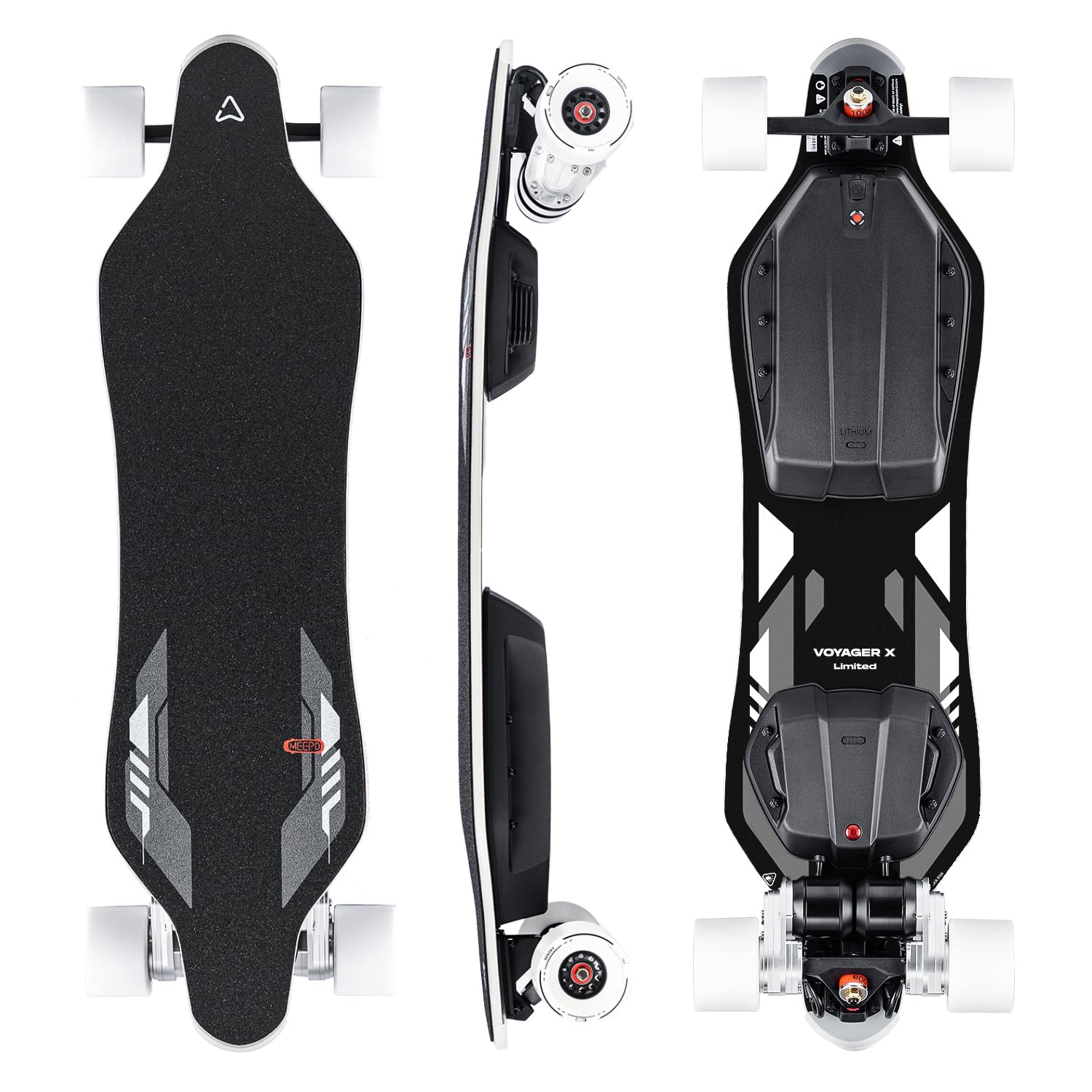
The 34 mph tourer that carries a 30-mile range and a battery so smart it monitors every cell
The MEEPO Voyager X is the board you buy when you want to ride far and ride fast without compromise. Its 2800W x2 gear drive motors push a 34 mph top speed and a 30-mile range, making it the fastest and longest-legged board in this lineup. The bamboo and fiberglass deck keeps the weight at a manageable 23.8 lbs while staying stiff enough to feel reassuring at speed — one taller owner at 6’2″ called the subtle concave deck “reassuring” on fast runs.
what separates it mechanically is the gear drive (a toothed gear system that transfers power directly to the wheels) and wheel flexibility. The board accepts wheels from 80mm to 120mm, so you can swap between street urethane and bigger rubber depending on the road. All 36 cells in the battery module are individually monitored, with UL2272 certified test-approved hardware and software protections — a serious safety credential for a machine that charges with a 50.4V 6A GaN charger (a fast, efficient gallium nitride charger) in about 3 hours. One owner logged 400 miles constantly near max speed and still called it the best board they have owned.
The review consensus is that it takes hills “without hesitation” and accelerates quietly and powerfully, with superb build quality and easy maintenance. Belts wear, pebbles lodge in the wheels, off-road tires wear quickly, and hard-ride range falls short of the 30-mile claim. Occasionally a board arrives with a motor that fails within days, and the replacement process demands a disassembly video — a hassle worth knowing before you buy.
Built for the long haul: the gear drive delivers torque and speed that hub motors (motors built into the wheel hubs) cannot match, and the cell-monitored battery adds real confidence for a 30-mile machine.
The trade-off: top-end performance means top-end maintenance — belts, wheels, and the occasional motor will need attention.
For the enthusiast: who rides long distances at speed and values safety-certified battery tech.
Not for: low-maintenance riders who want to low-maintenance — this one asks for care in return for its pace.
Understanding the Specs
Motor Power and Drive Type
Motor wattage tells you how much grunt the board has for hills and acceleration, and most boards list two motors (so 750W x2 means two 750-watt motors). Hub motors hide inside the wheels for quiet, low-maintenance riding on smooth pavement. Belt and gear drives deliver stronger torque, let you swap wheels, and handle rougher terrain, but they add noise and require occasional maintenance.
Battery Range and Charge Time
Advertised range is measured at low speed on flat ground with a light rider, so your real-world distance will always be lower — often by half if you ride at top speed or weigh more. Charge time matters for daily use: a 2.8-hour charge can refill during lunch, while a 4-hour charge needs overnight planning. A removable battery lets you carry a spare or charge it indoors without hauling the whole board.
FAQ
How much does rider weight affect an electric longboard’s speed and range?
Is a hub motor board or a belt and gear drive board better for me?
Will a 34 mph top speed board actually feel that fast to me?
How long does an electric longboard battery last before it needs replacing?
Can I ride an electric longboard in the rain?
What is the difference between advertised range and real-world riding range?
How important are the brakes on a high-speed electric longboard?
Do I need any safety gear to ride an electric longboard?
Which electric longboard is best for a heavier rider around 200 lbs?
Final Thoughts: The Verdict
Across the board, the electric longboard winner is the ASKATE A1 because it blends a forgiving beginner deck, dual 750W motors, and a 34 mph ceiling at a value price that the crowd has clearly embraced. If you want a light, carry-friendly board with IPX5 rain protection for campus life, grab the MEEPO Campus V3. And for long-distance speed, the MEEPO Voyager X is the serious machine to reach for. The crowd favorite remains the A1 for its combination of price and performance — it is the board most first-time owners end up recommending to their friends.
How We Picked
We do not accept paid placement. Every pick is matched to a real buyer and a real use-case; we do not hands-on test units.
Sources & Methodology
Specifications: manufacturer listings and product documentation. Review insights: verified customer reviews, as of August 2026. Pricing: not shown on this page (it changes often); check the current price via the retailer link.
As an Amazon Associate, Trending Car earns from qualifying purchases. This does not affect which products we feature.