
Our readers keep the lights on and my garage snacks stocked. As an Amazon Associate, I earn from qualifying purchases.
Specs are compiled from manufacturer listings and verified buyer reviews and can change over time — please confirm the key details on the product page before buying.
You want a paint that keeps barnacles and slime off your aluminum hull without eating into the metal itself. That means choosing a copper-free antifouling paint (a special bottom paint that stops marine growth but won’t corrode aluminum). The right copper-free formula keeps growth off for a full season, saving you the scraping job at haul-out.
I’m Min Islam — the founder and writer behind Trending Car. This guide is built by comparing the manufacturers’ published specifications and the patterns across verified customer reviews, so you get each pick’s real strengths and trade-offs instead of marketing spin.
Copper-free formulas are essential for aluminum because traditional copper biocides cause galvanic corrosion. Use this guide to find the best paint for aluminum boat—one that bonds tight, wears evenly, and keeps the hull clean all season long.
Our Picks at a Glance

How To Choose The Best Paint for Aluminum Boat
Aluminum boats need a specific kind of bottom paint because the metal reacts badly with the copper that most standard antifouling paints use. Copper-free formulas stop that reaction while still keeping barnacles and weeds from grabbing hold.
Match the paint to your water and usage
Brackish, salt, and fresh water each grow different organisms. If your boat sits in a slip for weeks at a time, an ablative paint that slowly wears away to expose fresh biocide gives the longest protection. If you run a fast airboat or jet ski over grass and sand, a hard epoxy coating resists that constant abrasion far better.
Read the coverage rate before you buy
Coverage per gallon varies wildly between products, and that changes how many cans you need for your hull. Always measure your boat’s underwater area, then divide by the stated square footage per gallon so you don’t run out halfway through the second coat.
Quick Comparison
| Model | Best For | Coverage | Type | Size | Amazon |
|---|---|---|---|---|---|
| Super Slick 2000 Epoxy★ Best Overall | Airboats & jet skis | 120 sq. ft./gal | Two-part epoxy | Gallon kit | Amazon |
| TotalBoat Alumipaint AF | Pontoon & aluminum hulls | 500 sq. ft./gal | Ablative copper-free | Quart | Amazon |
| TotalBoat Krypton | Multi-metal hulls | 46.5 sq. ft./gal | Ablative dual biocide | Quart | Amazon |
| Interlux Trilux 33 Aerosol | Outdrives & small repairs | — | Aerosol antifouling | 16 oz. can | Amazon |
In‑Depth Reviews
1. Super Slick 2000 Epoxy Bottom Coating for Airboats, Jet Ski’s, etc.: Gallon Kit
Our pick — 4.5★ from 150+ verified ratings; the strongest balance of quality and price.
The armor-plating option for hulls that grind over grass, mud, and sand.
This is not an antifouling paint—it’s a two-part epoxy built for boats that take a beating. Loaded with PTFE, it leaves an exceptionally slippery finish that cuts drag and lets an airboat glide across grass and mud instead of dragging through it.
One quart covered a waverunner hull four times, confirming the honest 120 square feet per gallon rating. That owner also gained over 5 mph after coating, a result that builds brand loyalty.
The mix is a simple 1:1 ratio with brush or roller, but there is a catch—the work time runs short once you combine the parts, and the second part arrives thick like a lumpy milkshake. Prep is non-negotiable: buyers report it breaks off if you skip grinding the aluminum down and etching it first.
Why it stands out
- Quality is the most-praised trait, with slickness a close second
- Sets up hard like a sheet of plastic for real abrasion resistance
- Bonds well to aluminum when prepped correctly
What to watch
- Application gets mixed marks—short work time once mixed
- Requires thorough grinding and etching or the coating won’t hold
- No antifouling biocide, so it won’t stop barnacles on its own
Built for: airboats, jet skis, and jon boats that slide over abrasive surfaces where wear beats growth.
Not for: slipped boats that sit in brackish water and need biocide protection.
2. Interlux YBA068A/16 Trilux 33 Aerosol Antifouling Paint – White, 16 oz.

The aerosol touch-up that keeps outdrives and props free of growth.
When your whole hull doesn’t need paint but your outdrive does, this spray can is the sensible middle ground. It’s specially formulated for aluminum outboards, outdrives, and hulls in underwater areas, and it works in fresh, salt, and brackish water alike.
The Biolux technology is what cuts the slime and boosts antifouling performance, and owners confirm it—one called it dependable on sailboat propellors and said it completely prohibits zebra-mussel and barnacle adhesion. Owners mention it beat other paints on a Volvo Penta outdrive, needing about two coats per can.
Know the color going in: the “White” label is accurate, but several owners note the finish reads closer to a primer gray than true white. Budget for two cans if you’re doing a full drive, since one 16-ounce can only stretches so far.
Best for: quick repairs, props, outdrives, and stern drives where a full bucket of paint is overkill.
The honest note: value and color both draw mixed feedback—it’s not cheap per ounce, and the gray tone surprises some buyers.
Grab this if: you need a fast, no-mixing antifouling coat for an outdrive or prop.
Pass if: you’re painting a full aluminum hull—the coverage per can is too small for that job.
3. TotalBoat Alumipaint AF Copper Free Aluminum and Pontoon Boat Bottom Paint (Black, Quart)
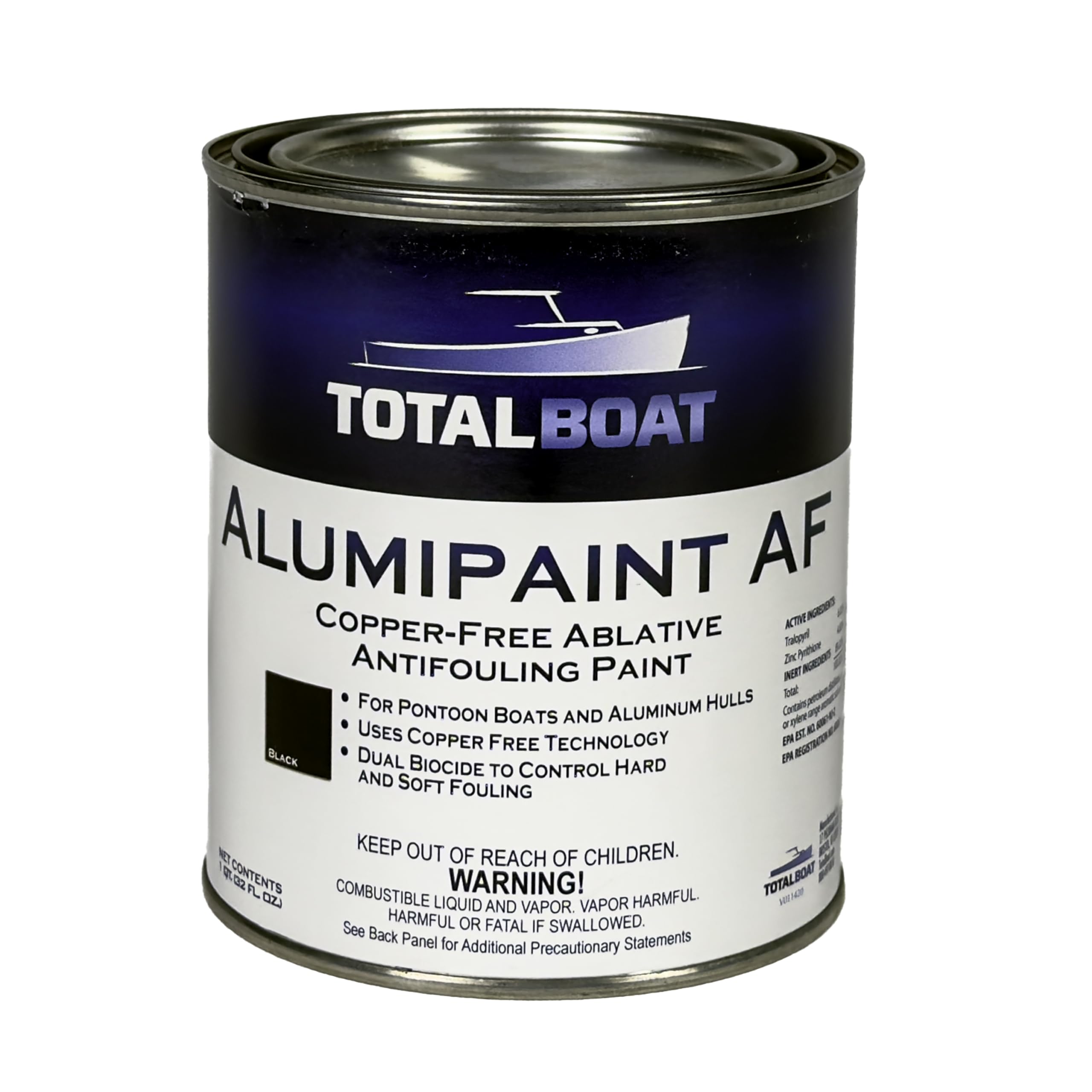
The coverage king—one gallon stretches 4.2x further than its epoxy rival.
If you’re painting a pontoon or a wide aluminum hull, this is the bottle to reach for. It’s an ablative paint, meaning it wears away slowly and continuously exposes fresh biocide, which is exactly what keeps mussels and slime off through a whole season in the water.
Its standout spec is coverage: 500 square feet per gallon, or 125 per quart. One quart covers two coats on a 14-foot Starcraft with a little left over, so you won’t overbuy.
The copper-free formula is the real safety net—it won’t cause galvanic corrosion on aluminum, outdrives, or running gear. That same property makes it safe to use on a restored Crab Tracker, where owners say barnacles and slime vanished with no scraping needed.
What wins people over
- Massive 500 sq. ft. per gallon coverage means one quart can finish a small hull
- Copper-free formula stops corrosion on aluminum and outdrives
- Single-season protection buyers confirm against mussels and slime
The honest catches
- Value draws mixed opinions—several owners find it pricey for the size
- One buyer warned it failed badly on pontoons after a light rain, so check your prep and weather
- UV resistant, but a light mist the day after painting left a polka-dot look for one owner
Reach for this if: you have a pontoon, jon boat, or aluminum hull and want maximum coverage per dollar spent.
Look elsewhere if: you only have a small outdrive or prop to coat—a spray can suits that job better.
4. TotalBoat Krypton Copper-Free Antifouling Boat Bottom Paint – Blue Quart
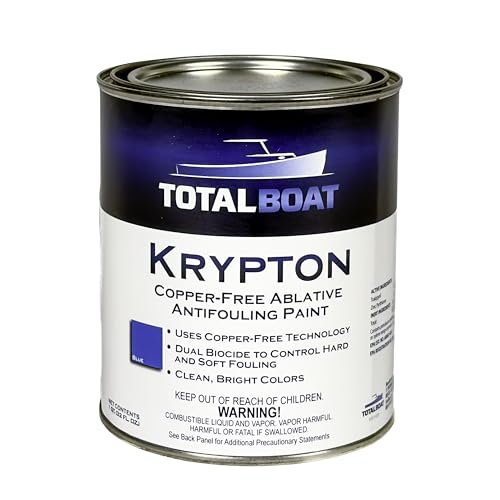
The vibrant blue that hides imperfections and dries in about an hour.
Where the Alumipaint above stretches its coverage, this one trades that for a brighter color and a finish that forgives a rough hull. The eggshell sheen is what owners rave about—it hides surface flaws while it works, which is a rare combo in bottom paint.
It’s a dual-biocide ablative formula, so two different biocides attack growth in fresh, salt, and brackish water. A single gallon coated a 22-foot Grady Seafarer with a quarter can left, showing how easily it applies by brush, roller, or spray.
Unlike the Alumipaint’s matte look, this carries a near-reflective blue sheen that owners describe as vibrant. Just know the coverage is far tighter—46.5 square feet per gallon and 11.6 per quart—so measure your hull before you commit to a single can.
Why it earns its spot: the quality and ease of application are what buyers praise most here, and the blue finish looks nothing like typical gray bottom paint.
The trade-off to know: durability draws mixed reviews, and a few cans arrived dented in shipping even though nothing leaked.
Pick this if: you want a good-looking blue finish that applies easily and works across aluminum, fiberglass, and wood.
skip it if: you’re covering a large pontoon and need the widest coverage per gallon.
5. Super Slick 2000 Epoxy Bottom Coating for Airboats, Jet Ski’s, etc.: Gallon Kit
The armor-plating option for hulls that grind over grass, mud, and sand.
This is not an antifouling paint—it’s a two-part epoxy built for boats that take a beating. Loaded with PTFE, it leaves an exceptionally slippery finish that cuts drag and lets an airboat glide across grass and mud instead of dragging through it.
One quart covered a waverunner hull four times, confirming the honest 120 square feet per gallon rating. That owner also gained over 5 mph after coating, a result that builds brand loyalty.
The mix is a simple 1:1 ratio with brush or roller, but there is a catch—the work time runs short once you combine the parts, and the second part arrives thick like a lumpy milkshake. Prep is non-negotiable: buyers report it breaks off if you skip grinding the aluminum down and etching it first.
Why it stands out
- Quality is the most-praised trait, with slickness a close second
- Sets up hard like a sheet of plastic for real abrasion resistance
- Bonds well to aluminum when prepped correctly
What to watch
- Application gets mixed marks—short work time once mixed
- Requires thorough grinding and etching or the coating won’t hold
- No antifouling biocide, so it won’t stop barnacles on its own
Built for: airboats, jet skis, and jon boats that slide over abrasive surfaces where wear beats growth.
Not for: slipped boats that sit in brackish water and need biocide protection.
6. Interlux YBA068A/16 Trilux 33 Aerosol Antifouling Paint – White, 16 oz.
The aerosol touch-up that keeps outdrives and props free of growth.
When your whole hull doesn’t need paint but your outdrive does, this spray can is the sensible middle ground. It’s specially formulated for aluminum outboards, outdrives, and hulls in underwater areas, and it works in fresh, salt, and brackish water alike.
The Biolux technology is what cuts the slime and boosts antifouling performance, and owners confirm it—one called it dependable on sailboat propellors and said it completely prohibits zebra-mussel and barnacle adhesion. Owners mention it beat other paints on a Volvo Penta outdrive, needing about two coats per can.
Know the color going in: the “White” label is accurate, but several owners note the finish reads closer to a primer gray than true white. Budget for two cans if you’re doing a full drive, since one 16-ounce can only stretches so far.
Best for: quick repairs, props, outdrives, and stern drives where a full bucket of paint is overkill.
The honest note: value and color both draw mixed feedback—it’s not cheap per ounce, and the gray tone surprises some buyers.
Grab this if: you need a fast, no-mixing antifouling coat for an outdrive or prop.
Pass if: you’re painting a full aluminum hull—the coverage per can is too small for that job.
7. Interlux YBA068A/16 Trilux 33 Aerosol Antifouling Paint – White, 16 oz.
The aerosol touch-up that keeps outdrives and props free of growth.
When your whole hull doesn’t need paint but your outdrive does, this spray can is the sensible middle ground. It’s specially formulated for aluminum outboards, outdrives, and hulls in underwater areas, and it works in fresh, salt, and brackish water alike.
The Biolux technology is what cuts the slime and boosts antifouling performance, and owners confirm it—one called it dependable on sailboat propellors and said it completely prohibits zebra-mussel and barnacle adhesion. Owners mention it beat other paints on a Volvo Penta outdrive, needing about two coats per can.
Know the color going in: the “White” label is accurate, but several owners note the finish reads closer to a primer gray than true white. Budget for two cans if you’re doing a full drive, since one 16-ounce can only stretches so far.
Best for: quick repairs, props, outdrives, and stern drives where a full bucket of paint is overkill.
The honest note: value and color both draw mixed feedback—it’s not cheap per ounce, and the gray tone surprises some buyers.
Grab this if: you need a fast, no-mixing antifouling coat for an outdrive or prop.
Pass if: you’re painting a full aluminum hull—the coverage per can is too small for that job.