
Our readers keep the lights on and my garage snacks stocked. As an Amazon Associate, I earn from qualifying purchases.
Specs are compiled from manufacturer listings and verified buyer reviews and can change over time — please confirm the key details on the product page before buying.
When you’re camping, the real test of a portable power station is simple: can it keep your fridge cold, your phones charged, and your CPAP running all night without gas fumes or loud noise? The units that pass that test balance three things — battery capacity, power output, and how fast they recharge. This guide ranks the top options by those trip-critical factors, so you know exactly how much juice you get, how quickly it refills, and whether it fits in your vehicle.
I’m Min Islam — the founder and writer behind Trending Car. This guide is built by comparing the manufacturers’ published specifications and the patterns across verified customer reviews, so you get each pick’s real strengths and trade-offs instead of marketing spin.
Whether you camp in a tent on weekends or live in an RV full-time, the right portable power station for camping matches your gear’s wattage (the power each device draws) to a battery you can physically carry.
Our Picks at a Glance


How To Choose The Best Portable Power Station for Camping
Before you pick a station, add up the wattage of everything you plan to plug in at once. A 300W unit is plenty for phones and a fan, but a mini-fridge or an electric kettle will want something closer to 1000W or more.
Match capacity to your trip length
Capacity, measured in watt-hours (Wh), is the total fuel tank. A 256Wh station might charge a phone 20 times, while a 1070Wh unit can run a fridge for hours. Longer trips and bigger appliances demand higher Wh, which usually means more weight to haul.
Prioritize battery chemistry for longevity
LiFePO4 (lithium iron phosphate) batteries are the standard for serious campers because they handle thousands of charge cycles before degrading. Cheaper lithium-ion cells wear out faster, so the higher upfront cost of LFP often pays off over years of weekend trips.
Quick Comparison
| Model | Best For | Capacity (Wh) | AC Output (W) | Weight | Amazon |
|---|---|---|---|---|---|
| Jackery Explorer 1000 v2★ Best Overall | High-power campers & RV | 1070Wh | 1500W | 23.8 lbs | Amazon |
| GRECELL 330WBudget Champion | Budget & small camper | 288.6Wh | 330W | — | Amazon |
| Anker SOLIX C200 DCStarlink Ready | Laptop & Starlink users | 192Wh | 200W | 1.9 kg | Amazon |
| EF ECOFLOW RIVER 2 | Light travel & outages | 256Wh | 600W | 7.7 lbs | Amazon |
| GRECELL 500W | Tent camping value | 519.48Wh | 500W | 14.1 lbs | Amazon |
| GRECELL 1000W | Mid-range all-rounder | 999Wh | 1000W | 18.2 lbs | Amazon |
| BLUETTI AC70 | Fast-charging campers | 768Wh | 1000W | 22.5 lbs | Amazon |
| Anker SOLIX C1000 | Power-hungry appliances | 1056Wh | 1800W | 27.6 lbs | Amazon |
| BLUETTI Elite 100 V2 | Compact high capacity | 1024Wh | 1800W | 25 lbs | Amazon |
| DJI Power 2000 | Whole-crew & RVs | 2048Wh | 3000W | 21.72 kg | Amazon |
| EcoFlow DELTA 3 + Panel | Solar-first camping | 1024Wh | 1800W | — | Amazon |
In‑Depth Reviews
1. Jackery Explorer 1000 v2
Our pick — over 4.5★ from 3,000+ verified ratings; the strongest balance of quality and price.
The crowd favorite that runs big appliances like fridges and AC units while still lifting easily at 23.8 lbs.
This is the station that ends the “will it run my fridge?” gamble. With a 1,070Wh capacity and a 1,500W AC output (plus a 3,000W surge peak for startup spikes), it powers everything from a portable AC unit to an electric pot. The crowd favorite — 4.7 stars across 3,400+ owners — proves this isn’t just spec-sheet ambition. Buyers report: “It powers my printer and can charge a computer and phones for an 8 hour event and still has more than 85% power left.”
Its 1-hour emergency full charge via the app is the fastest at this capacity. Use the one-hour emergency mode in the Jackery App, and it fills from 0% to 100% in about 60 minutes; stick with the default mode, and it tops off in 1.7 hours to protect battery health. The ChargeShield 2.0 technology (a battery management system) handles that safer, faster charging automatically. If you’re packing in a hurry, an hour’s wait beats an overnight charge on older models.
The LFP chemistry retains over 70% capacity after 4,000 cycles, per the maker. The LFP (lithium iron phosphate) chemistry retains over 70% of its original capacity after 4,000 charge cycles, which the maker says equals a lifespan beyond 10 years. You get two USB-C ports, one USB-A, one DC car port, and three pure sine wave AC ports (clean power safe for sensitive electronics), so a full campsite of devices can charge at once — and the 100W USB-C PD fast charging refills a laptop quickly without its own adapter.
Why it leads
- 1,500W output with 3,000W surge handles AC units and fridges
- 1-hour emergency full charge via the Jackery App
- 10-year lifespan from the LFP battery at 4,000 cycles
What to weigh
- Solar panel is sold separately, not in the box
- Only compatible with Jackery’s own solar panels
The pick for: campers and RV owners who need real appliance power and want the reassurance of a proven, heavily-reviewed unit.
Reach for it if: you want the fastest big-station recharge and a decade of dependable cycles; skip it if you need a panel included or plan to mix brands’ solar gear.
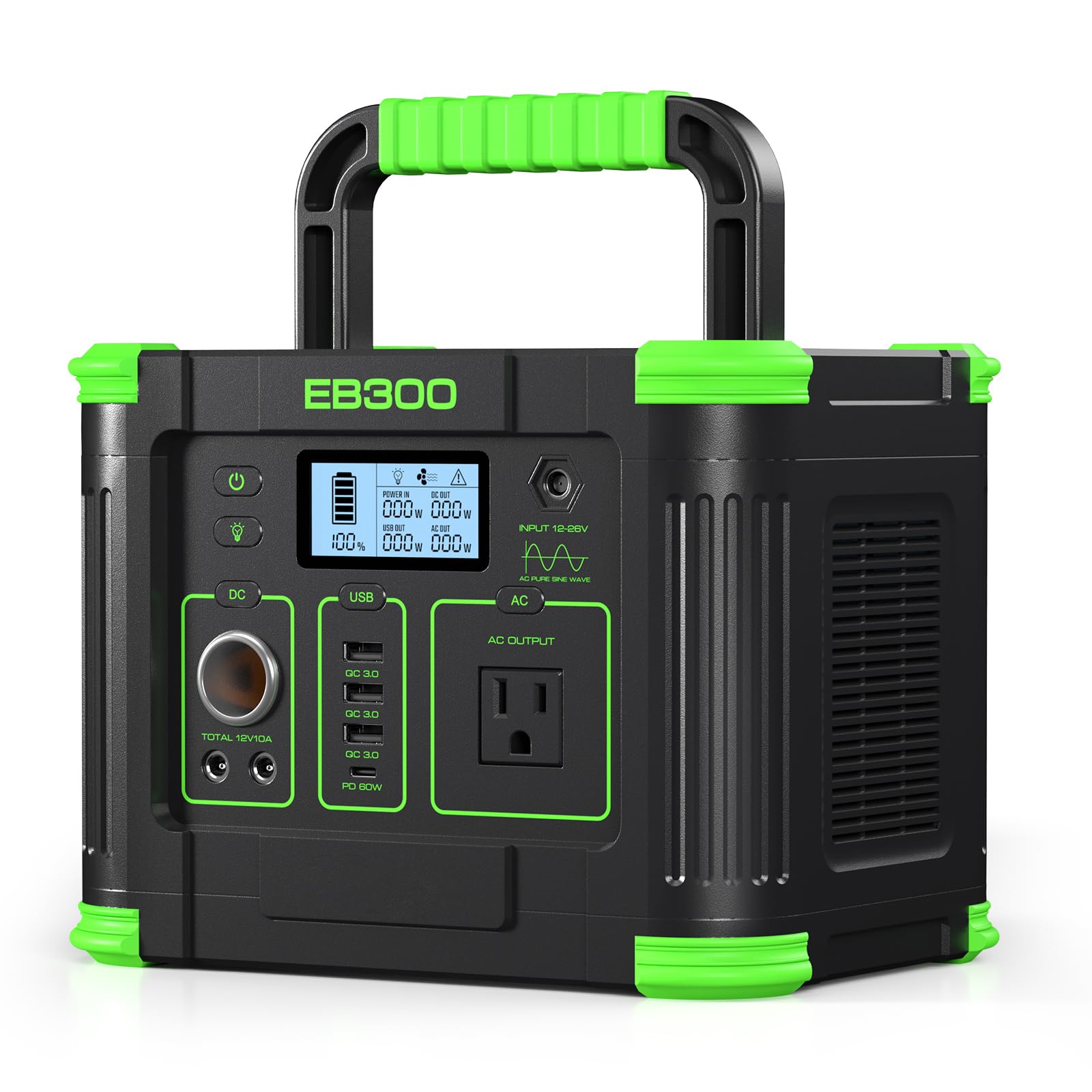
2. GRECELL 330W
The tiny green box that quietly replaced a gas generator for small-camper owners on a budget.
If your camping setup is modest — phones, lights, a fan, a mini-fridge — this is the station that delivers without emptying your wallet. The 288.6Wh battery pushes a 330W pure sine wave output (600W surge), which covers laptops, tablets, CPAP machines, projectors, and TVs rated under 330W. It’s the kind of unit that makes you rethink ever hauling a noisy gas generator again. Owners mention: “Great for small camper; 3 nights TV use left 97%; fan overnight left 73%; good gas generator alternative.”
Versatility is the theme here. The GRECELL packs one AC outlet, one 60W USB-C PD port, three USB-A fast-charge ports, one DC car port, two DC 5521 outputs, and even a 5W wireless charging pad — up to 9 devices at once. A 3-level LED flashlight with steady and SOS modes handles camp illumination. For a unit at this price, the port selection punches far above its weight.
Functionality is what owners praise most — it’s the top positive aspect by a wide margin, with battery life a close second. Three recharging routes keep it flexible: a 120V wall charger fills it in 6-7 hours, a 100W solar panel takes 5-9 hours depending on sun, and a 12V car socket works on the move. The upgraded BMS (battery management system) adds overload, overcharge, and short-circuit protection, with dual silent cooling fans keeping temperatures in check.
Who it fits: tent campers and small-camper owners who want a cheap, reliable way to keep essentials running and aren’t chasing big appliances.
The honest limit: charging capability draws mixed feedback — some owners note the charge time is slower than advertised, and one unit arrived with a faulty AC output.
3. Anker SOLIX C200 DC
The pocket-size powerhouse that keeps a fishing boat’s Starlink Mini humming for hours on end.
This one wins on pure portability and specialty use. The Anker SOLIX C200 DC delivers 192Wh from a LiFePO4 battery at just 1.9 kg, and it’s the station Starlink Mini owners consistently rave about. One buyer’s boat trip sums it up: used it to power a Starlink Mini for 5 or 6 hours and still had 40% left — no inverter needed, no worry about draining the starting battery. For van life and fishing trips, that means no more draining the vehicle’s starting battery.
The output is DC-focused, which is exactly why it’s so efficient for routers and laptops. A 140W two-way USB-C fast-charging port handles big pulls, backed by a 100W USB-C, a 15W USB-C, and two 12W USB-A ports for a total of 5 charging ports. It delivers 200W continuous. This is a far cry from the Jackery Explorer 1000 v2’s 1,500W output — a 7.5x gap in AC headroom — but the C200 was never meant to run a fridge; it’s built for tech.
The 140W USB-C port hits 80% in 1.3 hours, but the wall charger is sold separately. The 140W USB-C PD 3.1 port hits 80% in 1.3 hours, and solar input up to 100W extends your trip indefinitely. But the wall charger is sold separately — a genuine downside owners flag. The 3,000-cycle LFP battery is backed by a 3-year warranty, and owners note it’s 39% smaller than similar stations, making it an easy grab-and-go companion.
Perfect for: road-trippers, boaters, and remote workers who need reliable laptop and router power in the smallest possible footprint.
Know before buying: there’s no wall charger in the box, and the 192Wh capacity won’t handle TVs or mini-fridges — this is a tech charger, not an appliance runner.
4. EF ECOFLOW RIVER 2

The 7.7-lb featherweight that refills from empty to full in a single hour.
EcoFlow’s RIVER 2 is the answer for campers who hate waiting on chargers. Its X-Stream technology fully recharges from an AC outlet in just 1 hour — one of the fastest refills at this size. The 256Wh capacity and up to 600W output handle 6 essential appliances at once, from 300W AC outlets to USB-C. Weighing only 7.7 lbs with a 9.6 by 8.4 by 5.5-inch footprint, it slips into a backpack for off-grid adventures.
The LFP cells survive 3,000+ cycles before dropping to 80% capacity. Recharge RIVER 2 more than 3,000 times before hitting 80% capacity, which EcoFlow says is almost 10 years of regular use. Advanced BMS protection monitors voltage, current, and temperature to keep that battery healthy. For solar lovers, a 110W solar input recharges it in as fast as 2.3 hours — though owners note you need a quality panel of at least 25W to see real results.
Real-world feedback is strong. Owners use it for power outages, outdoor events, and travel, calling it compact, easy to operate, and genuinely worth the money. One reviewer noted it provides about 5 laptop charges or 20-25 phone charges per full tank — plenty for a weekend. The built-in handle and lightweight design make it the easiest station here to carry one-handed to a picnic table or tent.
Why it gets picked: the 1-hour wall recharge is class-leading at this weight, and the 3,000-cycle LFP battery means years of weekend trips.
Not built for: high-wattage appliances like microwaves or space heaters — the 600W cap and 256Wh tank are for essentials, not heavy loads.
5. GRECELL 500W
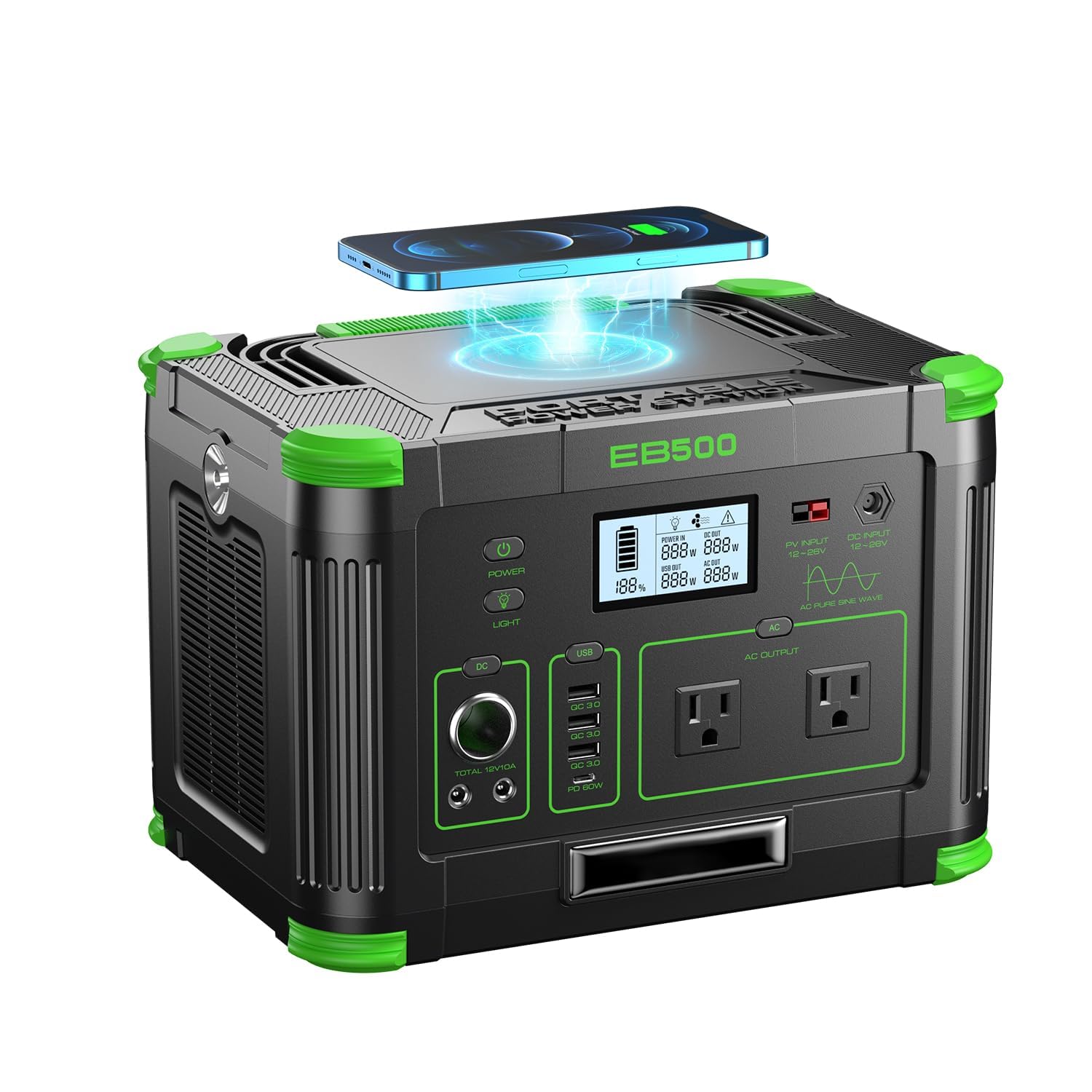
The reliable middleweight that’s become the default choice for tent campers who want real battery life without the bulk.
This GRECELL balances capacity and price well. Its 519.48Wh battery (140,400mAh) delivers 500W of pure sine wave output (clean power for sensitive devices) through two 120V AC outlets, and it’s rated to run phones, laptops, tablets, MacBooks, fans, routers, TVs, projectors, small blenders, car refrigerators, drones, cameras, and CPAP machines under 500 watts. Owners praise reliability most — it’s the #1 positive aspect, with battery life close behind.
The 14.1-lb build with a solid handle makes it comfortable to carry from car to campsite. Owners highlight how it’s easily stored in an RV and works well with a 100W folding solar panel for tent camping. One buyer called it a great value that charges phones, laptops, and small devices on camping trips and outages — with the battery lasting a long time between charges.
Ports are plentiful: 2 pure sine wave AC outlets, 3 USB-A QC3.0 ports (18W max), 1 USB-C PD output (60W max), 2 DC ports, 1 car port, and a 10W wireless charger. That’s up to 10 devices at once. Quick Charge USB 3.0 and USB-C PD claim to charge 2.5x faster than a universal USB-C charger. Recharging takes 6-7 hours from a wall outlet, 7-8 hours from a car charger, or 6-9 hours from a 100W solar panel in full sun.
What owners love: long battery life, quiet operation, and a build that’s well-made for the price — one buyer mentioned it powers a mini fridge for up to four days.
Where it sits: under the GRECELL 1000W in output but above the 330W in capacity, making it the middle-ground pick for families who want more than phone charging but don’t need appliance power.
6. GRECELL 1000W
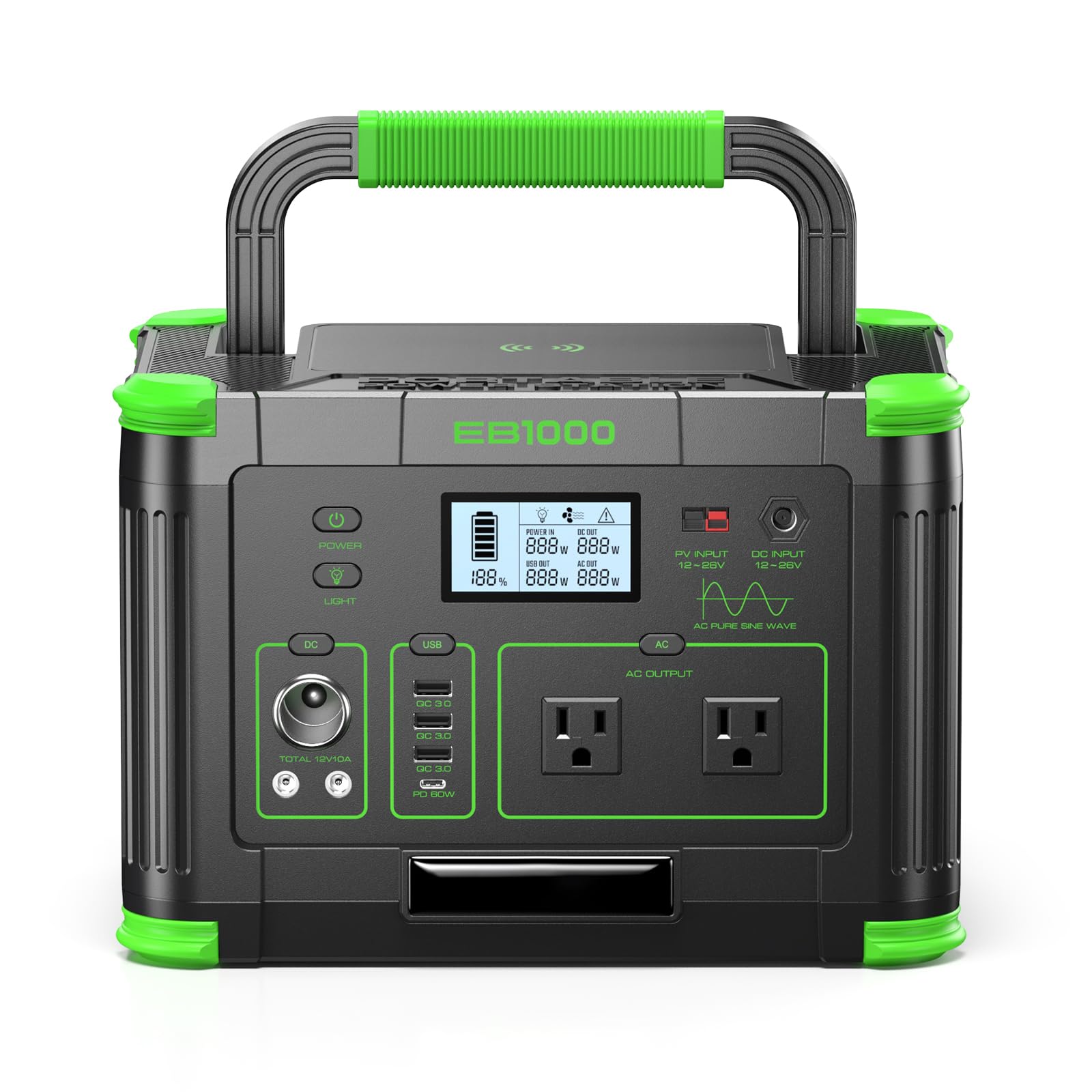
The one-box command center that runs a mini-fridge for 20-plus hours and still charges 10 devices at once.
GRECELL’s 1000W station is the definition of a versatile all-rounder. The 999Wh capacity and 1000W continuous output (2000W peak) deliver stable pure sine wave AC power that safely runs CPAP machines, mini-fridges, TVs, projectors, and laptops. The math is compelling: enough juice to charge a laptop 20+ times or run a mini-fridge for 20+ hours. For extended camping and RV travel, that’s days of comfort instead of hours.
It recharges via AC, car port, or MPPT solar, with pass-through charging for busy campsites. It recharges three ways — AC wall outlet in 7-8 hours, 12V car port, or MPPT solar panels for true energy independence. Pass-through charging lets you power devices while the station itself refills, which is huge for a busy campsite. The included MC4 solar cable means instant compatibility with most portable solar setups. The automotive-grade battery delivers 2000+ charge cycles for a claimed 10-year lifespan.
Ports cover every need: 2×120V AC outlets, 1×60W USB-C PD (fast-charges a MacBook), 3×USB-A QC 3.0 ports, a 10W wireless charging pad, 12V car port, and 2×DC outputs — 10 ports total. Individual module switches and a smart LCD show real-time wattage, battery percentage, and runtime estimates. An integrated LED light with SOS mode adds safety illumination, and a rugged shock-resistant housing shrugs off outdoor abuse.
Who it serves: campers and RV owners who want one station that covers both small electronics and a mini-fridge while staying affordable.
The trade-off: owners note solar charging is slow (a large panel takes hours), and the battery won’t sustain big appliances for long stretches — it’s built for light-to-moderate use.
7. BLUETTI AC70

The mid-size station that powers a full busking rig for 8 hours and still has battery to spare.
The BLUETTI AC70 packs serious punch into a 22.5-lb frame. With 768Wh capacity, a 1000W inverter, and 2000W power lifting (to handle startup surges), it runs essentials from TVs to fridges during outages and trips. But the real standout story comes from a musician: it ran a 100W guitar amp plus 5 pedals for 8 hours and only dropped to 59% — an estimated 8-10 hours for a full busking setup. For campers who double as performers, this is the station that replaces a battery/inverter rig.
Charging speed is a genuine highlight. A single cable charges it with up to 950W of AC input, hitting 0-80% in just 45 minutes and 0-100% in 1.5 hours. Up to 500W of solar input refills it in 1.9-2.4 hours in good sun. The LiFePO4 battery offers 3000+ cycles to 80%, giving it a decade of regular use. Reliability is the #1 thing owners praise, with build quality a close second.
Connectivity separates it. The BLUETTI App monitors status, sets charge/discharge modes, and updates battery firmware from your phone. Ports include 2 AC outlets, 2 USB-A (12W), and 2 USB-C (100W) — enough for a campsite. The 20ms UPS (uninterruptible power supply) switchover keeps Wi-Fi routers and PCs running smoothly during outages. Buyers also note it pairs well with a gas generator for emergency recharging.
Why fans return: “So nice I’ve bought it twice!” — the AC70’s mix of fast charging, power lifting, and compact size wins repeat buyers.
Keep in mind: at 22.5 lbs it’s not a backpack unit, and some owners note it drains quickly under heavy continuous loads like heaters.
8. Anker SOLIX C1000

The 1056Wh bruiser that runs 99% of household appliances thanks to a 2400W surge mode.
Anker’s C1000 brings serious muscle to the campsite. The 1056Wh LiFePO4 battery feeds an 1800W continuous output, but the standout feature is SurgePad technology, which delivers a massive 2400W peak — enough to cover 99% of appliances through 11 versatile ports. Owners have run 1800W microwaves, snow blowers, TVs, fridges, and even a Vitamix blender without tripping. Reliability is what owners praise most — it’s the top positive aspect by a wide margin, with build quality second.
Recharging is astonishingly fast. UltraFast recharging hits 80% capacity in just 43 minutes (within a 68-122°F operating range) and a full charge in under an hour using AC input. You toggle UltraFast mode through the Anker app, which also tracks power stats in real time. For solar users, up to 600W of fast solar recharging fully powers the unit in 1.8 hours. That speed means you can top off during a lunch break and keep the campsite running.
Adventure-ready engineering shows in the details. It’s 15% smaller than comparable 1kWh units, making it a better fit for RVs and campsites. The 10-year lifespan comes from 3,000 battery cycles over a decade. A 27.6-lb weight is noticeable, but owners note the build quality justifies it. For camper owners, pairing it with a BP1000 expansion battery runs a fridge all day and a TV for 10 hours — the unit alone handles a fridge for part of a day.
The stand-out: 43-minute 80% recharge and SurgePad’s 2400W peak make this the most flexible appliance-runner on this list.
The honest caveat: the fan gets noisy at max load, and at 27.6 lbs it’s the heaviest 1kWh unit here — best for car and RV campers, not backpackers.
9. BLUETTI Elite 100 V2
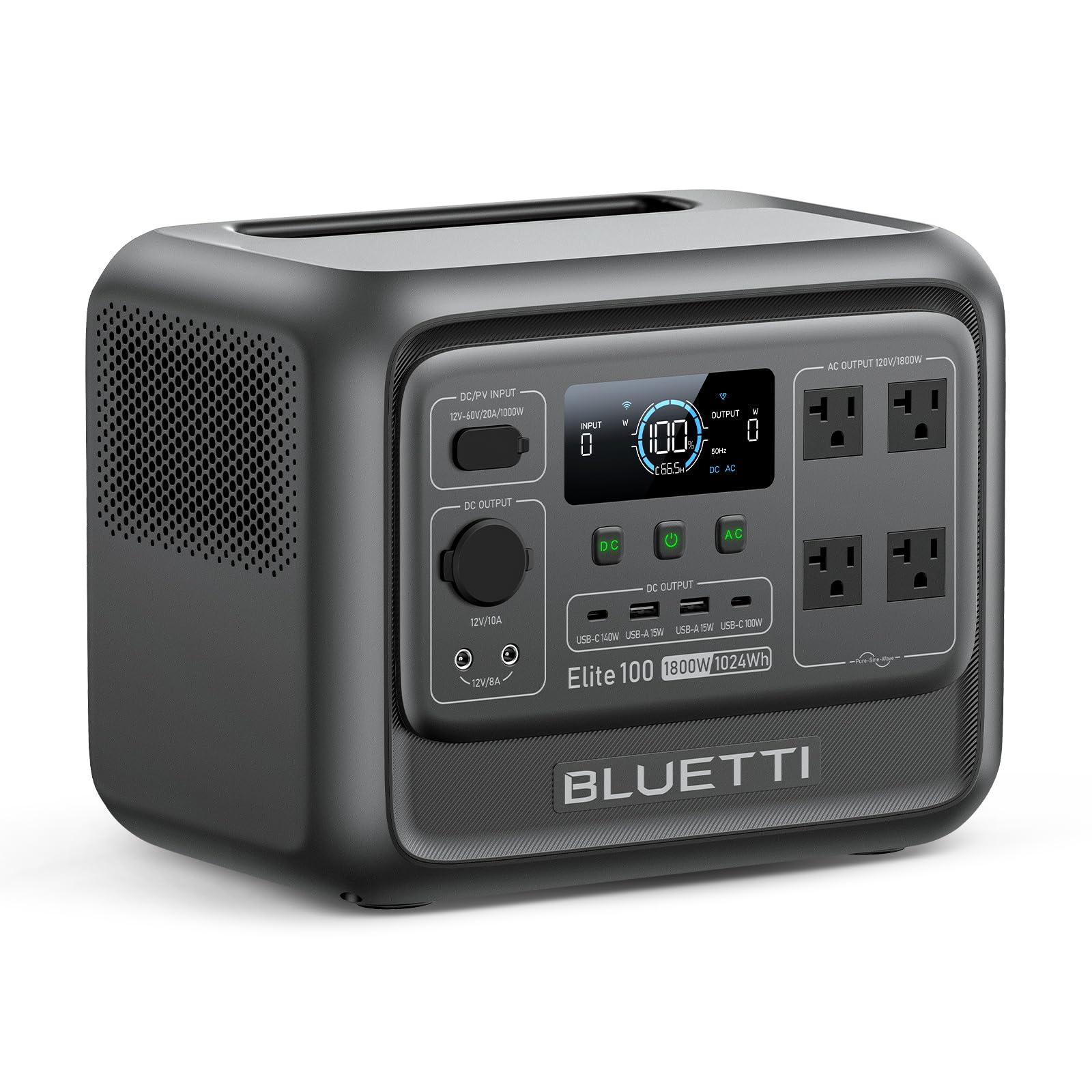
A full kilowatt-hour of power in a 25-lb package that’s 35% smaller than the competition.
The BLUETTI Elite 100 V2 is the answer for campers who want big capacity without the big footprint. Its 1024Wh battery and 1800W rated AC output (with a 3600W surge peak) power up to 90% of everyday appliances. At only 25 lbs with a compact 17L design, it’s built for one-handed carrying thanks to a hidden handle — a real advantage when you’re moving from car to campsite to off-grid cabin. Its 17L footprint and hidden handle make it the easiest 1kWh station to carry one-handed.
It’s also remarkably quiet. In silent mode it runs at just 30dB — 50% quieter than other 1kWh stations, which matters for overnight camping when you want to sleep, not listen to a fan. The built-in 10ms UPS switchover keeps Wi-Fi routers and PCs running during outages, making it a dual-purpose home backup and camping companion. Owners on a week-long trip watched the battery drop to just 39% after 4 days of typical use — a fan one night and small devices.
The 4000+ cycle LiFePO4 battery provides a reliable 10-year lifespan, and 1000W solar input recharges it fast in good sun. The BLUETTI App supports Wi-Fi and Bluetooth for remote monitoring, power management, and OTA updates. Owners call it compact, portable, and long-lasting, ideal for road trips and emergency backup. Forward-facing ports make plugging in a breeze at the campsite.
The winning combo: 1024Wh capacity in a 35% smaller, 30% lighter frame than peers — the balance for RV owners who watch every inch.
One caution: the app is a bit clunky and can’t power the unit on via Bluetooth or Wi-Fi; an occasional unit arrives dead on arrival, though Bluetti’s support resolves it.
10. DJI Power 2000
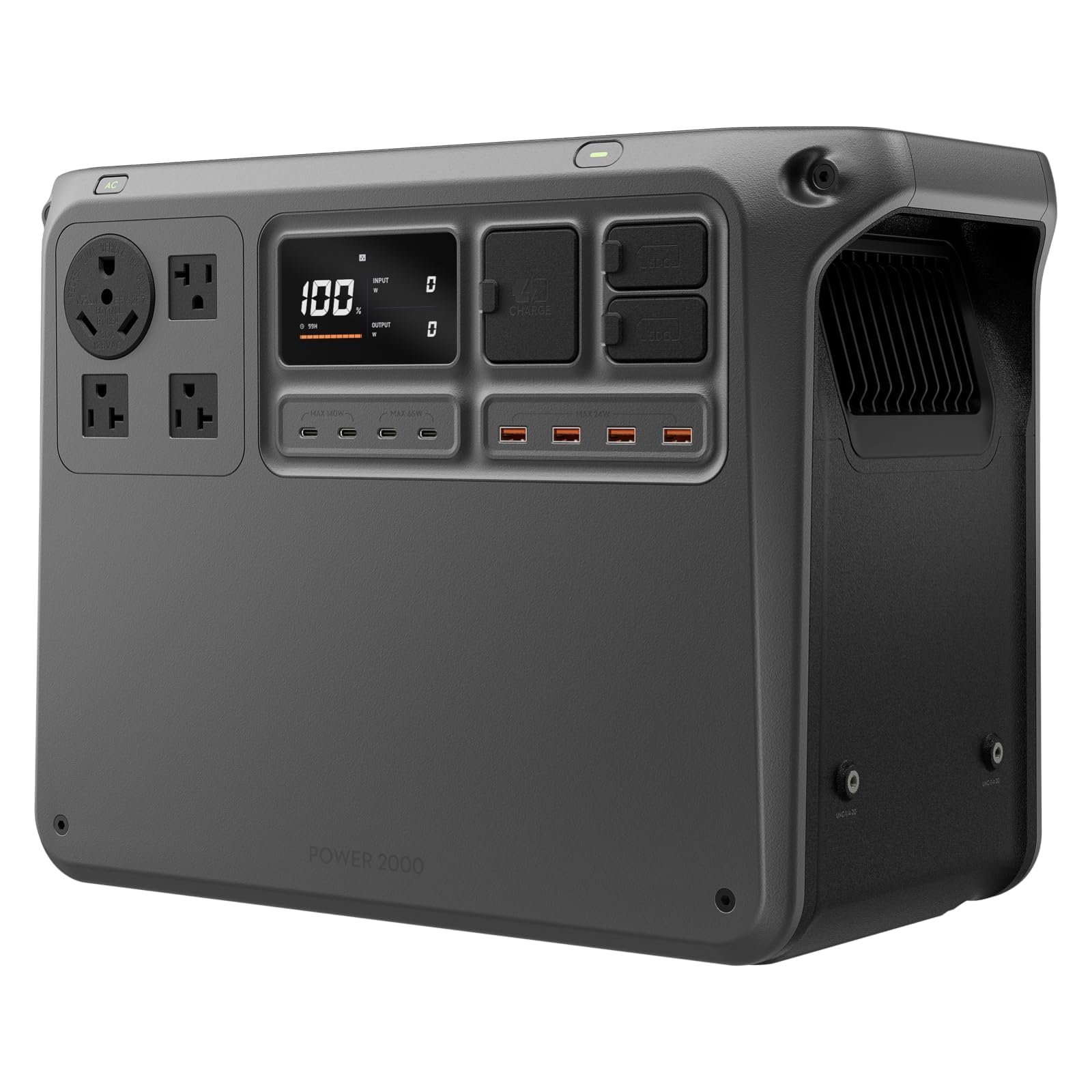
The 2048Wh giant that replaces a gas generator for an entire RV crew, running everything in near silence.
When you need power for 4-5 people, the DJI Power 2000 is the heavyweight answer. Its 2048Wh LFP battery and 3000W stable output run 99% of appliances — kettles, cookers, projectors, electric saws, and impact drills. For campers, that means the whole crew can charge phones, lights, fans, and laptops together through 15 ports, including dual full SDC ports. Customers note roughly 40 hours of runtime replacing a noisy gas generator for their camper, with absolutely quiet operation.
Recharging is fast for a unit this size. It hits 80% in just 55 minutes, so you’re never stuck waiting long before heading out. The smart BMS (battery management system), sub-nano coating, and flame-retardant housing provide safety even in wet or rugged outdoor conditions, and it runs as low as 30 dB (about a whisper) for undisturbed sleep in RVs. Build quality is the #1 thing owners praise, with power capacity second. A smooth UPS with 10ms switch time keeps devices running during outages — twice as fast as the Power 1000.
Expansion capability is a major draw. It supports expansion up to 22.5kWh, enough to power essential home devices for 4-6 days during blackouts (expansion batteries sold separately). The DJI Home app connects wirelessly for status checks and settings adjustments. Its 4,000-cycle lifespan means over a decade of heavy use, backed by a 5-year warranty. The 21.72 kg weight is a commitment, but so is the capacity.
The whole-crew pick: 2048Wh and 15 ports make it the station for large families and RV groups who refuse to run a gas generator.
Watch out for: proprietary SDC connectors limit third-party accessories, and owners warn expansion peripherals have been notoriously hard to find in stock; also no wheels for moving this 21.72 kg unit.
11. EF ECOFLOW DELTA 3 + Panel

The complete solar kit that includes a 220W bifacial panel — everything you need to go off-grid the moment the box lands.
This is the one box that ends the “what else do I need to buy?” question. The EcoFlow DELTA 3 comes bundled with a 220W Bifacial Portable Solar Panel, so solar charging works from the start — no separate purchases required. The 1024Wh LFP battery and 1800W AC output (with 100W USB-C) provide a sturdy foundation. The bifacial panel’s dual-sided design collects up to 28% more energy, and its 25% conversion efficiency is a genuine step up.
Charging speed is exceptional from every angle. Full charge takes just 56 minutes combining 500W solar input with 1500W max AC input; an 80% charge arrives in 30 minutes. Fully solar, one 220W panel charges the DELTA 3 in 5.8 hours, or 2.9 hours with two panels. For a 1024Wh station, those numbers are tough to top. Owners confirm the reliability, with one keeping freezer items frozen during a 6-hour outage and another running a portable fridge/freezer for 24+ hours per charge.
Expansion is a long-term advantage. The DELTA 3 Series integrates with EcoFlow’s ecosystem, expanding up to 5kWh with DELTA 3, DELTA Pro 3, and DELTA 2 Max battery packs. The 10-year LFP battery retains 80% capacity after 4,000 cycles — 25% more durability than industry standards, per EcoFlow. X-Boost handles resistive appliances over 2600W continuously, and 13 interfaces power 13 appliances at once. The IP65 battery pack is splash-proof, dust-proof, and oil-proof.
Why it wins for solar fans: the included 220W bifacial panel makes it the only true plug-and-play solar generator on this list.
The honest note: owners say the panel charges at about 50% of its advertised rate in full sun, and the station-plus-panel combo arrives in separate packages.
Understanding the Specs
Watt-hours (Wh) vs Watts
Watt-hours (Wh) is the fuel tank — it tells you how long the battery lasts. Watts (W) is the engine — it tells you what the station can actually run at any moment. A 256Wh station might power a phone for weeks but can’t start a microwave that needs 1000W. Match both to your gear, not just one.
LiFePO4 Battery Chemistry
Lithium iron phosphate (LiFePO4, or LFP) batteries are the gold standard for power stations because they last thousands of charge cycles — often 3,000 to 4,000 — before dropping to 80% capacity. That translates to roughly a decade of regular use, versus older lithium-ion cells that degrade faster. The trade-off is cost and weight, but for frequent campers, the lifespan wins.
FAQ
How do I know how many watts my camping gear needs?
How long will a portable power station last on a camping trip?
Can I charge a power station with solar panels while camping?
What is the difference between pure sine wave and modified sine wave inverters?
Is a LiFePO4 battery worth the higher price?
Can I run a CPAP machine all night on a portable power station?
What does the surge or peak wattage rating mean?
How heavy is too heavy for a camping power station?
Final Thoughts: The Verdict
For the majority of shoppers, the best portable power station for camping winner is the Jackery Explorer 1000 v2 because it delivers the rare combination of high output (1500W), deep capacity (1070Wh), and a fast one-hour recharge that leaves nothing to chance. If you want the fastest wall recharge in a lightweight package, grab the EcoFlow RIVER 2 — its 1-hour refill at just 7.7 lbs is class-leading at that size. And for the whole-crew camper who refuses to haul a gas generator, the DJI Power 2000 delivers 2048Wh of near-silent power that keeps everyone’s devices alive for days on end.
How We Picked
We do not accept paid placement. Every pick is matched to a real buyer and a real use-case; we do not hands-on test units.
Sources & Methodology
Specifications: manufacturer listings and product documentation. Review insights: verified customer reviews, as of August 2026. Pricing: not shown on this page (it changes often); check the current price via the retailer link.
As an Amazon Associate, Trending Car earns from qualifying purchases. This does not affect which products we feature.