
Our readers keep the lights on and my garage snacks stocked. As an Amazon Associate, I earn from qualifying purchases.
Specs are compiled from manufacturer listings and verified buyer reviews and can change over time — please confirm the key details on the product page before buying.
The core test for any front facing car camera is whether it can capture a readable license plate in a critical moment. That single test separates a gadget from a witness. These picks prioritize plate readability for daily commutes, work trips, or simple confidence.
I’m Min Islam — the founder and writer behind Trending Car. This guide is built by comparing the manufacturers’ published specifications and the patterns across verified customer reviews, so you get each pick’s real strengths and trade-offs instead of marketing spin.
From budget-friendly 1080P recorders to premium 4K sensors with GPS and Wi-Fi 6, the best front facing car camera for you balances sharp footage, easy setup, and a price that fits your driving style.
Our Picks at a Glance
How To Choose The Best Front Facing Car Camera
Before you buy, focus on the specs that decide whether your footage is usable in an insurance claim or just a blurry memory. Resolution, lens width, and night performance are the big three to get right.
Resolution and clarity
Higher resolution means more detail, which is exactly what you need to capture a plate number. A 4K (2160P) camera captures more detail than a standard 1080P unit. If your budget stretches, 4K is the safer bet for evidence-grade footage, while 1080P still works well for basic protection.
Field of view and night vision
A wider field of view covers more lanes and reduces blind spots, but it can distort edges. Look for a lens between 140 and 170 degrees for a good balance. For night driving, check the aperture value (F1.5 or F1.6 lets in more light than F1.8) and whether the camera uses WDR to balance bright headlights against dark roads.
Storage and power
Most dash cams use a microSD card (some include one, many do not). Loop recording overwrites old footage automatically, so you never run out of space. On power, supercapacitors handle extreme heat better than lithium batteries, which is important if you park in the sun for long stretches.
Quick Comparison
| Model | Best For | Resolution | Field of View | Max Storage | Amazon |
|---|---|---|---|---|---|
| Galphi 4K Mini Dashcam★ Best Overall | Best Overall Value | 4K (2160P) | 160° | 256 GB | Amazon |
| Avylet 2K Dash CamScreen Pick | Built-in Screen | 2K (1440P) | 150° | 128 GB | Amazon |
| 70mai M310 PlusVoice Control | Voice Control | 4K UHD | 140° | 256 GB | Amazon |
| REDTIGER F9Lite | Driver Alerts | 4K (2160P) | 160° | 256 GB | Amazon |
| BOOGIIO 1080P | Budget Simplicity | 1080P FHD | 170° | 32 GB included | Amazon |
| Botslab HK40 Plus | Rotatable Lens | 4K UHD | 150° | 256 GB | Amazon |
| ROVE R2-4K | Proven Popularity | 4K UHD 2160P | 150° | 512 GB | Amazon |
| VIOFO A119M Pro | Premium Sensor | 4K 30FPS | 130° | 512 GB | Amazon |
In‑Depth Reviews
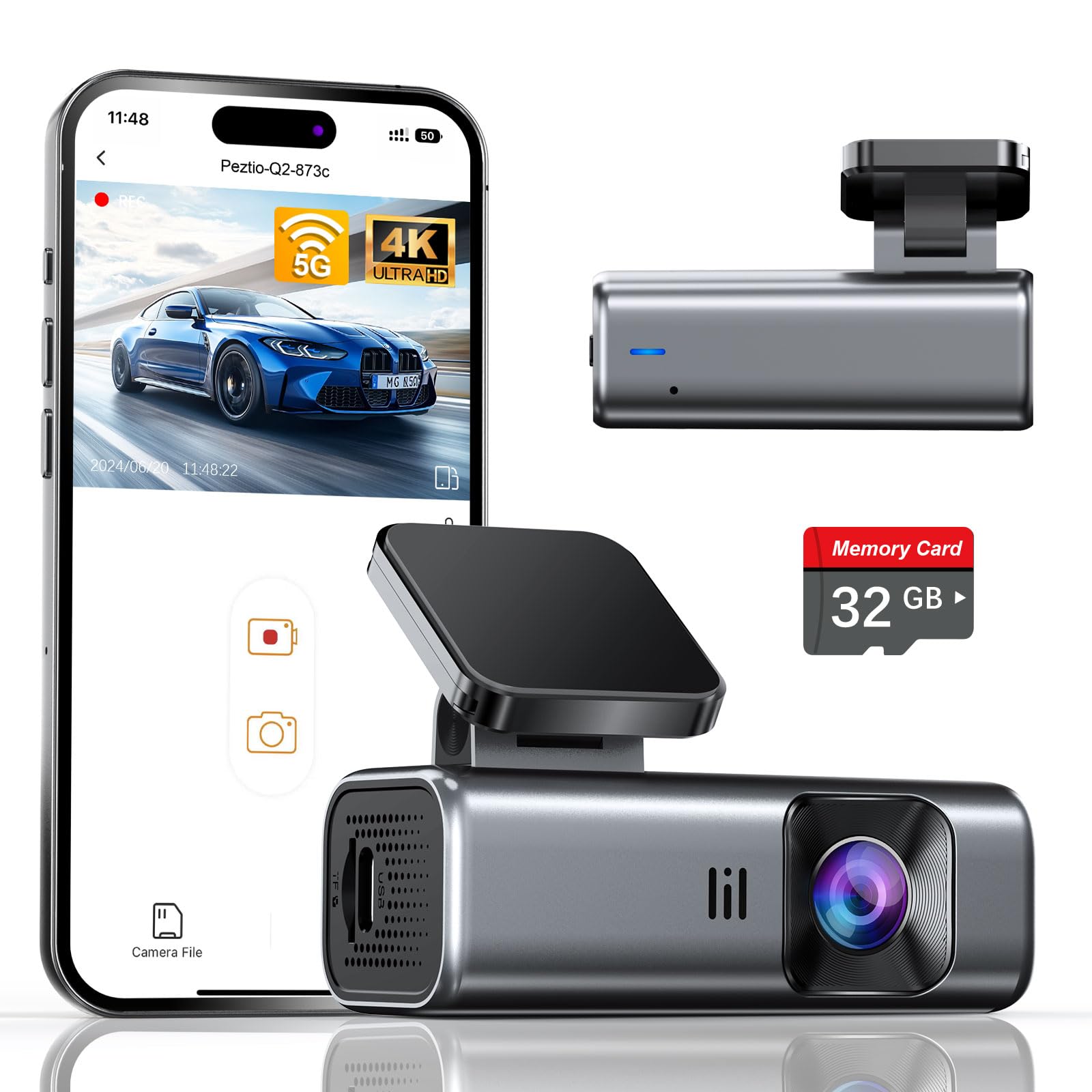
1. Galphi 4K Dash Cam Front
Our pick — over 4★ from 1,500+ verified ratings; the strongest balance of quality and price.
The crowd favorite that captures crisp 4K day and night without a screen to distract you.
You can read license plates in daylight and at night with the Galphi mini dashcam, thanks to its 4K (2160P) video, F/1.6 aperture (a lens opening that lets in more light), and WDR (wide dynamic range, which balances bright and dark areas). The 160° wide-angle lens captures multiple lanes ahead. With no screen, nothing glares back at you during night drives or blocks your view of the road.
Setup is genuinely easy thanks to the included 32GB memory card (pre-installed in the slot) and static pads that stick without leaving residue. The 5GHz WiFi pairs with a free app to download footage at up to 8MB/s, which is noticeably quicker than the 2MB/s you get from older 2.4GHz connections. If you want 24-hour parking monitoring, a Type-C hardwire kit is required but not included.
Buyers report a tinny speaker and a proprietary 11.5ft USB cable with no longer option. The short cord rarely matters for daily use, and the G-sensor locks collision footage against loop overwrites.
Why it wins
- Sharp 4K day and night footage with readable plates
- 32GB card included from the start
- Compact, screen-free design installs discreetly
Know before you buy
- Proprietary 11.5ft cable only, no longer options
- Speaker quality is weak and tinny
- Parking mode needs a separate hardwire kit
Your best all-rounder: pick this if you want a simple, reliable 4K witness for daily commutes without paying a premium.
Check your install spot: measure the distance to your power outlet first, since the fixed 11.5ft cable may not reach every vehicle.
2. Avylet 2K Dash Cam
A compact 2K camera with a small screen, external GPS support, and a 170° lens.
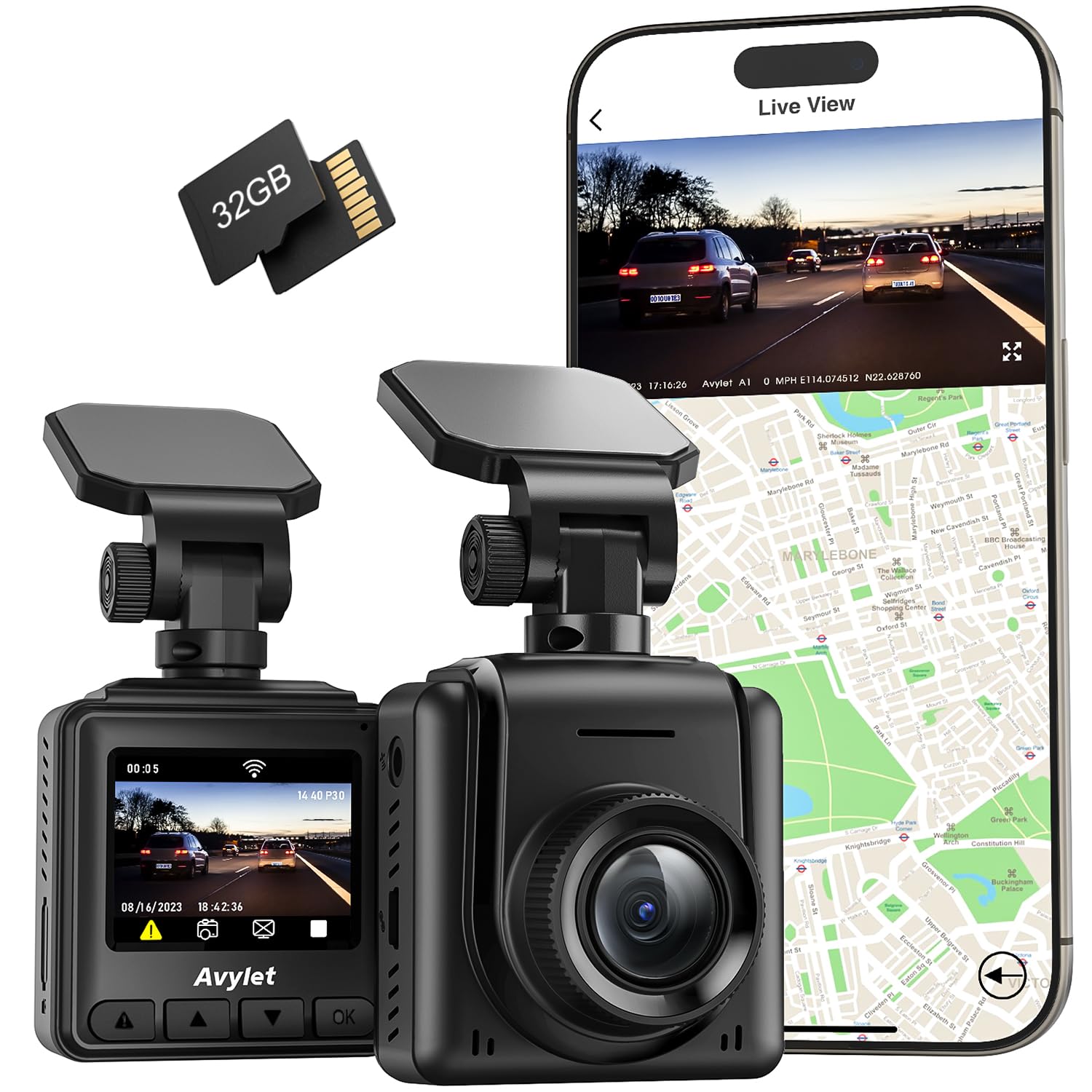
Road signs and plates stay legible with the Avylet, which records in 2K Quad HD (2560×1440) through a 170° ultra-wide lens—at 1440P versus 1296P resolution. The 1.5″ IPS screen (a type of display with wide viewing angles) lets you check recording status and replay footage right on the camera, no phone needed. A 32GB card comes pre-installed, so it works the moment you power it on.
For drivers who want evidence with context, this model supports an optional external GPS module (not included) that stamps speed, location, route, and time directly onto your video. The supercapacitor power system handles temperature swings from -4°F to 158°F with no battery to swell or fail, and it can endure more charge cycles for a longer working life than a lithium pack.
Owners complain the included power cord is too short to route cleanly to the cigarette lighter. The app downloads easily but demands broad permissions and can drop wireless CarPlay over WiFi.
What stands out
- On-camera 1.5″ IPS screen for quick playback
- Supercapacitor handles extreme heat and cold
- Optional GPS stamps speed and location
Watch for
- Power cord length may fall short in larger cars
- App needs full permissions and can drop CarPlay
Reach for this if: you want a small screen for quick on-camera checks and heat-proof supercapacitor reliability.
Look elsewhere if: your phone is your primary dashcam screen and you refuse to give up wireless CarPlay.
3. 70mai M310 Plus Dash Cam
A featherweight 4K camera with voice commands and an ultra-wide 140° view that hides behind your mirror.
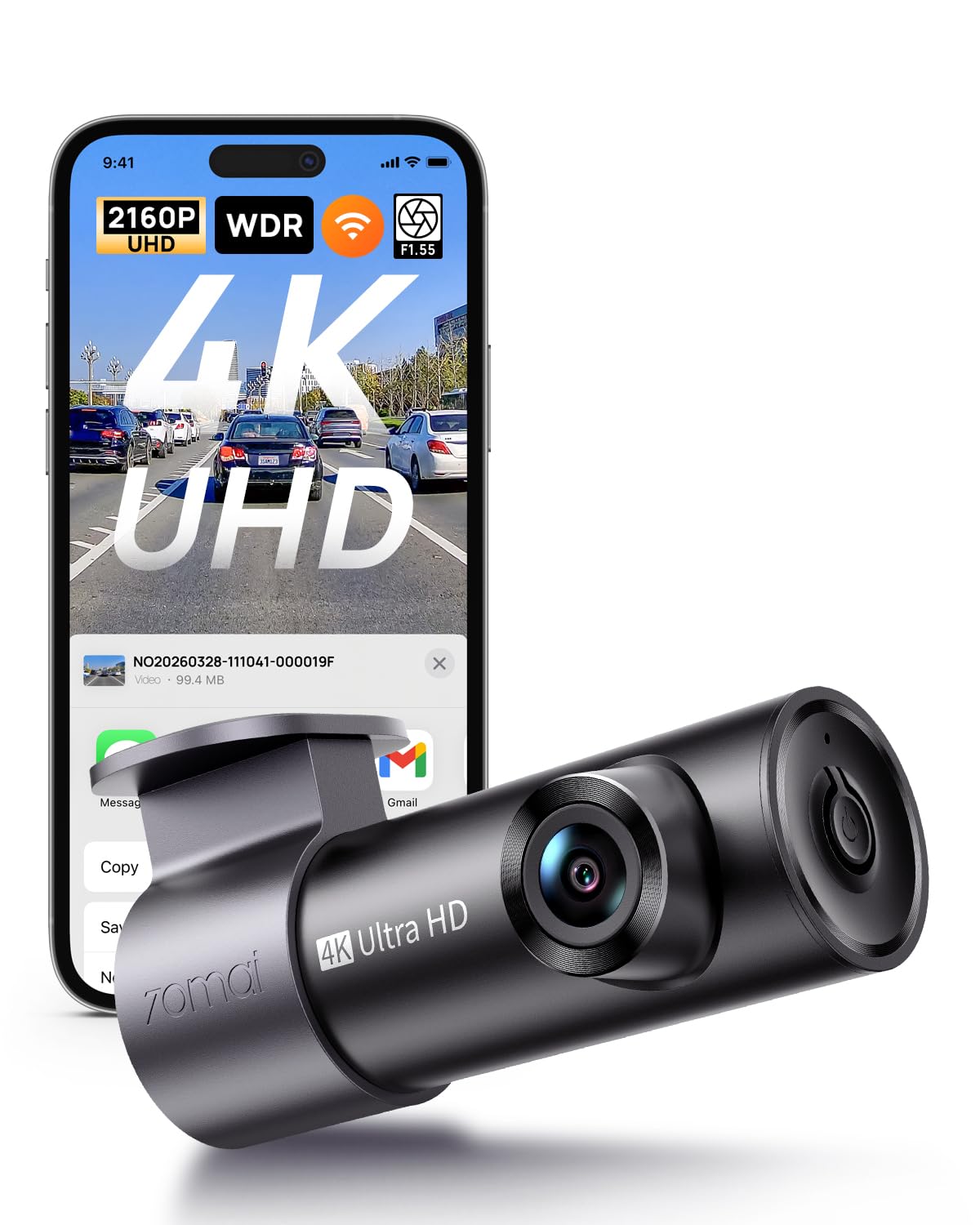
The 70mai M310 Plus packs true 4K UHD recording into a tiny 76.7-gram body (about 2.7 ounces) that tucks discreetly behind the rearview mirror. Its 140° field of view and F1.55 aperture with 3D noise reduction work together to keep night footage clear and cut glare from oncoming headlights. Voice control is the standout here — you can lock a video or snap a photo hands-free without taking your eyes off the road.
You get the full picture of what led up to a collision with smart pre-recording: when the G-sensor (a small motion sensor that detects a bump) feels an impact, it locks up to 1–3 minutes of footage from before the crash. An 11.48ft Type-C cable makes routing easy in most cars, and the 18-month warranty offers more coverage than many rivals. Built-in low-voltage protection (11.8V) helps prevent your car battery from draining during parking monitoring.
Buyers call it a great budget 4K option, but some units require a subscription and no memory card is included. It also conflicts with CarPlay on some phones — you may need to disable CarPlay to keep the dashcam WiFi connection stable.
Loved for
- 4K sharpness with readable plates at speed
- Hands-free voice control for locking clips
- Ultra-compact 76.7g body
Heads up
- No memory card included
- Some units require a subscription to operate
- Can conflict with wireless CarPlay
Best if: you want a tiny 4K camera with voice control and long pre-impact recording for stronger evidence.
Think twice if: you live inside wireless CarPlay and do not want to juggle connections.
4. REDTIGER F9Lite Dash Cam
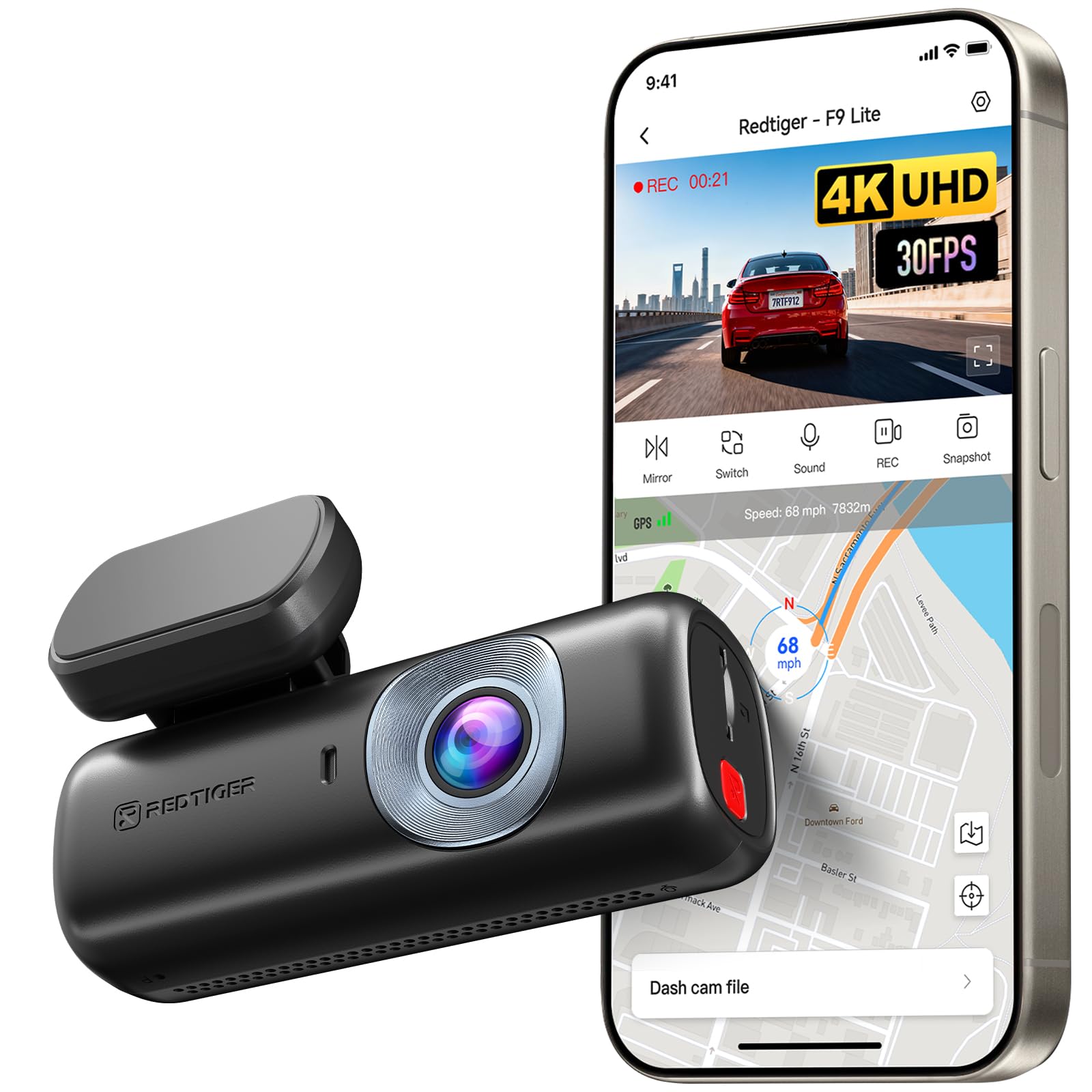
A slim 4K recorder that talks to you with collision and lane-departure warnings built right in.
The REDTIGER F9Lite shoots 4K (3840×2160P) at 30FPS through a 160° wide-angle lens and a 6-glass F1.5 aperture, delivering the clarity you need for insurance evidence in low light. Its defining feature is ADAS (Advanced Driver Assistance System), which gives forward collision warnings, start-from-stop alerts when the car ahead moves, and lane-departure voice alerts. That makes it a strong fit for long trips and stop-and-go city traffic where awareness slips.
A built-in supercapacitor (no battery) adds heat resistance, and the screenless body keeps glare and distraction down. The included bracket has built-in GPS to record location and speed, and OTA firmware updates mean you never touch a computer to upgrade it. It accepts cards up to 256GB, though no card is included, so budget for one separately.
The trade-off for this minimalist setup is the lack of a screen, and owners mention night vision is the weak spot — visibility drops sharply in low light even around street lamps. WiFi-only connectivity means no cloud backup, and it can interfere with wireless CarPlay, which is a pattern across several screenless models here.
Why pick it
- ADAS voice alerts for collision and lane departure
- Built-in GPS in the bracket
- Heat-resistant supercapacitor design
Where it falls short
- Night vision is poor in dimly lit areas
- No SD card included
- WiFi-only, with possible CarPlay conflicts
Grab this for: commercial vans or long highway hauls where lane-departure and collision alerts add a safety net.
Pass on it if: you regularly drive unlit roads at night and need dependable after-dark footage.
5. BOOGIIO 1080P FHD Dash Cam

A no-fuss 1080P workhorse with a big 3-inch screen and a 32GB card ready from the start.
The BOOGIIO keeps things simple: a 1080P@30fps Full HD lens (1080P resolution at 30 frames per second) with a 170° field of view, a 3″ IPS display for instant playback, and a 32GB card already installed so it records the second your engine turns over. That 170° lens is among the widest here, trimming blind spots across multiple lanes. The F1.8 aperture with WDR and HDR (high dynamic range, which preserves detail in bright and dark areas) keeps night shots brighter without blowing out under strong headlights.
Buyers love the straightforward suction-mount install and the fact that you can review footage on the spot without an app. With well over eight thousand owners giving feedback, it is among the most proven entry-level choices. Motion detection starts recording when objects move in front of the lens, and the G-sensor locks collision evidence automatically.
What it lacks is WiFi — there is no app and no phone connection, so you pull the card or use the included USB card reader to view files. Some owners also find the incident sensitivity over-reactive, triggering on speed bumps and locking clips unnecessarily. If you want a dead-simple, dependable witness and do not need phone integration, this is a safe bet.
Simple wins
- 32GB card included — works immediately
- Wide 170° lens covers multiple lanes
- 3″ screen for quick on-camera review
Simple limits
- No WiFi or app for phone viewing
- G-sensor can trigger on speed bumps
- Power cable may be short in larger cars
Best for: first-time buyers who want a cheap, dependable camera with a screen and zero app setup.
skip it if: you need to download clips to your phone regularly — you will be pulling the card instead.
6. Botslab HK40 Plus Dash Cam
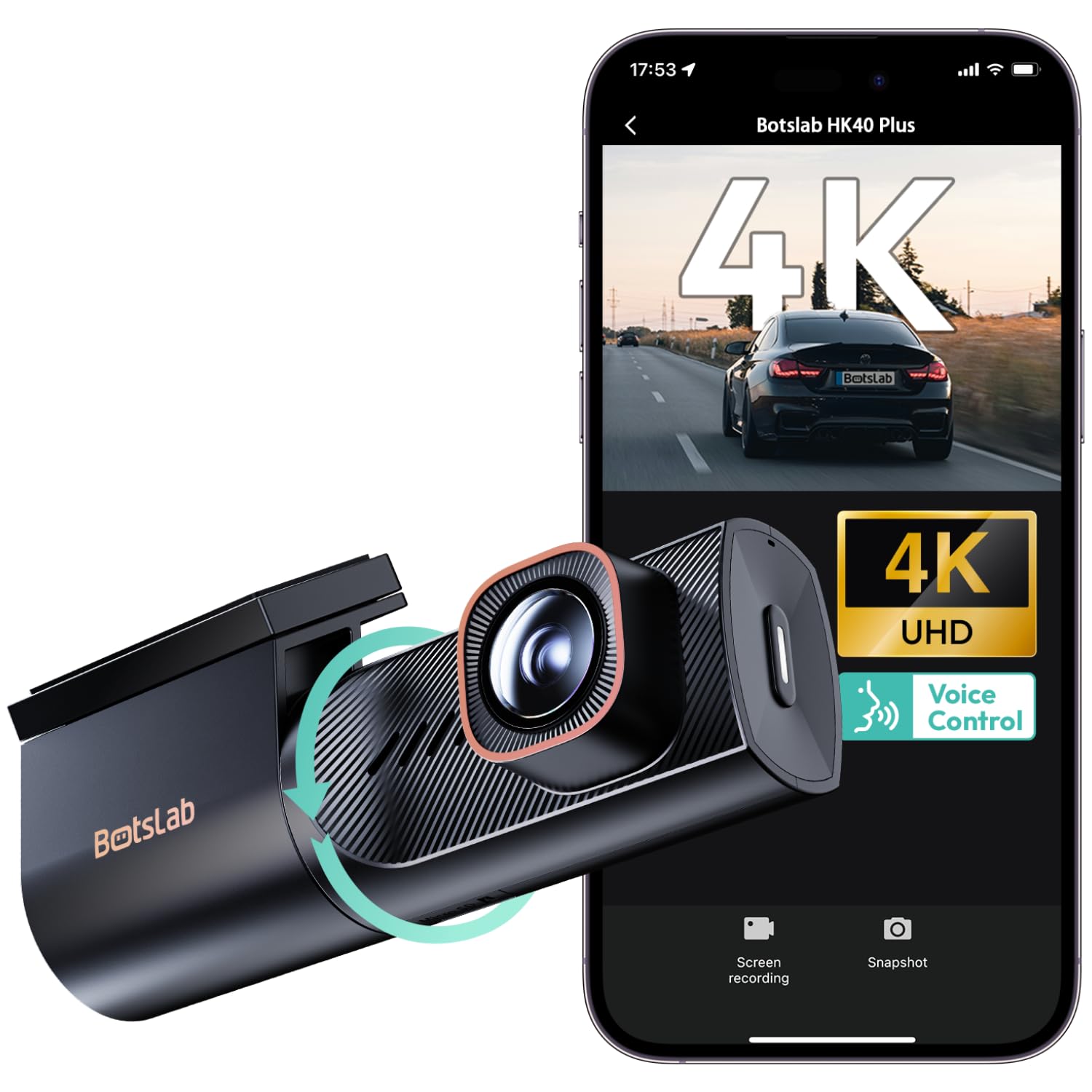
A 360° rotatable 4K lens that flips from the road to the cabin in a single twist.
The Botslab HK40 Plus earns its spot with a flexible lens you can rotate a full 360°, switching from filming the road ahead to recording the cabin, passengers, or a scenic route in seconds. It shoots 4K through a 150° field of view with an F1.5 aperture for brighter night footage, while the screen-free body sits discreetly behind the mirror. Dual-band WiFi (5.8GHz and 2.4GHz) gives you fast 4K transfers when you need them or a steadier connection when range matters.
For hot climates, the supercapacitor (a component that stores energy instead of a battery) is rated to run from -20°C to 70°C . A fatigue alert voices a gentle reminder after 2 hours of continuous driving, and 24-hour parking monitoring locks footage the moment the G-sensor feels a bump. Storage tops out at 256GB, and the 12-month warranty with 24-hour support adds confidence.
Early owners call it a good starter cam for new drivers, noting the video is adequate rather than jaw-dropping (some say it reads plates fine, others expected more from the 4K label). It is for cars under 5.5m in length, so check that before you buy, and the parking mode needs a separately sold hardwire kit.
Flex appeal
- 360° rotatable lens covers road or cabin
- Supercapacitor built for extreme temperatures
- Dual-band WiFi for fast, stable transfers
The fine print
- 4K quality reads as adequate, not exceptional
- Parking mode needs a separate hardwire kit
- Only fits cars under 5.5m long
Choose this if: you are a new driver or rideshare user who wants the option to record the cabin, not just the road.
Forget it if: you expect flagship-grade 4K detail — this leans toward practicality over pixel-perfection.
7. ROVE R2-4K Dash Cam
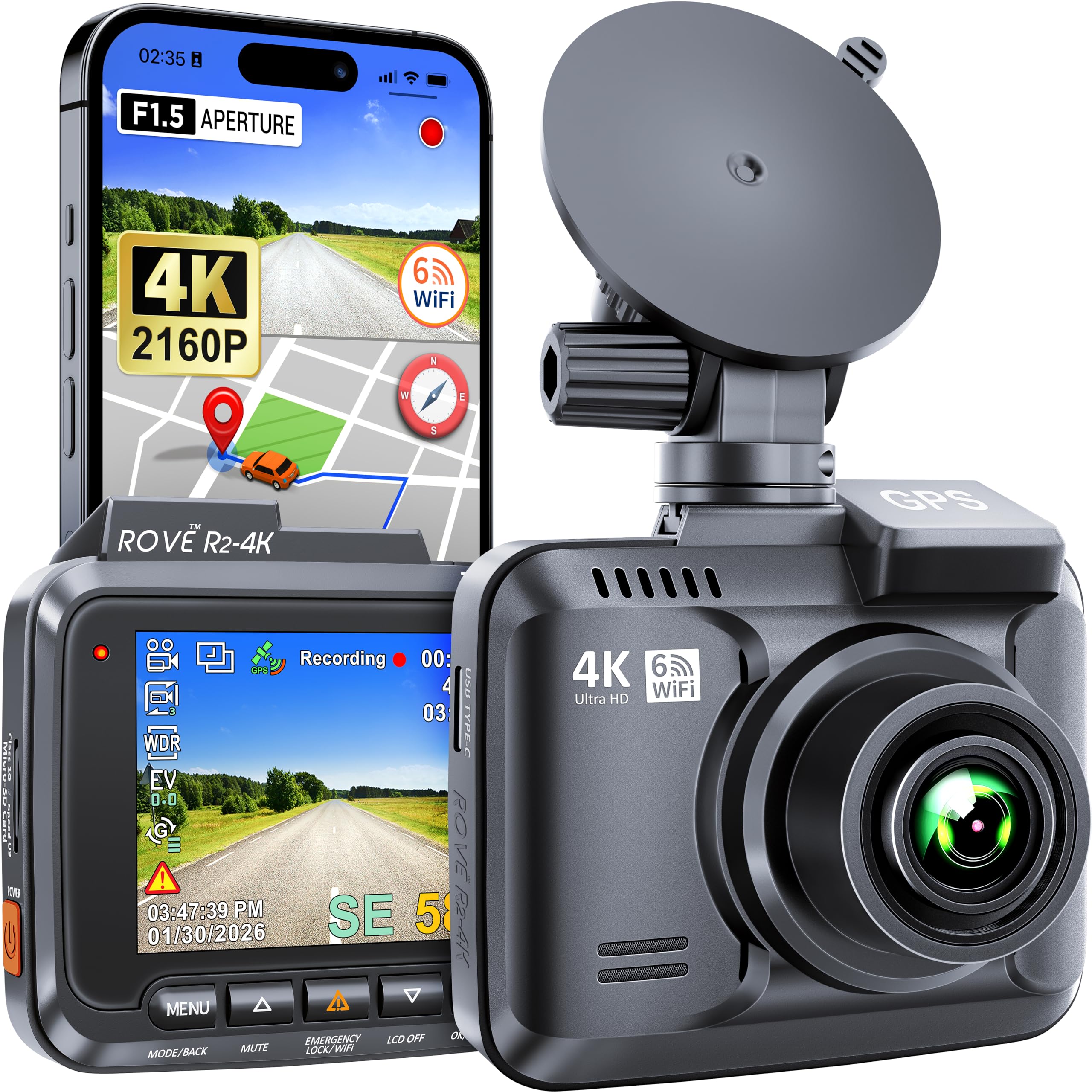
The proven 4K favorite with an 8MP SONY sensor, WiFi 6, and a 512GB ceiling.
The ROVE R2-4K is a heavyweight in reputation, backed by tens of thousands of owners who praise its crisp 4K footage and easy setup. At its core sits an 8MP SONY IMX415 sensor paired with a 6-glass F1.5 aperture lens — the largest aperture in its class — which delivers superb night vision and readable plates after dark. The 2.4″ screen lets you review footage on the spot, while built-in WiFi 6 downloads 4K clips to your phone at up to 6MB/s.
Integrated GPS stamps your route and speed onto every recording, viewable on Google Maps through the app or GPS Player, which is excellent for insurance claims. It records in 4K UHD 2160P, supports cards up to an impressive 512GB, and comes with parking mode, motion detection, loop recording, and emergency video lock. The supercapacitor replaces a battery for better heat resistance, and the 1-year warranty comes from a Chicago-based team that owners say responds fast.
The memory card is not included, and buyers strongly recommend a Class 10 / U3 card to avoid annoying “card too slow” warnings. Some customers note the mount shakes slightly at highway speed and note the mini-USB cable (10ft with a 90° bend) feels dated. It still holds a 4.3-star average across a massive owner base, which is about as proven as a dash cam gets.
Why it leads
- 8MP SONY IMX415 sensor for sharp night footage
- Built-in GPS with route playback on Google Maps
- Supports up to 512GB microSD
What to manage
- No memory card included — buy a U3 card
- Mount can shake slightly at speed
- Older mini-USB power cable design
Pick this if: you want a battle-tested 4K camera with GPS and the widest storage ceiling for long road trips.
Know going in: factor in the cost of a quality 128GB or larger U3 card, since it does not ship with one.
8. VIOFO A119M Pro Dash Cam
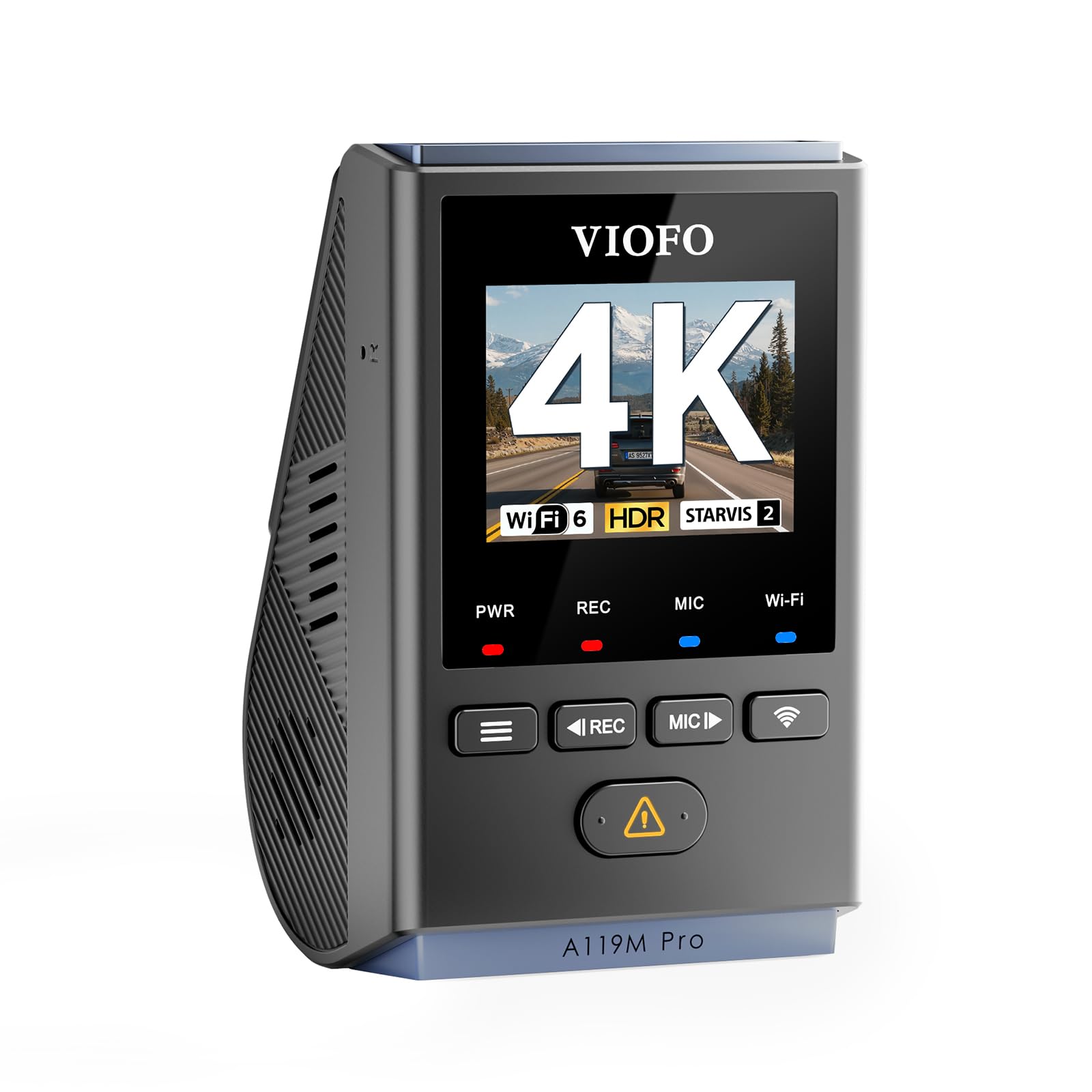
A premium 4K mini cam with a STARVIS 2 sensor and buffered parking that catches 15 seconds before impact.
The VIOFO A119M Pro is the spec-sheet king here, built around the STARVIS 2 IMX678 sensor, a Sony-class chip that keeps 4K 30FPS footage clean with minimal noise and motion blur even at speed. Owners consistently report outstanding picture quality — the single most-praised aspect across their feedback — and many say it captured accident details perfectly. The included CPL (Circular Polarizing Lens) filter cuts windshield glare from sunlight and headlights, which sharpens both day and night recordings.
Next-gen WiFi 6 moves footage at up to 30MB/s through the VIOFO App, and the built-in Quad-Mode GPS (GPS, BeiDou, Galileo, GLONASS) stamps precise location, speed, and time data. The buffered parking mode records 15 seconds before and 30 seconds after an event, so you get the lead-up to a hit-and-run, not just the aftermath. A supercapacitor handles temperatures from 5℉ to 149℉, and multis-lingual voice control lets you lock clips hands-free.
This model records in 4K with a 130° field of view, which is narrower than the 160° lenses on cheaper rivals — you trade some peripheral coverage for sharper, more focused detail. The microSD card and hardwire kit are both sold separately, and owners warn that third-party cards can fail in heat; VIOFO recommends its own industrial-grade cards. Setup is a touch more involved (some turn to YouTube tutorials), but the build quality and after-sales support make it a favorite among serious owners.
Premium payoffs
- STARVIS 2 IMX678 sensor — top-tier night clarity
- Buffered parking captures 15s before an event
- WiFi 6 transfers at up to 30MB/s
Premium caveats
- Narrower 130° field of view than rivals
- Card and hardwire kit sold separately
- Setup can require online tutorials
Worth the jump if: you demand the best night footage and want buffered parking evidence that shows what happened before a bump.
Look elsewhere if: you want maximum lane coverage on a budget — the narrower 130° lens limits the periphery.
Understanding the Specs
Resolution and sensor quality
Resolution tells you how much detail a camera captures — 4K (2160P) captures more detail than 1080P. The sensor matters just as much: a larger, newer sensor like the SONY IMX415 or STARVIS 2 IMX678 pulls in more light and keeps footage clean in the dark. For reading plates, a 4K camera with a good sensor is the gold standard.
Aperture, field of view, and night vision
The aperture (F1.5 vs F1.8) controls how much light hits the lens — a lower number like F1.5 captures brighter night footage. Field of view (measured in degrees) sets how much of the road you see; 140° to 170° is the balance for covering multiple lanes. WDR balances bright headlights against dark shadows, which is essential for night driving.
Power: supercapacitor vs battery
Supercapacitors store energy differently than lithium batteries and handle extreme heat far better, which is why they are becoming standard in dash cams. They also handle more charge cycles, so they last longer in daily use. If you park in the sun, a supercapacitor model is the safer, longer-lasting choice.
Parking mode and the G-sensor
Parking mode keeps the camera watching while your car is off, often in time-lapse to save power. The G-sensor (a small motion detector) feels impacts and locks that footage so loop recording cannot overwrite it. Most cameras need a hardwire kit (sold separately) to run parking mode without draining your car battery.
FAQ
Is a 4K dash cam worth it over a 1080P model?
Will a front dash cam drain my car battery?
What does the G-sensor do in a dash cam?
Do I need a memory card or does the dash cam come with one?
What is parking mode and do I need a hardwire kit?
Is a supercapacitor better than a lithium battery in a dash cam?
Will a dash cam interfere with my wireless Apple CarPlay?
How wide should the field of view be on a front dash cam?
Can I use a dash cam in a truck or large vehicle?
How do I download footage from a dash cam to my phone?
Final Thoughts: The Verdict
For most people, the best front facing car camera winner is the Galphi 4K Dash Cam because it delivers crisp 4K evidence, an included 32GB card, and fast 5GHz WiFi at a price that undercuts the competition. If you want a built-in screen for on-camera playback, the Avylet 2K with its heat-proof supercapacitor is the smarter pick. And for premium night performance and buffered parking evidence, the VIOFO A119M Pro with its STARVIS 2 sensor is the one to reach for.
How We Picked
We do not accept paid placement. Every pick is matched to a real buyer and a real use-case; we do not hands-on test units.
Sources & Methodology
Specifications: manufacturer listings and product documentation. Review insights: verified customer reviews, as of August 2026. Pricing: not shown on this page (it changes often); check the current price via the retailer link.
As an Amazon Associate, Trending Car earns from qualifying purchases. This does not affect which products we feature.