
Our readers keep the lights on and my garage snacks stocked. As an Amazon Associate, I earn from qualifying purchases.
Specs are compiled from manufacturer listings and verified buyer reviews and can change over time — please confirm the key details on the product page before buying.
If you live where winter means single-digit nights, a garage heater is not a luxury—it is the difference between a frozen pipe repair and a productive weekend. The challenge is finding one that can actually keep up when the mercury drops below zero without tripping your breaker or emptying your wallet on fuel. The best garage heater for cold climates balances raw heat output (in British thermal units, the standard measure of heating power) with the right fuel source for your space, your electrical panel, and your comfort with professional installation.
I’m Min Islam — the founder and writer behind Trending Car. This guide is built by comparing the manufacturers’ published specifications and the patterns across verified customer reviews, so you get each pick’s real strengths and trade-offs instead of marketing spin.
Whether you are outfitting a workshop for year-round projects or just keeping the chill off your tools, this roundup shows where each model excels and where the trade-offs really are in the search for the right garage heater for cold climates.
Our Picks at a Glance

How To Choose The Best Garage Heater for Cold Climates
Picking a heater for a freezing garage is not the same as picking one for a mild climate. The key factors are the raw heat output, the fuel type (electric vs. propane vs. natural gas), and whether the unit can run reliably in poorly insulated or drafty spaces. Below are the three things to nail down before you buy.
BTUs and Square Footage
The British thermal unit (BTU) rating tells you how much heat a unit can push out. A rule of thumb for cold climates is roughly 30 to 40 BTUs per square foot if the garage is insulated, and closer to 60 to 80 if it is not. A 7500-watt electric heater puts out about 25,590 BTUs—enough for a well-insulated typical two-car garage. A propane or kerosene model hitting 125,000 BTUs can cover over 3,000 square feet, but it needs ventilation and bigger fuel tanks.
Fuel Type: Electric vs. Gas vs. Propane
Electric units (hardwired or plug-in) are clean and quiet and need zero venting, but they pull huge amperage—many require a dedicated 30-amp or 60-amp 240-volt circuit that not every garage has. Propane forced-air heaters heat a space in minutes but produce carbon monoxide, so they require open doors or windows for ventilation. Natural gas units like the Modine Hot Dawg deliver lower operating costs long-term, but installation demands a gas line and professional venting, which pushes upfront costs higher.
Safety Features and Build Quality
Every unit on this list includes some form of overheat protection or flameout shutoff. For gas and propane models, a tip-over switch is critical. For electric units, look for a thermal cut-off and a sturdy steel housing rated for damp garage conditions. Look for a steel housing rated for damp conditions and overheat protection to survive freeze-thaw cycles without cracking.
Quick Comparison
| Model | Best For | Heat Output | Heating Coverage | Fuel Type | Amazon |
|---|---|---|---|---|---|
| InoKraft 7,500W★ Best Overall | Best Overall | 7,500 watts | 500 sq ft | Electric | Amazon |
| Flame King 60,000 BTUFastest Heat | Fast Portable Heat | 60,000 BTU | 1,500 sq ft | Propane | Amazon |
| TEMPWARE 7,500WBest Coverage | Best Coverage | 25,590 BTU | 1,250 sq ft | Electric | Amazon |
| Riseon 7,500W | Budget-Minded | 7,500 watts | 1,250 sq ft | Electric | Amazon |
| VEVOR 125,000 BTU | Large Spaces | 125,000 BTU | 3,100 sq ft | Propane | Amazon |
| Mr. Heater 125,000 BTU | Remote Job Sites | 125,000 BTU | 3,125 sq ft | Propane | Amazon |
In‑Depth Reviews
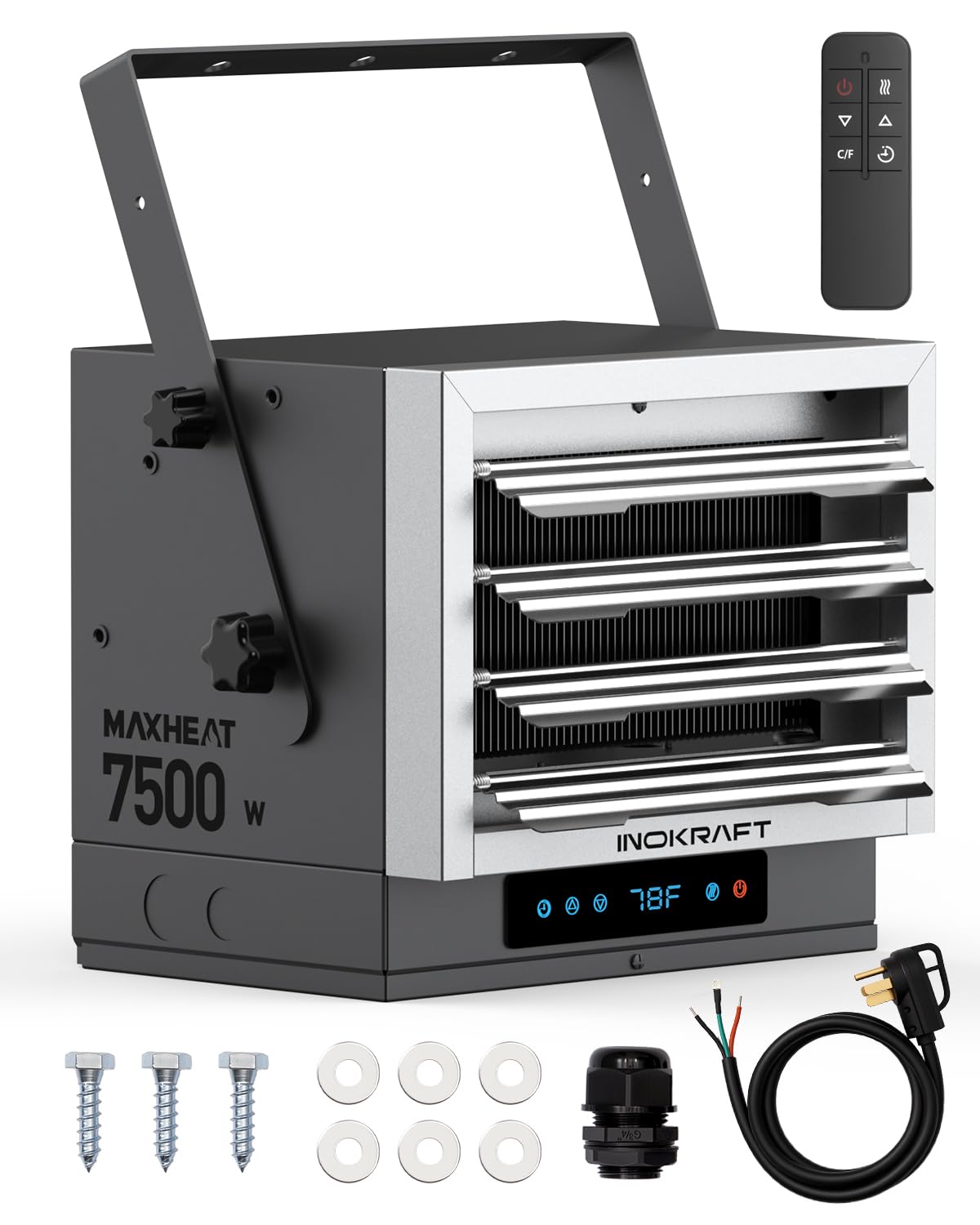
1. InoKraft 7,500W Electric Garage Heater
Our pick — over 4.5★ from 250+ verified ratings; the strongest balance of quality and price.
This quiet unit pulls a cold garage to a warm shirt-sleeve zone without drama.
This 7,500-watt unit, which produces about 25,590 BTUs, is equipped with a NEMA 14-50P plug and an 8 AWG cord so you do not have to guess about wiring quality. Owners note it raised a 950 sq ft insulated garage from 39°F to 65°F in two hours while outside temperatures sat at 10°F. The built-in digital thermostat lets you dial from 40°F to 99°F and set a 24-hour timer, so the heater runs only when you are actually out there.
The fan noise sits at 65 dB—quieter than most portable units and barely noticeable over shop tools. Reviewers consistently praise the remote control as responsive and the ECO mode as a genuine energy saver, automatically dialing back heat when the space is warm enough. The installation requires a professional electrician for the 240-volt circuit, but once mounted on the wall or ceiling, it frees up every square foot of floor space.
InoKraft 7,500W efficiency
- Effective in well over 50 owner stories, making it a crowd favorite.
- Heats a 500 sq ft space comfortably and maintains 60°F without running constantly.
- The remote control works from across the garage, which owners describe as surprisingly reliable.
Noisy at high fan
- The built-in thermostat sits close to the heat source, so the temperature reading can run about 10°F high at first.
- It still needs a proper 240-volt circuit and a 31.25-amp breaker—not a plug-and-play device for most garages.
Best for small garages: The owner of a medium to large garage (500 sq ft) who wants quiet, hands-off electric heat with precise temperature control.
Skip if noise sensitive: Your garage lacks a dedicated 240-volt circuit—this requires professional electrical work to run safely.
2. Flame King 60,000 BTU Portable Propane Forced Air Heater
This propane cannon turns a freezing garage into a warm workspace in under 15 minutes.
This unit kicks out 60,000 BTUs from a standard 20-pound propane tank. Buyers report it heats a 24×24 garage by 20°F to 30°F in 15 minutes. The forced-air design uses a 120-volt wall plug and a piezo ignition system, so setup is genuinely fast. It is CSA certified for safety, meaning it passed independent testing for gas-fired heaters, and includes a safety fuel shutoff, a fire detection system, and a tilt shutoff.
The 60,000 BTU output is higher than the 25,590 BTU output of a typical 7,500-watt electric unit like the InoKraft. That speed comes with two caveats: the heater needs adequate ventilation (it is rated for outdoor or well-ventilated use only), and the piezo ignitor can sometimes be finicky, needing a couple of attempts to catch. One buyer described the noise as moderate—loud enough to know it is running but not deafening.
Flame King portable power
- Provides blast-level heat in minutes—buyers frequently mention 15-minute warm-ups.
- Very compact unit at 17.5″ x 9″ x 14″, so it stows easily.
- The included hose and regulator mean you do not need to buy extra parts to start.
Propane tank extra
- Only runs about 8 hours on a single 20-pound propane tank at full output, which adds fuel cost over time.
- Must be used in an open space with airflow—never in a sealed garage with the door closed.
Grab this for portability: Quick, portable warmth in a well-ventilated garage or jobsite where you do not want to deal with permanent wiring.
Skip if indoor only: You need a long-running, hands-off solution—or you cannot keep a garage door or window cracked for ventilation.
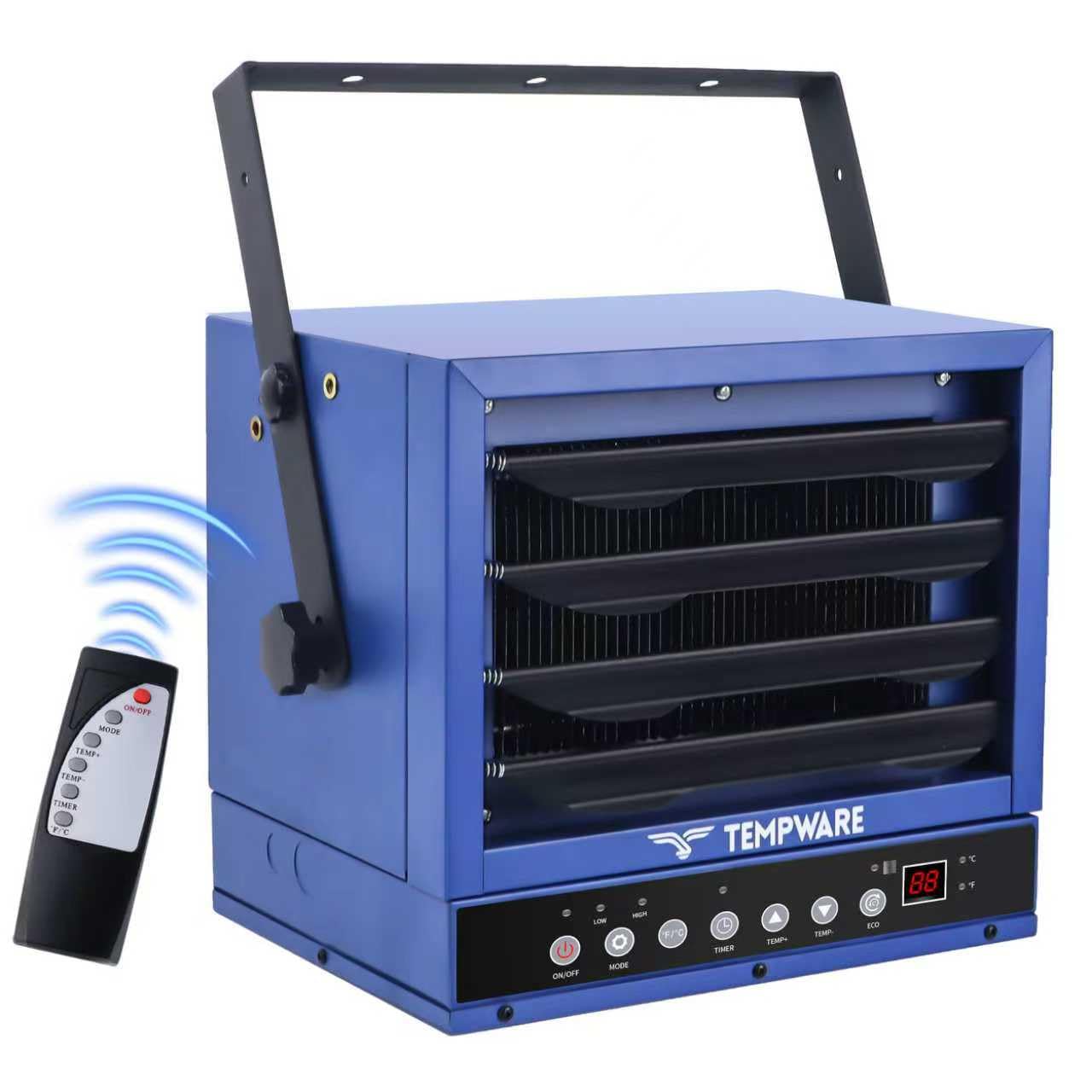
3. TEMPWARE 240V Hardwired Electric Garage Heater 7500W
This electric unit covers 1,250 sq ft, compared to the InoKraft’s 500 sq ft.
This hardwired 240-volt unit delivers 25,590 BTUs from a compact enclosure (10.6″ x 14″ x 12.6″). That is 1,250 sq ft compared to the InoKraft’s 500 sq ft. A buyer reported keeping a three-car garage at 45°F during a polar vortex, so the output is credible even when real cold hits. The digital thermostat adjusts between 45°F and 95°F, and the 12-hour timer gives you a low-maintenance cutoff.
The unit is ETL certified, meaning it met safety standards from a recognized national testing lab, and it comes with a remote control (batteries required separately, as the manufacturer notes). The louvers are adjustable, so you can aim the heated air exactly where you need it. The trade-off is that it is hardwired only—no power cord included—and you will need an electrician to connect it to a properly sized circuit breaker.
TEMPWARE hardwired reliability
- Covers a very large area for an electric unit—rated for spaces up to 1,250 sq ft.
- Owners frequently mention it keeps a three-car garage comfortable even in extreme cold.
- Very compact for its output, saving overhead space in low-ceiling garages.
Requires 240V outlet
- No power cord included, so installation is more involved than plug-in models.
- A few owners noted the noise level is mixed—some find it fairly quiet, others report rattling.
Reach for this if wired: You have a very large shop or three-car garage and want clean, electric heat without dealing with propane tanks.
Look elsewhere if no 240V: You are not ready for a hardwired installation—this needs an electrician and a dedicated 240-volt circuit.
4. 7500W Electric Garage Heater with Remote (Riseon / CZ231ER)
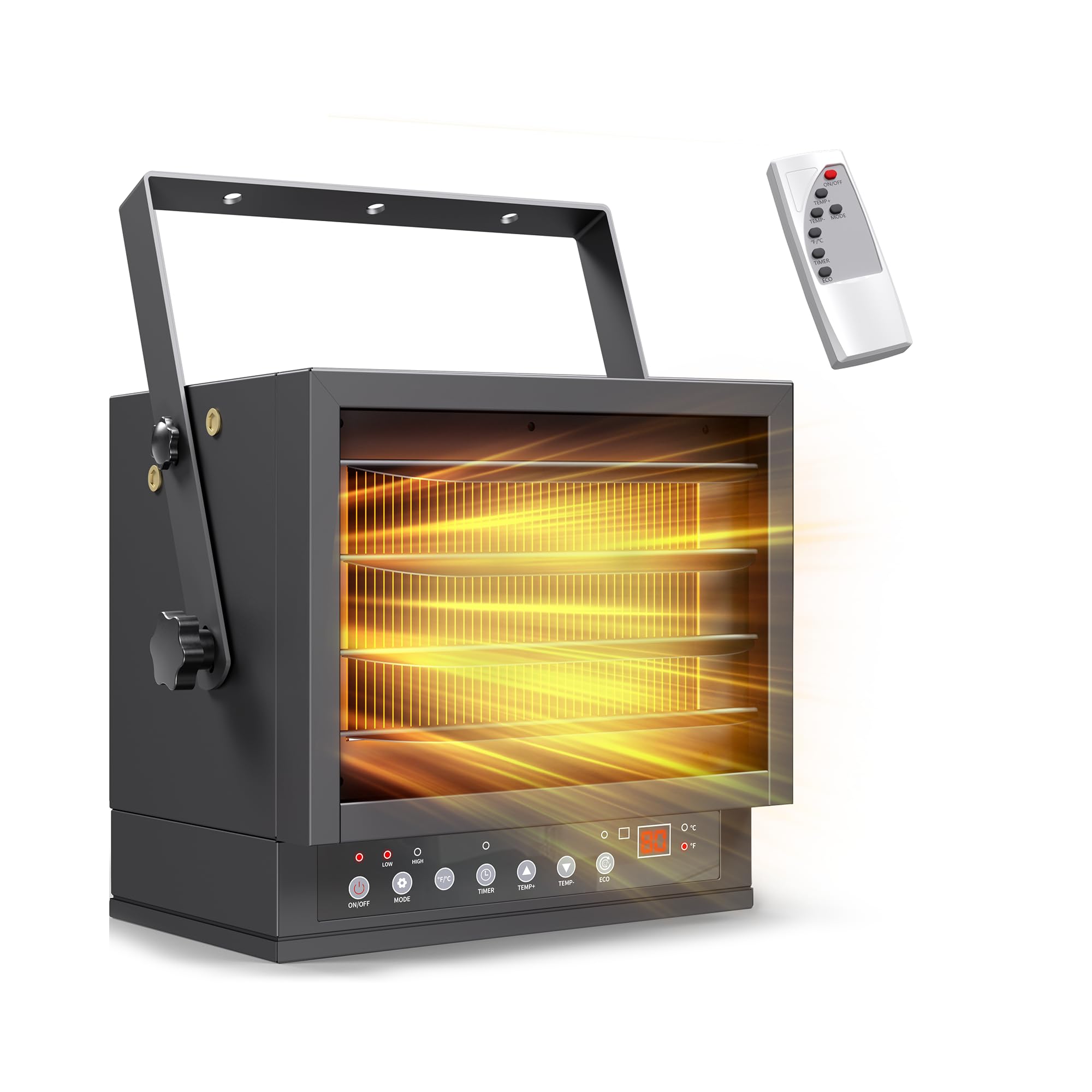
An entry-level electric heater that delivers 25,590 BTUs to a 1,250 sq ft space for a lower outlay.
This Riseon unit (model CZ231ER) delivers the same heating coverage as the TEMPWARE at a lower entry price. It offers three power settings—7500W, 6250W, and a fan-only mode—plus ECO mode that adjusts heat based on ambient temperature. The remote control and LED touch panel make it easy to adjust from across the garage. The built-in thermostat lets you set a target between 45°F and 95°F, and the overheat protection adds genuine confidence.
Owners call it a solid performer for the money, with one review noting it heats a 1,500 sq ft shop well enough to rarely need the space’s mini-split units. Another buyer in New England said it takes the chill out of a two-car garage, though it takes a couple of hours to feel worthwhile. The unit is ETL certified, and the adjustable louvers give you four directions to aim the airflow.
Riseon remote control ease
- Decent value for money—owners consistently mention the price-to-performance ratio.
- The fan-only mode is a nice extra for summer air circulation.
- Heats a 2-car garage noticeably, according to multiple New England owners.
Remote range limited
- No power cord included (hardwired only), so installation is a professional job.
- A few units arrived with a defective thermostat or fan speed control—quality control seems uneven.
Best for remote users: The budget-conscious buyer who still wants 240-volt electric heat and can handle a professional installation.
Skip if close access: You cannot afford to deal with a potential early defect and prefer a more established brand with better support.
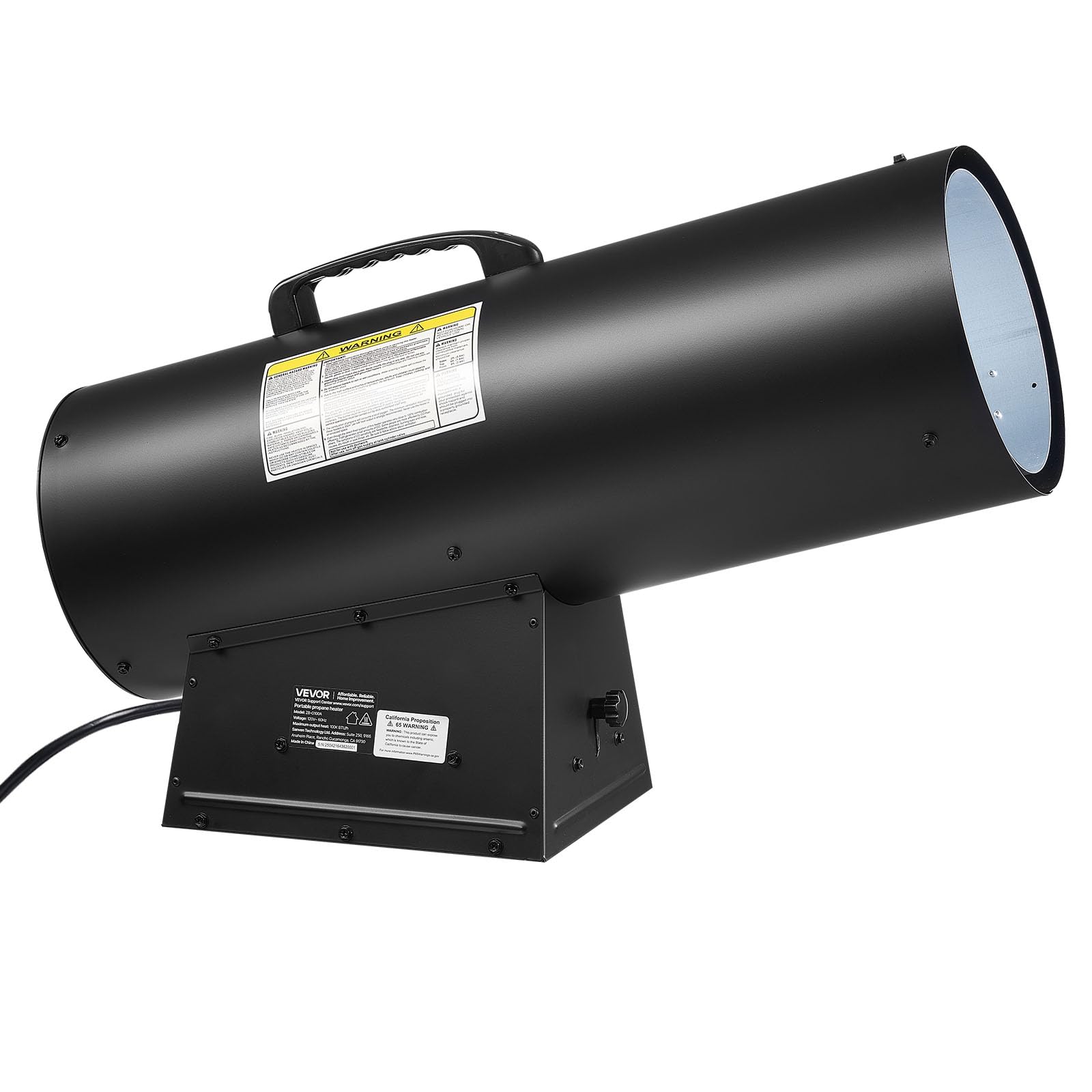
5. VEVOR Propane Heater, 125,000 BTU Forced Air
A propane workhorse that covers a massive 3,100 sq ft area, stepping beyond what typical electric units can handle.
This VEVOR unit steps way past the electric units, delivering 125,000 BTUs to cover up to 3,100 sq ft. It has a stepless temperature setting and an adjustable heating angle (30° to 45°). The carbon steel body is built to be impact-resistant and rust-resistant, making it suitable for construction sites or barns. It works with a standard 20-pound propane tank and runs for 3.5 to 4.5 hours at full blast.
Owners mention it puts out a tremendous amount of heat. One reviewer noted it is too powerful for a 3,000 sq ft shop and would be ideal for a 4,000–5,000 sq ft space. The electronic ignition is simple, and a built-in handle makes it portable at 19.7 pounds. It also includes overheat protection and a flameout safety system, plus a pressure regulator compatible with high-altitude use up to 4,921 feet.
VEVOR high BTU output
- Massive heat output for very large spaces—rated for 3,100 sq ft.
- Because it is portable, you can move it between a garage, jobsite, or barn.
- Adjustable angle and temperature settings give you real control over the heat direction.
Loud forced air
- Very fuel-hungry—runs only 3.5–4.5 hours on a 20-pound tank, so operating costs add up fast.
- Quality is so-so, according to some owners, with reports of units not working from the start.
Grab this for large spaces: A very large warehouse, barn, or shop where you need rapid, raw heat and have ventilation.
Skip if quiet needed: You want a heater to run all day—the fuel consumption and tank swaps make it expensive for long sessions.
6. Mr. Heater 125,000 BTU Forced Air Propane Heater
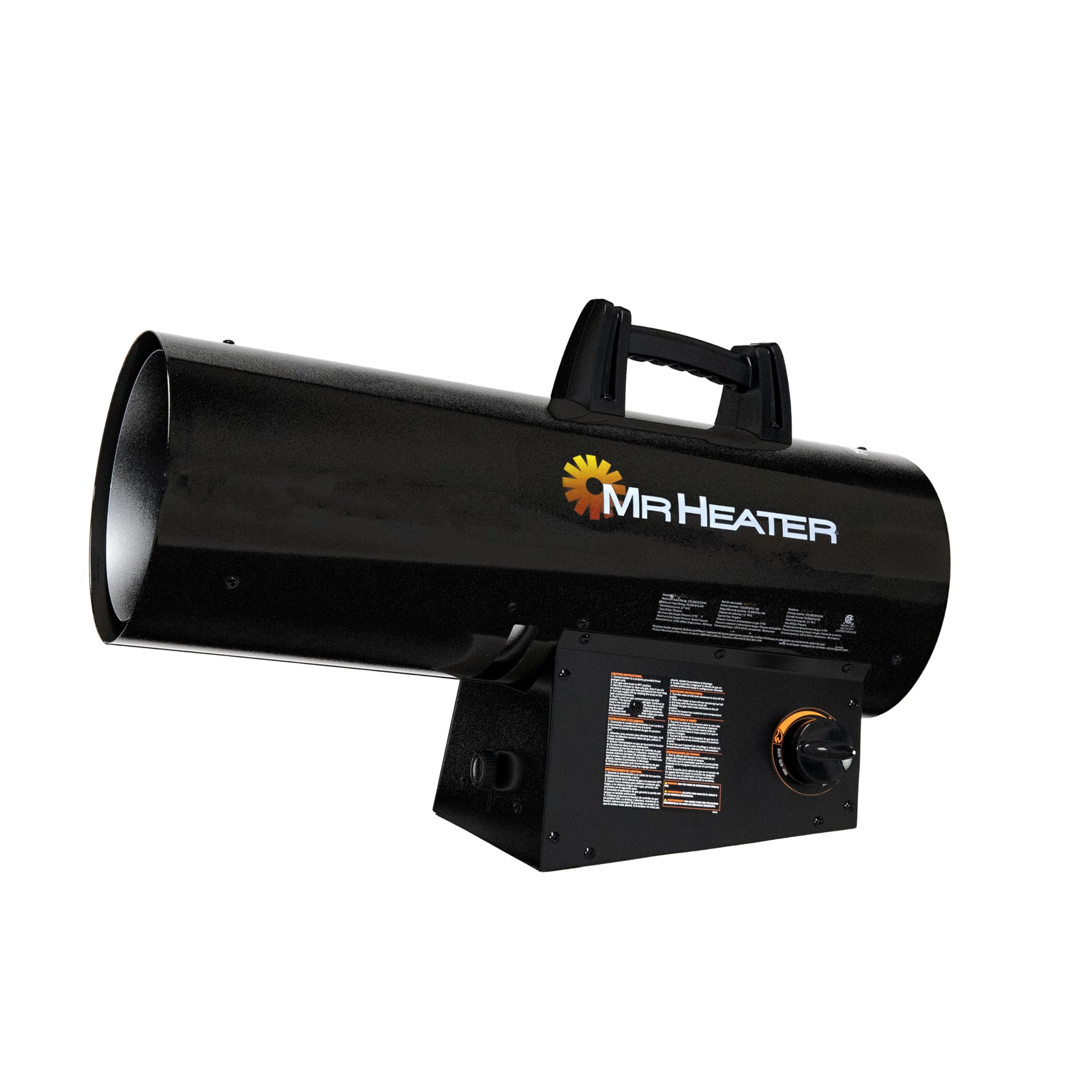
A well-known brand that delivers 125,000 BTUs and covers 3,125 sq ft with a reputation for reliability.
Mr. Heater has a long history in the portable heating market, and this model (MHC125FAV) delivers 125,000 BTUs to cover up to 3,125 sq ft. It features quiet burner technology, which owners consistently describe as less obtrusive than other forced-air propane units. The included 10-foot hose and regulator mean you can connect it to a standard propane tank immediately.
The good news: customers note it heats very well and the heat output is easily regulated from high to low. The practical insight from owners is that this heater works best with a 40-pound propane tank or larger. The reason is that the 125,000 BTU draw cools a 20-pound tank too quickly, causing the tank to freeze up and starve the flame. One buyer put it simply: “20# tanks freeze up.”
Mr. Heater trusted brand
- High-quality build from a trusted brand—owners say it works as advertised and lasts.
- Quiet operation for a propane forced-air unit, with a few buyers calling it surprisingly unobtrusive.
- The easy-to-use heat control knob lets you dial from high to low without any complex settings.
Propane consumption high
- Needs at least a 40-pound propane tank to avoid freeze-up during extended use—a common point in reviews.
- As with all unvented propane heaters, you must keep a door or window cracked for fresh air.
Best for reliability: Remote job sites, barns, or large workshops where you have access to larger propane tanks and need reliable heat fast.
Think twice if fuel cost: You only have 20-pound tanks and plan to run the heater for hours—the tank freeze-up issue is a real limitation.
7. Remington 140,000 BTU Kerosene/Diesel Heater
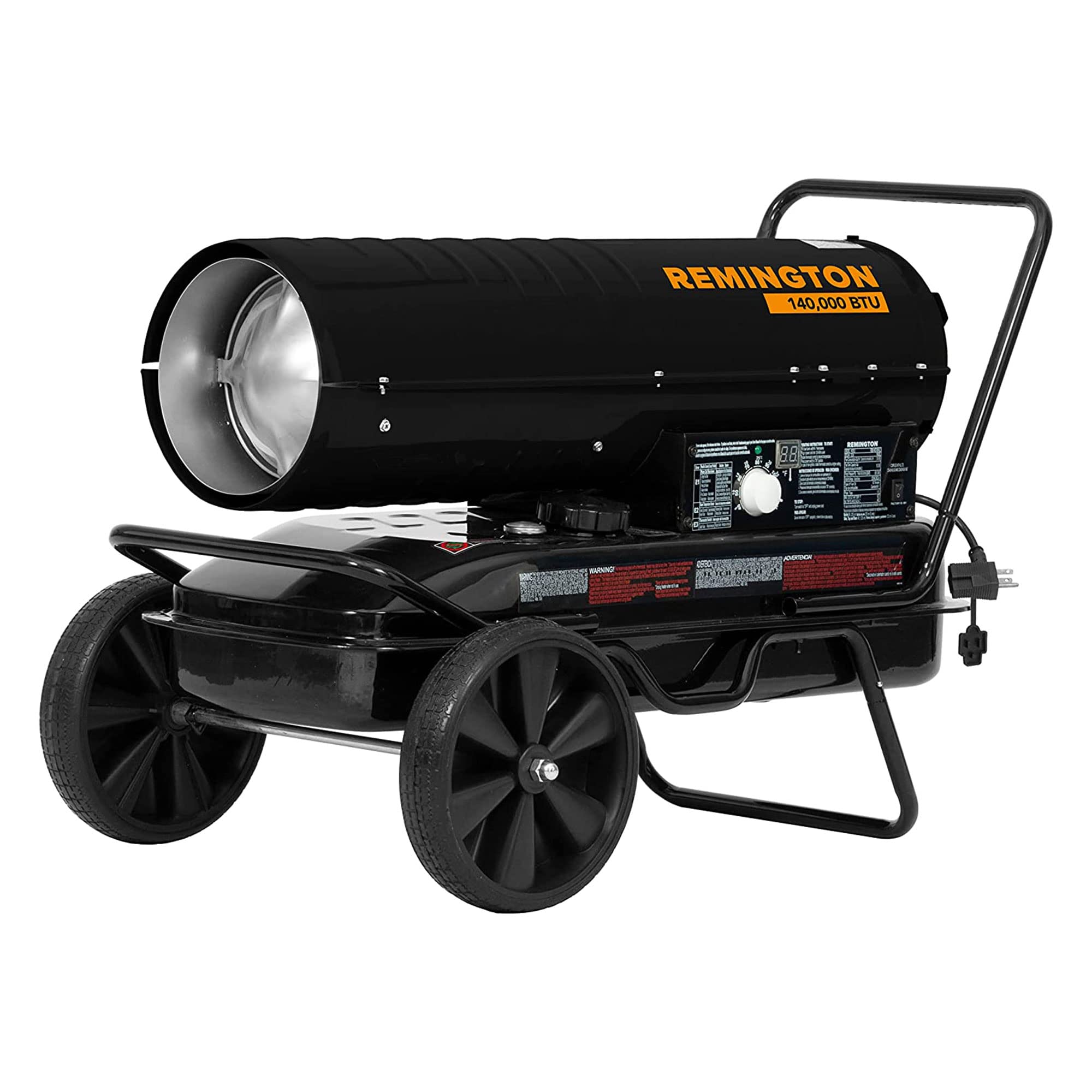
This fuel-flexible beast runs on kerosene, diesel, or Jet A fuel and heats 3,500 sq ft for 10 hours.
This Remington delivers 140,000 BTUs, the highest output on this list, and covers up to 3,500 sq ft on a full tank. It is rated for K-1 kerosene, #1 and #2 diesel fuel, JP8/Jet A fuel, and #1 and #2 fuel oil—so you can use whatever fuel is available in your area. The built-in 5-point safety system includes a high-temperature limit shutoff, flameout protection, a circuit breaker, and a heat sensor.
Reviewers point out it heats a garage from freezing to comfortable in about 10 minutes. The thermostat, air pressure gauge, and fuel gauge are all built in, so you can monitor the heater’s status at a glance. The steel construction and easy-lift handles make it rugged enough for construction sites. The biggest limitation is the fuel itself: kerosene and diesel heaters need proper ventilation and produce a distinct smell during startup and shutdown.
Remington dual fuel flexibility
- Runs ten hours on a full tank—the best continuous runtime among the high-BTU models here.
- Fuel flexibility is a real advantage when kerosene is hard to find but diesel is plentiful.
- The 5-point safety system covers all the major failure modes.
Kerosene smell
- The thermostat is a little iffy, as one owner put it, not perfectly precise for a set-and-forget experience.
- Must be used in a well-ventilated area—kerosene heaters produce carbon monoxide as a byproduct.
Reach for this if multi-fuel: You have a very large space (3,500 sq ft) and need a heater that can run all day on affordable fuel like diesel.
Look elsewhere if odor sensiti: You cannot provide good ventilation or you want a clean, odor-free heating experience.
8. Qmark MUH35 Self-Contained Unit Heater

A no-frills 5,000-watt electric unit from a commercial brand, built for factories and schools.
The Qmark MUH35 is a commercial-grade unit heater from Marley, running on 240 volts and pulling 20.83 amps. It includes a built-in thermostat and a wall/ceiling mounting bracket, plus adjustable discharge louvers to direct airflow where you want it. The wattage is field-adjustable, meaning you can tune the unit to match the actual size of your garage rather than running at full power all the time.
Owners say it works great for replacing aging heaters and is generally an awesome product for the money, despite a relatively high sticker price. The unit is listed as gray but a buyer noted it arrived in brown, which they actually preferred. It is hardwired, and one owner specifically mentioned the cord is not included and not mentioned in the description, so you will need to budget for that extra part and an electrician.
Qmark compact unit heater
- Field-adjustable wattage is a pro-level feature for matching output to space.
- The included mounting bracket and louvers make installation straightforward for a pro.
- Commercial brand with a long history in school and factory settings.
Low airflow coverage
- No power cord included—a surprise that adds to the overall cost.
- A few owners reported fan motor issues after 4–6 months, though customer service sent replacement parts without hesitation.
Best for tight spaces: The buyer who prefers a simple, repairable commercial-grade electric heater and already has an electrician lined up.
Skip if large area: You want a plug-and-play unit with a cord and a straightforward warranty process.
9. Dyna-Glo Dual Power 15,000W Electric Garage Heater

An electric heater that punches above its class with up to 51,180 BTUs and dual power settings.
This Dyna-Glo is the most powerful plug-in electric model here, offering a choice between 11,300 watts (38,556 BTUs) and 15,000 watts (51,180 BTUs). That second figure is 51,180 BTUs, compared to the approximately 25,590 BTUs of most 7,500-watt units, making it a genuine option for uninsulated garages. A buyer in New Hampshire reported it brought an uninsulated 36×26 ft room from 30°F to 65°F in 30 minutes using a 70-amp breaker.
It sits on a pedestal rather than mounting to the wall, so you can move it around your garage or shop. The digital remote control and 24 heat settings (50°F–95°F) give you fine-grained control. The fan-only mode is handy for summer air circulation. The catch is the electrical demand: 62.5 amps at full output requires a 70-amp breaker and 4 AWG cable, which is a heavy electrical upgrade for most homes.
Dyna-Glo dual power versatility
- Delivers 51,180 BTUs compared to the 25,590 BTUs of a standard 7,500W electric unit.
- Heats a large, uninsulated shop rapidly—owners call it a beast.
- The remote control and digital thermostat are very convenient.
Heavy unit
- Requires a 70-amp breaker and heavy-gauge wiring—a significant electrical project.
- The temperature probe sits near the heater, so the reading can run high; you may need to set it hotter than you expect.
Grab this for dual voltage: A large, uninsulated garage or shop where you need serious electric heat that a standard 7,500W unit cannot provide.
Skip if lightweight needed: Your electrical panel cannot handle a 70-amp upgrade, or you only have a 30-amp circuit available.
10. KING GH2405TB Electric Garage Heater
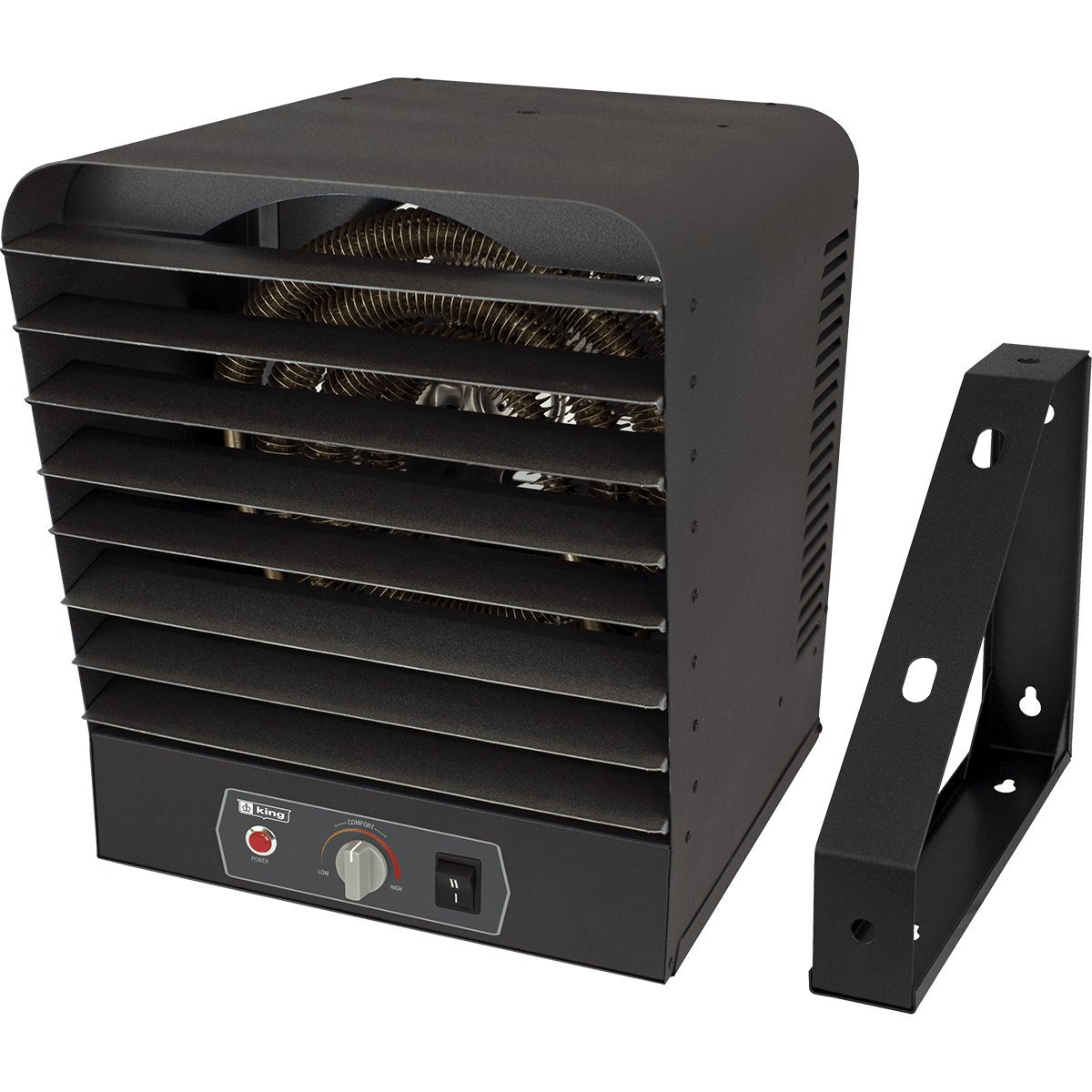
A compact 5,000-watt wall heater from a respected brand that fits small garages and heats them fast.
This KING model (GH2405TB) runs on 240 volts at 20.8 amps and is designed for wall mounting. It is rated for a modest coverage area, but reviewers consistently say it punches above its spec. One owner with a 20×28 garage said the heater gets the temperature past 60°F in under an hour, even when it is 0°F outside and the wind is howling. The built-in thermostat and adjustable louvers give you control over heat direction.
The unit includes a patented Smart Limit protection system and an over-temp indicator light. The high-mass steel fin heat exchanger is built to last. The trade-off is that quality control is mixed: some units arrive with a faulty indicator light or thermostat, though multiple shoppers say King Electric’s customer service is excellent and sends replacement parts quickly. For a single-car or small insulated garage, it is a well-engineered option.
KING GH2405TB quiet operation
- Fast heat-up—buyers report reaching 60°F from freezing in under an hour.
- Compact and wall-mounted, so it does not waste floor space.
- King Electric’s support team is responsive, often overnighting missing parts.
Lower power output
- Quality control is not perfect—a small number of units have defective indicators or thermostats.
- The listed coverage seems very low (15 ²), which is likely a data error; real owners use it in 20×28 garages successfully.
Best for silent heating: A small, insulated garage where you want a reliable electric heater from a brand with good customer service.
Think twice if high heat: Your garage is over 500 sq ft or poorly insulated—this 5,000W unit will struggle to keep up.
11. Modine HD45AS0111 Hot Dawg Garage Heater 45,000 BTU

A permanently installed natural gas heater that delivers quiet, even warmth with 80-percent efficiency—the gold standard for severe cold.
The Modine Hot Dawg is a 45,000 BTU natural gas unit with 80-percent thermal efficiency, meaning 80% of the fuel’s energy converts to heat you can feel. It is certified for residential, commercial, and industrial use, and owners mention it raises a three-car garage from the 30s to the 60s in 15–20 minutes. At -15°F outside, owners say it keeps a detached garage above freezing without any issues.
The unit operates very quietly—owners consistently call it silent or nearly silent compared to forced-air propane units. Installation is a serious project: it needs a gas line, a 120-volt electrical connection, and a vent pipe through the wall or roof. But once installed, the fuel cost is typically lower than electric or propane, and the heater does not produce any open flame inside the garage. The manufacturer’s 150 ratings show overwhelmingly positive feedback, and the crowd favorite among owners is its consistent, reliable performance in deep cold.
Modine Hot Dawg durability
- class-leading performance in extreme cold—owners praise its ability to keep garages warm when it is -15°F outside.
- Very quiet operation, with dozens of owners describing it as the quietest heater they have owned.
- Economical to run on natural gas, costing less per BTU than electric or propane alternatives.
Installation complex
- Professional installation is expensive and involved—you need a gas line, electrical hookup, and proper venting.
- The grey-green cabinet color is not exactly attractive; one owner plans to powder-coat it white.
Reach for this if permanent: You have natural gas available and want the most cost-effective, durable, and quiet heater for permanent installation in a cold climate.
Look elsewhere if DIY: You are renting, do not have a natural gas line, or want a portable solution you can move.
FAQ
Can I run a 7500-watt electric garage heater on a standard 120-volt outlet?
Final Thoughts: The Verdict
Across the board, the garage heater for cold climates winner is the InoKraft 7,500W because it combines genuine real-world performance (raising a garage from 39°F to 65°F in two hours) with a complete package that includes a high-quality cord, remote control, and quiet operation. If you need faster heat or have no 240-volt circuit, grab the Flame King 60,000 BTU propane heater for its blast-speed warmth in any location. And for a permanent, set-and-forget solution that handles the harshest winters, the Modine Hot Dawg 45,000 BTU natural gas heater is the one to reach for — it costs more upfront but delivers the lowest operating cost and the best sub-zero reliability of the group.
How We Picked
We do not accept paid placement. Every pick is matched to a real buyer and a real use-case; we do not hands-on test units.
Sources & Methodology
Specifications: manufacturer listings and product documentation. Review insights: verified customer reviews, as of July 2026. Pricing: not shown on this page (it changes often); check the current price via the retailer link.
As an Amazon Associate, Trending Car earns from qualifying purchases. This does not affect which products we feature.