
Our readers keep the lights on and my garage snacks stocked. As an Amazon Associate, I earn from qualifying purchases.
Specs are compiled from manufacturer listings and verified buyer reviews and can change over time — please confirm the key details on the product page before buying.
A dent in your car door or hood is frustrating, but a body shop quote can be even worse. The real solution is the right tool that pushes or pulls the metal back without damaging your paint. This guide cuts through the confusion to highlight kits that work for occasional garage use or heavy hail damage.
I’m Min Islam — the founder and writer behind Trending Car. This guide is built by comparing the manufacturers’ published specifications and the patterns across verified customer reviews, so you get each pick’s real strengths and trade-offs instead of marketing spin.
Whether you are dealing with a shallow door ding or a deeper crease, finding the right paintless dent removal kit depends on understanding three things: the dent type, the tool approach, and the quality of the components you are buying.
Our Picks at a Glance


How To Choose The Best Paintless Dent Removal Kit
Choosing the right dent repair kit starts with assessing your dent, not the tool. A shallow door ding with intact paint needs a completely different approach than a sharp crease on a fender edge. Match the tool to the dent’s shape, size, and access to save time and frustration.
Glue Pulling vs. Rods vs. Slide Hammers
Glue-pulling kits (like the Jerbor or ZEUSFIRE sets) use hot-melt glue and plastic tabs to pull dents outward from the surface. They work best on smooth, shallow dents where you cannot access the back of the panel. Rod kits, such as the VEVOR or WHDZ sets, require access behind the panel to push the dent out from the inside — a technique that takes more skill but gives precise control on door skins and quarter panels. Slide hammers (like the XtremepowerUS) attach to a screw-in stud or tab and use a weighted sliding mass to pull the dent outward; they are the most powerful option but can over-pull thin metal if you are not careful.
Count the Pieces, Not Just the Numbers
A 97-piece kit sounds impressive, but a high piece count often means many identical glue tabs in different colors. What matters more is the variety of practical tools: a 2-in-1 T-bar, bridge puller, golden lifter, reliable glue gun, and different-sized suction cups. A focused 20-piece rod kit can outperform a huge budget set on the right dent, because the rods are the actual working tools, not filler tabs.
Material Quality is the Real Divide
Drop-forged steel, stainless steel, and hardened alloy tools resist bending and rust over time. Cheaper kits sometimes use thin metal that flexes under pressure or plastic components that crack after a few pulls. Look for stainless steel in rod kits and heat-treated steel in slide hammers for long-term durability. The glue gun matters too — a 100W gun heats faster and maintains temperature better than a weaker 60W gun, especially in cooler weather.
Quick Comparison
| Model | Best For | Weight | Kit Contents | Primary Method | Amazon |
|---|---|---|---|---|---|
| XtremepowerUS Slide Hammer Kit★ Best Overall | Heavy-duty & professional shop use | 15 lb | 13 lb slide hammer + attachments | Slide hammer pulling | Amazon |
| Jerbor 97PCS KitBudget Champion | Budget DIY glue-pulling | 6.8 lb | 97 parts incl. glue gun & tabs | Glue pulling + slide hammer | Amazon |
| VEVOR 20pc Rod SetPrecision Pick | Precision push-from-behind repair | 8.8 lb | 10 rods, hooks, tap-down tool | Rod pushing / leverage | Amazon |
| ZEUSFIRE 135PCS Kit | All-in-one DIY for small/medium dents | 6.96 lb | 135 parts inc. T-bar & bridge puller | Glue pulling + slide hammer | Amazon |
| Bitlyle 129PCS Kit | Larger dents with suction cups | 6 lb | 129 parts inc. 3 suction cups | Glue pulling + suction | Amazon |
| GLISTON 89PCS Kit | Comprehensive glue-pulling starter | — | 89 parts inc. LED board & T-bar | Glue pulling + slide hammer | Amazon |
| Eastwood PDR Kit | Entry-level premium brand kit | — | 23 parts, blow-molded case | Glue pulling + lever puller | Amazon |
| Super PDR Kit | DIY with LED board & many tabs | 8.97 lb | 64 tabs, 100W glue gun, LED board | Glue pulling + slide hammer | Amazon |
| WHDZ 24pc Rod Set | Pro-level rod pushing & tapping | 12.03 lb | 24 rods, hammer, LED board | Rod pushing | Amazon |
In‑Depth Reviews
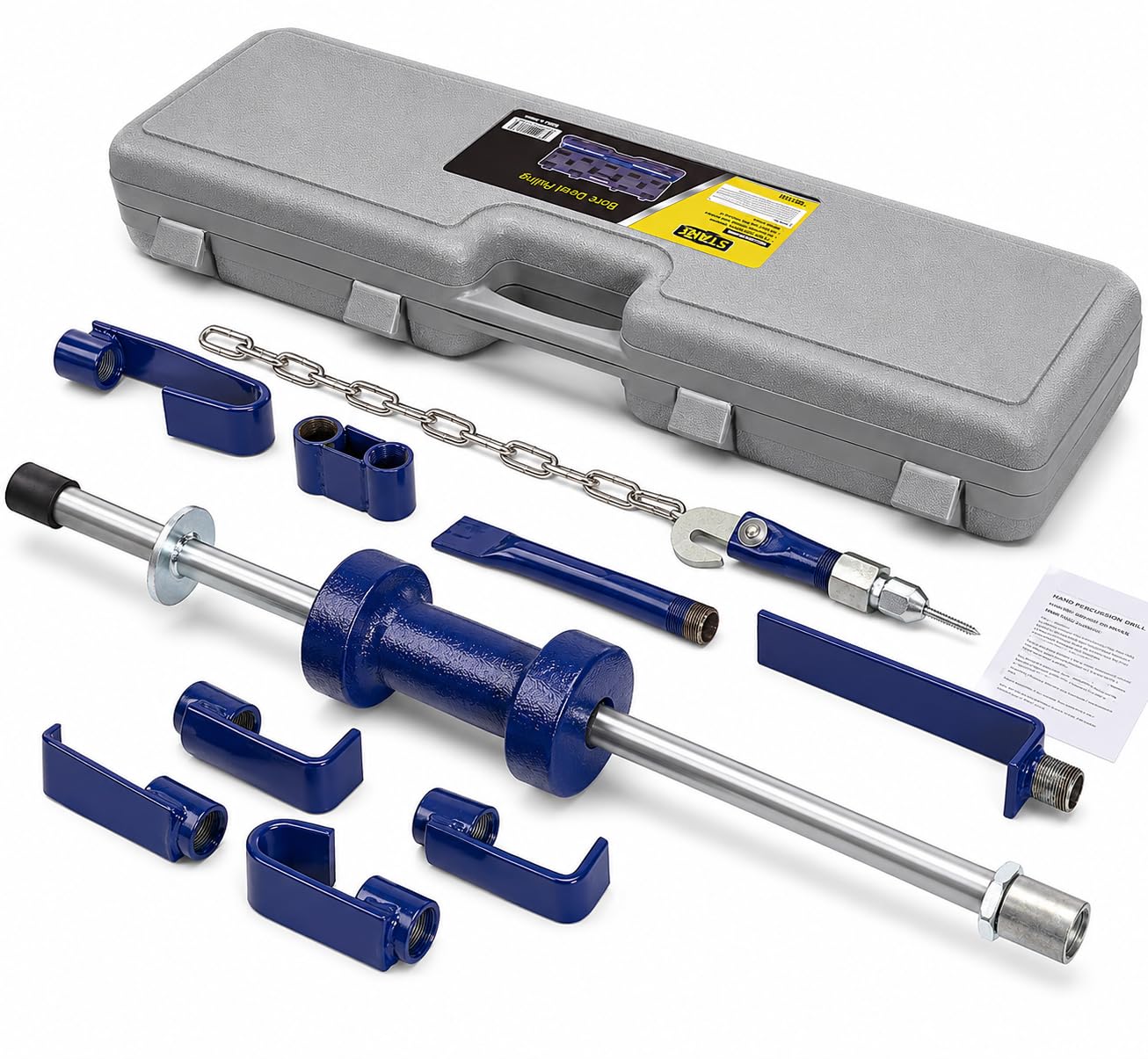
1. XtremepowerUS 13 lb Slide Hammer Dent Puller Kit
Our pick — over 4.5★ from 700+ verified ratings; the strongest balance of quality and price.
The heavy hitter that yanks stubborn dents and stubborn axles alike.
This is the kit you reach for when dent repair crosses over into serious body panel pulling and even mechanical extraction. The 13-pound slide hammer delivers controlled, heavy pulling force, and the drop-forged steel attachments handle automotive dent removal, flange pulling, wheel hub extraction, and rear axle pulling — it is a legitimate multi-purpose shop tool, not just a dent kit. Weighing in at 15 pounds, it is nearly 2.2 times heavier than the Jerbor glue-pulling kit, and that weight translates directly into pulling power on larger dents and stuck components.
Buyers report that “this dent puller kit is a lifesaver,” praising the sturdy slide hammer and the organized blow-molded carrying case. Quality is the most-praised aspect, with 45 owners highlighting it, closely followed by functionality at 36. The kit works surprisingly well on truck body panels and Jeep XJ doors, and several owners noted it pulled hub assemblies with minor modifications — a sign of genuine versatility. The trade-off is the weight and size; at 31 x 5 x 9.5 inches, the case takes up garage shelf space, and the tool is overkill for a shallow parking-lot ding where glue-pulling would be simpler.
Real-world pull power: This is not a starter DIY set — it is the choice for the owner who wants a single tool that can pull body dents, axles, and wheel hubs. The price is higher than budget glue kits but reflects the drop-forged steel build and the sheer range of mechanical tasks it covers.
Reach for this if: you are doing serious bodywork, hail damage on thick panels, or you need a multi-purpose slide hammer for both dent pulling and mechanical extraction.
Look elsewhere if: your dents are small, shallow, and on a modern thin-gauge door skin — a lighter glue-pulling kit is quicker and less likely to over-pull the metal.
2. Jerbor 97PCS Car Dent Puller Kit
The high-piece-count entry point that covers all the basic glue-pulling methods.
At 6.8 pounds, the Jerbor kit is a featherweight compared to the XtremepowerUS slide hammer, and it takes a fundamentally different approach: hot-melt glue and tab pulling. The kit includes a golden lifter for small dents, a bridge puller for medium dents, and a T-bar slide hammer for larger pulls — three distinct systems in one box. The 97 pieces include multiple glue tab shapes to match round, oval, and irregular dents, and the glue-pulling method means no drilling or repainting if the paint is intact.
The response is split. Some owners land a dent on the first try and call it a huge win, while others report the glue does not hold well on older or colder paint. Durability and adhesion are the recurring friction points — the glue often needs multiple tries, and the kit struggles on sharp creases or cracked paint. The most satisfied users are those who keep realistic expectations for a budget glue-pulling system and take the time to fully heat the surface and the glue gun before starting.
What wins people over
- Covers small, medium, and large dents with three different pulling tools.
- Massive piece count includes a huge variety of glue tabs for different dent shapes.
- Budget-friendly entry price for someone testing PDR for the first time.
The recurring trade-off
- Glue adhesion is inconsistent — cold panels or insufficient heat cause tab pop-off.
- Not effective on sharp creases, plastic bumpers, or repainted panels.
- Some owners mention the suction cups and tall tabs feel less durable than premium kits.
Best for: the first-time DIYer who wants to try glue-pulling on a shallow door ding or small hail dent without spending much.
skip it if: you need consistent results on deeper dents or you are working in cold weather without a heat gun to warm the panel.
3. VEVOR Rods Dent Removal Kit, 20 Pcs
The rod set that pushes dents out from behind — no glue, no mess.
Rod-based PDR is a different world from glue pulling. Instead of yanking the dent from the outside, you access the back of the panel and push the metal back into shape. The VEVOR set includes 10 stainless steel rods in sizes B2 through B11, ranging from 0.72 ft to 2.69 ft, plus O-style hooks, S-style hooks, a rubber hammer, and a tap-down tool. The rods are 3/8-inch diameter on the smaller ones and 7/16-inch on the longer ones — stout enough to resist bending during a firm push. The package comes in a sturdy canvas bag, and customers note the rods are “far better quality than I imagined.”
Quality is the most-cited positive, with 17 owners highlighting sturdiness, and the value-for-money rating at 11 confirms the set punches above its price. One 30-year collision repair veteran said the rods “helped me speed up removing dents at work.” The honest catch: durability is mixed, with 13 owners noting the rods can bend under extreme force, and some tips arrive with small burrs that need polishing. At 36.2 x 8.1 x 4.7 inches, the kit is 17% larger in dimensions than the XtremepowerUS case, so it needs a decent shelf.
Pro-grade feel at a mid-range price: This kit leans toward the experienced user who knows how to work a rod from behind a panel. The stainless steel resists rust, and the included S- and O-hooks let you use leverage principles for hard-to-reach dents. Beginners should budget time for practice, especially filing the tips smooth.
Reach for this if: you have some PDR experience and want a rod set that covers multiple lengths and tip shapes for door skins and quarter panels.
Look elsewhere if: you need a complete starter kit with glue gun, tabs, and a slide hammer — this is rods only, no glue-pulling system included.
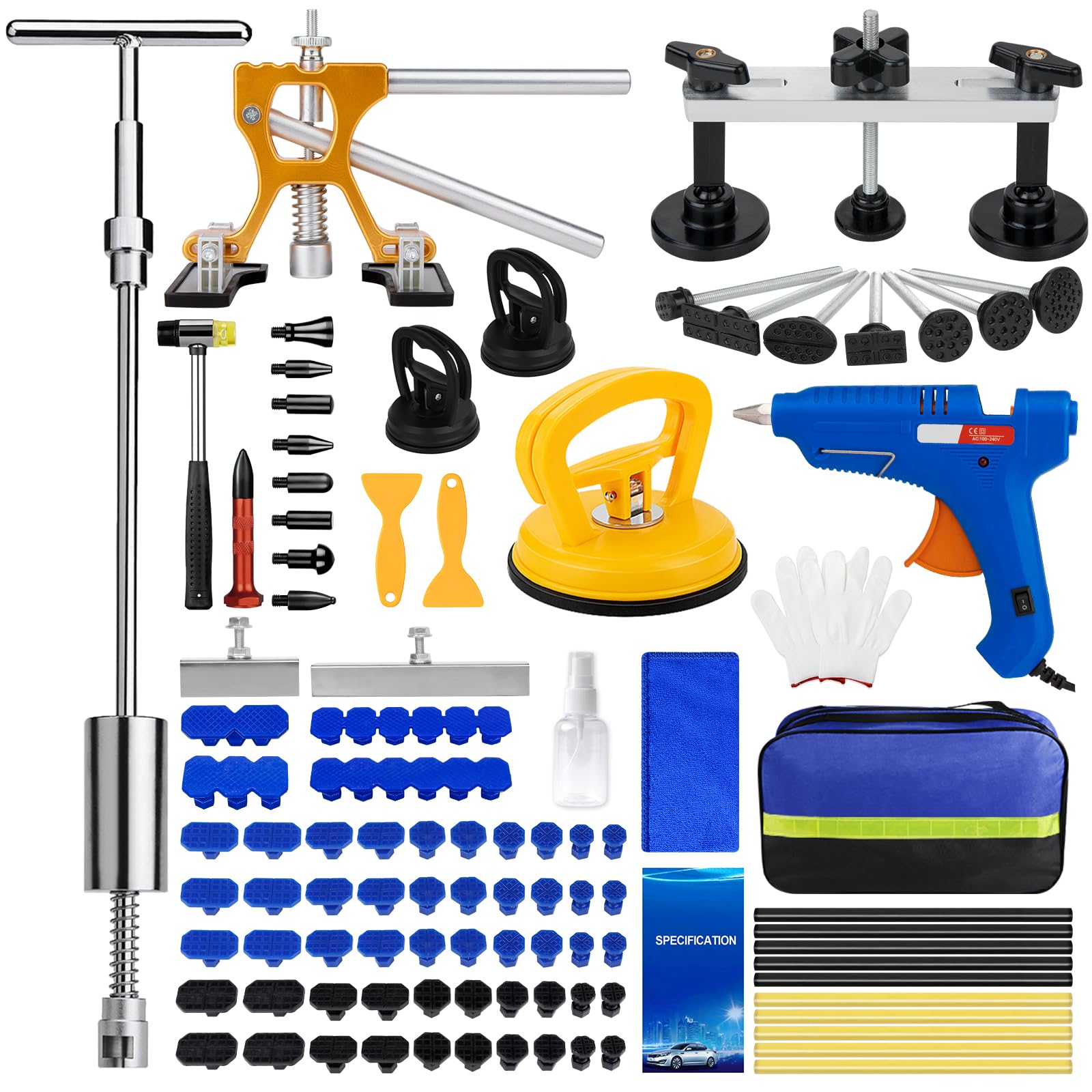
4. ZEUSFIRE 135PCS Professional Paintless Dent Repair Kit
The massive 135-piece kit that tries to be everything for every dent.
ZEUSFIRE packs a 2-in-1 T-bar puller, a bridge dent puller, a golden dent lifter, a glue gun, glue sticks, and over a hundred tabs into a single 6.96-pound kit. The T-bar can be used two ways — as a direct puller or with a slide-hammer action — and the bridge puller also offers two pulling modes to handle medium dents. The golden lifter uses a soft bottom pad to avoid scratching the paint, and the glue cleans off with water and a scraper. For a zero-experience user, the kit covers every glue-pulling method in one box.
Quality earns 28 positive mentions, and value for money gets 16 nods — owners see the 135-piece count as a strong deal. A first-time user wrote that it “saved me an expensive trip to the body shop,” pulling a large trunk dent with the T-bar slide hammer. However, durability and functionality are mixed: 34 owners flagged durability as a concern, and 33 had mixed results on functionality. The large suction cup dent puller broke after three uses for one owner, and glue strength is the most-praised negative aspect, with 27 owners saying the tabs pop off too easily.
What stands out
- 135 pieces cover T-bar, bridge puller, lifter, glue gun, and dozens of tab shapes in one box.
- 2-in-1 T-bar lets you switch between direct pulling and slide-hammer action.
- Soft lifter base and alcohol-cleanable glue protect factory paint.
The honest trade-off
- The large suction cup and some plastic components break after a few uses.
- Glue strength is inconsistent — the tabs pop off on deeper pulls.
- Best for patient DIYers; frustration sets in if you expect first-pull success.
Best for: the DIYer who wants every possible glue-pulling method in one kit and is willing to practice the technique.
pass on it if: you need a tool that survives repeated professional use — the plastic components are a weak link here.
5. Bitlyle 129PCS Dent Hail Puller Remover Kit

The 129-piece kit that adds three suction cups to the standard glue-pulling lineup.
Bitlyle takes the familiar T-bar, bridge puller, and golden lifter formula and adds three ergonomic suction cups (one yellow, two black) for a pulling method that requires no heat or glue. The suction cups use a single-stroke pump operation that clicks one-handed, making them accessible for users who want a quick grab on a smooth panel without waiting for glue to set. The golden lifter is adjustable in width and height, and the T-bar handles large dents. At 6 pounds, it is the lightest of the full-kit options, but the plastic suction cups and some plastic trim tools raise a durability question.
Quality scores 20 positive mentions, and functionality gets 18 — owners find the kit genuinely effective on small to medium dents. One owner described pulling “old hail dents out of my old cars with amazing success” after some practice. The darker side: 12 owners flagged durability as negative, with plastic tips breaking easily, and 9 noted weak adhesion from the hot-melt glue. The glue gun itself arrived defective for one owner (sparked and shorted out), though the rest of the kit was praised as complete.
The suction advantage: If you want to pull a dent without waiting for glue to cool, the ergonomic suction cups offer a clean, instant approach. Just understand the plastic tips on the slide hammer may need replacing with metal threaded rod (5/16-18) for long-term use.
Reach for this if: you want a single kit that offers both glue-free suction pulling and traditional glue-tab pulling, and you are comfortable filing down the occasional rough edge.
Look elsewhere if: you need all-metal construction and zero plastic components — the tip durability is the weak link here.
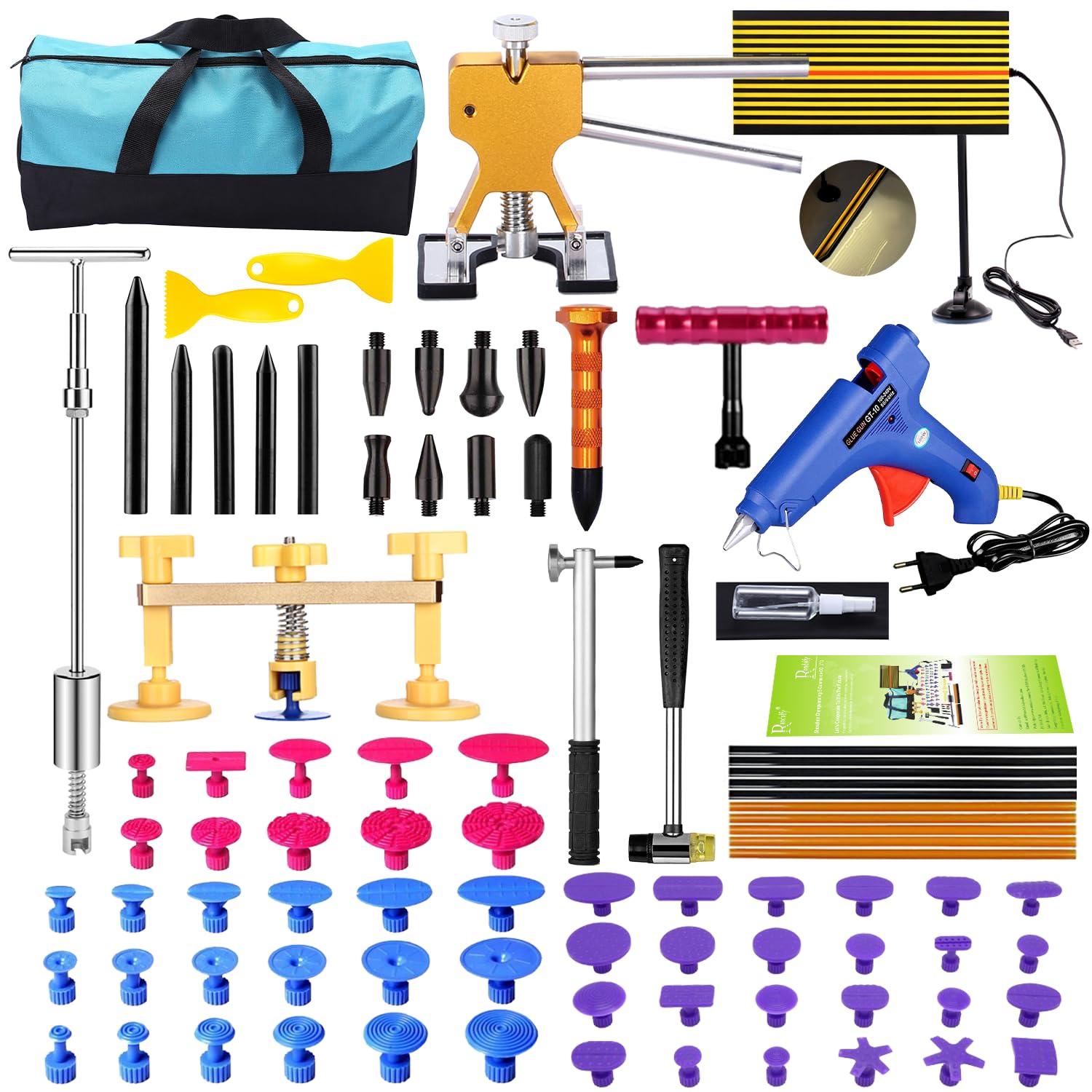
6. GLISTON DIY Paintless Dent Repair Kit 89pcs
The 89-piece kit that throws in an LED light board to spot dents you missed.
GLISTON’s approach is to cover all the traditional glue-pulling tools — golden lifter, bridge puller, 2-in-1 slide hammer, glue gun, and 52 glue tabs — and then add a LED reflector board to help you see high spots and low spots on the panel. The kit claims to repair dents from 0.1 inch up to 10 inches, making it one of the widest coverage ranges in this list. The included metal tap-down pen with 9 heads lets you fine-tune small high points, which is a detail many budget kits skip entirely.
Quality scores 54 positive mentions, the highest positive count in the entire list, and comprehensiveness gets 13 nods. Owners say the glue tab selection is “great” and that the kit “worked perfectly” on truck dents. But functionality is mixed at 49 mentions, and 32 owners had mixed feelings about value for money. The line light board’s suction cup does not stick well due to hard plastic, making it nearly useless unless you hold it. The glue gun is also flagged as cheap and likely short-lived — one owner used the smallest glue tab over 100 times but noted the gun feels disposable.
What owners love
- 54 positive quality mentions — the highest quality score of any kit in this roundup.
- LED light board with 360° rotation helps locate subtle dents on the panel.
- Wide 0.1-to-10-inch dent size range covers door dings to large hail damage.
The weaker spots
- Light board suction cup has a hard plastic base that won’t grip curved panels.
- Glue gun feels cheap and may fail after moderate use.
- Adhesion is inconsistent — surface must be very clean and warm for tabs to hold.
Best for: the DIYer who wants a complete glue-pulling starter kit with the added benefit of a visual inspection light board.
it’s not for you if: you need a durable glue gun that lasts through many projects, or if you rely on the light board to stick without holding it by hand.
7. Eastwood Paintless Dent Repair Kit

The name-brand 23-piece starter that keeps it simple and focused.
Eastwood is a well-known name in automotive restoration, and this 23-piece kit takes a no-filler approach: a lever-type dent puller, slide hammer dent puller, plastic pull buttons, an electric hot glue gun, glue sticks, a nylon scraper, and an aluminum spray bottle. The piece count is low compared to the 135-piece kits, but there are no duplicate colored tabs counted as separate pieces — every item serves a distinct purpose. The kit comes in a blow-molded case for organized storage, and Eastwood backs it with a 1-year limited warranty.
Owners call it “easy to use” and appreciate the quality, noting that “clean with alcohol, apply stud quickly for strong pull” is the key technique. One experienced owner repaired a dime-sized, deep dent after about 12 pulls, calling the kit “high-quality, worth price.” The glue gun, however, is a common complaint — several owners find it underpowered or poorly performing, with one replacing it with a glue gun from a cheaper kit. A single owner also reported the kit “didn’t fix the dent, just scratched my husband’s car,” though this appears to be a rare outcome when technique is followed correctly.
Focused, not flashy: Eastwood’s kit is for someone who values a curated set of quality basics over a huge piece count. The lever and slide hammer provide two distinct pulling methods, and the included spray bottle and scraper cover cleanup. The glue gun is the weakest link — budget a few extra dollars for a replacement if you plan heavy use.
Reach for this if: you recognize the Eastwood brand from restoration work and want a no-nonsense starter kit with a warranty.
Look elsewhere if: you want a massive piece count for the money or a glue gun that does not need upgrading from the start.
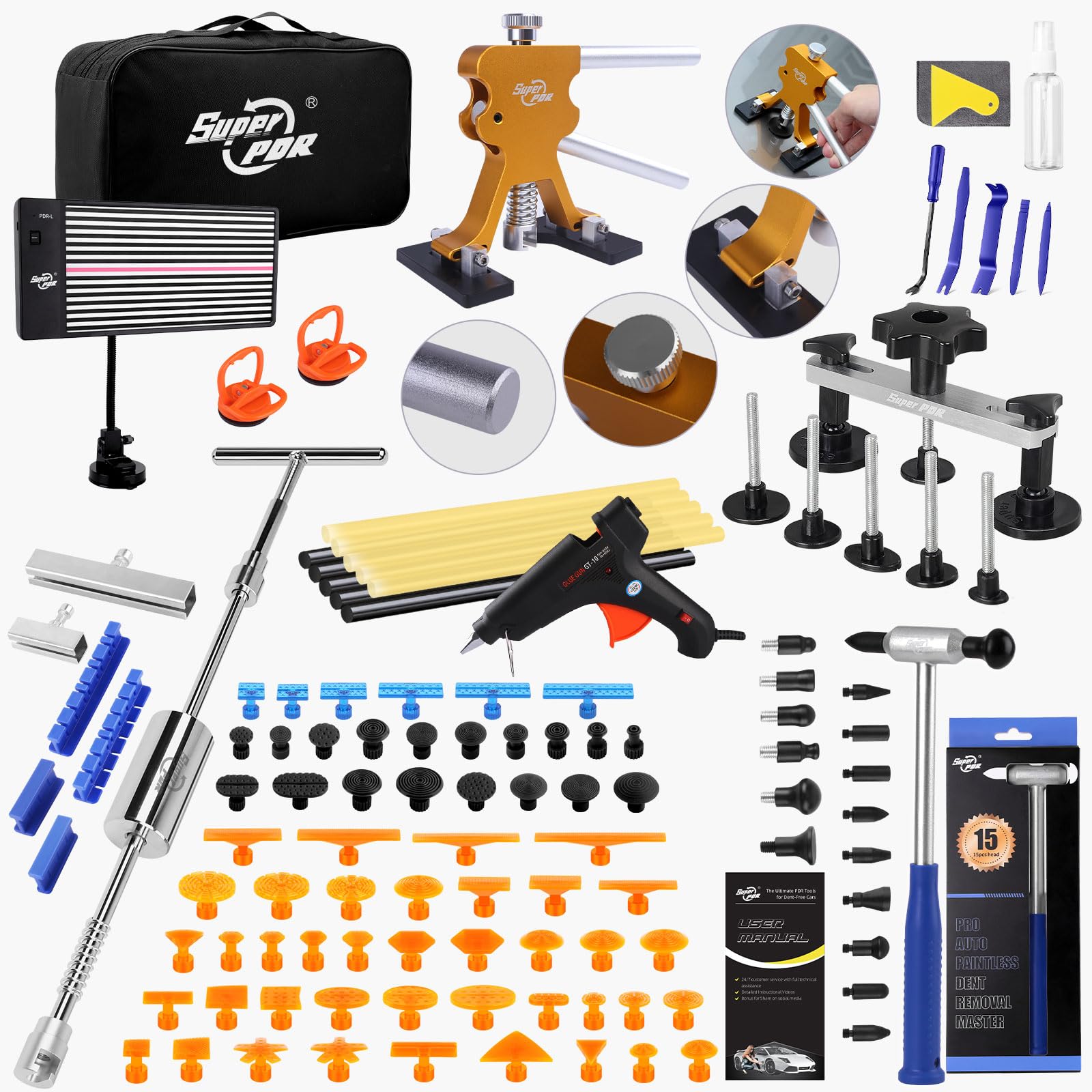
8. Super PDR Paintless Dent Repair Kit
The 64-tab set built for glue-pulling enthusiasts who want one tab for every contour.
Super PDR’s kit revolves around its 64 specialized glue tabs designed to match the precise contours of your car body. The 100W glue gun heats in 3-5 minutes without dripping, providing a strong bond even in cold weather if you preheat the panel with a heat gun. The 3-level brightness LED light board rotates 360 degrees and uses a suction cup base to help you see dent lines from any angle. The aluminum leveling hammer, bridge puller, golden lifter, and 2-in-1 T-bar round out the pulling tools, and everything packs into a tool bag.
Reviews are split. The kit is “awesome” and “very easy to use” for some, with one owner fixing a small door dent and saving money. Others find it “pricey for what you receive” and note it is “not suitable for high end vehicles with more substantial metal fenders.” The glue gun is the star feature for speed, but the overall build quality of accessories is average — the kit is clearly aimed at dedicated DIYers who want a lot of tab variety rather than professionals needing all-metal toughness. The 64 tabs are an advantage if you face multiple dent shapes, but they add weight: the kit is 8.97 pounds, heavier than most glue-only sets.
What works
- 64 specialized tabs cover more panel contours than any other kit in this roundup.
- 100W glue gun heats oil-free in 3-5 minutes for fast, dripping-free bonding.
- 3-level LED light board with 360° rotation helps locate subtle dents at any angle.
What to consider
- Some owners find it overpriced compared to kits with similar tools but fewer tabs.
- Not recommended for thick-gauge metal on trucks or high-end cars.
- Cold weather requires preheating the panel for the glue to bond properly.
Best for: the DIYer who wants the widest tab selection to match specific dent shapes and needs a fast-heating glue gun.
look elsewhere if: you work on thick metal panels or expect commercial-grade durability at a mid-range price.
9. WHDZ Paintless Dent Repair Rods Set 24 Pcs

The 24-rod stainless set that lets professional techs work without a glue gun in sight.
WHDZ offers a 24-piece rod set with three tip styles — sharp, flat, and round — across diameters from 6mm to 10mm and lengths from 26cm to 82cm. The rods are stainless steel, resisting rust and bending during normal use. The kit includes a repair hammer and 9 yellow tap-down tips for tapping high points and crowns, plus a reflector board to check dent progress. At 12.03 pounds, this is the heaviest kit in the roundup, reflecting the mass of 24 metal rods in a sturdy package.
Quality is the most-praised aspect at 29 mentions, and value for money follows at 22 — owners see the per-rod cost as excellent for a stainless steel set. A 15-year body tech called it “a great starter kit” that helps “push dents while keeping more of your factory coatings on the back side.” A first-time user successfully removed three small dents from a BMW rear door. The honest trade-off is tip finish: several owners, including a 16-year repair tech, note the tips have “metal burrs” that “caused finger injury” and require grinding and buffing before use. Durability is mixed at 23 mentions, with some finding the rods too thin and bending on older, thicker metal panels.
Real pro potential, with one caveat: If you can tolerate 20 minutes of tip-sanding, this set delivers professional-grade rod variety at a fraction of the cost of premium rod brands. The three tip shapes across 24 rods give you the leverage angles needed for door skins, fenders, and quarter panels. Beginners should be prepared for a learning curve — rod work demands patience and a feel for metal movement.
Reach for this if: you are a current or aspiring PDR tech who needs a wide range of rod lengths and tip shapes without paying premium brand prices.
Look elsewhere if: you prefer a plug-and-play experience — the burr-free tips require filing before first use, and rod work requires more skill than glue pulling.
Understanding the Specs
Slide Hammer Weight
The slide hammer’s weight — measured in pounds — determines how much pulling force you can generate with each stroke. A heavier slide hammer, like the 13 lb weight in the XtremepowerUS kit, delivers more momentum for stubborn dents and mechanical extraction, but it also risks over-pulling thin metal if you are not careful. Lighter hammers in glue-pulling kits are easier to handle for door dings but lack the power for deeper creases or axle work.
Rod Material and Diameter
Rod material directly affects durability and feel. Stainless steel rods (like those in the VEVOR and WHDZ kits) resist rust and bending, while thinner rods (6mm-10mm) flex differently than thicker ones. A 3/8-inch rod offers more rigidity for pushing, while a 1/4-inch rod can snake into tighter access holes behind door panels. Tips that are not polished can scratch the paint — sanding or filing them smooth is standard practice for professionals.
Glue Gun Wattage
Glue gun wattage controls how fast the glue melts and how consistently it flows. A 100W gun, like the one in the Super PDR kit, heats up in 3-5 minutes and maintains temperature better than lower-wattage guns, which can struggle in cool weather. A glue gun that heats slowly or drips will give weak adhesion, causing tabs to pop off mid-pull — a common frustration in lower-tier kits.
Kit Piece Count vs. Useful Tools
A high piece count (97, 129, 135) sounds impressive, but most of those pieces are glue tabs in different shapes and colors. What matters more is the variety of actual working tools: a T-bar slide hammer, a bridge puller, a golden lifter, and a functional glue gun. A focused 20-piece rod kit can outperform a massive glue-pulling set on a dent that requires access behind the panel, because the rods are the right tool for that specific job.
FAQ
Will a paintless dent removal kit work on any dent?
Can a beginner use a rod dent removal kit?
How important is the glue gun wattage in a dent repair kit?
Will the glue damage my car’s original paint?
How do I make the glue tabs stick better?
What is the difference between a T-bar slide hammer and a bridge puller?
Can I use a paintless dent removal kit on a motorcycle tank?
How many glue tabs should I use on one dent?
What does “oil-canning” mean in dent repair?
Do I need a heat gun for paintless dent repair?
Final Thoughts: The Verdict
For most buyers, the paintless dent removal kit winner is the XtremepowerUS 13 lb Slide Hammer Kit because it combines brute pulling force with drop-forged steel durability, earning a near-flawless reputation across 700+ owners. If you want a glue-pulling system with maximum tab variety and a fast-heating 100W gun, grab the Super PDR Kit. And for precision rod work behind the panel, the WHDZ 24-piece Rod Set is the one to reach for — just budget 20 minutes to sand the tips smooth before first use.
How We Picked
We do not accept paid placement. Every pick is matched to a real buyer and a real use-case; we do not hands-on test units.
Sources & Methodology
Specifications: manufacturer listings and product documentation. Review insights: verified customer reviews, as of July 2026. Pricing: not shown on this page (it changes often); check the current price via the retailer link.
As an Amazon Associate, Trending Car earns from qualifying purchases. This does not affect which products we feature.