
Our readers keep the lights on and my garage snacks stocked. As an Amazon Associate, I earn from qualifying purchases.
Specs are compiled from manufacturer listings and verified buyer reviews and can change over time — please confirm the key details on the product page before buying.
Your dashboard can only tell you so much. An OBD gauge display open up the engine data your car hides—real-time coolant temp, voltage, fuel trims, and turbo pressure that factory gauges simply skip. This guide covers nine monitors, from simple plug-and-play speedometers to pro-level scanners that read and clear fault codes, so you can pick the one that matches your vehicle and your driving style.
I’m Min Islam — the founder and writer behind Trending Car. This guide is built by comparing the manufacturers’ published specifications and the patterns across verified customer reviews, so you get each pick’s real strengths and trade-offs instead of marketing spin.
Whether you drive a daily commuter or a weekend project car, the right obd gauge display puts the numbers you actually need right where you can see them—while keeping your eyes on the road.
Our Picks at a Glance


How To Choose The Best OBD Gauge Display
Not every display works on every car. The first thing to check is your vehicle’s model year and OBD protocol—most modern gauges support 2008 and newer gasoline cars, while a few work back to 1996. Diesel, electric, and some European brands may need a GPS-based backup mode. Prioritize a dual OBD2+GPS system if compatibility is uncertain or if you plan to swap the gauge between vehicles. Then look for the readouts you actually need: basic speed and RPM, or deeper parameters like transmission temp, fuel pressure, and boost. The best units let you customize screens and set alarms for overheating, over-revving, or low voltage—so you catch trouble before it becomes a breakdown.
OBD2 vs. GPS Dual System
A pure OBD2 gauge pulls live data directly from the engine computer—accurate, fast, and full of parameters like coolant temp, voltage, and fuel trims. But it only works if your car’s computer speaks the same language. A dual-system gauge adds a GPS receiver that reads speed, direction, altitude, and time from satellites. This means you still get basic data even if the OBD2 port refuses to cooperate. The trade-off: GPS speed can lag or drift compared to the ECU’s signal.
Screen Quality and Visibility
You will glance at this screen while driving, so clarity matters. Bigger screens with IPS technology—like a 3.5-inch panel—offer wide viewing angles and stay readable in direct sunlight. Some units add auto-dimming that adjusts brightness to the ambient light, so the display is not blinding at night or washed out at noon. A reflective film or a dedicated shade can also help on bright days.
Customization, Alarms, and Extra Features
A basic display shows one or two parameters at a time. More advanced gauges let you build multiple pages—keep RPM and speed on page one, coolant temp and voltage on page two, fuel economy and trip distance on page three. Set visual and audible alarms for specific thresholds, like a temperature above 230°F or voltage below 12V, so you get a warning before you see steam. Some models also read and clear diagnostic trouble codes, turning an accessory into a real troubleshooting tool.
Quick Comparison
| Model | Best For | Screen Size | System Type | Fault Code Reading | Amazon |
|---|---|---|---|---|---|
| ScanGauge 3★ Best Overall | Full-featured diagnostics | 4.3 inches | OBD2 | Read & clear | Amazon |
| AEM 30-0311 X-SeriesPro Install | Pro install in gauge pods | 2.06 inches | OBD2 | Read & clear | Amazon |
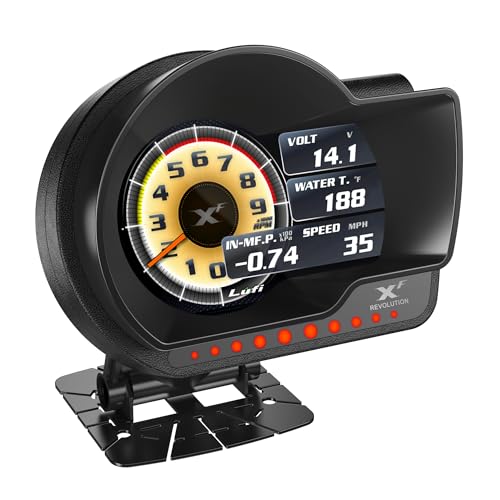
| XF (Lufi) XF-06Custom King | Deep customization | — | OBD2 | Read & clear | Amazon |
| KONNWEI KW206 | Budget-friendly all-rounder | 3.5 inches | OBD2 | Read & clear | Amazon |
| CAMECHO T8163 | Newer vehicles | 3.5 inches | OBD2+GPS | Read & clear | Amazon |
| MH P6 | Value with dual backup | — | OBD2+GPS | Read & clear | Amazon |
| KUOWEIHUD F16 | Budget dash replacement | 3.5 inches | OBD2+GPS | Read & clear | Amazon |
| wiiyii M7 | Entry-level HUD | — | OBD2+GPS | No | Amazon |
| KAOLALI A401 | Basic digital speedometer | — | OBD2+GPS | No | Amazon |
In‑Depth Reviews
1. ScanGauge 3 Touch Screen OBD2 Scanner, Digital Gauges & Trip Computer SG3
Our pick — 4.5★ from 450+ verified ratings; the strongest balance of quality and price.
The command center for drivers who want diagnostic depth, not just speed.
The ScanGauge 3 is a full trip computer and diagnostic scanner in one package. Its 4.3-inch capacitive touch display supports 16 million colors and lets you build multiple pages with up to nine gauges each—you can watch coolant temp, voltage, intake air temp, and instantaneous fuel economy all on one screen. The device connects to any 1996 or newer car or light truck with a standard 16-pin OBD2 plug, and it updates its software wirelessly via WiFi, so the feature set stays current without needing a laptop.
What owners highlight most is the sheer number of parameters it exposes. Beyond standard gauges, the X-Gauge feature reads manufacturer-specific data like exhaust gas temperature, EGR temps, and active regen numbers on compatible trucks. The magnetic window mount is sturdy, and the unit enters sleep mode when the engine is off to prevent battery drain. One recurring note: it reads transmission pan temperature but not torque converter temperature—a limitation for hardcore transmission monitoring, though the company may have a fix.
what separates it
- 4.3-inch color touchscreen—largest display in this roundup—with customizable gauge layouts
- WiFi updates mean you never need to hunt for a firmware file
- Visual and audible alarms for temperature, voltage, speed, and RPM thresholds
- Works on vehicles back to 1996, far wider than most 2008-only units
The honest trade-off
- Does not read torque converter temperature—only transmission pan temp
- Premium price reflects the deeper diagnostic capability
- Some users recommend gluing the metal mount plate for extra adhesion
The best pick for: Drivers who want a proper diagnostic suite—code reading, customizable data pages, and alarms—rather than a simple speedometer replacement.
Think twice if: You only need a basic digital speedo and never plan to explore ECU parameters.
2. AEM 30-0311 X-Series OBDII Gauge
The 52mm gauge-pod specialist that reads OEM data without extra sensors.
The AEM X-Series OBDII gauge fits a standard 2-1/16-inch (52mm) pod, so it blends into a dash that already has aftermarket gauges rather than sitting on the dashboard. It pulls power and data from the OBD2 port using a single supplied connector—no vacuum lines, no wiring to the fuse box. The face features 24 green outer LEDs that act as a quick-reference bar graph, and an auto-dimming sensor adjusts the display brightness so it does not wash out at night.
This gauge reads only OEM PID channels, meaning it shows what the factory computer already reports: coolant temperature, intake air temperature, battery voltage, RPM, air-fuel ratio, and fuel pressure if the vehicle has the sensor. It also reads and clears diagnostic trouble codes. The slim 0.825-inch overall depth lets it mount in tight pods. One common note: the unit needs constant power to retain PID memory, so if you disconnect it, it has to relearn which channels are available. Buyers also mention it works best on 2014 and newer vehicles despite the spec sheet saying 2008.
Clean install, narrow focus: If you already have an A-pillar gauge pod (a mount on your car’s front roof pillar), this display fits right in and shows you accurate data straight from your car’s computer (the ECU). The catch: it cannot read manufacturer-specific PIDs (custom data codes) beyond what the ECU sends out. So if you drive a truck and need exhaust gas temperature (EGT) or diesel regeneration (regen) info, skip this and get the ScanGauge 3 instead.
Route this into a pod if: You want a permanent, professional-looking gauge that does not clutter your windshield and handles the basics—temp, voltage, AFR—reliably.
Leave it on the shelf if: You drive a pre-2008 car, or you need a multi-parameter dashboard with customizable layouts.
3. XF (Lufi) XF-06 OBD2 Gauge Display
The gauge for tinkerers who want to personalize every pixel and parameter.
Where most OBD displays give you three or four preset layouts, the Lufi XF-06 lets you upload your own car logo, choose display colors, and combine data fields exactly how you want. You can set maintenance mileage reminders, odometer tracking for older cars, and even customize shift-light thresholds. The unit monitors water temperature, boost pressure, exhaust temperature, fuel consumption, and speed, and it triggers both pop-up and audible alarms when any value goes beyond a safe range.
Compatibility here requires attention: the manufacturer states the gauge works with American cars made after 2008 and Japanese/European cars after 2005. It does not support all pure electric vehicles. If your car can send custom PIDs, the engineers can help you pull oil temperature or transmission temperature data. Owners praise the near-zero-lag response and the built-in shift light capability, noting installation takes about ten minutes. The unit uses double-sided tape for mounting—no suction cup is included, by design, to avoid heat-related failures.
Where it shines
- class-leading customization—upload logos, set RPM limits (6000, 9000, or 11000), choose color themes
- Maintenance and odometer reminders add real utility for project cars
- Near-zero display lag according to early testing
Where it leaves you short
- Cannot set an 8000 RPM limit—only three preset limits, which wastes screen space for engines that hit 7000–8000
- Brand and model year restrictions mean it will not work on every car
Grab this if: You drive a supported vehicle and want to build a gauge that looks like it came from a specialist tuner shop.
skip it if: You own a diesel, a Peugeot/Citroen/Fiat, or any pure EV—the compatibility list is strict.
4. KONNWEI KW206 Car OBD2 HUD Digital Meter Gauge

A crowd-favorite scanner gauge that brings pro features into an approachable price bracket.
Thousands of owners trust the KONNWEI KW206 as a budget-friendly OBD gauge display that works as both a trip computer and a diagnostic scanner (a tool that reads your car’s error codes). Its 3.5-inch color TFT (thin-film transistor) screen shows you real-time engine data like speed, RPM (revolutions per minute), coolant temperature, fuel consumption, and intake air temperature. You can set four separate alarms for RPM, speed, coolant temperature, and voltage. If any reading goes past your set limit, you get a visual and audible warning—so you catch overheating or a dying battery before it strands you.
The KW206 works on all 2003 or newer OBDII-certified vehicles including gasoline and diesel cars, SUVs, and light trucks. It reads and clears engine fault codes, so you can diagnose a check-engine light without a separate tool. The unit enters sleep mode when the engine is off, meaning you can leave it plugged in full-time. Owners do note two common quirks: the adhesive on the stand is weak and may need reinforcement, and a small number of units have developed display artifacts after a hard bump. Still, for the price, it delivers accurate tachometer and speedometer data, coolant temp, and code-clearing ability that rivals units costing several times more.
Value-per-dollar leader: You get a 3.5-inch customizable display, universal compatibility from 2003 onward, and OBDII code reading—all for a fraction of the premium-tier options. The trade-off is the plastic build and the tape mount; budget for a stronger holder if you want it to stay put.
Your pick if: You want a do-it-all gauge that monitors coolant temp, reads codes, and fits any gasoline or diesel vehicle from 2003 onward—without spending big.
Think again if: You need a polished, pod-mountable gauge or you drive a pre-2003 vehicle.
5. CAMECHO T8163 Head Up Display HUD F16 OBD2 + GPS Dual System
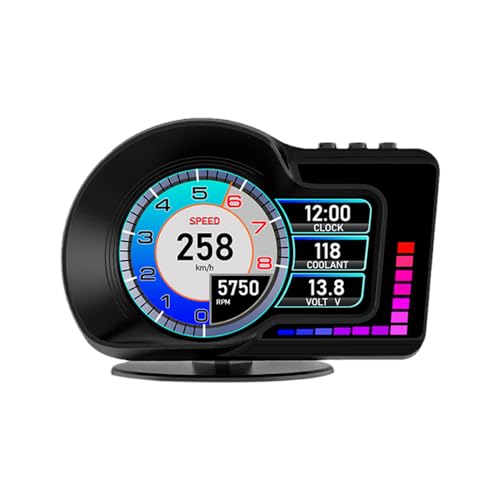
A 3.5-inch IPS smart gauge with dual-system redundancy for vehicles that do not love OBD2.
The CAMECHO T8163 runs both OBD2 and GPS modes, so if your car’s OBD2 protocol is not fully supported, the GPS receiver still provides speed, altitude, latitude and longitude, driving direction, and trip time. The 3.5-inch IPS screen offers wide viewing angles and auto-dimming that adjusts to ambient light—it stays readable in direct sun without blinding you at night. You can switch between multiple display interfaces to show speed, water temperature, oil temperature, voltage, fuel consumption, RPM, and turbo pressure.
Like most dual-system units, the OBD2 mode works on vehicles manufactured after 2008. The GPS mode covers everything, including older cars and some incompatible domestic brands. The bracket rotates in all directions, so you can mount it on the dashboard or stick it on the windshield and angle it precisely toward your eyeline. The device also reads and clears fault codes. One owner noted it worked well with a 2025 OBDII vehicle, delivering voltage and oil readings, but the time zone setup took a while.
Why choose this one
- 3.5-inch IPS gives better off-axis visibility than cheaper TN panels
- GPS fallback keeps speed, direction, and altitude working even when OBD2 fails
- Fully adjustable bracket—rotate to match your driving position
Heads-up
- One unit reportedly shut down after 20 seconds and caused dash-light flicker—quality control may vary
- Some data parameters depend on the car’s protocol openness; not every readout will work on every model
Best suited for: Drivers of 2008+ vehicles who want an IPS screen and GPS backup in case OBD2 handshaking fails.
Not for: People who need a long track record of reliability; the sample size of reviews is still modest.
6. MH P6 Head Up Display, OBD2+GPS Dual System

Ten interface layouts and glass-metal construction make this a smart middle-ground pick.
The MH P6 cycles through ten different display interfaces, from a simple speed view to a six-grid data screen and dedicated acceleration and brake test pages. It reads speed, tachometer, fuel consumption, water temperature, drive time, altitude, turbo pressure, compass, clock, and voltage from the ECU, plus GPS data when OBD2 is not available. The body uses glass and metal rather than all-plastic, which gives it a more substantial feel on the dashboard.
Compatibility follows the typical 2008+ OBDII rule, but the manufacturer explicitly lists incompatible types: diesel, hybrid electric, pickup truck, RV, computer-modified vehicle, and several brands including Jeep, Peugeot, Citroen, Fiat, Renault, DS, Lamborghini, and Suzuki. If your car falls into any of those categories, the GPS mode still provides speed, voltage, satellite time, altitude, and direction. Owners like the easy installation on late-model trucks and the ability to calibrate speed and fuel accuracy in the settings. A few report that GPS speed becomes inaccurate above 25 mph compared to phone apps, so OBD2 mode is the more reliable choice when it works.
Solid middle ground: Ten interfaces, glass-metal build, and dual-system backup at a reasonable price. The compatibility exclusions are unusually long, so check the list before buying—GPS mode is your safety net.
Go for it if: Your car is on the compatible list and you want a feature-dense gauge with a premium feel.
Look elsewhere if: You drive a diesel, a hybrid, or one of the excluded brands—stick with a universal GPS-only unit.
7. KUOWEIHUD F16 OBD2 Gauge Display
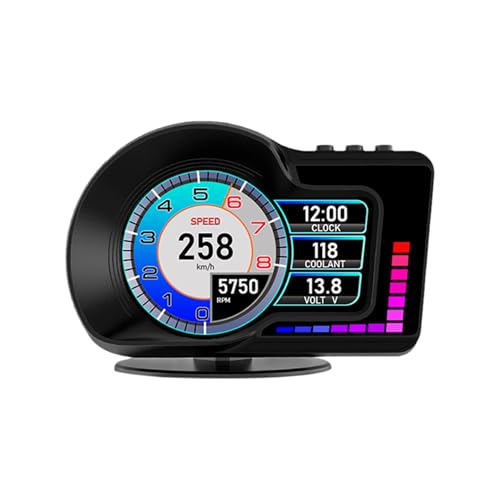
A compact, stylish gauge that works as a quick dashboard replacement when your original cluster fails.
The KUOWEIHUD F16 uses a 3.5-inch IPS screen and measures just 4.1 x 1.09 x 3.04 inches—noticeably smaller than the KAOLALI unit, which has a 2.2x larger footprint for its compact competitor. That slim profile lets it tuck onto the dashboard without blocking vents. It offers eight color ambient lights and five theme options, so you can match the gauge’s look to your interior. The unit runs both OBD2 and GPS systems, with automatic switching so data keeps flowing even if the car computer hiccups.
One owner summed up the real-world use perfectly: a daughter’s dashboard stopped working, and this gauge restored speed data instantly. The display can also find and erase fault codes. The downsides are honest: the sample rate is slow enough that the boost gauge refreshes only every 15 seconds in PSI, making it useless for real-time turbo monitoring. The buttons feel cheap, and one owner reported the unit draws battery power when the car is off unless you install an OBD2 switch. As an RPM meter and shift light it works fine, but it is not a precision instrument for boost junkies.
What works
- Sleek, compact IPS display with customizable ambient lighting and themes
- OBD2+GPS automatic switching prevents data gaps
- Emergency dash replacement when factory gauges fail
What does not
- Boost gauge refreshes too slowly for real-time monitoring
- Battery drain when parked—you will want an OBD2 on/off switch
- Button feel is not great, per multiple owners
Reach for this if: You need an inexpensive, good-looking speedometer replacement and do not care about turbo pressure readings.
Avoid if: Boost monitoring or fast data refresh is your priority—the sample lag makes it frustrating.
8. wiiyii M7 Head up Display for Cars
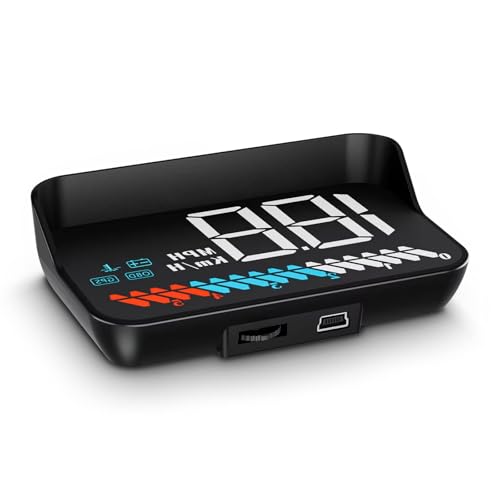
A budget-friendly HUD that gets the basics right—as long as your car cooperates.
The wiiyii M7 projects driving data onto your windshield, borrowing head-up display tech from fighter jets. It shows speed, water temperature, voltage, and driving distance in OBD2 mode, and switches to GPS mode for speed and voltage if OBD2 compatibility is an issue. The device automatically adjusts brightness to the environment, and the speed unit switches between km/h and MPH. Installation is plug-and-play: connect to the OBD2 port, lay the flat cable, and place the unit on the dash.
The catch is compatibility. The manufacturer states OBD2 mode works only on vehicles manufactured after 2008, and it explicitly excludes electric vehicles, diesel vehicles, pickup trucks, RVs, and computer-modified vehicles. Several owners found it simply did not work on their specific Nissan Versa or older cars—GPS mode remained functional but lacked the engine data they wanted. Build quality gets positive marks for the price, though some units have failed after a month of heat exposure in a parked car. The reflective cling film helps windshield readability but could be slightly larger.
Good concept, moderate execution: The M7 is an easy, cheap way to get a digital speedo on your windshield if your car falls inside the compatibility window. Accuracy is mixed—expect a 1–2 second delay versus the dashboard—and heat durability is a genuine concern for owners in sunny climates.
Works well for: Post-2008 gasoline car owners who want a basic heads-up speed display and do not need fault code reading.
Pass if: You own a diesel, EV, pickup, or RV, or if you park in direct sun regularly—heat damage has been reported.
9. KAOLALI A401 Head Up Display GPS+OBD2 Dual System
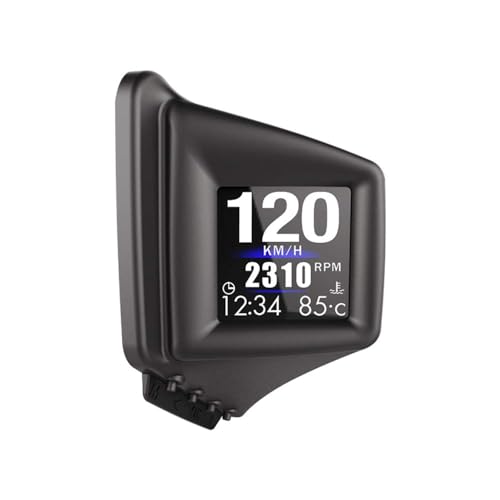
A tiny dual-system gauge with GPS backup that works best as a digital speedometer for older cars.
The KAOLALI A401 measures just 1.9 x 1.9 x 2.36 inches and weighs 40 grams—about half the footprint of the KUOWEIHUD F16. It switches between eight display interfaces, including a simple speed view, an OBD data page, a six-grid layout, acceleration and brake test screens, and a full-function interface. In OBD2 mode you get speed, RPM, water temperature, voltage, fuel consumption, oil temperature, turbine pressure, and fault code alerts. If OBD2 fails, the built-in GPS mode still delivers speed, voltage, altitude, direction, and trip data.
Several owners found the unit would not fetch OBD2 data on two different cars—a 2015 Chevy and a 2012 Hyundai—even though other scanners worked fine on both. The device still worked in GPS-only mode, but that defeated the purpose for buyers seeking engine readouts. On cars where OBD2 did connect, the gauge required three calibration cycles to match the OEM speedometer, and the menu system is not intuitive. On the positive side, once calibrated, the display is readable in bright sunlight and auto-dims at night. A few owners bought it specifically as a cheap digital speedometer for older Toyotas and were happy with the result.
Where it fits
- Very compact—smallest unit in this roundup, easy to tuck away
- GPS fallback keeps basic speed and direction alive when OBD2 fails
- Readable in direct sun after calibration
Where it falls short
- OBD2 mode fails on some cars entirely—GPS mode becomes the only option
- Non-intuitive menus and multi-step calibration required
- Does not read all the parameters some buyers purchased it for
Best for: Budget-conscious owners of older gasoline cars who just want a digital speedometer and treat the OBD2 engine data as a bonus.
Not for: Anyone who needs reliable OBD2 diagnostics or wants data from a modern Chevy, Hyundai, or similar 2010s vehicle.
Understanding the Specs
OBD2 vs. GPS Data Source
The OBD2 port talks directly to your car’s engine computer. It delivers accurate, low-lag data like RPM, coolant temperature, fuel trims, and turbo pressure—but only if your vehicle’s computer speaks the same protocol. GPS mode pulls speed, direction, altitude, and time from satellites. It works on every vehicle because it does not depend on the car’s computer at all, but the speed can lag or drift compared to the ECU reading. A dual-system gauge gives you both: OBD2 when it works, GPS as a fallback.
Screen Type and Auto-Dimming
You glance at this screen while driving, so the display quality matters. IPS (in-plane switching) screens keep colors and contrast correct from wide angles, which matters when the gauge is off to the side. Auto-dimming uses a light sensor to adjust brightness up in direct sun and down at night—without it, you may get glare during the day and a distracting glow after dark. A higher native resolution (like 480×272 on the ScanGauge 3) makes numbers sharper at a glance.
Fault Code Reading and Clearing
A display that reads diagnostic trouble codes (DTCs) can tell you why the check-engine light is on without a separate scan tool. Basic models show the code on screen; more advanced ones also clear it after the issue is fixed. Some units can only clear manufacturer-specific codes, while others handle hard DTCs. If you plan to use the gauge as a primary diagnostic aid, look for one that both reads and clears codes across multiple systems.
Customization and Alarms
Being able to choose which parameters appear on which page turns a generic gauge into a personalized dashboard. A good unit saves multiple page layouts so you can flip between a road-trip screen (speed, fuel economy, distance) and a performance screen (RPM, boost, coolant temp). Alarms that beep or flash when a value goes too high (or too low) add a layer of safety—you get warned about overheating or low voltage before damage happens.
FAQ
Will any OBD gauge display work on my 2005 car?
Can I leave an OBD gauge plugged in all the time?
Does every gauge show turbo boost pressure?
What is the difference between OBD2 and GPS mode for speed?
Can an OBD gauge display help me diagnose a check-engine light?
Do I need a separate sensor for water temperature or oil pressure?
Why do some displays not work on diesel or hybrid vehicles?
How many parameters can I see at the same time?
Is a capacitive touchscreen better than physical buttons for driving?
Can I mount the gauge in an A-pillar pod?
Final Thoughts: The Verdict
If you want one dependable pick, the obd gauge display winner is the ScanGauge 3 because its 4.3-inch color touchscreen, WiFi updates, and support for 1996-and-newer vehicles give it the widest compatibility and deepest feature set of any unit here. If you want a budget-friendly all-rounder with diagnostic code reading, grab the KONNWEI KW206. And for a professional pod-mounted installation that looks factory-fresh, the AEM 30-0311 X-Series is the one to reach for.
How We Picked
We do not accept paid placement. Every pick is matched to a real buyer and a real use-case; we do not hands-on test units.
Sources & Methodology
Specifications: manufacturer listings and product documentation. Review insights: verified customer reviews, as of July 2026. Pricing: not shown on this page (it changes often); check the current price via the retailer link.
As an Amazon Associate, Trending Car earns from qualifying purchases. This does not affect which products we feature.