
Our readers keep the lights on and my garage snacks stocked. As an Amazon Associate, I earn from qualifying purchases.
Specs are compiled from manufacturer listings and verified buyer reviews and can change over time — please confirm the key details on the product page before buying.
A diesel particulate filter (DPF — the part of your exhaust that traps soot) is supposed to clean itself every few hundred miles. But when your truck starts nagging you with a warning light, doing active regenerations every other trip, or losing power, the filter is clogged. Skip the dealership’s + replacement bill. The right additive, poured into your fuel tank, can burn that soot out, restore performance, and stretch your filter’s life by tens of thousands of miles.
I’m Min Islam — the founder and writer behind Trending Car. This guide is built by comparing the manufacturers’ published specifications and the patterns across verified customer reviews, so you get each pick’s real strengths and trade-offs instead of marketing spin.
Whether you drive a daily commuter or a heavy-duty work truck, the right formula lowers the temperature needed to burn soot inside the filter, lets the exhaust system clean itself, and gets you back on the road without an expensive shop visit. This breakdown of the best diesel additive to clean dpf covers eight top-rated options suited to different engines, budgets, and driving habits.
Our Picks at a Glance


How To Choose The Best Diesel Additive to Clean DPF
Not every diesel additive can actually clean a DPF. Many just condition the fuel or lubricate the injectors. For soot-fighting, you need a formula that actively lowers the temperature at which carbon burns inside your filter, allowing a passive regeneration to happen even during short trips. Here are the three things to check before you pour.
Regen Reduction Claim
The most useful number for a DPF cleaner is how much it cuts regeneration frequency. Some top formulas claim a 50% reduction in regen cycles. That means your truck goes twice as long between those annoying “exhaust filter cleaning” messages — saving fuel and reducing wear on the engine oil.
Cetane Boost vs. Soot Burner
A cetane boost (a measure of how easily diesel ignites — higher numbers mean quicker, more complete combustion) reduces the unburned fuel that turns into soot in the first place. Other additives work by lowering the ash-ignition temperature inside the filter, so the DPF burns off trapped soot at normal driving exhaust heat rather than needing a forced high-idle regen. The best products do both.
Single Treatment vs. Full-Time Use
Some cleaners are designed to be poured into a nearly empty tank as a one-time shock treatment — a “flush” that clears heavy buildup in one go. Others are meant to be added every fill-up as a preventive measure, keeping the system clean so the filter never clogs in the first place. If your DPF light is already on, go for the shock treatment. For routine maintenance, a full-time additive is a smarter, cheaper habit.
Quick Comparison
| Model | Best For | Size | Regen Reduction Claim | Formula Type | Amazon |
|---|---|---|---|---|---|
| Hot Shot’s Secret Fuel Duo★ Best Overall | Complete fuel system + DPF care | 2-Bottle Kit | Up to 50% | Cetane Booster + Cleaner | Amazon |
| Power Service DPF FlushPro Grade | One-tank shock cleaning | 12 oz | Up to 50% | RegenExtend Technology | Amazon |
| Rislone DPF CleanTDI Specialist | VW TDI & European diesels | 16.9 oz | — | Soot Ignition Reducer | Amazon |
| Liqui Moly Pro-Line | DIY removal & spray cleaning | 1 Liter | — | Spray-Applied Dissolver | Amazon |
| Lucas Diesel Deep Clean | Full-time maintenance | 64 oz | — | Deposit Dissolver | Amazon |
| Wynn’s DPF Regenerator | Professional fleet use | 500 ml | — | Soot Combustion Reducer | Amazon |
| MotorPower Care DPF Purge | Budget 2-pack maintenance | 15.4 oz (2-pack) | — | Soot Cleaner | Amazon |
| Nitrox Clean Cat | Emissions test pass | 17 fl oz | — | Carbon & Resin Remover | Amazon |
In‑Depth Reviews
1. Hot Shot’s Secret Fuel Duo Diesel Fuel Additive Kit
Our pick — over 4.5★ from 800+ verified ratings; the strongest balance of quality and price.
The two-bottle system that tackles soot and fuel quality at the same time.
This kit combines Diesel Extreme and Everyday Diesel Treatment (EDT) to attack DPF problems from two sides. Diesel Extreme clears injector deposits and reduces particulate matter in the filter — according to the maker, it can cut DPF regeneration cycles by as much as 50%. EDT, meanwhile, boosts the cetane number by up to 7 points. A higher cetane rating (more simply, how well the fuel ignites) means more complete combustion and less unburned carbon going into your exhaust. The result is a smoother-running engine that produces less soot in the first place.
Buyers report serious results on heavy-duty trucks. The review pages are full of GMC 2500HD Duramax 6.6L owners who say the additive “fixed ticking” in the engine after about four weeks of use, with noticeably better turbo response and restored horsepower. On tractors and farm equipment, the feedback is similar — a real difference in idle smoothness and throttle pickup. The EDT also helps with winter gelling, a nice bonus if you live in cold climates. The kit measures 2.1 x 4.5 x 10.63 inches, making it compact enough to stash in a glovebox or tool storage. The crowd gives this one a 4.7-star average, with over 800 owners weighing in, making it the clear favorite in this category for sheer reach and reputation.
What wins people over is the combined approach — you get a soot-buster and a fuel stabilizer in one purchase. The recurring gripe is that some owners prefer a single-bottle routine and don’t need the duo pack if they already use another brand for everyday treatment. But for anyone looking for a comprehensive system that cleans the DPF while improving fuel economy, this is the one that consistently delivers.
What Owners Love
- Proven to quiet ticking injectors and restore lost power on Duramax 6.6L engines
- Two-bottle system covers both DPF cleaning and ongoing fuel quality
- 7-point cetane boost means better cold starts and less unburned fuel
The Trade-Off
- Duo pack is overkill if you only need a one-time DPF flush
- Not everyone likes committing to a two-product routine
Reach for this if: you want a single purchase that both clears your DPF and improves daily fuel quality on a heavy-duty diesel truck or tractor.
Look elsewhere if: you prefer a simple one-bottle, one-time shock treatment for a clogged filter — the kit is designed for ongoing use.
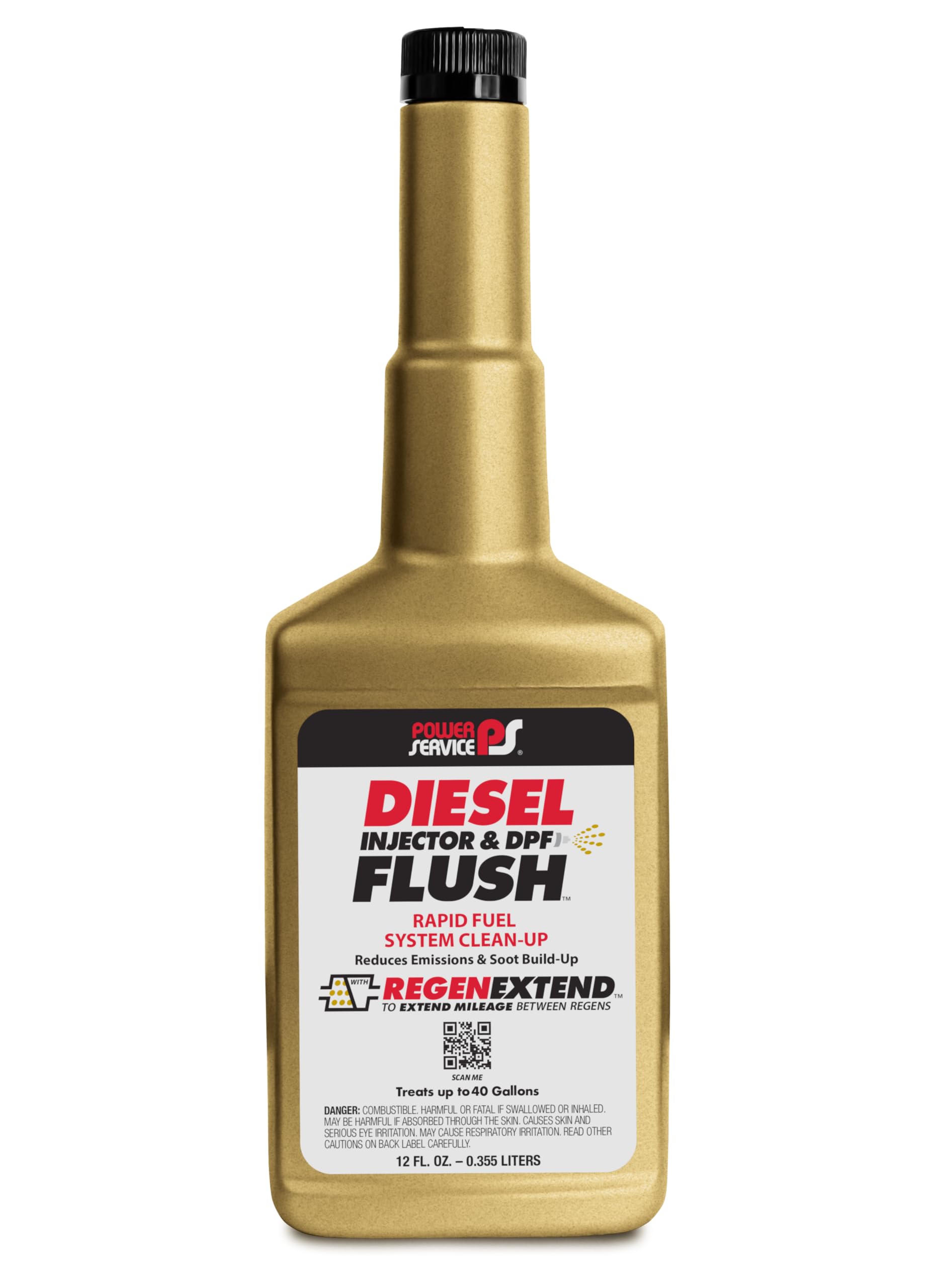
2. Power Service Diesel Injector & DPF Flush – 12 Ounce
A single-tank flush designed to clear stubborn injector deposits in one go.
Power Service calls its technology REGENEXTEND, and the claim is big: it reduces the frequency and duration of regenerations by up to 50%. This is a shock treatment — you pour the entire 12-ounce bottle into a single tank of fuel. The 12-ounce bottle measures 10.09 x 3.39 x 1.97 inches, making it noticeably longer and flatter than the other bottles here, but it’s still easy to store. The maker says it removes both internal injector deposits and nozzle coking (the hard carbon that builds up on injector tips) in a single tank, while also cutting emissions including NOx and black smoke by up to 50%.
On the road, owners mention that this is the real deal. One 2006 Duramax LBZ with 240,000 miles ran the flush once and, as buyers put it, “runs like new again” — idling quieter, smoking far less under acceleration, with noticeably smoother power delivery and better MPG. Another 2008 Duramax owner found that the product even fixed a stuck fuel gauge after two months; the gauge showed full for the first time in years. The same owner reported fuel economy improved by roughly 2 MPG. A few note that on first use at high RPM, a little tailpipe smoke appears for about a minute as the system clears out. That is the cleaner working, not a problem.
The strong consensus is that this is a highly effective single-use product. The downside, if you can call it one, is that it is designed as a one-and-done treatment — it is not meant for every fill-up. For a heavy clog that has already triggered the DPF light, this is the bottle to reach for.
The strong suit: One tank, one bottle, and customers note idling quieter, smoking less, and regaining lost power — even on 240,000-mile engines.
The catch: Not formulated for ongoing maintenance use; if you want a product to add every fill-up, look at a full-time additive instead.
Best for: a DPF that is already clogged and triggering a warning light — the single-tank shock treatment clears heavy buildup fast.
skip it if: you prefer a low-dose additive you can run continuously; this is a flush, not a maintenance dose.
3. Rislone 4744 DPF Clean – 16.9 oz
The go-to for VW TDI owners who need to clear a check engine light.
Rislone takes a slightly different approach: it lowers the ignition temperature inside the DPF itself, so the soot burns off at normal driving exhaust heat instead of requiring a forced high-idle regeneration. The 16.9-ounce bottle is designed to be used every 5,000 miles as a tune-up for the entire exhaust system, including the DOC (Diesel Oxidation Catalyst) and SCR (Selective Catalytic Reduction) devices. The maker specifically says it clears P242F and other OBD codes — a common DPF-related fault.
VW TDI owners are the most vocal fans here. A 2014 VW Jetta TDI at 140,000 miles had its check engine light cleared after using two bottles 500 miles apart. The owner reports the light never returned and plans to treat every 4,000 miles going forward. Another owner says it “saved me a huge repair bill on my VW Passat.” The formula works with all diesel types — ULSD (Ultra Low Sulfur Diesel, the standard US pump fuel), biodiesel blends from B2 to B20, and off-road diesel. The maker also confirms it will not void a manufacturer’s new vehicle warranty.
What stands out is the engine check light performance — it is the most-discussed aspect, and while most owners find it resolves the code, a smaller number report needing a second treatment. The positive takeaway is that Rislone works best as a preventive maintenance routine. If you drive a European diesel or a TDI and want to keep the DPF clear between oil changes, this is the additive that gets the job done without needing to remove anything.
Strengths: Specifically targets the P242F code common on TDI engines; safe for all diesel types including biodiesel blends and does not void manufacturer warranty.
Fit note: Some users find it takes a second bottle to fully clear a persistent CEL — plan for two treatments if the light is already on.
Reach for this if: you drive a VW TDI or European diesel and the check engine light is already flashing — it is purpose-built to clear those codes.
Look elsewhere if: you need a single-dose shock treatment; Rislone works best as a scheduled 5,000-mile maintenance habit.
4. Lucas Oil 10873 Diesel Deep Clean – 64 Ounce

A full 64-ounce jug designed for continuous use, with measurable soot reduction.
Lucas Oil claims its Diesel Deep Clean reduces particulate matter by up to 32% — a number that comes straight from the maker’s published data. The 64-ounce jug is easily the largest container here, and it is meant for full-time use. You pour it into every tank or every other tank, not as a one-time flush. The formula removes and dissolves exhaust deposits that could plug the filter, and it also cleans fuel injectors as a side benefit.
The review data here is hard to ignore. One 2023 Ram 2500 with a 6.7L Cummins had a clogged DPF that the dealership quoted to replace. The owner used the full 64-ounce bottle in a 30-gallon tank, performed a stationary regen, and drove 30 miles. The DPF gauge went from full to 0%. Another owner driving a 2024 Escalade diesel says the difference was instant — improved throttle response immediately on the highway. A Range Rover td6 owner uses it every fourth fill-up and reports consistent gains in throttle response and smoothness. On fuel mileage, the data is equally compelling: one owner saw regen intervals improve from 200 miles between regens to 325 miles after a single treatment.
The sheer volume of positive feedback — over 600 ratings — makes this among the most trusted products in the category. The mixed note comes from value: at this size and price point, some shoppers wish the bottle were even more concentrated. But for anyone running a heavy-duty diesel truck or a large fleet and wanting a product they can measure by the gallon, Lucas delivers a very strong cost-per-dose advantage.
The big win: A 64-ounce container that works as a continuous additive — reviewers point out regen intervals improving from 200 to 325 miles, after a single treatment.
The honest note: The jug is large. For a single-vehicle household, it might feel like a multi-year supply. That is only a problem if you prefer small doses.
Best for: Ram Cummins, Duramax, and Power Stroke owners who want a full-time additive in bulk and measurable soot reduction.
Consider another: if you drive a small diesel car and only need a 16-ounce bottle once a year — this jug is overkill for light use.
5. Liqui Moly Pro-Line Diesel Particulate Filter Cleaner – 1 Liter

A professional spray cleaner for removing the DPF and cleaning it yourself.
Liqui Moly’s approach is fundamentally different from the others on this list. This is not a fuel additive. It is a spray-on chemical cleaner that you apply directly to the DPF after removing it from the vehicle. The 1-liter bottle is designed for closed diesel particle filters on passenger vehicles, commercial vans, and trucks — explicitly including Cummins, Duramax, and Sprinter vans. The liquid dissolves the typical ash and soot contamination that rob the vehicle of performance.
Sprinter van owners are the biggest fans here. The procedure is well-documented on YouTube: you use a hand-held garden sprayer with a copper tubing tip to apply the cleaner into the filter, let it soak, then rinse. A 2014 Sprinter at 160,000 miles had its P242F error code cleared by this treatment. That owner did note that after about a year and 10,000 more miles, the code came back, which is normal for a high-mileage filter — they simply bought a second bottle and planned to reapply.
The trade-off is clear: this is not a pour-and-go solution. It requires you to remove the DPF (or at least access it), apply the spray, and let it work. That makes it a weekend wrenching project. But for owners who are comfortable with basic tools, this delivers the most thorough clean possible — dropping soot and ash levels to nearly zero, as buyers put it — and is far cheaper than a professional shop treatment.
Pros: The deepest clean of any product here — shoppers say soot/ash levels dropping to almost zero after a DIY spray treatment; far cheaper than a dealer DPF cleaning.
Cons: Requires removing the DPF from the vehicle and using a garden sprayer. Not a quick pour-and-go additive.
Reach for this if: you are comfortable removing your DPF and want the most thorough clean possible, especially on a Sprinter van or Cummins.
Look elsewhere if: you want a simple fuel additive you pour into the tank — this one requires tools and an afternoon.
6. Wynn’s Diesel Particulate Filter Regenerator – 500ml
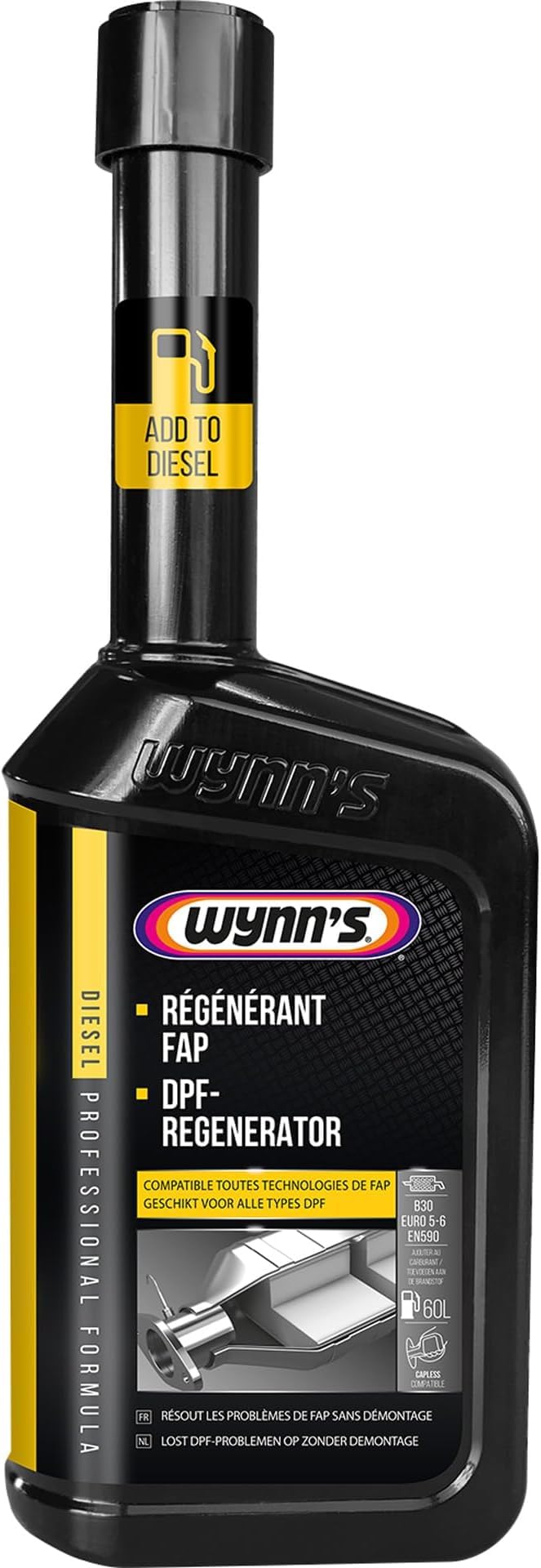
A professional-grade regenerator that cuts soot without dismantling the filter.
Wynn’s DPF Regenerator is described by the maker as a chemical treatment for professional use — it is designed to clear a blocked particulate filter without taking it off the vehicle. The 500ml bottle works by reducing the combustion temperature of soot so that the particles burn faster and at a lower temperature inside the exhaust. That means a blocked filter can begin to clear itself during normal driving rather than requiring a forced high-idle regen.
One owner ran a careful before-and-after test and found that the regen interval increased from 384 miles to 462 miles — a gain of 78 miles per regen cycle. They also noted improved injector balance and a reduction in idle fuel injection from 9mm to 8mm. Soot levels dropped to just 2 grams. Another owner reports the van “ran like someone put a new motor” after treating the fuel. The product measures 5.91 x 3.94 x 3.94 inches, a compact bottle that stores easily in a tool box or van storage cubby. The overall rating of 4.4 stars across 800+ ratings confirms consistent results across many diesel vans and trucks.
There is one point of caution from the Wynn’s crowd: follow the dosage exactly. The bottle is designed for 500ml per 10.6 gallons of fuel. One owner accidentally diluted it in 26 gallons and got less dramatic results. Stick to the recommended ratio and you get measurable regen interval gains without any check engine lights or adverse effects. The product is labeled for professional use, but any DIY owner can handle it — just measure carefully.
Measured result: Regen intervals improved from 384 to 462 miles in documented testing — a 78-mile gain per cycle — with soot dropping to 2 grams.
Dosage note: You must follow the 500ml-per-10.6-gallon ratio carefully; over-dilution reduces effectiveness.
Best for: fleet operators or van owners who want measurable, repeatable regen interval improvements from a professional-grade product.
pass on it if: you want a multi-purpose fuel system cleaner — Wynn’s is strictly a soot burner, not a fuel injector cleaner.
7. MotorPower Care DPF Filter Purge Additive 2-Pack

A two-bottle value pack for pickup owners who need a simple DPF purge.
MotorPower Care’s DPF Purge Additive comes as a two-pack of 16.9-ounce bottles (30.8 fluid ounces total). The product is straightforward: you pour one bottle into the fuel tank and drive at higher RPM in a lower gear — essentially getting the exhaust hot enough to help the additive work. The maker’s claim is simple: keep the DPF clean from carbon and soot, and improve fuel economy as a result.
Owners with modern heavy-duty pickups report exactly the results you want. A 2022 Ram 2500 with a check engine light for excessive regen frequency used one bottle in a quarter-tank of fuel. The regens stopped, the light went off, and the owner saved hundreds of dollars versus a dealership visit. A 2016 Nissan Titan XD needed two cans over two full tanks to clear a low particulate filter threshold code, but after three weeks the light had not returned. On the farm side, one owner reports reduced regen frequency on a diesel NH farm tractor — a strong sign that the formula works on both on-road and off-road equipment.
The two-pack format is the biggest selling point: you get two full treatments for roughly the same cost as a single bottle of some competitors. The main feedback from owners is that a stubborn code may need both bottles, so do not expect a single dose to always do the job. Plan for a full two-tank treatment if your DPF light is already solid.
Value angle: Two treatments in one purchase at an entry-level cost — owners of Ram 2500s and Nissan Titan XDs report cleared codes and stopped regens.
What to expect: A persistent DPF code may require both bottles across two full tanks; this is not a single-dose miracle for heavy clogs.
Reach for this if: you own a modern heavy-duty pickup (Ram, Ford, Chevy) and want a budget-friendly two-treatment pack for preventive maintenance.
Look elsewhere if: you need a guaranteed single-dose fix for an already-clogged filter — this works best as a prevention or a two-tank treatment.
8. Nitrox Clean Cat DPF Catalytic Converter & Diesel System Cleaner – 17 fl oz
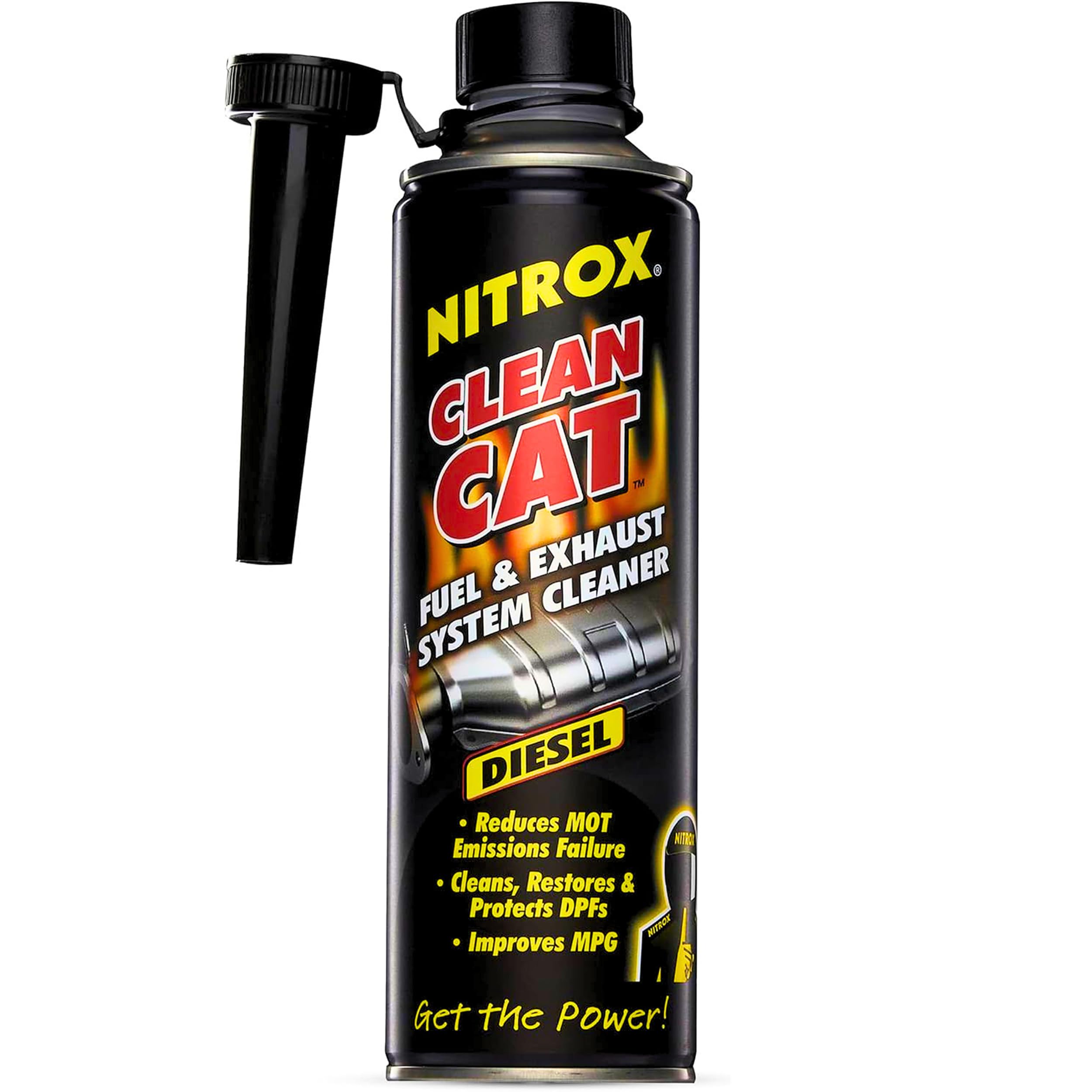
A multi-purpose cleaner aimed at passing smog tests and clearing DPF lights.
Nitrox Clean Cat markets itself as a system that cleans the catalytic converter, DPF, and fuel system all in one pour. The 17-ounce bottle works by dissolving harmful carbon and resin deposits throughout the engine and exhaust. The maker’s primary claim is that it helps you pass emissions tests, and that is the crowd it attracts — owners preparing for a government MOT or smog check.
One owner reports that the DPF light on their dash turned off after a single treatment. They poured the bottle in, drove at 3,000 RPM for a short time, and the light went out. The same owner says they will use it every other month as a preventive measure. Another reports their car passed an MOT test with no emissions issues and runs more smoothly. The 17-ounce bottle measures 2.56 x 2.56 x 8.82 inches and weighs 1.1 pounds, a compact and easy-to-store shape.
The honest picture: this product gets more mixed feedback than the others on this list. One owner tested it carefully on a 200,000-mile stock diesel truck and found that a 500ml dose in 22 gallons of fuel actually shortened the regen interval from 384 to 324 miles — meaning the filter cleaned less effectively than expected on that particular truck. A second, more concentrated test (500ml in 11 gallons) improved the interval to 402 miles. The lesson is that dosage matters a lot with this formula, and for heavy clogs it may not be the strongest option. For a light maintenance dose or a quick emissions test prep, it works well enough. For a fully blocked filter, choose one of the higher-concentration products above.
Good for: A quick emissions test prep — buyers report passing MOT and smog tests after a single pour, and the DPF light turns off.
Mixed results: On high-mileage trucks, the regen interval improvement depends heavily on correct dosage; a too-light dose can actually underperform.
Best for: a light preventive treatment before an emissions test or smog check — it clears carbon and helps the car run clean for the test.
Consider a stronger option: if your DPF is already clogged and causing a recurring warning light, the Power Service or Lucas products will give more reliable results.
Understanding the Specs
Regeneration Cycle Reduction
This is the most useful number on any DPF cleaner. A regen cycle is when your engine injects extra fuel to raise exhaust temperature and burn off trapped soot. Products like Power Service and Hot Shot’s Secret claim a 50% reduction in regen cycles — meaning your truck goes twice as long between those heavy-idle cleaning events. Fewer regens save fuel and reduce wear on the engine oil. If a product does not state a regen reduction percentage, it is likely a general fuel conditioner, not a dedicated DPF cleaner.
Cetane Rating Boost
Cetane is the diesel equivalent of octane in gasoline — it measures how easily the fuel ignites under compression. A higher cetane rating means the fuel burns more completely, leaving less unburned carbon to turn into soot in the DPF. Additives like Hot Shot’s Secret boost cetane by up to 7 points. A higher cetane number also reduces ignition delay, which helps the engine start cleaner and run smoother. For DPF maintenance, a cetane boost is a preventive measure — it stops soot from forming in the first place, rather than cleaning it after it has accumulated.
FAQ
Can a diesel additive really clean a clogged DPF without removing it?
How often should I use a DPF cleaning additive?
Will a DPF cleaner fix the check engine light (CEL) for a P242F code?
Is it safe to use a DPF cleaner on a brand new diesel truck?
What is the difference between a fuel additive and a DPF cleaner?
Can I use a DPF cleaner in a biodiesel or off-road diesel engine?
Will a DPF cleaner improve my fuel economy?
Can I use too much DPF cleaner?
How long does it take for a DPF cleaner to work?
What causes a DPF to clog in the first place?
Final Thoughts: The Verdict
For most people, the diesel additive to clean dpf winner is the Hot Shot’s Secret Fuel Duo because it combines a dedicated soot-reducing treatment with a cetane boost that prevents future deposits — all backed by over 800 ratings and a 4.7-star average. If you want a single-tank shock treatment for an already-clogged filter, grab the Power Service DPF Flush. And for VW TDI owners who need to clear a check engine light, the Rislone DPF Clean is the one to reach for.
How We Picked
We do not accept paid placement. Every pick is matched to a real buyer and a real use-case; we do not hands-on test units.
Sources & Methodology
Specifications: manufacturer listings and product documentation. Review insights: verified customer reviews, as of July 2026. Pricing: not shown on this page (it changes often); check the current price via the retailer link.
As an Amazon Associate, Trending Car earns from qualifying purchases. This does not affect which products we feature.