
Our readers keep the lights on and my garage snacks stocked. As an Amazon Associate, I earn from qualifying purchases.
Specs are compiled from manufacturer listings and verified buyer reviews and can change over time — please confirm the key details on the product page before buying.
An electronic boost controller (a small computer box that manages how much air your turbo pushes into the engine) is what turns a turbo that spools lazily into one that delivers consistent, repeatable boost pressure—no spikes, no sag, no guessing. You want boost you can trust at every rpm, and these six controllers actually hold their settings so you can tune with confidence on your forced-induction project (any car with a turbocharger and a wastegate).
I’m Min Islam — the founder and writer behind Trending Car. This guide is built by comparing the manufacturers’ published specifications and the patterns across verified customer reviews, so you get each pick’s real strengths and trade-offs instead of marketing spin.
The best way to shop for a best electronic boost controller is to match the unit’s features—duty-cycle control (how long the solenoid stays open to hold boost), boost-by-gear capability (varying boost level per gear for traction), and safety cutoffs (automatic power reduction if boost overshoots)—to your power goals and daily driving habits.
Our Picks at a Glance

How To Choose The Best Electronic Boost Controller
Picking the right electronic boost controller depends on understanding what each feature actually does for your setup. Here’s what to look at before you buy.
Boost Control Method: Solenoid vs. Stepper Motor
Most controllers use a solenoid (an electrically controlled valve that opens and closes rapidly) to bleed air from the wastegate signal (the small hose that tells the wastegate when to open), letting you raise boost above the spring pressure. Solenoid-based controllers are simple, responsive, and widely supported. Stepper-motor controllers (using a motor that moves more precisely in increments) offer finer resolution but are rarer. For a street-driven turbo car, a good solenoid-based unit is all you need.
Duty Cycle and Gain Control
The duty cycle is the percentage of time the solenoid stays open versus closed. A higher duty cycle generally lets the wastegate open later, producing more boost. Gain settings let you adjust how aggressively the controller responds to changes—important for eliminating boost spikes (a sudden surge of excess boost that can damage the engine). The best controllers let you tune both independently for a smooth, stable curve.
Safety Features
Look for an overboost alarm (a warning light or sound that triggers if boost exceeds a chosen limit), a peak-boost memory (stores the highest boost reading), and a fuel-cut (engine fuel shut-off) or ignition-cut failsafe (engine spark shut-off). These features automatically reduce or cut power if boost exceeds a safe threshold, protecting your engine during tuning. Controllers with a programmable boost-cut safety—referencing air/fuel ratio (the mixture of air and fuel in the cylinders) and pressure—add an extra layer of protection.
Quick Comparison
| Model | Best For | Display Type | Boost Settings | Key Feature | Amazon |
|---|---|---|---|---|---|
| GReddy Profec★ Best Overall | Overall Performance | OLED | Three graph settings | Redundancy and build | Amazon |
| AEM Tru-Boost KitPremium Pick | Complete Gauge Kit | 24 scalable LED | Two | Overboost alarm + timed shutdown | Amazon |
| AEM X-Series Tru-BoostX | Slim Panel Mount | 24 green outer LED | Two + scramble | On-board 80PSIg MAP sensor | Amazon |
| Turbosmart e-Boost 40 | Street Performance | Turn-and-push | Two + external switch | Holds boost past 9000 rpm | Amazon |
| Innovate SCG-1 | All-in-One Safety | OLED user configurable | Programmable | Boost cut via Air/Fuel + Pressure | Amazon |
| Turbosmart e-Boost2 | Advanced Tuning | Auto-dimming display | Up to 6 levels | Gear-based mapping | Amazon |
In‑Depth Reviews
1. GReddy (15500214) Profec Electronic Boost Controller
Our pick — over 4.5★ from 100+ verified ratings; the strongest balance of quality and price.
The Japanese classic that delivers surgical boost control without the learning curve of a standalone ECU (the main engine computer).
The GReddy Profec is the crowd favorite here, and for good reason. Its OLED display (a bright, high-contrast screen that uses organic light-emitting diodes) shows boost across three different graph views, giving you real-time feedback as you dial in the settings. Once wired correctly—a modest one-time effort—it holds pressure with the kind of consistency that inspires confidence at wide-open throttle. The build quality is the thing owners praise most, and the unit earns a spot in the top spot because it just works. Buyers report it is comparable, if not better, than the Turbosmart Eboost 2 controller, at least in terms of display clarity and overall feel.
That said, the setup takes a bit of knowing to figure out; this is not a plug-and-play device for someone who has never touched a boost controller before. The 80°C operating temperature (the maximum environment temperature for safe use, 176°F) and all-plastic housing mean it should live inside the cabin, not the engine bay. The reward for that initial tinkering is a controller that rivals units costing significantly more.
Why It Earns the Top Spot
- Three different graph views on a crisp OLED screen—you see boost behavior, not just a number.
- Build quality is the standout praise, with owners calling it “great” for its redundancy and precision.
- Wiring is straightforward; once dialed in, it holds boost perfectly.
The Fine Print
- Setup requires some tuning knowledge—owners mention it takes a little playing with to get right.
- Plastic housing and 80°C rating suggest a cabin install, not under-hood.
Reach for it if: you want proven reliability and a high-contrast display that makes real-time tuning easy. It is the strongest all-rounder on this list.
Look elsewhere if: you need an under-hood controller or you want plug-and-play simplicity from the first crank.
2. AEM 30-0352 Tru-Boost Controller Gauge Kit
A controller, gauge, and boost solenoid in one box—everything you need to see and control boost live.
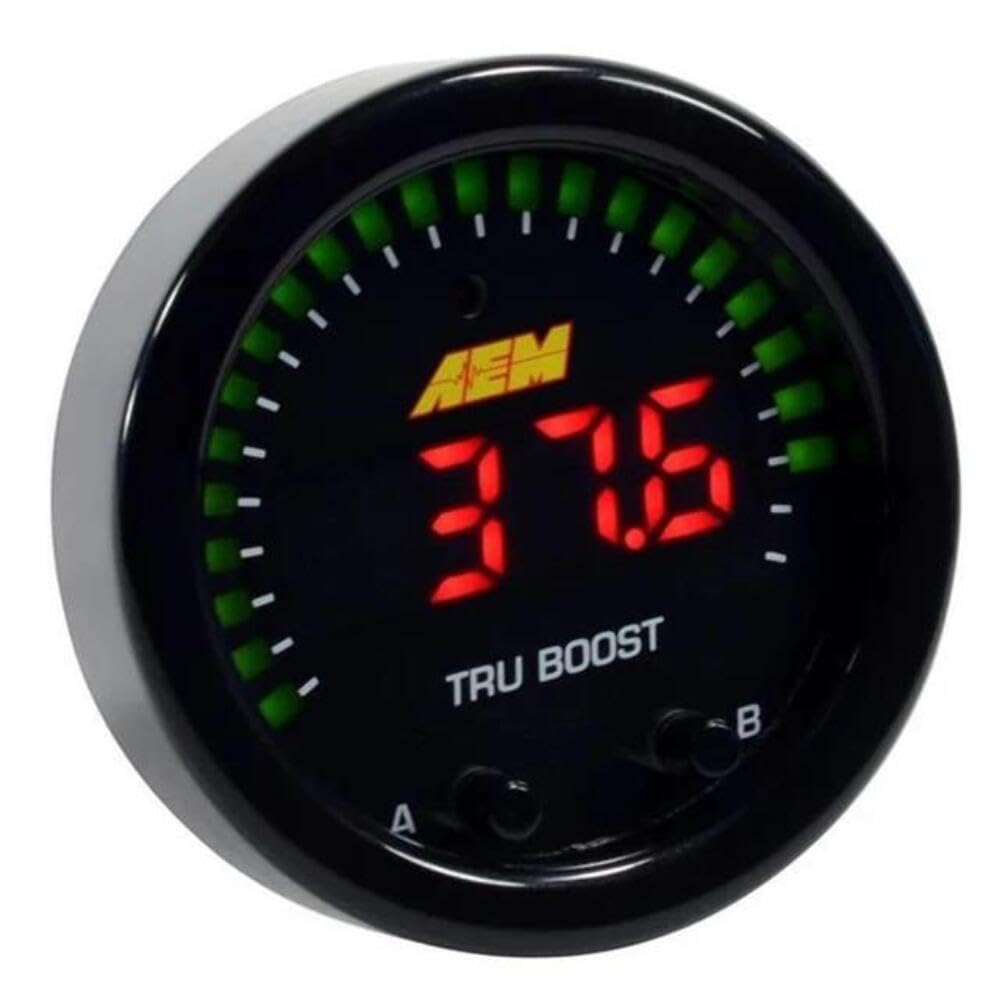
The AEM Tru-Boost is a complete system with a harness (the wiring loom), boost hose (the vacuum line connecting the solenoid), an on-board 29 psig pressure sensor (a sensor that measures boost at 29 pounds per square inch gauge, relative to atmospheric pressure), and a solenoid, so there is no hunting for missing parts. It measures up to 29 psig of boost and lets you switch between two boost settings instantly at the push of a button, even while driving. The user-configurable gauge has 24 scalable LEDs, plus interchangeable bezels and faceplates for a custom look. Quality and boost control are the top praises here, and the included overboost alarm with two timed shutdown levels (a warning at 10% overboost, then a power cut at 20% overboost, according to the manufacturer) gives real engine protection.
The main trade-off is the two-button programming—it works great once set, but it takes several tries to dial in the exact boost numbers. Customers note that all controls and settings are entered through just two buttons, which has a learning curve. Still, for a standalone kit that includes everything from the sensor to the fittings, it is tough to top the value of a system that is “real good stuff” according to long-term owners using it on heavy builds like 2010 turbo SS Camaros.
All-in-One Convenience: No extra parts to buy—the harness, gauge, solenoid, and fittings are in the box. Once tuned, it holds boost reliably with an easy-to-read gauge display and that useful overboost shutdown.
Grab it for: a clean install that combines gauge and controller in one unit, with the safety net of a timed overboost cutoff. The 24-LED gauge is bright and readable.
Pass it up for: a simpler, knob-based controller if you dislike menu-diving with two buttons for initial setup.
3. AEM 30-0352 X-Series Tru-BoostX Gauge

An 80-PSI sensor in a gauge that is shallow enough to mount nearly anywhere in your interior.
The X-Series Tru-BoostX fits where other controllers cannot. With a slim 0.825-inch overall gauge depth and a 0.200-inch cup depth (the depth from the mounting surface to the back of the gauge), you can mount it in tight gauge pods or custom panels. The 52mm diameter is the standard size for most aftermarket pods, so it drops in easily. On the inside, an on-board 80PSIg MAP sensor (a Manifold Absolute Pressure sensor that reads boost up to 80 pounds per square inch gauge, so you do not need a separate upgrade for high-boost setups) means no upgrade kit for high-boost vehicles, and the 24 green outer LEDs give you a quick reference of what the engine is doing at a glance. It has two boost level settings plus a scramble boost setting for a temporary overboost.
The honest downside here is reliability. Several reviewers point out units failing after 14 months—just past the 12-month warranty—with AEM refusing to repair them. As one buyer put it, the unit “died after 14 months and AEM has abandoned their products and refuse to repair like they used to.” If you need guaranteed long-term support, this is a risk to weigh. The AEMnet CANbus capability (a data network standard for aftermarket sensors and ECUs) is excellent for a standalone CANbus system, but the post-warranty situation is real.
Ultra-Slim Packaging: You get an 80PSIg sensor, two boost settings, a scramble mode, and CANbus connectivity all in a gauge that is barely deeper than a standard pod. The trade-off is the post-warranty support concerns.
Choose it for: a compact controller with huge sensor headroom and CANbus data output for logging. The slim depth is ideal for custom mounting.
Skip it for: confidence past the first year—look at the GReddy Profec for proven longevity instead.
4. Turbosmart TS-0302-1002 e-Boost 40 PSI STREET Boost Controller

The controller that solved a boost-drop problem above 5500 rpm on a custom turbo rotary—and it was an easy fix.
The Turbosmart e-Boost 40 is aimed at the street performance market and delivers class-leading boost control at a reasonable price. It comes with the control unit, wiring loom, solenoid with mounting bracket, vacuum fittings, hose, and clamps—everything you need for a clean install. One notable real-world result: it holds boost all the way to 9000 rpm on a custom turbo RX8 that was losing pressure above 5500 rpm. That kind of high-rpm stability is what this unit does best. It offers two boost settings easily selected via the turn-and-push button, plus an external switch input for changing between boost groups.
Functionality is the top praise, but installation gets mixed feedback. Some owners find it easy to set up, while others note the setup is complicated initially. The controller is not as fancy as newer units with full-color displays, but it works well and comes with an impressive array of fittings and adapters. The built-in scramble mode is there but untested by many buyers, so that feature is a bonus rather than a guarantee.
What Wins People Over
- Holds boost at high rpm—proven on a 9000-rpm rotary build where others fell off.
- Complete kit with solenoid, bracket, and all vacuum fittings included.
- Two boost settings plus external switch option for easy on-the-fly changes.
The Reality Check
- Initial setup is not intuitive—shoppers say a learning curve with the programming.
- Display is basic compared to OLED rivals, though it gets the job done.
Best for: a high-rpm turbo build where holding boost at the top of the rev range is the goal. The included fittings make the install straightforward for a mechanic.
Not ideal for: a buyer who wants a flashy OLED display or plug-and-play simplicity without reading the manual.
5. Innovate Motorsports SCG-1 Boost Control KIT, White, 52mm
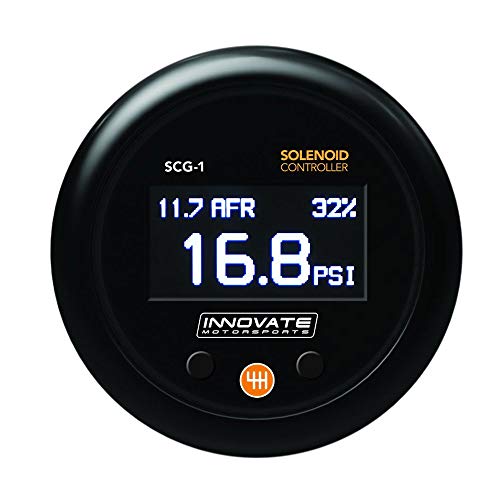
A boost controller, wideband gauge (sensor that measures air/fuel ratio), and shift light in one package—plus a fuel-cut failsafe using air/fuel ratio.
The Innovate SCG-1 is a 3-in-1 unit that combines a wideband O2 controller (a sensor that reads the exact air-to-fuel mixture in the exhaust), a boost gauge, and a boost controller in a single 52mm gauge. It uses a 4 BAR MAP sensor covering a pressure range from -29 inHg to 43.5 PSI (-1 to 3 BAR, so it reads from full vacuum to high boost), so it handles everything from deep vacuum to serious boost. what separates it is the user-programmable boost cut safety that references both air/fuel ratio and pressure—if the engine leans out (gets too much air, causing high temperatures) or boost spikes, the controller can cut power to protect your motor. No PC is required for configuration; the OLED user configurable display handles all setup, though data logging does need a computer. The solenoid ramping (how gradually the solenoid opens) is excellent for shaping the boost curve smoothly.
The mixed feedback here centers on boost control consistency. Some buyers report that the duty cycle and gain controls take real effort to dial in, wishing for a closed-loop option (an automatic feedback system that self-adjusts) that would auto-adjust. There are also scattered reports of sensor failures after several months, with some buyers feeling Innovate’s support was unhelpful. The majority of long-term users are happy—one called it “the best controller on the market” with the caveat that it takes fighting with the settings—but the inconsistency is real enough to note.
Feature-Packed All-in-One: For the price of a controller alone, you get a wideband sensor, boost controller, gauge, and shift light. The boost-cut safety using air/fuel ratio is a genuine engine-saving feature. The trade-off is the tuning effort required and some reliability concerns.
Ideal for: a tuner who wants a fully integrated safety system—wideband, boost control, and fuel-cut in one gauge. Great for engine protection during development.
Avoid if: you want a simple set-and-forget controller. This one demands ongoing attention to duty cycle and gain settings.
6. Turbosmart TS-0301-1003 e-Boost2 Black/Black 60 mm Sport Compact Boost Management System
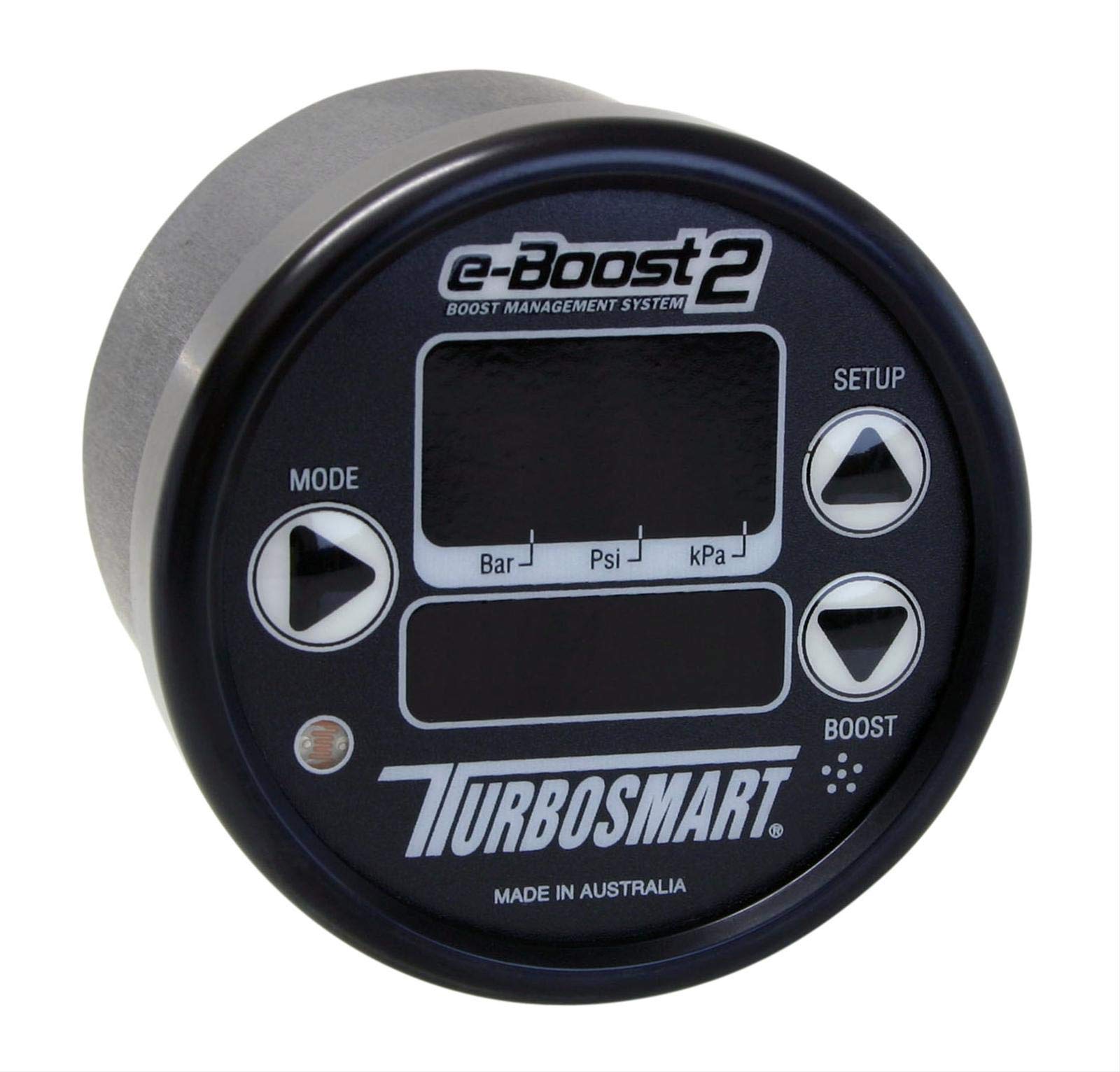
Gear-based boost mapping—up to six boost levels that adjust based on which gear you are in.
The e-Boost2 is the most sophisticated controller here. It offers up to 6 levels of boost, adjustable against time or engine revolutions per minute (rpm), plus fully programmable auxiliary output (can control extra functions like a water-methanol injection system). The gear-based mapping is the killer feature: it lets you run high boost in third, fourth, and fifth gears while keeping it tame in first and second for traction. The 60mm display auto-dims for all lighting conditions and the controls are intuitive—as one owner noted, it does not require “cranking a knob” to adjust. The unit is constructed from aluminum, plastic, and stainless steel, and it weighs 1.5 pounds.
The reality is that this is a premium product for advanced users, and it has the lowest average rating here mainly due to isolated quality-control issues and the 60mm size. The 60mm gauge does not fit standard 52mm pods (common aftermarket gauge holders)—you will likely need to modify your panel. There is also a non-trivial number of reports about defective units from the start, and Turbosmart’s warranty handling (requiring an RMA through Centerforce Clutches) adds friction. The boost control itself, when working, is excellent and praised for its precision.
The Advanced Advantage
- Gear-based boost mapping gives you traction-limited low gears and full power in high gears.
- Auto-dimming display is easy to read in all light, and the turn-and-push dial is much simpler than two-button menu systems.
Worth Noting
- 60mm gauge requires a larger pod or panel modification—it does not drop into a standard 52mm slot.
- Inconsistent quality control: some units arrive defective, and warranty support is slow.
Perfect for: a serious tuner who wants gear-by-gear boost control and is comfortable modifying a gauge panel. The 6-level programming is class-leading at this level.
Avoid if: you want a simple drop-in controller without panel work. Also consider the GReddy Profec if reliability is the top concern.
Understanding the Specs
Solenoid & Duty Cycle Control
The solenoid is the valve that bleeds pressure from the wastegate signal. Duty cycle refers to the percentage of time this valve stays open—raise the duty cycle and the wastegate opens later, producing more boost. Good controllers let you adjust duty cycle and gain (how quickly the controller responds) independently, so you can eliminate boost spikes and shape the curve to your engine’s needs. Without this fine control, you either have fixed spring pressure or a boost curve that overshoots and then sags.
Boost-by-Gear & Scramble Mode
Boost-by-gear allows the controller to vary boost pressure based on which gear you are in. This is essential for high-power street cars: you can run moderate boost in first and second gear for traction, then let it climb in third and fourth. Scramble mode is a temporary overboost function—usually activated by a button or switch—that gives you a short-duration boost increase for passing or merging. Both features require a controller that can accept a gear-position signal or use an external switch input.
FAQ
What is an electronic boost controller and how does it differ from a manual boost controller?
Will an electronic boost controller work with my factory turbo setup?
What is the difference between two-port and three-port solenoids?
How do I set the duty cycle and gain on my boost controller?
Can I use a boost controller with a twin-turbo or compound turbo setup?
What does an overboost alarm or boost-cut safety do?
Why does my boost decrease at high RPM even with a good controller?
Is a gauge-mounted boost controller better than a separate unit?
Final Thoughts: The Verdict
For most buyers, the best electronic boost controller winner is the GReddy Profec because it combines a high-contrast OLED display (so you see boost behavior in real-time, not just a number), proven reliability, and a build quality that owners consistently trust—all without the premium price of the most complex units. If you want a complete gauge-and-controller kit with overboost protection (a safety shutdown at two levels, 10% and 20% overboost), grab the AEM Tru-Boost. And for high-rpm builds where holding boost past 5500 RPM is non-negotiable, the Turbosmart e-Boost 40 is the one to reach for.
How We Picked
We do not accept paid placement. Every pick is matched to a real buyer and a real use-case; we do not hands-on test units.
Sources & Methodology
Specifications: manufacturer listings and product documentation. Review insights: verified customer reviews, as of July 2026. Pricing: not shown on this page (it changes often); check the current price via the retailer link.
As an Amazon Associate, Trending Car earns from qualifying purchases. This does not affect which products we feature.