
Our readers keep the lights on and my garage snacks stocked. As an Amazon Associate, I earn from qualifying purchases.
Specs are compiled from manufacturer listings and verified buyer reviews and can change over time — please confirm the key details on the product page before buying.
You found the scratch — the kind you feel with your fingernail. The one that makes you wince every time you walk past the car. Fixing it depends on one honest choice: which compound actually cuts deep enough without burning through your clear coat or leaving a haze that needs two more products to fix. This guide sorts the real cutters from the fillers, using nothing but the raw specs and the thousands of owner hours behind each bottle.
I’m Min Islam — the founder and writer behind Trending Car. This guide is built by comparing the manufacturers’ published specifications and the patterns across verified customer reviews, so you get each pick’s real strengths and trade-offs instead of marketing spin.
Whether you are tackling a key-scrape on the door or a set of decade-old swirls in the sun, finding a deep scratch remover for cars that truly levels the paint and finishes glossy is the difference between a weekend project and an endless to-do list.
Our Picks at a Glance

How To Choose The Best Deep Scratch Remover for Cars
The real trick is matching the compound’s abrasiveness to your scratch depth and your tool. Grab a heavy-cut grit (around 120-1500) for deep gashes you can feel with your nail, but plan a finishing polish after because coarse abrasives leave micro-marring. A finer-grit one-step product (1200 grit and up) is smarter for shallow swirls you barely see — it corrects and glosses in one pass, saving you an hour of buffing. Your pad matters too: wool cuts fastest, foam finishes finest, and microfiber splits the difference. A rotary buffer lets aggressive compounds work fastest; a dual-action polisher is far safer for beginners because it almost never burns paint.
The Grit Number Tells You The Bite
A compound’s grit rating (like 120, 1000, or 1200) directly tells you how coarse the abrasive is. Lower numbers mean bigger, more aggressive particles that chew through deeper scratches faster. The trade-off is that a low-grit compound leaves a rougher surface behind, so you almost always need a second, finer polish to bring back the gloss. Higher grit numbers (1200 and up) are finer — they remove less material per pass but leave a shine you can drive away with immediately. Match the compound’s grit to your scratch depth: clear-coat-only scratches respond to compound, but scratches exposing primer or bare metal need touch-up paint first. If you see white or primer, no compound will fix it — that needs touch-up paint.
Quick Comparison
| Model | Best For | Grit Rating | Size (oz) | Finish | Amazon |
|---|---|---|---|---|---|
| Griot’s Garage Complete Compound★ Best Overall | One-step versatility | — | 16 | Glossy, wax-ready | Amazon |
| 3D ACA 510 Rubbing CompoundTop Performer | Finishing-like cut on hard clears | — | 8 | Polish-level gloss | Amazon |
| Meguiar’s M105 Ultra-CutPro Grade | Professional sanding-mark removal | — | 8 | High-gloss, swirl-free | Amazon |
| Menzerna Heavy Cut 1000 | Fast cutting action | 1000 | 8 | Glossy after follow-up | Amazon |
| Meguiar’s M04 Heavy Cut Cleaner | Oxidized & single-stage paints | — | 16 | Buffing rouge finish | Amazon |
| CARPRO Clear Cut | Long buffing time, low dust | 1200 | 17 | Polish-like finish | Amazon |
| Malco Super Duty Heavy Cut | Heavy oxidation & marine gel coat | P1500 sand scratch | 32 | High-gloss | Amazon |
| Malco Epic One-Step | True all-in-one correction | P1500 sand scratch | 16 | Mirror-like, swirl-free | Amazon |
| SONAX Profiline ExCut 05-05 | Heavy swirls & etching | P1500 sand scratch | 33.8 | Reflective high-gloss | Amazon |
In‑Depth Reviews
1. Griot’s Garage Complete Compound
Our pick — over 4.5★ from 2,500+ verified ratings; the strongest balance of quality and price.
The one-bottle solution that wipes off clean and leaves paint ready for wax.
What wins people over is how easily this compound works in a single step. Buyers report using it by hand or with a polisher, and paint comes out glossy without a secondary polish — the review pages sum it up: “Used this as a one step, didn’t even need to go with another polish as it restored the gloss on my car and eliminated most swirls.” Because it contains no silicone or fillers, the finish is honest: what you cut is what stays, and the surface bonds perfectly with wax or ceramic coating right after. The grit rating of 120 is aggressive enough for deep clear-coat scratches yet fine enough that many owners skip a finishing pass entirely. At 16 ounces for the price of an 8-ounce competitor, the value is hard to argue.
Buyers consistently praise its effectiveness, reporting that it makes cars look factory new. The gentleness is a mixed note for some, meaning on the softest clear coats it may cut a little too fast, so go easy with pressure on a Japanese or older single-stage paint. The compound is fast-wiping and leaves almost no dust, which keeps your garage clean.
What makes it a winner
- Single-step correction — no finishing polish needed for most jobs
- Fast-wiping, low-dust formula keeps cleanup easy
- 16 oz bottle holds twice the product of many competitors
The honest trade-off
- May cut too aggressively on very soft clear coats
- Best results come with a dual-action polisher, not hand application
Perfect for the DIY weekend warrior: one bottle, one step, and you are done — no second polish, no haze, no mess.
skip it if you need the absolute finest finish: pro detailers wanting a flawless, no-follow-up finish on soft paints should pair it with a fine polish afterward.
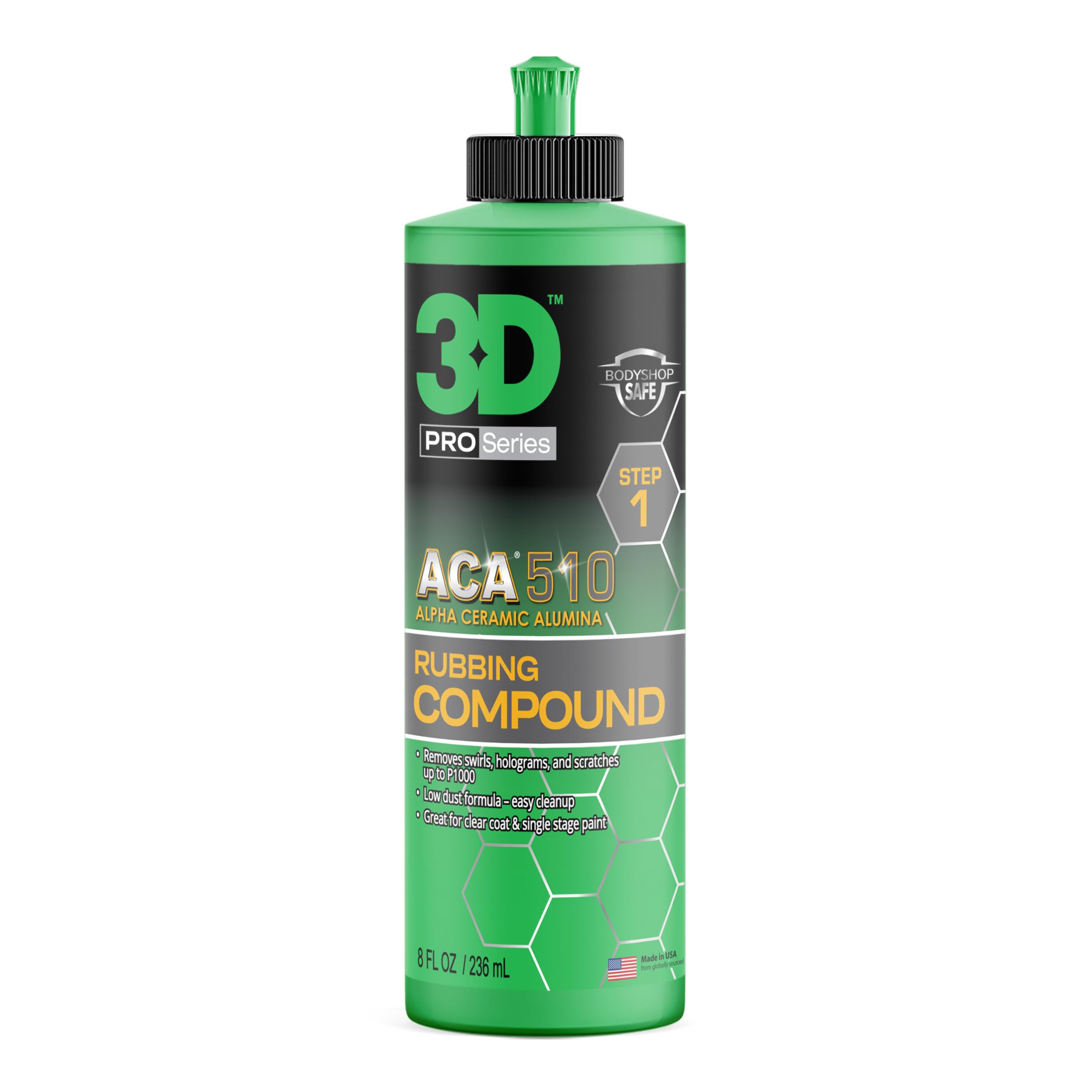
2. 3D ACA 510 Rubbing Compound
A ceramic-tech compound that finishes like a polish and creates almost no dust.
This is the crowd favorite among owners who have tried everything — 4.7 stars across hundreds of responses. The secret is Alpha Ceramic Alumina technology, an abrasive that levels paint faster and cooler than traditional aluminum oxide, so you can cut hard clears without worrying about heat buildup. Owners say it finishes like a polish, which means you can often skip the second step. The grit number is 1000, putting it squarely in heavy-cut territory, yet it leaves a smooth surface that needs no follow-up on many paints. One experienced detailer who uses it daily notes it is superior to Sonax, 3M, and Meguiar’s for this exact reason — it combines cutting power with a refined finish. The low dust formula is a real bonus; there is no compound spray across your garage floor.
The main caveat is that it uses more product per panel than some alternatives — one owner measured roughly one square foot per application. The ease of removal gets mixed feedback; dried streaks can be harder to wipe off by hand. Pair it with a wool pad for maximum cut or a foam pad for a finer finish, and it handles both rotary and dual-action machines equally well.
The catch for heavy users: you will go through the 8-ounce bottle faster than you expect, so buy two if you are doing an entire car.
Reach for this if you want show-car correction: the finish quality after ACA 510 rivals a two-step job from a pro shop.
Look elsewhere if budget is the main concern: the per-ounce cost sits above entry-level compounds.
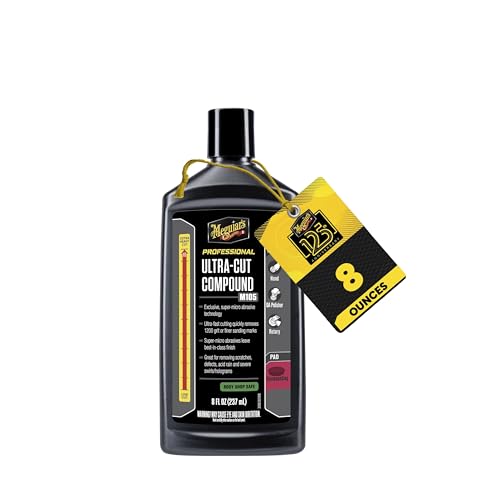
3. Meguiar’s Mirror Glaze M105 Ultra-Cut Compound
The pro-shop benchmark for removing 1200-grit sanding marks in a single pass.
This is the compound that detailers reach for when wetsanding marks need to disappear fast. With a grit rating of 1200, it is a micro-abrasive formula — fine enough to leave a high-gloss shine after cutting through moderate defects like acid rain etching and heavy swirls. Owners consistently report that a little goes a long way; it cuts faster than most compounds they have tried, and a single bottle handles multiple correction jobs. Unlike the Griot’s at 120 grit, M105 is finer, so on deeper scratches you may need two passes, but the final finish is so glossy that many users skip a second polish entirely. The crowd — over 10,000 owners — gives it a strong 4.5 stars, and the clear consensus is that it delivers professional results without needing a rotary buffer; it works by hand or dual-action polisher alike.
It works best on clear-coat scratches that “disappear when wet”; deeper scratches require a different tool. A few owners note that it can be a little dusty compared to newer ceramic compounds, and the 8-ounce bottle runs out fast on a full-car correction.
The standout spec: cuts through up to 1200-grit sanding marks, which is finer than the 1000-grit compounds and leaves a swirl-free surface immediately.
Ideal for the enthusiast with sanding projects: if you wet-sanded a repainted panel, this is the compound that brings the factory shine back.
Not for a quick hand-polish fix: hand application works but takes serious elbow grease — this compound shines brightest with a machine.
4. Menzerna Heavy Cut Compound 1000
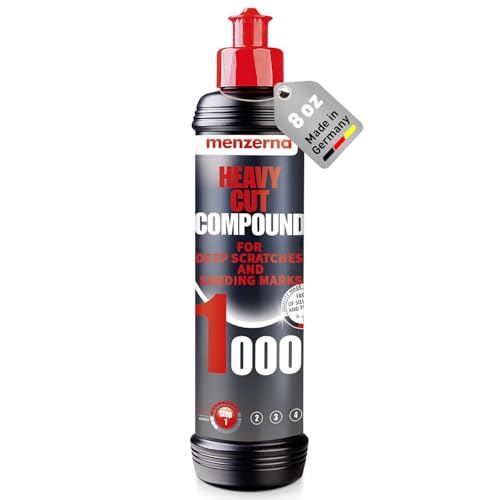
A fast-cutting compound that erased a granite-block scratch in one session.
Menzerna brings over 130 years of polish experience into an 8-ounce bottle. The Heavy Cut Compound 1000 uses a medium aluminum-oxide grit (rating 1000) that cuts noticeably fast — owners describe being impressed at how quickly it levels scratches after touch-up paint and wetsanding. One buyer who had a long, deep scratch from a granite block reported that it “took care of almost all of it.” The compound works with a rotary or dual-action machine on a foam pad, and some owners even got good results by hand with a cloth, which is rare for a heavy-cut product. The paint finishes glossy and flat after wiping. The 8.3 x 1.9 x 1.9-inch bottle is notably taller and narrower than the Griot’s container, which is roughly 5.1 times more compact in footprint.
The recurring gripe is noticeable dusting — 10 owners specifically mention it. It is heavier than compounds like the 3D ACA 510, so expect more cleanup after buffing. The 8-ounce bottle (half the weight of the Griot’s at 16 ounces) means you may need a second bottle for a full-body correction, and some owners wish the bottle was bigger.
The honest trade-off: cuts faster than most, but the dust means you will spend extra time wiping down panels.
Choose this when you need raw cutting speed: if you have deep scratches that already went through touch-up paint, this compound levels them fast.
Pass if you hate dust: the low-dust formulas from 3D or CARPRO are cleaner alternatives.
5. Meguiar’s M04 Heavy Cut Cleaner
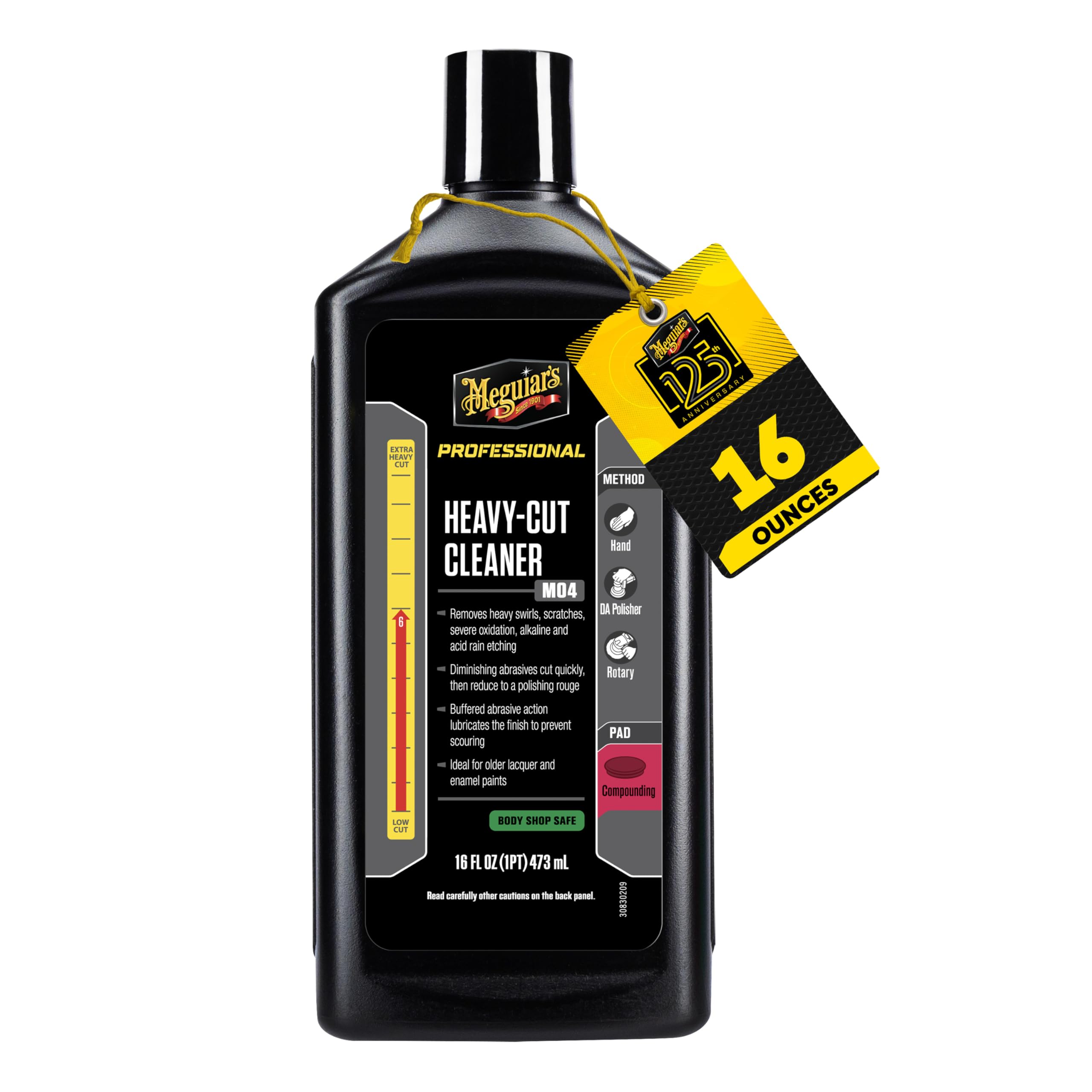
An aggressive paint cleaner purpose-built for older lacquer and enamel paints.
With a grit rating of 40 — the coarsest on this list by a wide margin — M04 is a serious abrasive. It is designed to cut through heavy oxidation, alkaline and acid rain etching, and the kind of deep swirls that milder compounds cannot touch. The formulation includes a buffered abrasive that starts cutting aggressively and then breaks down into a buffing rouge, so it minimizes further swirling as you work. Owners praise it for bringing classic cars back to life — one buyer with a heavily oxidized old classic reported being “surprised how the oxidation just cleared up and showed the original paint.” The 16-ounce bottle is generous, and the brand’s 125 years in the industry give confidence. It is clear-coat safe but really excels on single-stage paints where you need maximum cut without burning through.
M04 is designed for a rotary buffer only — it is not suitable for dual-action polishers or hand application. It is coarse enough that beginners can easily burn paint if they linger in one spot. The finish it leaves is not a final polish — plan a finer compound or polish afterward.
Think of it as surgical removal, not a quick shine: best for restorations where the paint is badly faded, not for a light scratch on a modern clear coat.
Perfect for the classic car restorer: if you are reviving a 20-year-old single-stage paint, this is the most effective value choice.
Stay away if you own a modern clear coat: the 40-grit abrasive is overkill and could do more harm than good.
6. Malco Super Duty Heavy Cut Compound
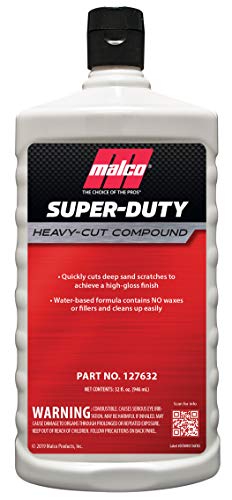
A 32-ounce workhorse that pro detailers grab for oxidized fleet vehicles and boats.
Malco’s Super Duty is a versatile heavy cutter that removes P1500 grit and finer sand scratches from automotive paint, marine gel coat, and industrial coatings. At 2 pounds and 32 ounces, it offers the largest volume on this list — nearly four times the 8-ounce bottles — making it the go-to for full-vehicle corrections. Owners who do cut-and-buff work daily report a night-and-day difference switching to this compound; one professional detailer noted that it “came out high polish finish and was easy to use.” It is clear-coat safe and body-shop compliant, with a grit material of wool meaning it pairs best with a wool cutting pad for maximum cut. The finish left behind is high-gloss, though many users follow with a fine polish for a show-car shine. The value for money and removability both score high with owners.
The downside is dusting — similar to the Menzerna, it leaves residue that needs wiping. Some owners note it is not ideal for soft clear coats; on those, the coarse grit can leave visible sand marks if you do not finish properly. It requires a rotary or high-power DA polisher to work effectively, not hand application.
Best for big jobs: the 32-ounce bottle means you are not running out halfway through a boat or an oxidized semi-truck.
Reach for this if you detail professionally: the volume and cut speed keep production moving on heavy corrections.
Skip it for a single scratch on a daily driver: the smaller 16-ounce Griot’s or Menzerna will be easier to store and use.
7. CARPRO Clear Cut Correction Compound
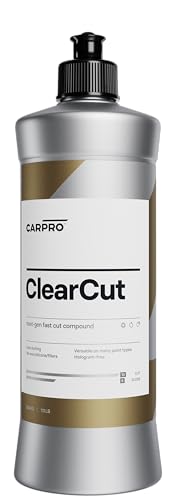
A next-gen compound that finishes down like a polish and creates almost zero dust.
CARPRO Clear Cut uses liquid abrasive technology that cuts fast (removing P1200 grit and finer marks) yet finishes down so well that you can follow it directly with a fine polish or even use it as a one-step on medium-hard paints. Owners who restored 27-year-old factory GM paint with a simple orange foam pad were impressed with the results. The compound is compatible with dual-action and rotary machines, and with foam, microfiber, and wool pads, giving it wide versatility. The consistent cut technology ensures predictable behavior from start to finish, so you do not get a sudden drop in abrasiveness mid-panel. It produces virtually zero dust, which is a massive advantage over the Menzerna and Malco heavy cutters. At 17 ounces, the bottle is generous for a premium compound.
It is on the expensive side, and a few owners reported spillage during shipping. One reviewer noted a little dust on longer passes, though “very minimal.” It works best with a machine — hand application is not recommended for this level of cut.
The low-dust edge: when other compounds coat your garage in a fine powder, CARPRO leaves your workspace clean.
Perfect for the detailer who values a clean workspace: low dust and long buffing time make panel-by-panel work stress-free.
Pass if you are on a tight budget: the value of the Griot’s Complete Compound is tough to top at half the price for similar results.
8. Malco Epic Heavy-Duty One-Step Compound
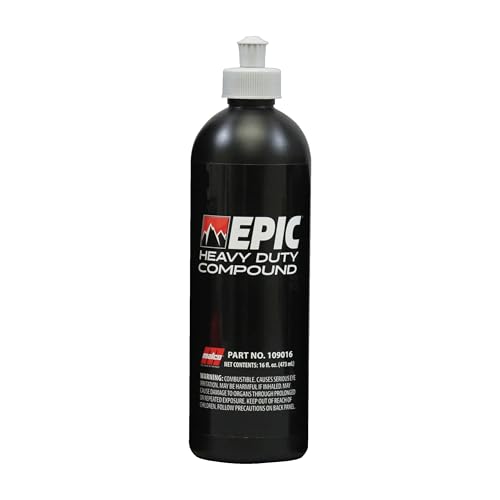
A true one-step heavy cut that breaks down into a polish as you work.
Malco Epic lives up to its name by combining heavy-duty cutting with a finishing polish in a single pass. It eliminates up to P1500 sand scratches, making it a strong candidate for correcting deep scratches on modern clear coats. The advanced formula breaks down as you buff: it starts as a heavy cutter and transitions into a polish, so you do not need a second bottle. Unlike many “one-step” products that hide defects with fillers or waxes, Epic is filler-free and silicone-free, so the correction is real and permanent. Owners using it on older vehicles saw UV-damaged paint come back to life — one who used it on a 2011 Lexus RX with a Harbor Freight polisher reported it restored the shine beautifully. It is also dust-free, keeping the work area cleaner than traditional heavy cuts. Made in the USA and body-shop safe.
Its price sits at the premium end of the spectrum. Some owners noted that it needs specific pads (Epic Purple Wool or Epic Gray Foam) for best results, though any high-density foam pad will work. A minor complaint is that occasional bottles arrive damaged in shipping.
The key advantage over standard compounds: the chemical breakdown means you correct and polish in one motion, saving a buffing pass.
Great for the perfectionist who wants a one-bottle workflow: cut, polish, and protect in a single application with no filler deception.
pass on it if you are on a strict budget: the Griot’s Complete Compound offers similar single-step results for a lower outlay.
9. SONAX Profiline ExCut 05-05
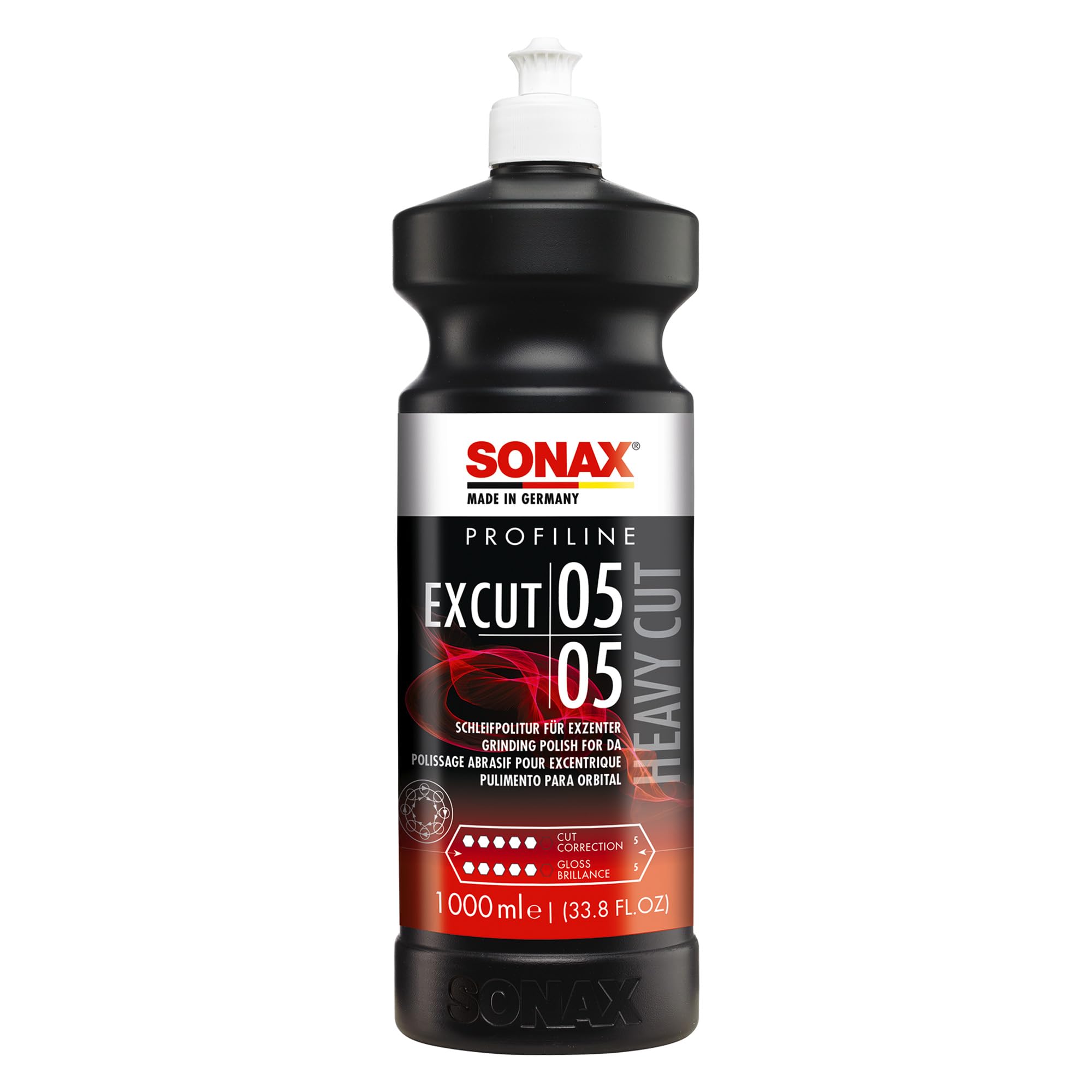
A 1-liter silicon-carbide paste built for removing bird-drop etching and tree-sap corrosion.
SONAX ExCut 05-05 uses silicon carbide abrasive — a harder, sharper grit than the aluminum oxide used in most compounds — to power through deep scratches, heavy swirls, and P1500 sanding marks. It removes tough contaminants like corrosion from bird droppings and tree sap that milder polishes cannot touch, making it a specialty tool for neglected paint. The 1-liter bottle (roughly 33.8 ounces) offers the most product per purchase on this list, and the silicone-free formula is body-shop safe for work before new paint or coatings. It works with dual-action and rotary polishers and leaves a high-gloss, reflective finish. At 4.6 stars, it earns respect from owners who need serious cutting power.
Feedback is split: newer bottles are reportedly thinner than previous batches, and some owners on silver paint with light scratches saw little improvement. It is a true heavy cutter; for shallow swirls on modern clear coats, a finer polish like Meguiar’s M105 is more appropriate. A few owners were disappointed with the cutting depth on light scratches, suggesting this compound is best for deep, etched-in defects rather than general light correction.
Best use case: neglected paint with bird-drop etching, acid rain marks, or heavy swirls that standard compounds leave untouched.
Choose this for deep environmental etching: if bird droppings or tree sap have left permanent marks in your clear coat, this silicone-carbide paste will level them.
Not for light maintenance buffing: for weekly swirl removal, a finer compound like Griot’s Complete Compound is easier to work with and leaves a more immediate shine.
Understanding the Specs
Grit Rating & Abrasive Type
The grit number (like 1000 or 1200) tells you the size of the abrasive particles in the compound. A lower number means larger, more aggressive particles that cut faster but leave a rougher surface — you will need a finer polish afterward. Higher grit numbers (1200 and up) use finer particles that remove less material per pass but leave a glossier finish directly. The abrasive type also matters: aluminum oxide is the most common and works well on clear coats, while ceramic alumina (like in the 3D ACA 510) cuts cooler and lasts longer before breaking down, and silicon carbide (in the SONAX ExCut) is sharper and better at removing hard contaminants like etched-in bird droppings.
Dust Level & Cleanup
Some compounds produce heavy dust as the carrier liquid evaporates during buffing. This coats your garage, your tools, and the panel you just finished in a fine powder that needs wiping off before the next pass. Low-dust formulas (like CARPRO Clear Cut and 3D ACA 510) save you time by keeping the workspace clean and letting you see the true finish as you work. If you detail indoors or in a shared space, low dust is a major quality-of-life advantage. Traditional heavy cutters like Menzerna and Malco Super Duty create more dust but often cost less per ounce, so you trade cleanup effort for value.
FAQ
Can I use a heavy-cut compound by hand or do I need a machine?
How deep is too deep for a scratch remover compound?
What grit compound should I use for a scratch I can feel with my fingernail?
Will a heavy-cut compound remove swirl marks and holograms from a bad car wash?
What is the difference between a “compound” and a “polish”?
Can I use these compounds on plastic headlights or trim?
How do I store an opened bottle of compound?
Is a wool pad or a foam pad better for deep scratch removal?
Can these compounds be used on matte or satin paint finishes?
How long does a bottle of compound last for typical car maintenance?
Final Thoughts: The Verdict
Across the board, the deep scratch remover for cars winner is the Griot’s Garage Complete Compound because it cuts deep enough for daily scratches yet finishes glossy in a single step — no second bottle, no haze, no fuss. If you need the absolute finest correction on hard clear coats, grab the 3D ACA 510 with its ceramic-tech abrasives that level faster and cooler than traditional compounds. And for restoring heavily oxidized paint on a classic car or marine surface, the Malco Super Duty Heavy Cut at 32 ounces gives you the most cut for your money.
How We Picked
We do not accept paid placement. Every pick is matched to a real buyer and a real use-case; we do not hands-on test units.
Sources & Methodology
Specifications: manufacturer listings and product documentation. Review insights: verified customer reviews, as of July 2026. Pricing: not shown on this page (it changes often); check the current price via the retailer link.
As an Amazon Associate, Trending Car earns from qualifying purchases. This does not affect which products we feature.