
Our readers keep the lights on and my garage snacks stocked. As an Amazon Associate, I earn from qualifying purchases.
Specs are compiled from manufacturer listings and verified buyer reviews and can change over time — please confirm the key details on the product page before buying.
You want a co-pilot that watches the road when you can’t — a system that warns you before you change lanes into a blind spot, nudges you when the car ahead rolls, and records everything in crystal clarity if something goes wrong. The best driver assistance systems do exactly that, mixing forward collision alerts, blind-spot radar, and 4K dash cam recording into one dependable setup. The catch is that specs vary wildly, and a cheap system with false alarms is worse than none at all.
I’m Min Islam — the founder and writer behind Trending Car. This guide is built by comparing the manufacturers’ published specifications and the patterns across verified customer reviews, so you get each pick’s real strengths and trade-offs instead of marketing spin.
Whether you drive a car, truck, or RV, the right driver assistance systems bring genuine safety upgrades that make every trip feel more secure and less stressful.
Our Picks at a Glance

How To Choose The Best Driver Assistance Systems
“Driver assistance” ranges from a basic dash cam with lane-departure beeps to a radar-based blind-spot system that integrates into your car’s electronics.
ADAS (Advanced Driver Assistance System) — the smart alerts you actually need
ADAS is the umbrella term for the computer vision that watches the road. The most useful alerts for most drivers are forward collision warning (beeps when you are closing too fast on the car ahead), lane departure warning (buzzes when you drift without a signal), and blind-spot detection (lights up a warning when a vehicle sits beside you). Some systems also add pedestrian detection, lead-vehicle start alerts (for stop-and-go traffic), and distance monitoring. Camera-based ADAS can struggle in heavy rain or direct sun, while radar-based systems are more sturdy but cost significantly more.
Camera resolution and sensor — the difference between a blurry shape and a readable plate
Night-time clarity depends on the sensor type (STARVIS 2 sensors like the Sony IMX678 capture roughly twice the light of standard sensors) and the resolution. A true 4K front camera (2160p) makes license plates readable when you zoom into footage, while 2K (1440p or 2.5K) is a noticeable step down in fine detail. For rear cameras, 1080p is the minimum for useful evidence. HDR and WDR processing matter too — they balance harsh backlight or sudden tunnel transitions so you do not get blown-out highlights or black shadows.
Parking mode — how it powers up when you are away
A system that only records while the engine is running misses the most common accident: a hit-and-run in a parking lot. Parking mode typically uses one of three power sources: a cigarette-lighter plug (easiest, but no continuous parking coverage), an OBD-II hardwire kit (plugs into your car’s diagnostic port, easy install, includes low-voltage protection), or a traditional hardwire fuse-tap (professional install, cleanest, most reliable). OBD and hardwire kits allow motion detection or time-lapse recording while parked, and the best systems use a radar sensor to wake the camera only when something approaches — saving your car battery significantly.
Blind-spot detection — camera-based vs. radar-based
Most mirror dash cams offer a camera-based blind-spot detection that uses the wide-angle rear camera to spot vehicles beside you and sound an audible alert. This works reasonably well in good weather but can be fooled by darkness or rain. True radar-based systems (like the Brandmotion RDBS-1600) use 76-77 GHz radar sensors mounted in the rear bumper or fascia. These are far more reliable, work in all weather, and do not produce false alarms from vehicles two lanes over. They are also much harder to install and cost several times more. For most daily drivers, a good camera-based BSD system is sufficient; for a work truck or older vehicle without factory blind-spot, a radar-based upgrade is the gold standard.
Quick Comparison
| Model | Best For | Front Resolution | Field of View | ADAS / BSD | Amazon |
|---|---|---|---|---|---|
| WOLFBOX G850 PRO★ Best Overall | Best Overall ADAS Mirror Cam | 4K (2160P) | 170° | ADAS + BSD | Amazon |
| Venluna RV SystemFull Coverage | Multi-Camera for Large Vehicles | 1080P (4 cams) | 145° | BSD audible alert | Amazon |
| HUPEJOS V8 MAXAI Co-Pilot | AI Driver Monitoring | 4K front | 360° | AI DMS + ADAS | Amazon |
| THINKWARE ARC | Compact 2K Dual with Parking Mode | 2K QHD (1440P) | 130° | Forward collision / lane departure | Amazon |
| AZDOME PG17 Pro | STARVIS 2 Mirror Cam | 4K + 2.5K rear | 170° | ADAS | Amazon |
| Pelsee P12 Pro Max | Premium Mirror Cam with OBD Kit | 4K + 2.5K rear | 160° | ADAS + BSD | Amazon |
| Type S T400 | AI Collision Alerts | 4K front + 1080P rear | 230° | AI ADAS (collision/lane/pedestrian) | Amazon |
| THINKWARE U3000 PRO | Radar Parking & LTE Ready | 4K + 2K rear | 147.2° | Forward collision / lane departure | Amazon |
| Brandmotion RDBS-1600 | Radar Blind Spot Upgrade | — (Radar only) | — | Radar BSD + cross-traffic | Amazon |
In‑Depth Reviews
1. WOLFBOX G850 PRO 4K Mirror Dash Cam with ADAS and BSD
Our pick — over 4★ from 950+ verified ratings; the strongest balance of quality and price.
The all-in-one mirror cam that wraps ADAS, BSD, and sharp 4K recording into a single 12-inch screen.
You get a full 12-inch IPS touchscreen that replaces your rearview mirror and serves up both live rear view and recorded footage — making it easy to glance at without taking your eyes far off the road. The front camera records in true 4K (2160P at 30fps) and the rear in 1080P, both using WDR and wide-angle lenses to keep details clear through shadows, direct sun, or at night. The 170-degree field of view gives you a broad sweep of the road ahead, and the included 64GB card means you can start recording straight from the start.
The ADAS suite here is straightforward and functional: forward collision warnings, pedestrian collision alerts, lane departure warnings, distance monitoring, and a lead-vehicle start alert for traffic jams. The BSD algorithm uses the rear camera to watch your blind spots and detect approaching vehicles during lane changes, plus it adds a rear collision alert. Buyers report that the system is well-built and the WOLFBOX app works reliably via the 5.8GHz WiFi connection — one owner calls it “the best dash camera computer available” for its viewability and feature set. The 12 voice commands (including “take picture” and “lock the video”) let you keep both hands on the wheel.
The large 12-inch mirror can obstruct a driver’s sun visor on some vehicles, so check your headliner clearance. A few owners mention that screen brightness, while fine in low light, feels distracting at night despite being adjustable.
What wins people over
- True 4K front + 1080P rear with wide 170° view captures plates and road signs clearly
- Includes a 64GB card and external GPS antenna — no hidden costs to start
- 12-inch full-touch display is responsive and serves as a crisp digital rearview mirror
What to know before buying
- Large mirror body can block the driver-side sun visor in some cars
- Screen brightness feels high at night; a wider dimming range would help
Reach for this if… you want one device that replaces your rearview mirror, watches for blind spots and collisions, and records 4K front video — all without a separate dash cam taking windshield space.
Think twice if… your vehicle has a tight headliner or you need a camera-based parking mode — the G850 needs a separate hardwire kit for 24-hour surveillance.
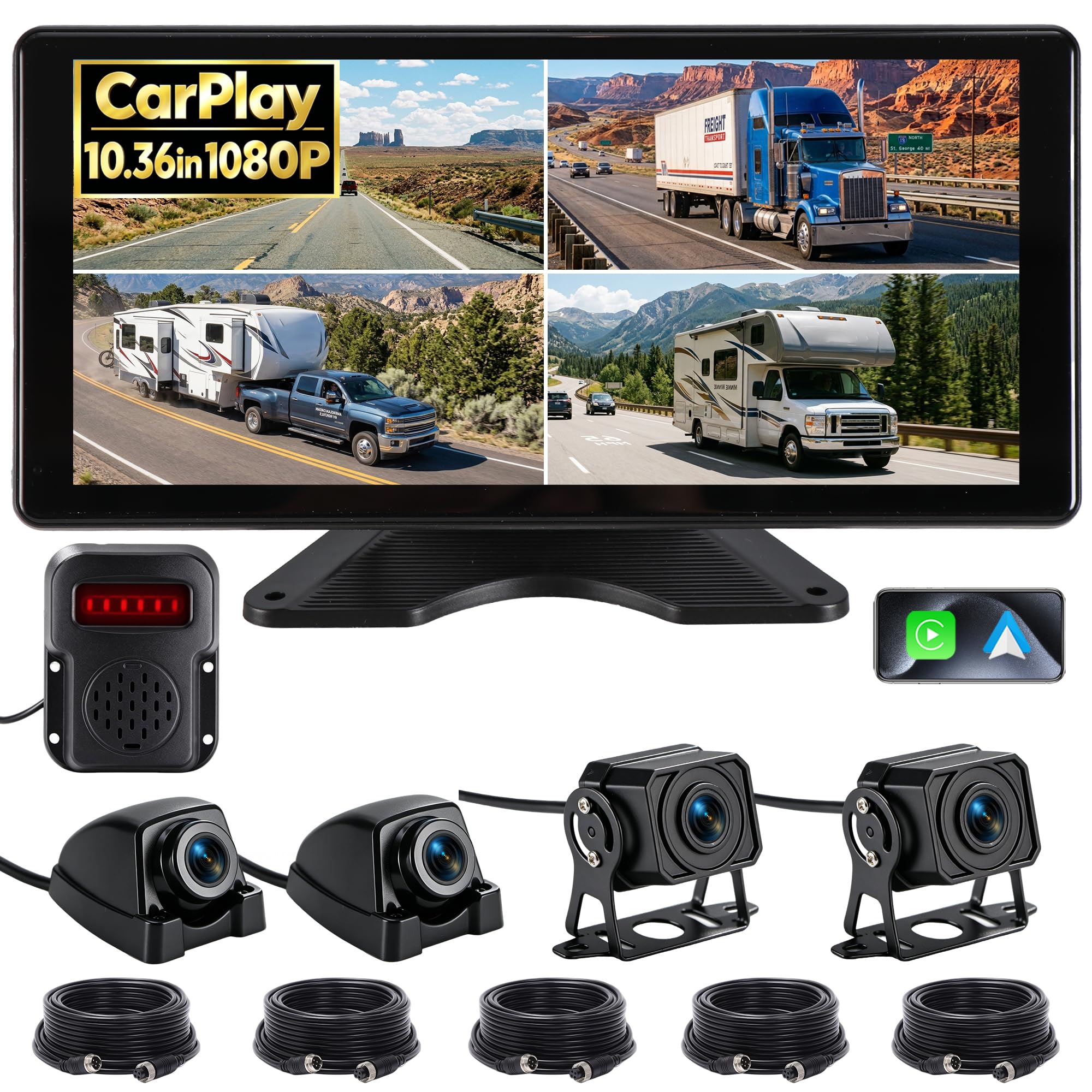
2. Venluna RV Camera System with CarPlay & 4x 1080P Cameras
Four 1080P cameras and a CarPlay monitor that turns an RV or truck cab into a 360-degree command center.
While the WOLFBOX covers front and rear, this Venluna system is built for large vehicles that need eyes on all four corners. It ships with four IP69 waterproof cameras (each with a 145-degree wide-angle lens) and a 10.36-inch HD touchscreen that supports 11 split-screen modes — so you can watch the front, rear, and both sides simultaneously. The wired connection uses professional-grade aviation cables (55ft, 33ft, and three 16ft runs) that eliminate the signal lag and flicker common with wireless RV cameras.
The system includes wireless Apple CarPlay and Android Auto for GPS navigation and hands-free calls, plus a built-in BSD (blind-spot detection) that emits both visual and audible alerts when a vehicle or pedestrian enters the danger zone. You can customize the detection range to match your trailer length. The DVR recording supports loop recording and one-key emergency locking, and the 24-hour parking monitor acts as a security camera when the rig is parked. Camera quality and installation are the most-praised aspects — owners say the “10.36” screen is super clear” and installation is straightforward on skoolies, box trucks, and 40-foot RVs. One buyer notes that daytime picture quality is great, while night clarity can blur from light sources, and there is no IR night vision.
Best suited for: RV, camper, semi truck, or box truck drivers who need to eliminate blind spots around a long vehicle and want smartphone integration in the same screen.
Go for this if… you drive anything longer than a standard van and would benefit from a dedicated multi-camera monitor with CarPlay built in.
Look elsewhere if… you only need front-and-rear coverage for a standard car — the four-camera setup and large monitor are overkill for a sedan.
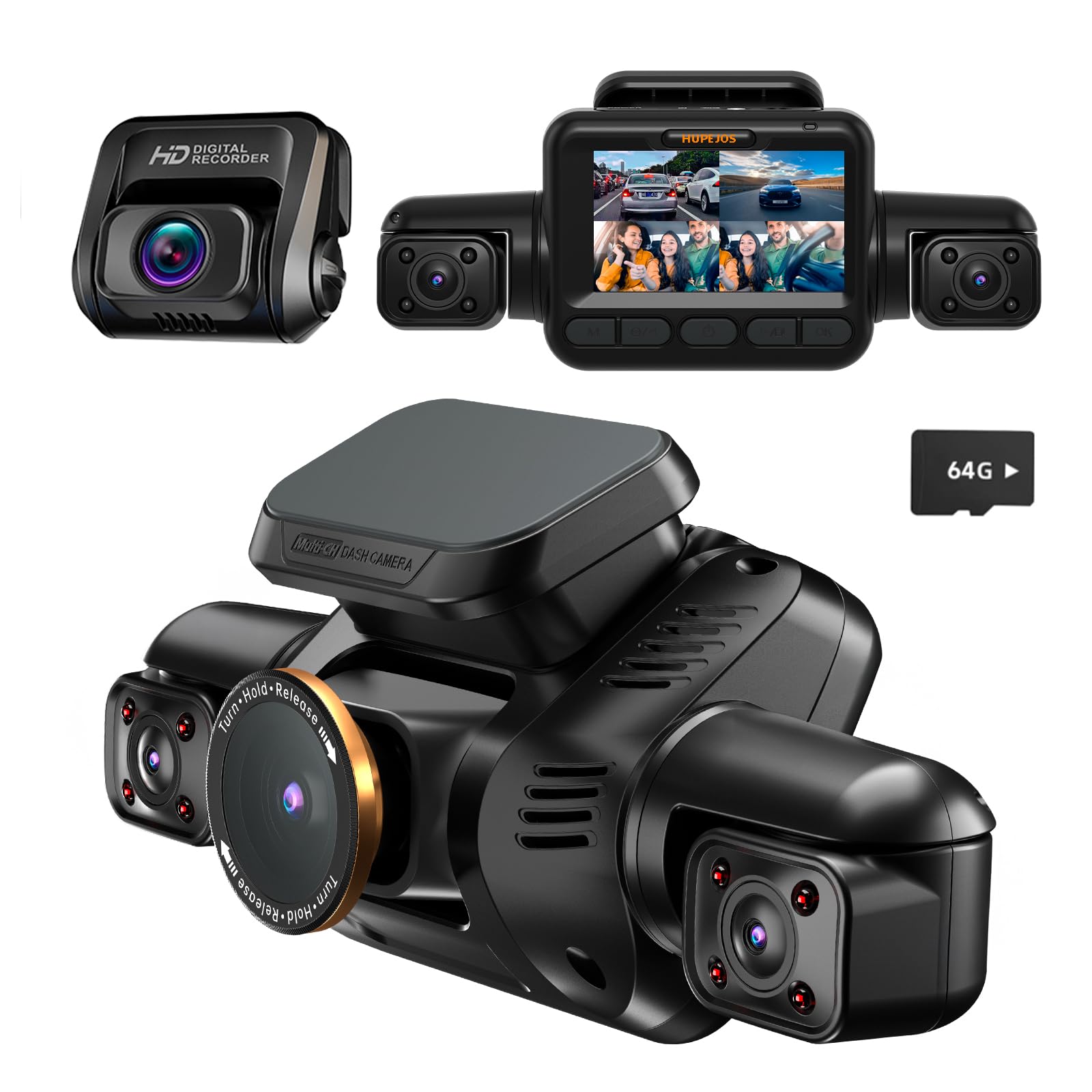
3. HUPEJOS V8 MAX AI 4K Dash Cam with Driver Monitoring
A 4-channel dash cam with AI that watches you as closely as it watches the road — detecting fatigue, distraction, and phone use.
Unlike the mirror-style G850, the V8 MAX is a 3-inch touchscreen unit that mounts on the windshield and brings a genuine AI Driver Monitoring System (DMS) into the cabin. The DMS uses a camera pointed at the driver to detect signs of drowsiness (yawning, head nodding), distraction (looking away from the road for too long), and phone handling. This is a meaningful safety upgrade for rideshare drivers, parents lending the car to a teen, or anyone who does long highway stretches. The system activates above a set speed and can be turned off if you prefer.
Video capture comes from four channels (front, rear, and two side cameras) for 360-degree coverage — the side cameras tilt and pivot to fit your windshield curve. The front camera uses a Sony STARVIS 2 IMX675 sensor with HDR and WDR to capture readable license plates in both bright daylight and near-complete darkness, aided by 8 IR lights. The package includes a 64GB card, a CPL filter to cut windshield glare, and an 18-month warranty. Owners consistently praise the crisp 4K video and excellent night vision, with one calling it “very impressive” for the price. The 5G WiFi connects quickly to the phone app, and voice commands like “Start Recording” work reliably.
The main caveat: the hardwire kit for 24/7 parking mode is sold separately (ASIN B0F5Q5N8XC). A few owners also report that the driver-absent alarm can false-trigger from bright headlights at night, and the included 12V power plug leaves a less clean look than a hardwire.
Why it stands out
- AI driver monitoring detects fatigue, yawning, and phone use — a rare feature at this price
- Four-channel 360° coverage with adjustable side cameras captures every blind spot
- STARVIS 2 sensor and 8 IR lights deliver crisp video even in complete darkness
Before you buy
- Parking mode hardwire kit is not included — budget for the separate purchase
- The 3-inch touchscreen is smaller than a mirror-style display; reading alerts at a glance is a bit harder
Ideal for… rideshare drivers, parents of teen drivers, or anyone who wants a system that monitors both road conditions and the driver’s alertness.
skip it if… you want a simple record-and-forget device without the driver-facing camera — consider the THINKWARE ARC instead.
4. THINKWARE ARC Dash Cam 2K QHD Front and Rear
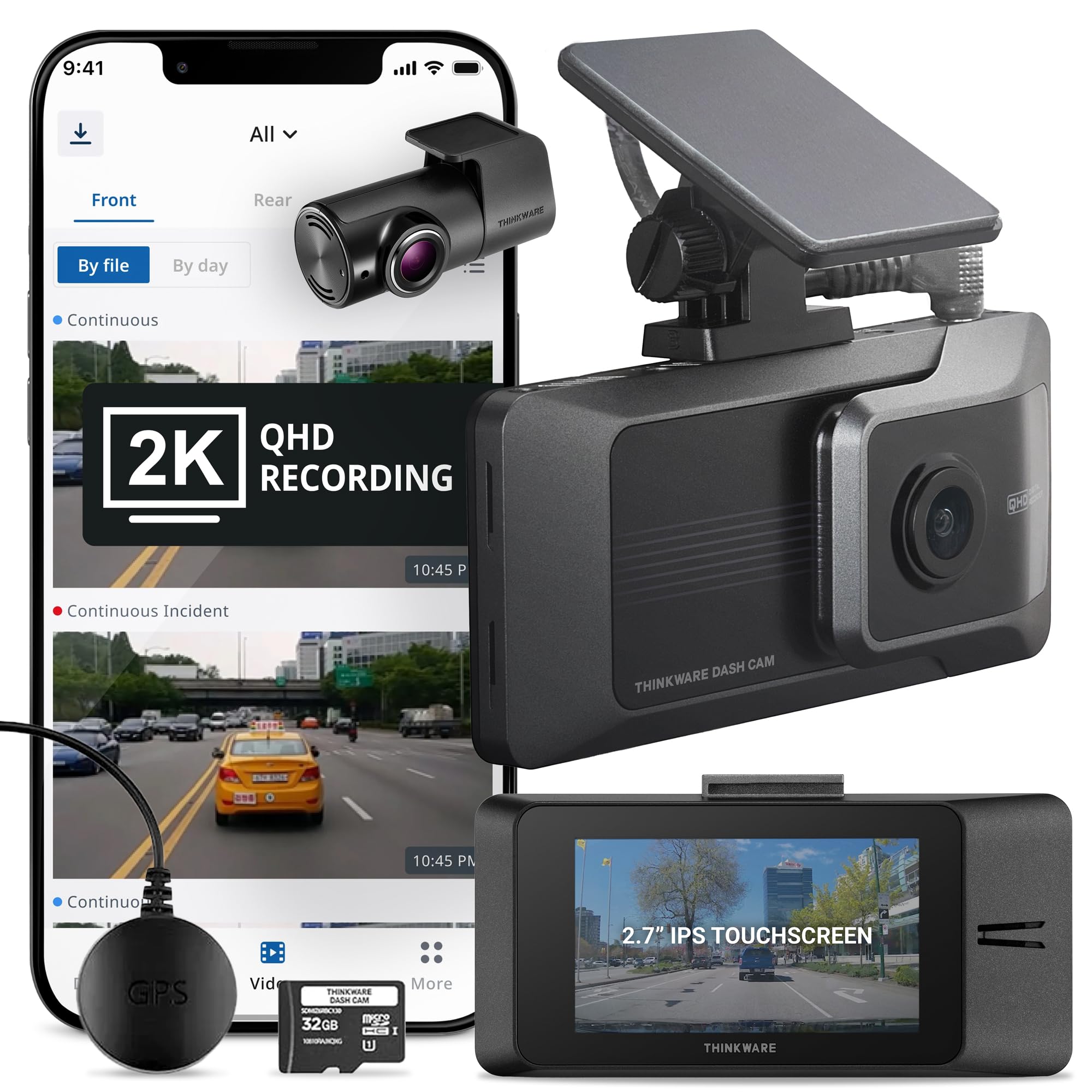
A compact on-dash unit from a trusted brand that balances 2K dual recording with a full parking mode kit in the box.
THINKWARE has a strong reputation for reliable dash cams, and the ARC delivers that reliability in a low-profile form factor that sticks to the windshield behind the mirror — no bulky mirror replacement, no giant touchscreen in your line of sight. Both the front and rear cameras record in 2K QHD (1440P) at 30fps with 125-degree viewing angles, and the built-in 2.7-inch IPS touchscreen lets you view alerts and adjust settings. The included hardwiring cable means you have 24/7 parking surveillance right away — motion detection, impact detection, time-lapse, and energy-saving mode are all supported.
ADAS features include forward collision warning, lane departure warning, front vehicle departure alerts, and traffic light change alerts. The GPS module logs speed and location into the video. Owners consistently rate the daytime image quality as excellent with sharp license plate detail, and night vision is “superb” according to many reviews. The WiFi app connection is quick and easy, and the heat protection mode is a nice touch for hot climates. The ARC also supports a 60fps frame rate for smoother footage capture.
One honest limitation: the GPS map view is only accessible on PC or Mac software, not in the phone app — so trip route visualization requires a computer. A small number of early owners also reported occasional touchscreen unresponsiveness.
Choose this if… you prefer a discreet, windshield-mounted camera from a brand with a track record of reliability, and you want a complete parking mode solution without buying extra parts.
Pass if… you need 4K front resolution or a mirror-style display that replaces your rearview mirror entirely.
5. AZDOME PG17 Pro STARVIS 2 Mirror Dash Cam
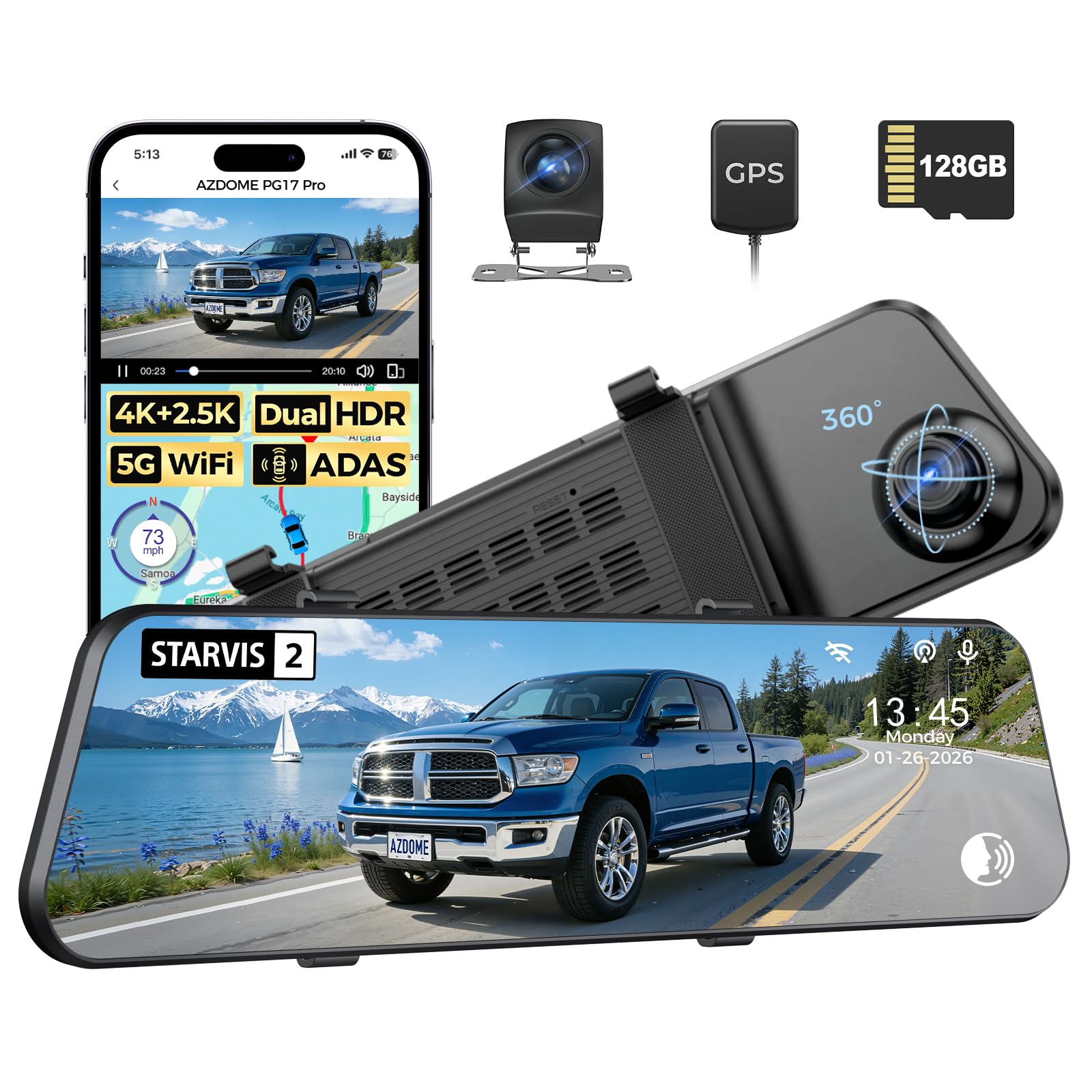
A 12-inch mirror cam packing Sony’s latest STARVIS 2 sensor for nighttime footage that rivals daytime clarity.
The PG17 Pro directly competes with the WOLFBOX G850 but upgrades the front sensor to the Sony STARVIS 2 IMX678, which captures roughly twice the light of standard sensors. The result is “bright, detailed nighttime footage” that makes license plates readable even on dark roads. The front records in true 4K UHD and the rear in 2.5K HDR — a meaningful step above the typical 1080P rear camera. The 12-inch LCD display doubles as a bright digital rearview mirror, and the 5.8GHz WiFi connects to the AZDOME app for quick downloads of incident clips.
ADAS covers forward collision warnings and lane departure alerts. The 128GB card is included, giving you substantial storage from day one. Camera quality is the most-praised feature by owners, with the wide viewing angle and large rearview display earning consistent positive mentions. Installation is straightforward — the front clips over the existing mirror in about 30 minutes, though routing the rear camera cable through the headliner takes more time. One owner says it offers “good value at half name-brand price.” A few owners mention glare in strong sunlight and that connecting via Bluetooth for phone calls can be finicky.
What makes it special
- STARVIS 2 IMX678 sensor delivers exceptional low-light plate capture, beating most mirror cams at night
- Rear camera records in 2.5K HDR, not just 1080P — better detail and exposure balance
- Large 128GB card included gives you days of loop recording before overwriting
Things to note
- Glare on the mirror screen in direct sunlight can wash out the view for some owners
- Bluetooth pairing for hands-free calls is not as reliable as the wired connection
Best for… anyone who does a lot of night driving and wants the sharpest possible nighttime video from a mirror-style dash cam.
Consider a different pick if… your vehicle gets strong direct sunlight on the rearview mirror area for long periods — the glare could be an issue.
6. Pelsee P12 Pro Max Mirror Dash Cam with OBD Hardwire Kit
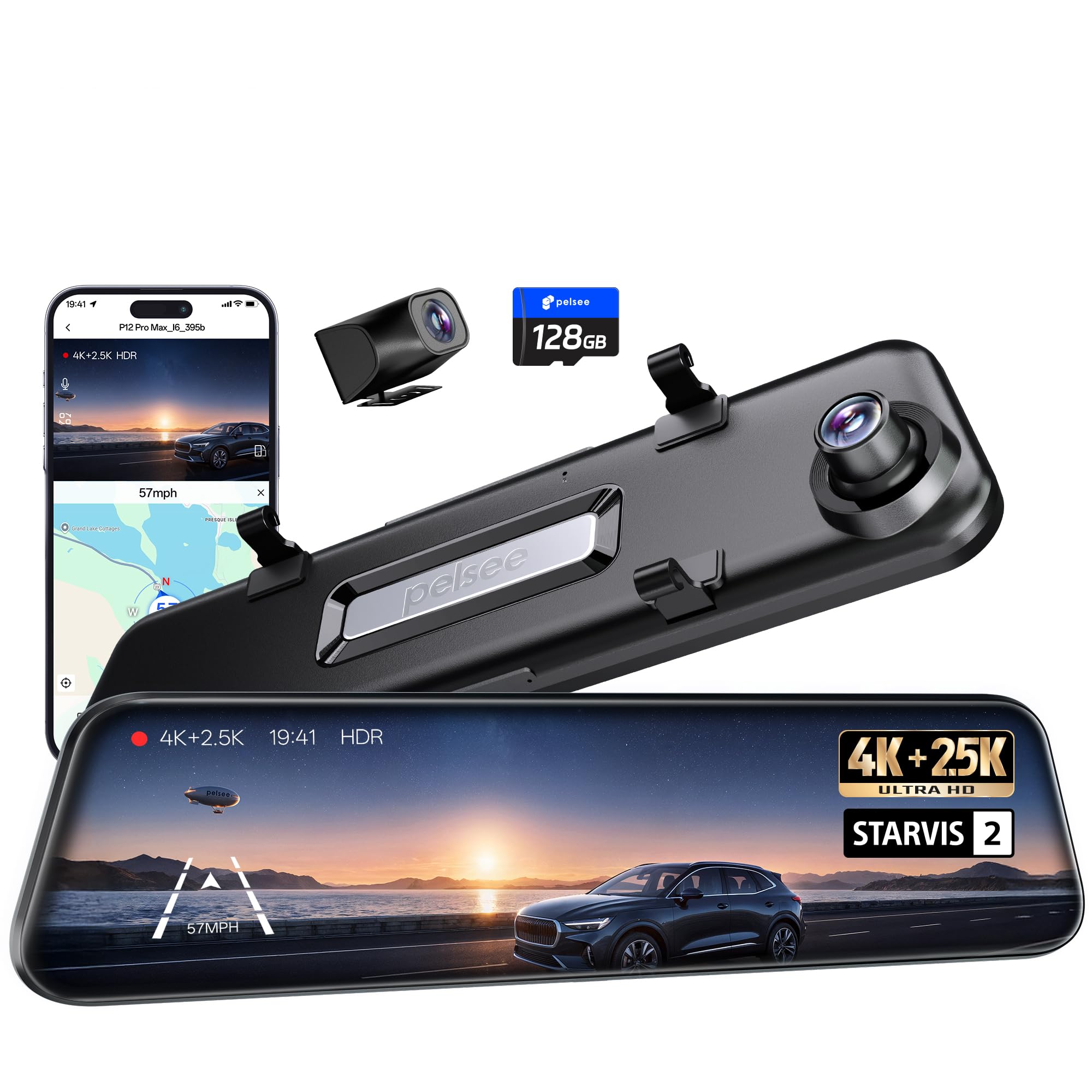
A mirror cam that comes with the OBD hardwire kit and a 128GB card in the box — everything you need for 24/7 parking recording.
The Pelsee P12 Pro Max is rare in its segment because the box includes an OBD-II hardwire power cable, not just a cigarette-lighter plug. That means you can set up parking surveillance (time-lapse, full-color night vision, and impact detection) the day you install it, without ordering separate parts. The front camera uses the same STARVIS 2 IMX678 sensor as the AZDOME above, recording true 4K at 30fps, while the rear camera uses a STARVIS IMX335 sensor for 2.5K recording. The 12-inch IPS display supports touch, voice commands, and app control.
The ADAS suite includes forward collision, lane departure, front vehicle start, and pedestrian detection alerts. The BSD algorithm monitors blind spots and sounds audible alerts during lane changes. The rear camera cable is a generous 33 feet — long enough to reach the back of large SUVs and trucks without an extension. Owners consistently praise the “exceptionally clear” front video and the responsiveness of the large touchscreen. A few note that the screen brightness could be higher for very sunny days, and the rear image reversal was fixed via customer support software update.
Standout feature: The dual-band Wi-Fi (2.4GHz and 5.8GHz) supports transfer speeds up to 20MB/s — noticeably faster than single-band mirror cams for downloading clips to your phone.
Pick this if… you want a mirror cam with a complete out-of-box experience — OBD hardwire kit, 128GB card, GPS, and dual STARVIS sensors all included — for easy 24-hour parking security.
Look elsewhere if… your vehicle’s OBD-II port is hard to access or already in use by another device.
7. Type S T400 AI-Powered 4K Dash Cam with ADAS
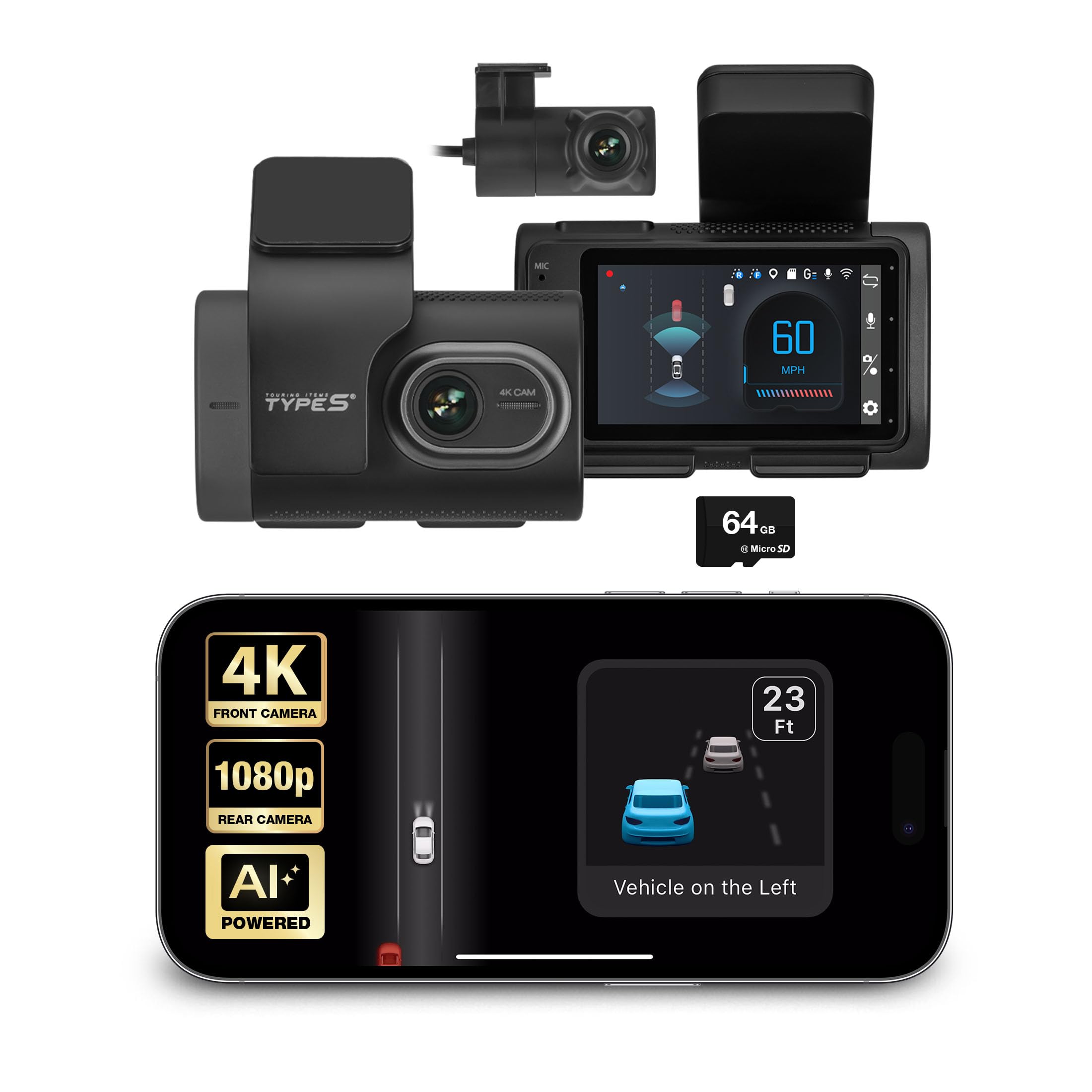
A 4K front-and-rear dash cam with AI-driven alerts that is designed to add modern safety features to older cars without OEM assistance.
The T400 uses AI algorithms for front and rear collision warnings, lane departure warnings, blind-spot alerts, and pedestrian detection. When hardwired, the parking mode captures a 20-second video upon impact. The 4K front camera has a generous 230-degree field of view, which is among the widest in this roundup. The setup connects to the Type S Drive app via built-in WiFi for viewing and downloading footage without removing the memory card.
Where this system differs from the top picks is consistency: the ADAS alerts work well for some drivers (“works beyond my expectations plus more,” says one owner) but sporadically for others — a few report that lane departure works intermittently and collision warnings fail to activate. The blind-spot detection and blinkers are praised by owners of older cars who now have a safety layer they lacked. Because of the mixed reports, the T400 is best treated as a useful extra safety layer — not a primary reliance system — and it works best for drivers who want an affordable way to add collision beeps to a car that had none.
Suitability: Great for adding modern driver alerts to an older vehicle that lacks factory ADAS, especially if you prioritize the blind-spot and departure warnings.
Not for… drivers who need perfectly reliable collision warnings every time — the inconsistent accuracy means you should still drive as if it doesn’t exist.
8. THINKWARE U3000 PRO 4K Dash Cam with Dual RADAR Parking
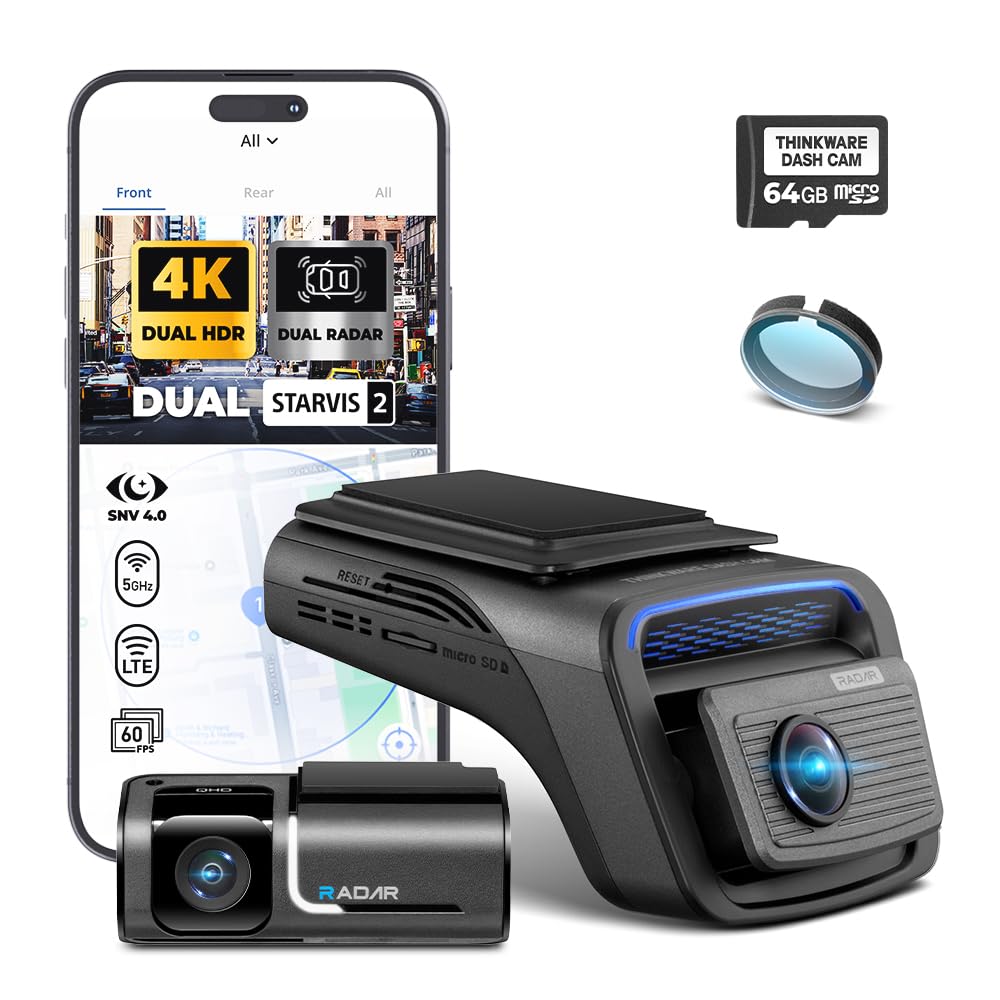
Thinkware’s flagship — dual STARVIS 2 sensors, radar-based parking that saves battery, and LTE-ready remote monitoring for total confidence.
Where most dash cams use motion-triggered parking mode that records every time a leaf blows past, the U3000 PRO uses dual radar sensors (one front, one rear) that wake the camera only when a person or vehicle enters its zone. This drastically reduces false recordings and saves your car battery. When motion is detected, the camera captures a 20-second clip (10 seconds before and after the event). The package includes a 64GB card and an OBD cable, plus a CPL filter to reduce windshield glare.
Video quality is top-tier: the front camera records in 4K and the rear in 2K, both using Sony STARVIS 2 sensors and an Ambarella CPU for natural color and minimal noise at night. The 147.2-degree field of view is slightly narrower than the 170-degree mirror cams, but the trade-off is reduced fisheye distortion and more accurate license plate capture. The U3000 PRO supports LTE hotspot connectivity (through a separate module) for real-time alerts and remote video access — a genuine advantage for fleet owners or anyone who leaves their car in long-term airport parking. Owners say night video is “sharper than the Q800 Pro” and radar parking is a standout for EV owners who worry about vampire drain. The crowd favorite rating — over 400 owners — speaks to its reliability.
Why it dominates
- Dual radar parking mode wakes only on real motion — minimal battery drain and fewer false recordings
- Front 4K + rear 2K with dual STARVIS 2 sensors produce some of the cleanest night footage available
- LTE-ready for remote alerts and live view when paired with a hotspot
Downsides to weigh
- Premium pricing — roughly 2-3x the cost of a good mirror cam — reflects the radar hardware and brand reliability
- Setup is more involved and uses two separate apps (one for the camera, one for parking mode configuration)
Who it’s for: drivers who want the absolute best parking security, minimal battery drain, and professional-grade night footage — especially EV owners or anyone parking on the street.
Who should skip: anyone on a mid-range budget or who simply wants a basic dash cam with alerts — the U3000 PRO’s features and price exceed what most casual drivers need.
9. Brandmotion RDBS-1600 Radar Blind Spot System

A dedicated radar system that adds factory-style blind-spot monitoring and cross-traffic alerts to vehicles from 2007 onward.
This is a fundamentally different product from the camera-based systems above. The RDBS-1600 is a pair of 76-77 GHz radar sensors that mount behind the rear bumper fascia (not compatible with metal pickup truck bumpers) and a CAN-integration module that ties into your vehicle’s turn signal and speed data. It provides both blind-spot detection (an audible tone and an LED indicator at the bottom of the windshield trim) and rear cross-traffic alert when backing out of parking spots. The detection range is 40 feet — 15 feet further than the earlier RDBS-1500 version.
Functionality is the most-discussed aspect among owners, and the sentiment is mixed for a reason: when everything works, the result is “like factory” integration with no false alarms or missed warnings. One owner reports a full year of flawless operation. The trick is installation — it is not a DIY job for most drivers, requiring the radar sensors to be mounted with precise clearance and wired into the CAN-BUS system. A few owners describe poor Brandmotion support and units that did not function after installation by an authorized dealer. The system also has a hard limitation: it does not alert below 15 mph or for stationary objects (parked cars, guardrails), so it is strictly a moving-traffic blind-spot tool.
The real advantages
- True radar detection (76-77 GHz) works reliably in rain, fog, and darkness — camera systems struggle here
- Integrated turn-signal logic means the warnings only activate when you signal, reducing nuisance beeps
- Built-in rear cross-traffic alert catches vehicles approaching from the sides while reversing
Before you commit
- Installation is complex and expensive — many customers note total install costs (parts + labor) exceeding
- Static objects and speeds under 15 mph are ignored — this is a blind-spot tool, not a parking sensor
Perfect for… owners of older vehicles (2007+) who want factory-style blind-spot monitoring and cross-traffic alerts and are comfortable with professional installation costs.
Avoid if… you want a simple DIY plug-and-play system or your vehicle has a metal rear bumper — the radar sensors require a plastic fascia to operate.
Understanding the Specs
STARVIS 2 Sensors — What They Do for Night Video
STARVIS 2 is Sony’s second-generation automotive sensor technology designed to capture clear images in very low light. Cameras that use the IMX678 or IMX675 STARVIS 2 sensor (like the AZDOME PG17 Pro and Pelsee P12 Pro Max) can read license plates and street signs in near-darkness where standard sensors produce grainy, unreadable footage. Think of it as the difference between seeing a face in the dark with your naked eye versus with night-vision goggles — the sensor captures roughly twice the light of a standard CMOS sensor.
ADAS vs. BSD — The Two Alert Systems Explained
ADAS (Advanced Driver Assistance System) refers to the camera-based computer vision that watches the road ahead and issues alerts — forward collision warnings when you are closing too fast, lane departure warnings when you drift, and sometimes pedestrian or lead-vehicle-start alerts. BSD (Blind Spot Detection) is a separate function that monitors the lanes beside and slightly behind your vehicle, often using the rear camera’s wide-angle view. A camera-based BSD works well in good weather but can struggle in heavy rain. Radar-based BSD (like the Brandmotion RDBS-1600) uses 76-77 GHz radio waves to detect vehicles in the blind spot regardless of weather — that is the same technology used in luxury cars.
Hardwire vs. OBD vs. Cigarette Lighter — Parking Mode Power
How you power a dash cam determines whether it can record while parked. A cigarette-lighter plug is the easiest setup but only works while the engine runs. An OBD hardwire kit (like the one included with the Pelsee P12 Pro Max) plugs into your car’s diagnostic port and provides continuous power with built-in low-voltage protection to prevent a dead battery. A traditional hardwire kit taps into your fuse box and is the most permanent option. The THINKWARE U3000 PRO uses a radar sensor in parking mode to wake the camera only when motion is detected — this saves significantly more battery than motion-triggered video recording.
Field of View — How Wide Is Too Wide?
Field of view (FOV) is measured in degrees and tells you how wide a scene the camera can see. A 170-degree or 160-degree angle (common in mirror dash cams) captures the full width of the road ahead plus both curbs, making it excellent for recording side collisions and cross-traffic. The HUPEJOS V8 MAX claims 360-degree coverage via four separate cameras, which covers all four corners. The Type S T400 has a very wide 230-degree front camera, but extremely wide lenses can introduce fisheye distortion and make distant license plates appear tiny. A narrower 130-147 degree FOV (like the THINKWARE ARC and U3000 PRO) trades some peripheral coverage for more true-to-life detail in the center of the frame.
FAQ
Will a mirror dash cam fit any car’s existing rearview mirror?
How does ADAS work at night or in heavy rain?
Can I use a driver assistance system in an older car without any factory safety tech?
What is the difference between OBD hardwire and fuse-box hardwire for parking mode?
How much storage do I need for a 4K dash cam?
Do these systems interfere with the car’s original blind-spot monitors?
What does a lead-vehicle start alert actually do?
Is a 230-degree field of view better than a 170-degree one?
Will a 4-channel dash cam drain my car battery in parking mode?
How long does the installation take for a mirror dash cam versus a radar blind-spot system?
Final Thoughts: The Verdict
For most drivers, the strongest all-rounder in the driver assistance systems category is the WOLFBOX G850 PRO because it packs true 4K recording, a responsive 12-inch touchscreen, functional ADAS and BSD alerts, voice control, and an included 64GB card — all at a fair mid-range price. If you prioritize the absolute best parking security and night video quality and have the budget, the THINKWARE U3000 PRO is the premium choice with its radar parking mode and dual STARVIS 2 sensors. And for owners of older vehicles who want to add a blind-spot system that works like factory equipment, the Brandmotion RDBS-1600 is the dedicated radar solution — just budget for professional installation.
How We Picked
We do not accept paid placement. Every pick is matched to a real buyer and a real use-case; we do not hands-on test units.
Sources & Methodology
Specifications: manufacturer listings and product documentation. Review insights: verified customer reviews, as of July 2026. Pricing: not shown on this page (it changes often); check the current price via the retailer link.
As an Amazon Associate, Trending Car earns from qualifying purchases. This does not affect which products we feature.