
Our readers keep the lights on and my garage snacks stocked. As an Amazon Associate, I earn from qualifying purchases.
Specs are compiled from manufacturer listings and verified buyer reviews and can change over time — please confirm the key details on the product page before buying.
Heating a 3-car garage is a different beast than warming a small workshop. You need enough raw power to push warm air across a large, drafty space with tall ceilings and cold concrete floors. The wrong unit leaves you shivering at a workbench or burning through fuel with nothing to show for it. This guide breaks down the top contenders—from hardwired electric units to roaring propane forced-air machines—so you can match the heater to your garage’s insulation, voltage, and your personal tolerance for noise.
I’m Min Islam — the founder and writer behind Trending Car. This guide is built by comparing the manufacturers’ published specifications and the patterns across verified customer reviews, so you get each pick’s real strengths and trade-offs instead of marketing spin.
The goal is to find the best heater for 3 car garage that actually takes the edge off those bitter winter mornings and keeps you comfortable all season long.
Our Picks at a Glance
How To Choose The Best Heater for a 3 Car Garage
A 3-car garage is a big space—typically around 600 to 800 square feet, but sometimes larger. You need a heater that can push air all the way to the far corners without struggling. Here are the key factors to zero in on.
Match the Heat Output to Your Space
Heat output is measured in BTUs (British Thermal Units) for gas and propane heaters, or in watts for electric ones. A rough rule of thumb: you need about 40-50 BTUs per square foot for a well-insulated garage, and up to 70 BTUs for a poorly insulated one. For a 3-car garage, you are looking at 30,000 to 60,000 BTUs, or 5,000 to 7,500 watts in an electric heater. Going too small means the unit runs constantly and never catches up.
Fuel Type: Electric, Propane, or Kerosene
Electric heaters are clean and quiet, perfect for attached garages where fumes are a concern, but they often require a dedicated 240-volt circuit and professional installation. Propane and kerosene forced-air heaters are portable, cheap to buy, and blast out massive heat fast. The trade-off is they need ventilation (crack the door), a fuel source, and they are noticeably louder. Natural gas heaters are the most expensive to install but the cheapest to run long-term, ideal for detached garages you heat daily.
Installation and Ventilation Requirements
Hardwired electric heaters and ceiling-mounted gas unit heaters need a professional electrician or a qualified HVAC contractor. Propane tanks must be stored outside, and any combustion heater needs adequate fresh air to operate safely and avoid carbon monoxide buildup. Portable propane radiant heaters don’t need electricity but do need a cracked door, while electric units are sealed and don’t consume oxygen.
Quick Comparison
| Model | Best For | Heat Output | Coverage | Installation | Amazon |
|---|---|---|---|---|---|
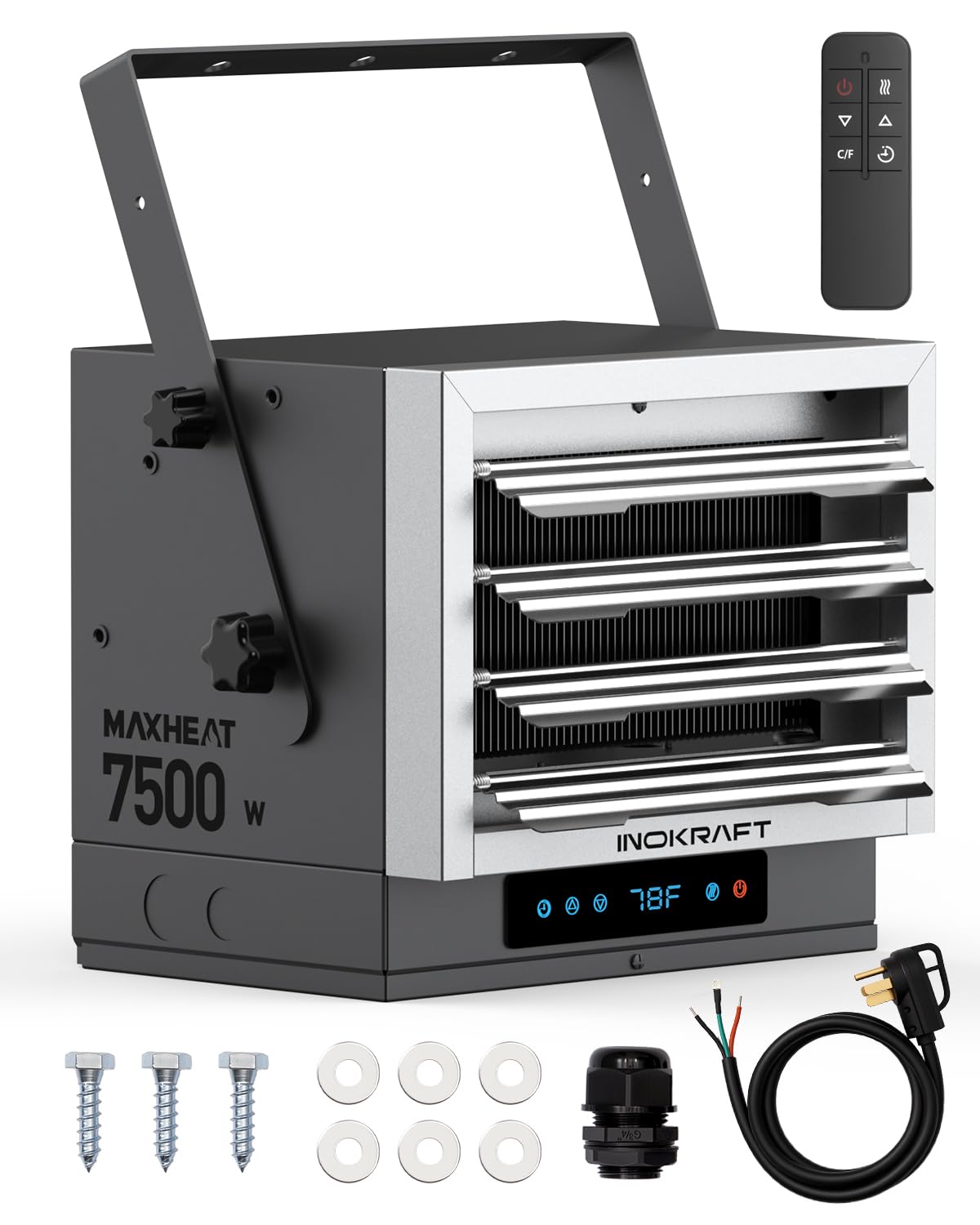
| InoKraft 7,500W Electric Garage Heater★ Best Overall | Best Overall | 7,500W / 25,590 BTU | 750 sq ft | Wall/Ceiling Mount, 240V Hardwired | Amazon |
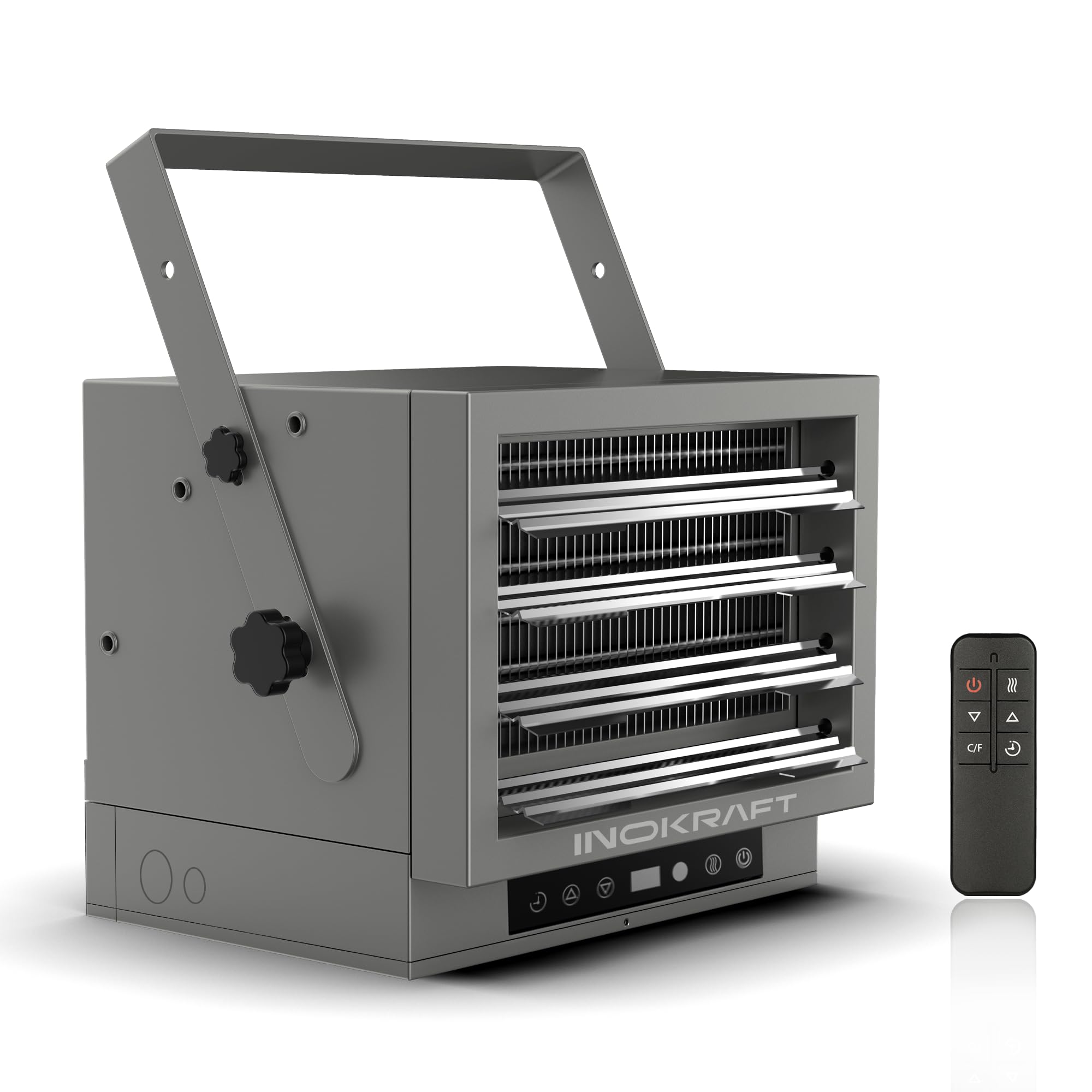
| InoKraft 7500W Electric Garage Heater (Grey)Best Value Electric | Value Electric with ECO Mode | 7,500W / 25,500 BTU | 750 sq ft | Wall/Ceiling Mount, 240V Hardwired | Amazon |
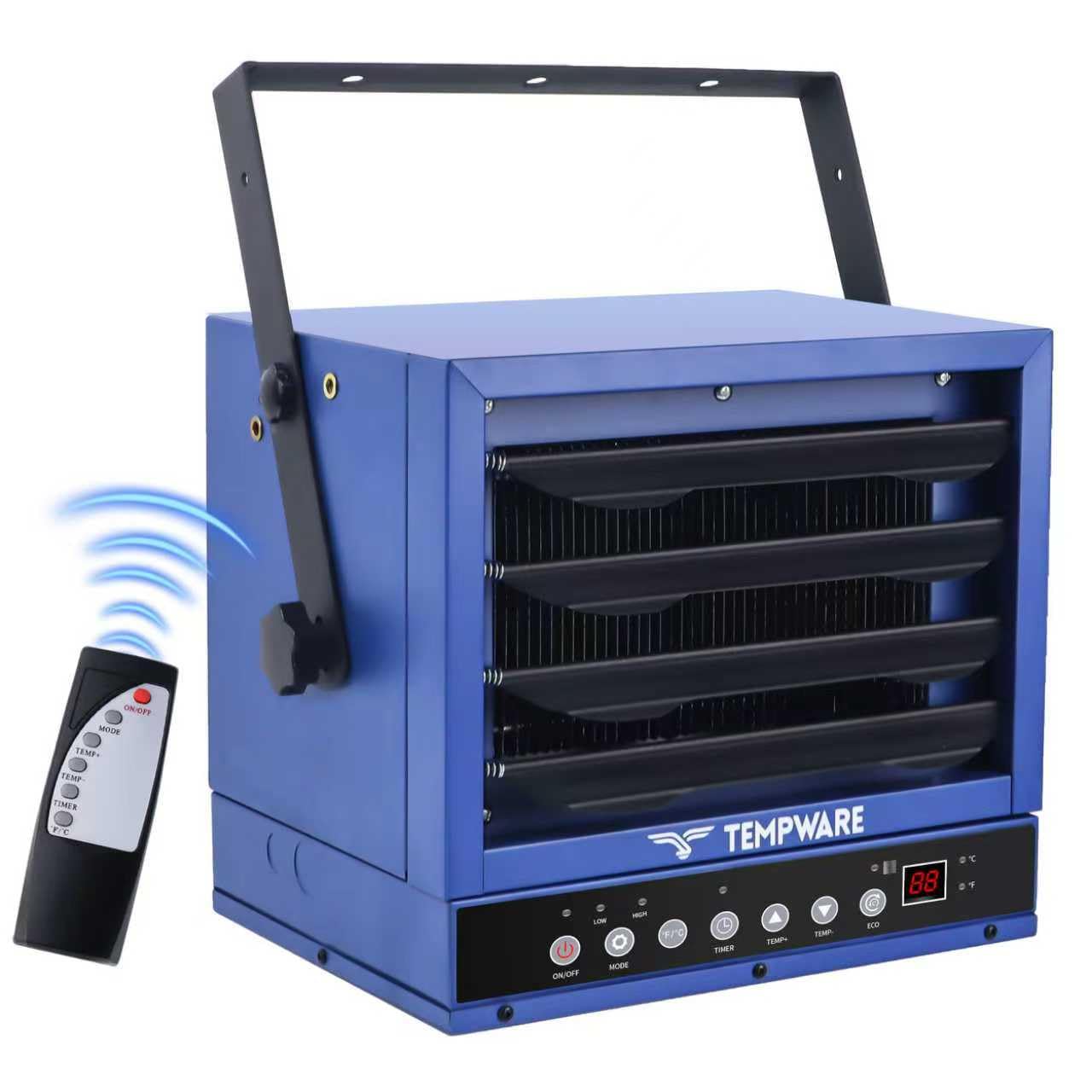
| TEMPWARE 7,500W Electric Garage HeaterTop Performer | Premium Electric | 7,500W / 25,590 BTU | 1,250 sq ft | Ceiling Mount, 240V Hardwired | Amazon |
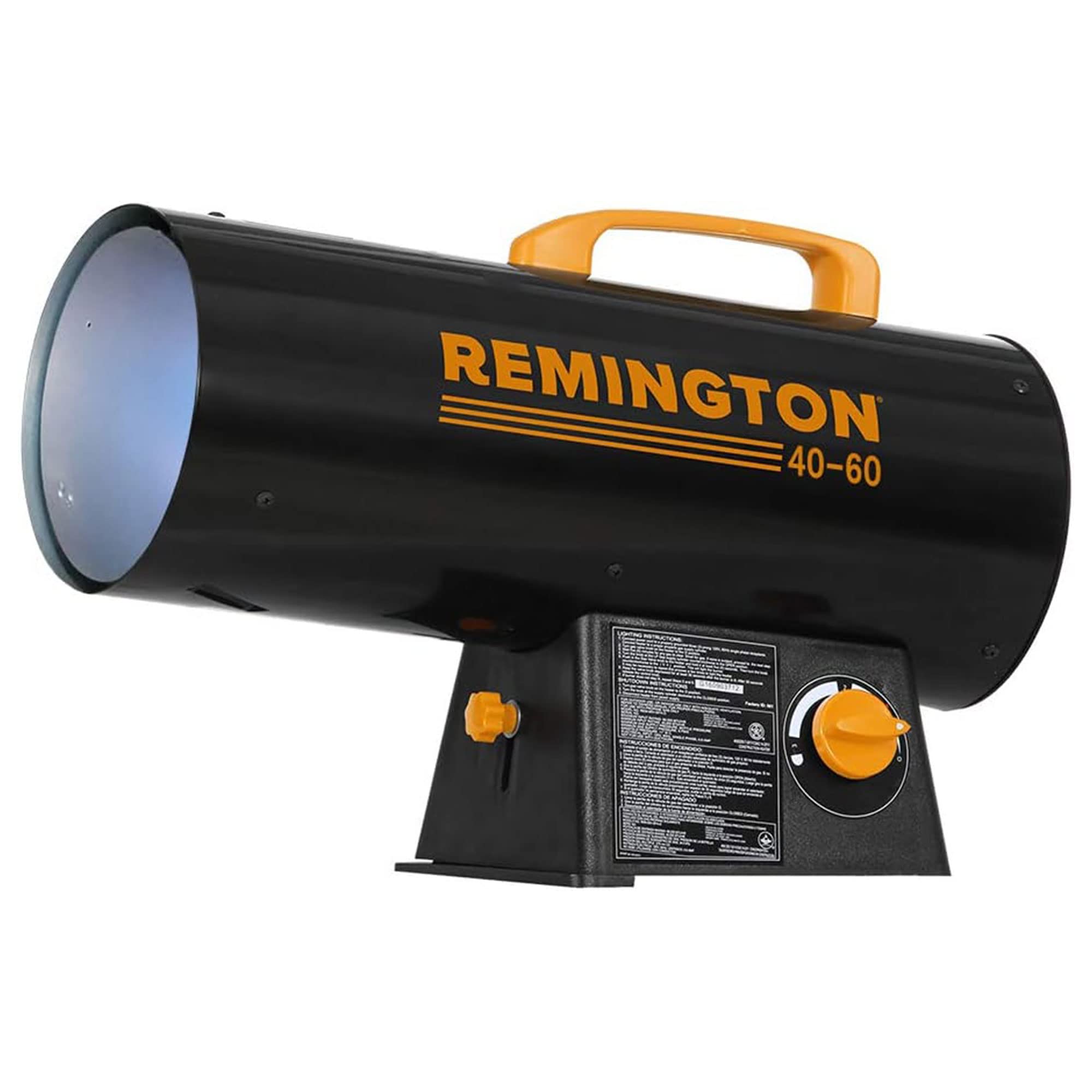
| Remington LP Forced Air Heater 60,000 BTU | Budget Portable Power | 60,000 BTU | 1,500 sq ft | Freestanding, Propane Tank | Amazon |
| VEVOR Electric Garage Heater 5000W | Budget Electric Performer | 5,000W / 17,064 BTU | 538 sq ft | Wall/Ceiling Mount, 240V Hardwired | Amazon |
| DEWALT 68,000 BTU Propane Heater | High-Performance Propane | 68,000 BTU | 1,700 sq ft | Freestanding, 20V Battery or AC | Amazon |
| DEWALT 75,000 BTU Kerosene Heater | Dual-Fuel High Heat | 75,000 BTU | 1,875 sq ft | Freestanding, Kerosene/Diesel | Amazon |
| Mr. Heater 170,000 BTU Propane Heater | Extreme Capacity Propane | 170,000 BTU | 4,250 sq ft | Freestanding, 100lb+ Propane Tank | Amazon |
| Mr. Heater 80,000 BTU Unit Heater | Ceiling-Mounted Natural Gas | 80,000 BTU | 2,667 sq ft | Ceiling Mount, Propane or Natural Gas | Amazon |
| Qmark MUH35 5000W Unit Heater | Commercial-Grade Electric | 5,000W / 17,064 BTU | — | Wall/Ceiling Mount, 240V Hardwired | Amazon |
| Modine Hot Dawg 45,000 BTU Natural Gas | Best Ceiling-Mounted Gas | 45,000 BTU | 700 sq ft | Ceiling Mount, Natural Gas | Amazon |
In‑Depth Reviews
1. InoKraft 7,500W Electric Garage Heater
Our pick — over 4.5★ from 250+ verified ratings; the strongest balance of quality and price.
Hardwired electric power that won’t wake the neighbors or cost a fortune to run.
This is the one owners consistently call a workhorse. The InoKraft 7,500W heater pumps out 25,590 BTU of forced air, covering a 750 sq ft space—perfectly sized for a 3-car garage. Unlike many electric units that need hardwiring, this one comes with an 8.2-foot power cord and a NEMA 14-50P plug, making the hookup much simpler for a DIYer with a 240V outlet. The digital thermostat lets you dial between 40°F and 99°F, and the ECO mode automatically adjusts output to save energy when the garage is already warm.
The crowd favorite feature is its quiet operation at 65 dB. Buyers report a 7500W heater on a 40A breaker heated a 950 sq ft insulated garage from 39°F to 65°F in about two hours at 10°F outside. The included remote control is a nice touch, and the five-angle adjustable mounting means you can aim the airflow exactly where you need it. Performance and heating performance are the aspects owners praise most, with the unit earning a very strong rating across over 270 reviews.
Why Owners Reach For It
- Powerful 7,500W output with a NEMA 14-50P plug for simpler wiring
- Quiet fan noise at 65 dB compared to roaring propane units
- ECO mode and digital thermostat save energy automatically
A Couple Details to Know
- Ceiling-mounted thermostat can read several degrees high initially
- Professional electrician recommended for the 240V circuit
Reach for this if: you want a permanent, clean, quiet electric heater that can handle a 3-car garage and don’t want to mess with propane tanks.
Look elsewhere if: you need an instant heat blast in an uninsulated space, or your garage lacks a 240V outlet.
2. InoKraft 7500W Electric Garage Heater (Grey)
A slightly leaner package with the same 7,500W core and a smarter ECO brain.
You get heat fast: owners say this InoKraft (the updated “second-gen” model) warms a 600 sq ft garage from the mid-50s to 70°F in about 10 minutes, thanks to its 7,500W (25,500 BTU) output. It connects directly to your home’s wiring (hardwired, no plug), and the digital thermostat lets you set any temperature from 40°F to 95°F with a timer from 1 to 12 hours. The ECO mode is the real money-saver: it automatically turns the power up or down based on the room’s current temperature and even shuts off once it’s warm enough, cutting your electricity bill noticeably. Reviewers with uninsulated garages and tall ceilings say it ran nonstop for three days straight in mid-teens temperatures without any issues.
Functionality and heat output are the top positive aspects. One owner who does woodworking loved being able to set it to 5,000W low for around /hour or crank it to 7,500W high for /hour (at their local rate). The remote makes adjusting from across the shop easy. Build quality is solid but some owners note the louvers feel a little stiff, and a small few have reported heating element failures after several weeks, though those are rare.
Who It Fits Best: The budget-minded buyer who wants 7,500W of electric heat on their terms, with smart ECO features to keep the electric bill down.
The One Trade-Off: It requires hardwiring by an electrician, so factor in that installation cost if you don’t have a 240V circuit ready.
Grab this if: you want the power of a 7,500W heater with smart energy-saving features and you’re okay with a permanent hardwired install.
skip it if: you need a plug-and-play unit or you’re looking for a portable heater you can store away in summer.
3. TEMPWARE 7,500W Electric Garage Heater
This blue beast covers more square footage than most at this wattage.
The TEMPWARE 7,500W heater heats up to 1,250 sq ft—significantly more than typical 750 sq ft electric heaters. That makes it a fantastic option for an oversized 3-car garage or a garage that opens into a workshop area. It offers two heat settings: low at 6,250W and high at 7,500W (25,590 BTU), so you can match output to how cold it is outside. The digital thermostat goes from 45°F to 95°F with a 1-12 hour timer, and the adjustable louvers let you direct the airflow high or low.
Buyers consistently praise how well this heater handles a full 3-car garage. One reviewer noted it kept his space at 45°F during a polar vortex while running on a 30A circuit. The ETL certification (a safety standard mark) gives you extra confidence. The trade-offs: some owners find the noise level loud, and there are isolated complaints about rattling parts. Also, because it requires hardwiring and does not include a power cord, you will need to hire an electrician for installation. Skip this if you want a plug-and-play unit; it is best for buyers who already have a dedicated circuit and want the most reliable, continuous heat for a large, uninsulated garage.
Why It Stands Out: The 1,250 sq ft coverage rating beats many 7,500W competitors, giving you a lot of reach for the same wattage.
What To Consider: The noise level is mixed—some find it fairly quiet, others say parts rattle. Check the unit for loose screws on arrival.
Best for: anyone with an extra-large garage or a combined garage-plus-workshop who wants maximum coverage from a 7,500W electric heater.
Think twice if: noise sensitivity is a priority—this one gets mixed reviews on that front.
4. VEVOR Electric Garage Heater 5,000W

A smaller, lighter electric heater that still punches hard for a 2-car setup.
At 5,000W (17,064 BTU), this VEVOR unit covers about 538 sq ft, making it ideal for a well-insulated 2.5-car garage or a smaller 3-car garage with good insulation. It’s significantly more compact than the 7,500W units—only 10.6 inches deep and weighing 20 pounds—so it fits in tighter ceiling spaces and is easier to install alone. Owners love that it heats up quickly, with one reporting it works great even in Wisconsin winters. The digital thermostat maintains a temperature difference of only 2°F, so you don’t get the big swings common with some cheap heaters.
Functionality and heat output are the top positive aspects. The SPCC cold-rolled steel casing is sturdy and resists deformation over time. The noise level is mixed—some find it quiet like an air conditioner, while others wish the fan didn’t cycle on and off so frequently near the set temperature. It’s ETL listed for safety and can be mounted on the wall or ceiling, freeing up floor space completely.
Who This Is For: The buyer who wants a high-quality, compact electric heater for a moderately sized garage and appreciates VEVOR’s solid build reputation.
The Catch: 5,000W is a step down from the 7,500W units—you’ll notice it on the coldest days in an uninsulated space.
Reach for this if: your garage is well-insulated, you want a compact ceiling-mounted unit, and 5,000W is enough for your climate.
Look elsewhere if: you have an uninsulated 3-car garage in a cold region—you’ll need more power.
5. Remington LP Forced Air Heater 60,000 BTU
The cheapest way to blast 60,000 BTUs into your garage in minutes.
This Remington is a monster for the money. With 60,000 BTUs of forced-air heat, it covers up to 1,500 sq ft—easily enough for a 3-car garage. At just 11 pounds and with a built-in handle, you can move it from the garage to a construction site or barn without breaking a sweat. Hook it up to a standard 20-pound propane grill tank (not included) using the included 10-foot hose and regulator, and the electronic ignition fires it up instantly.
Performance and heat output are the aspects owners praise most. One buyer mentioned it heated an insulated 2-car garage in 10 minutes. The variable heat settings let you dial back the output when you just need to take the chill off. The noise is the biggest trade-off—at 23 mentions, it’s the most-discussed negative aspect. Owners describe it as loud, like a jet engine, so it’s not something you want running during a quiet evening. It’s also labeled for outdoor use, so you need to vent the garage or crack a door for safety.
Why It’s A Bargain
- 60,000 BTUs for a very accessible price point
- Lightweight at 11 lbs and easy to move anywhere
- Simple hookup to a standard propane tank
What To Expect
- Very loud—far from quiet operation
- Labeled for outdoor use; requires garage ventilation
Grab this if: you need intense temporary heat fast and don’t mind the roar, or you need portability across multiple sites.
pass on it if: noise is a deal-breaker or you want a permanent, set-and-forget installation.
6. DEWALT 68,000 BTU Forced Air Propane Heater

A 68,000 BTU monster that runs on your Dewalt 20V batteries or a cord.
This DEWALT heater brings one killer trick: it runs on the same 20V MAX batteries as your drills and saws. An 8Ah battery lasts most of a day in teens temps, and you can also plug it into a standard AC outlet if the battery runs low. With 68,000 BTUs, it heats up to 1,700 sq ft, so a 3-car garage gets warm fast. Owners say it brings a 450 sq ft insulated shop to 65°F in just 5-10 minutes, or a 2.5-stall garage from 30°F to 70°F in about an hour.
Heat output and performance are the top positive aspects. The lack of a thermostat is an omission—you have to manually adjust the heat output and run it until you shut it off. It’s also not the quietest, but owners say it’s much quieter than kerosene alternatives and there’s almost no odor. The cordless battery feature is a huge plus for job sites without power or for quick heat without dragging an extension cord.
Why It Wins Fans: The cordless battery operation makes it the most portable powerful heater here, perfect for job sites or barns without mains power.
The Trade-Off: No thermostat means you babysit the heat level—it’s on full blast until you turn it down or off.
Best for: Dewalt power tool users who want a portable heater that works on their existing battery platform.
Not for: anyone who wants precise temperature control—this is a manual heat cannon.
7. DEWALT 75,000 BTU Kerosene Heater
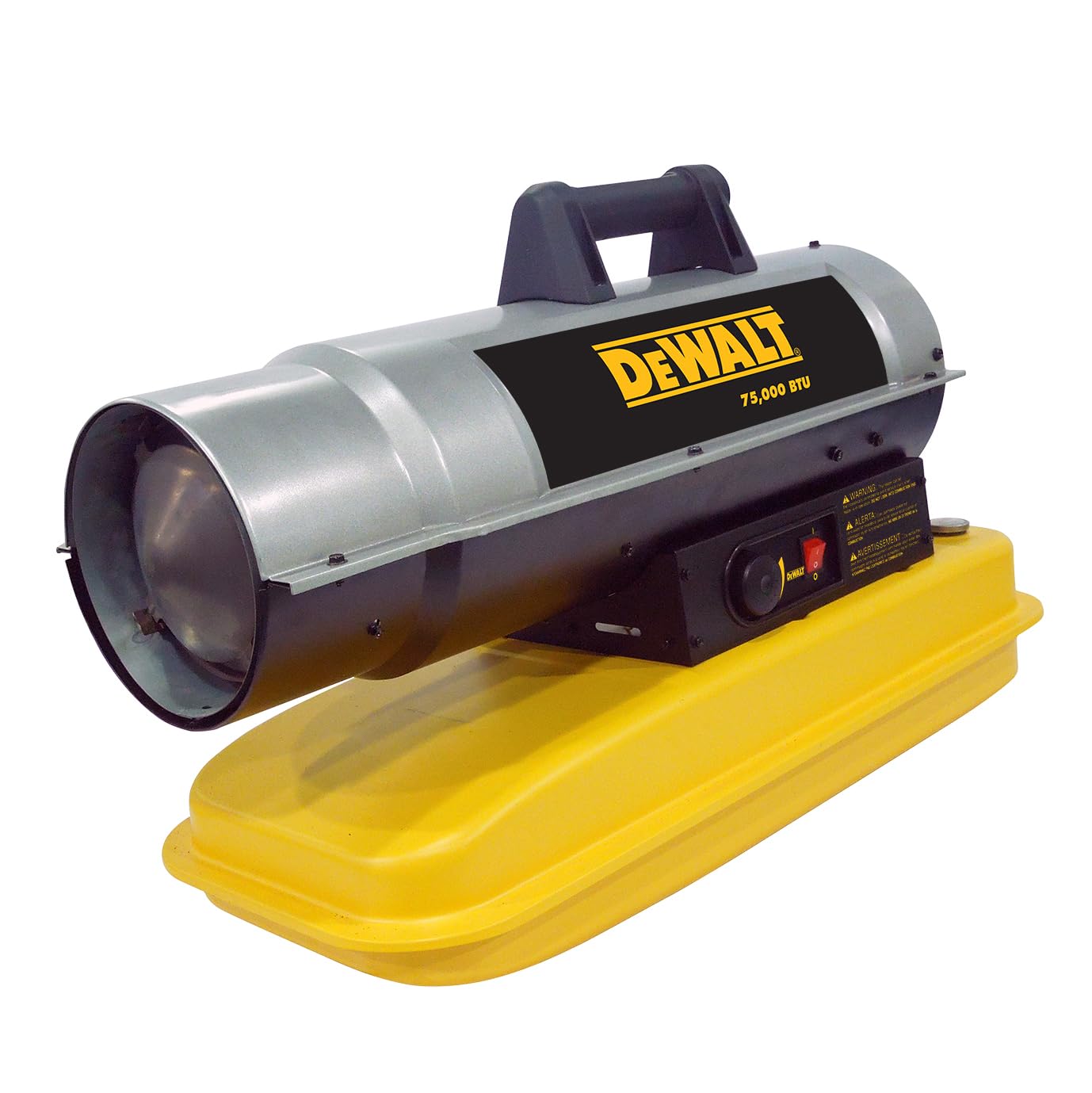
The king of raw, reliable heat for the largest, most exposed spaces.
When electric and propane just aren’t enough, kerosene heaters like this DEWALT step in. It pumps out 75,000 BTUs and covers approximately 1,875 sq ft, making it overkill for a 3-car garage—which is exactly the point for uninsulated garages in harsh northern winters. It burns either kerosene or diesel, giving you fuel flexibility depending on what’s cheaper or available. Owners love its reliability, with many reporting it works right from the start and maintains comfortable 60-degree temps even in extreme cold.
Reliability is the top positive aspect, with 33 owners singling it out. The simple operation means no electronics to fail—fill it with fuel, flip a switch, and you get 8-10 hours of heat. One owner saved their citrus trees during a freeze with it. The noise level is mixed (8 mentions), and it’s a forced-air unit, so it isn’t quiet. Durability also gets mixed feedback; some report the motor locked up after several tanks, though others have units working for years.
Why You’d Choose This: For the most extreme cold and uninsulated spaces, 75,000 BTU of kerosene heat with dual-fuel flexibility is the ultimate backup plan.
What To Know: It’s heavy at 26.8 lbs, loud, and requires good ventilation—this is a job-site tool, not a living-room heater.
Reach for this if: you need the most heat possible on a budget and have excellent ventilation in your garage or barn.
Look elsewhere if: you want quiet operation, or you need a heater for a finished attached garage where kerosene fumes would be an issue.
8. Mr. Heater 170,000 BTU Propane Heater
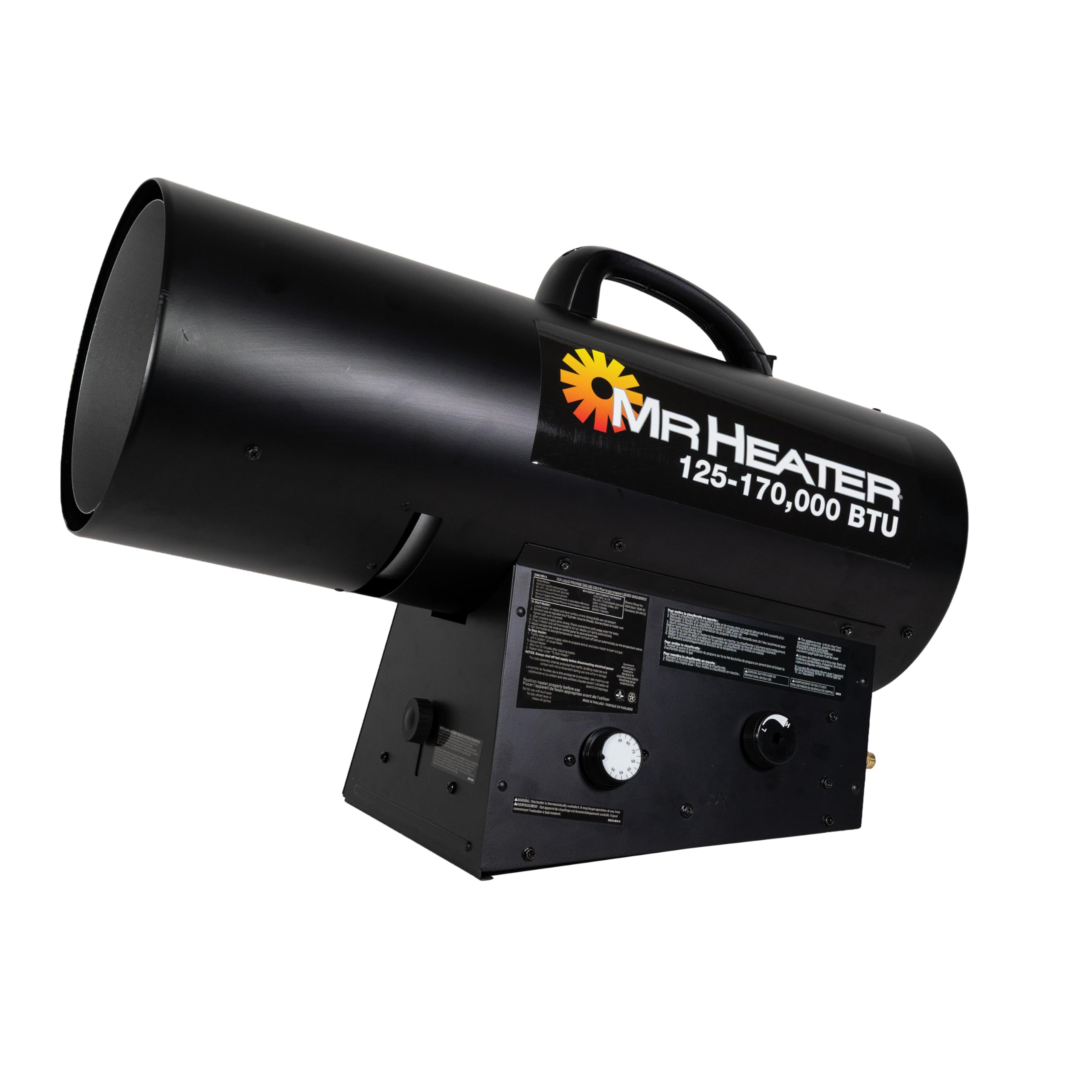
A monster that covers 4,250 sq ft—more than enough for even the largest 3-car garage.
This Mr. Heater is in a different league. At 170,000 BTU, it heats spaces up to 4,250 sq ft, making it suitable for a massive workshop, a garage with high ceilings, or even a small warehouse. It uses Quiet Burner Technology, which owners say is noticeably quieter than traditional forced-air propane heaters. On a full 100lb propane tank, it can run for up to 17 hours continuously. The variable heat output lets you dial it down to a more reasonable level for a 3-car garage when you don’t need maximum blast.
Owners rave about how quickly it heats a large space. One reported it took a 30×30 shop from 16°F outside to 80°F inside. The thermostat has a 20°F swing which some find annoying, and it needs at least a 100lb tank to avoid pressure loss. The cost of the tank and connection setup adds to the initial investment. It requires good ventilation—owners measure CO levels at 1-2 ppm with a door cracked 6 inches.
Who This Is For: The person with an enormous space, high ceilings, or a detached barn where only serious BTU numbers will do the job.
The Catch: You need a 100lb propane tank (minimum) and good ventilation—this is industrial-scale heat.
Best for: oversized or uninsulated garages where you need extreme heat capacity and can handle a large propane setup.
Not for: standard attached garages where such massive heat output would be overkill and a code concern.
9. Mr. Heater 80,000 BTU Unit Heater
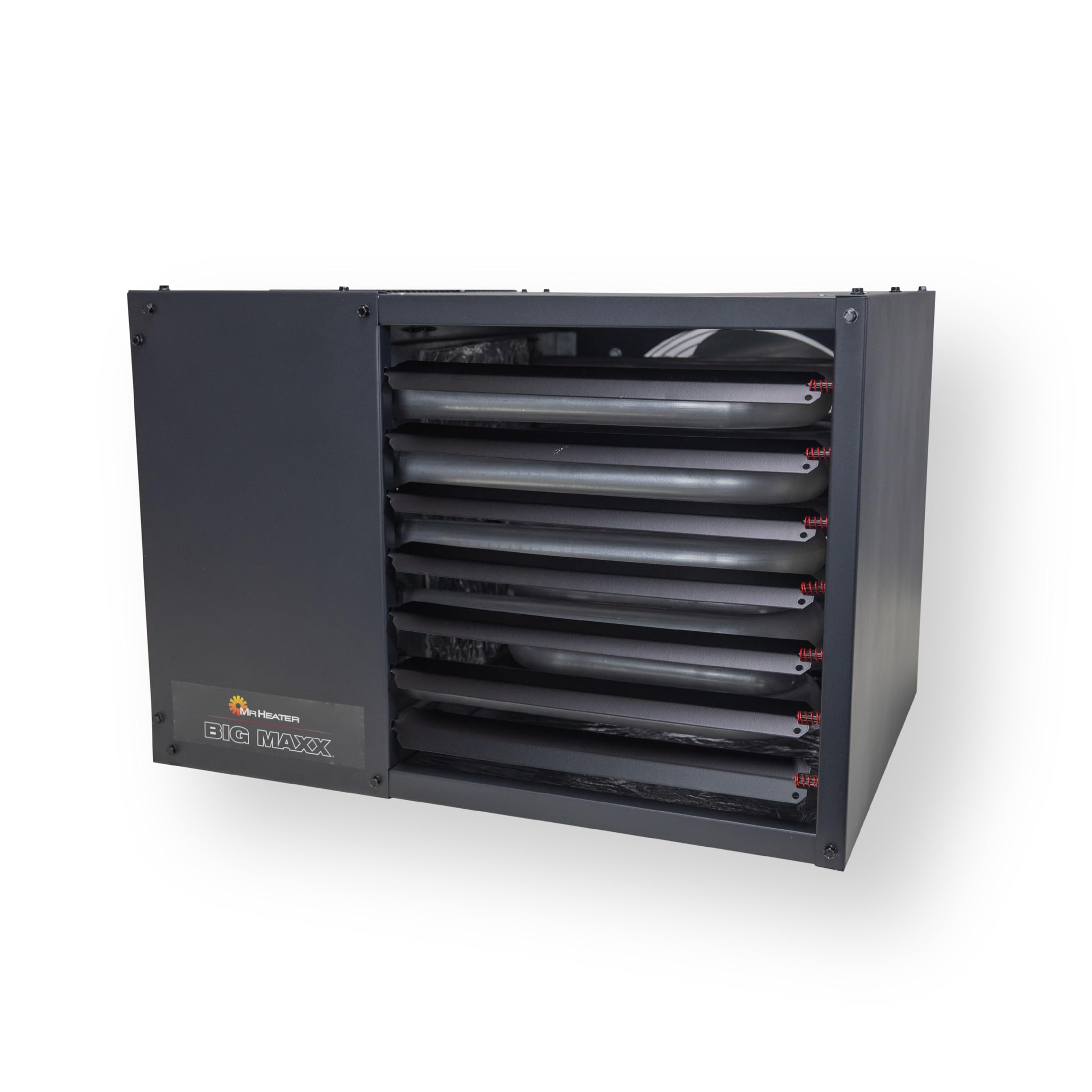
A ceiling-mounted gas unit that turns an entire garage into a heated workspace silently.
This Mr. Heater is the most popular gas unit on the list with over 840 ratings. At 80,000 BTU, it heats up to 2,667 sq ft—plenty for a 3-car garage. The ceiling-mounted design keeps it completely out of the way, and it works on either natural gas or propane (a conversion kit is included). It’s compatible with standard 24-volt thermostats or a new Wi-Fi thermostat (sold separately), so you can control the temperature remotely. Owners say it’s very quiet, easily heats a 24×36 shop, and maintains 40°F in 10°F weather with low fuel consumption.
Reliability is the top positive aspect with 82 mentions—the highest count of any product here. Installation takes some effort (you need a gas line and proper venting), but owners find the instructions clear. Some units arrive with shipping damage, so inspect the box carefully. There’s no pilot burner; it lights directly from the main burner, eliminating pilot cleaning issues.
Why It’s So Popular: It combines ceiling-mounted convenience, dual-fuel flexibility, and rock-solid reliability at a price that beats most competition.
The Setup: Requires a gas line and 10 ft minimum ceiling height—plan for an HVAC professional unless you’re experienced.
Grab this if: you have a gas line available in your garage and want a permanent, quiet, powerful heating solution.
it’s not for you if: you don’t have natural gas or propane delivery, or your ceiling is lower than 10 feet.
10. Qmark MUH35 5000W Unit Heater

A bulletproof commercial heater built for decades of service in factories and schools.
This Qmark (now Marley) unit heater is a commercial-grade machine. At 5,000W, it sits at the lower end of the power range compared to the 7,500W electric units, but its build quality is in a different class. It’s rated for use in factories, garages, warehouses, and schools—places where a heater runs constantly and can’t fail. The built-in thermostat, wall/ceiling mounting bracket, and adjustable discharge louvers are standard. The field-adjustable wattage allows you to match the output to the exact size of the space.
Owners call it an awesome heater that does the job well. However, at this price point for 5,000W, you’re paying for longevity and commercial reliability, not raw power. Some owners mention it’s very expensive for the wattage, and it doesn’t include a power cord (must be hardwired). There have been reports of fan motors failing after several months, though customer service sent replacements promptly under warranty.
Who This Is For: The buyer who prioritizes longevity and commercial-grade reliability over maximum power, and is willing to pay a premium for it.
The Trade-Off: 5,000W is less than many cheaper competitors—if you need pure heat output, you pay more here for less power.
Best for: a well-insulated garage or workshop where the heater runs for long hours and you can’t afford downtime.
Not for: anyone on a tighter budget who needs maximum heat for their dollar—other units offer more watts per dollar.
11. Modine Hot Dawg 45,000 BTU Natural Gas Heater

The gold standard for quiet, ceiling-mounted gas heat in a 3-car garage.
The Modine Hot Dawg is the name most often recommended by HVAC pros and garage enthusiasts alike. At 45,000 BTU with 80% efficiency, it covers 700 sq ft—the perfect size for a well-insulated 3-car garage. It runs on natural gas (with an optional propane conversion kit), and owners unanimously praise its quiet operation. One owner reported it heats a 3-car garage from the low 30s to the low 60s in just 15-20 minutes, then runs once per hour to maintain it. It’s compact and low-profile, with a neutral grey color that blends into the ceiling.
Performance is the top positive aspect with 31 mentions. The installation is straightforward for a qualified DIYer or contractor—one owner self-installed it in 4 hours using slotted angle braces. It requires venting (the standard power exhaust simplifies side-wall or roof venting with small-diameter vent pipe). The 80% efficiency means you get good fuel economy, and many owners note it’s much cheaper to run than electric or propane space heaters.
Why It’s Beloved: The combination of quiet operation, reliable performance, and economical fuel cost makes it the endgame for many garage owners.
The Cost: It’s a premium investment, with the heater itself plus installation, gas line, thermostat, and venting. But owners say it adds resale value as a “heated garage.”
Reach for this if: you want a permanent, whisper-quiet, long-term heating solution for your garage and are prepared for the professional installation.
Look elsewhere if: you need a portable or budget-friendly solution, or you don’t have a natural gas line nearby.
Understanding the Specs
BTU vs Wattage: What’s the Difference?
BTU (British Thermal Unit) measures how much heat a fuel-burning heater produces. Gas and propane heaters are rated in BTU (e.g. 60,000 BTU). Electric heaters are rated in watts (e.g. 5,000W or 7,500W). A quick comparison: 1 watt equals about 3.41 BTU. So a 7,500W electric heater produces about 25,590 BTU. In general, electric heaters are cleaner and quieter, while gas/propane heaters deliver higher peak heat output for less money upfront.
Installation Types: Hardwired, Plug-In, and Portable
Electric garage heaters either plug into a 240V outlet (like a dryer outlet) or are hardwired directly into a circuit breaker. Portable propane and kerosene heaters are freestanding and require no permanent installation, but they need good ventilation and a fuel source. Ceiling-mounted gas unit heaters (like the Mr. Heater or Modine) are the most permanent but also the most effective for evenly heating a large space without taking up floor room.
Voltage and Amperage Requirements for Electric Heaters
Most powerful electric garage heaters run on 240V (not the standard 120V household outlet). They typically require a dedicated circuit with a 30A to 50A breaker. The NEMA 14-50P plug (common on some models) fits an RV or electric range outlet. Hardwired models connect directly to the circuit breaker. Always have a licensed electrician handle 240V installations to meet local codes and avoid fire hazards.
Forced Air vs Radiant Heat
Forced air heaters use a fan to blow air over a heating element or heat exchanger, pushing warm air across the room. They heat the whole space faster but can be noisy. Radiant heaters use infrared panels to heat objects and people directly, not the air—they are silent but don’t warm a whole garage evenly. For a 3-car garage, forced air is almost always the better choice for widespread comfort.
FAQ
What size heater do I need for a 3 car garage?
Is an electric or propane heater better for a garage?
Can I use a portable propane heater in my garage?
Do I need a 240V outlet for an electric garage heater?
How many watts does a 3 car garage heater use?
Most powerful garage heaters (5,000W and above) require a 240V circuit because a standard 120V outlet can only provide up to 1,500W safely. You will likely need a dedicated 30A or 40A breaker and thicker wiring. Some models come with a NEMA 14-50P plug that fits a common dryer or EV outlet. Always consult an electrician to ensure your panel can handle the load.
How many watts does a 3 car garage heater use?
Can I install a garage heater myself?
How do I choose between natural gas and propane for a garage heater?
Is it safe to leave a garage heater on overnight?
What is a NEMA 14-50P plug?
Final Thoughts: The Verdict
Across the board, the best heater for 3 car garage is the InoKraft 7,500W Electric Garage Heater because it delivers the ideal balance of power, quiet operation, and easy installation with its NEMA 14-50P plug and remote control. If you prefer the raw, instant heat of propane and don’t mind the roar, the Remington 60,000 BTU Forced Air Heater offers unbeatable value for large spaces. And for the ultimate permanent, whisper-quiet solution that adds value to your home, the Modine Hot Dawg 45,000 BTU Natural Gas Heater is the investment that serious garage owners swear by.
How We Picked
We do not accept paid placement. Every pick is matched to a real buyer and a real use-case; we do not hands-on test units.
Sources & Methodology
Specifications: manufacturer listings and product documentation. Review insights: verified customer reviews, as of July 2026. Pricing: not shown on this page (it changes often); check the current price via the retailer link.
As an Amazon Associate, Trending Car earns from qualifying purchases. This does not affect which products we feature.