
Our readers keep the lights on and my garage snacks stocked. As an Amazon Associate, I earn from qualifying purchases.
Specs are compiled from manufacturer listings and verified buyer reviews and can change over time — please confirm the key details on the product page before buying.
A motorcycle dash cam can be the difference between a fair insurance payout and a losing he-said-she-said battle. But not every camera can handle rain, vibration, and highway speeds — most car units fail within weeks on a bike. You need something that records reliably when it matters, stays waterproof through a storm, and captures plates at a glance. We have sorted through the real-world reports to find the nine that actually deliver.
I’m Min Islam — the founder and writer behind Trending Car. This guide is built by comparing the manufacturers’ published specifications and the patterns across verified customer reviews, so you get each pick’s real strengths and trade-offs instead of marketing spin.
Whether you ride daily or tour on weekends, choosing the best dash cam for motorcycle means weighing video clarity, waterproofing, battery life, and storage capacity against your specific bike and routine.
Our Picks at a Glance

How To Choose The Best Dash Cam for Motorcycle
A good motorcycle dash cam is a permanent witness on your handlebars or helmet. The wrong one gives you grainy footage at the moment you need it most. Before you buy, match these four factors to your riding habits.
Waterproofing (IP Rating)
Your dash cam needs to survive rain, road spray, and pressure washes. Look for at least IP66 (strong water jets) — IP67 means it can survive submersion in shallow water. A lower rating invites moisture inside the lens once the seal ages.
Video Resolution and Frame Rate
Higher resolution captures plate numbers at speed. 1080p is the minimum; 2K or 4K gives you a much better chance of reading a plate from the playback. Frame rate matters too — 30fps is standard, but some cameras offer 55fps at 2K for smoother playback during fast cornering.
Power Source: Hardwire vs. Battery
Hardwired systems (connected to your bike’s battery) turn on and off with the ignition — no charging, no battery degradation. Battery-powered units are simpler to install but have limited runtime, and the battery loses capacity over time in hot weather. For daily riders, a hardwired setup is more reliable.
Storage and Loop Recording
Most moto dash cams use a microSD card. Loop recording automatically overwrites the oldest footage when the card is full, so you never run out of space mid-ride. A G-sensor (a small motion sensor that detects a bump) then locks the current video file so a crash clip is never overwritten. Higher maximum card support — 256GB or 512GB — means less frequent formatting.
Quick Comparison
| Model | Best For | Resolution | Waterproof Rating | Max Storage | Amazon |
|---|---|---|---|---|---|
| Vantrue F1★ Best Overall | Best Overall | 4K + 1080P | IP67 | 512 GB | Amazon |
| Magellan 2.5K+2.5KPremium Night Vision | Premium Night Vision | 2.5K + 2.5K | IP67 | 256 GB | Amazon |
| INNOVV K7High-End Build | High-End Build | 2K + 2K | IP67 | 512 GB | Amazon |
| INNOVV K6 | Compact Design | 2K + 1080P | IP67 | 256 GB | Amazon |
| AlienRider M12S | All-in-One Tech | 1080P + 1080P | IP68 | — | Amazon |
| VSYSTO Q3L | Fast WiFi Downloads | 2K + 2K | Waterproof | 512 GB | Amazon |
| AKEEYO 710Pro | Best Value Anti-Shake | 4K / 2K 55fps | IP66 | 64 GB (included) | Amazon |
| AKEEYO AKY-710S | Budget Pick | 4K / 2K 55fps | IP66 | 32 GB (included) | Amazon |
| LKT DB5 | Helmet-Mount Friendly | 2K + 2K | Waterproof | 64 GB (included) | Amazon |
In‑Depth Reviews
1. Vantrue F1 Motorcycle 4K Dash Cam Front and Rear
Our pick — over 4★ from 200+ verified ratings; the strongest balance of quality and price.
The 4K powerhouse that supports a massive 512GB for years of riding footage.
You get sharp 4K video from the front and 1080P from the rear simultaneously, both at 30fps — enough to read plates at 70mph, based on real-world clips. The 160-degree field of view covers more than three lanes of traffic, reducing blind spots on crowded highways. Unlike many competitors limited to 256GB, the Vantrue F1 handles up to 512GB microSD, which means weeks of continuous loop recording before circling back. The entire system, including both cameras and the main unit, carries an IP67 waterproof rating — you can ride through monsoon rain or dusty backroads without worrying about moisture damage.
Built-in 5GHz Wi-Fi pairs with the Vantrue app for previewing clips and adjusting settings without pulling the card. The GPS module logs speed, route, and elevation — exportable as a PDF report that strengthens your case after an accident. The wired remote lets you lock a file or snap a photo without taking your hand off the bars. What owners praise most is the camera quality — 48 buyer voices single out the sharpness alone. The recurring honest caveat is reliability: some units have experienced the G-sensor not triggering the emergency recording exactly as expected. As buyers put it, “the footage is great — I’ve got 2 years of riding videos.”
What Wins People Over
- True 4K + 1080P dual recording with STARVIS technology for low-light clarity
- Full-body IP67 waterproof design — no part needs extra sealing
- Supports up to 512GB cards, the highest in this comparison
- Voice prompts alert you to card errors and emergency recording activation
One Trade-Off to Know
- G-sensor trigger can be inconsistent — the system may not always start emergency recording on impact
Reach for this if: you want a fully waterproof, hardwired system with the highest resolution and largest storage capacity on the market — a true set-and-forget setup for daily riders and long-distance tourers.
Think twice if: you need a drop-in battery-powered camera; the F1 must be wired to your bike’s electrical system.
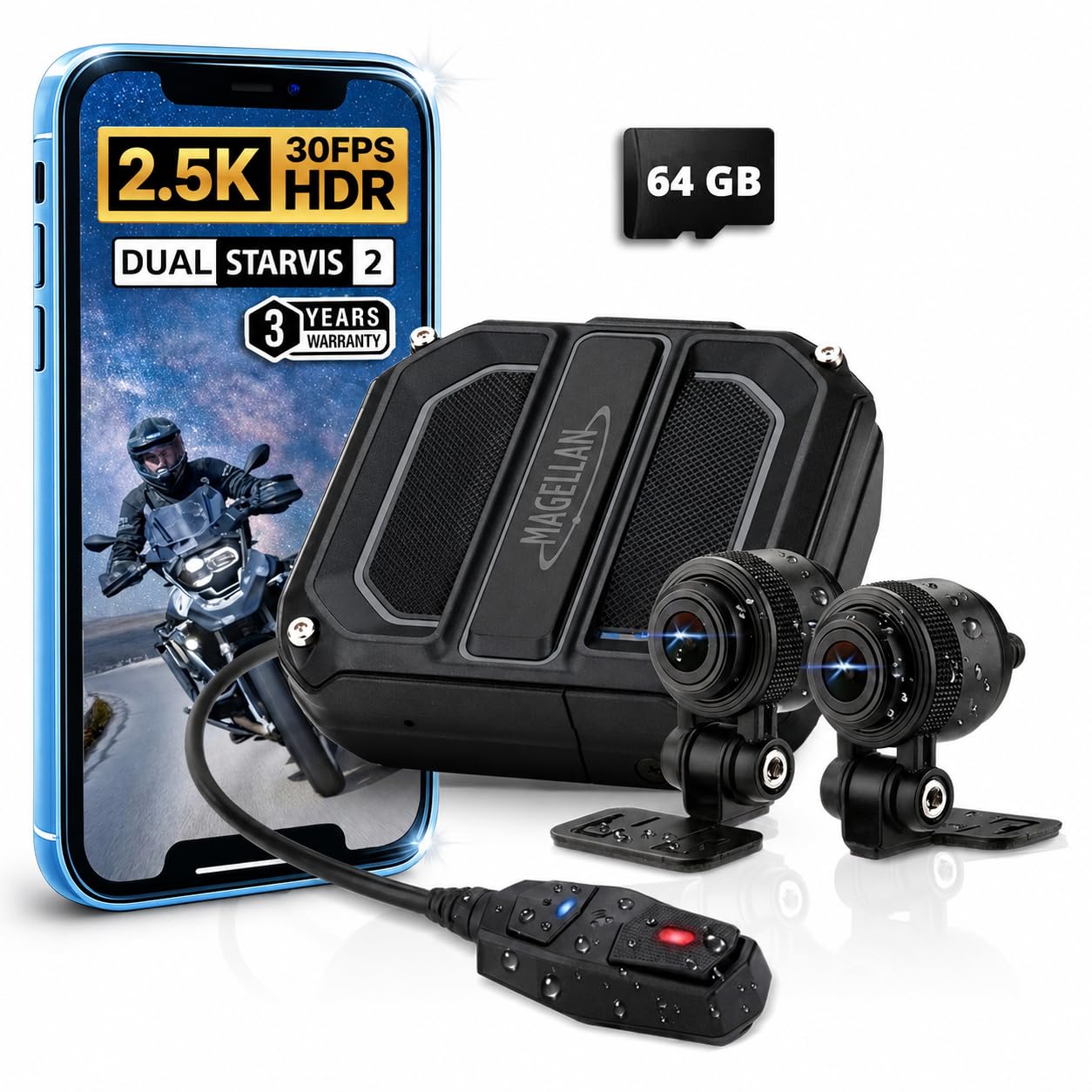
2. Magellan 2.5K+2.5K Motorcycle Dash Camera
Dual Sony STARVIS 2 sensors that read plates in near-total darkness.
Both front and rear cameras capture crisp 2.5K footage, not the typical 1080P compromise on the back channel. The STARVIS 2 sensor with HDR handles harsh glare and low-light conditions extremely well — owners consistently report reading license plates at night when other cameras would produce a blur. The IP67 rating covers the main unit and both cameras, so you can ride through heavy rain without sealing each piece separately. An included 64GB high-endurance SD card gets you recording immediately, and the system supports up to 256GB for longer trips.
While you are parked, the 3-in-1 Parking Mode (collision detection, time-lapse, and motion detection) watches your bike, and the voltage control automatically shuts off the unit when your battery drops below a safe level so you never return to a dead bike. The 5-satellite GPS logs your route and speed, and the Wi-Fi app lets you preview clips without removing the memory card. A recurring detail from owners is that the front camera mount can create a slight wobble on some bikes — a minor fitment nuance for an otherwise polished package.
Night-Testing Verdict: The Magellan is the pick if low-light plate capture is your top concern. The dual 2.5K STARVIS 2 setup outshines most competitors for night riding, and the included card plus voltage-protected parking mode makes it a complete kit from the start.
The Catch: Installation involves careful wire routing to access the bike’s battery for the voltage-monitoring feature, which adds an hour or two of setup time.
Perfect for: night riders and commuters who park outside — the parking mode and low-light clarity give genuine 24/7 coverage.
Not for: riders who want a plug-and-play handlebar mount without wiring to the battery.
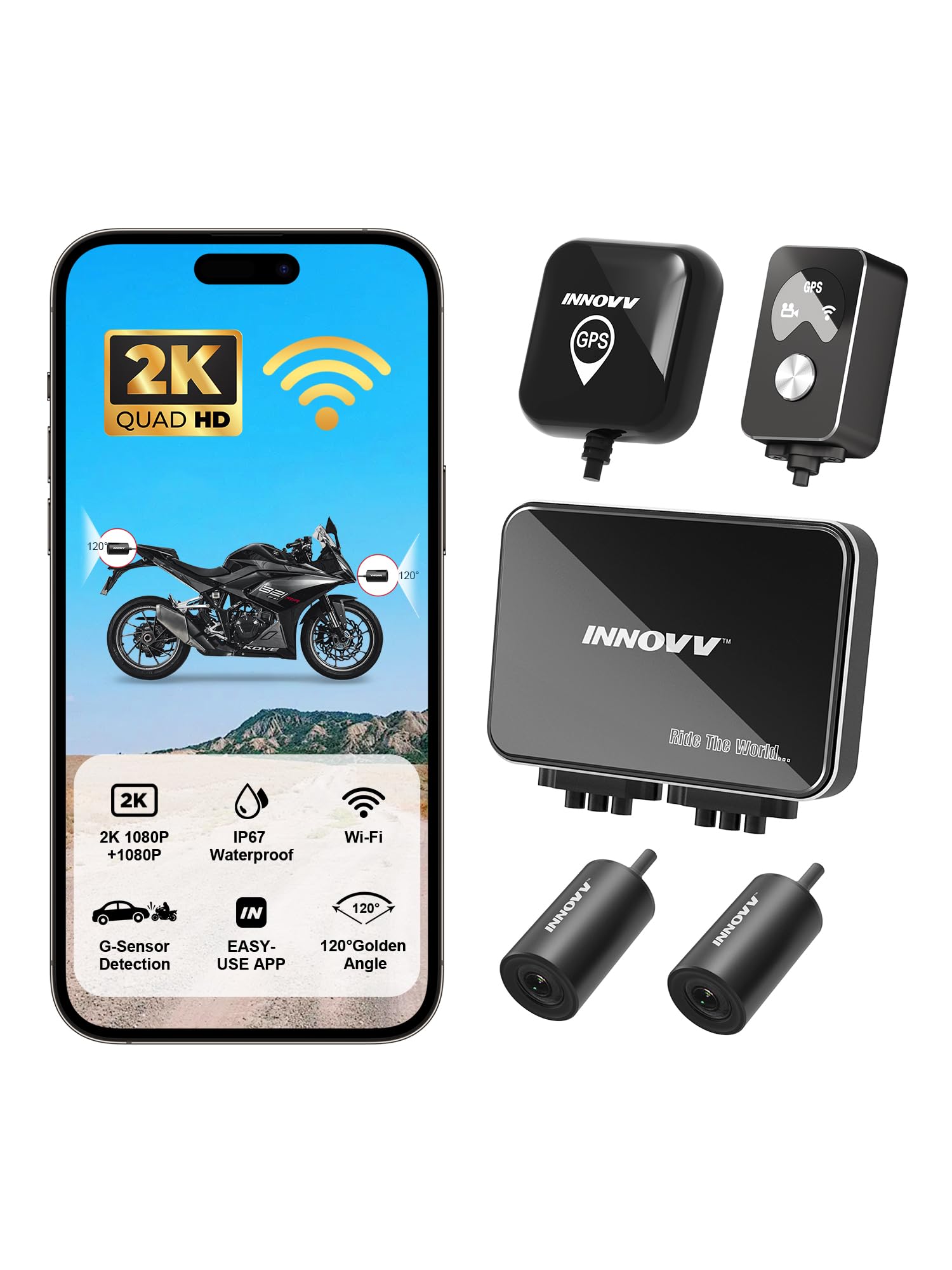
3. INNOVV K7 Motorcycle Dash Cam
The aluminum-alloy system with Electronic Image Stabilization for butter-smooth footage.
INNOVV designed the K7 specifically to handle extreme temperatures — the full aluminum-alloy body operates reliably from -30°C to 70°C, meaning hot asphalt or freezing mountain passes do not faze it. The 2K+2K recording at 30fps can run with EIS (Electronic Image Stabilization) engaged, which smooths out handlebar vibration for cleaner plate reads. If you switch to 1080P+1080P, you can keep the stabilization active while also maintaining a very clear picture. The front and rear cameras each offer a 160-degree field of view, covering three lanes of traffic to catch side-entering vehicles.
Parking mode triggers 30 seconds of emergency recording when the G-sensor detects movement or impact — useful for hit-and-runs in a parking lot. The 10Hz GPS tracker logs position changes at a high refresh rate so your video playback shows an accurate breadcrumb trail on the map. A 5.8GHz Wi-Fi module transfers files four times faster than the older 2.4GHz standard. Several owners note that the camera quality is excellent for recording accidents and identifying plates, though a few report that the front and rear video files can fall slightly out of sync during long rides.
Strengths
- Full-body IP67 waterproof design in durable aluminum alloy
- 2K+2K recording with electronic image stabilization
- 10Hz GPS for precise route and speed logging
- 160-degree front and rear lenses for wide coverage
Known Quirks
- Front and rear video files can lose sync on long recordings
- No memory card included — you must buy a high-endurance card separately
Choose this for: extreme-weather riders who need a rugged, metal-bodied unit with smooth stabilizing and GPS mapping for route documentation.
Pass if: you want a system with a screen or a card included in the box — the K7 is pure DVR-style, no display, no bundled SD card.
4. INNOVV K6 Motorcycle Dash Cam
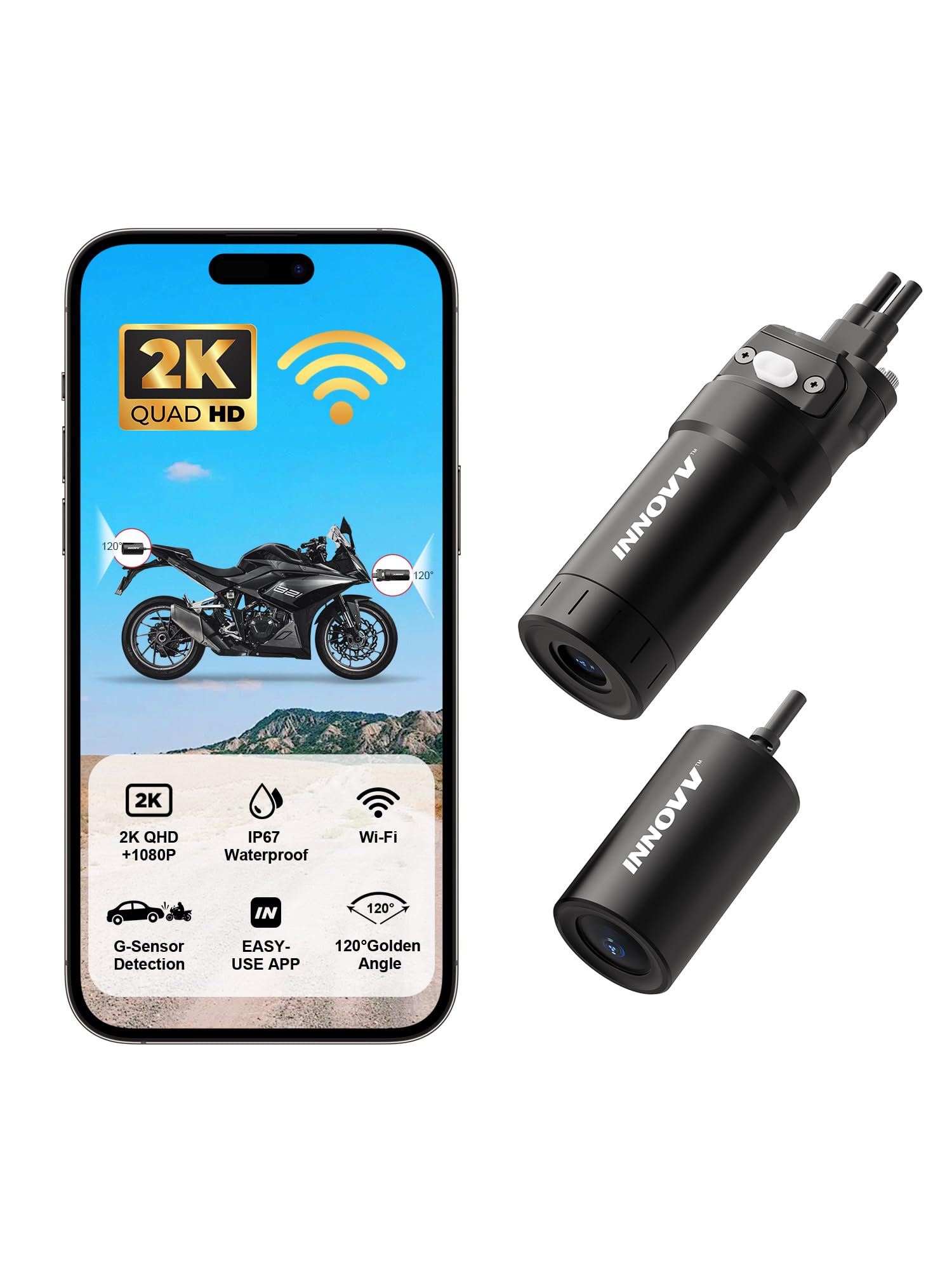
A mini 80.5mm camera that hides the DVR inside the lens body to avoid seat removal.
Most motorcycle dash cams force you to disassemble part of the bike to stash a separate DVR box under the seat. The K6 avoids this entirely by integrating the DVR directly inside the front camera housing (80.5mm x 28mm). The result is an ultra-compact system that mounts in minutes without pulling your seat or tail section. The front lens delivers 2K Quad HD 1440P at 30fps with a STARVIS sensor, while the rear records 1080P at 30fps — enough detail for plate reading in most conditions. The full aluminum-alloy body helps with heat dissipation, though the camera can run warm during long summer rides.
The IP67 waterproof rating matches the Vantrue and Magellan options — fully submersible in 0.5 meters of water for 30 minutes. Built-in Wi-Fi connects to the INNOVV app for viewing clips on your phone, and the system supports up to 256GB microSD. Camera quality earns top praise from owners who highlight clear daytime footage and good night vision at moderate distances. The trade-off noted by several riders is that the included mounting hardware can be fiddly — the adhesive mount screw can become inaccessible once installed, so plan your placement carefully.
Mini Marvel: If you hate digging under the seat to find a DVR box, the K6 is the neatest installation on this list. The 2K front camera is sharp for its size, and the aluminum build handles heat better than plastic rivals.
Reality Check: The mount design leaves the screw hidden after installation — get the placement perfect on the first try, because adjusting it later means peeling the adhesive and starting over.
Best for: riders who want a fast, invisible install on a sportbike or scooter with limited under-seat space.
Not for: anyone who needs a large display or a rear camera matching the front resolution.
5. AlienRider M12S Motorcycle System

The all-in-one that blends dash cam, blind-spot radar, CarPlay, and TPMS into a single unit.
The AlienRider M12S is not just a dash cam — it is a full motorcycle command center. The 77G millimeter-wave radar monitors your blind spots and provides BSD (Blind Spot Detection), LCA (Lane Change Assist), and RCW (Rear Collision Warning) in real time, day or night, regardless of fog or rain. The 1200-nit IPS touchscreen stays readable even under direct sunlight, and the entire system carries an IP68 waterproof rating — the highest in this comparison — so you can ride through a downpour without a second thought. Front and rear cameras record 1080P video with night vision, and the rearview streaming feature eliminates mirror blind spots while lane-changing.
Wireless CarPlay and Android Auto connect your phone for navigation and hands-free controls without taking your hands off the bars. The system also includes real-time tire pressure and temperature monitoring (TPMS), alerting you if a tire goes low or overheats. Buyers report that the radar blind-spot detection is accurate and fast, and the installation, while time-consuming (one owner spent about 8 hours routing wires), is well-supported by labeled cables and clear hardware. The recurring honest note is that the TPMS valve-stem sensors are heavy — one owner experienced a cracked valve stem from the added weight.
What It Does That Nothing Else Does
- 77G millimeter-wave radar for blind-spot and rear-collision warnings
- 1200-nit IPS touchscreen with wireless CarPlay and Android Auto
- IP68 waterproof — fully submersible, not just splash-proof
- Built-in TPMS with tire temperature monitoring
Before You Commit
- TPMS valve-stem sensors add weight that can crack a stem on rough roads
- Installation can take 6–8 hours due to radar and camera placement
Reach for this if: you want a full tech cockpit — radar, navigation, tire monitoring, and dash cam all in one weatherproof head unit. Ideal for touring riders who spend long days on the highway.
skip it if: a simple front/rear dash cam is all you need; the M12S is overkill and over-complicated for a basic recording setup.
6. VSYSTO Q3L Motorcycle Dash Camera
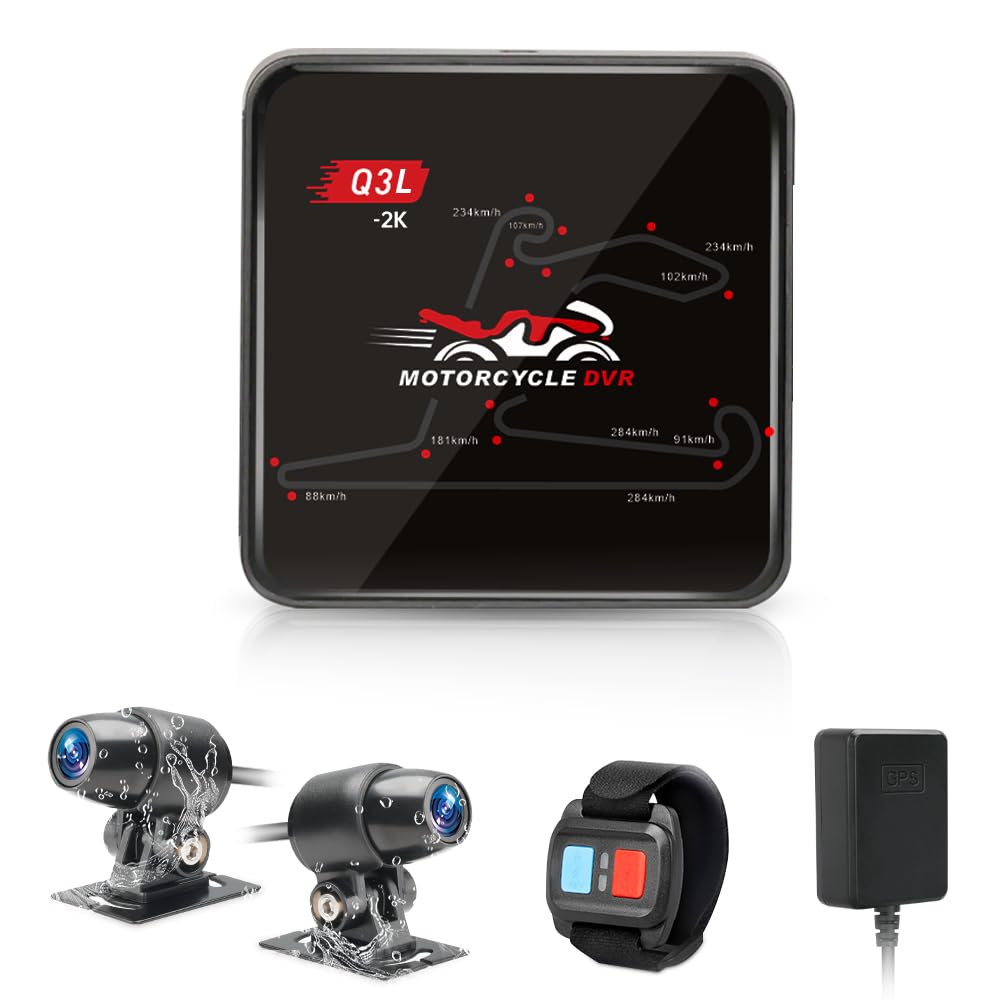
5G WiFi that downloads a full ride video at 10MB/s — no more waiting by the bike.
The VSYSTO Q3L records dual 2K (2560×1440) video at 25fps from both front and rear cameras. The 120-degree wide-angle lens captures the road ahead without the fisheye distortion typical of wider lenses. What separates this system from many competitors is the 5G WiFi module — video downloads hit up to 10MB/s, roughly four times faster than a standard 2.4GHz setup. You can pull a clip onto your phone and share it before you even take off your helmet. The MP4 video format means you can play the footage on virtually any device without converting files, and the camera saves the currently-recording file even if the SD card pops loose.
Parking monitoring activates on impact or movement — it records for 30 seconds and shuts off automatically. Low-battery voltage protection (11.5V cutoff) prevents the system from draining your bike battery. The wireless remote allows emergency recording or WiFi reset with a button press, though it requires the GPS module to function — the remote range is 3 meters max. Owners praise the video quality most, with 86 singling out the clarity, and installation earns strong marks for being straightforward. The honest friction point is the app experience: some find the WiFi connection finicky, and a few report that the G-sensor emergency record did not trigger during testing.
Speed Advantage: The 5G WiFi is a genuine time-saver if you regularly pull and edit ride clips. Most competitors still use 2.4GHz, which feels slow in comparison.
Honest Head-Scratcher: The remote only works when the GPS is installed, and the range is limited to about 10 feet — plan your handlebar layout accordingly.
Perfect for: riders who share videos often — the fast transfer and MP4 compatibility make this the easiest system for quick edits and social posts.
Not for: anyone who expects flawless app connectivity every time; the WiFi app has moments of frustration.
7. AKEEYO 710Pro EIS Motorcycle Camera

Electronic image stabilization at a mid-range price point that smooths out rough pavement.
The 710Pro runs on a Starvis IMX335 sensor that delivers 2K video at a smooth 55fps — noticeably smoother than the standard 30fps, which helps when reading fast-moving plates. It can upscale to 4K at 28fps for promotional clips, but the real highlight is the built-in EIS (Electronic Image Stabilization) system. A high-precision gyroscope inside the camera body compensates for handlebar vibration and rough road surfaces, producing stable footage even at the highest 4K resolution. The 142-degree wide-angle lens captures a broad view without extreme barrel distortion.
The IP66 rating (protection against heavy rain and dust) makes it suitable for all-season riding. A 1800mAh battery provides over 4.5 hours of 1080P recording on a full charge — enough for a full day of commuting or a half-day adventure. The included 64GB memory card gets you started immediately, and the OTA firmware update feature (over-the-air software updates) lets you improve camera performance without removing the card. Owners consistently praise the video quality and stability, with one calling it “very good quality” and another noting the “good image quality and image stability.” The most honest trade-off reported is that the body can become uncomfortably hot during extended operation — the heat sink is built in but does its job by dissipating warmth through the metal casing.
Why It Stands Out
- 2K video at 55fps for noticeably smoother motion than 30fps cameras
- Electronic image stabilization works throughout 4K recording
- 4.5 hours of battery life in 1080P mode covers a full day of riding
- 64GB card included — no immediate extra purchase needed
One Thing to Watch
- The camera body can get uncomfortably hot to the touch during long summer rides
Reach for this if: you want stabilized video at a mid-range budget and prefer a battery-powered unit you can charge overnight rather than hardwire to the bike.
Think twice if: you ride in extreme heat and dislike warm electronics against your gear; the metal body dissipates heat by getting warm.
8. AKEEYO AKY-710S Motorcycle Camera

The entry-level camera that shoots 4K upscaled footage and includes a 32GB card for under a hundred.
The AKY-710S shares the same Starvis IMX335 sensor as its Pro sibling but omits the electronic image stabilization to hit a lower price point. It still delivers crisp 2K video at 55fps with the option to upscale to 4K at 28fps, and the 142-degree lens offers a solid balance between coverage and distortion. The IP66 waterproof rating means it survives rain and road spray without issue. A 1800mAh battery provides over 4.5 hours of 1080P recording — enough for a daily commute or a leisurely weekend ride.
The package includes four mounting options (handlebar, helmet, rearview mirror, and a universal mount), so you can experiment with placement until you find the right angle. The built-in 2.4GHz Wi-Fi and OTA firmware updates let you adjust settings without a computer. Recharging via a standard power bank extends your riding day indefinitely. Where this camera falls short compared to pricier options is the companion app — owners frequently describe it as “terrible” and “buggy,” with Wi-Fi disconnects that interrupt setting adjustments. If you can live with a bare-bones app experience, the video quality for the price is genuinely impressive.
Value Verdict: At this price point, nothing else provides 55fps 2K video with a 32GB card included. The hardware is surprisingly capable — the app is the weak link.
You will need to offload or format the card more often on long tours.
Best for: budget-conscious riders who want decent video quality and don’t mind a no-frills app experience.
Not for: tech-heavy riders who expect a polished smartphone app with reliable Wi-Fi connectivity.
9. LKT Motorcycle Dash Cam Front and Rear
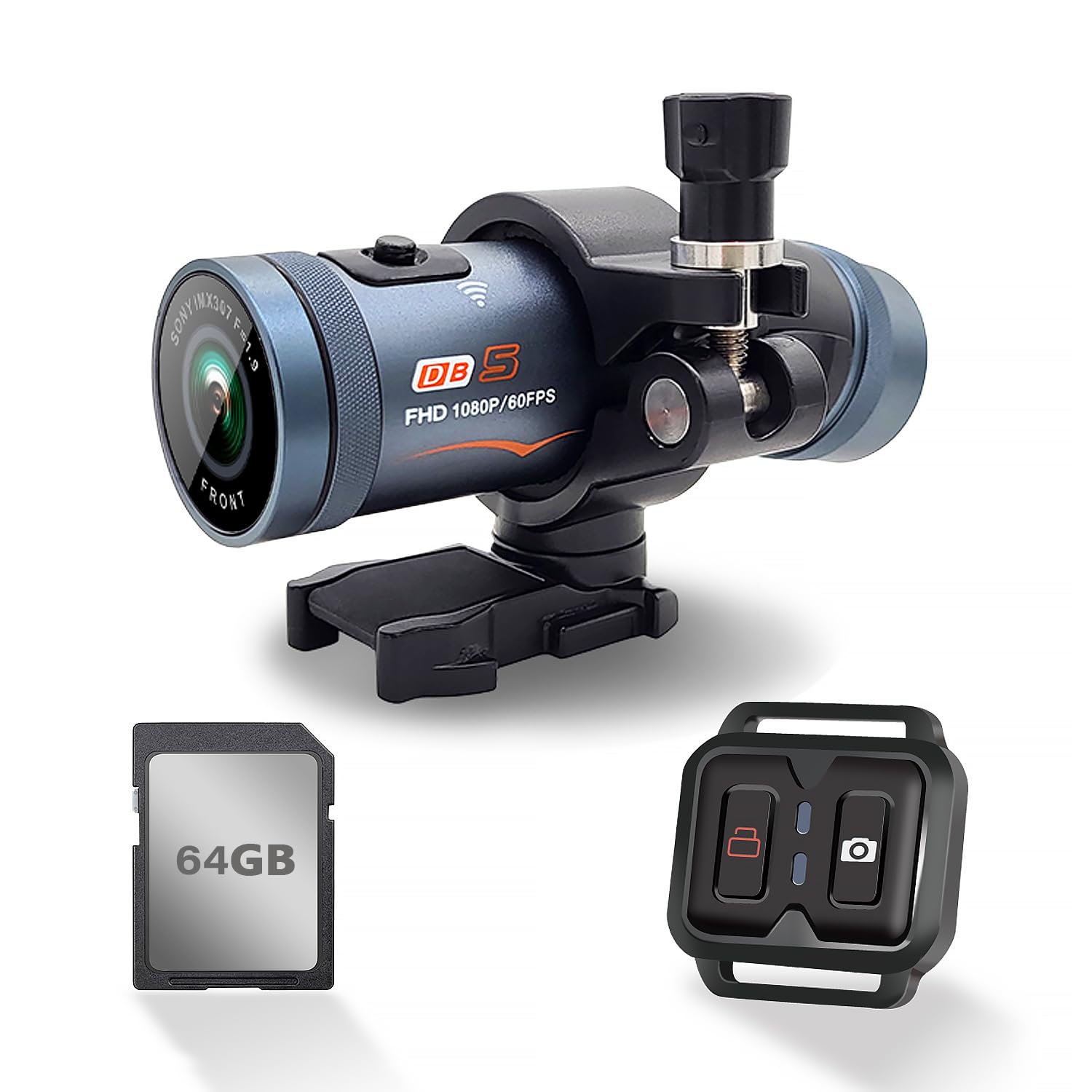
A dual-camera helmet system with a Sony IMX307 that specializes in low-light recording.
The LKT DB5 captures both front and rear views in 2K resolution using a Sony IMX307 sensor — a sensor known for strong low-light performance, which helps identify road signs and vehicles at dusk. The camera mounts to your helmet via strong adhesive and a versatile bracket, making it a good option for riders who switch between bikes or want to take the camera inside at night. The included 64GB memory card supports loop recording so the card never fills up mid-ride. A wireless wrist remote lets you lock a file or take a photo without reaching for the camera.
The built-in 1920mAh battery offers 3–4 hours of recording, enough for a half-day ride. GPS tracking logs your speed and route, and the WiFi connection pairs with the “LOOKING CAM” app for viewing and downloading clips. Owners highlight the picture quality as “amazing” and note that the mounting system is easy to attach. The honest drawbacks are that the lens can scratch more easily than expected — one owner reported that video quality degraded after months of use due to front lens scratches — and the battery life is middle-of-the-pack compared to the 4.5-hour AKEEYO options. WiFi connectivity can also be unstable, requiring several attempts to reconnect.
What Works
- Dual 2K recording with Sony IMX307 sensor for night clarity
- Wireless wrist remote for easy file locking while riding
- 64GB card included, supports loop recording from the start
- Helmet-mount design works across multiple bikes
What to Watch For
- Lens scratches relatively easily — a protector or careful cleaning is recommended
- WiFi can be unreliable; some owners mention frequent disconnections
Reach for this if: you ride different bikes or want to take the camera with you when you park — the helmet-mount design gives you flexibility that hardwired systems lack.
pass on it if: you ride daily in all weathers and need a permanently installed, fully protected unit with scratch-resistant lenses.
Understanding the Specs
Field of View (FOV)
Field of view is measured in degrees and tells you how much of the road the camera sees side to side. A 120-degree lens covers about three highway lanes, while 160-degree lenses capture nearly four lanes but introduce some fisheye distortion at the edges. For capturing a car merging from the adjacent lane, 140 degrees is a safe starting point. For catching a vehicle approaching on the shoulder or from a side street, a wider 160-degree lens gives you better peripheral coverage — worth the mild edge distortion.
Loop Recording and G-Sensor (Emergency Recording)
Loop recording means the camera automatically reuses the oldest footage once the SD card is full — you never run out of space mid-ride. The G-sensor (a small motion sensor inside the dash cam that detects a sudden jolt or impact) then marks that moment as “emergency” footage. When the G-sensor detects a collision, it locks the current video file into a protected folder so the loop overwrite cannot erase it. Without this feature, your crash footage could be overwritten before you ever retrieve the card. Look for an adjustable G-sensor sensitivity so you can dial it in for your bike’s normal vibration level.
FAQ
Will a car dash cam work on my motorcycle?
What is the difference between IP66 and IP67 waterproof ratings?
How much storage do I need for a motorcycle dash cam?
Can I install a hardwired dash cam myself?
What does a G-sensor do in a motorcycle dash cam?
Is 4K resolution necessary on a motorcycle dash cam?
How long does a battery-powered motorcycle dash cam last?
What is parking mode and do I need it?
Do I need GPS in a motorcycle dash cam?
Can a motorcycle dash cam record audio?
Final Thoughts: The Verdict
For most riders, the best dash cam for motorcycle is the Vantrue F1 because it combines true 4K front recording, full-body IP67 waterproofing, and 512GB card support — the longest storage runway in this group. If low-light plate capture is your priority, the Magellan 2.5K+2.5K with dual STARVIS 2 sensors and voltage-protected parking mode is the standout. And for budget-conscious riders who still want high frame rates and an included SD card, the AKEEYO 710Pro delivers smooth 55fps video with electronic stabilization at a fraction of the premium-tier cost.
How We Picked
We do not accept paid placement. Every pick is matched to a real buyer and a real use-case; we do not hands-on test units.
Sources & Methodology
Specifications: manufacturer listings and product documentation. Review insights: verified customer reviews, as of July 2026. Pricing: not shown on this page (it changes often); check the current price via the retailer link.
As an Amazon Associate, Trending Car earns from qualifying purchases. This does not affect which products we feature.