
Our readers keep the lights on and my garage snacks stocked. As an Amazon Associate, I earn from qualifying purchases.
Specs are compiled from manufacturer listings and verified buyer reviews and can change over time — please confirm the key details on the product page before buying.
A rough idle, a check-engine light that won’t quit, or the feeling your car has lost its punch — carbon buildup is the silent culprit, and an air intake cleaner spray is the quickest fix you can buy. The right spray dissolves carbon on throttle plates, intake valves, and MAF sensors without a shop visit, saving hundreds in labor.
I’m Min Islam — the founder and writer behind Trending Car. This guide is built by comparing the manufacturers’ published specifications and the patterns across verified customer reviews, so you get each pick’s real strengths and trade-offs instead of marketing spin.
Whether you drive a daily commuter or a high-mileage project car, choosing the best air intake cleaner spray hinges on matching the formula to your specific engine problem — throttle body gunk, sensor film, or deep valve deposits.
Our Picks at a Glance


How To Choose The Best Air Intake Cleaner Spray
Not every spray is for every job. Using a throttle-body cleaner on a mass air flow (MAF) sensor can ruin the delicate platinum wires. A MAF cleaner may lack the solvent power for thick carbon on intake valves. Your engine type and the specific symptom — rough idle, poor fuel economy, a check-engine code — dictate which can you grab. Here is what to look for.
Match the cleaner to the exact part
A throttle-body and air-intake cleaner attacks baked-on carbon and varnish inside the throttle body and plenum. A dedicated MAF sensor cleaner evaporates in seconds without leaving residue on the sensitive hot-wire element. An upper-engine or intake-valve spray is designed for direct-injection (GDI) engines where fuel never touches the valves, so you need a solvent like Polyetheramine (PEA) to break the carbon loose. A universal spray that claims to do everything often does neither well — picking the right kind for your target part is the first decision.
Check for oxygen sensor and catalytic converter safety
Sprays that are “safe for oxygen sensors and catalytic converters” contain no harmful chlorinated solvents that could poison your emissions system. This matters most for full-intake treatments and throttle-body cleaners that get pulled into the combustion stream. Most modern products carry this label, but if you are working on a newer car with a sensitive O2 sensor, confirm it on the can before spraying.
Consider your engine type: PFI, TBI, or GDI
Port-fuel-injected (PFI) engines get fuel sprayed onto the back of the intake valves, which naturally cleans them — these engines see less valve buildup. Throttle-body-injected (TBI) systems are similar. Gasoline-direct-injected (GDI) engines inject fuel straight into the cylinder, bypassing the valves entirely, so carbon accumulates rapidly on the intake valves. If you own a GDI vehicle, an intake-valve cleaner with PEA is essential maintenance. A simple throttle-body spray will not reach the valves in a GDI engine.
Aerosol format versus liquid additive
An aerosol spray lets you target the cleaner precisely through the intake, throttle body, or a vacuum line — you see exactly where the solvent goes. A liquid fuel-additive treatment, like the popular Sea Foam Motor Treatment in a bottle, is poured into the gas tank or crankcase and works its way through the fuel system. For deep, visual cleaning of the throttle plate and intake manifold, an aerosol wins. For ongoing prevention across the whole fuel system, an additive can supplement.
Value beyond the sticker price
Cost per can matters less than cleaning power per ounce. A premium product like the BG Throttle Body & Intake Cleaner sells for more upfront but buyers repeatedly report that “a little goes a long way,” so one can may cover several treatments. Meanwhile, budget-friendly options like Johnsen’s MAF cleaner cost less and perform the same job as more expensive brand-name equivalents. For a one-time deep clean, a pricier can with strong PEA concentration is worth the money. For routine maintenance, any reputable spray safe for your part type will do.
Quick Comparison
| Model | Best For | Volume | Key Ingredient | Sensor-Safe | Amazon |
|---|---|---|---|---|---|
| Sea Foam Combo Pack★ Best Overall | Best Overall | 16 oz + 14 oz | Petroleum-based | Yes | Amazon |
| CRC 05078Throttle Body Specialist | Throttle body precision | 12 oz | Proprietary solvent | Yes | Amazon |
| Johnsen’s 4721MAF Sensor Champion | MAF sensor cleaning | 10 oz | Quick-dry solvent | Yes | Amazon |
| Genuine Toyota 00289-1TP00 | OEM-grade cleaning | 14 oz | Proprietary | Yes | Amazon |
| Sea Foam Spray SS14 (2-pack) | GDI valve cleaning | 14 oz (x2) | Petroleum-based | Yes | Amazon |
| CRC MAF & Throttle Bundle | Two-in-one kit | 11 oz + 12 oz | Proprietary solvent | Yes | Amazon |
| ATP AT-100 | Smoke-free cleaning | 7.5 oz | PEA | Yes | Amazon |
| BG Throttle Body & Intake | Professional-grade results | — | Proprietary | Yes | Amazon |
| Berryman 2611 | Deep PEA cleaning | 16 oz | Polyetheramine (PEA) | Yes | Amazon |
In‑Depth Reviews
1. Sea Foam Motor Treatment and Intake Cleaner Combo Pack
Our pick — over 4.5★ from 29,500+ verified ratings; the strongest balance of quality and price.
The crowd favorite treats fuel, oil, and intake in one go.
This combo delivers a 16-ounce bottle of the classic Sea Foam Motor Treatment plus a 14-ounce can of Sea Foam Spray for the intake — covering every carbon-prone area in your engine. The motor treatment goes into the gas tank or crankcase to clean injectors, carburetors, and lifters, while the spray attacks intake valves and chamber deposits that fuel additives simply cannot reach. For GDI engines especially, that spray is critical because fuel never touches the back of the valves.
What wins people over is the breadth: buyers report smoother idle and improved performance across lawn mowers, chainsaws, generators, and daily drivers. A low-mileage car with a rough idle from water in the fuel got instantly smoother after a dose in the tank. The recurring theme is that this pack fixes “rough running” and “stalling” without a mechanic’s visit. The only real trade-off is that the spray can is single-use for a deep clean, and if you only need a throttle-body spray, the larger can of motor treatment may go unused unless you maintain multiple engines.
Owners mention that the motor treatment quiets noisy lifters when added to the crankcase and de-ices fuel lines in cold weather. The spray portion is specifically formulated to be safe for oxygen sensors and coated parts, so you can fog it through the intake without worry. A single owner put it plainly: “Great product..use it for all my engines and gas tanks…works every time.”
Sea Foam combo cleaner
- Treats fuel, oil, and air intake — three paths for carbon removal
- Spray is critical for GDI engines where fuel-only cleaners fall short
- Over 1,000 owners praise the quality alone
bulky two-bottle set
- If you only need a throttle-body spray, the motor treatment bottle may sit unused
- The spray can is smaller (14 oz) than a dedicated throttle-body cleaner
engine treatment: Anyone with multiple engines — a car, a mower, a generator — who wants one kit to handle fuel-system deposits, intake-valve buildup, and crankcase sludge.
not for quick jobs: If your car runs fine and you just need to clean the throttle plate, a focused throttle-body spray costs less and wastes zero product.
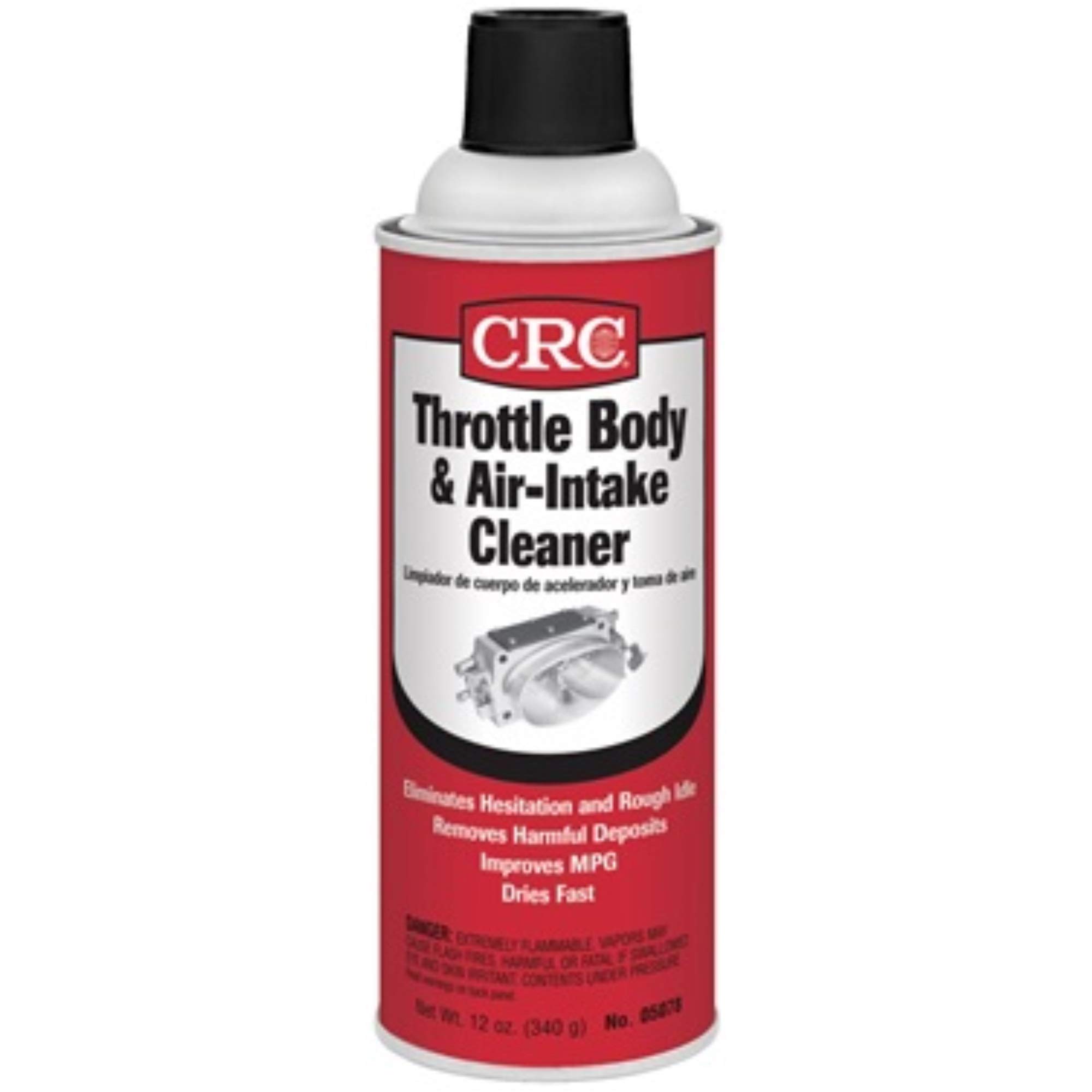
2. CRC 05078 Throttle Body and Air-Intake Cleaner
The go-to can when your throttle plate looks like a charcoal grill.
CRC 05078 is purpose-built for dissolving carbon, varnish, and gum deposits on throttle bodies and air-intake systems. The 12 oz aerosol delivers a deep-cleaning solvent that helps engines start easier, eliminates hesitation, and stops rough idle — exactly the symptoms of a dirty throttle plate. It works on all fuel-injected gasoline engines, both throttle-body and multi-port setups, and it is safe for the oxygen sensors and catalytic converter downstream.
The crowd is near-unanimous: 177 owners single out effectiveness as the top reason to buy, and 91 more highlight quality. One owner used it on a 2002 Mustang GT and noted the throttle body “wasn’t that dirty” but still saw improvement just from following the directions. Another cleared a P1011 code, saved a shop visit, and called it “easy application.” The group consensus is that CRC makes “great chemicals” and this can is “the best throttle body cleaner around.”
CRC explicitly markets this for throttle-body and air-intake cleaning — it is not a MAF sensor cleaner. The solvent is aggressive on carbon but plastic-safe on throttle-body components. If you are dealing with a gummed-up carburetor, it works in a pinch but is not a magic bullet for completely clogged jets. The scent is listed as “Gum,” which matches the real-world smell of the solvent.
CRC throttle spray: For a dedicated, one-spray fix for throttle-body grime, CRC 05078 is the most-trusted name on this list. Skip it only if you need a MAF-specific cleaner or a full-intake treatment for a GDI engine — this can stays in the throttle body zone.
throttle body: You have a rough idle, hesitation on acceleration, or a check-engine code tied to a dirty throttle body. A single can and ten minutes of work is all you need.
skip for sensors: Your issue is a faulty mass air flow sensor or carbon on GDI intake valves — those need a different chemistry.
3. Johnsen’s 4721 Mass Air Flow Sensor Cleaner
The budget-friendly cleaner that leaves no film on sensitive sensor wires.
Johnsen’s 4721 is formulated specifically for mass air flow sensors — the delicate hot-wire element that tells your engine computer how much air is coming in. A dirty MAF sensor causes lean or rich fuel mixtures, stumbling acceleration, and a check-engine light. This cleaner evaporates in seconds without leaving any residue, which is crucial because even a microscopic film can skew readings. At 10 ounces, it is a compact can that goes a long way on a single sensor cleaning.
Owners are clear on what this does well: cleaning performance leads the aspect list, with 39 buyers calling it out. A common story is a check-engine light that refuses to go away until the MAF sensor contacts are cleaned. “bought product in hopes of eliminating troublesome check engine light…cleaned contacts and works perfectly,” one owner reports. Fuel economy gains are also noted — a single cleaning can restore lost MPG by returning the air-fuel ratio to spec. One owner compared it directly to CRC’s MAF cleaner, found Johnsen’s “works as well at lower cost,” and called it a better value.
Compared to the heavier 14-ounce can of the Genuine Toyota Throttle Plate Cleaner, Johnsen’s is 40% lighter but targets a completely different part — the MAF sensor, not the throttle plate. The spray is effective on lawn mowers and snow blowers too, which suggests the quick-dry formula works on any sensor-type component. Some owners note that if your MAF sensor is physically damaged rather than just dirty, no cleaner will fix it — this is a maintenance tool, not a repair.
mass airflow: A cheap, effective first step before replacing a MAF sensor. If your engine runs rich, hesitates, or throws a lean-code, clean the sensor with this before buying a replacement.
not for throttle: Throttle-body carbon or intake valve deposits — this is a sensor cleaner, not a carbon dissolver.
4. Genuine Toyota Fluid 00289-1TP00 Throttle Plate Cleaner

Toyota’s own formula that removes deposits without removing the throttle plate.
This is the exact fluid Toyota dealerships use — the 14-ounce can says “no need to remove the throttle plate from the engine,” which is the whole point of a spray cleaner. It removes power-robbing deposits, improves fuel mileage, restores throttle efficiency, and cleans the idle control solenoid in one pass. The chemical is designed to leave no white residue, which is a common complaint with generic brake-parts cleaners used in its place.
Owners (149 ratings, mostly perfect scores) praise its OEM-level compatibility. One Toyota RAV4 owner was quoted for a throttle-body cleaning at the dealership; this spray can cost a fraction of that and “took like 10 min to DIY.” A 4Runner owner with a 1998 model reported a smoothed idle and better drivability from just a little spray — “a little goes a long way.” The cleaner also works on non-Toyota vehicles; a Mustang 5.0 owner used it and said the throttle valve came out “clean as a whistle.”
The caution is obvious: this is a throttle plate cleaner, not a full-intake or MAF cleaner. It does not treat fuel injectors or crankcase oil. You pay a slight premium for the Toyota branding, but the no-residue formula and 14-ounce volume make it a strong choice if you want the exact chemistry the engineers specified.
OEM fit: You drive a Toyota (or any car) and want the dealership-grade cleaner without the dealership markup. The no-removal-required design and safe-on-plastics formula make it hard to mess up.
skip aftermarket: You need a MAF sensor cleaner or an intake-valve treatment for a GDI engine — this spray stays in the throttle body.
5. Sea Foam Spray Upper Engine Cleaner and Lube, SS14, 14 oz Pack of 2

The aerosol that reaches where fuel injectors never touch.
This 14-ounce spray is the dedicated upper-engine weapon in Sea Foam’s lineup — it is not the same as the motor-treatment bottle. The spray is critical for Gasoline Direct Injection (GDI) engines where fuel never contacts the intake valves, so carbon builds up hard and fast. It safely removes intake valve and chamber deposits when applied through the air intake or carburetor throat, and it lubricates throttle plates, bushings, and upper cylinders during the process.
Real owner stories are dramatic. A 2009 Jeep Liberty at 143,000 miles cleared a P0430 code after the spray treatment — a code that previously returned within a day. The owner says it “saved cat replacement” by cleaning the catalytic converter’s upstream deposits. A Mazda RX8 with a rough idle eliminated the problem entirely, though the owner noted heavy smoke for three days afterward (normal as the dissolved carbon burns off). A BMW V8 owner used a borescope before and after and confirmed two-thirds of the carbon buildup was removed from the combustion chambers. The pack of two gives you a spare for the next service or a second pass on a heavily carboned engine.
The formula is safe for coated parts and oxygen sensors, which is important for direct-injection engines where spray residue passes through the exhaust. Some owners note that this spray works where regular Sea Foam in the gas tank failed, which underscores the difference between fuel-system cleaning and intake-valve cleaning. The single can weighs 1.96 pounds for the pair.
Sea Foam spray lube: If you drive a GDI vehicle — which covers most modern cars — this is the Sea Foam product you actually need for valve cleaning. The two-pack is enough for a thorough treatment and a follow-up.
upper engine: GDI engine owners who have never cleaned their intake valves. The borescope-verified results prove it actually shifts carbon.
not for MAF: Port-injected engines where fuel already cleans the valves — you can save the spray for a more needy vehicle.
6. CRC Mass Air Flow Sensor Cleaner 11oz & Throttle Body Cleaner 12oz Bundle

Two sprays in one pack so you hit the MAF and throttle body on the same day.
This CRC bundle gives you an 11-ounce MAF sensor cleaner and a 12-ounce throttle body and air-intake cleaner in one purchase — no guessing which can you need. The MAF cleaner is plastic-safe and dries in seconds, designed to restore the air-fuel ratio and MPG by removing the oil film that dirty air filters leave on the sensor wire. The throttle body cleaner goes after carbon, varnish, and gum that cause hesitation and rough idle. Together they cover the two most common air-intake cleaning jobs on any fuel-injected gasoline engine.
The feedback is consistent: “works as long as you’re very careful with the sensor while spraying” warns one owner, which is good advice on any MAF sensor job — never touch the delicate wires. Another buyer says “always use this before ordering a new sensor,” making the point that a clean can save a part. The throttle body half gets the same praise as the standalone CRC 05078, so you are not getting a weaker formula in the bundle. A few owners note that the cans are standard sizes, so there is no hidden mark-up for the bundle format.
The bundle is especially useful if you are tackling a rough-idle condition and are not sure whether the MAF or the throttle body is the culprit — clean both on the same afternoon and eliminate variables. Packaged at just over 1 pound total.
MAF and TB: The first-time DIYer who wants both critical cleaners in one order. No second guessing, no separate shopping.
skip combustion: You already have a MAF cleaner or a throttle-body cleaner at home — you only need the one that is missing from your shelf.
7. ATP AT-100 Intake Blast Complete Intake System Cleaner

A cleaner that dissolves carbon without the smoke show.
ATP’s Intake Blast is a 7.5-ounce aerosol that targets carbon and oil deposits throughout the intake system — throttle body, plenum, intake runners, and valves. It is formulated with Polyetheramine (PEA), the same active ingredient used in high-end fuel-system cleaners, but delivered directly through a vacuum line via the included tapered hose and multi-adapter fitting. The big selling point is the “smoke free” claim: unlike Sea Foam-style treatments that produce thick white exhaust clouds as the carbon burns off, ATP produces at most a faint tailpipe odor.
Buyers appreciate the practical design. The tapered vacuum plug seals tightly, which is easier to use than a generic hose that dribbles cleaner onto the engine bay. One owner on a 2007 Chrysler Pacifica saw improved low-end torque and cleared an intake-valve runner code. A 2006 Civic Si with 140,000 miles lost its low-RPM surging and idled smoother after treatment. The chemical freezes as it aerosolizes — the can and hose frost over during injection, which is normal and harmless. A few owners mention you must feather the button to prevent the engine from stalling as the solvent floods in.
The main trade-off is can size: at 7.5 ounces, it is the smallest volume on this list, so you may use the whole can in one thorough treatment on a larger V6 or V8 engine. The nozzle leaked on one can during use, so wear gloves and eye protection as a precaution. Price per ounce is higher than the larger cans, but the included application kit and the no-smoke convenience justify it for indoor or garage cleaning.
complete system: Anyone who hates the smoke clouds from traditional intake treatments. The PEA formula with a proper vacuum-line kit makes it the most civil way to decarbon an intake.
not for sensors: A simple throttle-body spray job — you are buying more tool than you need for that.
8. Smilyeez Listing for BG Throttle Body & Intake Cleaner Spray Can PN 406

Dealership-grade chemistry in a can that out-cleans the parts-store brands.
BG Products is a staple in actual dealership service bays, and this PN 406 spray is the throttle-body and intake cleaner they use. It removes accumulated deposits, restores air flow, corrects the air-fuel ratio, and returns a smooth idle and fuel economy. The can comes bundled with a pocket screwdriver — a small bonus that suggests this is aimed at the serious DIYer who appreciates a free tool. The consensus among owners is that the formula is noticeably stronger than off-the-shelf parts-store brands.
Reviews use phrases like “the absolute best carb and throttle cleaner in the universe” and “you cannot find a comparable product in a parts store.” Owners emphasize that a little goes a long way — you can treat multiple vehicles with one can, which offsets the higher upfront cost. One owner has been using BG products for years and specifically calls out this induction cleaner for use on all their vehicles. GDI (gasoline direct injection) engine owners in particular say it “works great every 30k” as preventive maintenance against carbon buildup.
The obvious catch is that BG is hard to find at local auto parts retailers — you order it here or from a specialty shop. The can weighs 1.26 pounds and comes sealed in its container. There is no extensive spec sheet on the chemical composition, and some customers note the can does not list a volume on the Amazon page. But the owner results speak clearly, and the bundled screwdriver is a nice touch.
Smilyeez BG cleaner: If you want what the pros actually use and are willing to pay for the step-up in cleaning power, BG PN 406 is as good as it gets in a spray can. Keep it for your GDI vehicles and expect it to last multiple services.
throttle body: You treat your car’s intake cleaning like an oil change — regular, thorough, and using the best chemistry available.
skip for valves: You are on a tight budget or only need a one-time clean; a cheaper can will do the job for a single use.
9. Berryman Products 2611 Intake Valve and Combustion Chamber Cleaner
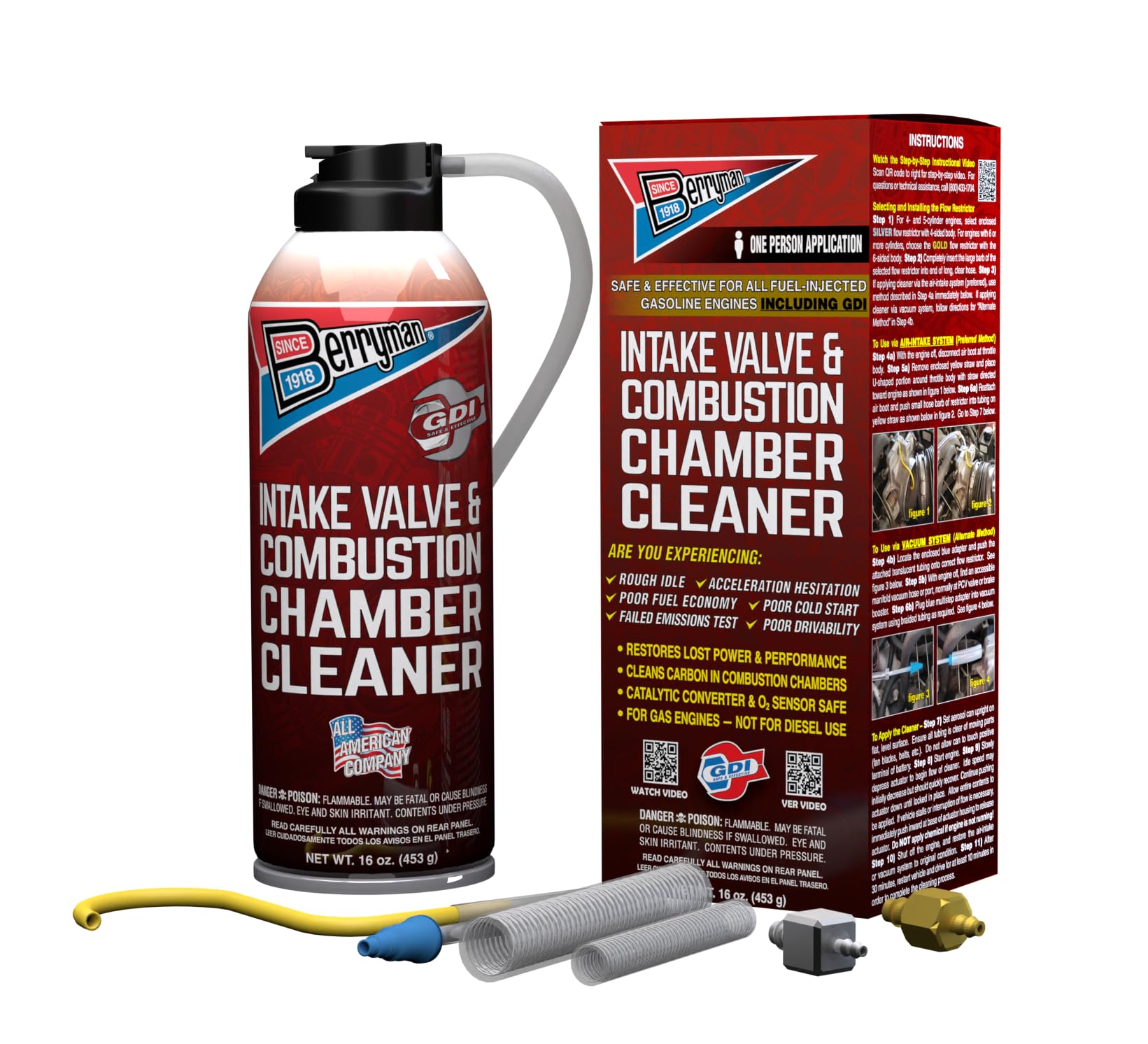
A 16-ounce can of Polyetheramine (PEA) that tackles valves and combustion chambers in one shot.
Berryman 2611 is the largest single-can spray on this list at 16 ounces, and it comes formulated with Polyetheramine (PEA) — the chemical that dissolves carbon buildup in combustion chambers and intake valves. It works on all fuel-injected engines including PFI, TBI, and GDI, cleaning “ALL Types of Intake Valves” as the label states. The included application kit with flow control makes it a one-person job, and the formula is safe on catalytic converters and oxygen sensors. It is not for diesel engines.
The owner stories are convincing. A 2012 Jeep Liberty V6 improved from 12-16 MPG to 15-19 MPG after the first can, with further acceleration gains from a second treatment. A 2014 Chevy Sonic saw its city MPG jump from 26.6 to 29 after one treatment, though it produced heavy smoke during the process. A 2013 Mini Cooper S had a P0303 misfire code that persisted even after new plugs and coils; Berryman resolved it with no misfire since, along with smoother acceleration. A 2012 Porsche Cayenne owner confirmed a “noticeably better throttle response, acceleration, and idle” and noted the spray was “10x cheaper than shop blasting.”
The main honest caveat: the can has a mixed record on leakage. The aspect list shows 48 owners mentioning leakage, and it is flagged as MIXED — meaning some cans arrive with a compromised seal or leaking nozzle. The format is effective but messy if you are not careful with the included attachments. Overall, if you want the highest concentration of PEA in a spray form, Berryman 2611 is the volume leader.
valve cleaning: The heavy-carbon scenario — high-mileage GDI, engines with stalling or misfire codes, or any car that has never had its intake valves cleaned. The PEA concentration and 16-ounce volume mean you can really soak the valves.
not for MAF: If your can arrives with a damaged seal, you will deal with a leak. Also, the smoke output during treatment is significant, so do it outside with ventilation.
Understanding the Specs
Polyetheramine (PEA)
PEA is a high-performance detergent molecule that breaks down carbon deposits at high temperatures inside the combustion chamber. It is the active ingredient found in top-tier fuel system cleaners like Berryman 2611 and ATP AT-100. When you see PEA on the label, it means the cleaner is targeting the hard, baked-on carbon on intake valves and piston tops — not just light varnish. It costs more to formulate, but it is the only chemistry proven to shift heavy GDI deposits without abrasive media.
Sensor-Safe vs. Standard Formula
A cleaner labeled “safe for oxygen sensors and catalytic converters” contains no harmful chlorinated solvents (like perchloroethylene or methylene chloride) that can poison the sensor element or clog the catalyst. A standard carburetor cleaner or brake parts cleaner is NOT safe for O2 sensors. Always check this label if you are spraying through the intake on any car built after 1996 — the downstream emissions system is expensive to replace.
Aerosol Volume vs. Concentrated Power
The can size in ounces tells you how many treatments you get, but it does not tell you the concentration of active solvents. A 7.5-ounce can of ATP Intake Blast costs about the same as a 16-ounce can of Berryman 2611 — the ATP uses a higher-concentration PEA blend in a smaller carrier volume. A more concentrated cleaner often means less wasted propellant and a faster soak time. For a first-time deep clean on a heavily carboned GDI engine, a smaller can of higher-concentration PEA is usually the smarter buy than a large can of mild solvent.
Included Application Hardware
Some sprays come with a vacuum-line adapter and hose (ATP AT-100, Berryman 2611) that lets you introduce the cleaner downstream of the mass air flow sensor. This is critical for GDI cleaning because you need the solvent to hit the intake valves while the engine is running. A simple “point and spray” can is fine for throttle-body cleaning with the engine off and the air cleaner removed. If you do not have the right adapter, you risk spraying the cleaner onto the MAF sensor wires and damaging them. The included kit is a strong signal that the product was designed for a specific application method.
FAQ
Can I use throttle body cleaner on my MAF sensor?
How often should I clean the intake system?
Will an intake cleaner spray fix a check-engine light?
Is it safe to spray intake cleaner through the air intake while the engine is running?
What is the difference between Sea Foam Motor Treatment and Sea Foam Spray?
Will an intake cleaner harm my catalytic converter?
Can I use an intake cleaner on a lawn mower or small engine?
How long does an intake cleaner treatment take?
What does the smoke mean when I use an intake cleaner?
Can I use Berryman 2611 in a diesel engine?
Final Thoughts: The Verdict
For most people, the air intake cleaner spray winner is the Sea Foam Combo Pack because it gives you both a fuel-system treatment and an intake spray in one buy — the same chemical that has the highest owner satisfaction on the market and enough volume to treat multiple engines. If you only need to clean a dirty throttle body, grab the CRC 05078 for its proven ability to dissolve varnish and clear rough-idle codes immediately. And for a GDI (gasoline direct injection) vehicle that has never had its intake valves cleaned, the Sea Foam Spray SS14 two-pack or the Berryman 2611 are the ones to reach for, as both deliver the PEA (polyether amine, a chemical that breaks down carbon deposits) needed to shift the stubborn carbon that fuel additives cannot touch.
How We Picked
We do not accept paid placement. Every pick is matched to a real buyer and a real use-case; we do not hands-on test units.
Sources & Methodology
Specifications: manufacturer listings and product documentation. Review insights: verified customer reviews, as of July 2026. Pricing: not shown on this page (it changes often); check the current price via the retailer link.
As an Amazon Associate, Trending Car earns from qualifying purchases. This does not affect which products we feature.